RETAIL SHOP
MANAGEMENT
UNIT - IV
VISUAL MERCHANDISING
 Visual Merchandising: The physical display
of goods in the most attractive and
appealing ways.
 Store Layout: the interior arrangement of retail
facilities.
 Selling areas: where merchandise is displayed
and customers interact with sales personnel.
(75-80% of the total space)
 Sales support areas: devoted to customer
services, merchandise receiving and distribution,
management offices and staff activities.
2
MERCHANDISE PRESENTATION
 Merchandise presentation includes the ways
that goods are hung, placed on shelves, or
otherwise made available for sale in retail
stores.
 Shoulder-out presentation: The way most
garments are hung in home with only one side
showing from shoulder to bottom.
 Face-forward presentation (face-out
presentation): Hanging of clothing with the front
fully facing the viewer. This should always be done
at entrances and walkway. 3
RETAIL FIXTURES
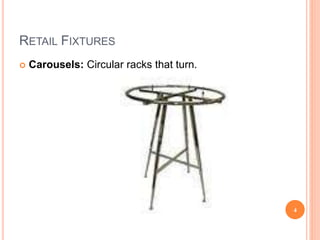
 Carousels: Circular racks that turn.
4
RETAIL FIXTURES
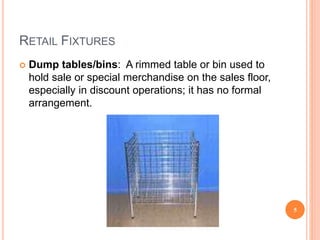
 Dump tables/bins: A rimmed table or bin used to
hold sale or special merchandise on the sales floor,
especially in discount operations; it has no formal
arrangement.
5
RETAIL FIXTURES
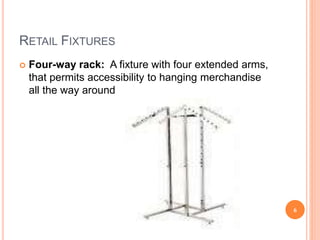
 Four-way rack: A fixture with four extended arms,
that permits accessibility to hanging merchandise
all the way around
6
RETAIL FIXTURES
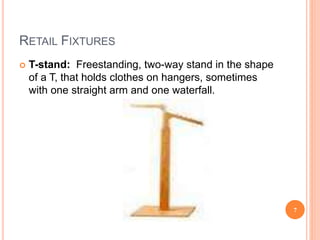
 T-stand: Freestanding, two-way stand in the shape
of a T, that holds clothes on hangers, sometimes
with one straight arm and one waterfall.
7
RETAIL FIXTURES
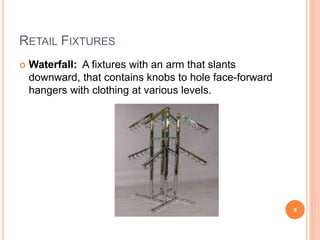
 Waterfall: A fixtures with an arm that slants
downward, that contains knobs to hole face-forward
hangers with clothing at various levels.
8
DISPLAYS
 Displays: individual and notable physical
presentation of merchandise.
 Displays are intended to:
 Stimulate product interest
 Provide information
 Suggest merchandise coordination
 Generate traffic flow
 Remind customers of planned purchases
 Create additional sales of impulse items
 Enhance the store’s visual image
9
SPACE MANAGEMENT
Locations/space for interior displays:
 Just in the entrance
 Entrance to department
 Near cash counter
 Next to related items
 Across from elevators/escalators
 Ends of walkway
10
COMPONENTS OF DISPLAYS
Merchandise
Lighting
Props
Signage
11
MERCHANDISE
Groups:
One-category, or line-of-goods
Related groupings: go together or
reinforce each other
Theme groupings: event, holiday, etc.
Variety or assortment groupings:
collection of unrelated items all sold at
the same store.
12
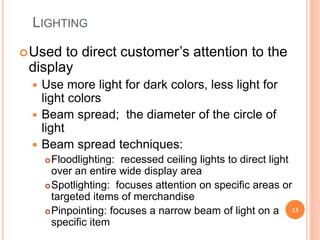
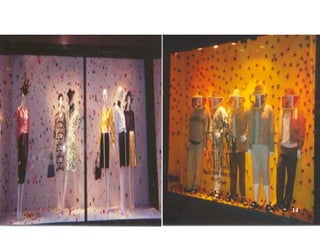
LIGHTING
Used to direct customer’s attention to the
display
 Use more light for dark colors, less light for
light colors
 Beam spread; the diameter of the circle of
light
 Beam spread techniques:
Floodlighting: recessed ceiling lights to direct light
over an entire wide display area
Spotlighting: focuses attention on specific areas or
targeted items of merchandise
Pinpointing: focuses a narrow beam of light on a
specific item
13
14
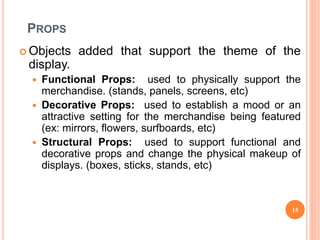
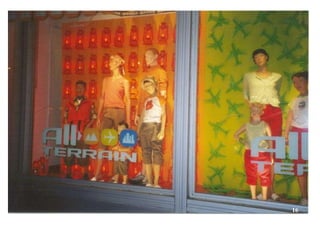
PROPS
 Objects added that support the theme of the
display.
 Functional Props: used to physically support the
merchandise. (stands, panels, screens, etc)
 Decorative Props: used to establish a mood or an
attractive setting for the merchandise being featured
(ex: mirrors, flowers, surfboards, etc)
 Structural Props: used to support functional and
decorative props and change the physical makeup of
displays. (boxes, sticks, stands, etc)
15
16
17
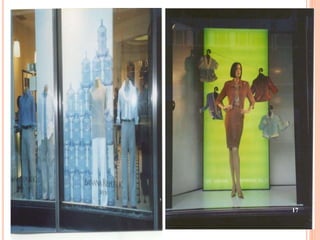
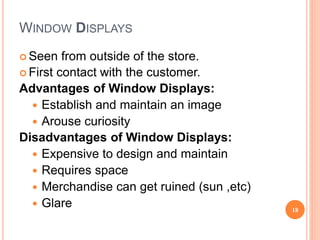
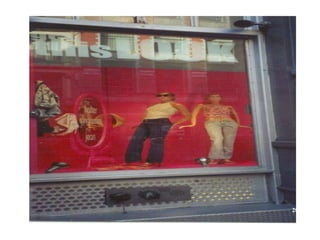
WINDOW DISPLAYS
 Seen from outside of the store.
 First contact with the customer.
Advantages of Window Displays:
 Establish and maintain an image
 Arouse curiosity
Disadvantages of Window Displays:
 Expensive to design and maintain
 Requires space
 Merchandise can get ruined (sun ,etc)
 Glare 18
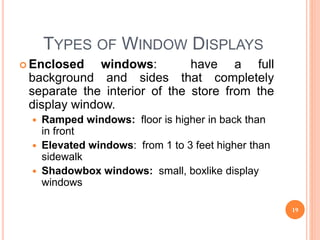
TYPES OF WINDOW DISPLAYS
 Enclosed windows: have a full
background and sides that completely
separate the interior of the store from the
display window.
 Ramped windows: floor is higher in back than
in front
 Elevated windows: from 1 to 3 feet higher than
sidewalk
 Shadowbox windows: small, boxlike display
windows
19
20
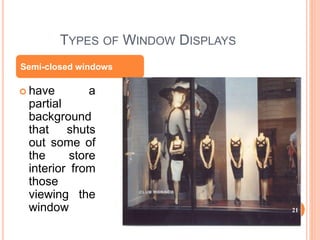
TYPES OF WINDOW DISPLAYS
 have a
partial
background
that shuts
out some of
the store
interior from
those
viewing the
window
Semi-closed windows
21
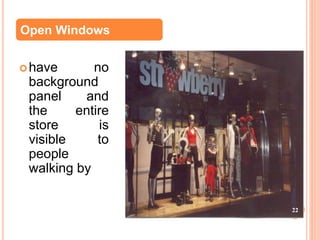
have no
background
panel and
the entire
store is
visible to
people
walking by
Open Windows
22
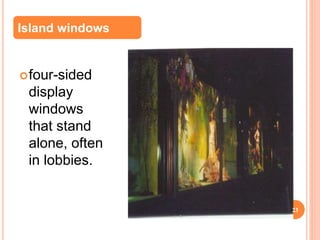
four-sided
display
windows
that stand
alone, often
in lobbies.
Island windows
23
COMPETENCIES FOR VISUAL MERCHANDISING
1. Explain the purposes of visual merchandising as
they relate to customer satisfaction and
profitability.
2. Describe areas of the space that can be focal
points for visual display.
3. Explain the role that lighting plays in visual
merchandising.
4. Prepare skin, body, and beauty products for
display.
24
(continued)
COMPETENCIES FOR VISUAL MERCHANDISING
5. Describe various types of written display
materials and their purposes.
6. Describe types of fixtures used to display
apparel and explain how each is used.
7. Prepare apparel for display.
25
(continued)
COMPETENCIES FOR VISUAL MERCHANDISING
8. Explain how to display books and CDs to
maximize sales potential.
9. Describe display techniques for gifts and
accessories.
10. List steps for keeping the retail area fresh
and appealing to customers.
26
(continued)
Retail Inventory Management
27
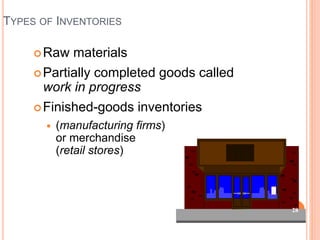
TYPES OF INVENTORIES
Raw materials
Partially completed goods called
work in progress
Finished-goods inventories
 (manufacturing firms)
or merchandise
(retail stores)
28
TYPES OF INVENTORIES (CONT’D)
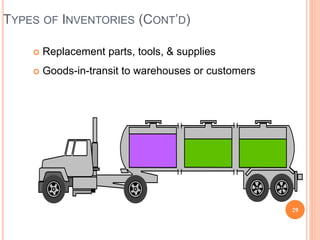
 Replacement parts, tools, & supplies
 Goods-in-transit to warehouses or customers
29
FUNCTIONS OF INVENTORY
 To meet anticipated demand
 To smooth production requirements
 To decouple operations
 To protect against stock-outs
30
FUNCTIONS OF INVENTORY (CONT’D)
 To take advantage of order cycles
 To help against price increases
 To permit operations
 To take advantage of quantity discounts
31
OBJECTIVE OF INVENTORY CONTROL
 To achieve satisfactory levels of customer service
while keeping inventory costs within reasonable
bounds
 Level of customer service
 Costs of ordering and carrying inventory
32
 A system to keep track of inventory
 A reliable forecast of demand
 Knowledge of lead times
 Reasonable estimates of
 Holding costs
 Ordering costs
 Shortage costs
 A classification system
EFFECTIVE INVENTORY MANAGEMENT
33
RETAIL MANAGEMENT INFORMATION SYSTEM
 An Information System is an organized
combination of people, hardware, software,
communication networks and the data resources
that collects, transforms and disseminates
information in a organization.
 Management Information System that helps the
management to take appropriate decision for
solving the business problems.
 The retailer use MIS for taking appropriate sales
decision and competitive advantage. 34
 Emerging digital firm
 Electronic commerce
 Electronic business
 Challenges and opportunities
Essentials of Management Information Systems
 Round-the-clock service: Web sites
available to consumers 24 hours a day
 Extended distribution channels:
Outlets created for attracting customers
who otherwise would not support
 Reduced transaction costs: Costs of
searching for buyers, sellers, etc. reduced
Internet Technology and the Digital Firm
Internet Business Models
1. Virtual storefront: Sell goods and
services through on-line
2. Information broker: Provide information
on products, pricing, etc.
3. Transaction broker: Buyers view rates,
terms from various sources
4. Online Marketplace: Concentrates
information from several providers
5. Content provider: Creates revenue
through providing client for a fee, and
advertising
Internet Business Models
6. On-line service provider: Provides service,
support for hardware, software products
7. Virtual community: Chat room, on-line
meeting place
Internet Business Models
8. Portal: Initial point of entry to Web, specialized
content, services
9. Syndicator : Aggregate information from several
sources sold to other companies
10. Auction: Electronic clearinghouse products,
prices, change in response to demand
Internet Business Models
11. Dynamic pricing: real-time interactions
between buyers and sellers determine worth of
items
12. Banner ad: Graphic display used for
advertising, linked to the advertiser’s Web site
Internet Business Models
Categories of Electronic Commerce
• Business-to-customer (B2C): Retailing of
products and services directly to individual
customers
• Business-to-business (B2B): Sales of goods
and services among businesses
• Consumer-to-consumer (C2C): Individuals
use Web for private sales or exchange
Business-To-Consumer
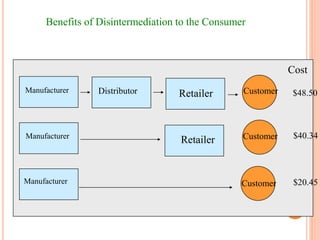
• Dis-intermediation: The removal of
organizations or business process layers
responsible for certain intermediary steps in a
value chain
• Re-intermediation: The shifting of the
intermediary role in a value chain to a new source
Benefits of Disintermediation to the Consumer
Manufacturer
Manufacturer
Manufacturer
Distributor Retailer
Retailer
Customer
Customer
Customer
Cost
$48.50
$40.34
$20.45
Interactive Marketing and Personalization
Web personalization:
• Benefits of using individual sales people
• Dramatically lower costs
M-Commerce and Next Generation Marketing
Mobile commerce (m-commerce):
• Wireless devices used to conduct both business-to-
consumer and business-to-business, e-commerce
transactions over the Internet
• Extend personalization by delivering new value-
added services directly to customers at any time
and place
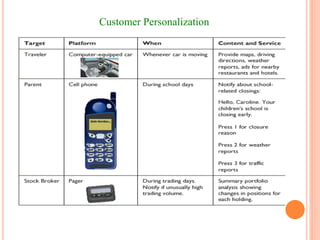
Customer Personalization
Business-To-Business Electronic Commerce
Automation of purchase, sale transactions
from business to business
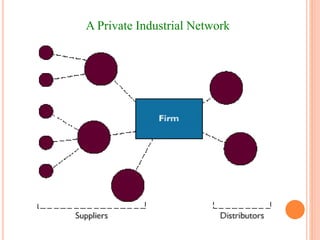
• Private industrial networks: Coordination between
companies for efficient supply chain management and
collaborative activities
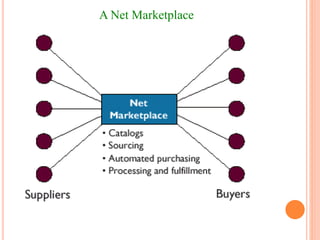
• Electronic hubs: On-line marketplaces, point-to-
point connections, integrated information
A Private Industrial Network
A Net Marketplace
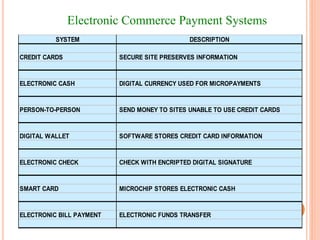
Electronic Commerce Payment Systems
SYSTEM DESCRIPTION
CREDIT CARDS SECURE SITE PRESERVES INFORMATION
ELECTRONIC CASH DIGITAL CURRENCY USED FOR MICROPAYMENTS
PERSON-TO-PERSON SEND MONEY TO SITES UNABLE TO USE CREDIT CARDS
DIGITAL WALLET SOFTWARE STORES CREDIT CARD INFORMATION
ELECTRONIC CHECK CHECK WITH ENCRIPTED DIGITAL SIGNATURE
SMART CARD MICROCHIP STORES ELECTRONIC CASH
ELECTRONIC BILL PAYMENT ELECTRONIC FUNDS TRANSFER
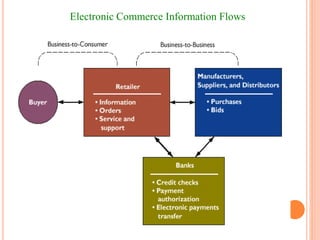
Electronic Commerce Information Flows
Advertising
It refers to any paid, mass-
mediated and attempt to persuade.
Characteristics of Advertising:
•mass selling
• non-personal communication
54
PURPOSES OF PRODUCT ADVERTISING
To educate people
To emphasize a brand’s
features
To create the customer goodwill
TWO MAJOR TYPES OF RETAIL ADVERTISING
 To explain potential buyers
 The availability and price of nationally
known merchandise
55
RETAIL ADVERTISING METHODS
 In-house flyers indicating products
 Informative in-house displays of
merchandise
 Direct mail advertising
 Local newspapers
 Distribution of flyers by hand or using the
local newspaper deliveries
56
RETAIL SALES PROMOTION
“sales promotion includes those sales
activities that supplement both personal
selling and advertising and coordinate them
and help to make them effective”.
57
TYPES OF RETAIL PROMOTION
 In-Store Promotion
 window displays
 special in-store displays
 posters
 personal selling efforts
58
Retail Displays
Both in-house displays of
merchandise and advertising displays
should be:
attention getting in layout
informative in regard to the product
convince the customer
informative of price
59
RETAIL ACCOUNTING
 "Retail Accounting" is a method of
accounting to account for inventory
using retail prices only for sales,
purchases, beginning inventory, and
ending inventory.
60
6
1
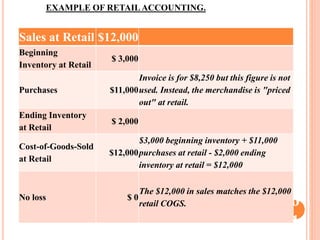
EXAMPLE OF RETAILACCOUNTING.
Sales at Retail $12,000
Beginning
Inventory at Retail
$ 3,000
Purchases $11,000
Invoice is for $8,250 but this figure is not
used. Instead, the merchandise is "priced
out" at retail.
Ending Inventory
at Retail
$ 2,000
Cost-of-Goods-Sold
at Retail
$12,000
$3,000 beginning inventory + $11,000
purchases at retail - $2,000 ending
inventory at retail = $12,000
No loss $ 0
The $12,000 in sales matches the $12,000
retail COGS.
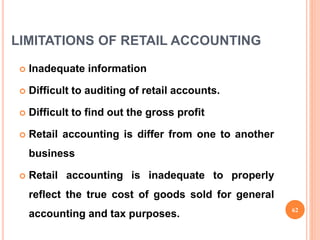
LIMITATIONS OF RETAIL ACCOUNTING
 Inadequate information
 Difficult to auditing of retail accounts.
 Difficult to find out the gross profit
 Retail accounting is differ from one to another
business
 Retail accounting is inadequate to properly
reflect the true cost of goods sold for general
accounting and tax purposes. 62
RETAIL ACCOUNTING-
THE SIGNIFICANCE AND BENEFITS
 It is the growth factor.
 Record monitoring helps to find out the errors.
 Records and account maintenance with the years
of expertise supporting the business
 Easily find out the errors
63
RETAIL STORE BRAND
Store brands are a line of
products sold by a retailer under a
single marketing identity.
store brands have been able to
position themselves as premium
brands.
64
TYPES OF RETAIL STORE BRANDS
 Convenience store
 Supermarket
 Superstore
 Combination store
 Warehouse store
 Departmental store
 Discount store
 Factory outlet
 Membership club
 Flea market
 Specialty store
 Category killer
65
EMERGING TRENDS IN INDIAN RETAIL
SECTOR
The trends to follow in the future:
 The Indian retail sector will grow up to 10% of
total retailing by 2011.
 No difference in cultures regionally.
 The most encouraging format now would be the
hypermarkets.
 The hypermarket format would be further
encouraged with the entry of the Transnational
Companies (TNCs).
66

retail UNIT_-_IV.ppt

  • 1.
  • 2.
    VISUAL MERCHANDISING  VisualMerchandising: The physical display of goods in the most attractive and appealing ways.  Store Layout: the interior arrangement of retail facilities.  Selling areas: where merchandise is displayed and customers interact with sales personnel. (75-80% of the total space)  Sales support areas: devoted to customer services, merchandise receiving and distribution, management offices and staff activities. 2
  • 3.
    MERCHANDISE PRESENTATION  Merchandisepresentation includes the ways that goods are hung, placed on shelves, or otherwise made available for sale in retail stores.  Shoulder-out presentation: The way most garments are hung in home with only one side showing from shoulder to bottom.  Face-forward presentation (face-out presentation): Hanging of clothing with the front fully facing the viewer. This should always be done at entrances and walkway. 3
  • 4.
    RETAIL FIXTURES  Carousels:Circular racks that turn. 4
  • 5.
    RETAIL FIXTURES  Dumptables/bins: A rimmed table or bin used to hold sale or special merchandise on the sales floor, especially in discount operations; it has no formal arrangement. 5
  • 6.
    RETAIL FIXTURES  Four-wayrack: A fixture with four extended arms, that permits accessibility to hanging merchandise all the way around 6
  • 7.
    RETAIL FIXTURES  T-stand:Freestanding, two-way stand in the shape of a T, that holds clothes on hangers, sometimes with one straight arm and one waterfall. 7
  • 8.
    RETAIL FIXTURES  Waterfall:A fixtures with an arm that slants downward, that contains knobs to hole face-forward hangers with clothing at various levels. 8
  • 9.
    DISPLAYS  Displays: individualand notable physical presentation of merchandise.  Displays are intended to:  Stimulate product interest  Provide information  Suggest merchandise coordination  Generate traffic flow  Remind customers of planned purchases  Create additional sales of impulse items  Enhance the store’s visual image 9
  • 10.
    SPACE MANAGEMENT Locations/space forinterior displays:  Just in the entrance  Entrance to department  Near cash counter  Next to related items  Across from elevators/escalators  Ends of walkway 10
  • 11.
  • 12.
    MERCHANDISE Groups: One-category, or line-of-goods Relatedgroupings: go together or reinforce each other Theme groupings: event, holiday, etc. Variety or assortment groupings: collection of unrelated items all sold at the same store. 12
  • 13.
    LIGHTING Used to directcustomer’s attention to the display  Use more light for dark colors, less light for light colors  Beam spread; the diameter of the circle of light  Beam spread techniques: Floodlighting: recessed ceiling lights to direct light over an entire wide display area Spotlighting: focuses attention on specific areas or targeted items of merchandise Pinpointing: focuses a narrow beam of light on a specific item 13
  • 14.
  • 15.
    PROPS  Objects addedthat support the theme of the display.  Functional Props: used to physically support the merchandise. (stands, panels, screens, etc)  Decorative Props: used to establish a mood or an attractive setting for the merchandise being featured (ex: mirrors, flowers, surfboards, etc)  Structural Props: used to support functional and decorative props and change the physical makeup of displays. (boxes, sticks, stands, etc) 15
  • 16.
  • 17.
  • 18.
    WINDOW DISPLAYS  Seenfrom outside of the store.  First contact with the customer. Advantages of Window Displays:  Establish and maintain an image  Arouse curiosity Disadvantages of Window Displays:  Expensive to design and maintain  Requires space  Merchandise can get ruined (sun ,etc)  Glare 18
  • 19.
    TYPES OF WINDOWDISPLAYS  Enclosed windows: have a full background and sides that completely separate the interior of the store from the display window.  Ramped windows: floor is higher in back than in front  Elevated windows: from 1 to 3 feet higher than sidewalk  Shadowbox windows: small, boxlike display windows 19
  • 20.
  • 21.
    TYPES OF WINDOWDISPLAYS  have a partial background that shuts out some of the store interior from those viewing the window Semi-closed windows 21
  • 22.
    have no background panel and theentire store is visible to people walking by Open Windows 22
  • 23.
  • 24.
    COMPETENCIES FOR VISUALMERCHANDISING 1. Explain the purposes of visual merchandising as they relate to customer satisfaction and profitability. 2. Describe areas of the space that can be focal points for visual display. 3. Explain the role that lighting plays in visual merchandising. 4. Prepare skin, body, and beauty products for display. 24 (continued)
  • 25.
    COMPETENCIES FOR VISUALMERCHANDISING 5. Describe various types of written display materials and their purposes. 6. Describe types of fixtures used to display apparel and explain how each is used. 7. Prepare apparel for display. 25 (continued)
  • 26.
    COMPETENCIES FOR VISUALMERCHANDISING 8. Explain how to display books and CDs to maximize sales potential. 9. Describe display techniques for gifts and accessories. 10. List steps for keeping the retail area fresh and appealing to customers. 26 (continued)
  • 27.
  • 28.
    TYPES OF INVENTORIES Rawmaterials Partially completed goods called work in progress Finished-goods inventories  (manufacturing firms) or merchandise (retail stores) 28
  • 29.
    TYPES OF INVENTORIES(CONT’D)  Replacement parts, tools, & supplies  Goods-in-transit to warehouses or customers 29
  • 30.
    FUNCTIONS OF INVENTORY To meet anticipated demand  To smooth production requirements  To decouple operations  To protect against stock-outs 30
  • 31.
    FUNCTIONS OF INVENTORY(CONT’D)  To take advantage of order cycles  To help against price increases  To permit operations  To take advantage of quantity discounts 31
  • 32.
    OBJECTIVE OF INVENTORYCONTROL  To achieve satisfactory levels of customer service while keeping inventory costs within reasonable bounds  Level of customer service  Costs of ordering and carrying inventory 32
  • 33.
     A systemto keep track of inventory  A reliable forecast of demand  Knowledge of lead times  Reasonable estimates of  Holding costs  Ordering costs  Shortage costs  A classification system EFFECTIVE INVENTORY MANAGEMENT 33
  • 34.
    RETAIL MANAGEMENT INFORMATIONSYSTEM  An Information System is an organized combination of people, hardware, software, communication networks and the data resources that collects, transforms and disseminates information in a organization.  Management Information System that helps the management to take appropriate decision for solving the business problems.  The retailer use MIS for taking appropriate sales decision and competitive advantage. 34
  • 35.
     Emerging digitalfirm  Electronic commerce  Electronic business  Challenges and opportunities Essentials of Management Information Systems
  • 36.
     Round-the-clock service:Web sites available to consumers 24 hours a day  Extended distribution channels: Outlets created for attracting customers who otherwise would not support  Reduced transaction costs: Costs of searching for buyers, sellers, etc. reduced Internet Technology and the Digital Firm
  • 37.
    Internet Business Models 1.Virtual storefront: Sell goods and services through on-line 2. Information broker: Provide information on products, pricing, etc. 3. Transaction broker: Buyers view rates, terms from various sources
  • 38.
    4. Online Marketplace:Concentrates information from several providers 5. Content provider: Creates revenue through providing client for a fee, and advertising Internet Business Models
  • 39.
    6. On-line serviceprovider: Provides service, support for hardware, software products 7. Virtual community: Chat room, on-line meeting place Internet Business Models
  • 40.
    8. Portal: Initialpoint of entry to Web, specialized content, services 9. Syndicator : Aggregate information from several sources sold to other companies 10. Auction: Electronic clearinghouse products, prices, change in response to demand Internet Business Models
  • 41.
    11. Dynamic pricing:real-time interactions between buyers and sellers determine worth of items 12. Banner ad: Graphic display used for advertising, linked to the advertiser’s Web site Internet Business Models
  • 42.
    Categories of ElectronicCommerce • Business-to-customer (B2C): Retailing of products and services directly to individual customers • Business-to-business (B2B): Sales of goods and services among businesses • Consumer-to-consumer (C2C): Individuals use Web for private sales or exchange
  • 43.
    Business-To-Consumer • Dis-intermediation: Theremoval of organizations or business process layers responsible for certain intermediary steps in a value chain • Re-intermediation: The shifting of the intermediary role in a value chain to a new source
  • 44.
    Benefits of Disintermediationto the Consumer Manufacturer Manufacturer Manufacturer Distributor Retailer Retailer Customer Customer Customer Cost $48.50 $40.34 $20.45
  • 45.
    Interactive Marketing andPersonalization Web personalization: • Benefits of using individual sales people • Dramatically lower costs
  • 46.
    M-Commerce and NextGeneration Marketing Mobile commerce (m-commerce): • Wireless devices used to conduct both business-to- consumer and business-to-business, e-commerce transactions over the Internet • Extend personalization by delivering new value- added services directly to customers at any time and place
  • 47.
  • 48.
    Business-To-Business Electronic Commerce Automationof purchase, sale transactions from business to business • Private industrial networks: Coordination between companies for efficient supply chain management and collaborative activities • Electronic hubs: On-line marketplaces, point-to- point connections, integrated information
  • 49.
  • 50.
  • 51.
    Electronic Commerce PaymentSystems SYSTEM DESCRIPTION CREDIT CARDS SECURE SITE PRESERVES INFORMATION ELECTRONIC CASH DIGITAL CURRENCY USED FOR MICROPAYMENTS PERSON-TO-PERSON SEND MONEY TO SITES UNABLE TO USE CREDIT CARDS DIGITAL WALLET SOFTWARE STORES CREDIT CARD INFORMATION ELECTRONIC CHECK CHECK WITH ENCRIPTED DIGITAL SIGNATURE SMART CARD MICROCHIP STORES ELECTRONIC CASH ELECTRONIC BILL PAYMENT ELECTRONIC FUNDS TRANSFER
  • 52.
  • 53.
    Advertising It refers toany paid, mass- mediated and attempt to persuade. Characteristics of Advertising: •mass selling • non-personal communication
  • 54.
    54 PURPOSES OF PRODUCTADVERTISING To educate people To emphasize a brand’s features To create the customer goodwill
  • 55.
    TWO MAJOR TYPESOF RETAIL ADVERTISING  To explain potential buyers  The availability and price of nationally known merchandise 55
  • 56.
    RETAIL ADVERTISING METHODS In-house flyers indicating products  Informative in-house displays of merchandise  Direct mail advertising  Local newspapers  Distribution of flyers by hand or using the local newspaper deliveries 56
  • 57.
    RETAIL SALES PROMOTION “salespromotion includes those sales activities that supplement both personal selling and advertising and coordinate them and help to make them effective”. 57
  • 58.
    TYPES OF RETAILPROMOTION  In-Store Promotion  window displays  special in-store displays  posters  personal selling efforts 58
  • 59.
    Retail Displays Both in-housedisplays of merchandise and advertising displays should be: attention getting in layout informative in regard to the product convince the customer informative of price 59
  • 60.
    RETAIL ACCOUNTING  "RetailAccounting" is a method of accounting to account for inventory using retail prices only for sales, purchases, beginning inventory, and ending inventory. 60
  • 61.
    6 1 EXAMPLE OF RETAILACCOUNTING. Salesat Retail $12,000 Beginning Inventory at Retail $ 3,000 Purchases $11,000 Invoice is for $8,250 but this figure is not used. Instead, the merchandise is "priced out" at retail. Ending Inventory at Retail $ 2,000 Cost-of-Goods-Sold at Retail $12,000 $3,000 beginning inventory + $11,000 purchases at retail - $2,000 ending inventory at retail = $12,000 No loss $ 0 The $12,000 in sales matches the $12,000 retail COGS.
  • 62.
    LIMITATIONS OF RETAILACCOUNTING  Inadequate information  Difficult to auditing of retail accounts.  Difficult to find out the gross profit  Retail accounting is differ from one to another business  Retail accounting is inadequate to properly reflect the true cost of goods sold for general accounting and tax purposes. 62
  • 63.
    RETAIL ACCOUNTING- THE SIGNIFICANCEAND BENEFITS  It is the growth factor.  Record monitoring helps to find out the errors.  Records and account maintenance with the years of expertise supporting the business  Easily find out the errors 63
  • 64.
    RETAIL STORE BRAND Storebrands are a line of products sold by a retailer under a single marketing identity. store brands have been able to position themselves as premium brands. 64
  • 65.
    TYPES OF RETAILSTORE BRANDS  Convenience store  Supermarket  Superstore  Combination store  Warehouse store  Departmental store  Discount store  Factory outlet  Membership club  Flea market  Specialty store  Category killer 65
  • 66.
    EMERGING TRENDS ININDIAN RETAIL SECTOR The trends to follow in the future:  The Indian retail sector will grow up to 10% of total retailing by 2011.  No difference in cultures regionally.  The most encouraging format now would be the hypermarkets.  The hypermarket format would be further encouraged with the entry of the Transnational Companies (TNCs). 66

Editor's Notes

  • #49 Ritu, plz check the content