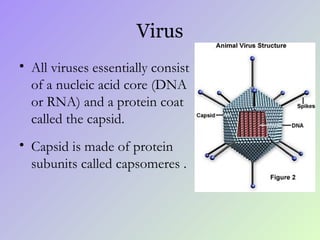
Viruses are obligate intracellular parasites that consist of a nucleic acid core surrounded by a protein coat called a capsid. They can only reproduce inside a living host cell by using the host's materials and enzymes. Viruses come in a wide range of sizes but are generally 20-400 nanometers. Some viruses have an envelope formed from the host cell membrane that may contain spikes. The complete, infectious viral particle is called a virion. Bacteriophages are viruses that infect bacteria and have a more complex structure including a head and tail used to inject viral DNA. They can undergo lytic replication, releasing new virus particles, or lysogenic replication where their DNA inserts into the host chromosome.