Food Pyramid
Food Pyramid
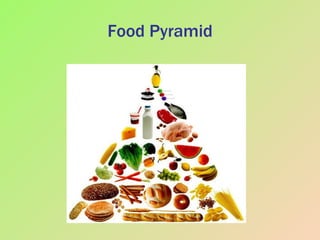
Food Pyramid The Food Pyramid is an easy way to create a healthy diet. It consists of 6 food groups and 4 levels.  One should eat more servings per day from the lower levels, fewer from the higher ones.
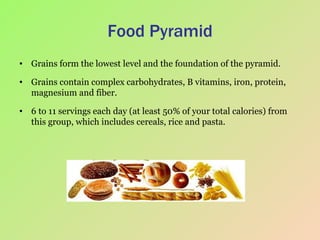
Food Pyramid Grains form the lowest level and the foundation of the pyramid.  Grains contain complex carbohydrates, B vitamins, iron, protein, magnesium and fiber.  6 to 11 servings each day (at least 50% of your total calories) from this group, which includes cereals, rice and pasta.
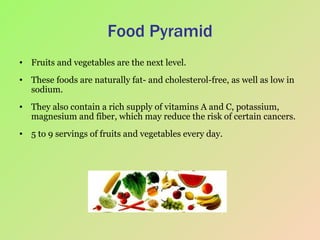
Food Pyramid Fruits and vegetables are the next level.  These foods are naturally fat- and cholesterol-free, as well as low in sodium.  They also contain a rich supply of vitamins A and C, potassium, magnesium and fiber, which may reduce the risk of certain cancers.  5 to 9 servings of fruits and vegetables every day.
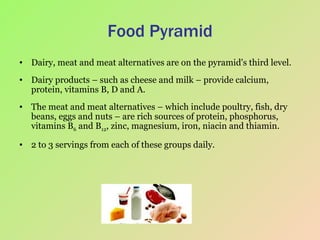
Food Pyramid Dairy, meat and meat alternatives are on the pyramid's third level.  Dairy products – such as cheese and milk – provide calcium, protein, vitamins B, D and A.  The meat and meat alternatives – which include poultry, fish, dry beans, eggs and nuts – are rich sources of protein, phosphorus, vitamins B 6  and B 12 , zinc, magnesium, iron, niacin and thiamin.  2 to 3 servings from each of these groups daily.
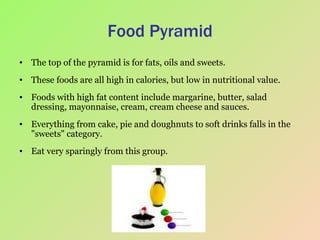
Food Pyramid The top of the pyramid is for fats, oils and sweets.  These foods are all high in calories, but low in nutritional value.  Foods with high fat content include margarine, butter, salad dressing, mayonnaise, cream, cream cheese and sauces.  Everything from cake, pie and doughnuts to soft drinks falls in the "sweets" category.  Eat very sparingly from this group.
Serving Size One serving of rice and alternatives can be 2 slices of bread / ½ bowl of rice / 1 ½ cup of cornflakes One serving of fruit can be  1 apple / 1 wedge pineapple / 1 medium sized banana One serving of vegetables can be ¾ mug of cooked vegetables / 1 mug of raw leafy vegetables One serving of meat and meat alternatives can be 90 g of fish / 90 g of chicken / ¾ cup of cooked pulses
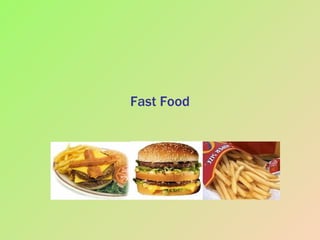
Fast Food
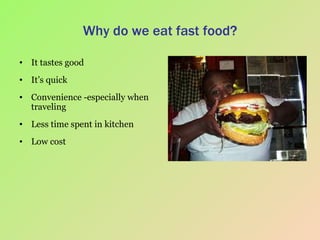
Why do we eat fast food? It tastes good It’s quick Convenience -especially when traveling Less time spent in kitchen Low cost
Why is fast food bad for us? Contains a lot of Calories Many fast foods are fried in fat - even if they are heated up in an oven. High in saturated fat Contains some trans fat High in cholesterol A lot of sodium Low nutritional value Likely you will overeat
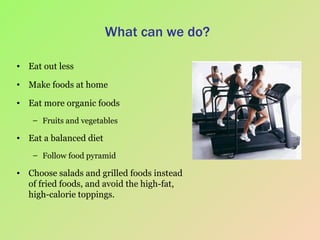
What can we do? Eat out less Make foods at home Eat more organic foods Fruits and vegetables Eat a balanced diet Follow food pyramid  Choose salads and grilled foods instead of fried foods, and avoid the high-fat, high-calorie toppings.
Trans fat Trans fat is the common name for a type of unsaturated fat Unlike other dietary fats, trans fats are neither required nor beneficial for health Eating trans fats increases the risk of coronary heart disease
What is a Calorie? A calorie is a unit of measurement for energy. The small calorie or gram calorie approximates the energy needed to increase the temperature of 1 gram of water by 1 °C. The large calorie or kilogram calorie approximates the energy needed to increase the temperature of 1 kg of water by 1 °C In scientific contexts, the name "calorie" refers strictly to the gram calorie, and this unit has the symbol cal. The kilogram calorie is known as the "kilocalorie" and has the symbol kcal. The more calories a food has the more energy (ATP) the body can get from it (Calorie Seen on food labels)  1 Calorie = 1,000 calories or 1 kcal
Caloric Contents Carbohydrate = 4 kcal/gram Protein = 4 kcal/gram Lipid = 9 kcal/gram
How many kcal would 10 grams of pure carbohydrate contain? Answer: 4 kcal/gram x 10 grams = 40 kcal How many kcal would 10 grams of pure protein contain? Answer: 4 kcal/gram x 10 grams = 40 kcal How many kcal would 10 grams of pure lipid contain? Answer: 9 kcal/gram x 10 grams = 90 kcal

Food pyramid

  • 1.
  • 2.
  • 3.
    Food Pyramid TheFood Pyramid is an easy way to create a healthy diet. It consists of 6 food groups and 4 levels. One should eat more servings per day from the lower levels, fewer from the higher ones.
  • 4.
    Food Pyramid Grainsform the lowest level and the foundation of the pyramid. Grains contain complex carbohydrates, B vitamins, iron, protein, magnesium and fiber. 6 to 11 servings each day (at least 50% of your total calories) from this group, which includes cereals, rice and pasta.
  • 5.
    Food Pyramid Fruitsand vegetables are the next level. These foods are naturally fat- and cholesterol-free, as well as low in sodium. They also contain a rich supply of vitamins A and C, potassium, magnesium and fiber, which may reduce the risk of certain cancers. 5 to 9 servings of fruits and vegetables every day.
  • 6.
    Food Pyramid Dairy,meat and meat alternatives are on the pyramid's third level. Dairy products – such as cheese and milk – provide calcium, protein, vitamins B, D and A. The meat and meat alternatives – which include poultry, fish, dry beans, eggs and nuts – are rich sources of protein, phosphorus, vitamins B 6 and B 12 , zinc, magnesium, iron, niacin and thiamin. 2 to 3 servings from each of these groups daily.
  • 7.
    Food Pyramid Thetop of the pyramid is for fats, oils and sweets. These foods are all high in calories, but low in nutritional value. Foods with high fat content include margarine, butter, salad dressing, mayonnaise, cream, cream cheese and sauces. Everything from cake, pie and doughnuts to soft drinks falls in the "sweets" category. Eat very sparingly from this group.
  • 8.
    Serving Size Oneserving of rice and alternatives can be 2 slices of bread / ½ bowl of rice / 1 ½ cup of cornflakes One serving of fruit can be 1 apple / 1 wedge pineapple / 1 medium sized banana One serving of vegetables can be ¾ mug of cooked vegetables / 1 mug of raw leafy vegetables One serving of meat and meat alternatives can be 90 g of fish / 90 g of chicken / ¾ cup of cooked pulses
  • 9.
  • 10.
    Why do weeat fast food? It tastes good It’s quick Convenience -especially when traveling Less time spent in kitchen Low cost
  • 11.
    Why is fastfood bad for us? Contains a lot of Calories Many fast foods are fried in fat - even if they are heated up in an oven. High in saturated fat Contains some trans fat High in cholesterol A lot of sodium Low nutritional value Likely you will overeat
  • 12.
    What can wedo? Eat out less Make foods at home Eat more organic foods Fruits and vegetables Eat a balanced diet Follow food pyramid Choose salads and grilled foods instead of fried foods, and avoid the high-fat, high-calorie toppings.
  • 13.
    Trans fat Transfat is the common name for a type of unsaturated fat Unlike other dietary fats, trans fats are neither required nor beneficial for health Eating trans fats increases the risk of coronary heart disease
  • 14.
    What is aCalorie? A calorie is a unit of measurement for energy. The small calorie or gram calorie approximates the energy needed to increase the temperature of 1 gram of water by 1 °C. The large calorie or kilogram calorie approximates the energy needed to increase the temperature of 1 kg of water by 1 °C In scientific contexts, the name "calorie" refers strictly to the gram calorie, and this unit has the symbol cal. The kilogram calorie is known as the "kilocalorie" and has the symbol kcal. The more calories a food has the more energy (ATP) the body can get from it (Calorie Seen on food labels) 1 Calorie = 1,000 calories or 1 kcal
  • 15.
    Caloric Contents Carbohydrate= 4 kcal/gram Protein = 4 kcal/gram Lipid = 9 kcal/gram
  • 16.
    How many kcalwould 10 grams of pure carbohydrate contain? Answer: 4 kcal/gram x 10 grams = 40 kcal How many kcal would 10 grams of pure protein contain? Answer: 4 kcal/gram x 10 grams = 40 kcal How many kcal would 10 grams of pure lipid contain? Answer: 9 kcal/gram x 10 grams = 90 kcal