3.6 VIRTUALIZATION OF CPU, MEMORY, AND I/O DEVICES
1. Hardware Virtualization
2. CPU Virtualization
3. Memory Virtualization
4. I/O Virtualization
5. Multi-Core ProcessorsVirtualization
1. Hardware Virtualization
 Modern operating systems and processors permit multiple processesto run
simultaneously.
 If there is no protection mechanismin a processor, all instructions from
different processes will access the hardware directly and cause a system crash.
 Therefore, all processors have at least two modes, user mode and
supervisor mode, to ensure controlled accessof critical hardware.
 Instructions running in supervisor mode are called privileged instructions.
Other instructions are unprivileged instructions. -User mode
 In a virtualized environment, it is more difficult to make OSes and
applications run correctly.
 The VMware Workstationis a VM software suite for x86 and x86-64
computers.
 This software suiteallows users to set up multiple(x86 and x86-64 virtual computers, and
to use) one or more of these VMs simultaneously.
 KVM can support hardware-assisted virtualization and paravirtualization by
using the Intel VT-x or AMD-v respectively.
2. CPU Virtualization
 Unprivileged instructionsof VMs run directly on the host machinefor higher
efficiency.
 Critical instructionsshould be handled carefully for correctness and stability.
The critical instructions are divided into three categories
o privileged instructions- instructions execute in a privileged modeand will
be trapped if executed outside this mode.
o control-sensitive instructions - attempt to change the configuration of
resources used.
o behavior-sensitive instructions - have different behaviors depending on
the configuration of resources,
 A CPU architecture is virtualizable, the ability to run the VM’s privileged and
unprivileged instructions.
 VMM acts as a unified mediator
 RISC- CPU architectures can be naturally virtualized Best-Reduced Set
Computer Instructions
3. Memory Virtualization
 Virtual memory virtualization is similar to the virtual memory support
provided by modern operating systems.
 In a traditional execution environment, the operating system maintains
mappings of virtual memory to machine memory using page tables, which is a
one-stage mapping from virtual memory to machine memory.
 All modern x86 CPUs include a memory management unit (MMU) and
a translation lookaside buffer (TLB) to optimize virtual memory
performance.
 In avirtual memory virtualization involves sharing the physical system
memory in RAM and dynamically allocating it to the physical memory of the
VMs.
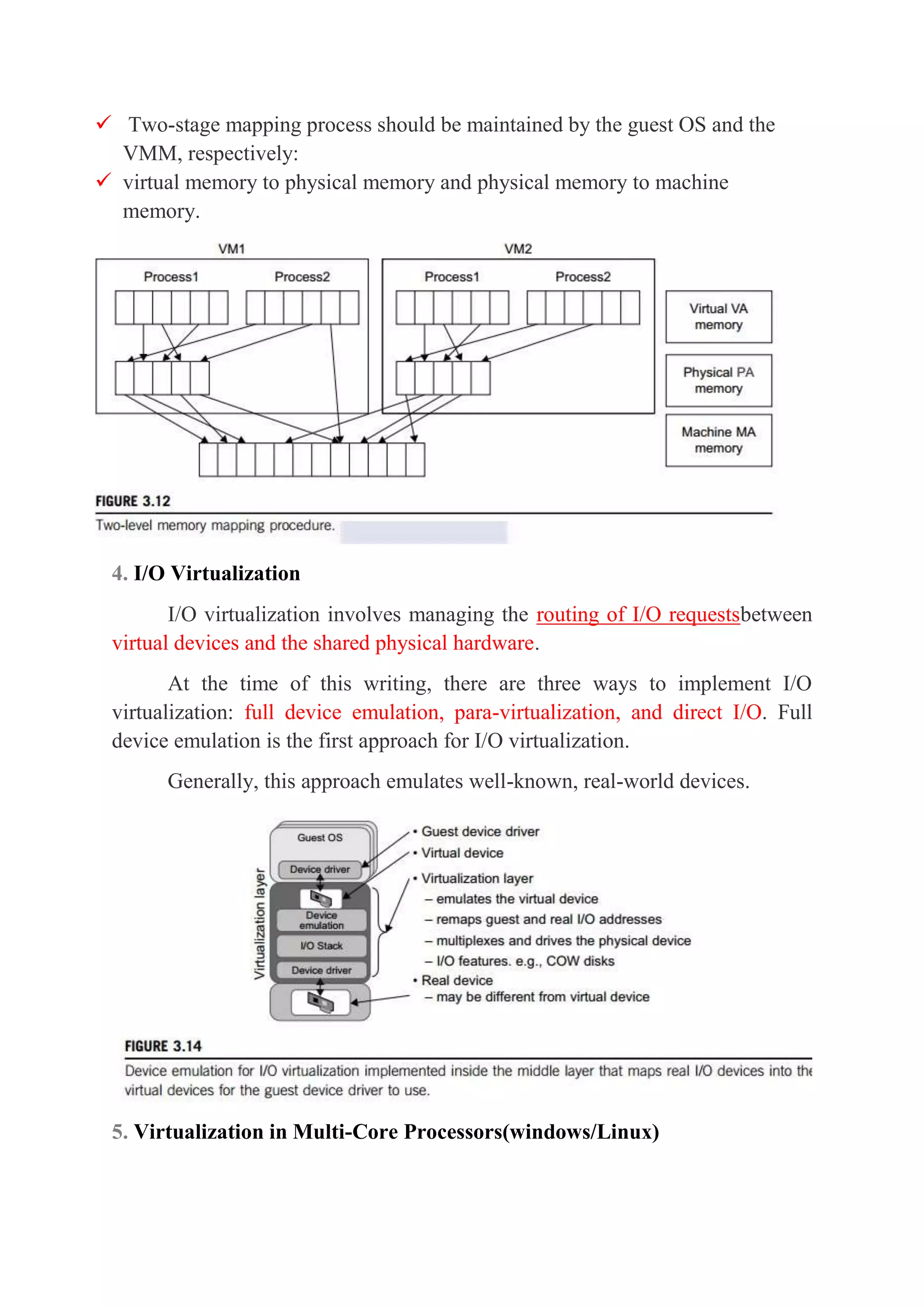
 Two-stage mapping process should be maintained by the guest OS and the
VMM, respectively:
 virtual memory to physical memory and physical memory to machine
memory.
4. I/O Virtualization
I/O virtualization involves managing the routing of I/O requestsbetween
virtual devices and the shared physical hardware.
At the time of this writing, there are three ways to implement I/O
virtualization: full device emulation, para-virtualization, and direct I/O. Full
device emulation is the first approach for I/O virtualization.
Generally, this approach emulates well-known, real-world devices.
5. Virtualization in Multi-Core Processors(windows/Linux)
 Virtualizing a multi-core processor is relatively more complicated than
virtualizing a uni-core processor.
 multicore processors are claimed to have higher performance by integrating
multiple processor cores in a single chip, muti-core virtualiuzation has
raised some new challenges to computer architects, compiler constructors,
system designers, and application programmers.
 first challenge, new programming models, languages, and libraries are
needed to make parallel programming easier.
 second challenge has spawned research involving scheduling
algorithms and resource management policies.
 The dynamic heterogeneity of hardware infrastructure mainly comes from
less reliable transistors and increased complexity in using the transistors.

Virtualize of IO Devices .docx

  • 1.
    3.6 VIRTUALIZATION OFCPU, MEMORY, AND I/O DEVICES 1. Hardware Virtualization 2. CPU Virtualization 3. Memory Virtualization 4. I/O Virtualization 5. Multi-Core ProcessorsVirtualization 1. Hardware Virtualization  Modern operating systems and processors permit multiple processesto run simultaneously.  If there is no protection mechanismin a processor, all instructions from different processes will access the hardware directly and cause a system crash.  Therefore, all processors have at least two modes, user mode and supervisor mode, to ensure controlled accessof critical hardware.  Instructions running in supervisor mode are called privileged instructions. Other instructions are unprivileged instructions. -User mode  In a virtualized environment, it is more difficult to make OSes and applications run correctly.  The VMware Workstationis a VM software suite for x86 and x86-64 computers.  This software suiteallows users to set up multiple(x86 and x86-64 virtual computers, and to use) one or more of these VMs simultaneously.  KVM can support hardware-assisted virtualization and paravirtualization by using the Intel VT-x or AMD-v respectively. 2. CPU Virtualization
  • 2.
     Unprivileged instructionsofVMs run directly on the host machinefor higher efficiency.  Critical instructionsshould be handled carefully for correctness and stability. The critical instructions are divided into three categories o privileged instructions- instructions execute in a privileged modeand will be trapped if executed outside this mode. o control-sensitive instructions - attempt to change the configuration of resources used. o behavior-sensitive instructions - have different behaviors depending on the configuration of resources,  A CPU architecture is virtualizable, the ability to run the VM’s privileged and unprivileged instructions.  VMM acts as a unified mediator  RISC- CPU architectures can be naturally virtualized Best-Reduced Set Computer Instructions 3. Memory Virtualization  Virtual memory virtualization is similar to the virtual memory support provided by modern operating systems.  In a traditional execution environment, the operating system maintains mappings of virtual memory to machine memory using page tables, which is a one-stage mapping from virtual memory to machine memory.  All modern x86 CPUs include a memory management unit (MMU) and a translation lookaside buffer (TLB) to optimize virtual memory performance.  In avirtual memory virtualization involves sharing the physical system memory in RAM and dynamically allocating it to the physical memory of the VMs.
  • 3.
     Two-stage mappingprocess should be maintained by the guest OS and the VMM, respectively:  virtual memory to physical memory and physical memory to machine memory. 4. I/O Virtualization I/O virtualization involves managing the routing of I/O requestsbetween virtual devices and the shared physical hardware. At the time of this writing, there are three ways to implement I/O virtualization: full device emulation, para-virtualization, and direct I/O. Full device emulation is the first approach for I/O virtualization. Generally, this approach emulates well-known, real-world devices. 5. Virtualization in Multi-Core Processors(windows/Linux)
  • 4.
     Virtualizing amulti-core processor is relatively more complicated than virtualizing a uni-core processor.  multicore processors are claimed to have higher performance by integrating multiple processor cores in a single chip, muti-core virtualiuzation has raised some new challenges to computer architects, compiler constructors, system designers, and application programmers.  first challenge, new programming models, languages, and libraries are needed to make parallel programming easier.  second challenge has spawned research involving scheduling algorithms and resource management policies.  The dynamic heterogeneity of hardware infrastructure mainly comes from less reliable transistors and increased complexity in using the transistors.