Virtualization Technology and An Application of Building VmWareMehmet Açıkgöz
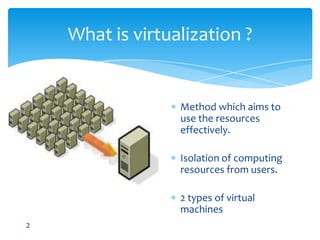
What is virtualization ?Method which aims to use the resources effectively.Isolation of computing resources from users.2 types of virtual machines2
These virtual machines share the physical resource between each other.Each virtual machine has own operating system.Hardware sharing is set by an interface.System Virtual Machines3
VM which is designed to operate just one software.Runs on an OS as a module.Provides to execute only one process.The software which uses the resource provided by any VM can not step out to the virtual environment.This is the most important characteristic feature of VMs.Process Virtual Machine4
 Conceptof incorporating virtualization at a layer beloweven the OSVirtualization layer often called as a Hypervisor(Virtual Machine)Each of the individual virtual machines is completely and wholly segregated from each other. Hardware Virtualization5
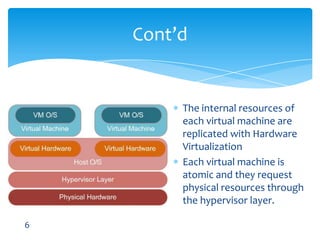
The internal resources of each virtual machine are replicated withHardware Virtualization Eachvirtual machine is atomic and they request physical resources through the hypervisor layer. Cont’d6
Full emulation of complete hardwareSupports different hardware components on a different hardware infrastructureEnableseach virtual machine to work with its own processor, RAM-everything physical computer contains.Hardware Emulation7
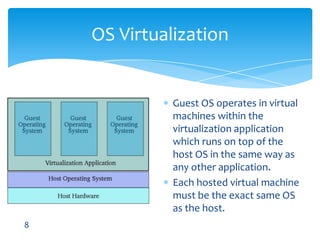
GuestOS operatesin virtual machines within the virtualization application whichruns on top of the host OS in the same way as any other application.Each hosted virtual machine must be the exact same OS as the host.OS Virtualization8
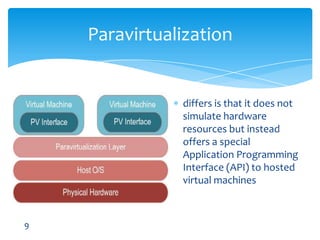
differs is that it does not simulate hardwareresources but instead offers a special Application Programming Interface (API) to hosted virtual machinesParavirtualization9
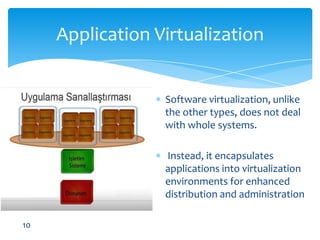
Application VirtualizationSoftware virtualization, unlike the other types, does not deal with whole systems.Instead, itencapsulates applications into virtualizationenvironments forenhanced distribution and administration10
Allowsthe use of virtual machines to let multiple network subscribers maintain individualized desktops on a single, centrally located computer or server. Users may be geographically scattered, but all may be connected to the central machine by a LAN,WAN, or the public Internet.Desktop Virtualization11
VMware's desktop software runs on Windows,Linux and Mac OS X.It has ESX software series (bare-metal) for enterprisesThey run on hardware as a hypervisorSome products:Vmware Server,Vmware ESX,Vmware ESXi,Vmware ThinAppVmWare & Its Rivals12
An extensiveand open source machine emulator and virtualizer.As a virtualizer QEMU achieves near native(nonvirtualized)performanceby executing the guest code directly on the host CPUQemu13
Supports virtualization when executing under the Xen hypervisor or using the KVM kernel module in Linux.When using KVM, QEMU can virtualize x86, server and embedded PowerPCCont’d14
Windows Virtual PCWindows-hosted version as a free product It originally required hardware virtualization support updatedto Microsoft Virtual PC which allows it to run on PCs without hardware support15
Cause problems with open source OS such as upgrading of kernelCorrect permissions on Windows VistaUnidentified program requires access to the computerProblems16
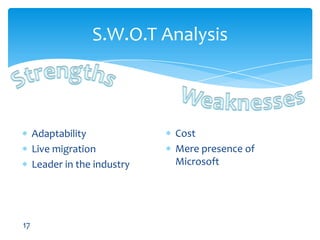
S.W.O.T AnalysisStrengthsWeaknessesAdaptability	Live migrationLeader in the industryCostMere presence of Microsoft17
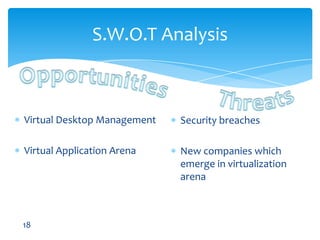
S.W.O.T AnalysisThreatsOpportunitiesVirtual Desktop ManagementVirtual Application ArenaSecurity breachesNew companies which emerge in virtualization arena18

Virtualization technology and an application of building vm ware

  • 1.
    Virtualization Technology andAn Application of Building VmWareMehmet Açıkgöz
  • 2.
    What is virtualization?Method which aims to use the resources effectively.Isolation of computing resources from users.2 types of virtual machines2
  • 3.
    These virtual machinesshare the physical resource between each other.Each virtual machine has own operating system.Hardware sharing is set by an interface.System Virtual Machines3
  • 4.
    VM which isdesigned to operate just one software.Runs on an OS as a module.Provides to execute only one process.The software which uses the resource provided by any VM can not step out to the virtual environment.This is the most important characteristic feature of VMs.Process Virtual Machine4
  • 5.
     Conceptof incorporating virtualizationat a layer beloweven the OSVirtualization layer often called as a Hypervisor(Virtual Machine)Each of the individual virtual machines is completely and wholly segregated from each other. Hardware Virtualization5
  • 6.
    The internal resourcesof each virtual machine are replicated withHardware Virtualization Eachvirtual machine is atomic and they request physical resources through the hypervisor layer. Cont’d6
  • 7.
    Full emulation ofcomplete hardwareSupports different hardware components on a different hardware infrastructureEnableseach virtual machine to work with its own processor, RAM-everything physical computer contains.Hardware Emulation7
  • 8.
    GuestOS operatesin virtualmachines within the virtualization application whichruns on top of the host OS in the same way as any other application.Each hosted virtual machine must be the exact same OS as the host.OS Virtualization8
  • 9.
    differs is thatit does not simulate hardwareresources but instead offers a special Application Programming Interface (API) to hosted virtual machinesParavirtualization9
  • 10.
    Application VirtualizationSoftware virtualization,unlike the other types, does not deal with whole systems.Instead, itencapsulates applications into virtualizationenvironments forenhanced distribution and administration10
  • 11.
    Allowsthe use ofvirtual machines to let multiple network subscribers maintain individualized desktops on a single, centrally located computer or server. Users may be geographically scattered, but all may be connected to the central machine by a LAN,WAN, or the public Internet.Desktop Virtualization11
  • 12.
    VMware's desktop softwareruns on Windows,Linux and Mac OS X.It has ESX software series (bare-metal) for enterprisesThey run on hardware as a hypervisorSome products:Vmware Server,Vmware ESX,Vmware ESXi,Vmware ThinAppVmWare & Its Rivals12
  • 13.
    An extensiveand opensource machine emulator and virtualizer.As a virtualizer QEMU achieves near native(nonvirtualized)performanceby executing the guest code directly on the host CPUQemu13
  • 14.
    Supports virtualization whenexecuting under the Xen hypervisor or using the KVM kernel module in Linux.When using KVM, QEMU can virtualize x86, server and embedded PowerPCCont’d14
  • 15.
    Windows Virtual PCWindows-hostedversion as a free product It originally required hardware virtualization support updatedto Microsoft Virtual PC which allows it to run on PCs without hardware support15
  • 16.
    Cause problems withopen source OS such as upgrading of kernelCorrect permissions on Windows VistaUnidentified program requires access to the computerProblems16
  • 17.
    S.W.O.T AnalysisStrengthsWeaknessesAdaptability Live migrationLeaderin the industryCostMere presence of Microsoft17
  • 18.
    S.W.O.T AnalysisThreatsOpportunitiesVirtual DesktopManagementVirtual Application ArenaSecurity breachesNew companies which emerge in virtualization arena18