04/29/14 1
Communication
04/29/14 2
System Architecture & Communication
 System Architectures
 Processes
 Communication in a Distributed System
 Communication Abstractions
04/29/14 3
BUILDING A DISTRIBUTED SYSTEM
 Placing the hardware.
 Placing the software.
“Logical organization of components”
04/29/14 4
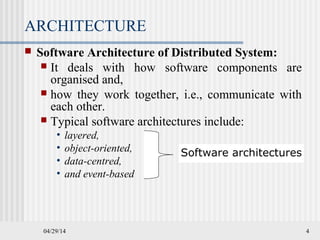
ARCHITECTURE
 Software Architecture of Distributed System:
 It deals with how software components are
organised and,
 how they work together, i.e., communicate with
each other.
 Typical software architectures include:
• layered,
• object-oriented,
• data-centred,
• and event-based
Software architectures
Contd…
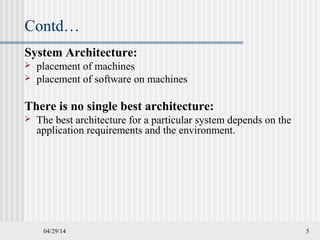
System Architecture:
 placement of machines
 placement of software on machines
There is no single best architecture:
 The best architecture for a particular system depends on the
application requirements and the environment.
04/29/14 5
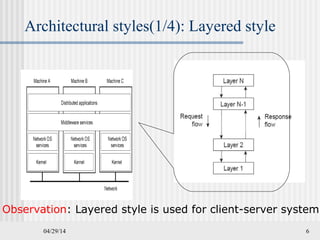
Architectural styles(1/4): Layered style
04/29/14 6
Observation: Layered style is used for client-server system.
Contd…
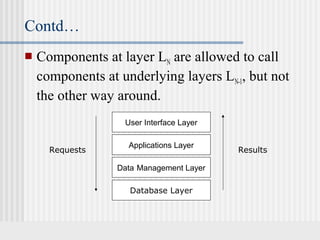
 Components at layer LN are allowed to call
components at underlying layers LN-1, but not
the other way around.
Database Layer
Data Management Layer
Applications Layer
User Interface Layer
Requests Results
Architectural styles (2/4): object based
04/29/14 8
Object
Object
Object
Object
Object
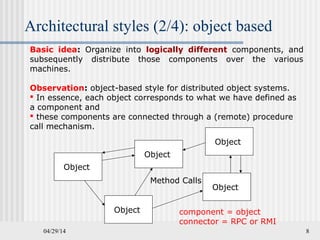
Method Calls
Basic idea: Organize into logically different components, and
subsequently distribute those components over the various
machines.
Observation: object-based style for distributed object systems.
 In essence, each object corresponds to what we have defined as
a component and
 these components are connected through a (remote) procedure
call mechanism.
component = object
connector = RPC or RMI
Architectural styles (3/4): data-centered
04/29/14 9
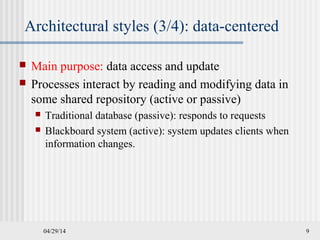
 Main purpose: data access and update
 Processes interact by reading and modifying data in
some shared repository (active or passive)
 Traditional database (passive): responds to requests
 Blackboard system (active): system updates clients when
information changes.
Architectural Styles (4/4): event-based
04/29/14 10
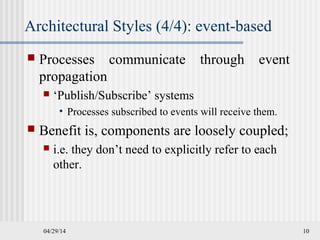
 Processes communicate through event
propagation
 ‘Publish/Subscribe’ systems
• Processes subscribed to events will receive them.
 Benefit is, components are loosely coupled;
 i.e. they don’t need to explicitly refer to each
other.
Contd…
04/29/14 11
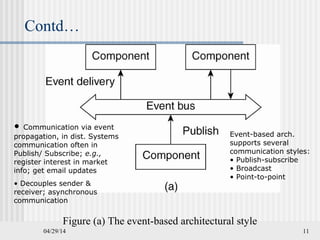
Figure (a) The event-based architectural style
• Communication via event
propagation, in dist. Systems
communication often in
Publish/ Subscribe; e.g.,
register interest in market
info; get email updates
• Decouples sender &
receiver; asynchronous
communication
Event-based arch.
supports several
communication styles:
• Publish-subscribe
• Broadcast
• Point-to-point
Contd…
04/29/14 12
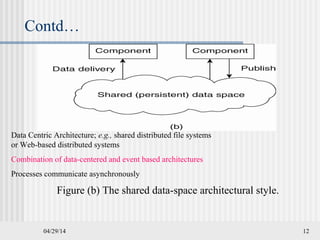
Figure (b) The shared data-space architectural style.
Data Centric Architecture; e.g., shared distributed file systems
or Web-based distributed systems
Combination of data-centered and event based architectures
Processes communicate asynchronously
04/29/14 13
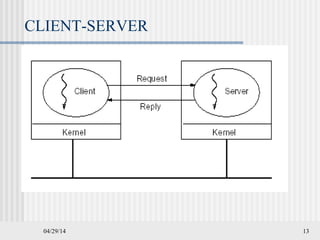
CLIENT-SERVER
04/29/14 14
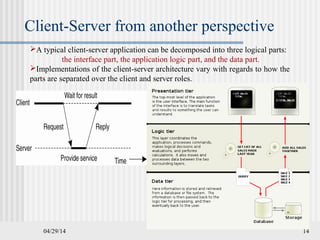
Client-Server from another perspective
A typical client-server application can be decomposed into three logical parts:
the interface part, the application logic part, and the data part.
Implementations of the client-server architecture vary with regards to how the
parts are separated over the client and server roles.
04/29/14 15
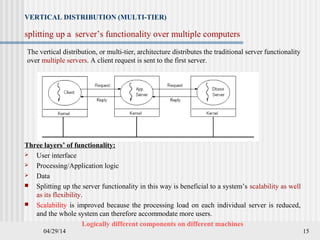
VERTICAL DISTRIBUTION (MULTI-TIER)
splitting up a server’s functionality over multiple computers
Three layers’ of functionality:
 User interface
 Processing/Application logic
 Data
 Splitting up the server functionality in this way is beneficial to a system’s scalability as well
as its flexibility.
 Scalability is improved because the processing load on each individual server is reduced,
and the whole system can therefore accommodate more users.
Logically different components on different machines
The vertical distribution, or multi-tier, architecture distributes the traditional server functionality
over multiple servers. A client request is sent to the first server.
04/29/14 16
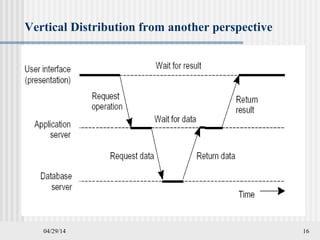
Vertical Distribution from another perspective
04/29/14 17
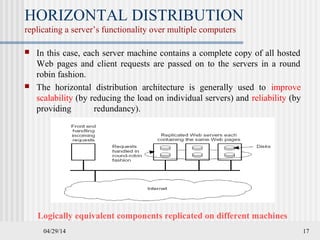
HORIZONTAL DISTRIBUTION
replicating a server’s functionality over multiple computers
 In this case, each server machine contains a complete copy of all hosted
Web pages and client requests are passed on to the servers in a round
robin fashion.
 The horizontal distribution architecture is generally used to improve
scalability (by reducing the load on individual servers) and reliability (by
providing redundancy).
Logically equivalent components replicated on different machines
04/29/14 18
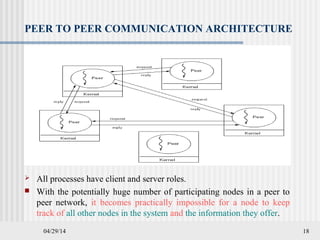
PEER TO PEER COMMUNICATION ARCHITECTURE
 All processes have client and server roles.
 With the potentially huge number of participating nodes in a peer to
peer network, it becomes practically impossible for a node to keep
track of all other nodes in the system and the information they offer.
04/29/14 19
OVERLAY NETWORKS
 How do peers keep track of all other peers?
 Overlay networks connect nodes in the P2P system
 Nodes in the overlay use their own addressing system for
storing and retrieving data in the system
 Nodes can route requests to locations that may not be
known by the requester.
 Overlay Network
1. Unstructured
2. Structured
04/29/14 20
UNSTRUCTURED OVERLAY
 Data stored at random nodes.
 Partial view: which means that a node partial view
consists of a random list of other nodes.
 Exchange partial views with neighbours to update.
04/29/14 21
STRUCTURED OVERLAY
 The choice of a node’s neighbours is determined according
to a specific structure.
 Nodes have identifier and range.
 Node is responsible for data that falls in its range.
 Search is routed to appropriate node.
Comparison
 Structured networks typically guarantee that if an
object is in the network it will be located in a
bounded amount of time.
 Unstructured networks offer no guarantees.
 For example, some will only forward search requests to a
specific number of hops
 Random graph approach means there may be loops
 Graph may become disconnected
04/29/14 23
HYBRID ARCHITECTURES
 Combination of architectures:
Examples:
 Super peer networks
 Edge-server systems
 Collaborative distributed systems
04/29/14 24
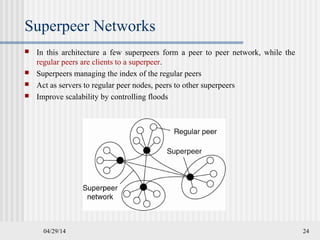
Superpeer Networks
 In this architecture a few superpeers form a peer to peer network, while the
regular peers are clients to a superpeer.
 Superpeers managing the index of the regular peers
 Act as servers to regular peer nodes, peers to other superpeers
 Improve scalability by controlling floods
04/29/14 25
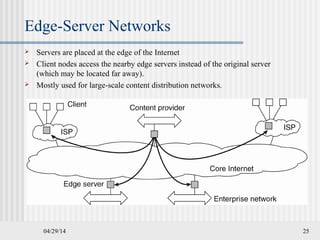
Edge-Server Networks
 Servers are placed at the edge of the Internet
 Client nodes access the nearby edge servers instead of the original server
(which may be located far away).
 Mostly used for large-scale content distribution networks.
04/29/14 26
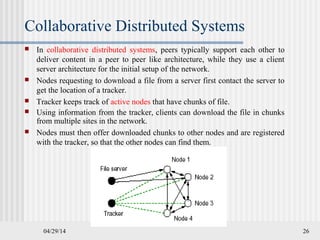
Collaborative Distributed Systems
 In collaborative distributed systems, peers typically support each other to
deliver content in a peer to peer like architecture, while they use a client
server architecture for the initial setup of the network.
 Nodes requesting to download a file from a server first contact the server to
get the location of a tracker.
 Tracker keeps track of active nodes that have chunks of file.
 Using information from the tracker, clients can download the file in chunks
from multiple sites in the network.
 Nodes must then offer downloaded chunks to other nodes and are registered
with the tracker, so that the other nodes can find them.
04/29/14 27
PROCESSES AND THREADS
 A process, in the simplest terms, is an executing program.
 One or more threads run in the context of the process.
 Sometimes threads are also referred to as lightweight
processes because they take up less operating system
resources than regular processes.
 A thread is the basic unit to which the operating system
allocates processor time. A thread can execute any part of
the process code, including parts currently being executed
by another thread.
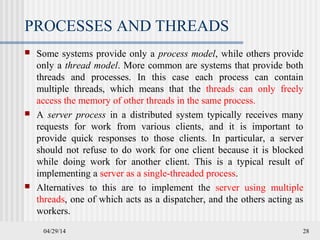
PROCESSES AND THREADS
 Some systems provide only a process model, while others provide
only a thread model. More common are systems that provide both
threads and processes. In this case each process can contain
multiple threads, which means that the threads can only freely
access the memory of other threads in the same process.
 A server process in a distributed system typically receives many
requests for work from various clients, and it is important to
provide quick responses to those clients. In particular, a server
should not refuse to do work for one client because it is blocked
while doing work for another client. This is a typical result of
implementing a server as a single-threaded process.
 Alternatives to this are to implement the server using multiple
threads, one of which acts as a dispatcher, and the others acting as
workers.
04/29/14 28
04/29/14 29
STATEFUL VS STATELESS SERVERS
 Stateful:
 Keeps persistent information about clients
 Improved performance
 Expensive recovery
 Must track clients
 Stateless:
 Does not keep state of clients
 Soft state design: limited client state
 Can change own state without informing clients
 Increased communication
04/29/14 30
COMMUNICATION
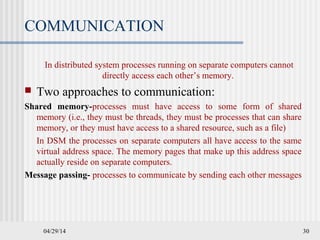
In distributed system processes running on separate computers cannot
directly access each other’s memory.
 Two approaches to communication:
Shared memory-processes must have access to some form of shared
memory (i.e., they must be threads, they must be processes that can share
memory, or they must have access to a shared resource, such as a file)
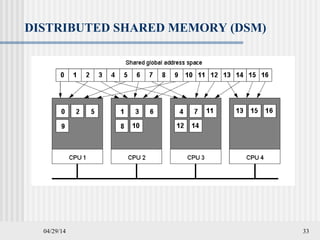
In DSM the processes on separate computers all have access to the same
virtual address space. The memory pages that make up this address space
actually reside on separate computers.
Message passing- processes to communicate by sending each other messages
04/29/14 31
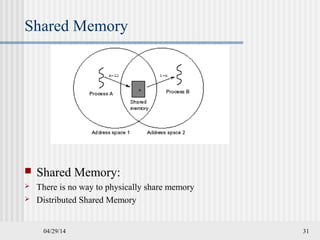
Shared Memory
 Shared Memory:
 There is no way to physically share memory
 Distributed Shared Memory
04/29/14 32
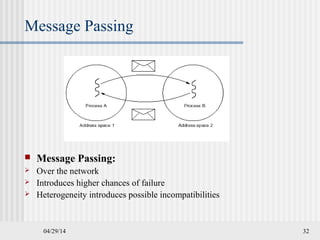
Message Passing
 Message Passing:
 Over the network
 Introduces higher chances of failure
 Heterogeneity introduces possible incompatibilities
04/29/14 33
DISTRIBUTED SHARED MEMORY (DSM)
04/29/14 34
COMMUNICATION MODES
 Data oriented vs control oriented communication
 Synchronous vs asynchronous communication
 Transient vs persistent communication
04/29/14 35
Data-Oriented vs Control-Oriented Communication
 Data-oriented communication
 Facilitates data exchange between threads
 Control-oriented communication
 Associates a transfer of control with every data transfer
 remote procedure call (RPC) & remote method invocation
(RMI)
 Observation:
 Hardware and OSes often provide data-oriented
communication
 Higher-level infrastructure often provides control-oriented
communication – middleware
04/29/14 36
Synchronous vs Asynchronous Communication
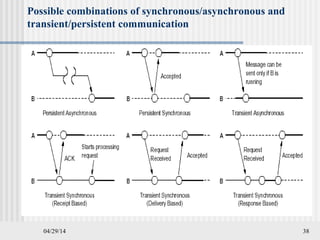
 Synchronous:
 Sender blocks until message received
• Often sender blocked until message is processed and a
reply received
 Sender and receiver must be active at the same time
 Client-Server generally uses synchronous communication
 Asynchronous:
 Sender continues execution after sending message (does not block waiting
for reply)
 Message may be queued if receiver not active
 Message may be processed later at receiver’s convenience
When is Synchronous suitable? Asynchronous?
04/29/14 37
Transient vs Persistent Communication
 Transient:
 Message discarded if cannot be delivered to receiver immediately
 a message will only be delivered if a receiver is active. If there is no
active receiver process (i.e., no one interested in or able to receive
messages) then an undeliverable message will simply be dropped.
 Example: HTTP request
 Persistent
 A message will be stored in the system until it can be delivered to the
intended recipient.
 Example: email
04/29/14 38
Possible combinations of synchronous/asynchronous and
transient/persistent communication
04/29/14 39
COMMUNICATION ABSTRACTIONS
 Number of communication abstractions that make writing distributed
applications easier.
Provided by higher level APIs:
 Remote Procedure Call (RPC)
 Remote Method Invocation (RMI)
 Message-Oriented Communication
 Group Communication
 Streams
04/29/14 40
REMOTE PR OCEDURE CALL (RPC)
 Idea: allows a computer program to cause a subroutine or procedure to
execute in another address space (commonly on another computer on a
shared network).
 Synchronous - based on blocking messages
 Message-passing details hidden from application
 Procedure call parameters used to transmit data
 Client calls local “stub” which does messaging and marshaling
04/29/14 41
REMOTE METHOD INVOCATION (RMI)
 The transition from Remote Procedure Call (RPC) to Remote Method
Invocation (RMI) is a transition from the server metaphor to the object
metaphor.
Why is this important?
 Using RPC: programmers must explicitly specify the server on which
they want to perform the call.
 Using RMI: programmers invoke methods on remote objects.
 More natural resource management and error handling
04/29/14 42
MESSAGE-ORIENTED COMMUNICATION:
MESSAGE-ORIENTED MIDDLEWARE (MOM)
 Message-oriented communication is provided by message-oriented middleware
(MOM).
Middleware support for message passing:-
 Asynchronous or Synchronous communication
 Persistent or Transient messages
 Various combinations of the above
What more does it provide than send()/receive()?
 Persistent communication (Message queues)
 Hides implementation details
 Marshaling (packing of function parameters into a message packet)
04/29/14 43
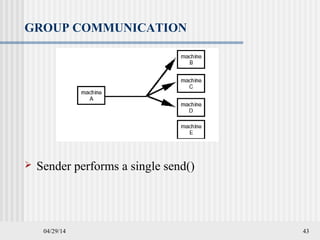
GROUP COMMUNICATION
 Sender performs a single send()
04/29/14 44
GROUP COMMUNICATION………..
 Two kinds of group communication:
 Broadcast (messgae sent to everyone)
 Multicast (message sent to specific group)
 Used for:
 Replication of services
 Replication of data
 Service discovery
 Issues:
 Reliability
 Ordering
 Example:
 IP multicast
04/29/14 45
STREAMS
 Support for Continuous Media
1. Between applications
2. Between devices
3. Data represented as single stream rather than discrete chunks
04/29/14 46
SUMMARY
 Architectures
 Client-server (and multi-tier)
 Peer to peer
 Hybrid architectures
 Processes in distributed systems
 Communication modes (data oriented vs control oriented,
synchronous vs asynchronous, transient vs persistent)
 Communication Aastractions
 RPC and RMI
 Message-oriented communication
 Group communication (multicast)
 Streams
04/29/14 47
Appendix:
Internet Group Management Protocol
• IP protocol can be involved in two types of communication: unicastingIP protocol can be involved in two types of communication: unicasting
and multicasting. Multicasting has many applications.and multicasting. Multicasting has many applications. For example,For example,
multiple stockbrokers can simultaneously be informed of changes in amultiple stockbrokers can simultaneously be informed of changes in a
stock price.stock price.
•IGMP is a protocol that manages group membership. The IGMPIGMP is a protocol that manages group membership. The IGMP
protocol gives the multicast routers information about the membershipprotocol gives the multicast routers information about the membership
status of hosts (routers) connected to the network. .status of hosts (routers) connected to the network. .
04/29/14 48
IGMP is a group management
protocol. It helps a multicast router
create and update a list of loyal
members related to each router
interface.
Note:Note:
04/29/14 49
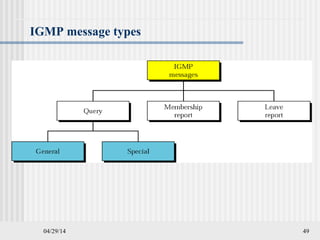
IGMP message types

Communications is distributed systems

  • 1.
  • 2.
    04/29/14 2 System Architecture& Communication  System Architectures  Processes  Communication in a Distributed System  Communication Abstractions
  • 3.
    04/29/14 3 BUILDING ADISTRIBUTED SYSTEM  Placing the hardware.  Placing the software. “Logical organization of components”
  • 4.
    04/29/14 4 ARCHITECTURE  SoftwareArchitecture of Distributed System:  It deals with how software components are organised and,  how they work together, i.e., communicate with each other.  Typical software architectures include: • layered, • object-oriented, • data-centred, • and event-based Software architectures
  • 5.
    Contd… System Architecture:  placementof machines  placement of software on machines There is no single best architecture:  The best architecture for a particular system depends on the application requirements and the environment. 04/29/14 5
  • 6.
    Architectural styles(1/4): Layeredstyle 04/29/14 6 Observation: Layered style is used for client-server system.
  • 7.
    Contd…  Components atlayer LN are allowed to call components at underlying layers LN-1, but not the other way around. Database Layer Data Management Layer Applications Layer User Interface Layer Requests Results
  • 8.
    Architectural styles (2/4):object based 04/29/14 8 Object Object Object Object Object Method Calls Basic idea: Organize into logically different components, and subsequently distribute those components over the various machines. Observation: object-based style for distributed object systems.  In essence, each object corresponds to what we have defined as a component and  these components are connected through a (remote) procedure call mechanism. component = object connector = RPC or RMI
  • 9.
    Architectural styles (3/4):data-centered 04/29/14 9  Main purpose: data access and update  Processes interact by reading and modifying data in some shared repository (active or passive)  Traditional database (passive): responds to requests  Blackboard system (active): system updates clients when information changes.
  • 10.
    Architectural Styles (4/4):event-based 04/29/14 10  Processes communicate through event propagation  ‘Publish/Subscribe’ systems • Processes subscribed to events will receive them.  Benefit is, components are loosely coupled;  i.e. they don’t need to explicitly refer to each other.
  • 11.
    Contd… 04/29/14 11 Figure (a)The event-based architectural style • Communication via event propagation, in dist. Systems communication often in Publish/ Subscribe; e.g., register interest in market info; get email updates • Decouples sender & receiver; asynchronous communication Event-based arch. supports several communication styles: • Publish-subscribe • Broadcast • Point-to-point
  • 12.
    Contd… 04/29/14 12 Figure (b)The shared data-space architectural style. Data Centric Architecture; e.g., shared distributed file systems or Web-based distributed systems Combination of data-centered and event based architectures Processes communicate asynchronously
  • 13.
  • 14.
    04/29/14 14 Client-Server fromanother perspective A typical client-server application can be decomposed into three logical parts: the interface part, the application logic part, and the data part. Implementations of the client-server architecture vary with regards to how the parts are separated over the client and server roles.
  • 15.
    04/29/14 15 VERTICAL DISTRIBUTION(MULTI-TIER) splitting up a server’s functionality over multiple computers Three layers’ of functionality:  User interface  Processing/Application logic  Data  Splitting up the server functionality in this way is beneficial to a system’s scalability as well as its flexibility.  Scalability is improved because the processing load on each individual server is reduced, and the whole system can therefore accommodate more users. Logically different components on different machines The vertical distribution, or multi-tier, architecture distributes the traditional server functionality over multiple servers. A client request is sent to the first server.
  • 16.
    04/29/14 16 Vertical Distributionfrom another perspective
  • 17.
    04/29/14 17 HORIZONTAL DISTRIBUTION replicatinga server’s functionality over multiple computers  In this case, each server machine contains a complete copy of all hosted Web pages and client requests are passed on to the servers in a round robin fashion.  The horizontal distribution architecture is generally used to improve scalability (by reducing the load on individual servers) and reliability (by providing redundancy). Logically equivalent components replicated on different machines
  • 18.
    04/29/14 18 PEER TOPEER COMMUNICATION ARCHITECTURE  All processes have client and server roles.  With the potentially huge number of participating nodes in a peer to peer network, it becomes practically impossible for a node to keep track of all other nodes in the system and the information they offer.
  • 19.
    04/29/14 19 OVERLAY NETWORKS How do peers keep track of all other peers?  Overlay networks connect nodes in the P2P system  Nodes in the overlay use their own addressing system for storing and retrieving data in the system  Nodes can route requests to locations that may not be known by the requester.  Overlay Network 1. Unstructured 2. Structured
  • 20.
    04/29/14 20 UNSTRUCTURED OVERLAY Data stored at random nodes.  Partial view: which means that a node partial view consists of a random list of other nodes.  Exchange partial views with neighbours to update.
  • 21.
    04/29/14 21 STRUCTURED OVERLAY The choice of a node’s neighbours is determined according to a specific structure.  Nodes have identifier and range.  Node is responsible for data that falls in its range.  Search is routed to appropriate node.
  • 22.
    Comparison  Structured networkstypically guarantee that if an object is in the network it will be located in a bounded amount of time.  Unstructured networks offer no guarantees.  For example, some will only forward search requests to a specific number of hops  Random graph approach means there may be loops  Graph may become disconnected
  • 23.
    04/29/14 23 HYBRID ARCHITECTURES Combination of architectures: Examples:  Super peer networks  Edge-server systems  Collaborative distributed systems
  • 24.
    04/29/14 24 Superpeer Networks In this architecture a few superpeers form a peer to peer network, while the regular peers are clients to a superpeer.  Superpeers managing the index of the regular peers  Act as servers to regular peer nodes, peers to other superpeers  Improve scalability by controlling floods
  • 25.
    04/29/14 25 Edge-Server Networks Servers are placed at the edge of the Internet  Client nodes access the nearby edge servers instead of the original server (which may be located far away).  Mostly used for large-scale content distribution networks.
  • 26.
    04/29/14 26 Collaborative DistributedSystems  In collaborative distributed systems, peers typically support each other to deliver content in a peer to peer like architecture, while they use a client server architecture for the initial setup of the network.  Nodes requesting to download a file from a server first contact the server to get the location of a tracker.  Tracker keeps track of active nodes that have chunks of file.  Using information from the tracker, clients can download the file in chunks from multiple sites in the network.  Nodes must then offer downloaded chunks to other nodes and are registered with the tracker, so that the other nodes can find them.
  • 27.
    04/29/14 27 PROCESSES ANDTHREADS  A process, in the simplest terms, is an executing program.  One or more threads run in the context of the process.  Sometimes threads are also referred to as lightweight processes because they take up less operating system resources than regular processes.  A thread is the basic unit to which the operating system allocates processor time. A thread can execute any part of the process code, including parts currently being executed by another thread.
  • 28.
    PROCESSES AND THREADS Some systems provide only a process model, while others provide only a thread model. More common are systems that provide both threads and processes. In this case each process can contain multiple threads, which means that the threads can only freely access the memory of other threads in the same process.  A server process in a distributed system typically receives many requests for work from various clients, and it is important to provide quick responses to those clients. In particular, a server should not refuse to do work for one client because it is blocked while doing work for another client. This is a typical result of implementing a server as a single-threaded process.  Alternatives to this are to implement the server using multiple threads, one of which acts as a dispatcher, and the others acting as workers. 04/29/14 28
  • 29.
    04/29/14 29 STATEFUL VSSTATELESS SERVERS  Stateful:  Keeps persistent information about clients  Improved performance  Expensive recovery  Must track clients  Stateless:  Does not keep state of clients  Soft state design: limited client state  Can change own state without informing clients  Increased communication
  • 30.
    04/29/14 30 COMMUNICATION In distributedsystem processes running on separate computers cannot directly access each other’s memory.  Two approaches to communication: Shared memory-processes must have access to some form of shared memory (i.e., they must be threads, they must be processes that can share memory, or they must have access to a shared resource, such as a file) In DSM the processes on separate computers all have access to the same virtual address space. The memory pages that make up this address space actually reside on separate computers. Message passing- processes to communicate by sending each other messages
  • 31.
    04/29/14 31 Shared Memory Shared Memory:  There is no way to physically share memory  Distributed Shared Memory
  • 32.
    04/29/14 32 Message Passing Message Passing:  Over the network  Introduces higher chances of failure  Heterogeneity introduces possible incompatibilities
  • 33.
  • 34.
    04/29/14 34 COMMUNICATION MODES Data oriented vs control oriented communication  Synchronous vs asynchronous communication  Transient vs persistent communication
  • 35.
    04/29/14 35 Data-Oriented vsControl-Oriented Communication  Data-oriented communication  Facilitates data exchange between threads  Control-oriented communication  Associates a transfer of control with every data transfer  remote procedure call (RPC) & remote method invocation (RMI)  Observation:  Hardware and OSes often provide data-oriented communication  Higher-level infrastructure often provides control-oriented communication – middleware
  • 36.
    04/29/14 36 Synchronous vsAsynchronous Communication  Synchronous:  Sender blocks until message received • Often sender blocked until message is processed and a reply received  Sender and receiver must be active at the same time  Client-Server generally uses synchronous communication  Asynchronous:  Sender continues execution after sending message (does not block waiting for reply)  Message may be queued if receiver not active  Message may be processed later at receiver’s convenience When is Synchronous suitable? Asynchronous?
  • 37.
    04/29/14 37 Transient vsPersistent Communication  Transient:  Message discarded if cannot be delivered to receiver immediately  a message will only be delivered if a receiver is active. If there is no active receiver process (i.e., no one interested in or able to receive messages) then an undeliverable message will simply be dropped.  Example: HTTP request  Persistent  A message will be stored in the system until it can be delivered to the intended recipient.  Example: email
  • 38.
    04/29/14 38 Possible combinationsof synchronous/asynchronous and transient/persistent communication
  • 39.
    04/29/14 39 COMMUNICATION ABSTRACTIONS Number of communication abstractions that make writing distributed applications easier. Provided by higher level APIs:  Remote Procedure Call (RPC)  Remote Method Invocation (RMI)  Message-Oriented Communication  Group Communication  Streams
  • 40.
    04/29/14 40 REMOTE PROCEDURE CALL (RPC)  Idea: allows a computer program to cause a subroutine or procedure to execute in another address space (commonly on another computer on a shared network).  Synchronous - based on blocking messages  Message-passing details hidden from application  Procedure call parameters used to transmit data  Client calls local “stub” which does messaging and marshaling
  • 41.
    04/29/14 41 REMOTE METHODINVOCATION (RMI)  The transition from Remote Procedure Call (RPC) to Remote Method Invocation (RMI) is a transition from the server metaphor to the object metaphor. Why is this important?  Using RPC: programmers must explicitly specify the server on which they want to perform the call.  Using RMI: programmers invoke methods on remote objects.  More natural resource management and error handling
  • 42.
    04/29/14 42 MESSAGE-ORIENTED COMMUNICATION: MESSAGE-ORIENTEDMIDDLEWARE (MOM)  Message-oriented communication is provided by message-oriented middleware (MOM). Middleware support for message passing:-  Asynchronous or Synchronous communication  Persistent or Transient messages  Various combinations of the above What more does it provide than send()/receive()?  Persistent communication (Message queues)  Hides implementation details  Marshaling (packing of function parameters into a message packet)
  • 43.
    04/29/14 43 GROUP COMMUNICATION Sender performs a single send()
  • 44.
    04/29/14 44 GROUP COMMUNICATION……….. Two kinds of group communication:  Broadcast (messgae sent to everyone)  Multicast (message sent to specific group)  Used for:  Replication of services  Replication of data  Service discovery  Issues:  Reliability  Ordering  Example:  IP multicast
  • 45.
    04/29/14 45 STREAMS  Supportfor Continuous Media 1. Between applications 2. Between devices 3. Data represented as single stream rather than discrete chunks
  • 46.
    04/29/14 46 SUMMARY  Architectures Client-server (and multi-tier)  Peer to peer  Hybrid architectures  Processes in distributed systems  Communication modes (data oriented vs control oriented, synchronous vs asynchronous, transient vs persistent)  Communication Aastractions  RPC and RMI  Message-oriented communication  Group communication (multicast)  Streams
  • 47.
    04/29/14 47 Appendix: Internet GroupManagement Protocol • IP protocol can be involved in two types of communication: unicastingIP protocol can be involved in two types of communication: unicasting and multicasting. Multicasting has many applications.and multicasting. Multicasting has many applications. For example,For example, multiple stockbrokers can simultaneously be informed of changes in amultiple stockbrokers can simultaneously be informed of changes in a stock price.stock price. •IGMP is a protocol that manages group membership. The IGMPIGMP is a protocol that manages group membership. The IGMP protocol gives the multicast routers information about the membershipprotocol gives the multicast routers information about the membership status of hosts (routers) connected to the network. .status of hosts (routers) connected to the network. .
  • 48.
    04/29/14 48 IGMP isa group management protocol. It helps a multicast router create and update a list of loyal members related to each router interface. Note:Note:
  • 49.