V.V. VANNIAPERUMAL COLLEGE FOR WOMEN
(An Autonomous Institution Affiliated to Madurai Kamaraj University)
VIRUDHUNAGAR
(Re-Accredited with “A” Grade (3 rd Cycle) by NAAC)
Online classes for
cloud computing
By
D.Shunmuga Kumari, M.Sc., M.Phil.,
Assistant Professor,
Department of information Technology,
11.08.2020 meet.google.com/zij-ngfi-ipm
V.V. VANNIAPERUMAL COLLEGE FOR WOMEN
(An Autonomous Institution Affiliated to Madurai Kamaraj University)
VIRUDHUNAGAR
(Re-Accredited with “A” Grade (3 rd Cycle) by NAAC)
1.2 Technologies for Network-Based
System
I. Multicore CPUs and Multithreaded Technologies
II. Memory, Storage and Wide-Area Networking
III. Virtual Machines and virtualization middleware
IV. Data Centre virtualization for Cloud computing
Technologies for Network-Based System
 Efficient and Scalable computing,
 Need to explore H/W, S/W, N/W
 for distributed computing system design and applications
 Focused on distributed operating systems in parallelism approach
 A distributed operating system is a software over a collection of independent, networked,
communicating, and physically separate computational nodes. They handle jobs which are serviced by
multiple CPUs.
I Multicore CPUs and Multithreaded
Technologies
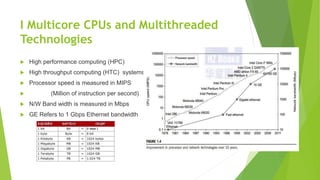
 High performance computing (HPC)
 High throughput computing (HTC) systems
 Processor speed is measured in MIPS
 (Million of instruction per second)
 N/W Band width is measured in Mbps
 GE Refers to 1 Gbps Ethernet bandwidth
I.1 Advanced in CPU Processor
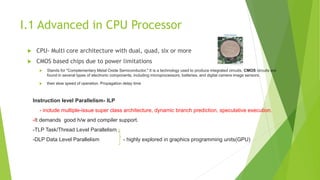
 CPU- Multi core architecture with dual, quad, six or more
 CMOS based chips due to power limitations
 Stands for "Complementary Metal Oxide Semiconductor." It is a technology used to produce integrated circuits. CMOS circuits are
found in several types of electronic components, including microprocessors, batteries, and digital camera image sensors.
 their slow speed of operation. Propagation delay time
Instruction level Parallelism- ILP
- include multiple-issue super class architecture, dynamic branch prediction, speculative execution.
-It demands good h/w and compiler support.
-TLP Task/Thread Level Parallelism ,
-DLP Data Level Parallelism - highly explored in graphics programming units(GPU)
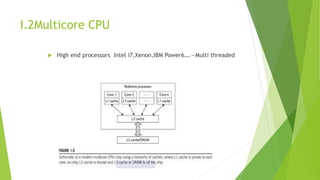
I.2Multicore CPU
 High end processors Intel i7,Xenon,IBM Power6….—Multi threaded
I.3Multicore CPU, Manycore GPU
 Many core GPU with 100 or more of thin cores
 IA-32,IA-64 instruction set architecture.
 (RISC Processors replaces by)X-86 Processors extend to serve HPC,HTC systems
in high end server processors.
 X-86 upgrades will dominate data centres, super computers.
 Asymmetric and heterogenous chip multiprocessors in thin GPU.
I.4Multi Threading Technology
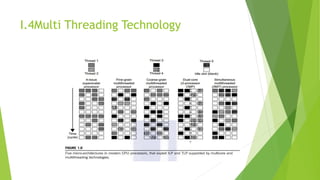
 Thread – 5, Pipelined data paths- 4
 4-issue superscalar processors – single thread
 Fine grain multithreaded processors- multi threading
 Coarse grain multithreaded Processors- executes many thread in few cycles
of instruction switching
 Dual core Processors(2-CMP)-execute instruction from different thread
completely.
 Simultaneous multithreaded processor(SMT).- simultaneous scheduling of ins
from diff thread in the same cycle.
 Blank square – no available ins on time
 More blank- lower scheduling efficiency
II. Memory storage, Wide Area
Networking
 Memory Technology:
 Processors get faster, memory capacity is needs in wider space which gives wider gap between
the processors and memory
 From 260 MB- 250 GB to 3 TB
 Disk Storage Technology:
 Rapid growth of flash memory and Solid State Driver(SSD) also impacts the future of HPC
& HTC Systems.
 SSD handle 300,000 to 1 million write cycles per block.
 Impressive speed up in many applications.
 Power consumption, cooling and packaging , Clock rate, voltage applied on chips needs
to redefine
 System Area interconnection:
II. Memory storage, Wide Area
Networking
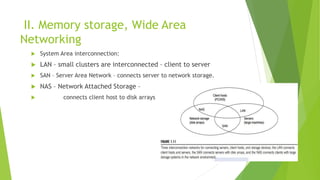
 System Area interconnection:
 LAN – small clusters are interconnected – client to server
 SAN – Server Area Network – connects server to network storage.
 NAS – Network Attached Storage –
 connects client host to disk arrays
III. Virtual Machines and Virtualizations
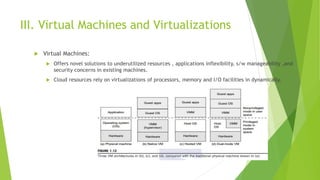
 Virtual Machines:
 Offers novel solutions to underutilized resources , applications inflexibility, s/w manageability ,and
security concerns in existing machines.
 Cloud resources rely on virtualizations of processors, memory and I/O facilities in dynamically.
III. Virtual Machines and Virtualizations
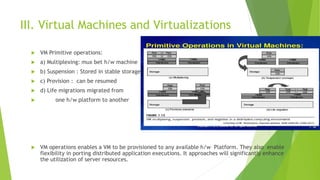
 VM Primitive operations:
 a) Multiplexing: mux bet h/w machine
 b) Suspension : Stored in stable storage
 c) Provision : can be resumed
 d) Life migrations migrated from
 one h/w platform to another
 VM operations enables a VM to be provisioned to any available h/w Platform. They also enable
flexibility in porting distributed application executions. It approaches will significantly enhance
the utilization of server resources.
IV. Data Center virtualizations for cloud
computing
 Large data centers are built with 1000 of servers. (Small data center – 100 of
servers)
 Low cost design philosophy
 high-band width networks may not fit the economics of cloud computing.
 s/w layer handles n/w traffic balancing, fault tolerance and expandability
 Convergence of technologies
 H/w Virtualizations and multi core chips
 Utility and grid computing
 Web 2.0
 Autonomic computing and data center automation

Cloud 1.2.pptx

  • 1.
    V.V. VANNIAPERUMAL COLLEGEFOR WOMEN (An Autonomous Institution Affiliated to Madurai Kamaraj University) VIRUDHUNAGAR (Re-Accredited with “A” Grade (3 rd Cycle) by NAAC) Online classes for cloud computing By D.Shunmuga Kumari, M.Sc., M.Phil., Assistant Professor, Department of information Technology, 11.08.2020 meet.google.com/zij-ngfi-ipm V.V. VANNIAPERUMAL COLLEGE FOR WOMEN (An Autonomous Institution Affiliated to Madurai Kamaraj University) VIRUDHUNAGAR (Re-Accredited with “A” Grade (3 rd Cycle) by NAAC)
  • 2.
    1.2 Technologies forNetwork-Based System I. Multicore CPUs and Multithreaded Technologies II. Memory, Storage and Wide-Area Networking III. Virtual Machines and virtualization middleware IV. Data Centre virtualization for Cloud computing
  • 3.
    Technologies for Network-BasedSystem  Efficient and Scalable computing,  Need to explore H/W, S/W, N/W  for distributed computing system design and applications  Focused on distributed operating systems in parallelism approach  A distributed operating system is a software over a collection of independent, networked, communicating, and physically separate computational nodes. They handle jobs which are serviced by multiple CPUs.
  • 4.
    I Multicore CPUsand Multithreaded Technologies  High performance computing (HPC)  High throughput computing (HTC) systems  Processor speed is measured in MIPS  (Million of instruction per second)  N/W Band width is measured in Mbps  GE Refers to 1 Gbps Ethernet bandwidth
  • 5.
    I.1 Advanced inCPU Processor  CPU- Multi core architecture with dual, quad, six or more  CMOS based chips due to power limitations  Stands for "Complementary Metal Oxide Semiconductor." It is a technology used to produce integrated circuits. CMOS circuits are found in several types of electronic components, including microprocessors, batteries, and digital camera image sensors.  their slow speed of operation. Propagation delay time Instruction level Parallelism- ILP - include multiple-issue super class architecture, dynamic branch prediction, speculative execution. -It demands good h/w and compiler support. -TLP Task/Thread Level Parallelism , -DLP Data Level Parallelism - highly explored in graphics programming units(GPU)
  • 6.
    I.2Multicore CPU  Highend processors Intel i7,Xenon,IBM Power6….—Multi threaded
  • 7.
    I.3Multicore CPU, ManycoreGPU  Many core GPU with 100 or more of thin cores  IA-32,IA-64 instruction set architecture.  (RISC Processors replaces by)X-86 Processors extend to serve HPC,HTC systems in high end server processors.  X-86 upgrades will dominate data centres, super computers.  Asymmetric and heterogenous chip multiprocessors in thin GPU.
  • 8.
  • 9.
    I.4Multi Threading Technology Thread – 5, Pipelined data paths- 4  4-issue superscalar processors – single thread  Fine grain multithreaded processors- multi threading  Coarse grain multithreaded Processors- executes many thread in few cycles of instruction switching  Dual core Processors(2-CMP)-execute instruction from different thread completely.  Simultaneous multithreaded processor(SMT).- simultaneous scheduling of ins from diff thread in the same cycle.  Blank square – no available ins on time  More blank- lower scheduling efficiency
  • 10.
    II. Memory storage,Wide Area Networking  Memory Technology:  Processors get faster, memory capacity is needs in wider space which gives wider gap between the processors and memory  From 260 MB- 250 GB to 3 TB  Disk Storage Technology:  Rapid growth of flash memory and Solid State Driver(SSD) also impacts the future of HPC & HTC Systems.  SSD handle 300,000 to 1 million write cycles per block.  Impressive speed up in many applications.  Power consumption, cooling and packaging , Clock rate, voltage applied on chips needs to redefine  System Area interconnection:
  • 11.
    II. Memory storage,Wide Area Networking  System Area interconnection:  LAN – small clusters are interconnected – client to server  SAN – Server Area Network – connects server to network storage.  NAS – Network Attached Storage –  connects client host to disk arrays
  • 12.
    III. Virtual Machinesand Virtualizations  Virtual Machines:  Offers novel solutions to underutilized resources , applications inflexibility, s/w manageability ,and security concerns in existing machines.  Cloud resources rely on virtualizations of processors, memory and I/O facilities in dynamically.
  • 13.
    III. Virtual Machinesand Virtualizations  VM Primitive operations:  a) Multiplexing: mux bet h/w machine  b) Suspension : Stored in stable storage  c) Provision : can be resumed  d) Life migrations migrated from  one h/w platform to another  VM operations enables a VM to be provisioned to any available h/w Platform. They also enable flexibility in porting distributed application executions. It approaches will significantly enhance the utilization of server resources.
  • 14.
    IV. Data Centervirtualizations for cloud computing  Large data centers are built with 1000 of servers. (Small data center – 100 of servers)  Low cost design philosophy  high-band width networks may not fit the economics of cloud computing.  s/w layer handles n/w traffic balancing, fault tolerance and expandability  Convergence of technologies  H/w Virtualizations and multi core chips  Utility and grid computing  Web 2.0  Autonomic computing and data center automation