Dr Zuraida Zainun
MSc (Medical Audiology), MD
Senior lecturer
Audiology Prgramme
School of Helth Sciences
Universiti Sains Malaysia
drzuraida@yahoo.com
http://bal-exercise.blogspot.com/
*
 Elicit history and evaluate dizziness
 Understand vestibular testing
 Knows differential diagnosis in dizziness
 Understand management concepts
3
*What is a balance disorder?
‘’a disturbance that causes an individual to
feel unsteady, giddy, woozy, or have a
sensation of movement, spinning, or
floating’’. http://www.nidcd.nih.gov/health/balance/balance_disorders.asp
*Dizziness
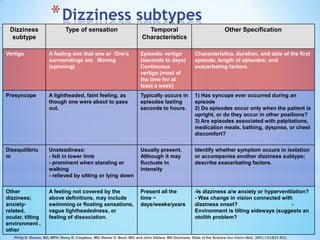
*Dizziness subtypes
Philip D. Sloane, MD, MPH; Remy R. Coeytaux, MD; Rainer S. Beck, MD; and John Dallara, MD Dizziness: State of the Science Ann Intern Med. 2001;134:823-832.
Dizziness
subtype
Type of sensation Temporal
Characteristics
Other Specification
Vertigo A feeling one that one or One’s
surroundings are Moving
(spinning)
Episodic vertigo
(seconds to days)
Continuous
vertigo (most of
the time for at
least a week)
Characteristics, duration, and date of the first
episode, length of episodes; and
exacerbating factors.
Presyncope A lightheaded, faint feeling, as
though one were about to pass
out.
Typically occurs in
episodes lasting
seconds to hours.
1) Has syncope ever occurred during an
episode
2) Do episodes occur only when the patient is
upright, or do they occur in other positions?
3) Are episodes associated with palpitations,
medication meals, bathing, dyspnea, or chest
discomfort?
Disequilibriu
m
Unsteadiness:
- felt in lower limb
- prominent when standing or
walking
- relieved by sitting or lying down
Usually present.
Although it may
fluctuate in
intensity
Identify whether symptom occurs in isolation
or accompanies another dizziness subtype;
describe exacerbating factors.
Other
dizziness;
anxiety-
related,
ocular, tilting
environment ,
other
A feeling not covered by the
above definitions, may include
swimming or floating sensations,
vague lightheadedness, or
feeling of dissociation.
Present all the
time ~
days/weeks/years
-Is dizziness a/w anxiety or hyperventilation?
- Was change in vision connected with
dizziness onset? -
Environment is tilting sideways (suggests an
otolith problem?
http://www.aan.com/go/education/curricula/family/chapter5/section1
Nature
Duration
Associated
symptoms
Precipitating
factors
OBJECTIVE
VNG
VEMP (Ocul & Cer.)
V-Hit
EcohG
Posturography
Rotating Chair
Subjective vertical test
SUBJECTIVE
Malay Version VSS
Malay version Modified
VSS
Gen. exam.
Eye exam.
Aural exam.
Neurology
exam.
Specific test
*
*Chief complaints
*Dizzy !! Lightheadacheness!! Headache!! Floating!! Presyncope!!
*Whirling !! Swaying!! Unsteadiness!!
*True vertigo or not ?
A) Nature
*B) Duration of attack:
BPPV-seconds
TIA-minutes
Meniere’s-hours
Vestibular Neuronitis-Days
Ototoxins-years (See Hain, 1997)
*C) Associated symptom
positional related, hearing disturbance, headache,
stress
D) Precipitating/ provoking factors
Spinning Vestibular
Unsteadiness Central lesion
Presyncopal/
feeling faint Orthostatic
Unspecific
(dissociation) Psychology
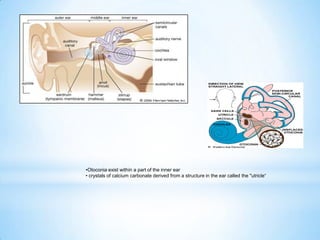
•Otoconia exist within a part of the inner ear
• crystals of calcium carbonate derived from a structure in the ear called the "utricle“
*
Duration of episode
Suggested diagnosis
Seconds Peripheral: unilateral loss of vestibular fx, late
stage of acute vestibular neuronitis & MD
Seconds - minutes BPPV. perilymphatic fistula
Minutes – one hour Posterior transient ischemic attack; perilymphatic
fistula
Hours MD; perilymphatic; migraine. Acoustic neuroma
Days Early acute vestibular neuronitis*’stroke; migraine;
Multiple sclerosis
Weeks Psychogenic (constant ~weeks w/o Improvement)
*-Early acute vestibular neuritis can be two days or as long as one week or more .
*
Symptom Suggested diagnosis
Aural fullness Acoustic neuroma;Meniere’s disease
Ear or mastoid
pain
Acoustic neuroma; acute middle ear disease (e.g; otitis zoster
oticus)
Facial weakness Acoustic neuroma; herpes zoster oticus
Facial neurologic CPA tumour; CVA; MS
Headache Acoustic neuroma; migraine
Hearing loss MD; PLF; acoustic neuroma; cholesteatoma;otosclerosis;TIA or
stroke involving anterior cerebella artery, herpes zoster oticus
Imbalance Acute vestibular neuronitis(usually moderate); CPA tumor
(usually severe)
Nystagmus Peripheral or central vertigo
Phonophobia,
photophobia
Migraine
Tinnitus Acute labyrinthitis; acoustic neuroma; Meniera’s disease
*
Provoking Factor Suggested diagnosis
Changes in head
position
Acute labyrinthitis;BPPV; CPA
Tumour ;multiple sclerosis (MS);
PLF
Spontaneous
episodes
AVN; CVA (stroke or TIA; MD ;
migraine; MS
Recent URTI Acute vestibular neuronitis (AVN)
Stress Psychiatric or psychological
causes; migraine
Changes in ear
press., trauma,
excess. straining,
loud noises
Perilymphatic fistula (PLF)
 Past medical history
-vascular risk factors
-ear surgery
 Family History
-Similar disorder ?
-Migraine
 Drug History
-present and past exposures to ototoxins,
antihypertensives.
Clinical Examination
*
Aural Examination
otitis media
ear wax,
perforated ear drum
cholesteatoma
Eye Examination
Visual acuity
Nystagmus
-
saccadic, vestibular
, pendular, congeni
tal, alternating
Rebound nystagmus
Saccades, pursuit,
vergence, gaze
General Medical condition
Blood pressure (lying and
sitting)
Cardiac arrhythmias
Neurological
Examination
cranial nerve palsies
(Multiple sclerosis
, acoustic
neuroma, advanced brain
stem tumor or basilar
artery insufficiency
Neck examination
*
*Gait
*Cranial nerves
*Motor power and
reflexes (e.g. Babinski)
*Sensory
(proprioception)
 Cerebellar sign ;
a) Finger to nose
b) Dysdiadokinesia
c) Tandem gait (hell
to toe) with eye
open and closed
*Romberg’s test
Fall to one side:
- Posterior column lesion
- Acute ipsilateral vestibular lesion
*Fukuda @ Unterberger test
-Walk on the spot for 2 minutes with eye closed
-Positive when patient turn > 45°
-Ipsilateral peripheral lesion
*
l) Spontaneous nystagmus
MD, Vestibular Neuronitis, central disorders, to
rule out Psychiatric (used Frenzel's goggles)
ii) Range of eye movements
Gaze paresis
Ocular paresis
iii) Cover test for strabismus : a
deviation or misalignment eyes.
strabism– eye muscle position ~ one or both
eyes may turn in (esotropia), out (exotropia), up
(hypertropia) or down (hypotropia).
http://dewa-dony.blogspot.com/2008/10/strabismus.html
*
- to detect vestibular
neuritis, acoustics, and to rule out
psychiatric disturbance
Head-shake test - (Hain et al, 1987)
75% sensitive but wrong side in 1/4 of
the time.
Head Thrust test
http://cueflash.com/decks/CONTROL_OF_EYE_MOVEMENTS_-_57
Saccade when head turning toward lesion side
*
- to detect ototoxicity and other
bilateral vestibulopathies
Dynamic illegible 'E' test or DIE
(Longridge, 87).
*
1. DIX-HALLPIKE TEST
-Rotatory upbeating; Post SCC
-Rotatory downbeating; Ant. SCC
video 1
video 2
video 3 cupulo
Treatment for Post. SCC- Epley’s
menourve
2. ROLL TEST
- horizontal nystagmus
video 1
Treatment- Barbeque menourve
Video 1
nystagmus
*
3) Fistula Test or Valsalva test- Occasionally helpful
4) Hyperventilation test – 30 seconds, look for
nystagmus. Helpful when nystagmus changes
direction compared to vibration or head-shaking
nystagmus.
5) Carotid Sinus Compression - for syncope patients.
6) Vertebral artery test - for persons with neck-
position induced vertigo (cervical vertigo).
*
Feature Peripheral Vertigo Central Vertigo
Nystagmus Mix horizontal & tensional;
inhib. by fixation of eyes;
Fades after a few days; not
change direction with gaze
to either side
Purely vertical , horizontal, or
torsional; not inhibited by
fixation of eyes ; last weeks
to months; change direction
With gaze towards fast phase
Of Nystagmus
Imbalance Mild to moderate; able to
walk
Severe; unable to stand or
walk
Nausea,
vomiting
May be severe Varies
Hearing loss,
tinnitus
Common Rare
Neurologic
Sx
Rare Common
Latency
(follow. pro-
vocative)
Longer (up to 20 seconds) Shorter (up to 5 seconds)
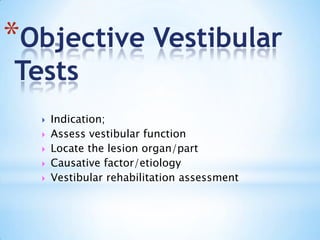
*Objective Vestibular
Tests
 Indication;
 Assess vestibular function
 Locate the lesion organ/part
 Causative factor/etiology
 Vestibular rehabilitation assessment
*Videonystagmography
(VNG)/Electronystagmograpy (ENG)
*Video Head impulsetTest (V-HIT)
*Vestibular evoked myogenic potential (VEMP)
- Ocular & cervical
*Electrocochleargraphy (EcohG)
*Rotating chair
*Computerized Posturography (CDP)
*Subjective vertical test
*VNG – Horizontal SCC
*Rotatory Chair – Horizontal SCC
*Computerized Dynamic
Posturography
file:///F:/LECTURE%202007/posturography/Posturography.htm
*
*Evaluation of the inner ear (cochlea) has an
excessive amount of fluid pressure.
SummaryofVEMPrecordingsteps
Iran Audiology Congress 26-28 May 2011 Dr
Zuraida Zainun
33
*
http://www.unmc.edu/physiology/Mann/mann9.html
Video nystagmography (VNG)Video Head impulsetTest (V-HIT)
Ocular VEMP
Cervical VEMP
Rotating chair
Bone-conducted cVEMP
*Others investigations
*Audiological test
* PTA
* Tympanometry
* ABR
*Radiological test
* CT Scan
* MRI Scan
* Vascular studies
*Laboratory investigations:
* FBC
* Blood sugar
* Lipid profile
* Thyroid profile
*
*MALAY VERSION VERTIGO SYMPTOM SCALE QUESTIONNAIRES
(MVSS) ~ 22 questions (34 items)
*MALAY VERSION MODIFIED VERTIGO SYMPTOM SCALE
QUESTIONNAIRES (MMVVSS) ~ 14 items
37
*
1. Investigation and diagnosis
2. Explanation
3. Rehabilitation plan
- correction of remediable problems
-General medical condition
- general fitness programmed
- physical exercise regimens (i.e. Vestibular rehabilitation by
physiotherapist/ homebased)
 Cawthorne cookseey exercise (CCE)
 Customised CCE
 Epley’s Menourve
 Brandt Daroff exercise
- psychological assessment
-Psychological intervention i.e. CBT, Relaxation Rx.
- medication- realistic family/social/occupational goals
- surgery
4. Monitoring/feedback/follow up
5. Discharge
Reproduced with permission from Luxon LM, Davies RA, eds.
Handbook of vestibular medicine. London: Whurr Publishers, 1997.
40
*
 Cawthorne cookseey exercise (CCE)
 Customised CCE
Bal Ex : Homebased video module for
balance exercises = customised CCE +Prayer
movement
*
1. Kroenke K, Lucas CA, Rosenberg ML, et al. Causes of persistent dizziness: a
prospective study of 100 patients in ambulatory care. Ann Intern Med.
1992;117:898-904.
2. LM Nashner, FO Black, and C Wall, 3d Adaptation to altered support and visual
conditions during stance: patients with vestibular deficits J. Neurosci. 1982 2: 536-
544.
3. Shupert CL, Black FO, Horak FB & Nashner LM (1988) Coordination of head and
body in response to support surface translations in normals and patients with
bilaterally reduced vestibular function. In Amblard B, Berthoz A, Clarac F (eds)
Posture and gait: Development, Adaptation and Modulation. New York: Elsevier
Science Publishers.
4. Allum, J.H.J., Honegger, F. and Pfaltz, C.R. (1989) The role of stretch and
vestibulo-spinal reflexes in the generation of human equilibriating reactions.
Progress in Brain Research 80, 399-409
5. Bles W, de Jong JMBV. Uni- and bilateral loss of vestibular function. In: Disorders
of posture and gait.—Bles W, Brandt T, eds. (1986) Amsterdam: Elsevier, 1986, PP
127-139
6.Fregly AR (1974) Vestibular ataxia and its measurement in man. In: Kornhuber HH
(ed) Handbook of Sensory Physiology,. vol VI. Springer, New York, pp 321–360
7.Handbook of Balance Function Testing by Gary P. Jacobson (Author), Craig W.
Newman (Author), Jack M. Kartush Singular; 1 edition (October 1, 1997)
8.http://www.neuroanatomy.wisc.edu/virtualbrain/BrainStem/13VNAN.html
9.http://www.utmb.edu/otoref/Grnds/Vestibular-2004-0414/Vestibular-2004-
0414.htm
10. http://www.bcdecker.com/SampleOfChapter/1550092634.pdf
Vertigo 1

Vertigo 1

  • 1.
    Dr Zuraida Zainun MSc(Medical Audiology), MD Senior lecturer Audiology Prgramme School of Helth Sciences Universiti Sains Malaysia drzuraida@yahoo.com http://bal-exercise.blogspot.com/
  • 2.
    *  Elicit historyand evaluate dizziness  Understand vestibular testing  Knows differential diagnosis in dizziness  Understand management concepts
  • 3.
    3 *What is abalance disorder? ‘’a disturbance that causes an individual to feel unsteady, giddy, woozy, or have a sensation of movement, spinning, or floating’’. http://www.nidcd.nih.gov/health/balance/balance_disorders.asp
  • 4.
  • 5.
    *Dizziness subtypes Philip D.Sloane, MD, MPH; Remy R. Coeytaux, MD; Rainer S. Beck, MD; and John Dallara, MD Dizziness: State of the Science Ann Intern Med. 2001;134:823-832. Dizziness subtype Type of sensation Temporal Characteristics Other Specification Vertigo A feeling one that one or One’s surroundings are Moving (spinning) Episodic vertigo (seconds to days) Continuous vertigo (most of the time for at least a week) Characteristics, duration, and date of the first episode, length of episodes; and exacerbating factors. Presyncope A lightheaded, faint feeling, as though one were about to pass out. Typically occurs in episodes lasting seconds to hours. 1) Has syncope ever occurred during an episode 2) Do episodes occur only when the patient is upright, or do they occur in other positions? 3) Are episodes associated with palpitations, medication meals, bathing, dyspnea, or chest discomfort? Disequilibriu m Unsteadiness: - felt in lower limb - prominent when standing or walking - relieved by sitting or lying down Usually present. Although it may fluctuate in intensity Identify whether symptom occurs in isolation or accompanies another dizziness subtype; describe exacerbating factors. Other dizziness; anxiety- related, ocular, tilting environment , other A feeling not covered by the above definitions, may include swimming or floating sensations, vague lightheadedness, or feeling of dissociation. Present all the time ~ days/weeks/years -Is dizziness a/w anxiety or hyperventilation? - Was change in vision connected with dizziness onset? - Environment is tilting sideways (suggests an otolith problem?
  • 6.
  • 7.
    Nature Duration Associated symptoms Precipitating factors OBJECTIVE VNG VEMP (Ocul &Cer.) V-Hit EcohG Posturography Rotating Chair Subjective vertical test SUBJECTIVE Malay Version VSS Malay version Modified VSS Gen. exam. Eye exam. Aural exam. Neurology exam. Specific test
  • 8.
    * *Chief complaints *Dizzy !!Lightheadacheness!! Headache!! Floating!! Presyncope!! *Whirling !! Swaying!! Unsteadiness!! *True vertigo or not ? A) Nature *B) Duration of attack: BPPV-seconds TIA-minutes Meniere’s-hours Vestibular Neuronitis-Days Ototoxins-years (See Hain, 1997) *C) Associated symptom positional related, hearing disturbance, headache, stress D) Precipitating/ provoking factors Spinning Vestibular Unsteadiness Central lesion Presyncopal/ feeling faint Orthostatic Unspecific (dissociation) Psychology
  • 9.
    •Otoconia exist withina part of the inner ear • crystals of calcium carbonate derived from a structure in the ear called the "utricle“
  • 10.
    * Duration of episode Suggesteddiagnosis Seconds Peripheral: unilateral loss of vestibular fx, late stage of acute vestibular neuronitis & MD Seconds - minutes BPPV. perilymphatic fistula Minutes – one hour Posterior transient ischemic attack; perilymphatic fistula Hours MD; perilymphatic; migraine. Acoustic neuroma Days Early acute vestibular neuronitis*’stroke; migraine; Multiple sclerosis Weeks Psychogenic (constant ~weeks w/o Improvement) *-Early acute vestibular neuritis can be two days or as long as one week or more .
  • 11.
    * Symptom Suggested diagnosis Auralfullness Acoustic neuroma;Meniere’s disease Ear or mastoid pain Acoustic neuroma; acute middle ear disease (e.g; otitis zoster oticus) Facial weakness Acoustic neuroma; herpes zoster oticus Facial neurologic CPA tumour; CVA; MS Headache Acoustic neuroma; migraine Hearing loss MD; PLF; acoustic neuroma; cholesteatoma;otosclerosis;TIA or stroke involving anterior cerebella artery, herpes zoster oticus Imbalance Acute vestibular neuronitis(usually moderate); CPA tumor (usually severe) Nystagmus Peripheral or central vertigo Phonophobia, photophobia Migraine Tinnitus Acute labyrinthitis; acoustic neuroma; Meniera’s disease
  • 12.
    * Provoking Factor Suggesteddiagnosis Changes in head position Acute labyrinthitis;BPPV; CPA Tumour ;multiple sclerosis (MS); PLF Spontaneous episodes AVN; CVA (stroke or TIA; MD ; migraine; MS Recent URTI Acute vestibular neuronitis (AVN) Stress Psychiatric or psychological causes; migraine Changes in ear press., trauma, excess. straining, loud noises Perilymphatic fistula (PLF)
  • 13.
     Past medicalhistory -vascular risk factors -ear surgery  Family History -Similar disorder ? -Migraine  Drug History -present and past exposures to ototoxins, antihypertensives.
  • 14.
  • 15.
    * Aural Examination otitis media earwax, perforated ear drum cholesteatoma Eye Examination Visual acuity Nystagmus - saccadic, vestibular , pendular, congeni tal, alternating Rebound nystagmus Saccades, pursuit, vergence, gaze General Medical condition Blood pressure (lying and sitting) Cardiac arrhythmias Neurological Examination cranial nerve palsies (Multiple sclerosis , acoustic neuroma, advanced brain stem tumor or basilar artery insufficiency Neck examination
  • 16.
    * *Gait *Cranial nerves *Motor powerand reflexes (e.g. Babinski) *Sensory (proprioception)  Cerebellar sign ; a) Finger to nose b) Dysdiadokinesia c) Tandem gait (hell to toe) with eye open and closed
  • 17.
    *Romberg’s test Fall toone side: - Posterior column lesion - Acute ipsilateral vestibular lesion *Fukuda @ Unterberger test -Walk on the spot for 2 minutes with eye closed -Positive when patient turn > 45° -Ipsilateral peripheral lesion
  • 18.
    * l) Spontaneous nystagmus MD,Vestibular Neuronitis, central disorders, to rule out Psychiatric (used Frenzel's goggles) ii) Range of eye movements Gaze paresis Ocular paresis iii) Cover test for strabismus : a deviation or misalignment eyes. strabism– eye muscle position ~ one or both eyes may turn in (esotropia), out (exotropia), up (hypertropia) or down (hypotropia). http://dewa-dony.blogspot.com/2008/10/strabismus.html
  • 19.
    * - to detectvestibular neuritis, acoustics, and to rule out psychiatric disturbance Head-shake test - (Hain et al, 1987) 75% sensitive but wrong side in 1/4 of the time. Head Thrust test
  • 20.
  • 21.
    * - to detectototoxicity and other bilateral vestibulopathies Dynamic illegible 'E' test or DIE (Longridge, 87).
  • 22.
    * 1. DIX-HALLPIKE TEST -Rotatoryupbeating; Post SCC -Rotatory downbeating; Ant. SCC video 1 video 2 video 3 cupulo Treatment for Post. SCC- Epley’s menourve 2. ROLL TEST - horizontal nystagmus video 1 Treatment- Barbeque menourve
  • 23.
  • 24.
    * 3) Fistula Testor Valsalva test- Occasionally helpful 4) Hyperventilation test – 30 seconds, look for nystagmus. Helpful when nystagmus changes direction compared to vibration or head-shaking nystagmus. 5) Carotid Sinus Compression - for syncope patients. 6) Vertebral artery test - for persons with neck- position induced vertigo (cervical vertigo).
  • 25.
    * Feature Peripheral VertigoCentral Vertigo Nystagmus Mix horizontal & tensional; inhib. by fixation of eyes; Fades after a few days; not change direction with gaze to either side Purely vertical , horizontal, or torsional; not inhibited by fixation of eyes ; last weeks to months; change direction With gaze towards fast phase Of Nystagmus Imbalance Mild to moderate; able to walk Severe; unable to stand or walk Nausea, vomiting May be severe Varies Hearing loss, tinnitus Common Rare Neurologic Sx Rare Common Latency (follow. pro- vocative) Longer (up to 20 seconds) Shorter (up to 5 seconds)
  • 26.
    *Objective Vestibular Tests  Indication; Assess vestibular function  Locate the lesion organ/part  Causative factor/etiology  Vestibular rehabilitation assessment
  • 27.
    *Videonystagmography (VNG)/Electronystagmograpy (ENG) *Video HeadimpulsetTest (V-HIT) *Vestibular evoked myogenic potential (VEMP) - Ocular & cervical *Electrocochleargraphy (EcohG) *Rotating chair *Computerized Posturography (CDP) *Subjective vertical test
  • 28.
  • 29.
    *Rotatory Chair –Horizontal SCC
  • 30.
  • 31.
    * *Evaluation of theinner ear (cochlea) has an excessive amount of fluid pressure.
  • 32.
  • 33.
  • 34.
    http://www.unmc.edu/physiology/Mann/mann9.html Video nystagmography (VNG)VideoHead impulsetTest (V-HIT) Ocular VEMP Cervical VEMP Rotating chair Bone-conducted cVEMP
  • 35.
    *Others investigations *Audiological test *PTA * Tympanometry * ABR *Radiological test * CT Scan * MRI Scan * Vascular studies *Laboratory investigations: * FBC * Blood sugar * Lipid profile * Thyroid profile
  • 36.
    * *MALAY VERSION VERTIGOSYMPTOM SCALE QUESTIONNAIRES (MVSS) ~ 22 questions (34 items) *MALAY VERSION MODIFIED VERTIGO SYMPTOM SCALE QUESTIONNAIRES (MMVVSS) ~ 14 items
  • 37.
  • 39.
    * 1. Investigation anddiagnosis 2. Explanation 3. Rehabilitation plan - correction of remediable problems -General medical condition - general fitness programmed - physical exercise regimens (i.e. Vestibular rehabilitation by physiotherapist/ homebased)  Cawthorne cookseey exercise (CCE)  Customised CCE  Epley’s Menourve  Brandt Daroff exercise - psychological assessment -Psychological intervention i.e. CBT, Relaxation Rx. - medication- realistic family/social/occupational goals - surgery 4. Monitoring/feedback/follow up 5. Discharge Reproduced with permission from Luxon LM, Davies RA, eds. Handbook of vestibular medicine. London: Whurr Publishers, 1997.
  • 40.
    40 *  Cawthorne cookseeyexercise (CCE)  Customised CCE Bal Ex : Homebased video module for balance exercises = customised CCE +Prayer movement
  • 41.
    * 1. Kroenke K,Lucas CA, Rosenberg ML, et al. Causes of persistent dizziness: a prospective study of 100 patients in ambulatory care. Ann Intern Med. 1992;117:898-904. 2. LM Nashner, FO Black, and C Wall, 3d Adaptation to altered support and visual conditions during stance: patients with vestibular deficits J. Neurosci. 1982 2: 536- 544. 3. Shupert CL, Black FO, Horak FB & Nashner LM (1988) Coordination of head and body in response to support surface translations in normals and patients with bilaterally reduced vestibular function. In Amblard B, Berthoz A, Clarac F (eds) Posture and gait: Development, Adaptation and Modulation. New York: Elsevier Science Publishers. 4. Allum, J.H.J., Honegger, F. and Pfaltz, C.R. (1989) The role of stretch and vestibulo-spinal reflexes in the generation of human equilibriating reactions. Progress in Brain Research 80, 399-409
  • 42.
    5. Bles W,de Jong JMBV. Uni- and bilateral loss of vestibular function. In: Disorders of posture and gait.—Bles W, Brandt T, eds. (1986) Amsterdam: Elsevier, 1986, PP 127-139 6.Fregly AR (1974) Vestibular ataxia and its measurement in man. In: Kornhuber HH (ed) Handbook of Sensory Physiology,. vol VI. Springer, New York, pp 321–360 7.Handbook of Balance Function Testing by Gary P. Jacobson (Author), Craig W. Newman (Author), Jack M. Kartush Singular; 1 edition (October 1, 1997) 8.http://www.neuroanatomy.wisc.edu/virtualbrain/BrainStem/13VNAN.html 9.http://www.utmb.edu/otoref/Grnds/Vestibular-2004-0414/Vestibular-2004- 0414.htm 10. http://www.bcdecker.com/SampleOfChapter/1550092634.pdf