VESTIBULAR
EXAMINATION
BY:
DR. APOORVA SRIVASTAVA (PT)
MPT (NEURO)
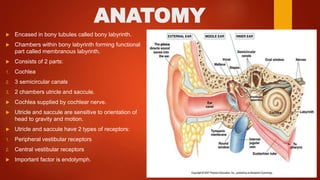
ANATOMY
 Encased in bony tubules called bony labyrinth.
 Chambers within bony labyrinth forming functional
part called membranous labyrinth.
 Consists of 2 parts:
1. Cochlea
2. 3 semicircular canals
3. 2 chambers utricle and saccule.
 Cochlea supplied by cochlear nerve.
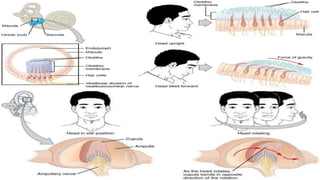
 Utricle and saccule are sensitive to orientation of
head to gravity and motion.
 Utricle and saccule have 2 types of receptors:
1. Peripheral vestibular receptors
2. Central vestibular receptors
 Important factor is endolymph.
PHYSIOLOGY
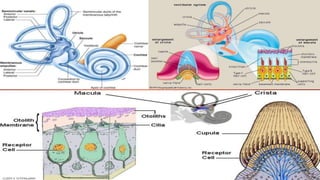
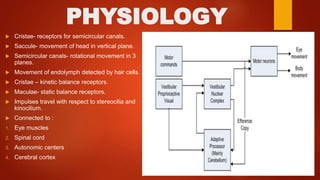
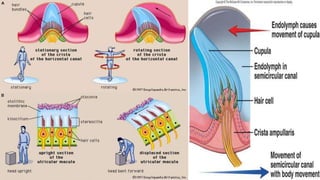
 Cristae- receptors for semicircular canals.
 Saccule- movement of head in vertical plane.
 Semicircular canals- rotational movement in 3
planes.
 Movement of endolymph detected by hair cells.
 Cristae – kinetic balance receptors.
 Maculae- static balance receptors.
 Impulses travel with respect to stereocilia and
kinocilium.
 Connected to :
1. Eye muscles
2. Spinal cord
3. Autonomic centers
4. Cerebral cortex
FUNCTIONS
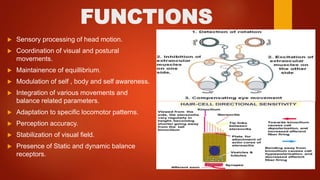
 Sensory processing of head motion.
 Coordination of visual and postural
movements.
 Maintainence of equillibrium.
 Modulation of self , body and self awareness.
 Integration of various movements and
balance related parameters.
 Adaptation to specific locomotor patterns.
 Perception accuracy.
 Stabilization of visual field.
 Presence of Static and dynamic balance
receptors.
PHYSICAL TESTS
 Caloric test
 Dizziness handicap inventory
 Head impulse test
 Head shaking induced
nystagmus test
 Dix- hallpike test
 Dynamic visual acuity test
 Rotational chair test
 Romberg test
Caloric test
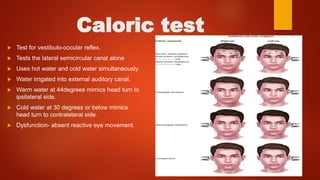
 Test for vestibulo-occular reflex.
 Tests the lateral semicircular canal alone
 Uses hot water and cold water simultaneously.
 Water irrigated into external auditory canal.
 Warm water at 44degrees mimics head turn to
ipsilateral side.
 Cold water at 30 degrees or below mimics
head turn to contraleteral side.
 Dysfunction- absent reactive eye movement.
DIZZINESS HANDICAP
INVENTORY
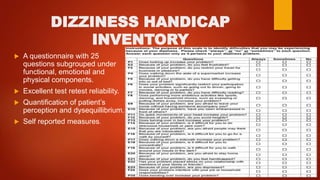
 A questionnaire with 25
questions subgrouped under
functional, emotional and
physical components.
 Excellent test retest reliability.
 Quantification of patient’s
perception and dysequillibrium.
 Self reported measures.
HEAD IMPULSE TEST
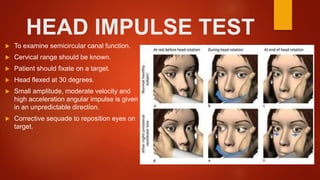
 To examine semicircular canal function.
 Cervical range should be known.
 Patient should fixate on a target.
 Head flexed at 30 degrees.
 Small amplitude, moderate velocity and
high acceleration angular impulse is given
in an unpredictable direction.
 Corrective sequade to reposition eyes on
target.
HEAD SHAKING INDUCED
NYSTAGMUS TEST
 Useful in diagnosis of unilateral
peripheral vestibular defect.
 Eyes of patient are closed.
 Head flexion is 30 degrees.
 Horizontal oscillation for 20 cycles
at frequency of 2 reps/second.
 Nystagmus to be checked on eye
opening.
 Seen in patients with acoustic
neuroma.
DIX- HALLPIKE TEST
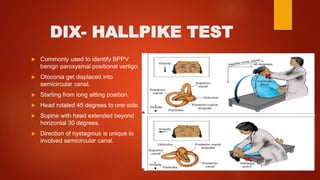
 Commonly used to identify BPPV
benign paroxysmal positional vertigo.
 Otoconia get displaced into
semicircular canal.
 Starting from long sitting position.
 Head rotated 45 degrees to one side.
 Supine with head extended beyond
horizontal 30 degrees.
 Direction of nystagmus is unique to
involved semicircular canal.
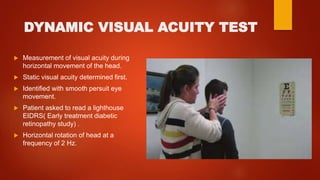
DYNAMIC VISUAL ACUITY TEST
 Measurement of visual acuity during
horizontal movement of the head.
 Static visual acuity determined first.
 Identified with smooth persuit eye
movement.
 Patient asked to read a lighthouse
EIDRS( Early treatment diabetic
retinopathy study) .
 Horizontal rotation of head at a
frequency of 2 Hz.
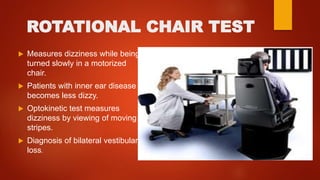
ROTATIONAL CHAIR TEST
 Measures dizziness while being
turned slowly in a motorized
chair.
 Patients with inner ear disease
becomes less dizzy.
 Optokinetic test measures
dizziness by viewing of moving
stripes.
 Diagnosis of bilateral vestibular
loss.
ROMBERG TEST
 Patient stands with feet close
together and arms open by side with
first eyes open and then eyes
closed.
 Eyes staring at an object for 3
minutes.
 Then eyes closed and sway is seen.
 Maximum sway is measured.
 Sharpened romberg test includes
standing with one toe forward of the
other and hands folded at the chest
level.
Vestibular Apparatus and Examination

Vestibular Apparatus and Examination

  • 1.
  • 2.
    ANATOMY  Encased inbony tubules called bony labyrinth.  Chambers within bony labyrinth forming functional part called membranous labyrinth.  Consists of 2 parts: 1. Cochlea 2. 3 semicircular canals 3. 2 chambers utricle and saccule.  Cochlea supplied by cochlear nerve.  Utricle and saccule are sensitive to orientation of head to gravity and motion.  Utricle and saccule have 2 types of receptors: 1. Peripheral vestibular receptors 2. Central vestibular receptors  Important factor is endolymph.
  • 4.
    PHYSIOLOGY  Cristae- receptorsfor semicircular canals.  Saccule- movement of head in vertical plane.  Semicircular canals- rotational movement in 3 planes.  Movement of endolymph detected by hair cells.  Cristae – kinetic balance receptors.  Maculae- static balance receptors.  Impulses travel with respect to stereocilia and kinocilium.  Connected to : 1. Eye muscles 2. Spinal cord 3. Autonomic centers 4. Cerebral cortex
  • 6.
    FUNCTIONS  Sensory processingof head motion.  Coordination of visual and postural movements.  Maintainence of equillibrium.  Modulation of self , body and self awareness.  Integration of various movements and balance related parameters.  Adaptation to specific locomotor patterns.  Perception accuracy.  Stabilization of visual field.  Presence of Static and dynamic balance receptors.
  • 8.
    PHYSICAL TESTS  Calorictest  Dizziness handicap inventory  Head impulse test  Head shaking induced nystagmus test  Dix- hallpike test  Dynamic visual acuity test  Rotational chair test  Romberg test
  • 9.
    Caloric test  Testfor vestibulo-occular reflex.  Tests the lateral semicircular canal alone  Uses hot water and cold water simultaneously.  Water irrigated into external auditory canal.  Warm water at 44degrees mimics head turn to ipsilateral side.  Cold water at 30 degrees or below mimics head turn to contraleteral side.  Dysfunction- absent reactive eye movement.
  • 10.
    DIZZINESS HANDICAP INVENTORY  Aquestionnaire with 25 questions subgrouped under functional, emotional and physical components.  Excellent test retest reliability.  Quantification of patient’s perception and dysequillibrium.  Self reported measures.
  • 11.
    HEAD IMPULSE TEST To examine semicircular canal function.  Cervical range should be known.  Patient should fixate on a target.  Head flexed at 30 degrees.  Small amplitude, moderate velocity and high acceleration angular impulse is given in an unpredictable direction.  Corrective sequade to reposition eyes on target.
  • 12.
    HEAD SHAKING INDUCED NYSTAGMUSTEST  Useful in diagnosis of unilateral peripheral vestibular defect.  Eyes of patient are closed.  Head flexion is 30 degrees.  Horizontal oscillation for 20 cycles at frequency of 2 reps/second.  Nystagmus to be checked on eye opening.  Seen in patients with acoustic neuroma.
  • 13.
    DIX- HALLPIKE TEST Commonly used to identify BPPV benign paroxysmal positional vertigo.  Otoconia get displaced into semicircular canal.  Starting from long sitting position.  Head rotated 45 degrees to one side.  Supine with head extended beyond horizontal 30 degrees.  Direction of nystagmus is unique to involved semicircular canal.
  • 14.
    DYNAMIC VISUAL ACUITYTEST  Measurement of visual acuity during horizontal movement of the head.  Static visual acuity determined first.  Identified with smooth persuit eye movement.  Patient asked to read a lighthouse EIDRS( Early treatment diabetic retinopathy study) .  Horizontal rotation of head at a frequency of 2 Hz.
  • 15.
    ROTATIONAL CHAIR TEST Measures dizziness while being turned slowly in a motorized chair.  Patients with inner ear disease becomes less dizzy.  Optokinetic test measures dizziness by viewing of moving stripes.  Diagnosis of bilateral vestibular loss.
  • 16.
    ROMBERG TEST  Patientstands with feet close together and arms open by side with first eyes open and then eyes closed.  Eyes staring at an object for 3 minutes.  Then eyes closed and sway is seen.  Maximum sway is measured.  Sharpened romberg test includes standing with one toe forward of the other and hands folded at the chest level.