Dr. Zaimal Shahan 
PGT Department of ENT 
Capital Hospital
SUBJECTIVE SENSE OF IMBALANCE 
“Sensation as if the external world 
is revolving around the patient or as if he 
himself is revolving in space”
 How do we maintain 
EQUILIBRIUM?
 The Bony Labyrinth lies in the petrous 
temporal bone. 
 Bony Labyrinth contains the membranous 
labyrinth surrounded by a fluid called 
perilymph 
 Membranous Labyrinth consists of: 
An Anterior Cochlear Duct HEARING 
Posterior vestibular Apparatus: 
 Utricle 
 Sacculae BALANCE 
 3 Semicircular Canals.
 Semicircular canals are 
three small ring 
structures each forming 
2/3rd of a circle with a 
dia. Of 6.5 mm, 
containing endolymph. 
 One end of each canal 
is dilated “Ampula” 
 Endolymph has a high K 
and low sodium 
Concentration & is 
secreted by Stria 
Vascularis and Dark 
Cells.
 Five Vestibular Receptor organs 
are present in the Vestibular 
Labyrinth. 
Two Maculae in utricle and saccule 
(otolith organs) Monitor 
Linear Acceleration. 
Three Cristae Ampullares of 
SSC Monitor Angular 
Accleration.
 Each macula is found on floor of Utricle in horizontal plane & 
medial wall of Saccule in Vertical plane. 
 Macula supports a statoconial membrane which consists of small 
Ca.Carbonate cryustals (otoconia) embedded in mucopolysaccharide 
gel. 
 Static tilt and linear acceleration results in movement of membrane 
resulting in bending of hairs of hair cells and stimulation of nerve 
endings. 
 Crista Ampullaris are a crest of sensory epithelium lying at right 
angles to the longitudinal axis of the canal and surrounded by a 
bulbous gelatinous mass, the cupula. 
 When head is rotated the endolymph within the ducts tends to 
remain stationary. The resultant flow of endolymph with respect to 
duct is resisted by elacticity of cupula which becomes deflected 
bending hairs of sensory hair cells.
 The balance system (vestibular, visual, 
and somatosensory) are a two sided push 
and pull system. 
In static neutral position, each side contributes 
equal sensory information. 
During movement ie., turning or tilt, there is a 
temporary change in push and pull system 
which is connected by appropriate reflexes and 
motor outputs to the eyes (vestibulo0ocular 
reflex), neck (vestibulo-cervical reflex), and 
trunk and limbs (vestibulo0spinal reflex) to 
maintain new position of head and body.
Normally there is balanced 
input from both vestibular 
systems 
Vertigo develops from 
asymmetrical vestibular 
activity 
Abnormal bilateral 
vestibular activation 
results in truncal ataxia
 ANATOMICAL 
 DURATION OF VERTIGO 
 NATURE OF VERTIGO
A.PERIPHERAL VESTIBULAR DISORDERS 
BPPV 
MENEIR’S DISEASE 
VESTIBULAR NEURONITIS 
LABYRINTHITIS 
VESTIBULOTOXIC DRUGS 
HEAD TRAUMA 
PERILYMPH FISTULA 
SYPHILIS 
ACOUSTIC NEUROMA
B.CENTRAL VESTIBULAR DISORDERS 
VERTEBROBASILAR INSUFFICIENCY 
POSTERIOR INFERIOR CEREBELLAR ARTERY 
SYNDROME 
BASILAR MIGRAINE 
CEREBELLAR DISEASE 
MULTIPLE SCLEROSIS 
TUMORS OF BRAINSTEM 
EPILEPSY
 ROTATIONAL 
 UNSTEADINESS
 BPPV 
 LABYRINTH FISTULA 
 VERTEBROBASILAR INSUFFICINCEY 
 MENIERE’S DISEASE 
 VESTIBULAR NEURONITIS 
 TRAUMA 
 LABYRINTHITIS 
 METASTATIC DEPOSITS IN CP ANGLE
 DRUGS 
 TRAVEL SICKNESS 
 PERILYMPH FISTULA 
 HYPERVENTILLATION 
 VESTIBULAR INSUFFICIENCY 
 CNS LESIONS
 ROTATIONAL VERTIGO 
 HEAD AND BODY MOVED IN PARTICULAR 
DIRECTION 
 LATENT PERIOD: FEW SECONDS 
 LASTS NOT MORE THAN 30 SECONDS 
 NO HEARING LOSS OR ANY OTHER 
NEUROLOGICAL SYMPTOMS 
 HISTORY OF EAR TRAUMA/EAR INFECTION
 OTOCONIAL DEBRIS RELEASED FROM THE 
DEGENERATING MACULA
 OTOCONIAL DEBRIS SETTLES ON CUPULA OF 
POSTERIOR SEMICIRCULAR CANAL 
 CERTAIN HEAD POSITIONS CAUSE 
DISPLACEMENT OF CUPULA HENCE VERTIGO
 OTOCONIAL DEBRIS FLOATS FREELY IN THE 
SEMICIRCULAR CANAL 
 CERTAIN CHANGES IN HEAD POSITION CAUSE 
DISPLACEMENT AND VERTIGO
 VERTIGO:FATIGUABLE 
 DIX HALLPIKE MANOEUVRE
 TRIAD OF 
1.VERTIGO 
2.FLUCTUATIND HEARING LOSS 
3.TINNITUS 
 MAY BE ACCOMPANIED BY SENSE OF AURAL 
FULLNESS
 ENDOLYMPHATIC HYDROPS 
 CAUSE UNCLEAR
 Inflammation of labyrinth dduuee ttoo aannyy ccaauussee.. 
 MMaayy bbee vviirraall oorr bbaacctteerriiaall.. 
 VViirraall mmaayy ooccccuurr dduurriinngg ccoouurrssee ooff aann 
eexxaanntthheemmaattoouuss ddiisseeaassee lliikkee mmuummppss//mmeeaasslleess 
oorr iinnfflluueennzzaa ttyyppee iillllnneessss.. 
 BBaacctteerriiaall llaabbyyrriinntthhiiss mmaayy bbee cciirrccuummssccrriibbeedd,, 
sseerroouuss oorr ssuuppppuurraattiivvee iinn aa ccaassee ooff oottoorrrrhhooeeaa.. 
 IItt mmaayy aallssoo ooccccuurr dduurriinngg ccoouurrssee ooff mmeenniinnggiittiiss..
 Vestibular ssyymmppttoommss aarree vvaarriiaabbllee aanndd 
ttiinnnniittuuss iiss ccoommmmoonn.. 
 DDiiaaggnnoossiiss iiss mmaaddee oonn tthhee bbaassiiss ooff rraaddiioollooggiiccaall 
iinnvveessttiiggaattiioonnss..
 Non-Operative: Labyrinthine ccoonnccuussssiioonn oorr 
ffrraaccttuurree ooff tteemmppoorraall bboonnee.. 
 PPoosstt--OOppeerraattiivvee:: AA ppeerriillyymmpphh ffiissttuullaa mmaayy 
ooccccuurr aafftteerr eeaarr ssuurrggeerryy eesspp.. ssttaappeeddeeccttoommyy
 Tumors involving bbrraaiinnsstteemm,, cceerreebbeelllluumm oorr 
mmiiddbbrraaiinn 
 OOtthheerr ssiiggnnss ooff iinnttrraaccrraanniiaall ddiisseeaassee aarree ffoouunndd 
 OOnn EENNGG nnyyssttaaggmmuuss iiss ffoouunndd ttoo bbee iirrrreegguullaarr 
aanndd eennhhaanncceedd oonn eeyyee ooppeenniinngg..
 OOnnsseett iiss wwiitthh sseevveerree vveerrttiiggoo wwiitthh 
ccoonnttrraallaatteerraall hheemmiiaannaallggeessiiaa..
 Episodes of vertigo wwiitthh ootthheerr ssiiggnnss ooff bbrraaiinn 
sstteemm ddyyssffuunnccttiioonn..
 HISTORY: 
DESCRIPTION 
 Ask the patient to describe the problem 
 True rotatory vertigo or dizziness. 
 Severity 
 Number of attacks 
 Temporal pattern (continuous vs. episodic / short vs. prolonged) 
 If associated with turning the head, lying supine, or sitting upright. 
 Vestibular & cochlear symptoms (hearing loss either fluctuating or 
progressive, tinnitus, ear pressure, nausea and vomiting) 
 Degree of impairment during the attack 
 Syncope:Transient loss of consciousness with loss of postural tone 
 Presyncope: Lightheadedness-an impending loss of consciousness 
 Psychiatric dizziness: Dizziness not related to vestibular dysfunction 
 Disequilibrium: Feeling of unsteadiness, imbalance or sensation of 
“floating” while walking
SECONDARY SYMPTOMS 
 Tinnitis 
 Hearing impairment 
 Headache or visual symptoms. 
 Neurological abnormalities 
 Brainstem symptoms (diplopoia, dysarthria, facial 
parenthesis, extremity numbness or weakness.)
 PREVIOUS HISTORY 
 Injuries: 
 Head trauma in the past (post traumatic hydrops) 
 Hx. Of prior ear surgery (labyrinthine fistula, 
perilymphatic fistula.) 
 Drugs : Aminoglycosides, cisplatin, miocycline 
 Stress situations 
 Family illness 
 Systemic Diseases: 
 Hx. of DM (causes visual, proprioceptive, vascular 
problems) 
 HTN, cardiovascular and cerebrovascular diseases
GPE 
Cardiovascular, BP (including orthostatic) in both 
arms, pulse 
Neurologic 
ENT HEAD AND NECK EXAMINATION 
Detailed ENT Examination 
 Tympanic membrane for retraction, perforation, 
Infection, cholesteatoma,valsalva 
 Assess hearing on both sides 
Detailed Head & Neck Examination 
 Cranial nerves 
 Bruits in the neck
SPECIFIC VESTIBULAR SYSTEM EXAM 
(Balance tests need not be performed in acute vertigo) 
 Nystagmus 
 Corneal test 
 Fistula test 
 Postural tests 
 Caloric tests 
 Electronystagmography 
 Cerebellar test
 Rhythmic slow and fast eye movements 
 Direction named by fast component 
 Slow component usually ipsilateral to 
diseased structure 
 Fast component due to cortical 
correction
 Central 
 Spontaneous nystagmus 
that can not be 
suppressed by fixation. 
 Changes direction with 
gaze. 
 Purely vertical, 
horizontal, or torsional 
 Paroxysmal but Not 
fatigable in Dix-hallpike 
test, no latency, Lasting 
longer than 60 sec. and 
often vertical, may 
change direction with 
different head positions. 
 Peripheral 
 Suppressed by fixation 
 Doesn’t change direction with 
gaze. 
 Horizontal, rotatory.Never 
vertical. 
 Paroxysmal but fatigable in 
Dix-hallpike test, has latency, 
lasts less than a minute, 
doesn't change direction with 
different head positions,
 loss of corneal reflex -- Cerrebelopontine Angle 
 Pressing tragus 
 Seigel’s pneumatic spectrum 
 NYSTAGMUS OPPOSITE SIDE
 INTERPRETATION 
POSITIVE: Fistula usually LATERAL SCC 
NEGATIVE: Fistula present 
 Dead labyrinth 
 Fistula covered by 
 Granulation tissue 
 Cholesteatoma 
 POSITIVE: no fistula 
 Congenital Syphillis
 PERIPHERAL LESION: 
sway to side of lesion 
 CENTRAL LESION (Posteroir white column) 
Instability
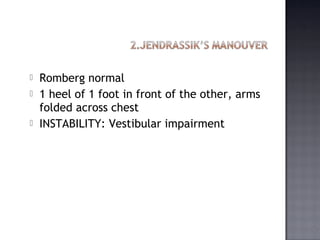
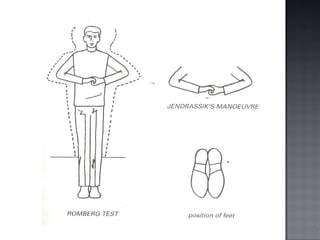
 Romberg normal 
 1 heel of 1 foot in front of the other, arms 
folded across chest 
 INSTABILITY: Vestibular impairment
 Patient walks towards target 
 Eyes open, then closed 
 PERIPHERAL LESION: pt deviates on affected 
side
 Unilateral Paralytic Labyrinthitis: 
Patient deviates to ipsilateral side 
 Active irrelative lesion: 
not able to perform test for more than 3 
seconds
 Patients eyes shut:30 seconds 
 5 PACES forward,5 PACES backward 
 STAR SHAPED: Unilateral Vestibular 
Disorder
 Acute Unilateral Vestibular Disorders 
 Deviation to 1 particular side
 Patient 45 degrees on couch 
 Water 33degrees or 45 degrees 
 Normal nystagmus 
COLD: OPPOSITE 
WARM: SAME
1.CANAL PARESIS: 
 Decreased duration of nystagmus 
 both hot and cold 
2.DEAD LABYRINTH: 
 No nystagmoid response 
3.DIRECTION PREPONDERANCE: 
BY Both Hot and Cold 
CENTRAL/PERIPHERAL lesion
 Now a routine investigation in Vertigo 
 ADVANTAGES: 
closed eyes nystagmus recorded 
Small amplitude Nystagmus
SSaaffeettyy:: 
AAccuuttee VVeessttiibbuullaarr SSuupppprreessssiioonn:: 
VVeessttiibbuullaarr RReehhaabbiilliittaattiioonn:: 
MMeeddiiccaall && SSuurrggiiccaall MMaannaaggeemmeenntt::
Safety 
Self-Care at Home 
Avoid Driving , work on dangerous machinery/ 
fire. 
Home therapy should only be undertaken if 
patient has already been diagnosed with vertigo 
and is under the close supervision of a doctor.
 Two components: 
First, one must control the acute episode, and 
Secondly, speed the recovery and prevent future 
episodes.
 Vertigo can be treated symptomatically or 
specifically. 
Symptomatic treatment involves controlling 
the acute symptoms and autonomic 
complaints. 
Specific treatment involves targeting the 
underlying cause of the vertigo. 
Some common types of vertigo have either established 
or postulated patho- physiology and lend themselves to 
specific treatment, others are still unknown and 
symptomatic control is the only option.
 Characteristics of peripheral 
vertigo and dizziness 
 Characteristics of vertigo and 
dizziness of central origin 
 Recognizing stroke syndromes 
that may present with dizziness 
as a prominent feature 
 Treatment considerations in 
dizziness of 
central origin 
 Treatment of peripheral 
vestibular dysfunction
 Management of acute vertigo includes: 
 Bed rest, 
 Fluids and 
 Reassurance. Head movements can be particularly 
distressing with peripheral vestibular dysfunction. 
 Medications that suppress vestibular signs can be 
helpful acutely. Four general classes of drugs are useful 
in the treatment of vertigo and its associated 
autonomic symptoms :- 
 Anticholinergics, The most effective single drug for the 
prophylaxis and treatment of motion sickness is the 
anticholinergic scopolamine 
 Antihistamines, Antihistamines include meclizine, 
dimenhydrinate, and promethazine. The newer nonsedating 
antihistamines do not enter the CNS and have no value in 
the treatment of vertigo and motion sickness
 Antidopaminergics, such as prochlorperazine and 
chlorpromazine act at the chemoreceptor trigger zone, reducing 
neural impulses to the vomiting center. These drugs do not 
prevent vertigo and motion sickness but may be useful in 
treating the nausea and vomiting caused by these disorders 
 Monoaminergic drugs include amphetamines and ephedrine. 
They appear to potentiate the effects of scopolamine and may 
be used in combination with one of the antihistamines for 
intense symptoms or in those who do not respond adequately to 
single-drug therapy 
 Lastly, the benzodiazepine diazepam act as a vestibular 
suppressant through the GABAergic system and can also 
minimize the associated anxiety and panic that occurs with 
vertigo.
After several days, gradual increased activity and 
graded exercises can facilitate the adaptive 
recovery of the vestibular system. 
While pharmacologic treatment of the acute, 
severe symptoms of vertigo is probably 
beneficial, some experts feel that prolonged use 
of these agents may actually retard the normal 
compensatory mechanisms.
The choice of treatment will depend on the diagnosis. 
 Vertigo can be treated with medicine 
 Specific types of vertigo may require additional treatment and 
referral: 
 Bacterial infection of the middle ear requires antibiotics. 
 Meniere disease, in addition to symptomatic treatment, people 
might be placed on a low salt diet and may require medication used 
to increase urine output. 
 A hole in the inner ear causing recurrent infection may require 
referral to an ear, nose, and throat (ENT) specialist for surgery. 
 Several physical maneuvers can be used to treat conditions 
like BPPV.
Vestibular Neuritis 
 Since viral origin is implicated, treatment aimed at stopping 
the inflammation has been proposed. 
 Studies show that in patients on methylprednisolone, 90% 
experienced a decrease in vertigo within 24 hours Most 
patients will have spontaneous, complete symptomatic 
recovery even only with supportive treatment. 
 Patients who have persistent unsteadiness or motion 
provoked symptoms may have incomplete central 
compensation and should benefit from a customized 
vestibular rehabilitation program.
Meniere’s Disease 
 Diatary salt restriction and diuretics. Thiazide diuretics 
are traditionally used for at least 3 months 
 Vasodilators. IV histamine, isosorbide dinitrate, 
cinnarizine (calcium antagonist) and betahistine (oral 
histamine analogue) have all been used with anecdotal 
success 
 In some patient’s there is thought to be an association of 
immune-mediated phenomena. Systemic and 
intratympanic glucocorticoids, cyclophosphamide, and 
methotrexate have all been used by clinicians. 
 For intractable disease with disabling vertigo despite 
medical treatment, vestibular surgery should be 
considered. 
 The chemical labyrinthectomy, or transtympanic 
gentamicin (intratympanic aminoglycoside, allows 
treatment of unilateral disease without producing 
systemic toxicity or affecting the opposite ear.
Benign Paroxysmal Positional Vertigo (BPPV) 
 Semont et al proposed a liberatory maneuver as a single 
treatment alternative. The reported cure rates are 84% 
after one, and 93% following two treatments. 
 Epley proposed a canalith repositioning procedure Epley 
reported 80% cure after one treatment and 100% 
improvement after multiple sessions in 30 patients. 
 Brandt and Daroff designed habituation exercises 
requiring the patient to move into the provoking 
position repeatedly, several times a day. They report a 
98% success rate after 3 to 14 days of exercises.
Vertebrobasilar insufficiency (VBI) 
 VBI is characterized by vertigo, diplopia, dysarthria, gait 
ataxia and bilateral sensory and motor disturbance. 
Symptoms of transient ischemia are alarming but generally 
benign as there is rich collateral blood supply and a relatively 
low incidence of stroke. Antiplatelet therapy is warranted 
usually with aspirin. 
Migraine 
 Treatment includes modifying risk factors, abortive medical 
therapy, and prophylaxis. These patients should avoid 
nicotine products, exogenous estrogens, and foods that 
exacerbate symptoms 
 Exercise programs and stress reduction are also important. 
Ergots, sumatriptin, and midrin are helpful in aborting acute 
attacks. 
 Prophylactic medical therapy can be started if migraines 
occur several times a month (aspirin, ibuprofen, lithium, 
calcium channel blockers, amitryptiline and beta blockers).
 In perilymph fistula, surgery may be used 
to plug a leak in the inner ear. 
 In the microvascular compression 
syndrome, surgery may be used to move 
a blood vessel off of the vestibular nerve. 
 In Meniere’s Disease, shunt surgery is 
intended to improve inner ear plumbing. 
All treatments for Meniere's disease must 
be compared with the natural history the 
disease, where 60% of patients are in 
remission by six months.
 For Meniere's disease, destructive procedures 
are associated with better control of vertigo 
than shunt surgery, showing good control in 
over 90% of patients followed for five or more 
years. 
 The vestibular nerve section. 
 Transtympanic gentamicin treatment 
 Labyrinthectomy
 Acoustic Neuroma Surgery 
 For Benign Paroxysmal Positional Vertigo 
 Selective posterior canal plugging offers a 
reasonable surgical approach to intractable 
symptoms. 
 Singular neurectomy, an older procedure, is less 
popular because it produces hearing loss in 7 to 17% 
of patients and fails in 8 to 12%. 
 Vestibular rehabilitation therapy is 
appropriate in all patients who have had 
destructive treatment.
 Selection of the best type depends on both 
the diagnosis and health care situation. 
Indications: 
 Specific interventions for (BPPV) 
 The Epley and Semont maneuvers 
 The Brandt-Daroff exercises 
 General interventions for vestibular loss 
 Empirical treatment for common situations where the 
diagnosis is unclear 
 Post-traumatic vertigo 
 Multifactorial disequilibrium of the elderly
Office Treatment of BPPV: 
The Epley and Semont Maneuvers 
 Are both intended to move debris out of the 
sensitive part of the ear (posterior canal) to a 
less sensitive location. Each maneuver takes 
about 15 minutes to complete. 
 Semont maneuver: It involves a procedure 
whereby the patient is rapidly moved from 
lying on one side to lying on the other. 
 Epley Maneuver: It involves sequential 
movement of the head into four positions, 
staying in each position for roughly 30 seconds
Home Treatment Of 
BPPV: 
Brandt-Daroff Exercises 
 The Brandt-Daroff Exercises 
is a method of treating BPPV, 
usually used when the office 
treatment fails. They 
succeed in 95% of cases.
Cawthorne Cooksey Exercises: 
 Sitting 
 Eye movements and head movements 
 Shoulder shrugging and circling 
 Bending forward and picking up objects from the ground 
 Standing 
 Eye, head and shoulder movements as before 
 Changing form sitting to standing position with eyes open and shut 
 Throwing a small ball from hand to hand (above eye level) 
 Throwing a ball from hand to hand under knee 
 Changing from sitting to standing and turning around in between 
 Moving about (in class) 
 Circle around center person who will throw a large ball and to whom it will 
be returned 
 Walk across room with eyes open and then closed 
 Walk up and down slope with eyes open and then closed 
 Walk up and down steps with eyes open and then closed 
 Any game involving stooping and stretching and aiming such as bowling and 
basketball 
Dix and Hood, 1984 and Herdman, 1994; 2000.
 T'ai Chi, a Chinese 
exercise routine similar 
to ballet is one such 
method. 
 Sports activities such as 
golf, bowling, or 
recreational walking can 
also be used for 
rehabilitation.
 Anywhere between 15 and 50% of patients evaluated by 
tertiary care "dizziness" clinics go undiagnosed. In this 
situation, it is often useful to have an organized 
approach to try out all reasonable interventions. 
 This includes both medications as well as a one- or two-month 
enrollment in a balance/vestibular rehabilitation 
program, for patients who have chronic symptoms. 
 Similarly, patients with central vestibular problems (for 
example, a cerebellar cerebrovascular accident) are 
highly unlikely to benefit from medication or therapy. 
Nevertheless, these patients are usually so impaired that 
it seems ill advised not to try out all possible modalities.
Vertigo
Vertigo

Vertigo

  • 1.
    Dr. Zaimal Shahan PGT Department of ENT Capital Hospital
  • 2.
    SUBJECTIVE SENSE OFIMBALANCE “Sensation as if the external world is revolving around the patient or as if he himself is revolving in space”
  • 3.
     How dowe maintain EQUILIBRIUM?
  • 6.
     The BonyLabyrinth lies in the petrous temporal bone.  Bony Labyrinth contains the membranous labyrinth surrounded by a fluid called perilymph  Membranous Labyrinth consists of: An Anterior Cochlear Duct HEARING Posterior vestibular Apparatus:  Utricle  Sacculae BALANCE  3 Semicircular Canals.
  • 7.
     Semicircular canalsare three small ring structures each forming 2/3rd of a circle with a dia. Of 6.5 mm, containing endolymph.  One end of each canal is dilated “Ampula”  Endolymph has a high K and low sodium Concentration & is secreted by Stria Vascularis and Dark Cells.
  • 8.
     Five VestibularReceptor organs are present in the Vestibular Labyrinth. Two Maculae in utricle and saccule (otolith organs) Monitor Linear Acceleration. Three Cristae Ampullares of SSC Monitor Angular Accleration.
  • 9.
     Each maculais found on floor of Utricle in horizontal plane & medial wall of Saccule in Vertical plane.  Macula supports a statoconial membrane which consists of small Ca.Carbonate cryustals (otoconia) embedded in mucopolysaccharide gel.  Static tilt and linear acceleration results in movement of membrane resulting in bending of hairs of hair cells and stimulation of nerve endings.  Crista Ampullaris are a crest of sensory epithelium lying at right angles to the longitudinal axis of the canal and surrounded by a bulbous gelatinous mass, the cupula.  When head is rotated the endolymph within the ducts tends to remain stationary. The resultant flow of endolymph with respect to duct is resisted by elacticity of cupula which becomes deflected bending hairs of sensory hair cells.
  • 10.
     The balancesystem (vestibular, visual, and somatosensory) are a two sided push and pull system. In static neutral position, each side contributes equal sensory information. During movement ie., turning or tilt, there is a temporary change in push and pull system which is connected by appropriate reflexes and motor outputs to the eyes (vestibulo0ocular reflex), neck (vestibulo-cervical reflex), and trunk and limbs (vestibulo0spinal reflex) to maintain new position of head and body.
  • 11.
    Normally there isbalanced input from both vestibular systems Vertigo develops from asymmetrical vestibular activity Abnormal bilateral vestibular activation results in truncal ataxia
  • 12.
     ANATOMICAL DURATION OF VERTIGO  NATURE OF VERTIGO
  • 13.
    A.PERIPHERAL VESTIBULAR DISORDERS BPPV MENEIR’S DISEASE VESTIBULAR NEURONITIS LABYRINTHITIS VESTIBULOTOXIC DRUGS HEAD TRAUMA PERILYMPH FISTULA SYPHILIS ACOUSTIC NEUROMA
  • 14.
    B.CENTRAL VESTIBULAR DISORDERS VERTEBROBASILAR INSUFFICIENCY POSTERIOR INFERIOR CEREBELLAR ARTERY SYNDROME BASILAR MIGRAINE CEREBELLAR DISEASE MULTIPLE SCLEROSIS TUMORS OF BRAINSTEM EPILEPSY
  • 16.
     ROTATIONAL UNSTEADINESS
  • 17.
     BPPV LABYRINTH FISTULA  VERTEBROBASILAR INSUFFICINCEY  MENIERE’S DISEASE  VESTIBULAR NEURONITIS  TRAUMA  LABYRINTHITIS  METASTATIC DEPOSITS IN CP ANGLE
  • 18.
     DRUGS TRAVEL SICKNESS  PERILYMPH FISTULA  HYPERVENTILLATION  VESTIBULAR INSUFFICIENCY  CNS LESIONS
  • 20.
     ROTATIONAL VERTIGO  HEAD AND BODY MOVED IN PARTICULAR DIRECTION  LATENT PERIOD: FEW SECONDS  LASTS NOT MORE THAN 30 SECONDS  NO HEARING LOSS OR ANY OTHER NEUROLOGICAL SYMPTOMS  HISTORY OF EAR TRAUMA/EAR INFECTION
  • 21.
     OTOCONIAL DEBRISRELEASED FROM THE DEGENERATING MACULA
  • 22.
     OTOCONIAL DEBRISSETTLES ON CUPULA OF POSTERIOR SEMICIRCULAR CANAL  CERTAIN HEAD POSITIONS CAUSE DISPLACEMENT OF CUPULA HENCE VERTIGO
  • 23.
     OTOCONIAL DEBRISFLOATS FREELY IN THE SEMICIRCULAR CANAL  CERTAIN CHANGES IN HEAD POSITION CAUSE DISPLACEMENT AND VERTIGO
  • 24.
     VERTIGO:FATIGUABLE DIX HALLPIKE MANOEUVRE
  • 25.
     TRIAD OF 1.VERTIGO 2.FLUCTUATIND HEARING LOSS 3.TINNITUS  MAY BE ACCOMPANIED BY SENSE OF AURAL FULLNESS
  • 26.
     ENDOLYMPHATIC HYDROPS  CAUSE UNCLEAR
  • 27.
     Inflammation oflabyrinth dduuee ttoo aannyy ccaauussee..  MMaayy bbee vviirraall oorr bbaacctteerriiaall..  VViirraall mmaayy ooccccuurr dduurriinngg ccoouurrssee ooff aann eexxaanntthheemmaattoouuss ddiisseeaassee lliikkee mmuummppss//mmeeaasslleess oorr iinnfflluueennzzaa ttyyppee iillllnneessss..  BBaacctteerriiaall llaabbyyrriinntthhiiss mmaayy bbee cciirrccuummssccrriibbeedd,, sseerroouuss oorr ssuuppppuurraattiivvee iinn aa ccaassee ooff oottoorrrrhhooeeaa..  IItt mmaayy aallssoo ooccccuurr dduurriinngg ccoouurrssee ooff mmeenniinnggiittiiss..
  • 28.
     Vestibular ssyymmppttoommssaarree vvaarriiaabbllee aanndd ttiinnnniittuuss iiss ccoommmmoonn..  DDiiaaggnnoossiiss iiss mmaaddee oonn tthhee bbaassiiss ooff rraaddiioollooggiiccaall iinnvveessttiiggaattiioonnss..
  • 29.
     Non-Operative: Labyrinthineccoonnccuussssiioonn oorr ffrraaccttuurree ooff tteemmppoorraall bboonnee..  PPoosstt--OOppeerraattiivvee:: AA ppeerriillyymmpphh ffiissttuullaa mmaayy ooccccuurr aafftteerr eeaarr ssuurrggeerryy eesspp.. ssttaappeeddeeccttoommyy
  • 30.
     Tumors involvingbbrraaiinnsstteemm,, cceerreebbeelllluumm oorr mmiiddbbrraaiinn  OOtthheerr ssiiggnnss ooff iinnttrraaccrraanniiaall ddiisseeaassee aarree ffoouunndd  OOnn EENNGG nnyyssttaaggmmuuss iiss ffoouunndd ttoo bbee iirrrreegguullaarr aanndd eennhhaanncceedd oonn eeyyee ooppeenniinngg..
  • 31.
     OOnnsseett iisswwiitthh sseevveerree vveerrttiiggoo wwiitthh ccoonnttrraallaatteerraall hheemmiiaannaallggeessiiaa..
  • 32.
     Episodes ofvertigo wwiitthh ootthheerr ssiiggnnss ooff bbrraaiinn sstteemm ddyyssffuunnccttiioonn..
  • 33.
     HISTORY: DESCRIPTION  Ask the patient to describe the problem  True rotatory vertigo or dizziness.  Severity  Number of attacks  Temporal pattern (continuous vs. episodic / short vs. prolonged)  If associated with turning the head, lying supine, or sitting upright.  Vestibular & cochlear symptoms (hearing loss either fluctuating or progressive, tinnitus, ear pressure, nausea and vomiting)  Degree of impairment during the attack  Syncope:Transient loss of consciousness with loss of postural tone  Presyncope: Lightheadedness-an impending loss of consciousness  Psychiatric dizziness: Dizziness not related to vestibular dysfunction  Disequilibrium: Feeling of unsteadiness, imbalance or sensation of “floating” while walking
  • 34.
    SECONDARY SYMPTOMS Tinnitis  Hearing impairment  Headache or visual symptoms.  Neurological abnormalities  Brainstem symptoms (diplopoia, dysarthria, facial parenthesis, extremity numbness or weakness.)
  • 35.
     PREVIOUS HISTORY  Injuries:  Head trauma in the past (post traumatic hydrops)  Hx. Of prior ear surgery (labyrinthine fistula, perilymphatic fistula.)  Drugs : Aminoglycosides, cisplatin, miocycline  Stress situations  Family illness  Systemic Diseases:  Hx. of DM (causes visual, proprioceptive, vascular problems)  HTN, cardiovascular and cerebrovascular diseases
  • 36.
    GPE Cardiovascular, BP(including orthostatic) in both arms, pulse Neurologic ENT HEAD AND NECK EXAMINATION Detailed ENT Examination  Tympanic membrane for retraction, perforation, Infection, cholesteatoma,valsalva  Assess hearing on both sides Detailed Head & Neck Examination  Cranial nerves  Bruits in the neck
  • 38.
    SPECIFIC VESTIBULAR SYSTEMEXAM (Balance tests need not be performed in acute vertigo)  Nystagmus  Corneal test  Fistula test  Postural tests  Caloric tests  Electronystagmography  Cerebellar test
  • 39.
     Rhythmic slowand fast eye movements  Direction named by fast component  Slow component usually ipsilateral to diseased structure  Fast component due to cortical correction
  • 41.
     Central Spontaneous nystagmus that can not be suppressed by fixation.  Changes direction with gaze.  Purely vertical, horizontal, or torsional  Paroxysmal but Not fatigable in Dix-hallpike test, no latency, Lasting longer than 60 sec. and often vertical, may change direction with different head positions.  Peripheral  Suppressed by fixation  Doesn’t change direction with gaze.  Horizontal, rotatory.Never vertical.  Paroxysmal but fatigable in Dix-hallpike test, has latency, lasts less than a minute, doesn't change direction with different head positions,
  • 42.
     loss ofcorneal reflex -- Cerrebelopontine Angle  Pressing tragus  Seigel’s pneumatic spectrum  NYSTAGMUS OPPOSITE SIDE
  • 43.
     INTERPRETATION POSITIVE:Fistula usually LATERAL SCC NEGATIVE: Fistula present  Dead labyrinth  Fistula covered by  Granulation tissue  Cholesteatoma  POSITIVE: no fistula  Congenital Syphillis
  • 45.
     PERIPHERAL LESION: sway to side of lesion  CENTRAL LESION (Posteroir white column) Instability
  • 46.
     Romberg normal  1 heel of 1 foot in front of the other, arms folded across chest  INSTABILITY: Vestibular impairment
  • 48.
     Patient walkstowards target  Eyes open, then closed  PERIPHERAL LESION: pt deviates on affected side
  • 49.
     Unilateral ParalyticLabyrinthitis: Patient deviates to ipsilateral side  Active irrelative lesion: not able to perform test for more than 3 seconds
  • 51.
     Patients eyesshut:30 seconds  5 PACES forward,5 PACES backward  STAR SHAPED: Unilateral Vestibular Disorder
  • 53.
     Acute UnilateralVestibular Disorders  Deviation to 1 particular side
  • 57.
     Patient 45degrees on couch  Water 33degrees or 45 degrees  Normal nystagmus COLD: OPPOSITE WARM: SAME
  • 58.
    1.CANAL PARESIS: Decreased duration of nystagmus  both hot and cold 2.DEAD LABYRINTH:  No nystagmoid response 3.DIRECTION PREPONDERANCE: BY Both Hot and Cold CENTRAL/PERIPHERAL lesion
  • 59.
     Now aroutine investigation in Vertigo  ADVANTAGES: closed eyes nystagmus recorded Small amplitude Nystagmus
  • 60.
    SSaaffeettyy:: AAccuuttee VVeessttiibbuullaarrSSuupppprreessssiioonn:: VVeessttiibbuullaarr RReehhaabbiilliittaattiioonn:: MMeeddiiccaall && SSuurrggiiccaall MMaannaaggeemmeenntt::
  • 61.
    Safety Self-Care atHome Avoid Driving , work on dangerous machinery/ fire. Home therapy should only be undertaken if patient has already been diagnosed with vertigo and is under the close supervision of a doctor.
  • 62.
     Two components: First, one must control the acute episode, and Secondly, speed the recovery and prevent future episodes.
  • 63.
     Vertigo canbe treated symptomatically or specifically. Symptomatic treatment involves controlling the acute symptoms and autonomic complaints. Specific treatment involves targeting the underlying cause of the vertigo. Some common types of vertigo have either established or postulated patho- physiology and lend themselves to specific treatment, others are still unknown and symptomatic control is the only option.
  • 64.
     Characteristics ofperipheral vertigo and dizziness  Characteristics of vertigo and dizziness of central origin  Recognizing stroke syndromes that may present with dizziness as a prominent feature  Treatment considerations in dizziness of central origin  Treatment of peripheral vestibular dysfunction
  • 65.
     Management ofacute vertigo includes:  Bed rest,  Fluids and  Reassurance. Head movements can be particularly distressing with peripheral vestibular dysfunction.  Medications that suppress vestibular signs can be helpful acutely. Four general classes of drugs are useful in the treatment of vertigo and its associated autonomic symptoms :-  Anticholinergics, The most effective single drug for the prophylaxis and treatment of motion sickness is the anticholinergic scopolamine  Antihistamines, Antihistamines include meclizine, dimenhydrinate, and promethazine. The newer nonsedating antihistamines do not enter the CNS and have no value in the treatment of vertigo and motion sickness
  • 66.
     Antidopaminergics, suchas prochlorperazine and chlorpromazine act at the chemoreceptor trigger zone, reducing neural impulses to the vomiting center. These drugs do not prevent vertigo and motion sickness but may be useful in treating the nausea and vomiting caused by these disorders  Monoaminergic drugs include amphetamines and ephedrine. They appear to potentiate the effects of scopolamine and may be used in combination with one of the antihistamines for intense symptoms or in those who do not respond adequately to single-drug therapy  Lastly, the benzodiazepine diazepam act as a vestibular suppressant through the GABAergic system and can also minimize the associated anxiety and panic that occurs with vertigo.
  • 69.
    After several days,gradual increased activity and graded exercises can facilitate the adaptive recovery of the vestibular system. While pharmacologic treatment of the acute, severe symptoms of vertigo is probably beneficial, some experts feel that prolonged use of these agents may actually retard the normal compensatory mechanisms.
  • 70.
    The choice oftreatment will depend on the diagnosis.  Vertigo can be treated with medicine  Specific types of vertigo may require additional treatment and referral:  Bacterial infection of the middle ear requires antibiotics.  Meniere disease, in addition to symptomatic treatment, people might be placed on a low salt diet and may require medication used to increase urine output.  A hole in the inner ear causing recurrent infection may require referral to an ear, nose, and throat (ENT) specialist for surgery.  Several physical maneuvers can be used to treat conditions like BPPV.
  • 71.
    Vestibular Neuritis Since viral origin is implicated, treatment aimed at stopping the inflammation has been proposed.  Studies show that in patients on methylprednisolone, 90% experienced a decrease in vertigo within 24 hours Most patients will have spontaneous, complete symptomatic recovery even only with supportive treatment.  Patients who have persistent unsteadiness or motion provoked symptoms may have incomplete central compensation and should benefit from a customized vestibular rehabilitation program.
  • 72.
    Meniere’s Disease Diatary salt restriction and diuretics. Thiazide diuretics are traditionally used for at least 3 months  Vasodilators. IV histamine, isosorbide dinitrate, cinnarizine (calcium antagonist) and betahistine (oral histamine analogue) have all been used with anecdotal success  In some patient’s there is thought to be an association of immune-mediated phenomena. Systemic and intratympanic glucocorticoids, cyclophosphamide, and methotrexate have all been used by clinicians.  For intractable disease with disabling vertigo despite medical treatment, vestibular surgery should be considered.  The chemical labyrinthectomy, or transtympanic gentamicin (intratympanic aminoglycoside, allows treatment of unilateral disease without producing systemic toxicity or affecting the opposite ear.
  • 73.
    Benign Paroxysmal PositionalVertigo (BPPV)  Semont et al proposed a liberatory maneuver as a single treatment alternative. The reported cure rates are 84% after one, and 93% following two treatments.  Epley proposed a canalith repositioning procedure Epley reported 80% cure after one treatment and 100% improvement after multiple sessions in 30 patients.  Brandt and Daroff designed habituation exercises requiring the patient to move into the provoking position repeatedly, several times a day. They report a 98% success rate after 3 to 14 days of exercises.
  • 74.
    Vertebrobasilar insufficiency (VBI)  VBI is characterized by vertigo, diplopia, dysarthria, gait ataxia and bilateral sensory and motor disturbance. Symptoms of transient ischemia are alarming but generally benign as there is rich collateral blood supply and a relatively low incidence of stroke. Antiplatelet therapy is warranted usually with aspirin. Migraine  Treatment includes modifying risk factors, abortive medical therapy, and prophylaxis. These patients should avoid nicotine products, exogenous estrogens, and foods that exacerbate symptoms  Exercise programs and stress reduction are also important. Ergots, sumatriptin, and midrin are helpful in aborting acute attacks.  Prophylactic medical therapy can be started if migraines occur several times a month (aspirin, ibuprofen, lithium, calcium channel blockers, amitryptiline and beta blockers).
  • 76.
     In perilymphfistula, surgery may be used to plug a leak in the inner ear.  In the microvascular compression syndrome, surgery may be used to move a blood vessel off of the vestibular nerve.  In Meniere’s Disease, shunt surgery is intended to improve inner ear plumbing. All treatments for Meniere's disease must be compared with the natural history the disease, where 60% of patients are in remission by six months.
  • 77.
     For Meniere'sdisease, destructive procedures are associated with better control of vertigo than shunt surgery, showing good control in over 90% of patients followed for five or more years.  The vestibular nerve section.  Transtympanic gentamicin treatment  Labyrinthectomy
  • 78.
     Acoustic NeuromaSurgery  For Benign Paroxysmal Positional Vertigo  Selective posterior canal plugging offers a reasonable surgical approach to intractable symptoms.  Singular neurectomy, an older procedure, is less popular because it produces hearing loss in 7 to 17% of patients and fails in 8 to 12%.  Vestibular rehabilitation therapy is appropriate in all patients who have had destructive treatment.
  • 79.
     Selection ofthe best type depends on both the diagnosis and health care situation. Indications:  Specific interventions for (BPPV)  The Epley and Semont maneuvers  The Brandt-Daroff exercises  General interventions for vestibular loss  Empirical treatment for common situations where the diagnosis is unclear  Post-traumatic vertigo  Multifactorial disequilibrium of the elderly
  • 80.
    Office Treatment ofBPPV: The Epley and Semont Maneuvers  Are both intended to move debris out of the sensitive part of the ear (posterior canal) to a less sensitive location. Each maneuver takes about 15 minutes to complete.  Semont maneuver: It involves a procedure whereby the patient is rapidly moved from lying on one side to lying on the other.  Epley Maneuver: It involves sequential movement of the head into four positions, staying in each position for roughly 30 seconds
  • 81.
    Home Treatment Of BPPV: Brandt-Daroff Exercises  The Brandt-Daroff Exercises is a method of treating BPPV, usually used when the office treatment fails. They succeed in 95% of cases.
  • 82.
    Cawthorne Cooksey Exercises:  Sitting  Eye movements and head movements  Shoulder shrugging and circling  Bending forward and picking up objects from the ground  Standing  Eye, head and shoulder movements as before  Changing form sitting to standing position with eyes open and shut  Throwing a small ball from hand to hand (above eye level)  Throwing a ball from hand to hand under knee  Changing from sitting to standing and turning around in between  Moving about (in class)  Circle around center person who will throw a large ball and to whom it will be returned  Walk across room with eyes open and then closed  Walk up and down slope with eyes open and then closed  Walk up and down steps with eyes open and then closed  Any game involving stooping and stretching and aiming such as bowling and basketball Dix and Hood, 1984 and Herdman, 1994; 2000.
  • 83.
     T'ai Chi,a Chinese exercise routine similar to ballet is one such method.  Sports activities such as golf, bowling, or recreational walking can also be used for rehabilitation.
  • 84.
     Anywhere between15 and 50% of patients evaluated by tertiary care "dizziness" clinics go undiagnosed. In this situation, it is often useful to have an organized approach to try out all reasonable interventions.  This includes both medications as well as a one- or two-month enrollment in a balance/vestibular rehabilitation program, for patients who have chronic symptoms.  Similarly, patients with central vestibular problems (for example, a cerebellar cerebrovascular accident) are highly unlikely to benefit from medication or therapy. Nevertheless, these patients are usually so impaired that it seems ill advised not to try out all possible modalities.