Objectives
• Vertigo
Defintion, Types, Causes

• Central & Peripheral Vertigo
• Clinical Tests
• Laboratory Tests
• BPPV
• Vestibular Neuronitis
• Dizziness and Vertigo
• Quiz
What will
I Learn
Today ?
FAQ’s in RGUHS Examination
• Fistula Test
• Caloric Test
• BPPV
• Vestibular Neuronitis
• Aural causes of Vertigo
• Evaluation Of Vertigo
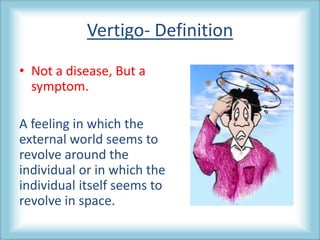
Vertigo- Definition
• Not a disease, But a
symptom.
A feeling in which the
external world seems to
revolve around the
individual or in which the
individual itself seems to
revolve in space.
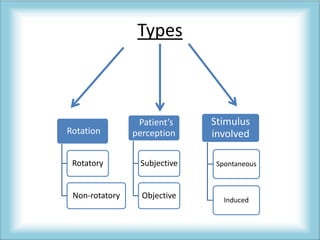
Types
Rotation
Rotatory
Non-rotatory
Patient’s
perception
Subjective
Objective
Stimulus
involved
Spontaneous
Induced
Physiological Vertigo
• Balance between 3 stabilising sensory systems
is lost.
• Non-adaptation of vestibular system to
unfamiliar head movements.
• Unusual head & neck positions
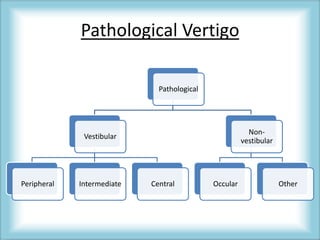
Pathological Vertigo
Pathological
Vestibular
Peripheral Intermediate Central
Non-
vestibular
Occular Other
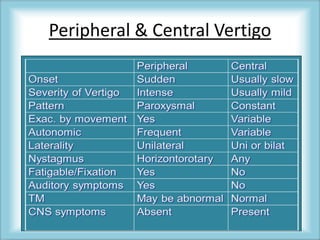
Peripheral & Central Vertigo
Peripheral: Lesions of vestibular
end organs
( 85% of all cases of vertigo)
Intermediate: Lesions in
vestibular nerve
Central: Lesions of central
nervous system(vestibular nuclei)
( 15% of all cases)
Peripheral & Central Vertigo
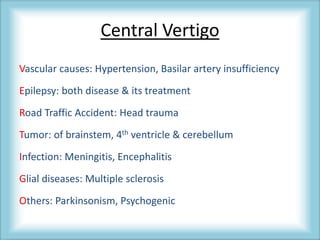
Central Vertigo
Vascular causes: Hypertension, Basilar artery insufficiency
Epilepsy: both disease & its treatment
Road Traffic Accident: Head trauma
Tumor: of brainstem, 4th ventricle & cerebellum
Infection: Meningitis, Encephalitis
Glial diseases: Multiple sclerosis
Others: Parkinsonism, Psychogenic
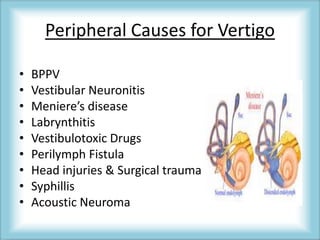
Peripheral Causes for Vertigo
• BPPV
• Vestibular Neuronitis
• Meniere’s disease
• Labrynthitis
• Vestibulotoxic Drugs
• Perilymph Fistula
• Head injuries & Surgical trauma
• Syphillis
• Acoustic Neuroma
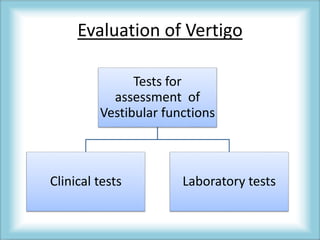
Evaluation of Vertigo
Tests for
assessment of
Vestibular functions
Clinical tests Laboratory tests
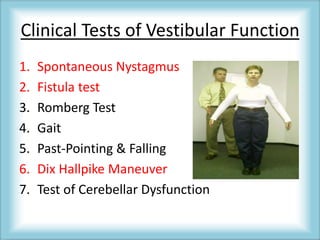
Clinical Tests of Vestibular Function
1. Spontaneous Nystagmus
2. Fistula test
3. Romberg Test
4. Gait
5. Past-Pointing & Falling
6. Dix Hallpike Maneuver
7. Test of Cerebellar Dysfunction
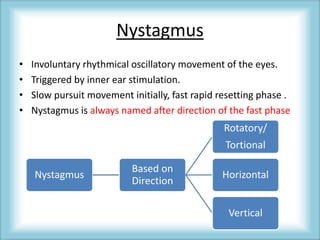
Nystagmus
• Involuntary rhythmical oscillatory movement of the eyes.
• Triggered by inner ear stimulation.
• Slow pursuit movement initially, fast rapid resetting phase .
• Nystagmus is always named after direction of the fast phase
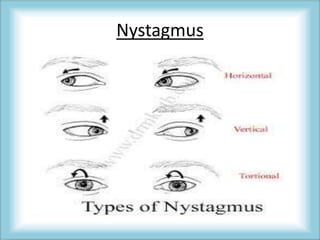
Nystagmus
Based on
Direction
Rotatory/
Tortional
Horizontal
Vertical
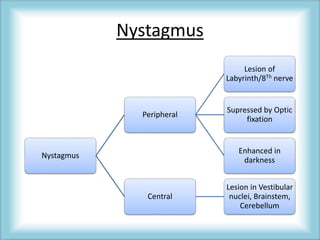
Nystagmus
Nystagmus
Peripheral
Lesion of
Labyrinth/8Th nerve
Supressed by Optic
fixation
Enhanced in
darkness
Central
Lesion in Vestibular
nuclei, Brainstem,
Cerebellum
Nystagmus
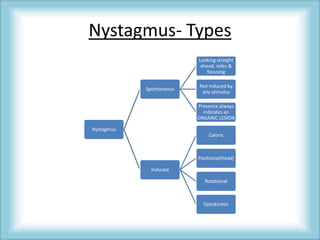
Nystagmus- Types
Nystagmus
Spontaneous
Looking straight
ahead, sides &
focusing
Not induced by
any stimulus
Presence always
indicates an
ORGANIC LESION
Induced
Caloric
Positional(Head)
Rotational
Optokinetic
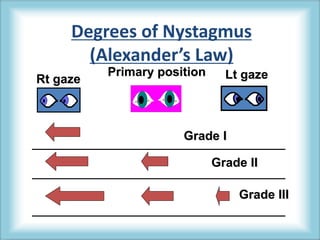
Rt gaze Lt gaze
Degrees of Nystagmus
(Alexander’s Law)
Grade I
Grade III
Grade II
Primary position
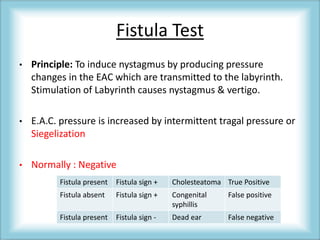
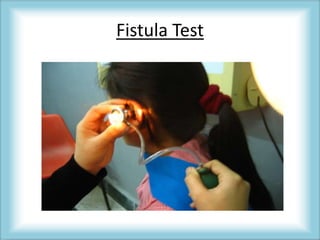
Fistula Test
• Principle: To induce nystagmus by producing pressure
changes in the EAC which are transmitted to the labyrinth.
Stimulation of Labyrinth causes nystagmus & vertigo.
• E.A.C. pressure is increased by intermittent tragal pressure or
Siegelization
• Normally : Negative
Fistula present Fistula sign + Cholesteatoma True Positive
Fistula absent Fistula sign + Congenital
syphillis
False positive
Fistula present Fistula sign - Dead ear False negative
Fistula Test
Laboratory Tests
1. Caloric Test
2. Electronystagmography
3. Optokinetics
4. Rotational Test
5. Galvanic Test
6. Posturography
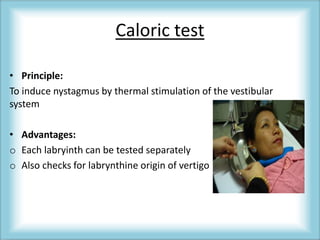
Caloric test
• Principle:
To induce nystagmus by thermal stimulation of the vestibular
system
• Advantages:
o Each labryinth can be tested separately
o Also checks for labrynthine origin of vertigo
Caloric Test- Types
1. Modified Kobrak Test: 60°, 60 s, Ice water
2. Fitzgerald-Hallpike Test/Bithermal Caloric Test:
• Supine position
• Water at 30° & 44°
• Head tilt: 30° forward
• 5 mins gap b/w 2 ears
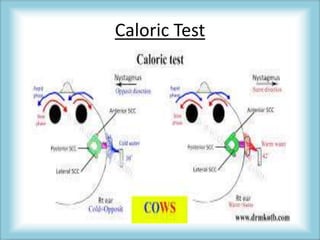
• Direction of Nystagmus:COWS
Cold- Same
Warm- Opposite
3. Cold air caloric test: Done in TM perforation
Caloric Test
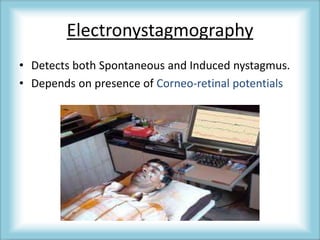
Electronystagmography
• Detects both Spontaneous and Induced nystagmus.
• Depends on presence of Corneo-retinal potentials
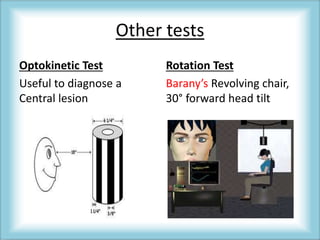
Other tests
Optokinetic Test
Useful to diagnose a
Central lesion
Rotation Test
Barany’s Revolving chair,
30° forward head tilt
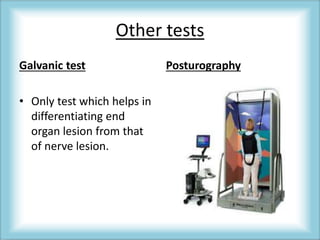
Other tests
Galvanic test
• Only test which helps in
differentiating end
organ lesion from that
of nerve lesion.
Posturography
Treatment of Vertigo
1. Reassurance/Psychological Support
2. Pharmacotherapy
3. Adaptation exercises
4. Intratympanic antibiotic injections
5. Surgery
• Conservative
• Destructive
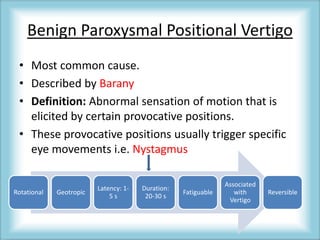
Benign Paroxysmal Positional Vertigo
• Most common cause.
• Described by Barany
• Definition: Abnormal sensation of motion that is
elicited by certain provocative positions.
• These provocative positions usually trigger specific
eye movements i.e. Nystagmus
Rotational Geotropic
Latency: 1-
5 s
Duration:
20-30 s
Fatiguable
Associated
with
Vertigo
Reversible
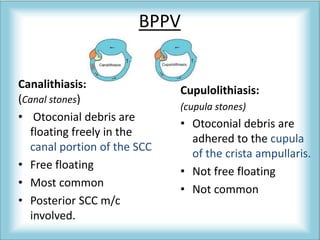
BPPV
Canalithiasis:
(Canal stones)
• Otoconial debris are
floating freely in the
canal portion of the SCC
• Free floating
• Most common
• Posterior SCC m/c
involved.
Cupulolithiasis:
(cupula stones)
• Otoconial debris are
adhered to the cupula
of the crista ampullaris.
• Not free floating
• Not common
Benign Paroxysmal Positional Vertigo
• Sex: F>M
• Age: Old age (6th decade)
• Predisposing factors: MAC
• Causes: TIM
• Associations: Cervical diseases, Ear diseases,
Vertibrobasilar insufficiency , CNS Disease
• Differential Diagnosis:
Signs & Symptoms
Symptoms
• Sudden Onset
• Have few asymptomatic
periods in between
• Dizziness triggered by head
movements
• Classic BPPV: erect to
supine, 45°
• During attacks, Rolling spin
• Symptoms dissipate within
20-30 s after a violent start.
Signs
• Neurological examination:
Normal
• Dix-Hallpike maneuver:
• Caloric Test: Normal or
Hypofunctional
Investigations
• Electronystagmography(ENG)
• Caloric Test
• Audiometry
• Posturography
Treatment
Medical
1. WAIT & WATCH
2. Vestibulo-suppressant
medication
3. Vestibular Rehabilitation:
Cawthorne exercises
4. Canalith repositioning
(CRP):
• Epley Maneuver
• Semont maneuver
Surgical
(failure of CRP)
1. Labyrinthectomy
2. Posterior canal Occlusion
3. Singular neurectomy
4. Vestibular nerve section
5. Transtympanic
Aminoglycoside application
Vestibular Neuronitis
• Sudden onset of vertigo, nausea, vomiting w/o tinnitus and
deafness.
• Etiology: Labrynthine Stimulation by:
Virus, Idiopathic
Age(>adolescents)
Sex(M=F)
• Pathophysiology: Inflammatory process in vestibular nerve,
self-limiting
Vestibular Neuronitis
• Clinical Features:1. Vertigo
2. Nausea and Vomiting
3. Normal Hearing
4. Nystagmus
• Investigations: PTA, Caloric Test, ENG
Treatment:
1. Bed Rest and Reassurance
2. Drugs
Vertigo-like symptoms
 Faintness
 Light-headedness
 Unsteadiness
 Motion intolerance
 Imbalance
 Floating sensation
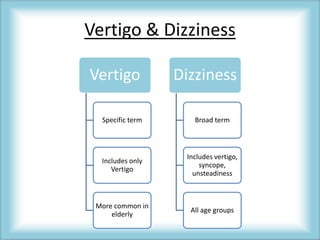
Vertigo & Dizziness
Vertigo
Specific term
Includes only
Vertigo
More common in
elderly
Dizziness
Broad term
Includes vertigo,
syncope,
unsteadiness
All age groups
Question 1
• Nystagmus pattern in peripheral Vertigo
Question 2
• Other name of Bithermal Caloric Test
Question 3
• Treatment of Choice in BPPV?
Question 4
• Vestibular disease in which patient presents
with vertigo & normal hearing?
Question 5
• Vestibulotoxic Drugs
Vertigo

Vertigo

  • 2.
    Objectives • Vertigo Defintion, Types,Causes • Central & Peripheral Vertigo • Clinical Tests • Laboratory Tests • BPPV • Vestibular Neuronitis • Dizziness and Vertigo • Quiz What will I Learn Today ?
  • 3.
    FAQ’s in RGUHSExamination • Fistula Test • Caloric Test • BPPV • Vestibular Neuronitis • Aural causes of Vertigo • Evaluation Of Vertigo
  • 4.
    Vertigo- Definition • Nota disease, But a symptom. A feeling in which the external world seems to revolve around the individual or in which the individual itself seems to revolve in space.
  • 5.
  • 6.
    Physiological Vertigo • Balancebetween 3 stabilising sensory systems is lost. • Non-adaptation of vestibular system to unfamiliar head movements. • Unusual head & neck positions
  • 7.
  • 8.
    Peripheral & CentralVertigo Peripheral: Lesions of vestibular end organs ( 85% of all cases of vertigo) Intermediate: Lesions in vestibular nerve Central: Lesions of central nervous system(vestibular nuclei) ( 15% of all cases)
  • 9.
  • 10.
    Central Vertigo Vascular causes:Hypertension, Basilar artery insufficiency Epilepsy: both disease & its treatment Road Traffic Accident: Head trauma Tumor: of brainstem, 4th ventricle & cerebellum Infection: Meningitis, Encephalitis Glial diseases: Multiple sclerosis Others: Parkinsonism, Psychogenic
  • 11.
    Peripheral Causes forVertigo • BPPV • Vestibular Neuronitis • Meniere’s disease • Labrynthitis • Vestibulotoxic Drugs • Perilymph Fistula • Head injuries & Surgical trauma • Syphillis • Acoustic Neuroma
  • 12.
    Evaluation of Vertigo Testsfor assessment of Vestibular functions Clinical tests Laboratory tests
  • 13.
    Clinical Tests ofVestibular Function 1. Spontaneous Nystagmus 2. Fistula test 3. Romberg Test 4. Gait 5. Past-Pointing & Falling 6. Dix Hallpike Maneuver 7. Test of Cerebellar Dysfunction
  • 14.
    Nystagmus • Involuntary rhythmicaloscillatory movement of the eyes. • Triggered by inner ear stimulation. • Slow pursuit movement initially, fast rapid resetting phase . • Nystagmus is always named after direction of the fast phase Nystagmus Based on Direction Rotatory/ Tortional Horizontal Vertical
  • 15.
    Nystagmus Nystagmus Peripheral Lesion of Labyrinth/8Th nerve Supressedby Optic fixation Enhanced in darkness Central Lesion in Vestibular nuclei, Brainstem, Cerebellum
  • 16.
  • 17.
    Nystagmus- Types Nystagmus Spontaneous Looking straight ahead,sides & focusing Not induced by any stimulus Presence always indicates an ORGANIC LESION Induced Caloric Positional(Head) Rotational Optokinetic
  • 18.
    Rt gaze Ltgaze Degrees of Nystagmus (Alexander’s Law) Grade I Grade III Grade II Primary position
  • 19.
    Fistula Test • Principle:To induce nystagmus by producing pressure changes in the EAC which are transmitted to the labyrinth. Stimulation of Labyrinth causes nystagmus & vertigo. • E.A.C. pressure is increased by intermittent tragal pressure or Siegelization • Normally : Negative Fistula present Fistula sign + Cholesteatoma True Positive Fistula absent Fistula sign + Congenital syphillis False positive Fistula present Fistula sign - Dead ear False negative
  • 20.
  • 21.
    Laboratory Tests 1. CaloricTest 2. Electronystagmography 3. Optokinetics 4. Rotational Test 5. Galvanic Test 6. Posturography
  • 22.
    Caloric test • Principle: Toinduce nystagmus by thermal stimulation of the vestibular system • Advantages: o Each labryinth can be tested separately o Also checks for labrynthine origin of vertigo
  • 23.
    Caloric Test- Types 1.Modified Kobrak Test: 60°, 60 s, Ice water 2. Fitzgerald-Hallpike Test/Bithermal Caloric Test: • Supine position • Water at 30° & 44° • Head tilt: 30° forward • 5 mins gap b/w 2 ears • Direction of Nystagmus:COWS Cold- Same Warm- Opposite 3. Cold air caloric test: Done in TM perforation
  • 24.
  • 25.
    Electronystagmography • Detects bothSpontaneous and Induced nystagmus. • Depends on presence of Corneo-retinal potentials
  • 26.
    Other tests Optokinetic Test Usefulto diagnose a Central lesion Rotation Test Barany’s Revolving chair, 30° forward head tilt
  • 27.
    Other tests Galvanic test •Only test which helps in differentiating end organ lesion from that of nerve lesion. Posturography
  • 28.
    Treatment of Vertigo 1.Reassurance/Psychological Support 2. Pharmacotherapy 3. Adaptation exercises 4. Intratympanic antibiotic injections 5. Surgery • Conservative • Destructive
  • 29.
    Benign Paroxysmal PositionalVertigo • Most common cause. • Described by Barany • Definition: Abnormal sensation of motion that is elicited by certain provocative positions. • These provocative positions usually trigger specific eye movements i.e. Nystagmus Rotational Geotropic Latency: 1- 5 s Duration: 20-30 s Fatiguable Associated with Vertigo Reversible
  • 30.
    BPPV Canalithiasis: (Canal stones) • Otoconialdebris are floating freely in the canal portion of the SCC • Free floating • Most common • Posterior SCC m/c involved. Cupulolithiasis: (cupula stones) • Otoconial debris are adhered to the cupula of the crista ampullaris. • Not free floating • Not common
  • 31.
    Benign Paroxysmal PositionalVertigo • Sex: F>M • Age: Old age (6th decade) • Predisposing factors: MAC • Causes: TIM • Associations: Cervical diseases, Ear diseases, Vertibrobasilar insufficiency , CNS Disease • Differential Diagnosis:
  • 32.
    Signs & Symptoms Symptoms •Sudden Onset • Have few asymptomatic periods in between • Dizziness triggered by head movements • Classic BPPV: erect to supine, 45° • During attacks, Rolling spin • Symptoms dissipate within 20-30 s after a violent start. Signs • Neurological examination: Normal • Dix-Hallpike maneuver: • Caloric Test: Normal or Hypofunctional
  • 33.
    Investigations • Electronystagmography(ENG) • CaloricTest • Audiometry • Posturography
  • 34.
    Treatment Medical 1. WAIT &WATCH 2. Vestibulo-suppressant medication 3. Vestibular Rehabilitation: Cawthorne exercises 4. Canalith repositioning (CRP): • Epley Maneuver • Semont maneuver Surgical (failure of CRP) 1. Labyrinthectomy 2. Posterior canal Occlusion 3. Singular neurectomy 4. Vestibular nerve section 5. Transtympanic Aminoglycoside application
  • 35.
    Vestibular Neuronitis • Suddenonset of vertigo, nausea, vomiting w/o tinnitus and deafness. • Etiology: Labrynthine Stimulation by: Virus, Idiopathic Age(>adolescents) Sex(M=F) • Pathophysiology: Inflammatory process in vestibular nerve, self-limiting
  • 36.
    Vestibular Neuronitis • ClinicalFeatures:1. Vertigo 2. Nausea and Vomiting 3. Normal Hearing 4. Nystagmus • Investigations: PTA, Caloric Test, ENG Treatment: 1. Bed Rest and Reassurance 2. Drugs
  • 37.
    Vertigo-like symptoms  Faintness Light-headedness  Unsteadiness  Motion intolerance  Imbalance  Floating sensation
  • 38.
    Vertigo & Dizziness Vertigo Specificterm Includes only Vertigo More common in elderly Dizziness Broad term Includes vertigo, syncope, unsteadiness All age groups
  • 40.
    Question 1 • Nystagmuspattern in peripheral Vertigo
  • 41.
    Question 2 • Othername of Bithermal Caloric Test
  • 42.
    Question 3 • Treatmentof Choice in BPPV?
  • 43.
    Question 4 • Vestibulardisease in which patient presents with vertigo & normal hearing?
  • 44.