Perceptual and cognitive
dysfunction
SHIVA TIWARI
Perception

• Perception is process of integrating sensory stimuli or
impression into the information that is psychologically
meaningful. By lezak
• Perception (from the Latin perceptio, percipio) is the
organization, identification and interpretation of
sensory information in order to represent and understand
the environment. All perception involves signals in
the nervous system result from physical stimulation of the
sense organs. For example, vision involves light striking
the retinas of the eyes. Perception is not the passive
receipt of these signals ,but can be shaped by learning
, memory and expectation.
• Sensation is just appreciation of stimuli eg
hot,cold.
• Perception is that ability to:
 Select stimuli (needs attention and action)
 Integrate those stimuli with each other and
with prior information
 Finally to interpret them
Cognition
• Cognition is the act or process of knowing
including awareness ,reasoning ,judgment
,intuition and memory.
• Executive function also categories sometimes
as a cognition and sometimes as
metacognition, or higher order cognition
Assessment
• Need:
1. Perception is positively correlated with ability to
perform ADLs.
2. Perception is the per-requisite for learning and
rehabilitation .
• Clinical indicators of perception deficit are:
1. functional loss unexplained by motor, sensory
deficit
2. deficient comprehension
• Aim of perceptual testing:
1. is to determine which perceptual abilities are
intact and which are affected.
2. How task performance is affected due to
perception deficit.
3. To plan realistic and cost effective
intervention
Factors influencing assessment:
1.
2.
3.
4.
5.
6.
7.
8.
9.
10.
11.
12.
13.

Psycho and emotional status
Coping with disability
Level of comprehension
Co-operation, motivation, anxiety.
Realistic about outcomes
Family support
Environment
Poor judgment
Patient’s language skills
Medications –(drowsiness)
Fatigue
Premorbid intellectual level, memory
Vision
• Distinguish between sensory and perceptual
problems
• Rule out pure sensory deficits- hearing
loss, vision, sensory
loss, language, disorientation, lack of
comprehension.
• Visual disturbance-visual acuity
•
visual field defect (hemianopsia)
•
occulomotor disturbance
Management
5 approaches to therapy:
• Transfer of training approach
• Sensory integrative approach
• Neuro developmental approach
• Functional approach
• Cognitive approach
Retraining approach
• Also called transfer of training approach
• Described by Averbuch and Katz
• Assumption:
1)Disruption in one brain region can have negative impact on brain function
as a whole.
2)Practice of one task with particular perceptual requirements will enhance
performance in other tasks with similar perceptual demands.
• Young et al demonstrated that training persons with left hemiplegia in
block design, in addition to visual scanning and visual cancellation tasks,
resulted in improvements in reading and writing, although no specific
training in these areas was offered (Young et al, 1983).
• Neistadt (1995) suggests that a person’s capacity to learn must be
evaluated, and that learning capacity is the key to the person’s ability to
generalise the material learned in one situation to others.
• If transfer of training does occur, then strategies to enhance this can be
incorporated into other components of the treatment programme, such as
those aimed at maintaining sitting balance, weight-bearing exercises or
the functional use of the affected extremities (O’Sullivan & Schmitz,2007).
Sensory integrative approach
• Ayres
• Organization of sensation for use
• Integration of basic sensory motor functions
(tactile, vestibular, proprioceptive) proceeds in
a developmental sequence in the normal
child.
• Production of an adaptive response facilitates
sensory integration
Neuro developmental approach
• To facilitate perception
• E.g. Bilateral activity to unilateral neglect
•
Wt bearing activity to enhance perception
Rehabilitative /compensatory
(Functional) approach
Assumption
• Adults with brain damage Will have difficulty in
generalizing and learning from dissimilar tasks
• Direct repetitive practice of specific functional skills
that are impaired is an efficient approach.
• The environment in which practice is taking place
should be Similar to home environment so that less
generalizing is required.
• Components of functional approach:
1) Compensation and
2) Adaptation
•
•
•
•
•
•
•
•

•
•
•

Compensation:
Changes that need to made in the patient’s approach to takes
Adaptation:
Alteration that to be made in the environment in order to facilitate
relearning of skills
Compensation:
Patient should be made aware of the deficiencies (cognitive
awareness).
Environmental scanning
Eg. Visual neglect- make the patient turn the head to see the other
½ to compensate for his disability.
Adaptation:
Make alteration in the patient strategy and environment.
Eg. Hemi neglect – a red tape stuck on his affected side shoe during
gait training.
• Guideline while teaching compensatory
approach
• 1)Use simple direction
• 2)Establish and carry out a routine
• 3)Do each activity in consistent manner
• 4)Employ repetition
• Limitation
• Method learned in one task are not typically
generalized to the performance of another
task.
Cognitive rehabilitation and
QUADRAPHONIC APPROACH
Addresses- dysfunction of memory ,language
Disorder and perception
• also include information processing ,
awareness , judgment and decision making
• cognitive remediation approach helps in
transfer of training
Perception training:
• Can divide in 2 part
1)Remedial approach :
• S.I. , Transfer of training ,Cognitive
rehabilitation
2)adaptive/compensatory aapproach
• functional approach
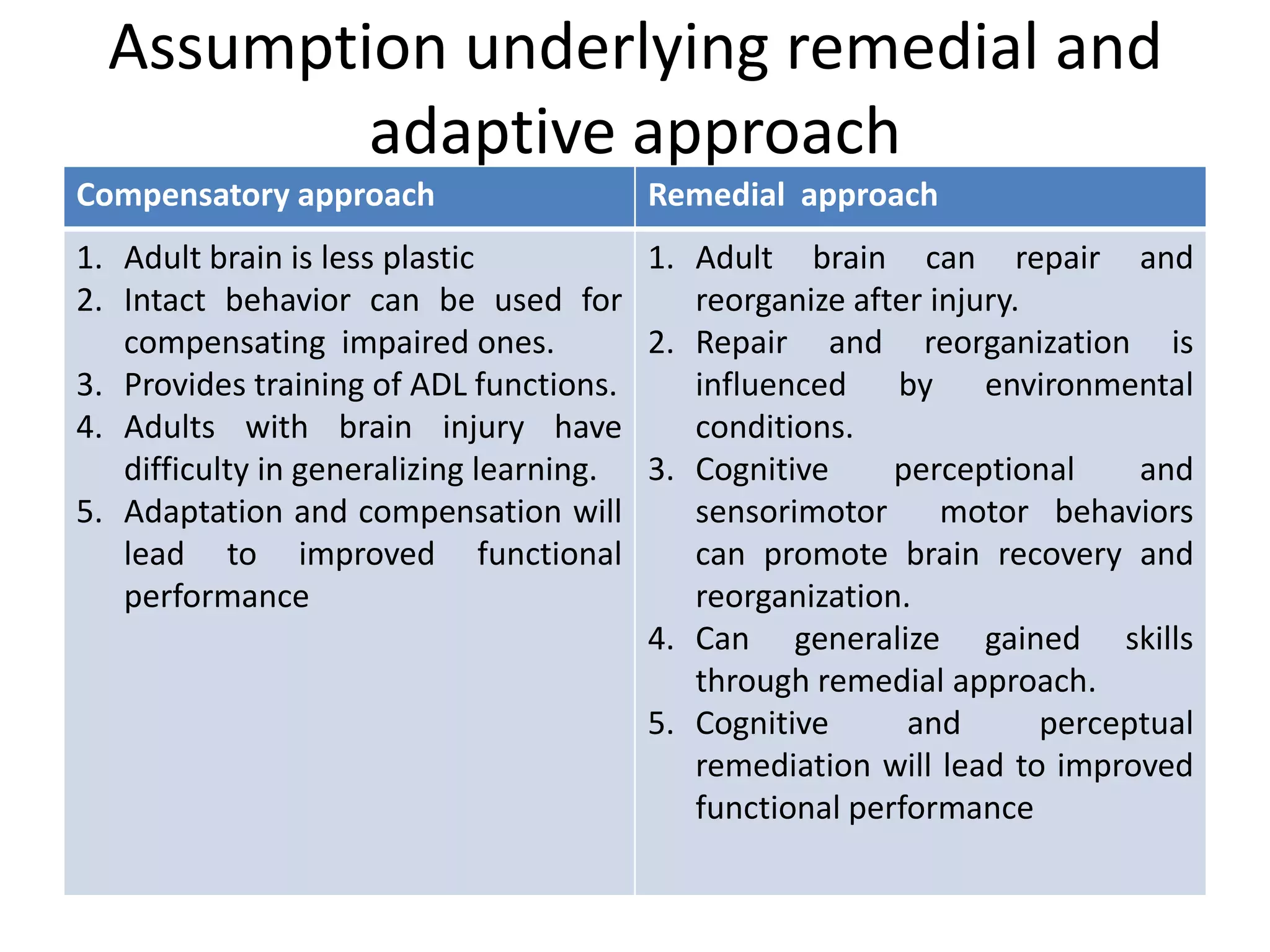
Assumption underlying remedial and
adaptive approach
Compensatory approach

Remedial approach

1. Adult brain is less plastic
1. Adult brain can repair and
2. Intact behavior can be used for
reorganize after injury.
compensating impaired ones.
2. Repair and reorganization is
3. Provides training of ADL functions.
influenced by environmental
4. Adults with brain injury have
conditions.
difficulty in generalizing learning. 3. Cognitive
perceptional
and
5. Adaptation and compensation will
sensorimotor motor behaviors
lead to improved functional
can promote brain recovery and
performance
reorganization.
4. Can generalize gained skills
through remedial approach.
5. Cognitive
and
perceptual
remediation will lead to improved
functional performance
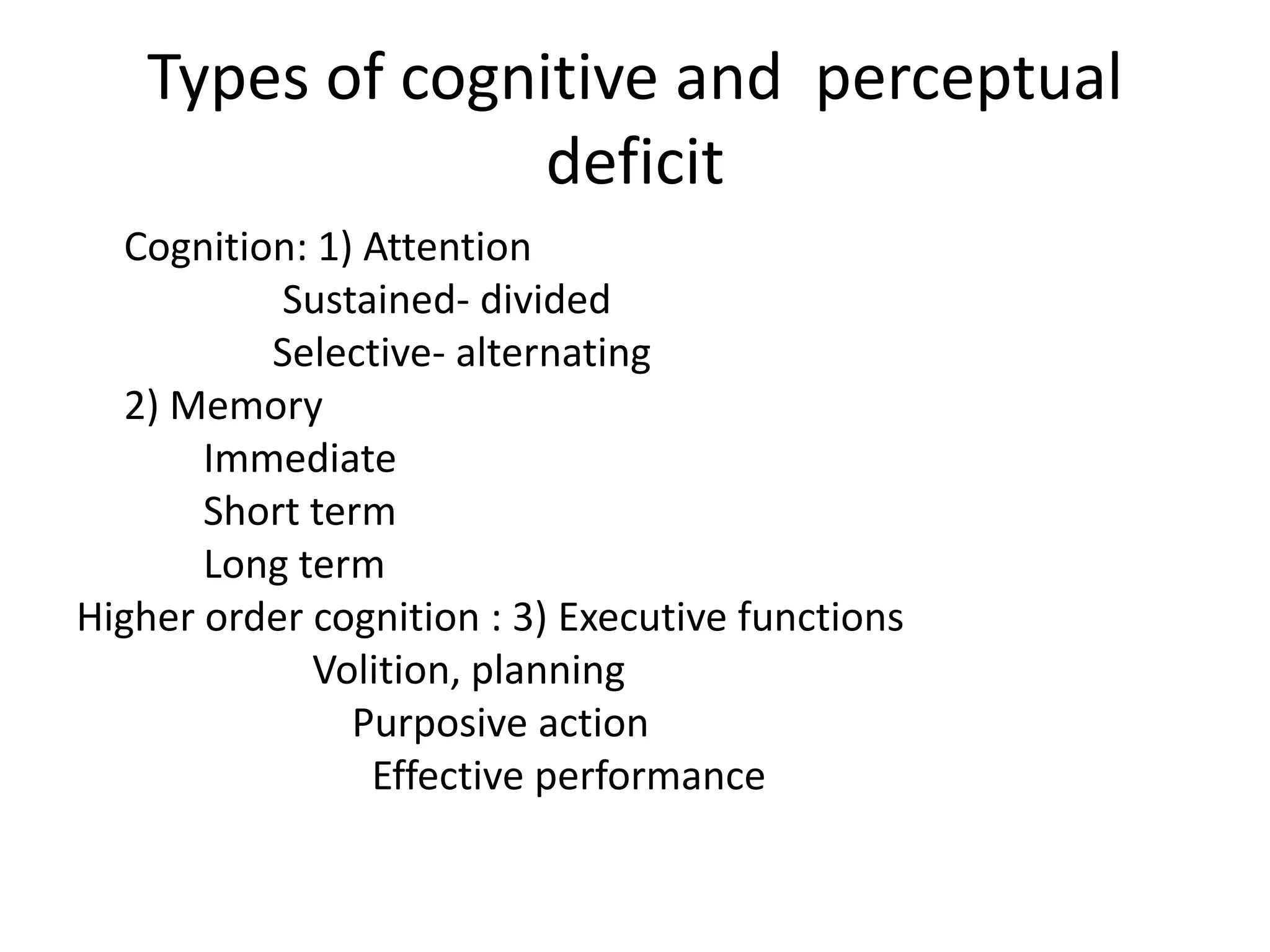
Types of cognitive and perceptual
deficit
Cognition: 1) Attention
Sustained- divided
Selective- alternating
2) Memory
Immediate
Short term
Long term
Higher order cognition : 3) Executive functions
Volition, planning
Purposive action
Effective performance
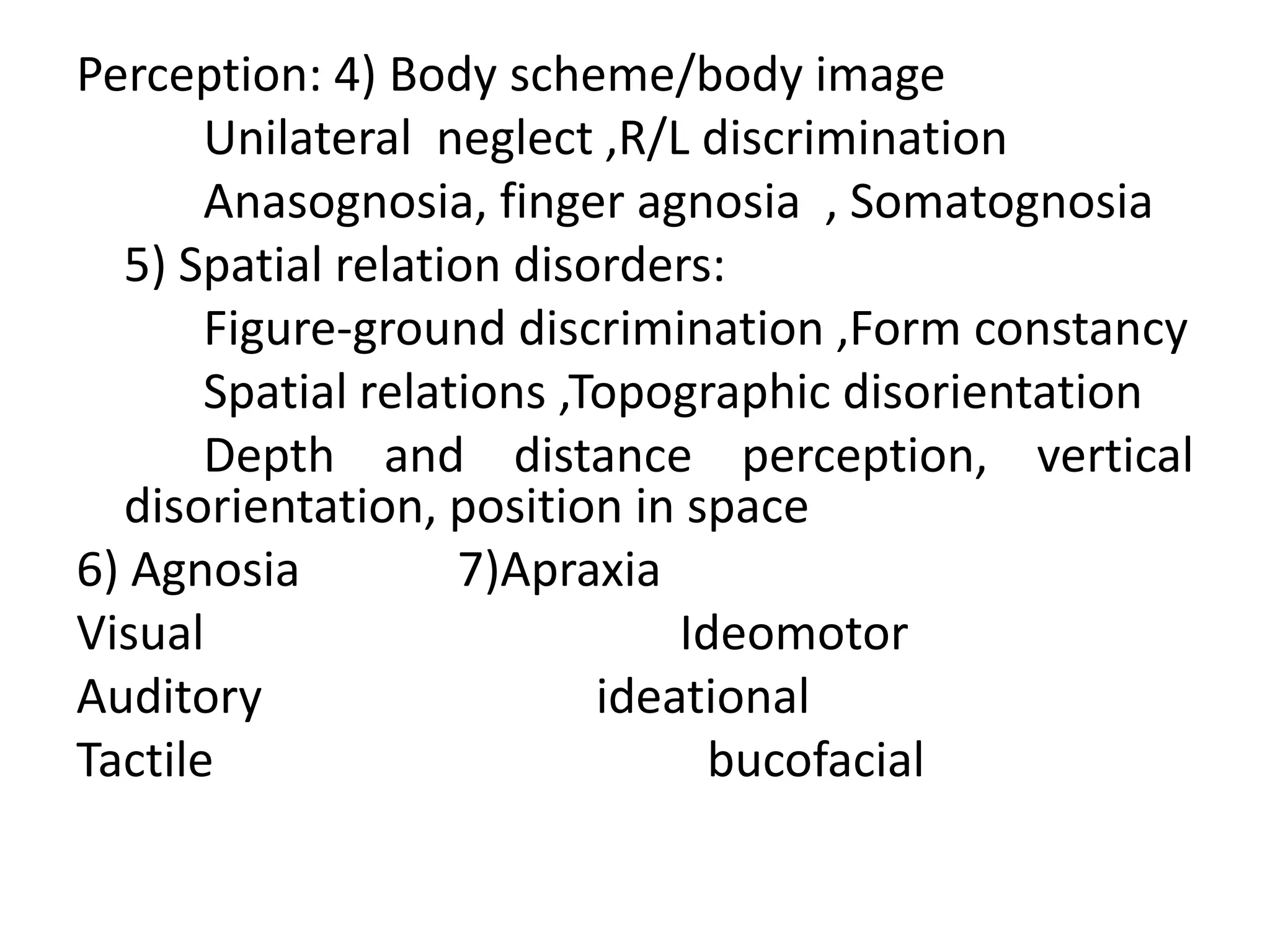
Perception: 4) Body scheme/body image
Unilateral neglect ,R/L discrimination
Anasognosia, finger agnosia , Somatognosia
5) Spatial relation disorders:
Figure-ground discrimination ,Form constancy
Spatial relations ,Topographic disorientation
Depth and distance perception, vertical
disorientation, position in space
6) Agnosia
7)Apraxia
Visual
Ideomotor
Auditory
ideational
Tactile
bucofacial
Attention
Ability to select and attend to a specific
stimulus while simultaneously suppressing
extraneous stimulus .
Feature
• Difficulty in processing and assimilating new
information
• low arousal level eg CVA
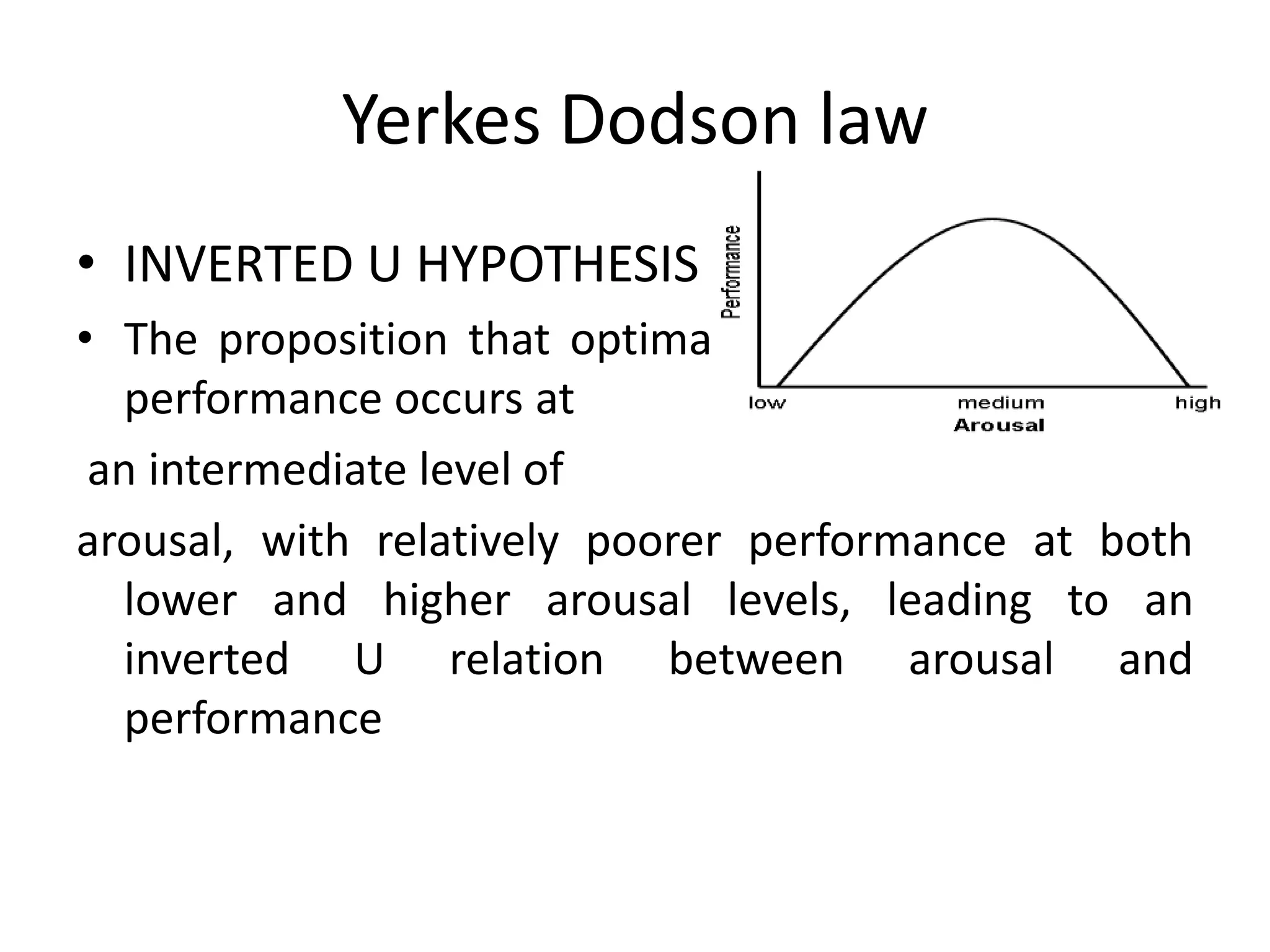
Yerkes Dodson law
• INVERTED U HYPOTHESIS
• The proposition that optimal
task
performance occurs at
an intermediate level of
arousal, with relatively poorer performance at both
lower and higher arousal levels, leading to an
inverted U relation between arousal and
performance
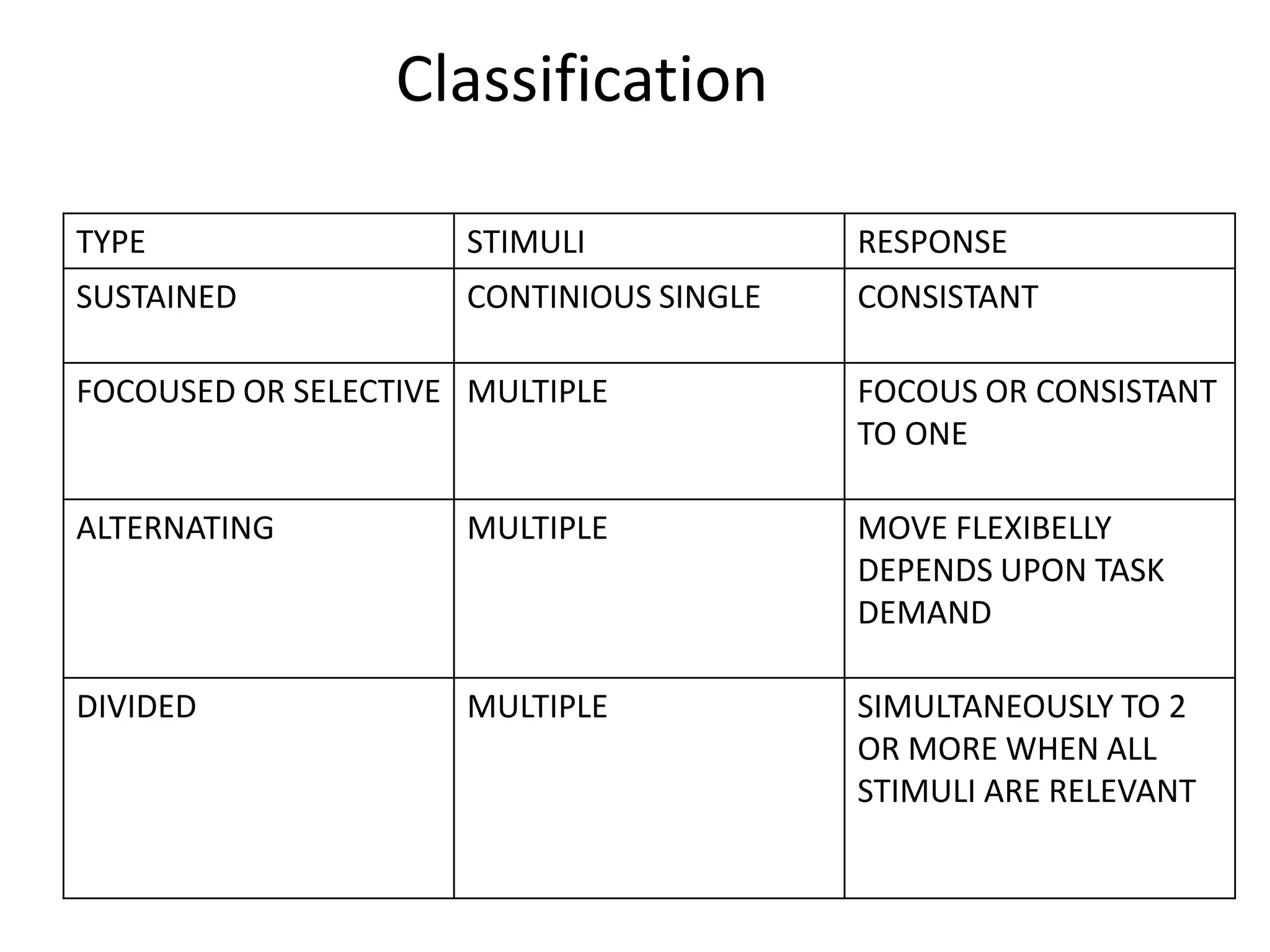
Classification
TYPE

STIMULI

RESPONSE

SUSTAINED

CONTINIOUS SINGLE

CONSISTANT

FOCOUSED OR SELECTIVE MULTIPLE

FOCOUS OR CONSISTANT
TO ONE

ALTERNATING

MULTIPLE

MOVE FLEXIBELLY
DEPENDS UPON TASK
DEMAND

DIVIDED

MULTIPLE

SIMULTANEOUSLY TO 2
OR MORE WHEN ALL
STIMULI ARE RELEVANT
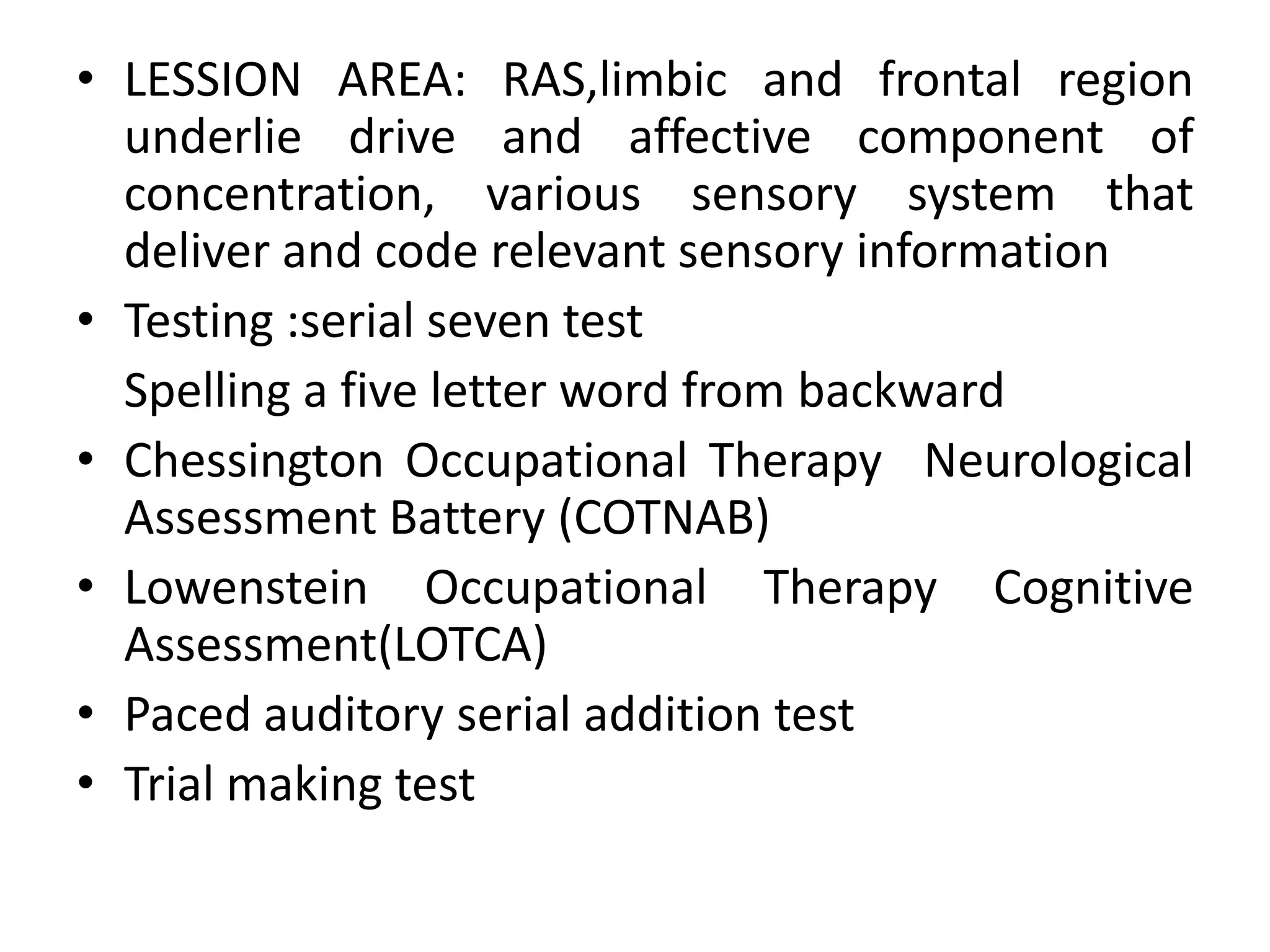
• LESSION AREA: RAS,limbic and frontal region
underlie drive and affective component of
concentration, various sensory system that
deliver and code relevant sensory information
• Testing :serial seven test
Spelling a five letter word from backward
• Chessington Occupational Therapy Neurological
Assessment Battery (COTNAB)
• Lowenstein Occupational Therapy Cognitive
Assessment(LOTCA)
• Paced auditory serial addition test
• Trial making test
•
•
•

•
•
•

•
•

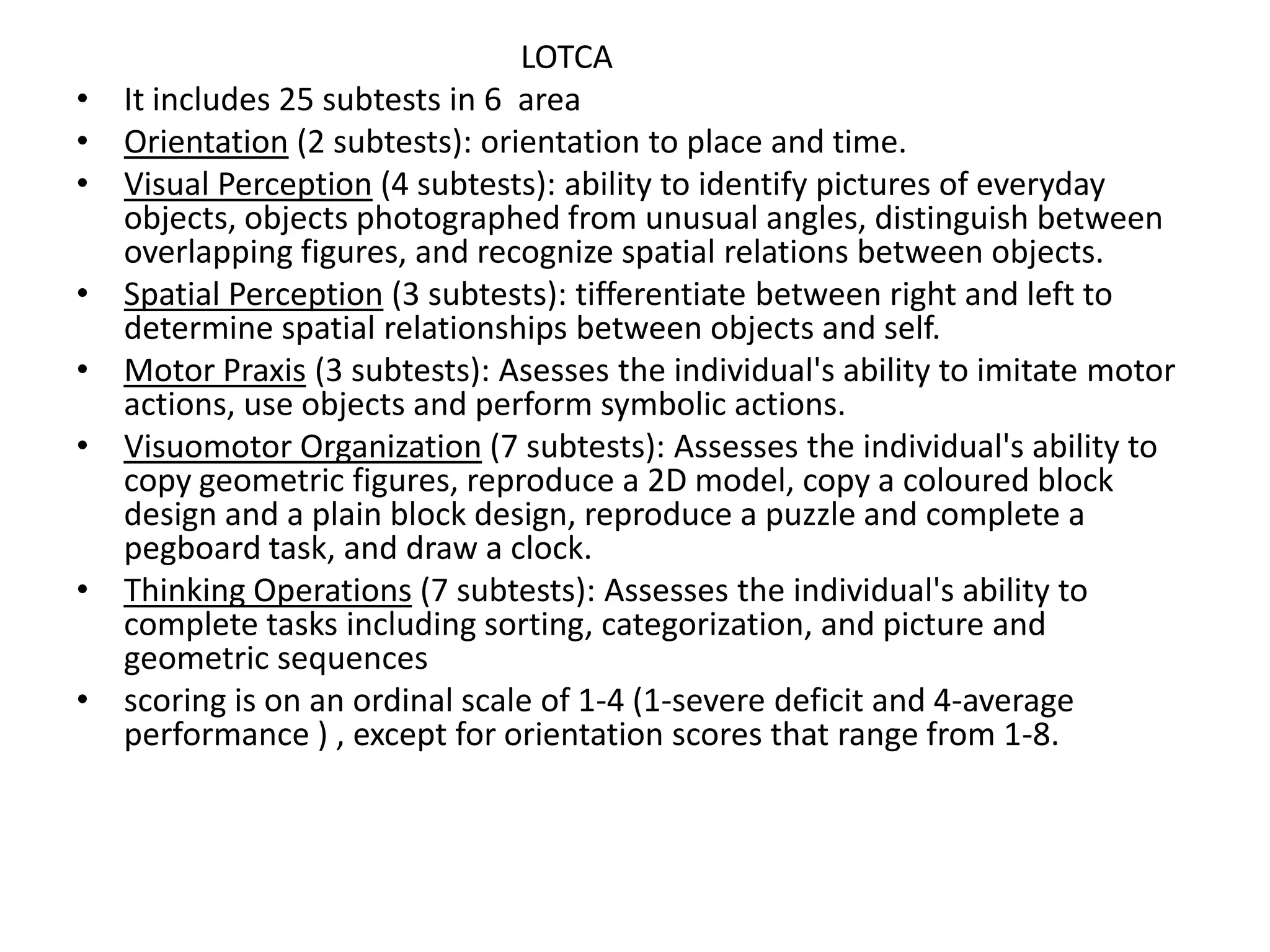
LOTCA
It includes 25 subtests in 6 area
Orientation (2 subtests): orientation to place and time.
Visual Perception (4 subtests): ability to identify pictures of everyday
objects, objects photographed from unusual angles, distinguish between
overlapping figures, and recognize spatial relations between objects.
Spatial Perception (3 subtests): tifferentiate between right and left to
determine spatial relationships between objects and self.
Motor Praxis (3 subtests): Asesses the individual's ability to imitate motor
actions, use objects and perform symbolic actions.
Visuomotor Organization (7 subtests): Assesses the individual's ability to
copy geometric figures, reproduce a 2D model, copy a coloured block
design and a plain block design, reproduce a puzzle and complete a
pegboard task, and draw a clock.
Thinking Operations (7 subtests): Assesses the individual's ability to
complete tasks including sorting, categorization, and picture and
geometric sequences
scoring is on an ordinal scale of 1-4 (1-severe deficit and 4-average
performance ) , except for orientation scores that range from 1-8.
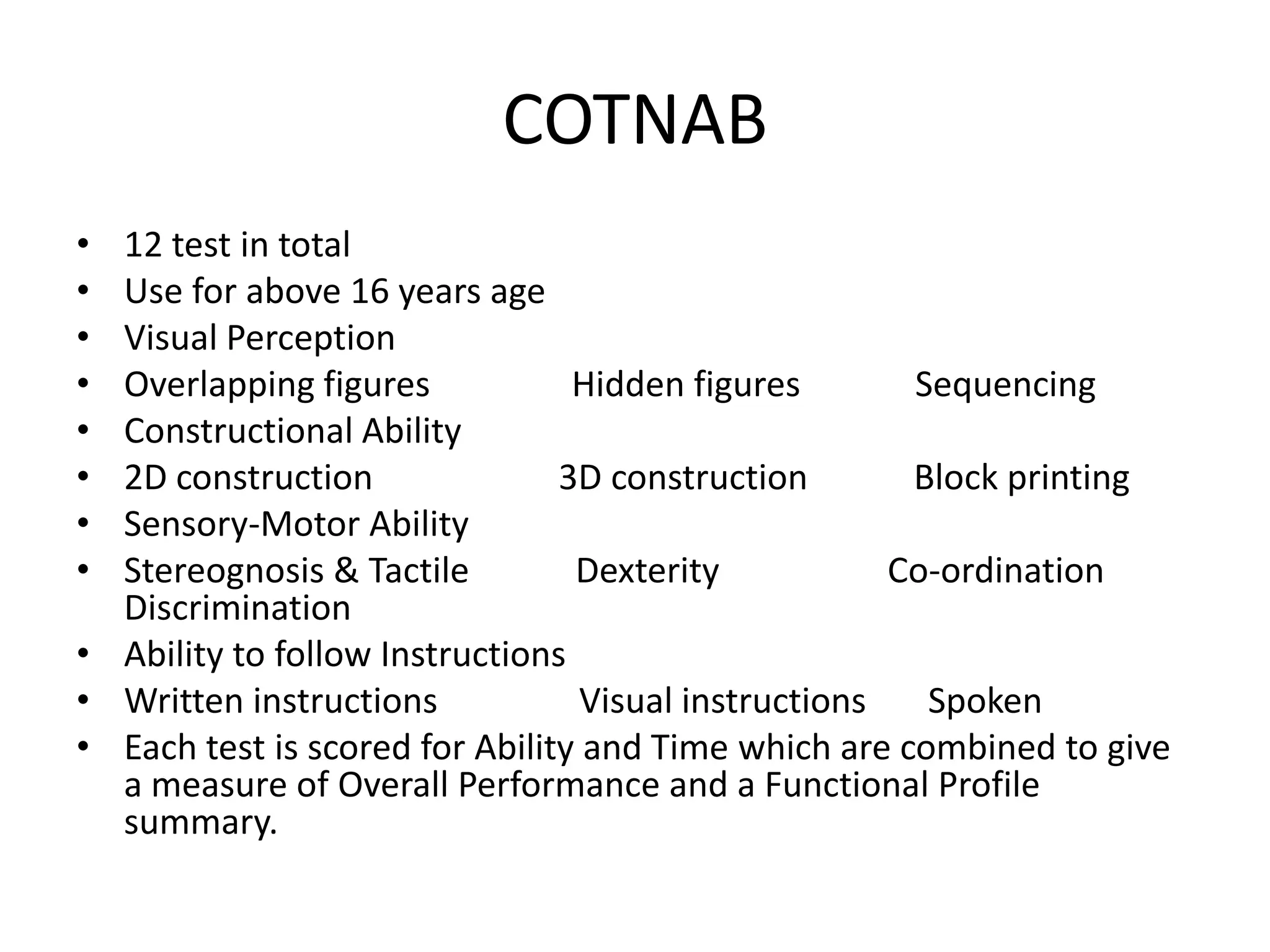
COTNAB
•
•
•
•
•
•
•
•

12 test in total
Use for above 16 years age
Visual Perception
Overlapping figures
Hidden figures
Sequencing
Constructional Ability
2D construction
3D construction
Block printing
Sensory-Motor Ability
Stereognosis & Tactile
Dexterity
Co-ordination
Discrimination
• Ability to follow Instructions
• Written instructions
Visual instructions
Spoken
• Each test is scored for Ability and Time which are combined to give
a measure of Overall Performance and a Functional Profile
summary.
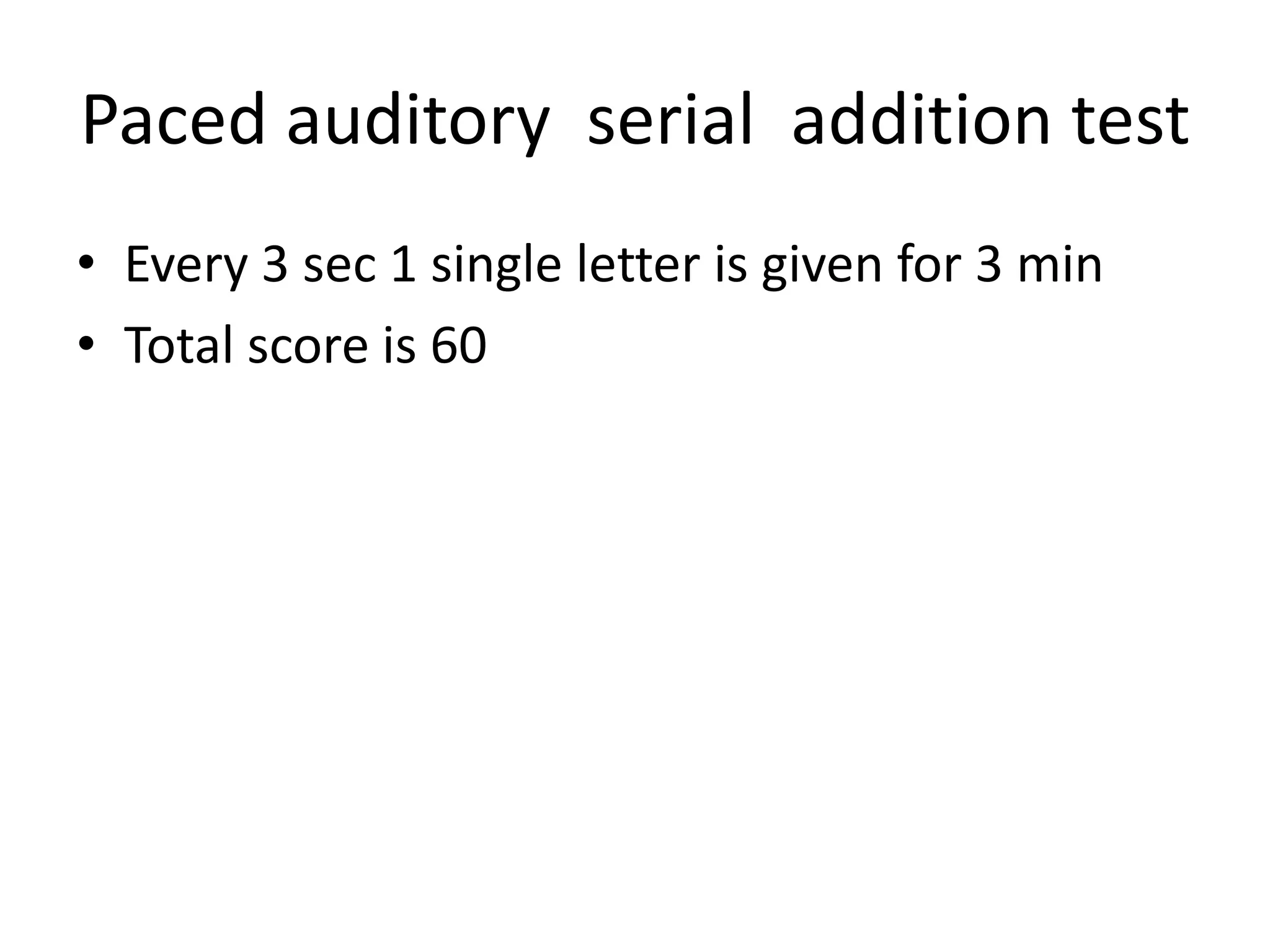
Paced auditory serial addition test
• Every 3 sec 1 single letter is given for 3 min
• Total score is 60
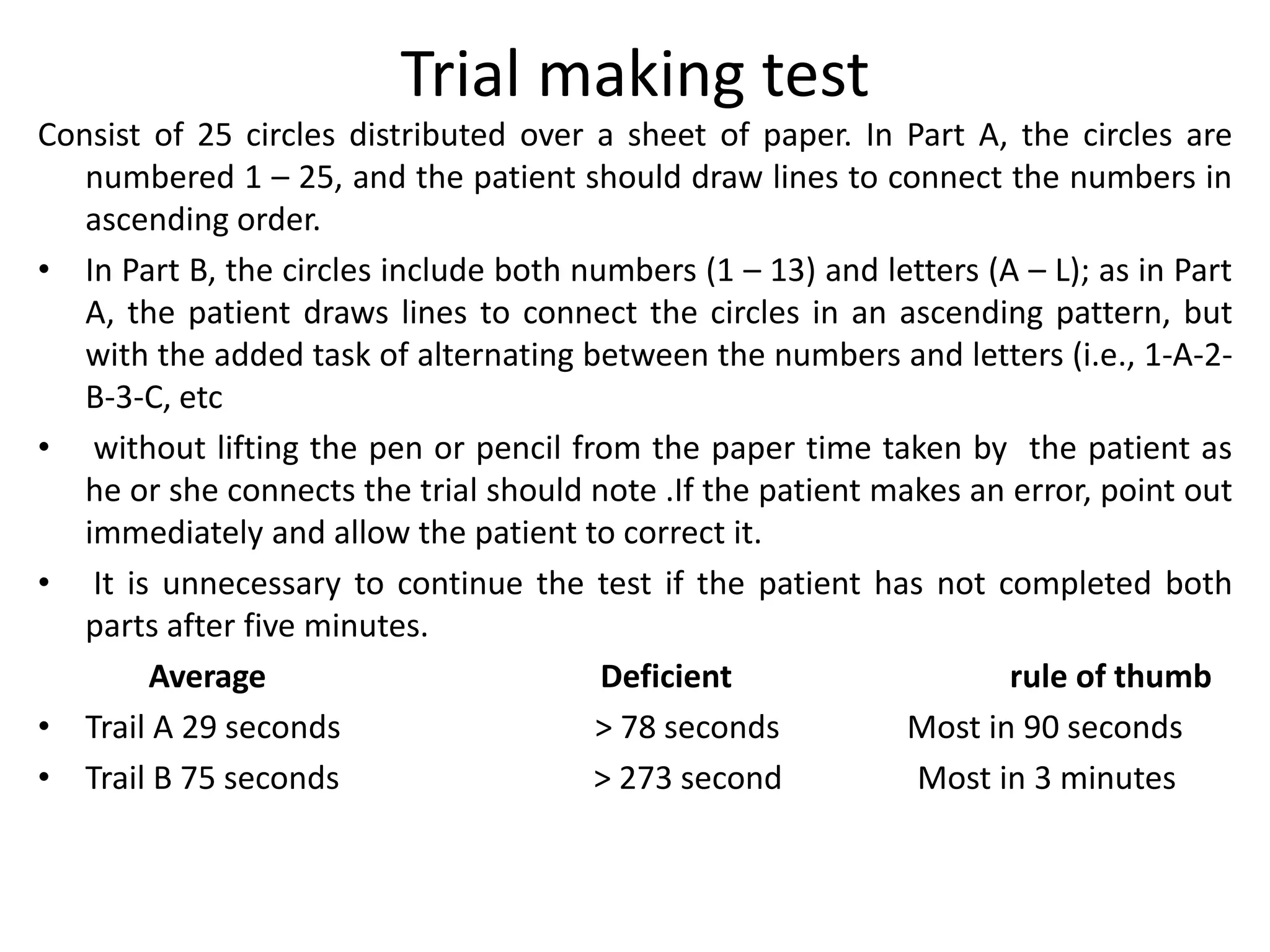
Trial making test
Consist of 25 circles distributed over a sheet of paper. In Part A, the circles are
numbered 1 – 25, and the patient should draw lines to connect the numbers in
ascending order.
• In Part B, the circles include both numbers (1 – 13) and letters (A – L); as in Part
A, the patient draws lines to connect the circles in an ascending pattern, but
with the added task of alternating between the numbers and letters (i.e., 1-A-2B-3-C, etc
• without lifting the pen or pencil from the paper time taken by the patient as
he or she connects the trial should note .If the patient makes an error, point out
immediately and allow the patient to correct it.
• It is unnecessary to continue the test if the patient has not completed both
parts after five minutes.
Average
Deficient
rule of thumb
• Trail A 29 seconds
> 78 seconds
Most in 90 seconds
• Trail B 75 seconds
> 273 second
Most in 3 minutes
Treatment
• Aim: increase attention to appropriate stimuli and
disregard inappropriate stimuli.
• Remedial approach: visual scanning
• lt hemiplegic should encourage to use verbalization to
improve visualization and vice versa for rt .
• Setting time and speed limit, amplification of critical
stimuli and make crucial stimuli salient (noticeable)
• Training in close to open environment .
• Compensatory: avoid distraction due to external
stimuli
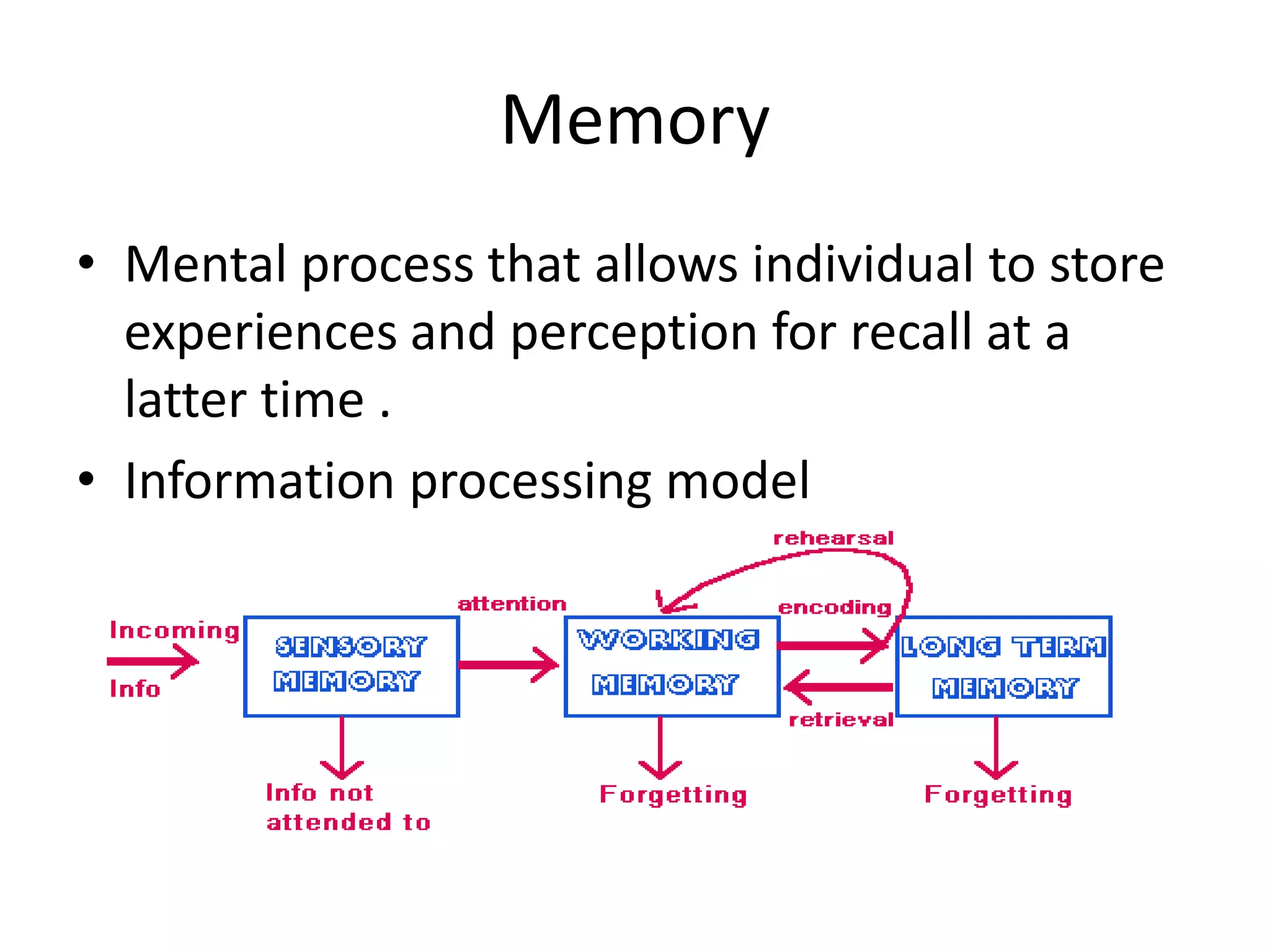
Memory
• Mental process that allows individual to store
experiences and perception for recall at a
latter time .
• Information processing model
• There are three stages that must take place for
memory to occur ENCODING,STORAGE ,RECALL
• Most memory problems are due to lack of
attention, so the information never gets
processed in a meaningful way (encoded) and
never makes it to storage. Making a conscious
decision to pay attention is the first important
step toward improving memory skills. Then
simple techniques can help to process
information so it stands a better chance of
making it to storage for retrieval.
Immediate recall and short term
memory
• Immediate memory is the ability to remember a small
amount of information over a few seconds. what you can
repeat immediately after perceiving it
• Short term memory that is capable of storing material for a
brief period of time Short-term memory (or "primary" or
"active memory") is the capacity for holding a small
amount of information in mind in an active, readily
available state for a short period of time. In contrast, long
term memory indefinitely stores a seemingly unlimited
amount of information.
• Short-term memory should be distinguished from working
memory, which refers to structures and processes used for
temporarily storing and manipulating information
• Remedial approach: improve attention skill
• Organizing material to be remembered and
making logical association.
• Compensatory:memmory log
• Environmental prompt such as wall calendar
beeper
Long term memory
• Structure involved: hippocampus and
amygdela(limbic memory structure)
• Testing: recall of personal historical event
• RBMT
• Question the family about premorbid
memory.
Types of Memory - Declarative
Explicit - person’s knowledge base, conscious
awareness, “learning that”
– Working - ability to hold information while
working with it (eg. math calculations)
– Semantic - general knowledge of concepts,
rules, principles & meanings (eg, knowing that
a cat is an animal)
– Episodic - remember specific personally
experienced events (eg, holiday taken last year)
Non-Declarative
Implicit - without conscious awareness,
“learning how”
 Procedural - skills becomes automatic through
practice (eg, riding a bike)
 Priming - cues prompt accurate recall without
awareness (eg, name starting with M)
Prospective
• Remembering to do something in the future
or carry out intentions
• Remembering to remember
• Most practical aspect of everyday memory
Eg. pick children up after school
Why Should PTs Assess Memory?
• Memory impairments can cause great
difficulty in performance of everyday tasks
• Memory impairments can be a major barrier
to rehabilitation - individual is unable to
learn or carry over the techniques taught in
the therapy sessions
Commonly Used Assessments
• Contextual Memory Test, 1993
• Rivermead Behavioral Memory Test, 1985
Contextual Memory Test (CMT)
• Purpose/Focus - created to assess awareness of
memory capacity (metamemory), strategy use, and
recall
• Population - adults 18 + years, tested on a wide
variety of diagnoses
• Approach – structured interview & assessment
• Unique Feature - tests a person’s insight into the
knowledge of their memory limitations
CMT – Process Part 1
Step #1 - Administer memory questionnaire (#1-9)
Step #2 - Present picture card non-contextual method

Step #3 - Immediate recall of pictures
Step #4 - Administer memory questionnaire (#10-20)
Step #5 - Delayed recall of pictures (after 15-20 min)
Step #6 - Repeat administration of 2nd part of memory
questionnaire
CMT – Process Part 2

• Perform with people who fall below norms in Part
I, 2 to 36 hours after

• Steps #1-6 same as Part I, however, present
alternate picture card, context method (Eg. as you
study objects, think of what you do in the morning)
• If during step #5 (delayed recall) person has difficulty
recalling items, may use retrieval cues.
– Recall cuing first (Eg. What do you eat with?)
– If poor performance with recall, use recognition cards (Eg.
Do you remember seeing this on the Picture Card?)
Scoring
• Various scores with norms
– Immediate Recall (IR)
– Delayed Recall (DR)
– Total of IR + DR
– Strategy score
– Predicted score
– Discrepancy score
Analysis of Test
Information Processing:
Short term - Immediate recall
Long term – Delayed recall (recognition)
 Types of Memory:

Episodic (medial temporal lobe) – Picture Card event

Semantic (neo-cortex, non frontal)- General knowledge of
objects on Picture Card
 Memory Processes:

Encoding – visual, intentional

Retrieval – free recall, (cued recall)
• Reliability
– Test-retest correlations for immediate and delayed recall .85-.94.
(Mackler, MMY)
– Test-retest correlations for person’s with BI .85-.95 (Josman et
al., 2000)

• Validity
– Concurrent (correlated with RBMT) - upper .70s to mid .80s
(Raphael, MMY)
– Concurrent (correlated with RBMT) is .80-.84 (Josman et al., 2000)
Rivermead Behavioral
Memory Test (RBMT)
• Purpose/Focus – developed to detect impairment
of everyday memory functioning & monitor change
throughout treatment
• Population - adults 16 - 69 years, tested on a wide
variety of diagnoses
• Approach – structured assessment
• Unique Feature – attempts to simulate demands
placed on memory by normal, everyday life
• Versions – 2nd edition, elderly, extended, children
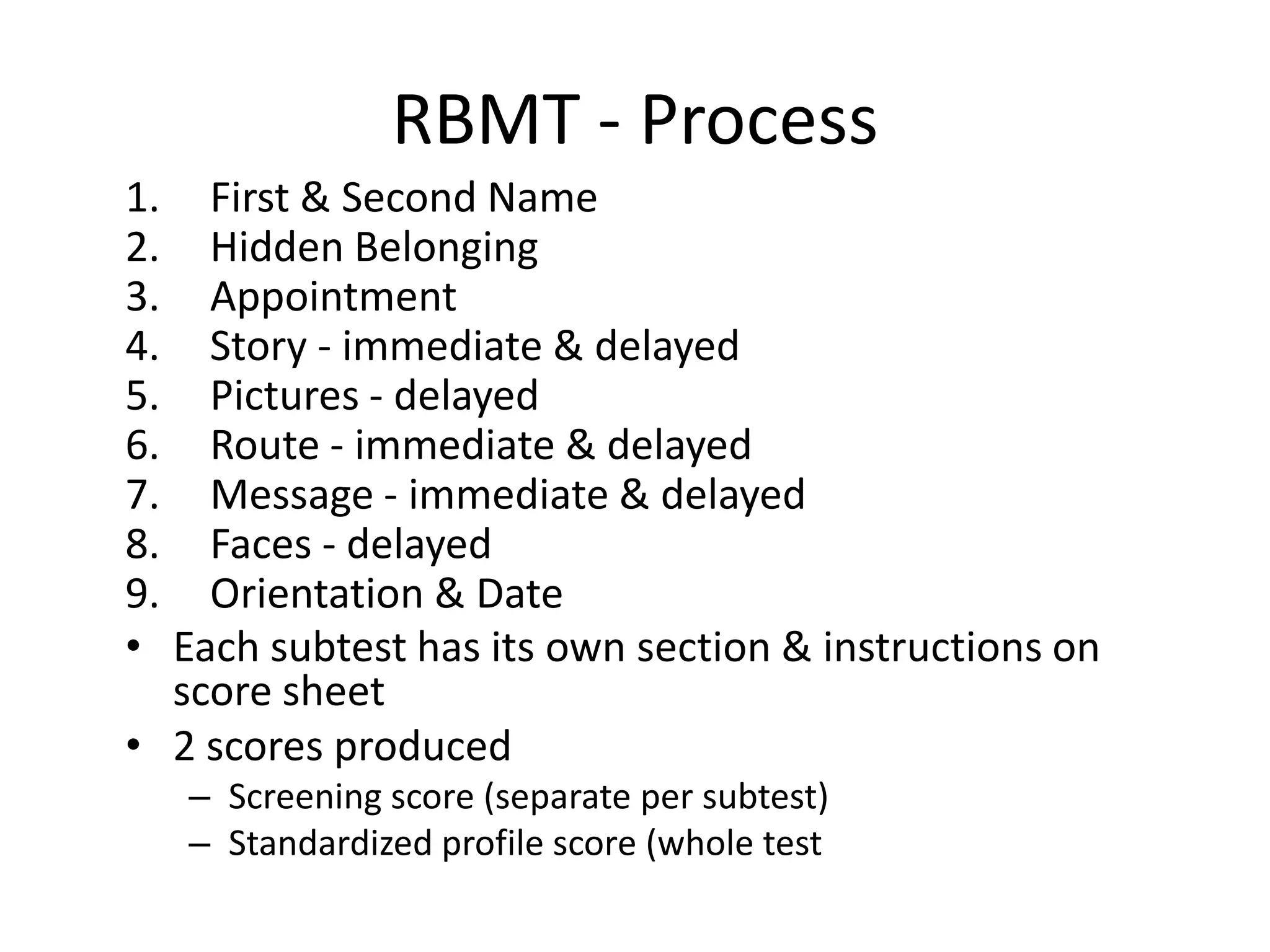
RBMT - Process
1. First & Second Name
2. Hidden Belonging
3. Appointment
4. Story - immediate & delayed
5. Pictures - delayed
6. Route - immediate & delayed
7. Message - immediate & delayed
8. Faces - delayed
9. Orientation & Date
• Each subtest has its own section & instructions on
score sheet
• 2 scores produced
– Screening score (separate per subtest)
– Standardized profile score (whole test
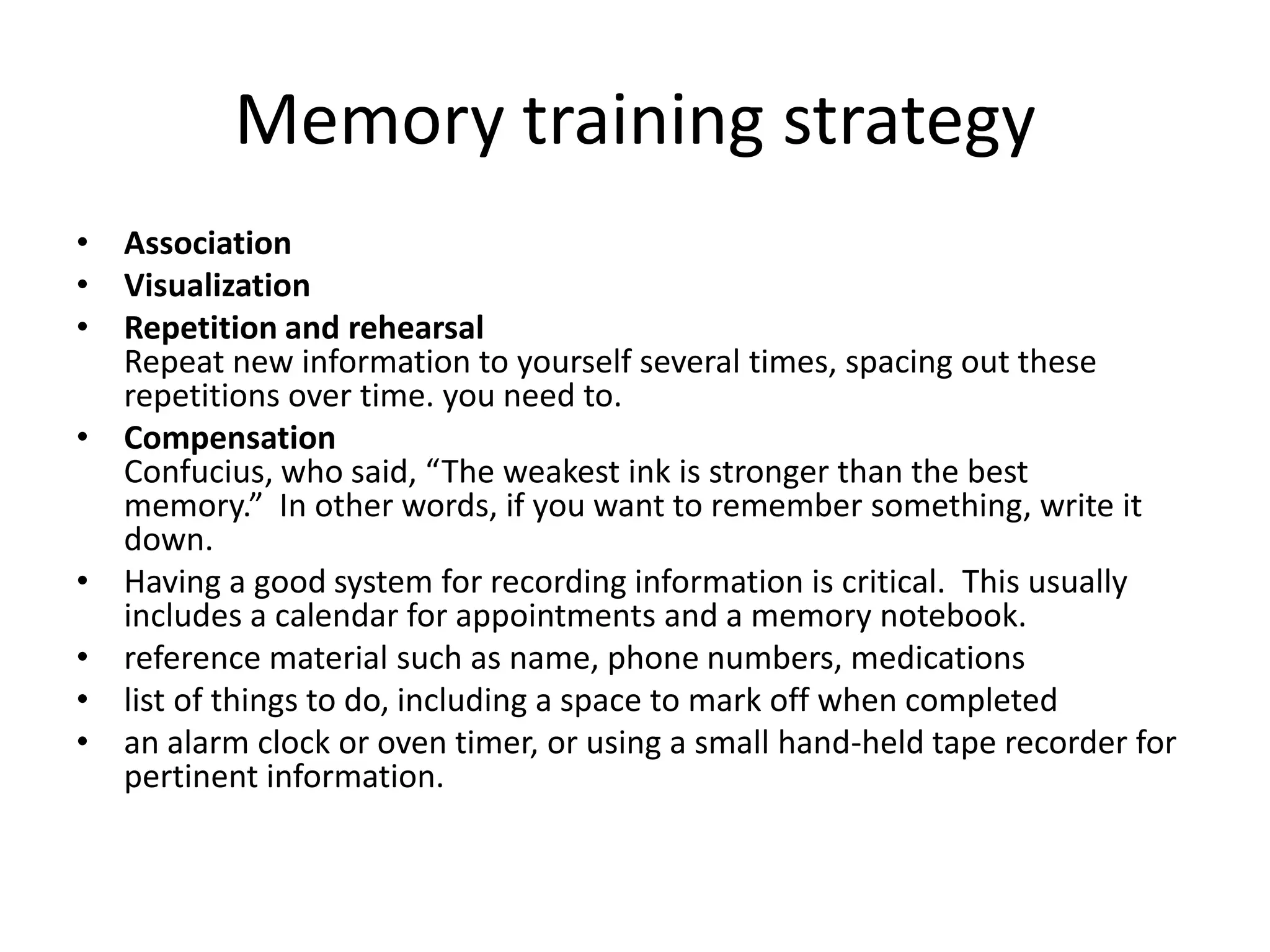
Memory training strategy
• Association
• Visualization
• Repetition and rehearsal
Repeat new information to yourself several times, spacing out these
repetitions over time. you need to.
• Compensation
Confucius, who said, “The weakest ink is stronger than the best
memory.” In other words, if you want to remember something, write it
down.
• Having a good system for recording information is critical. This usually
includes a calendar for appointments and a memory notebook.
• reference material such as name, phone numbers, medications
• list of things to do, including a space to mark off when completed
• an alarm clock or oven timer, or using a small hand-held tape recorder for
pertinent information.
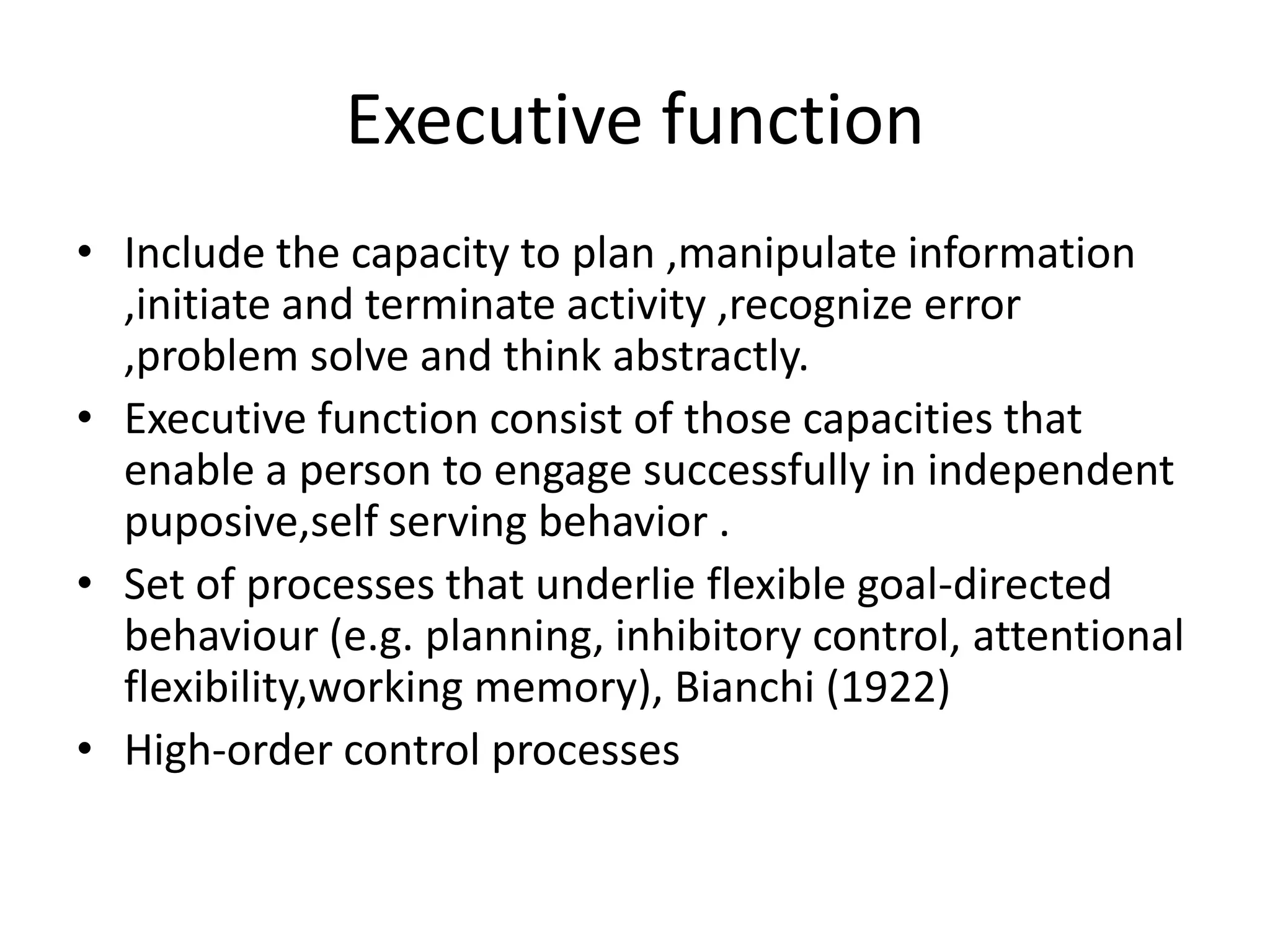
Executive function
• Include the capacity to plan ,manipulate information
,initiate and terminate activity ,recognize error
,problem solve and think abstractly.
• Executive function consist of those capacities that
enable a person to engage successfully in independent
puposive,self serving behavior .
• Set of processes that underlie flexible goal-directed
behaviour (e.g. planning, inhibitory control, attentional
flexibility,working memory), Bianchi (1922)
• High-order control processes
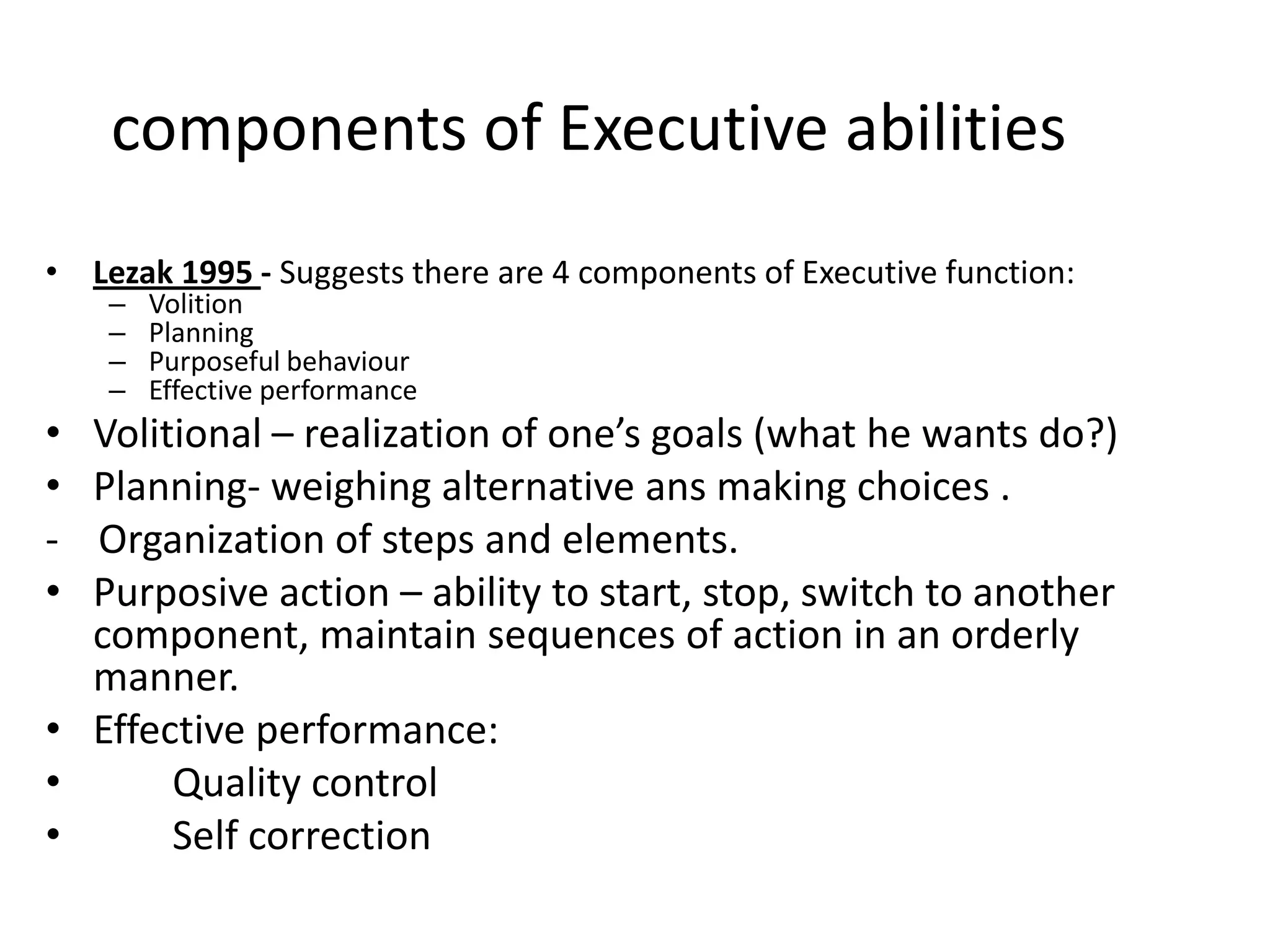
components of Executive abilities
• Lezak 1995 - Suggests there are 4 components of Executive function:
–
–
–
–

•
•
•

Volition
Planning
Purposeful behaviour
Effective performance

Volitional – realization of one’s goals (what he wants do?)
Planning- weighing alternative ans making choices .
Organization of steps and elements.
Purposive action – ability to start, stop, switch to another
component, maintain sequences of action in an orderly
manner.
• Effective performance:
•
Quality control
•
Self correction
• Stuss 1987 - Identifies a number of associated skills
necessary for goal-directed behaviour
– Ability to shift from one concept to another
– Ability to modify behaviour in light of new info
– Ability to synthesise & integrate isolated details into coherent
whole
– Ability to manage multiple sources of information
– Ability to make use of relevant acquired knowledge
Anderson et al. (2001) propose 3 separable but unified
components of EF:
1.) Attentional control: selective attention and sustained
attention
2.) Cognitive flexibility: working memory, attentional
shift, self-monitoring, and conceptual transfer
3.) Goal setting: initiating, planning and organisation,
generating and implementing strategies for problem
solving, and strategic behaviour
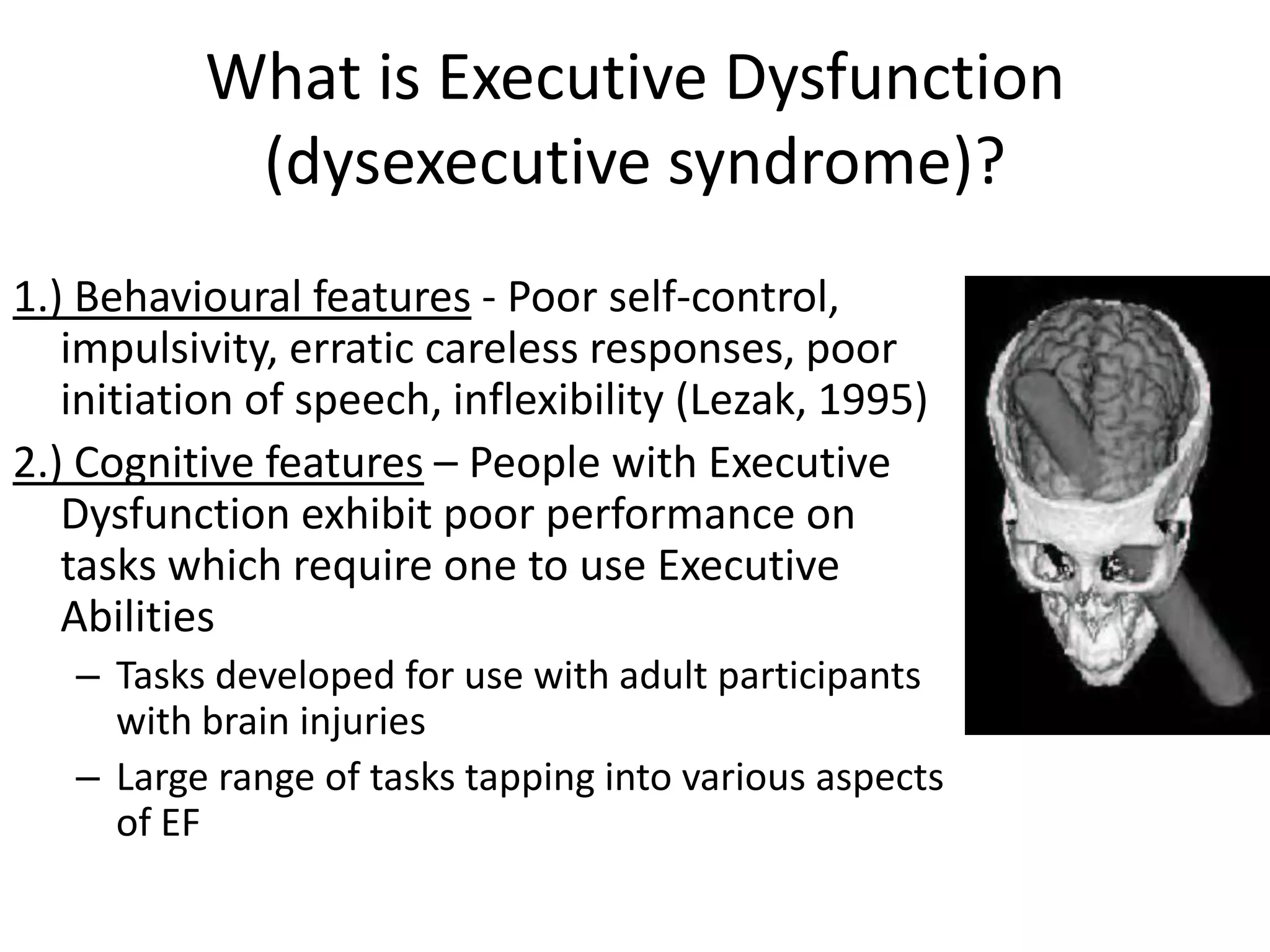
What is Executive Dysfunction
(dysexecutive syndrome)?
1.) Behavioural features - Poor self-control,
impulsivity, erratic careless responses, poor
initiation of speech, inflexibility (Lezak, 1995)
2.) Cognitive features – People with Executive
Dysfunction exhibit poor performance on
tasks which require one to use Executive
Abilities
– Tasks developed for use with adult participants
with brain injuries
– Large range of tasks tapping into various aspects
of EF
What is executive dysfunction?
• 3). Biological features
• The “Frontal Metaphor”
• Association noted between tasks which
involve EF processes and damage to the prefrontal cortex
• Neuropsychologists may say an individual’s
symptoms “look frontal”, without knowing the
nature of the brain damage
• Assessment:
•
hemi – imulsivensess,
•
poor judgment
•
poor planning ability
•
lack of foresight
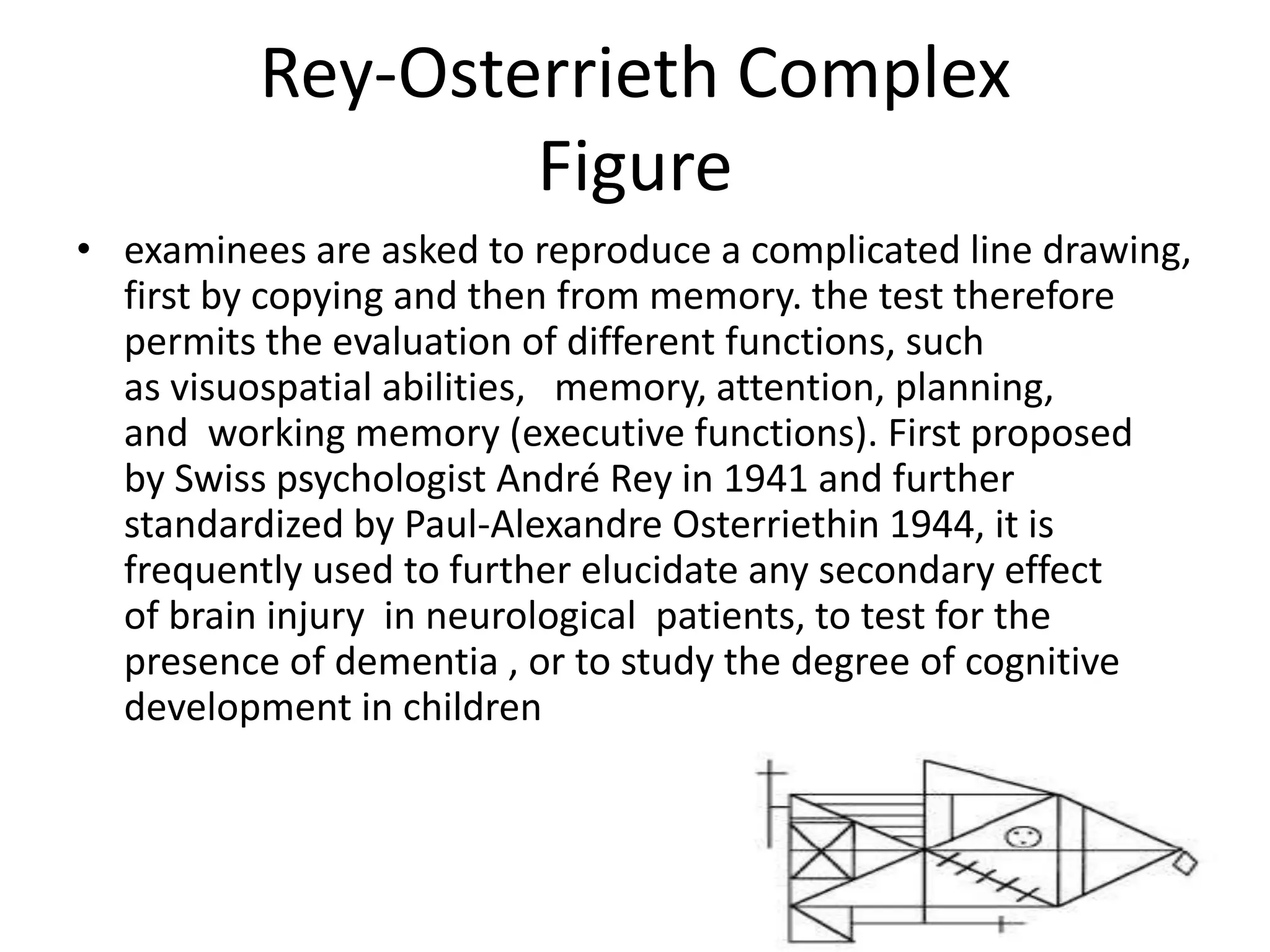
Rey-Osterrieth Complex
Figure
• examinees are asked to reproduce a complicated line drawing,
first by copying and then from memory. the test therefore
permits the evaluation of different functions, such
as visuospatial abilities, memory, attention, planning,
and working memory (executive functions). First proposed
by Swiss psychologist André Rey in 1941 and further
standardized by Paul-Alexandre Osterriethin 1944, it is
frequently used to further elucidate any secondary effect
of brain injury in neurological patients, to test for the
presence of dementia , or to study the degree of cognitive
development in children
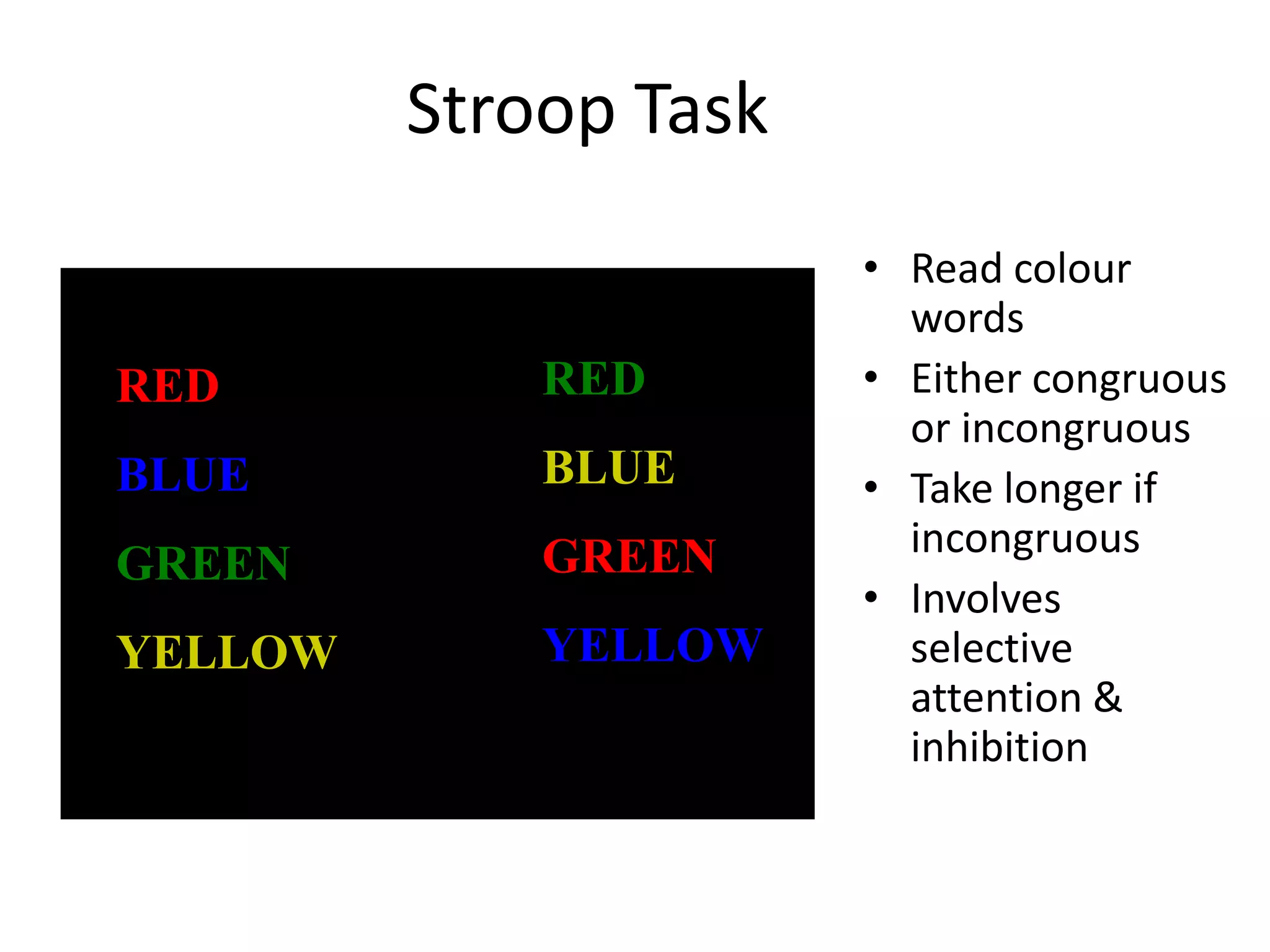
Stroop Task

RED

RED

BLUE

BLUE

GREEN

GREEN

YELLOW

YELLOW

• Read colour
words
• Either congruous
or incongruous
• Take longer if
incongruous
• Involves
selective
attention &
inhibition
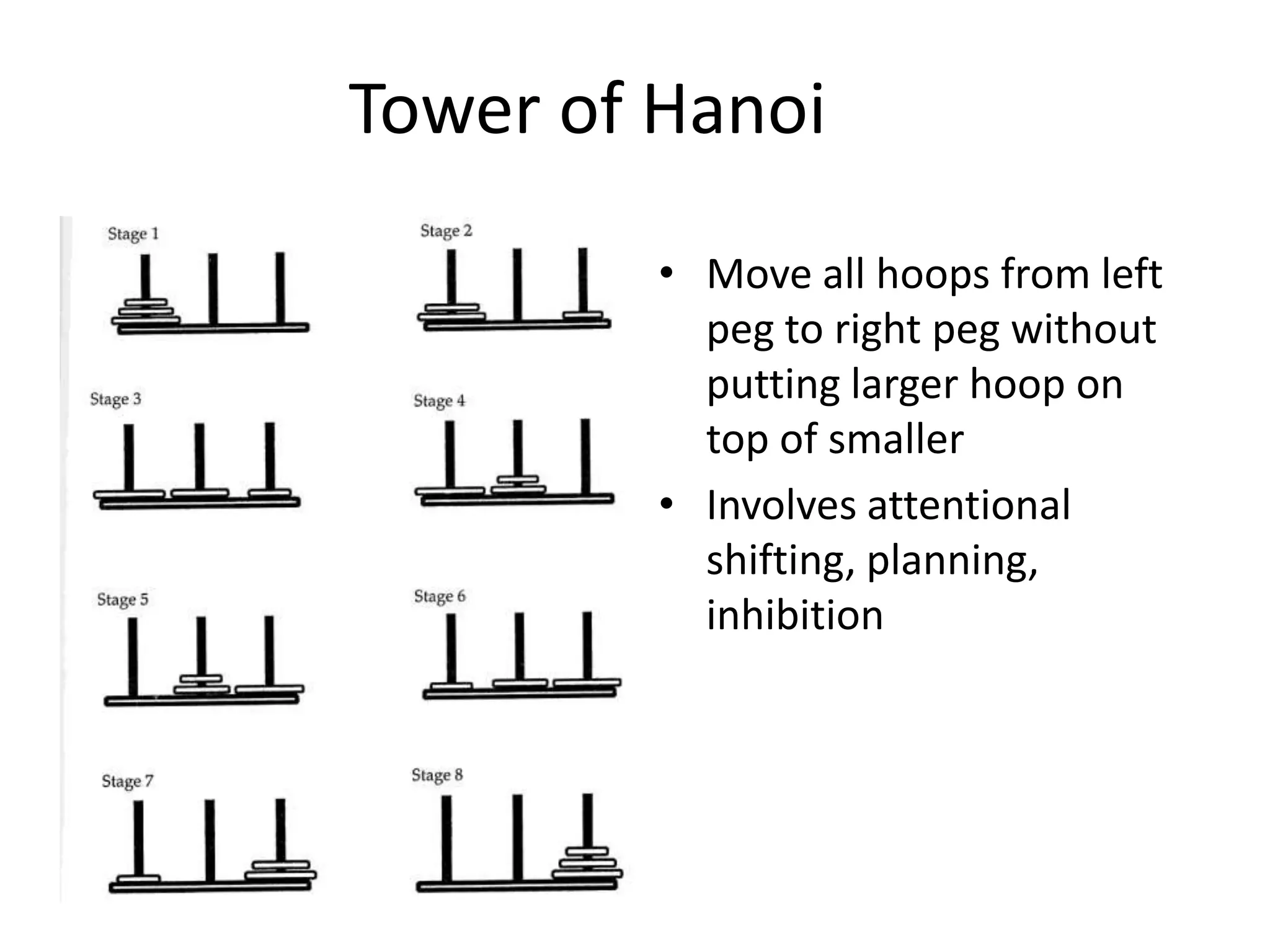
Tower of Hanoi
• Move all hoops from left
peg to right peg without
putting larger hoop on
top of smaller
• Involves attentional
shifting, planning,
inhibition
Body scheme/Body image disorder
• Body image: visual and mental image about
one’ body – that includes feeling about one’s
especially in relation to health and disease.
Perception of body size.
• Body scheme: PERCEPTION OF own body
parts, Postural model of body, including
relationship of body parts to each other and
relationship of body parts to environment .
Unilateral neglect:
• Inability to register and integrate stimuli and
perceptions from one side of the body (BODY
NEGLECT) or the environment (spatial neglect
)which is not due to sensory loss ( intact vision)
• Many terms are used unilateral spatial
neglect, hemi-inattention, visual neglect and
hemi spatial neglect
• does not try to compensate by turning head may
even deny that side belongs to him ,avoids
crossing the midline visually or during motor
activity , when dressing forgets to put on (L)
sleeve forgets to shave (L) ½ of his face ,neglect
to eat from (L) ½ of his plate, reads newspaper till
midline.
• Lesion area :inferior posterior region of right
Behavioral inattention test
• The BIT, initially called as Rivermead Behavioural
Inattention Test
• The BIT is divided into two subtests: Conventional
and Behavioural. The BIT Conventional subtest
(BITC) consists of 6 items: line crossing, letter
cancelation, star cancellation, figure and shape
copying, line bisection, and representational
drawing. The BIT Behavioural subtest (BITB)
consists of 9 items: pre-scanning, phone dialling,
menu reading, article reading, telling and setting
the time, coin sorting, address and sentence
copying, map navigation, and card sorting.
• Cut-offs scores for the BIT, BITC, and BITB are
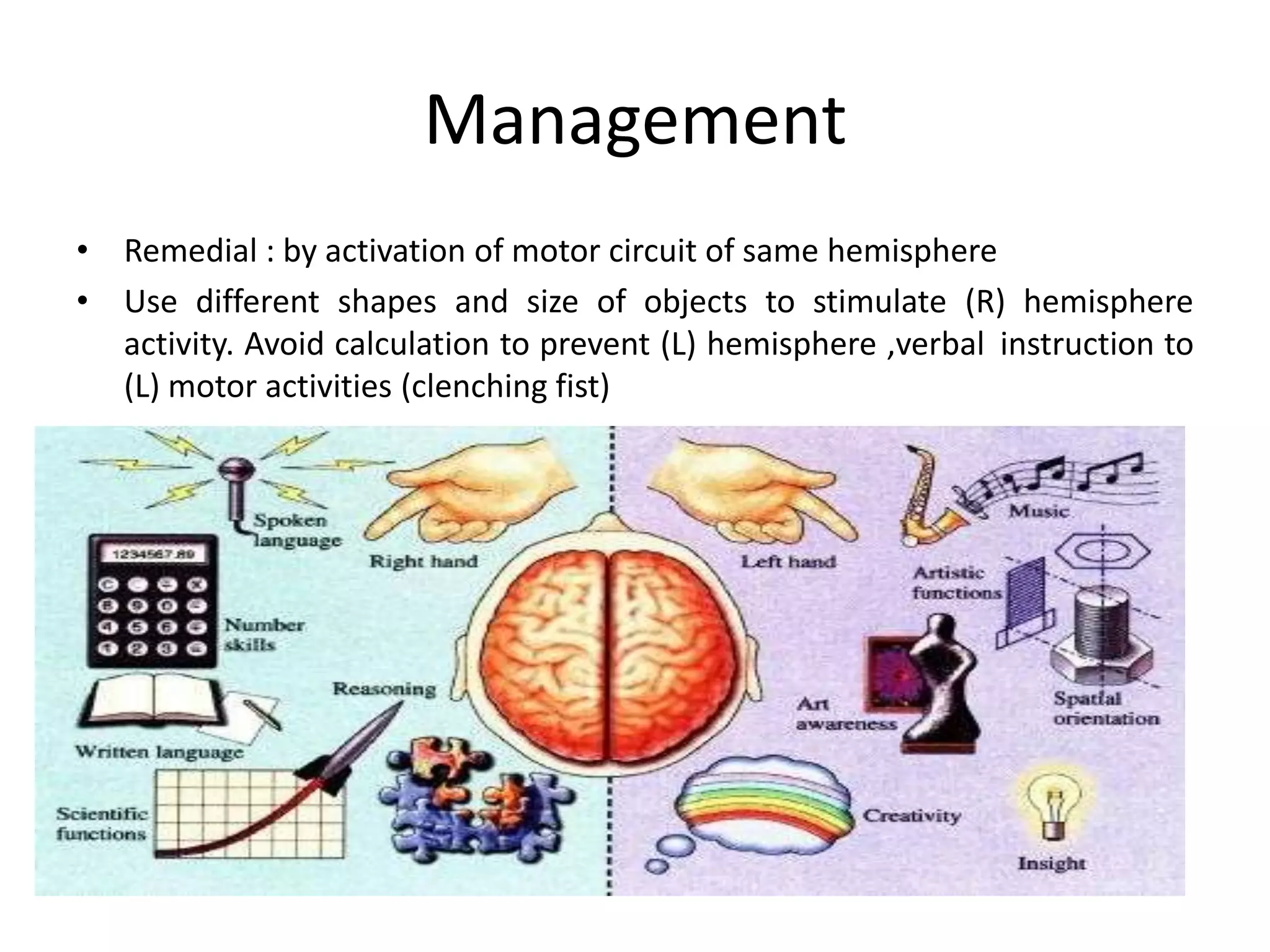
Management
• Remedial : by activation of motor circuit of same hemisphere
• Use different shapes and size of objects to stimulate (R) hemisphere
activity. Avoid calculation to prevent (L) hemisphere ,verbal instruction to
(L) motor activities (clenching fist)
• Adaptive:
Instructions from unaffected side
Placing mirror while dressing
Sonsorimotor approach on (L) side: ice, brush.
Move the television from midline to affected
side
• Cognitive compensation:
-taught to be aware of the deficit
-visual scanning
• Functional approach:
-Repeat functional task
Evidence based approach
• Visual Scanning :
• individuals with neglect do not visually scan
their whole environnent (Weinberg et al.
1977)
• paying no attention to their left-sided space
(Ladavas et al. 1994). Cicerone et al. (2000)
noted that the research literature concerning
remediation of visuospatial deficits
encompassed two basic approaches. One
group of studies addressed the remediation of
basic abilities and behaviour such as visual
Activation Strategies Activation strategies are intended to increase
orientation and attention to the neglected hemi space. A
stimulus, either a motor stimulus or externally applied sensory
stimulus, to the affected side is thought to “activate” the right
hemisphere. The mechanism by which this might improve neglect is
still under debate. The activation may be a general activation of the
right hémisphère (Robertson et al. 1994), which improves attention
control in the neglected space (Kinsbourne 1987 cited in Bailey et al.
2002). Others postulate a personal space system that, when
activated, improves the representation of the left-sided personal space
(Robertson 1999 cited in Pierce & Buxbaum 2002). Activation
strategies include limb activation as well as the application of a sensory
stimulus.
1.
Limb Activation
2.
Sensory Stimulation Interventions.
3.
Feedback Strategies :Feedback strategies are intended to improve
awareness of and attention to the neglected space (Pierce &
Buxbaum 2002). Typical methods of feedback used include
auditory and visual.
• Prism Treatment As noted by Rossi et al.
(1990) Prisms affect spatial representation by
causing an optical deviation of the visual field
to either the left or the right other optical aids
have been used to achieve a similar effect
including wideangle lenses (Drasdo 1976,
Weiss 1969), mirrors attached to the spectacle
frame (Nerenberg 1980, Nooney 1986,
Duszynski 1955) and closed circuit TV monitor
systems(Turner 1976).
Eye-Patching and Hemispatial Glasses Beis et al.
(1999) eye patches can be used to alter the
processing of visual information by affecting
the information processing structures of the
central nervous system.” Shulman (1984)
noted that in healthy subjects, eye patches
should increase eye movements towards the
contralateral space. Thus, eye patching of the
eye ipsilateral to the lesion causes patients to
look toward contralateral space by either
moving their eye or by movement of the head.
• Caloric/Vestibular Stimulation: when cold water is funnelled into the
external ear canal, the vestibular-ocular reflex induces the slow phase
of nystagmus toward the stimulated ear (Pierce & Buxbaum 2002). If
warm water is used, this slow phase is directed away from the
stimulation.
• Vestibular Galvanic Stimulation Caloric stimulation, while producing
some transient, beneficial effect on neglect, has been criticised for
being relatively impractical for use in applications outside of research
(Rorsman et al. 1999). Rorsman et al. (1999) propose that stimulation of
the vestibular system is possible without the discomfort and
inconvenience associated with irrigation. Galvanic stimulation involves
electrical stimulation of the vestibular nerves at a very low level
(Rorsman et al. 1999).
• Optokinetic Stimulation Optokinetic stimulation functions in a fashion
similar to vestibular stimulation in that it is based on the induction of
nystagmus by exposure to a stimulus. Optokinetic stimulation uses a
visual stimulus moving linearly from right to left (Pierce & Buxbaum
2002).
• Trunk Rotation Therapy the orientation of the trunk midline in
space functions as the dividing line between our personal
representation of left versus right space and acts as an anchor for
the calculation of body position (Karnath et al. 1991). Karnath et al.
(1993) demonstrated that turning only the trunk of the patient to
the left such that both right and left stimuli were projected to the
right side of the trunk could compensate for deficits in reaction
times to stimuli in the left visual field
• Neck Muscle VibrationKarnath et al. (1993) demonstrated that the
detection and identification of stimuli in the left visual field in
patients with neglect could be improved by trunk rotation, resulting
in the lengthening of left posterior neck muscles, or by
somatosensory stimulation applied to the left posterior neck
muscles in the form of neck muscle vibration.
Transcutaneous Electrical Nerve Stimulation (TENS) Transcutaneous
electrical nerve stimulation (TENS) is an alternate form of
somatosensory stimulation thought to be capable of reducing
neglect in a fashion somewhat similar to that of neck muscle
vibration (Vallar et al. 1995).
• Virtual reality
• With virtual reality technology, the user is immersed in
a rich, multimodal, 3D world. Computer-generated
virtual reality environments are interactive and
realistic, with parameters and applications within the
environment that are easily controlled. Application of
virtual reality techniques does lead to improvements in
performance for individuals with neglect on standard
measures of neglect and on ‘real-life’ virtual tasks A
recent review by Tsirlin and colleagues provides a
thorough discussion of the potential uses of virtual
reality in neglect assessment and intervention in the
hope of spurring more research in this area.
Anosognosia
• A lack of awareness of impairment, not knowing that a deficit or illness
exists, in memory or other function
• The impairment may be in memory, thinking skills, emotion, or
movement.
• lack of awareness or denial of a paretic extremity as belonging to the
person.
• disowning paralyzed limbs patient maintains that nothing is wrong with
him. it has been considered a temporary condition
• common in the acute and post-acute phases. The presence of anosognosia
in a chronic phase (i.e. lasting more than few weeks) is a rare occurrence,
• Lesion is usually located in non dominant (R) parietal lobe
• Assessment :
• By faking to patient.
• It is difficult to compensate for anosognosia safety is main concern
• In some patients anosognosia disappeared immediately following caloric
vestibular stimulation(Gianna Cocchini 2002
• However, very recently, Fotopoulou and colleagues
provided preliminary evidence that self-observation of
motor behaviour from the third-person perspective may
lead to permanent recovery
• People with anosognosia will often confabulate.
Confabulation is making up an answer or responding with
remarks that link pieces of information, time, places, and
people that do not belong together. Sometimes people will
combine memories from different events and insist that the
event unfolded that way.
• They may describe an event as recent but it actually
happened decades ago with different people. Sometimes
they mix information from the newspaper or television
with a personal event.
• A confabulation is not a lie.
Somatognosia
• Impairment of body scheme ,lack of awareness of body
structure and relationship of body parts to oneself or
to other
• Have difficulty to follow verbal instructions
• Have difficulty in imitating movement
• Lesion: dominant parietal lobe (L)
• Assessment- point to the body parts named by the
examiner, imitate movement ,required to answer
question about relationship of body parts .
• Remedial: sensoriomotor approach, using different
sensory input
• Verbally identify body parts or point the part on the
picture
Rt -Lt discrimination
Inability to identify (R) and (L) sides of one’s own body Or
of others
• c/f unable to respond to verbal command contain rt /lt
• Unable to imitate movement
lesion: parital lobe (any side)
• Assessment : ask the patient to point to body parts
first without using rt and lt latter with(R) ear, (L) foot.
• Compensatory:
• avoid words (R) & (L) instead command should be arm
with the watch
• Adaptive environment: right side of all objects should
be marked with red tape e.g.. Shoes, clothing.
Finger agnosia:
• Inability to identify finger of one’s one hands or
of the examiners
• Feature: difficult on naming finger on command
,identify which finger was touched and difficult to
mimic finger movement
• Lesion: parietal lobe
• Assessment: sauguet’s test :touch the finger
named by therapist on self ,on therapist and in
the picture total 10 command in each.
• Remedial :Sensori motor approach
Spatial relations disorder
• Inability to perceive relationship between the self and
2 or more objects. (inability of space perception)
• Lesion: (R) parietal lobe- (L) hemiplegia
A)Figure ground discrimination:
• -inability to distinguish a figure from its background
• FEATURE :can not locate items in a drawer, locate
button on a shirt, words on a paper
• Lesion area: parito occipital region of rt
• Assessment:Ayres figure –ground test :require subject
to distinguish 3 subject from 6 embedded item
Functional assessment :Ask the patient to find a white towel
placed on a white paper
• Pick a spoon from unsorted array of eating utensils
• Rule out poor eye sight, hemianopsia, visual agnosia, poor
comprehension
• Remedial: arrange object in a simple array that is 3 object
and ask to identify latter increase more
• compensation: awareness of the deficit
• -make use of other sense –touch
• adaptation: simplification of environment placing red tape
• Make the edge of the stairs with brightly colored tapes.
• Functional approach:
• Repeated practice of a task
• Transfer of training
Form discrimination:
• Inability to perceive differences between forms and
shapes. ( key, cup, pin)
• Confuse a pen with a tooth brush.
• Lesion: non dominant parito-temporo-occipital
association areas
• Testing : arrange different shape and forms of matarial
together and ask to identify 1.
• Remedial: practice by describing ,demonstrating and
identifying use of similarly sized and shaped object .
• Compensatory :labeled object if pts can read ,use of
vision, touch self verbalization
Position in space
• Inability to perceive and interpret spatial
concepts up, down, behind
• Area ;non dominant parital
• Testing :give 2 object and ask to place1 in
different location in relation to other like pen
above head
• Remedial ;3-4 identical object placed in some
orientation and in another location
Topographic disorientation
• Unable to understand and remember relationship
between one location to another.
• Going from one room to another.
• Difficult to go out of the house without an attendant
• Lession :right retrosplenial cortex
• Remedial :practising going from one place to another
on verbal command ,initially simple route latter
complicated
• Compensatory :marked frequently travelled route by
coloured dots and gradually increase distance of mark.
Depth and distance perception
•
•
•
•
•

Inaccurate judgment of direction distance and depth .
Eg.Difficult navigation stairs.
Miss the chair when attempting to sit
continue pouring juice when glass is full.
Testing :ask to grasp object placing in different
location, ask to pour water in glass
• Remedial :foot mark on the ground during gait training
,ask for proper positioning of foot on instructed stairs
• Compensatory :manipulating object on environment
Vertical disorientation
•
•
•
•

Unable to perceive which is vertical.
Affects motor performance on posture and gait
Lession area ;nondominant parital
Assessment: therapist hold a cane vertically and
turn sideways ask pts to align on previous
position
• Remedial: line on a mirror align it with a line on
the shirt ,use of touch ,elevator instead of stairs
Agnosia
• Inability to recognize or make sense of
incoming information despite intact sensory
capacities.
• dominant hemisphere lesion ( parietal)
• Visual agnosia :Inability to recognize familiar
objects despite normal eye sight.(may
recognize the same object by touching)
• Eg. Recognize familiar faces (people)
prosopagnosia
• Familiar objects, colour agnosia.
• Auditory agnosia: Different between ring
Treatment
• Remedial;practise on easy street environment
(visual)
• If tactile :felling various common object with
vision occluded
• Drilling patient on sound (auditory)
• Compensatory :use of intact sensation
Apraxia
• Impairment of voluntary skilled learned
movement ,characterized by inability to
perform purposeful movement not caused
by weakness, deafferentiation (loss of
sensory capacity), abnormality of tone or
posture, abnormal movements, intellectual
deterioration, poor comprehension, or
uncooperativeness
Ideomotor
• Inability to perform acts to verbal
commands, even though they might be
performed spontaneously, or when aroused
emotionally
• Area:left dominant hemisphere
• Test ;goodglass and coplan test :ask to do
universally known movement like chewing
,brushing ,blowing
• Remedial:give very short command and slowly
,one command at a time
Ideational
• And, “ideational apraxia” in which the patient
identifies the wrong overall plan, despite
preserving the elements. A common example
is a patient who puts the match to their
mouth to light with a cigarette in their hand.
(large diffuse lesions and many question
whether its not a severe form of ideomotor
apraxia
• ideational apraxics failing on pantomiming but
not imitation, and ideomotor apraxics on both
• consistent with the idea that ideomotor is just
Buccofacial apraxia
• Difficult to perform purposeful movement
with lips ,tongue ,cheeks on command
• Area frontal and central opercula ,anterior
insula
THANK YOU

Perceptual and cognitive disorder

  • 1.
  • 2.
    Perception • Perception isprocess of integrating sensory stimuli or impression into the information that is psychologically meaningful. By lezak • Perception (from the Latin perceptio, percipio) is the organization, identification and interpretation of sensory information in order to represent and understand the environment. All perception involves signals in the nervous system result from physical stimulation of the sense organs. For example, vision involves light striking the retinas of the eyes. Perception is not the passive receipt of these signals ,but can be shaped by learning , memory and expectation.
  • 3.
    • Sensation isjust appreciation of stimuli eg hot,cold. • Perception is that ability to:  Select stimuli (needs attention and action)  Integrate those stimuli with each other and with prior information  Finally to interpret them
  • 4.
    Cognition • Cognition isthe act or process of knowing including awareness ,reasoning ,judgment ,intuition and memory. • Executive function also categories sometimes as a cognition and sometimes as metacognition, or higher order cognition
  • 5.
    Assessment • Need: 1. Perceptionis positively correlated with ability to perform ADLs. 2. Perception is the per-requisite for learning and rehabilitation . • Clinical indicators of perception deficit are: 1. functional loss unexplained by motor, sensory deficit 2. deficient comprehension
  • 6.
    • Aim ofperceptual testing: 1. is to determine which perceptual abilities are intact and which are affected. 2. How task performance is affected due to perception deficit. 3. To plan realistic and cost effective intervention
  • 7.
    Factors influencing assessment: 1. 2. 3. 4. 5. 6. 7. 8. 9. 10. 11. 12. 13. Psychoand emotional status Coping with disability Level of comprehension Co-operation, motivation, anxiety. Realistic about outcomes Family support Environment Poor judgment Patient’s language skills Medications –(drowsiness) Fatigue Premorbid intellectual level, memory Vision
  • 8.
    • Distinguish betweensensory and perceptual problems • Rule out pure sensory deficits- hearing loss, vision, sensory loss, language, disorientation, lack of comprehension. • Visual disturbance-visual acuity • visual field defect (hemianopsia) • occulomotor disturbance
  • 9.
    Management 5 approaches totherapy: • Transfer of training approach • Sensory integrative approach • Neuro developmental approach • Functional approach • Cognitive approach
  • 10.
    Retraining approach • Alsocalled transfer of training approach • Described by Averbuch and Katz • Assumption: 1)Disruption in one brain region can have negative impact on brain function as a whole. 2)Practice of one task with particular perceptual requirements will enhance performance in other tasks with similar perceptual demands. • Young et al demonstrated that training persons with left hemiplegia in block design, in addition to visual scanning and visual cancellation tasks, resulted in improvements in reading and writing, although no specific training in these areas was offered (Young et al, 1983). • Neistadt (1995) suggests that a person’s capacity to learn must be evaluated, and that learning capacity is the key to the person’s ability to generalise the material learned in one situation to others. • If transfer of training does occur, then strategies to enhance this can be incorporated into other components of the treatment programme, such as those aimed at maintaining sitting balance, weight-bearing exercises or the functional use of the affected extremities (O’Sullivan & Schmitz,2007).
  • 11.
    Sensory integrative approach •Ayres • Organization of sensation for use • Integration of basic sensory motor functions (tactile, vestibular, proprioceptive) proceeds in a developmental sequence in the normal child. • Production of an adaptive response facilitates sensory integration
  • 12.
    Neuro developmental approach •To facilitate perception • E.g. Bilateral activity to unilateral neglect • Wt bearing activity to enhance perception
  • 13.
    Rehabilitative /compensatory (Functional) approach Assumption •Adults with brain damage Will have difficulty in generalizing and learning from dissimilar tasks • Direct repetitive practice of specific functional skills that are impaired is an efficient approach. • The environment in which practice is taking place should be Similar to home environment so that less generalizing is required. • Components of functional approach: 1) Compensation and 2) Adaptation
  • 14.
    • • • • • • • • • • • Compensation: Changes that needto made in the patient’s approach to takes Adaptation: Alteration that to be made in the environment in order to facilitate relearning of skills Compensation: Patient should be made aware of the deficiencies (cognitive awareness). Environmental scanning Eg. Visual neglect- make the patient turn the head to see the other ½ to compensate for his disability. Adaptation: Make alteration in the patient strategy and environment. Eg. Hemi neglect – a red tape stuck on his affected side shoe during gait training.
  • 15.
    • Guideline whileteaching compensatory approach • 1)Use simple direction • 2)Establish and carry out a routine • 3)Do each activity in consistent manner • 4)Employ repetition • Limitation • Method learned in one task are not typically generalized to the performance of another task.
  • 16.
    Cognitive rehabilitation and QUADRAPHONICAPPROACH Addresses- dysfunction of memory ,language Disorder and perception • also include information processing , awareness , judgment and decision making • cognitive remediation approach helps in transfer of training
  • 17.
    Perception training: • Candivide in 2 part 1)Remedial approach : • S.I. , Transfer of training ,Cognitive rehabilitation 2)adaptive/compensatory aapproach • functional approach
  • 18.
    Assumption underlying remedialand adaptive approach Compensatory approach Remedial approach 1. Adult brain is less plastic 1. Adult brain can repair and 2. Intact behavior can be used for reorganize after injury. compensating impaired ones. 2. Repair and reorganization is 3. Provides training of ADL functions. influenced by environmental 4. Adults with brain injury have conditions. difficulty in generalizing learning. 3. Cognitive perceptional and 5. Adaptation and compensation will sensorimotor motor behaviors lead to improved functional can promote brain recovery and performance reorganization. 4. Can generalize gained skills through remedial approach. 5. Cognitive and perceptual remediation will lead to improved functional performance
  • 19.
    Types of cognitiveand perceptual deficit Cognition: 1) Attention Sustained- divided Selective- alternating 2) Memory Immediate Short term Long term Higher order cognition : 3) Executive functions Volition, planning Purposive action Effective performance
  • 20.
    Perception: 4) Bodyscheme/body image Unilateral neglect ,R/L discrimination Anasognosia, finger agnosia , Somatognosia 5) Spatial relation disorders: Figure-ground discrimination ,Form constancy Spatial relations ,Topographic disorientation Depth and distance perception, vertical disorientation, position in space 6) Agnosia 7)Apraxia Visual Ideomotor Auditory ideational Tactile bucofacial
  • 21.
    Attention Ability to selectand attend to a specific stimulus while simultaneously suppressing extraneous stimulus . Feature • Difficulty in processing and assimilating new information • low arousal level eg CVA
  • 22.
    Yerkes Dodson law •INVERTED U HYPOTHESIS • The proposition that optimal task performance occurs at an intermediate level of arousal, with relatively poorer performance at both lower and higher arousal levels, leading to an inverted U relation between arousal and performance
  • 23.
    Classification TYPE STIMULI RESPONSE SUSTAINED CONTINIOUS SINGLE CONSISTANT FOCOUSED ORSELECTIVE MULTIPLE FOCOUS OR CONSISTANT TO ONE ALTERNATING MULTIPLE MOVE FLEXIBELLY DEPENDS UPON TASK DEMAND DIVIDED MULTIPLE SIMULTANEOUSLY TO 2 OR MORE WHEN ALL STIMULI ARE RELEVANT
  • 24.
    • LESSION AREA:RAS,limbic and frontal region underlie drive and affective component of concentration, various sensory system that deliver and code relevant sensory information • Testing :serial seven test Spelling a five letter word from backward • Chessington Occupational Therapy Neurological Assessment Battery (COTNAB) • Lowenstein Occupational Therapy Cognitive Assessment(LOTCA) • Paced auditory serial addition test • Trial making test
  • 25.
    • • • • • • • • LOTCA It includes 25subtests in 6 area Orientation (2 subtests): orientation to place and time. Visual Perception (4 subtests): ability to identify pictures of everyday objects, objects photographed from unusual angles, distinguish between overlapping figures, and recognize spatial relations between objects. Spatial Perception (3 subtests): tifferentiate between right and left to determine spatial relationships between objects and self. Motor Praxis (3 subtests): Asesses the individual's ability to imitate motor actions, use objects and perform symbolic actions. Visuomotor Organization (7 subtests): Assesses the individual's ability to copy geometric figures, reproduce a 2D model, copy a coloured block design and a plain block design, reproduce a puzzle and complete a pegboard task, and draw a clock. Thinking Operations (7 subtests): Assesses the individual's ability to complete tasks including sorting, categorization, and picture and geometric sequences scoring is on an ordinal scale of 1-4 (1-severe deficit and 4-average performance ) , except for orientation scores that range from 1-8.
  • 26.
    COTNAB • • • • • • • • 12 test intotal Use for above 16 years age Visual Perception Overlapping figures Hidden figures Sequencing Constructional Ability 2D construction 3D construction Block printing Sensory-Motor Ability Stereognosis & Tactile Dexterity Co-ordination Discrimination • Ability to follow Instructions • Written instructions Visual instructions Spoken • Each test is scored for Ability and Time which are combined to give a measure of Overall Performance and a Functional Profile summary.
  • 27.
    Paced auditory serialaddition test • Every 3 sec 1 single letter is given for 3 min • Total score is 60
  • 28.
    Trial making test Consistof 25 circles distributed over a sheet of paper. In Part A, the circles are numbered 1 – 25, and the patient should draw lines to connect the numbers in ascending order. • In Part B, the circles include both numbers (1 – 13) and letters (A – L); as in Part A, the patient draws lines to connect the circles in an ascending pattern, but with the added task of alternating between the numbers and letters (i.e., 1-A-2B-3-C, etc • without lifting the pen or pencil from the paper time taken by the patient as he or she connects the trial should note .If the patient makes an error, point out immediately and allow the patient to correct it. • It is unnecessary to continue the test if the patient has not completed both parts after five minutes. Average Deficient rule of thumb • Trail A 29 seconds > 78 seconds Most in 90 seconds • Trail B 75 seconds > 273 second Most in 3 minutes
  • 29.
    Treatment • Aim: increaseattention to appropriate stimuli and disregard inappropriate stimuli. • Remedial approach: visual scanning • lt hemiplegic should encourage to use verbalization to improve visualization and vice versa for rt . • Setting time and speed limit, amplification of critical stimuli and make crucial stimuli salient (noticeable) • Training in close to open environment . • Compensatory: avoid distraction due to external stimuli
  • 30.
    Memory • Mental processthat allows individual to store experiences and perception for recall at a latter time . • Information processing model
  • 31.
    • There arethree stages that must take place for memory to occur ENCODING,STORAGE ,RECALL • Most memory problems are due to lack of attention, so the information never gets processed in a meaningful way (encoded) and never makes it to storage. Making a conscious decision to pay attention is the first important step toward improving memory skills. Then simple techniques can help to process information so it stands a better chance of making it to storage for retrieval.
  • 32.
    Immediate recall andshort term memory • Immediate memory is the ability to remember a small amount of information over a few seconds. what you can repeat immediately after perceiving it • Short term memory that is capable of storing material for a brief period of time Short-term memory (or "primary" or "active memory") is the capacity for holding a small amount of information in mind in an active, readily available state for a short period of time. In contrast, long term memory indefinitely stores a seemingly unlimited amount of information. • Short-term memory should be distinguished from working memory, which refers to structures and processes used for temporarily storing and manipulating information
  • 33.
    • Remedial approach:improve attention skill • Organizing material to be remembered and making logical association. • Compensatory:memmory log • Environmental prompt such as wall calendar beeper
  • 34.
    Long term memory •Structure involved: hippocampus and amygdela(limbic memory structure) • Testing: recall of personal historical event • RBMT • Question the family about premorbid memory.
  • 35.
    Types of Memory- Declarative Explicit - person’s knowledge base, conscious awareness, “learning that” – Working - ability to hold information while working with it (eg. math calculations) – Semantic - general knowledge of concepts, rules, principles & meanings (eg, knowing that a cat is an animal) – Episodic - remember specific personally experienced events (eg, holiday taken last year)
  • 36.
    Non-Declarative Implicit - withoutconscious awareness, “learning how”  Procedural - skills becomes automatic through practice (eg, riding a bike)  Priming - cues prompt accurate recall without awareness (eg, name starting with M)
  • 37.
    Prospective • Remembering todo something in the future or carry out intentions • Remembering to remember • Most practical aspect of everyday memory Eg. pick children up after school
  • 38.
    Why Should PTsAssess Memory? • Memory impairments can cause great difficulty in performance of everyday tasks • Memory impairments can be a major barrier to rehabilitation - individual is unable to learn or carry over the techniques taught in the therapy sessions
  • 39.
    Commonly Used Assessments •Contextual Memory Test, 1993 • Rivermead Behavioral Memory Test, 1985
  • 40.
    Contextual Memory Test(CMT) • Purpose/Focus - created to assess awareness of memory capacity (metamemory), strategy use, and recall • Population - adults 18 + years, tested on a wide variety of diagnoses • Approach – structured interview & assessment • Unique Feature - tests a person’s insight into the knowledge of their memory limitations
  • 41.
    CMT – ProcessPart 1 Step #1 - Administer memory questionnaire (#1-9) Step #2 - Present picture card non-contextual method Step #3 - Immediate recall of pictures Step #4 - Administer memory questionnaire (#10-20) Step #5 - Delayed recall of pictures (after 15-20 min) Step #6 - Repeat administration of 2nd part of memory questionnaire
  • 42.
    CMT – ProcessPart 2 • Perform with people who fall below norms in Part I, 2 to 36 hours after • Steps #1-6 same as Part I, however, present alternate picture card, context method (Eg. as you study objects, think of what you do in the morning) • If during step #5 (delayed recall) person has difficulty recalling items, may use retrieval cues. – Recall cuing first (Eg. What do you eat with?) – If poor performance with recall, use recognition cards (Eg. Do you remember seeing this on the Picture Card?)
  • 43.
    Scoring • Various scoreswith norms – Immediate Recall (IR) – Delayed Recall (DR) – Total of IR + DR – Strategy score – Predicted score – Discrepancy score
  • 44.
    Analysis of Test InformationProcessing: Short term - Immediate recall Long term – Delayed recall (recognition)  Types of Memory:  Episodic (medial temporal lobe) – Picture Card event  Semantic (neo-cortex, non frontal)- General knowledge of objects on Picture Card  Memory Processes:  Encoding – visual, intentional  Retrieval – free recall, (cued recall)
  • 45.
    • Reliability – Test-retestcorrelations for immediate and delayed recall .85-.94. (Mackler, MMY) – Test-retest correlations for person’s with BI .85-.95 (Josman et al., 2000) • Validity – Concurrent (correlated with RBMT) - upper .70s to mid .80s (Raphael, MMY) – Concurrent (correlated with RBMT) is .80-.84 (Josman et al., 2000)
  • 46.
    Rivermead Behavioral Memory Test(RBMT) • Purpose/Focus – developed to detect impairment of everyday memory functioning & monitor change throughout treatment • Population - adults 16 - 69 years, tested on a wide variety of diagnoses • Approach – structured assessment • Unique Feature – attempts to simulate demands placed on memory by normal, everyday life • Versions – 2nd edition, elderly, extended, children
  • 47.
    RBMT - Process 1.First & Second Name 2. Hidden Belonging 3. Appointment 4. Story - immediate & delayed 5. Pictures - delayed 6. Route - immediate & delayed 7. Message - immediate & delayed 8. Faces - delayed 9. Orientation & Date • Each subtest has its own section & instructions on score sheet • 2 scores produced – Screening score (separate per subtest) – Standardized profile score (whole test
  • 48.
    Memory training strategy •Association • Visualization • Repetition and rehearsal Repeat new information to yourself several times, spacing out these repetitions over time. you need to. • Compensation Confucius, who said, “The weakest ink is stronger than the best memory.” In other words, if you want to remember something, write it down. • Having a good system for recording information is critical. This usually includes a calendar for appointments and a memory notebook. • reference material such as name, phone numbers, medications • list of things to do, including a space to mark off when completed • an alarm clock or oven timer, or using a small hand-held tape recorder for pertinent information.
  • 49.
    Executive function • Includethe capacity to plan ,manipulate information ,initiate and terminate activity ,recognize error ,problem solve and think abstractly. • Executive function consist of those capacities that enable a person to engage successfully in independent puposive,self serving behavior . • Set of processes that underlie flexible goal-directed behaviour (e.g. planning, inhibitory control, attentional flexibility,working memory), Bianchi (1922) • High-order control processes
  • 50.
    components of Executiveabilities • Lezak 1995 - Suggests there are 4 components of Executive function: – – – – • • • Volition Planning Purposeful behaviour Effective performance Volitional – realization of one’s goals (what he wants do?) Planning- weighing alternative ans making choices . Organization of steps and elements. Purposive action – ability to start, stop, switch to another component, maintain sequences of action in an orderly manner. • Effective performance: • Quality control • Self correction
  • 51.
    • Stuss 1987- Identifies a number of associated skills necessary for goal-directed behaviour – Ability to shift from one concept to another – Ability to modify behaviour in light of new info – Ability to synthesise & integrate isolated details into coherent whole – Ability to manage multiple sources of information – Ability to make use of relevant acquired knowledge
  • 52.
    Anderson et al.(2001) propose 3 separable but unified components of EF: 1.) Attentional control: selective attention and sustained attention 2.) Cognitive flexibility: working memory, attentional shift, self-monitoring, and conceptual transfer 3.) Goal setting: initiating, planning and organisation, generating and implementing strategies for problem solving, and strategic behaviour
  • 53.
    What is ExecutiveDysfunction (dysexecutive syndrome)? 1.) Behavioural features - Poor self-control, impulsivity, erratic careless responses, poor initiation of speech, inflexibility (Lezak, 1995) 2.) Cognitive features – People with Executive Dysfunction exhibit poor performance on tasks which require one to use Executive Abilities – Tasks developed for use with adult participants with brain injuries – Large range of tasks tapping into various aspects of EF
  • 54.
    What is executivedysfunction? • 3). Biological features • The “Frontal Metaphor” • Association noted between tasks which involve EF processes and damage to the prefrontal cortex • Neuropsychologists may say an individual’s symptoms “look frontal”, without knowing the nature of the brain damage
  • 55.
    • Assessment: • hemi –imulsivensess, • poor judgment • poor planning ability • lack of foresight
  • 56.
    Rey-Osterrieth Complex Figure • examineesare asked to reproduce a complicated line drawing, first by copying and then from memory. the test therefore permits the evaluation of different functions, such as visuospatial abilities, memory, attention, planning, and working memory (executive functions). First proposed by Swiss psychologist André Rey in 1941 and further standardized by Paul-Alexandre Osterriethin 1944, it is frequently used to further elucidate any secondary effect of brain injury in neurological patients, to test for the presence of dementia , or to study the degree of cognitive development in children
  • 57.
    Stroop Task RED RED BLUE BLUE GREEN GREEN YELLOW YELLOW • Readcolour words • Either congruous or incongruous • Take longer if incongruous • Involves selective attention & inhibition
  • 58.
    Tower of Hanoi •Move all hoops from left peg to right peg without putting larger hoop on top of smaller • Involves attentional shifting, planning, inhibition
  • 59.
    Body scheme/Body imagedisorder • Body image: visual and mental image about one’ body – that includes feeling about one’s especially in relation to health and disease. Perception of body size. • Body scheme: PERCEPTION OF own body parts, Postural model of body, including relationship of body parts to each other and relationship of body parts to environment .
  • 60.
    Unilateral neglect: • Inabilityto register and integrate stimuli and perceptions from one side of the body (BODY NEGLECT) or the environment (spatial neglect )which is not due to sensory loss ( intact vision) • Many terms are used unilateral spatial neglect, hemi-inattention, visual neglect and hemi spatial neglect • does not try to compensate by turning head may even deny that side belongs to him ,avoids crossing the midline visually or during motor activity , when dressing forgets to put on (L) sleeve forgets to shave (L) ½ of his face ,neglect to eat from (L) ½ of his plate, reads newspaper till midline. • Lesion area :inferior posterior region of right
  • 61.
    Behavioral inattention test •The BIT, initially called as Rivermead Behavioural Inattention Test • The BIT is divided into two subtests: Conventional and Behavioural. The BIT Conventional subtest (BITC) consists of 6 items: line crossing, letter cancelation, star cancellation, figure and shape copying, line bisection, and representational drawing. The BIT Behavioural subtest (BITB) consists of 9 items: pre-scanning, phone dialling, menu reading, article reading, telling and setting the time, coin sorting, address and sentence copying, map navigation, and card sorting. • Cut-offs scores for the BIT, BITC, and BITB are
  • 62.
    Management • Remedial :by activation of motor circuit of same hemisphere • Use different shapes and size of objects to stimulate (R) hemisphere activity. Avoid calculation to prevent (L) hemisphere ,verbal instruction to (L) motor activities (clenching fist)
  • 63.
    • Adaptive: Instructions fromunaffected side Placing mirror while dressing Sonsorimotor approach on (L) side: ice, brush. Move the television from midline to affected side • Cognitive compensation: -taught to be aware of the deficit -visual scanning • Functional approach: -Repeat functional task
  • 64.
    Evidence based approach •Visual Scanning : • individuals with neglect do not visually scan their whole environnent (Weinberg et al. 1977) • paying no attention to their left-sided space (Ladavas et al. 1994). Cicerone et al. (2000) noted that the research literature concerning remediation of visuospatial deficits encompassed two basic approaches. One group of studies addressed the remediation of basic abilities and behaviour such as visual
  • 65.
    Activation Strategies Activationstrategies are intended to increase orientation and attention to the neglected hemi space. A stimulus, either a motor stimulus or externally applied sensory stimulus, to the affected side is thought to “activate” the right hemisphere. The mechanism by which this might improve neglect is still under debate. The activation may be a general activation of the right hémisphère (Robertson et al. 1994), which improves attention control in the neglected space (Kinsbourne 1987 cited in Bailey et al. 2002). Others postulate a personal space system that, when activated, improves the representation of the left-sided personal space (Robertson 1999 cited in Pierce & Buxbaum 2002). Activation strategies include limb activation as well as the application of a sensory stimulus. 1. Limb Activation 2. Sensory Stimulation Interventions. 3. Feedback Strategies :Feedback strategies are intended to improve awareness of and attention to the neglected space (Pierce & Buxbaum 2002). Typical methods of feedback used include auditory and visual.
  • 66.
    • Prism TreatmentAs noted by Rossi et al. (1990) Prisms affect spatial representation by causing an optical deviation of the visual field to either the left or the right other optical aids have been used to achieve a similar effect including wideangle lenses (Drasdo 1976, Weiss 1969), mirrors attached to the spectacle frame (Nerenberg 1980, Nooney 1986, Duszynski 1955) and closed circuit TV monitor systems(Turner 1976).
  • 67.
    Eye-Patching and HemispatialGlasses Beis et al. (1999) eye patches can be used to alter the processing of visual information by affecting the information processing structures of the central nervous system.” Shulman (1984) noted that in healthy subjects, eye patches should increase eye movements towards the contralateral space. Thus, eye patching of the eye ipsilateral to the lesion causes patients to look toward contralateral space by either moving their eye or by movement of the head.
  • 68.
    • Caloric/Vestibular Stimulation:when cold water is funnelled into the external ear canal, the vestibular-ocular reflex induces the slow phase of nystagmus toward the stimulated ear (Pierce & Buxbaum 2002). If warm water is used, this slow phase is directed away from the stimulation. • Vestibular Galvanic Stimulation Caloric stimulation, while producing some transient, beneficial effect on neglect, has been criticised for being relatively impractical for use in applications outside of research (Rorsman et al. 1999). Rorsman et al. (1999) propose that stimulation of the vestibular system is possible without the discomfort and inconvenience associated with irrigation. Galvanic stimulation involves electrical stimulation of the vestibular nerves at a very low level (Rorsman et al. 1999). • Optokinetic Stimulation Optokinetic stimulation functions in a fashion similar to vestibular stimulation in that it is based on the induction of nystagmus by exposure to a stimulus. Optokinetic stimulation uses a visual stimulus moving linearly from right to left (Pierce & Buxbaum 2002).
  • 69.
    • Trunk RotationTherapy the orientation of the trunk midline in space functions as the dividing line between our personal representation of left versus right space and acts as an anchor for the calculation of body position (Karnath et al. 1991). Karnath et al. (1993) demonstrated that turning only the trunk of the patient to the left such that both right and left stimuli were projected to the right side of the trunk could compensate for deficits in reaction times to stimuli in the left visual field • Neck Muscle VibrationKarnath et al. (1993) demonstrated that the detection and identification of stimuli in the left visual field in patients with neglect could be improved by trunk rotation, resulting in the lengthening of left posterior neck muscles, or by somatosensory stimulation applied to the left posterior neck muscles in the form of neck muscle vibration. Transcutaneous Electrical Nerve Stimulation (TENS) Transcutaneous electrical nerve stimulation (TENS) is an alternate form of somatosensory stimulation thought to be capable of reducing neglect in a fashion somewhat similar to that of neck muscle vibration (Vallar et al. 1995).
  • 70.
    • Virtual reality •With virtual reality technology, the user is immersed in a rich, multimodal, 3D world. Computer-generated virtual reality environments are interactive and realistic, with parameters and applications within the environment that are easily controlled. Application of virtual reality techniques does lead to improvements in performance for individuals with neglect on standard measures of neglect and on ‘real-life’ virtual tasks A recent review by Tsirlin and colleagues provides a thorough discussion of the potential uses of virtual reality in neglect assessment and intervention in the hope of spurring more research in this area.
  • 71.
    Anosognosia • A lackof awareness of impairment, not knowing that a deficit or illness exists, in memory or other function • The impairment may be in memory, thinking skills, emotion, or movement. • lack of awareness or denial of a paretic extremity as belonging to the person. • disowning paralyzed limbs patient maintains that nothing is wrong with him. it has been considered a temporary condition • common in the acute and post-acute phases. The presence of anosognosia in a chronic phase (i.e. lasting more than few weeks) is a rare occurrence, • Lesion is usually located in non dominant (R) parietal lobe • Assessment : • By faking to patient. • It is difficult to compensate for anosognosia safety is main concern • In some patients anosognosia disappeared immediately following caloric vestibular stimulation(Gianna Cocchini 2002
  • 72.
    • However, veryrecently, Fotopoulou and colleagues provided preliminary evidence that self-observation of motor behaviour from the third-person perspective may lead to permanent recovery • People with anosognosia will often confabulate. Confabulation is making up an answer or responding with remarks that link pieces of information, time, places, and people that do not belong together. Sometimes people will combine memories from different events and insist that the event unfolded that way. • They may describe an event as recent but it actually happened decades ago with different people. Sometimes they mix information from the newspaper or television with a personal event. • A confabulation is not a lie.
  • 73.
    Somatognosia • Impairment ofbody scheme ,lack of awareness of body structure and relationship of body parts to oneself or to other • Have difficulty to follow verbal instructions • Have difficulty in imitating movement • Lesion: dominant parietal lobe (L) • Assessment- point to the body parts named by the examiner, imitate movement ,required to answer question about relationship of body parts . • Remedial: sensoriomotor approach, using different sensory input • Verbally identify body parts or point the part on the picture
  • 74.
    Rt -Lt discrimination Inabilityto identify (R) and (L) sides of one’s own body Or of others • c/f unable to respond to verbal command contain rt /lt • Unable to imitate movement lesion: parital lobe (any side) • Assessment : ask the patient to point to body parts first without using rt and lt latter with(R) ear, (L) foot. • Compensatory: • avoid words (R) & (L) instead command should be arm with the watch • Adaptive environment: right side of all objects should be marked with red tape e.g.. Shoes, clothing.
  • 75.
    Finger agnosia: • Inabilityto identify finger of one’s one hands or of the examiners • Feature: difficult on naming finger on command ,identify which finger was touched and difficult to mimic finger movement • Lesion: parietal lobe • Assessment: sauguet’s test :touch the finger named by therapist on self ,on therapist and in the picture total 10 command in each. • Remedial :Sensori motor approach
  • 76.
    Spatial relations disorder •Inability to perceive relationship between the self and 2 or more objects. (inability of space perception) • Lesion: (R) parietal lobe- (L) hemiplegia A)Figure ground discrimination: • -inability to distinguish a figure from its background • FEATURE :can not locate items in a drawer, locate button on a shirt, words on a paper • Lesion area: parito occipital region of rt • Assessment:Ayres figure –ground test :require subject to distinguish 3 subject from 6 embedded item
  • 77.
    Functional assessment :Askthe patient to find a white towel placed on a white paper • Pick a spoon from unsorted array of eating utensils • Rule out poor eye sight, hemianopsia, visual agnosia, poor comprehension • Remedial: arrange object in a simple array that is 3 object and ask to identify latter increase more • compensation: awareness of the deficit • -make use of other sense –touch • adaptation: simplification of environment placing red tape • Make the edge of the stairs with brightly colored tapes. • Functional approach: • Repeated practice of a task • Transfer of training
  • 78.
    Form discrimination: • Inabilityto perceive differences between forms and shapes. ( key, cup, pin) • Confuse a pen with a tooth brush. • Lesion: non dominant parito-temporo-occipital association areas • Testing : arrange different shape and forms of matarial together and ask to identify 1. • Remedial: practice by describing ,demonstrating and identifying use of similarly sized and shaped object . • Compensatory :labeled object if pts can read ,use of vision, touch self verbalization
  • 79.
    Position in space •Inability to perceive and interpret spatial concepts up, down, behind • Area ;non dominant parital • Testing :give 2 object and ask to place1 in different location in relation to other like pen above head • Remedial ;3-4 identical object placed in some orientation and in another location
  • 80.
    Topographic disorientation • Unableto understand and remember relationship between one location to another. • Going from one room to another. • Difficult to go out of the house without an attendant • Lession :right retrosplenial cortex • Remedial :practising going from one place to another on verbal command ,initially simple route latter complicated • Compensatory :marked frequently travelled route by coloured dots and gradually increase distance of mark.
  • 81.
    Depth and distanceperception • • • • • Inaccurate judgment of direction distance and depth . Eg.Difficult navigation stairs. Miss the chair when attempting to sit continue pouring juice when glass is full. Testing :ask to grasp object placing in different location, ask to pour water in glass • Remedial :foot mark on the ground during gait training ,ask for proper positioning of foot on instructed stairs • Compensatory :manipulating object on environment
  • 82.
    Vertical disorientation • • • • Unable toperceive which is vertical. Affects motor performance on posture and gait Lession area ;nondominant parital Assessment: therapist hold a cane vertically and turn sideways ask pts to align on previous position • Remedial: line on a mirror align it with a line on the shirt ,use of touch ,elevator instead of stairs
  • 83.
    Agnosia • Inability torecognize or make sense of incoming information despite intact sensory capacities. • dominant hemisphere lesion ( parietal) • Visual agnosia :Inability to recognize familiar objects despite normal eye sight.(may recognize the same object by touching) • Eg. Recognize familiar faces (people) prosopagnosia • Familiar objects, colour agnosia. • Auditory agnosia: Different between ring
  • 84.
    Treatment • Remedial;practise oneasy street environment (visual) • If tactile :felling various common object with vision occluded • Drilling patient on sound (auditory) • Compensatory :use of intact sensation
  • 85.
    Apraxia • Impairment ofvoluntary skilled learned movement ,characterized by inability to perform purposeful movement not caused by weakness, deafferentiation (loss of sensory capacity), abnormality of tone or posture, abnormal movements, intellectual deterioration, poor comprehension, or uncooperativeness
  • 86.
    Ideomotor • Inability toperform acts to verbal commands, even though they might be performed spontaneously, or when aroused emotionally • Area:left dominant hemisphere • Test ;goodglass and coplan test :ask to do universally known movement like chewing ,brushing ,blowing • Remedial:give very short command and slowly ,one command at a time
  • 87.
    Ideational • And, “ideationalapraxia” in which the patient identifies the wrong overall plan, despite preserving the elements. A common example is a patient who puts the match to their mouth to light with a cigarette in their hand. (large diffuse lesions and many question whether its not a severe form of ideomotor apraxia • ideational apraxics failing on pantomiming but not imitation, and ideomotor apraxics on both • consistent with the idea that ideomotor is just
  • 88.
    Buccofacial apraxia • Difficultto perform purposeful movement with lips ,tongue ,cheeks on command • Area frontal and central opercula ,anterior insula
  • 89.