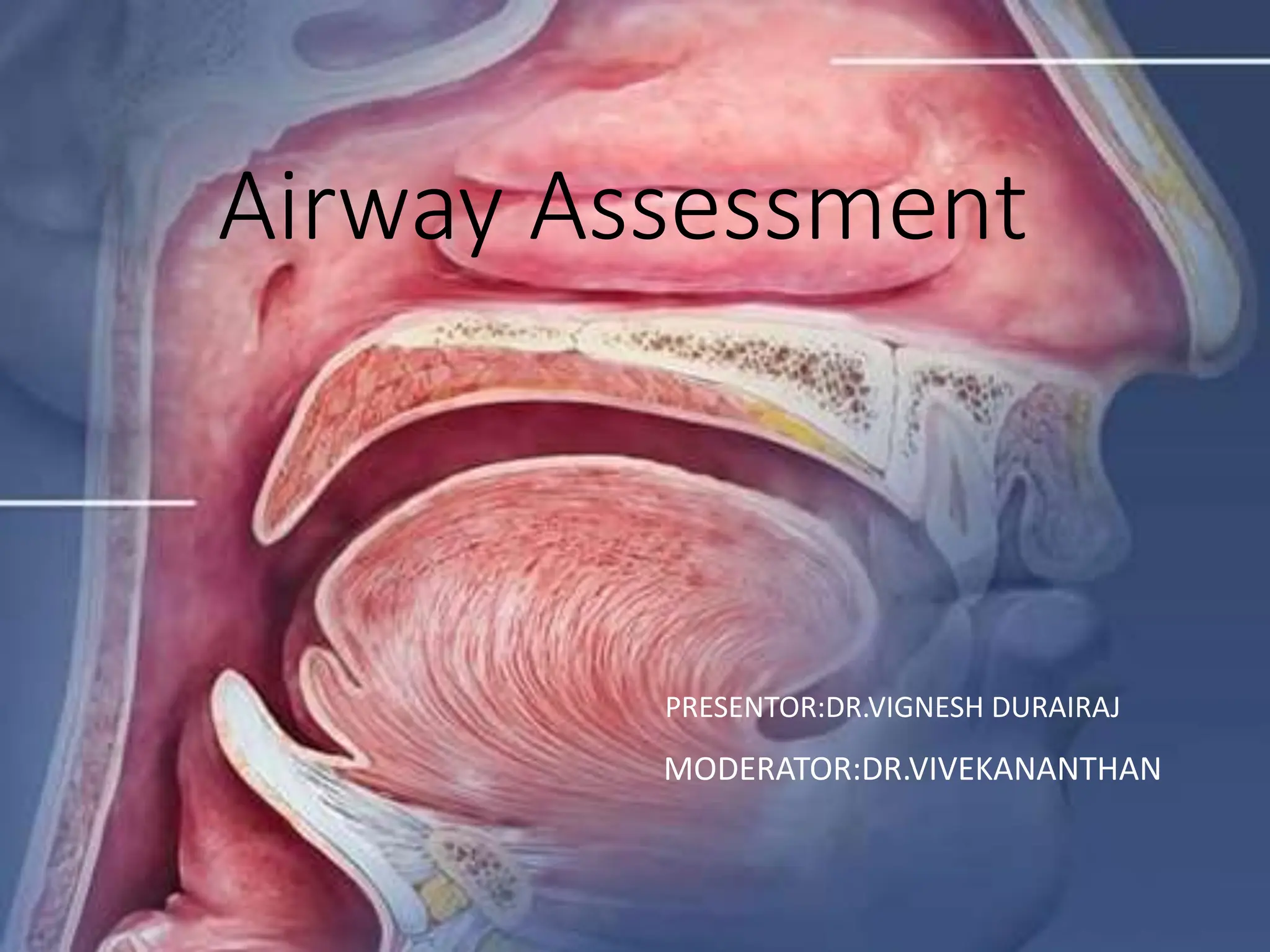
Airway Assessment
PRESENTOR:DR.VIGNESH DURAIRAJ
MODERATOR:DR.VIVEKANANTHAN
• AIRWAY ANATOMY
• HISTORY TAKING
• PHYSICAL EXAMINATION
• PREDICTORS OF DIFFICULT MASK VENTILATION
• PREDICTORS OF DIFFICULT LARYNGOSCOPY AND
INTUBATION
• PREDICTORS OF SUPRAGLOTTIC AIRWAY DEVICE
INSERTION
• PREDICTORS OF DIFFICULTY IN SURGICAL AIRWAY
ACCESS.
Incidence
What is an airway?
The passage through which the air or gas passes
during respiration.
Airway can be divided into upper and lower airway.
Upper airway includes oral cavity, nasal cavity,
pharynx and larynx.
Lower airway includes trachea,bronchi,bronchioles,
alveoli.
Upper airway
• Oral cavity - mouth opening to anterior tonsillar
pillar.(lips,teeth,cheek,tongue)
• Nasal cavity -naris to end of the
turbinates.(Floor,roof,lateral wall,medial wall)
• Nasopharynx - posterior end of turbinate to posterior
pharyngeal wall above the soft palate.(adenoids)
• Orophaynx -soft palate to epiglottis.
(Tonsils,uvula,epiglottis,vallecula).
• Larynx - laryngeal inlet(C3-C4) to lower border of
cricoid cartilage(C6)
Lower airway
• Trachea extends from lower border of cricoid
cartilage (C6) to its division into brochi(T4).
• Trachea divides at carina into left[45 to 55 ] and
right(20 to 25) main bronchus .
• Bronchi
• Brochioles which branch and end up in alveoli.
Why assessment is important?
• Main purpose is to predict difficult airway .
• The ASA defined a difficult airway as
• Proper selection of equipment and technique.
• Optimal patient preparation.
• Participation of experienced personnel.
The clinical situation in which a conventionally trained
anesthesiologist experiences difficulty with mask
ventilation,difficulty with tracheal intubation or both.
Components of airway
assessment
• Proper history taking, general examination and
specific test to predict difficult airway.
• Four pillars of airway management include
1.Mask ventilation
2.Laryngoscopy and tracheal intubation
3.Placement of supraglottic device
4.Performing surgical access to airway.
History taking
• Some features of patients' medical history or records may point to
difficult airway.
• Previous history of difficult airway.
• History of joint disorders like Ankylosing spondylitis,RA,
scleroderma,etc..
• History of irradiation to Head and neck.
• History of previous cervical spine surgeries,Head and neck surgeries.
• History of burns which may lead to fibrosis.
• History of trauma
FACIAL ANAMOLIES
Cleft lip,cleft palate
Mandibular and maxillary
hyperplasia
Traumatic /surgical
disfigurement
NASAL CAVITY
DNS,hypertrophic
turbinates
Tumour,foreign body
Choanal atresia
PHARYNX
Hypertrophic tonsils and
adenoids
Tumours
Retro/parapharyngeal
abscess
Swelling of uvula
ORAL CAVITY
Microstomia
Macroglossia,narrow
arch
Protruded or loose or
missing tooth
Tumour,Ludwig.
angina
LARYNX
Epiglottitis
Foreign body
Tumour,edema
Laryngomalacia
Congenital stenosia
LOWER AIRWAY
Tracheo osophageal
fistula
Tracheitis
Foreign body
Bronchial Tumour
Mass displacing trachea
MASK VENTILATION
• Mask ventilation is a
noninvasive technique for
airway management that can
be used as a primary mode of
ventilation for an anesthetic of
short duration or as a bridge to
establishing of a more
definitive airway.
• The ability to ventilate the
patient always remains the
crucial .
Difficult mask ventilation
• The ASA task force defines it as occurring when "it is
not possible for the unassisted anesthesiologist to maintain
Oxygen saturation >90% using 100% O2 and positive
pressure mask ventilation in a patient whose saturation was
more than 90% before anaesthetic intervention and /or,it is
not possible for unassisted anesthesiologist to prevent or
reverse signs of inadequate ventilation during positive
pressure mask ventilation .
• It is not possible to provide adequate ventilation (confirmed
by etCO2),because of one or more of the following
problem:inadequate mask seal,excessive gas leak or
excessive resistance to ingress or egress of gas.
PREDICTORS OF DIFFICULT MASK
VENTILATION
INDIVIDUAL INDICES
1.Presence of beard
2.OSA or h/o snoring
3.Obesity > 30kg/m2
4.Elderly patient > 55 years
5.Abnormality of teeth,edentulous
6.Mallampatti 3 or 4
7.Male gender
8.Hair bun
GROUP INDICES
• BONES(Beard,Obese,No teeth,Elderly,Snore)
• OBESE(Obese,Beard,Elderly,Snore,Edentulous)
• MIMS(Male,Increasing age,Mallampatti 4,Snore)
• MOANS (Mask seal difficult,Obese,Advanced age,No
teeth,Snorer)
PREDICTORS OF DIFFICULT
LARYNGOSCOPY AND TRACHEAL
INTUBATION
• The ASA defined difficult laryngoscopy as occuring
when"It is not possible to visualize any portion of
vocal cords with conventional laryngoscope. "
• No visualization of vocal cords despite multiple
attempts at laryngoscopy.
• The ASA defined difficult endotracheal intubation as
occurring when"Proper insertion of tracheal tube
with conventional larynsgoscopy requires more than
three attempts or >10 minutes.
INDIVIDUAL INDICES
Physical examination indices
1.Assesment of cervical and atlanto occipital joint
function .
2.Assesment of TMJ function
3.Upper lip bite test
4.Assesment of mandibular space
5.Adequacy of oropharynx for laryngoscopy
6.Assesment of quality of glottic viewing.
7.Sternomental distance
8.Thyroid to floor of mouth
9.Symmetry of upper and lower face
10.Neck circumference and length of neck
Sniffing position or Magill's
position
• Flexion at neck and extension at atlanto occipital
junction facilitates the sniffing position.
• Normal flexion should be > 25 to 30
• Normal Extension should be > 80 to 85
• Normal head /neck rotation should be > 70 to 75.
Cervical and atlanto occipital joint
function
• Direct assessment
Ask the patient to
touch his manubrium
sternum with his/her
chin.
Ask the patient to
look at the ceiling
without raising
eyebrows.
• Indirect assessment
Prayer sign (stiff
joint syndrome)
Palm print
test(tissue glycosylation)
Assessment of TMJ function
• Rotational and forward movement of the condyle
are tested.
• Ask the patient to wide open his mouth and place
his three fingers[index,middle,ring].If done ,this is >
5cm and is adequate.[se-22,spe-94】.
• Index finger - infront of tragus ,thumb- lower part of
mastoid process behind the ear .Ask the patient to
open the mouth.
• CALDER TEST -Protrude the mandible as far as
possible
Upper lip bite test
• It test the range and freedom of mandibular
movement and the architecture of the teeth.
• Class 3 will correspond to CL 3 or 4. ( se 67,spc 92)
Assessment of mandibular space
• This space accompaines the tongue pushed by the
laryngoscopy blade and it also determines how easily
the laryngeal and pharyngeal axis will fall in line when
head is extended.
• HYOMENTAL DISTANCE
Distance between hyoid and mentum when the
neck is fully extended. Grade 3-impossible laryngoscopy
and intubation
Grade 1 :>6cm
Grade 2: 4 to 6 cm
Grade 3:<4cm
Distance between thyroid notch
and mentum when the neck is fully
extended.
>6.5cm -no problem
6- 6.5cm- without other
concomitant anatomical
problems,possible
<6cm - maybe impossible
A modified version is thyromental
distance which is ameasure of
vertical height between anterior
border of thyroid cartilage and
mentum.sensitivity of 83 and
specificity of 99
THYROMENTAL DISTANCE
Adequacy of oropharynx for
laryngoscopy and intubation
• MALLAMPATTI grading
It indicates the amount of space within the oral
cavity in relation to the size of the tongue.
Patient in sitting position,head protrudes forward
and ask the patient to open the mouth as wide as
possible and stick out the tongue without phonation
.Based on the structures visible, grading is given.
Nowadays we use modified Mallampatti proposed by
samsoon and young.
Class 1 - PUSH[91.2]
Class 2-USH[6.3]
Class 3-SH[2.1]
Class 4 -H[0.4]
Class 0
Quality of glottic
viewing during
laryngoscopy
• It can be done by
indirect mirror
laryngoscopy and
direct
laryngoscopy
awake look.
• They provide
better data than
Mallampatti
grading.
POGO scoring
• Percentage of glottic opening seen while directly
visualizing through a scope.
• Entire aperture visible -100%
• If only lower portion of vocal cord and arytenoids
seen - 33%
• When no glottic structure visible - 0 %
Sternomental distance
• It is measured from sternal notch to mentum with
head in full extension and mouth closed.
• Value of less than 12.5 cm predict difficult
intubation.
• Sensitivity of 82 and specificity of 89 % .
•Symmetry of upper and lower face
• Upper face- bridge of nose to nasal septa at upper
lip.Lower face- from septa to mentum.
• If lower face > upper face,then the difficult line up
should be expected.
Neck circumference
• It is commonly increased in obese group of people.
• Men having circumference >17 inch and women
having >16 inch have high risk for difficult
intubation.
• Short neck also a risk factor.
Radiological and advanced indices for
predicting difficult airway
• Lateral xray of neck along with marking between
bony landmarks
Distance between occiput and spinous process of
C1 shoulld be > 5mm
Increase in posterior depth of mandible >2.5 cm
poses problem during laryngoscopy
• Ratio of effective mandibular length to its
posterior depth that is <3.6 predict difficult
laryngoscopy.
• Volume loop curves,mri,fluoroscopy and
oesophagogram can also be used.
Ultrasonography
Useful in
Identification cricothyroid membrane
Localisation of trachea
Quantifying the soft tissue in anterior neck in
obese for predicting difficult intubation.Distance from
skin to anterior aspect of trachea in three zone is
measured and averaged.If average is more than
28mm then it is difficult laryngoscopy.
Zone 1 - vocal cords
Zone 2- thyroid isthmus
Zone 3- suprasternal notch
Group indices
• Wilson scoring system
• benumof 11 parameter analysis
• Lemon law
• Ali magbouls four D
• Rapid airway assessment can be done less than 15
sec in emergency situation.1-2-3finger assessment
test
• 1 finger- tmj joint movement
• 2finger-mouth opening
• 3 finger - thyromental distance
Predictors of difficult placement
/subsequent ventilation with
supraglottic devices
•Restricted mouth opening
•Obstruction of the upper airway
•Disrupted upper airway as following trauma,burns
•Stiff lung (poor lung or thoracic complaine)
Predictors of difficulty in surgical
airway
•Bleeding tendency
•Agitated Patients
•Neck scarring and neck flexion deformity
•Growth or vascular abnormalities in region of
surgical airway.
There is no single method or indicator
which can detect 100% of difficult airway.
Anaesthesia related death are 1 in
10000.Of these 1 in 4 case is due to
difficult airway.
Regret is always the worst.So ,do a
proper airway assessment for each
case.

Airway Assessment in surgery patients -implications

  • 1.
  • 3.
    • AIRWAY ANATOMY •HISTORY TAKING • PHYSICAL EXAMINATION • PREDICTORS OF DIFFICULT MASK VENTILATION • PREDICTORS OF DIFFICULT LARYNGOSCOPY AND INTUBATION • PREDICTORS OF SUPRAGLOTTIC AIRWAY DEVICE INSERTION • PREDICTORS OF DIFFICULTY IN SURGICAL AIRWAY ACCESS.
  • 4.
  • 5.
    What is anairway? The passage through which the air or gas passes during respiration. Airway can be divided into upper and lower airway. Upper airway includes oral cavity, nasal cavity, pharynx and larynx. Lower airway includes trachea,bronchi,bronchioles, alveoli.
  • 8.
    Upper airway • Oralcavity - mouth opening to anterior tonsillar pillar.(lips,teeth,cheek,tongue) • Nasal cavity -naris to end of the turbinates.(Floor,roof,lateral wall,medial wall) • Nasopharynx - posterior end of turbinate to posterior pharyngeal wall above the soft palate.(adenoids) • Orophaynx -soft palate to epiglottis. (Tonsils,uvula,epiglottis,vallecula). • Larynx - laryngeal inlet(C3-C4) to lower border of cricoid cartilage(C6)
  • 9.
    Lower airway • Tracheaextends from lower border of cricoid cartilage (C6) to its division into brochi(T4). • Trachea divides at carina into left[45 to 55 ] and right(20 to 25) main bronchus . • Bronchi • Brochioles which branch and end up in alveoli.
  • 10.
    Why assessment isimportant? • Main purpose is to predict difficult airway . • The ASA defined a difficult airway as • Proper selection of equipment and technique. • Optimal patient preparation. • Participation of experienced personnel. The clinical situation in which a conventionally trained anesthesiologist experiences difficulty with mask ventilation,difficulty with tracheal intubation or both.
  • 11.
    Components of airway assessment •Proper history taking, general examination and specific test to predict difficult airway. • Four pillars of airway management include 1.Mask ventilation 2.Laryngoscopy and tracheal intubation 3.Placement of supraglottic device 4.Performing surgical access to airway.
  • 12.
    History taking • Somefeatures of patients' medical history or records may point to difficult airway. • Previous history of difficult airway. • History of joint disorders like Ankylosing spondylitis,RA, scleroderma,etc.. • History of irradiation to Head and neck. • History of previous cervical spine surgeries,Head and neck surgeries. • History of burns which may lead to fibrosis. • History of trauma
  • 13.
    FACIAL ANAMOLIES Cleft lip,cleftpalate Mandibular and maxillary hyperplasia Traumatic /surgical disfigurement NASAL CAVITY DNS,hypertrophic turbinates Tumour,foreign body Choanal atresia PHARYNX Hypertrophic tonsils and adenoids Tumours Retro/parapharyngeal abscess Swelling of uvula ORAL CAVITY Microstomia Macroglossia,narrow arch Protruded or loose or missing tooth Tumour,Ludwig. angina
  • 14.
    LARYNX Epiglottitis Foreign body Tumour,edema Laryngomalacia Congenital stenosia LOWERAIRWAY Tracheo osophageal fistula Tracheitis Foreign body Bronchial Tumour Mass displacing trachea
  • 15.
    MASK VENTILATION • Maskventilation is a noninvasive technique for airway management that can be used as a primary mode of ventilation for an anesthetic of short duration or as a bridge to establishing of a more definitive airway. • The ability to ventilate the patient always remains the crucial .
  • 16.
    Difficult mask ventilation •The ASA task force defines it as occurring when "it is not possible for the unassisted anesthesiologist to maintain Oxygen saturation >90% using 100% O2 and positive pressure mask ventilation in a patient whose saturation was more than 90% before anaesthetic intervention and /or,it is not possible for unassisted anesthesiologist to prevent or reverse signs of inadequate ventilation during positive pressure mask ventilation . • It is not possible to provide adequate ventilation (confirmed by etCO2),because of one or more of the following problem:inadequate mask seal,excessive gas leak or excessive resistance to ingress or egress of gas.
  • 17.
    PREDICTORS OF DIFFICULTMASK VENTILATION INDIVIDUAL INDICES 1.Presence of beard 2.OSA or h/o snoring 3.Obesity > 30kg/m2 4.Elderly patient > 55 years 5.Abnormality of teeth,edentulous 6.Mallampatti 3 or 4 7.Male gender 8.Hair bun
  • 18.
    GROUP INDICES • BONES(Beard,Obese,Noteeth,Elderly,Snore) • OBESE(Obese,Beard,Elderly,Snore,Edentulous) • MIMS(Male,Increasing age,Mallampatti 4,Snore) • MOANS (Mask seal difficult,Obese,Advanced age,No teeth,Snorer)
  • 19.
    PREDICTORS OF DIFFICULT LARYNGOSCOPYAND TRACHEAL INTUBATION • The ASA defined difficult laryngoscopy as occuring when"It is not possible to visualize any portion of vocal cords with conventional laryngoscope. " • No visualization of vocal cords despite multiple attempts at laryngoscopy. • The ASA defined difficult endotracheal intubation as occurring when"Proper insertion of tracheal tube with conventional larynsgoscopy requires more than three attempts or >10 minutes.
  • 20.
    INDIVIDUAL INDICES Physical examinationindices 1.Assesment of cervical and atlanto occipital joint function . 2.Assesment of TMJ function 3.Upper lip bite test 4.Assesment of mandibular space 5.Adequacy of oropharynx for laryngoscopy 6.Assesment of quality of glottic viewing. 7.Sternomental distance 8.Thyroid to floor of mouth 9.Symmetry of upper and lower face 10.Neck circumference and length of neck
  • 22.
    Sniffing position orMagill's position • Flexion at neck and extension at atlanto occipital junction facilitates the sniffing position. • Normal flexion should be > 25 to 30 • Normal Extension should be > 80 to 85 • Normal head /neck rotation should be > 70 to 75.
  • 23.
    Cervical and atlantooccipital joint function • Direct assessment Ask the patient to touch his manubrium sternum with his/her chin. Ask the patient to look at the ceiling without raising eyebrows. • Indirect assessment Prayer sign (stiff joint syndrome) Palm print test(tissue glycosylation)
  • 25.
    Assessment of TMJfunction • Rotational and forward movement of the condyle are tested. • Ask the patient to wide open his mouth and place his three fingers[index,middle,ring].If done ,this is > 5cm and is adequate.[se-22,spe-94】. • Index finger - infront of tragus ,thumb- lower part of mastoid process behind the ear .Ask the patient to open the mouth. • CALDER TEST -Protrude the mandible as far as possible
  • 27.
    Upper lip bitetest • It test the range and freedom of mandibular movement and the architecture of the teeth. • Class 3 will correspond to CL 3 or 4. ( se 67,spc 92)
  • 28.
    Assessment of mandibularspace • This space accompaines the tongue pushed by the laryngoscopy blade and it also determines how easily the laryngeal and pharyngeal axis will fall in line when head is extended. • HYOMENTAL DISTANCE Distance between hyoid and mentum when the neck is fully extended. Grade 3-impossible laryngoscopy and intubation Grade 1 :>6cm Grade 2: 4 to 6 cm Grade 3:<4cm
  • 29.
    Distance between thyroidnotch and mentum when the neck is fully extended. >6.5cm -no problem 6- 6.5cm- without other concomitant anatomical problems,possible <6cm - maybe impossible A modified version is thyromental distance which is ameasure of vertical height between anterior border of thyroid cartilage and mentum.sensitivity of 83 and specificity of 99 THYROMENTAL DISTANCE
  • 30.
    Adequacy of oropharynxfor laryngoscopy and intubation • MALLAMPATTI grading It indicates the amount of space within the oral cavity in relation to the size of the tongue. Patient in sitting position,head protrudes forward and ask the patient to open the mouth as wide as possible and stick out the tongue without phonation .Based on the structures visible, grading is given. Nowadays we use modified Mallampatti proposed by samsoon and young.
  • 31.
    Class 1 -PUSH[91.2] Class 2-USH[6.3] Class 3-SH[2.1] Class 4 -H[0.4] Class 0
  • 33.
    Quality of glottic viewingduring laryngoscopy • It can be done by indirect mirror laryngoscopy and direct laryngoscopy awake look. • They provide better data than Mallampatti grading.
  • 35.
    POGO scoring • Percentageof glottic opening seen while directly visualizing through a scope. • Entire aperture visible -100% • If only lower portion of vocal cord and arytenoids seen - 33% • When no glottic structure visible - 0 %
  • 36.
    Sternomental distance • Itis measured from sternal notch to mentum with head in full extension and mouth closed. • Value of less than 12.5 cm predict difficult intubation. • Sensitivity of 82 and specificity of 89 % . •Symmetry of upper and lower face • Upper face- bridge of nose to nasal septa at upper lip.Lower face- from septa to mentum. • If lower face > upper face,then the difficult line up should be expected.
  • 37.
    Neck circumference • Itis commonly increased in obese group of people. • Men having circumference >17 inch and women having >16 inch have high risk for difficult intubation. • Short neck also a risk factor.
  • 38.
    Radiological and advancedindices for predicting difficult airway • Lateral xray of neck along with marking between bony landmarks Distance between occiput and spinous process of C1 shoulld be > 5mm Increase in posterior depth of mandible >2.5 cm poses problem during laryngoscopy • Ratio of effective mandibular length to its posterior depth that is <3.6 predict difficult laryngoscopy. • Volume loop curves,mri,fluoroscopy and oesophagogram can also be used.
  • 39.
    Ultrasonography Useful in Identification cricothyroidmembrane Localisation of trachea Quantifying the soft tissue in anterior neck in obese for predicting difficult intubation.Distance from skin to anterior aspect of trachea in three zone is measured and averaged.If average is more than 28mm then it is difficult laryngoscopy. Zone 1 - vocal cords Zone 2- thyroid isthmus Zone 3- suprasternal notch
  • 40.
    Group indices • Wilsonscoring system • benumof 11 parameter analysis • Lemon law • Ali magbouls four D • Rapid airway assessment can be done less than 15 sec in emergency situation.1-2-3finger assessment test • 1 finger- tmj joint movement • 2finger-mouth opening • 3 finger - thyromental distance
  • 43.
    Predictors of difficultplacement /subsequent ventilation with supraglottic devices •Restricted mouth opening •Obstruction of the upper airway •Disrupted upper airway as following trauma,burns •Stiff lung (poor lung or thoracic complaine)
  • 44.
    Predictors of difficultyin surgical airway •Bleeding tendency •Agitated Patients •Neck scarring and neck flexion deformity •Growth or vascular abnormalities in region of surgical airway.
  • 45.
    There is nosingle method or indicator which can detect 100% of difficult airway. Anaesthesia related death are 1 in 10000.Of these 1 in 4 case is due to difficult airway. Regret is always the worst.So ,do a proper airway assessment for each case.