VEGETATIVE MORPHOLOGY- A GENERAL ACCOUNT OF
LEAVES WITH SPECIAL REFERENCE TO LAMINA, BASE,
APEX, MARGIN & SURFACE.
Dr. N. Sannigrahi,
Associate Professor,
Department of Botany,
Nistarini College, Purulia,
D.B.Road, Purulia
723101, India
PRESENTED BY GO GREEN----------------
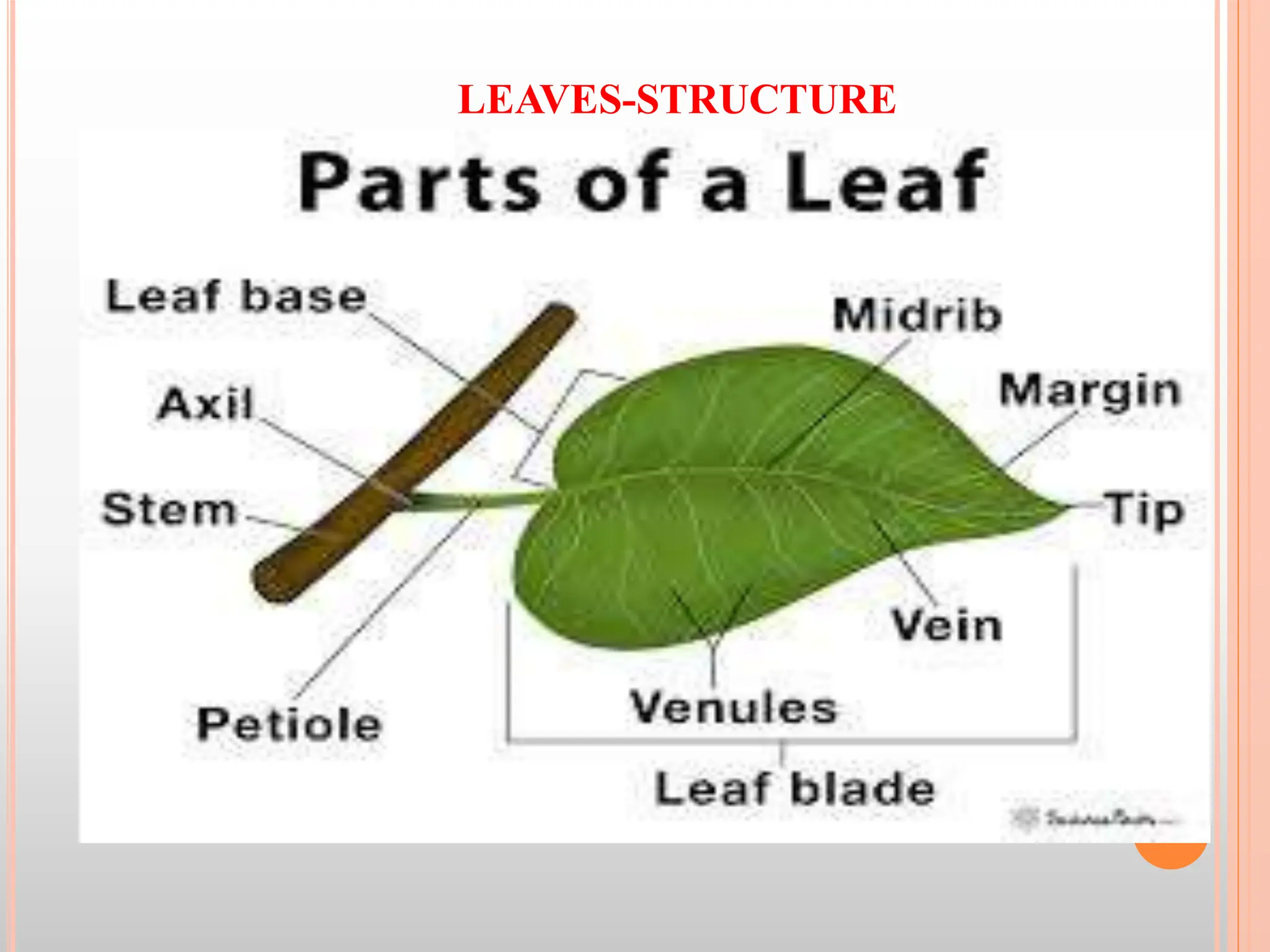
LEAVES-STRUCTURE
 Expanded lateral members of stem, exogenous in origin, develop on stem or
branches in acropetal order bearing buds at their axis is known as leaf.
 Depending on duration, it may be as follows:
 Caducous - leaves fall off very soon as Acacia recurva of Mimosaceae,
 Deciduous- Fall off after one growing season as Ficus benghalensis of
Moraceae, Bombyx ceiba of Bombacaceae, Ficus religiosa of Moraceae,
 Persistent- Remain more than one season as evergreen texture as Artocarpus
heterophyllus of Moraceae, Mangifera indica of Anacardiaceae,
 According to functions, the leaves are-
 Cotyledonary leaves- First embryonic leaf,
 Scale leaves or Cataphylls-thin, scaly, membranous, non-green leaves as in
Zingiber officinale; Scales in Magnolia grandiflora of Magnoliaceae; green
color develop in the aerial shoots of Bambusa tulda of Poaceae, Asparagus
racrmosus etc.
 Prophylls -Few leaves differ from other leaves like Citus sp of Rutaceae
LEAVES-STRUCTURE
 Bract leaves or Hypsophylls -Either in individual flower or at the base of
inflorescence, some leaves of different color may develop like leafy in
Acalypha indica of Euphorbiaceae, petaloid in Bougainvillea spectabilis of
Nyctaginaceae. Ponsettia pulcherrima of Euphorbiaceae, spathe in
Colocasia antiquorum of Araceae, Glume in Triticum aestivum of Poaceae,
Epicalyxes in Hibiscus rosa-sinensis of Malvaceae, involucres in Helianthus
annus in Asteraceae, or cupule in Quercus spicata in Fagaceae etc.
 Floral leaves-Floral leaves like sepal, petal, stamen and carpel,
 Foliage leaves- Common green, leaves with different functions.

LEAVES-STRUCTURE
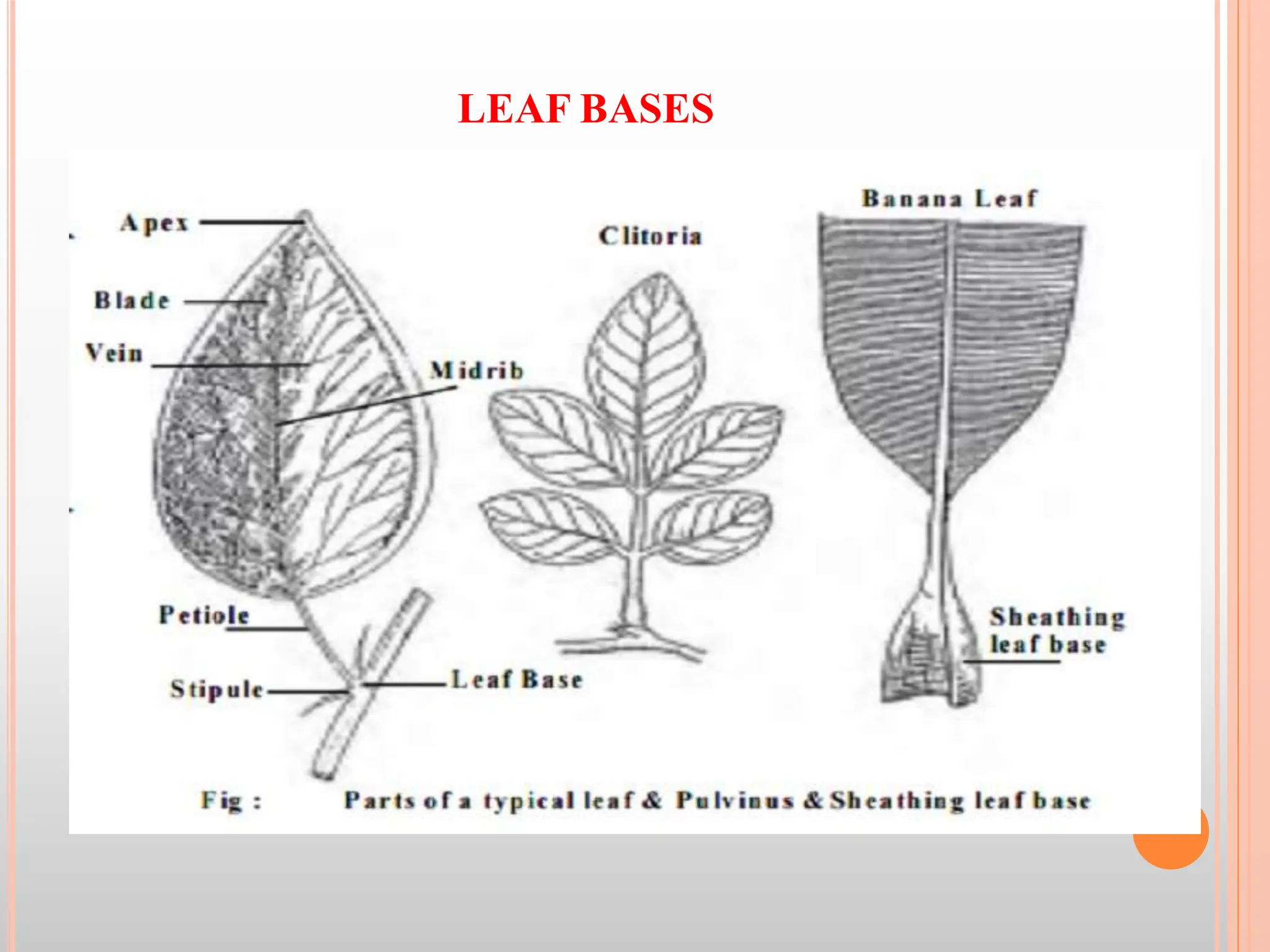
PARTS OF LEAF
 A typical leaf consists of the three main regions-
 Leaf base or Hypopodium - Lowermost part attached to the stem or branch,
 Petiole or Mesopodium-More or less cylindrical and elongated structure,
extending from leaf base to the base of leaf blade,
 Epipodium or Lamina- apical region of the leaf, normally green, thin and
expanded
 All the three parts together constitute Phyllopodium.
 HYPOPODIUM- it may be diverse types having taxonomic significance.
i. Pulvinus -Swollen, forms of cushion structure as found in Mimosa pudica
of Fabaceae, Mangifera indica of Anacardiaceae,
ii. Amplexicaul -Forms a sheath around the stem as found in Polygonum sp.
Of Polygonaceae,
iii. Semi- amplexicaul - Sheath around the stem partially as found in different
members of Rananculaceae, Apiaceae, Musaceae etc,
iv. Decurrent -Leaf-base and petiole becomes flat, broad and winged as
found in Symphytum officinale of Boraginaceae
LEAF BASES
LIGULE, AURICLE & STIPULES
 At the junction of petiole and lamina, the membranous outgrowth appears
called ligules.
 May be scaly or hairy,
 Found in the members of Zingiberaceae and Poaceae.
 AURICLE
 It is the winged expansion of hypopodium continuous with lamina, appears
to be overlapped by such expanded leaf base,
 Found in the members of Oryza sativa of Poaceae, Aegetlitis outundifolia of
Plumbaginaceae
 STIPULES
 Lateral growth of the leaf bases , usually occurs in pairs
 Mostly found in Dicotyledons but rare in monocotyledons,
 With stipule called stipulate as in Hibiscus rosa-sinensis but exstipulate in
Mangifera indica of Anacardiaceae, Psidium guajava of Myrtaceae
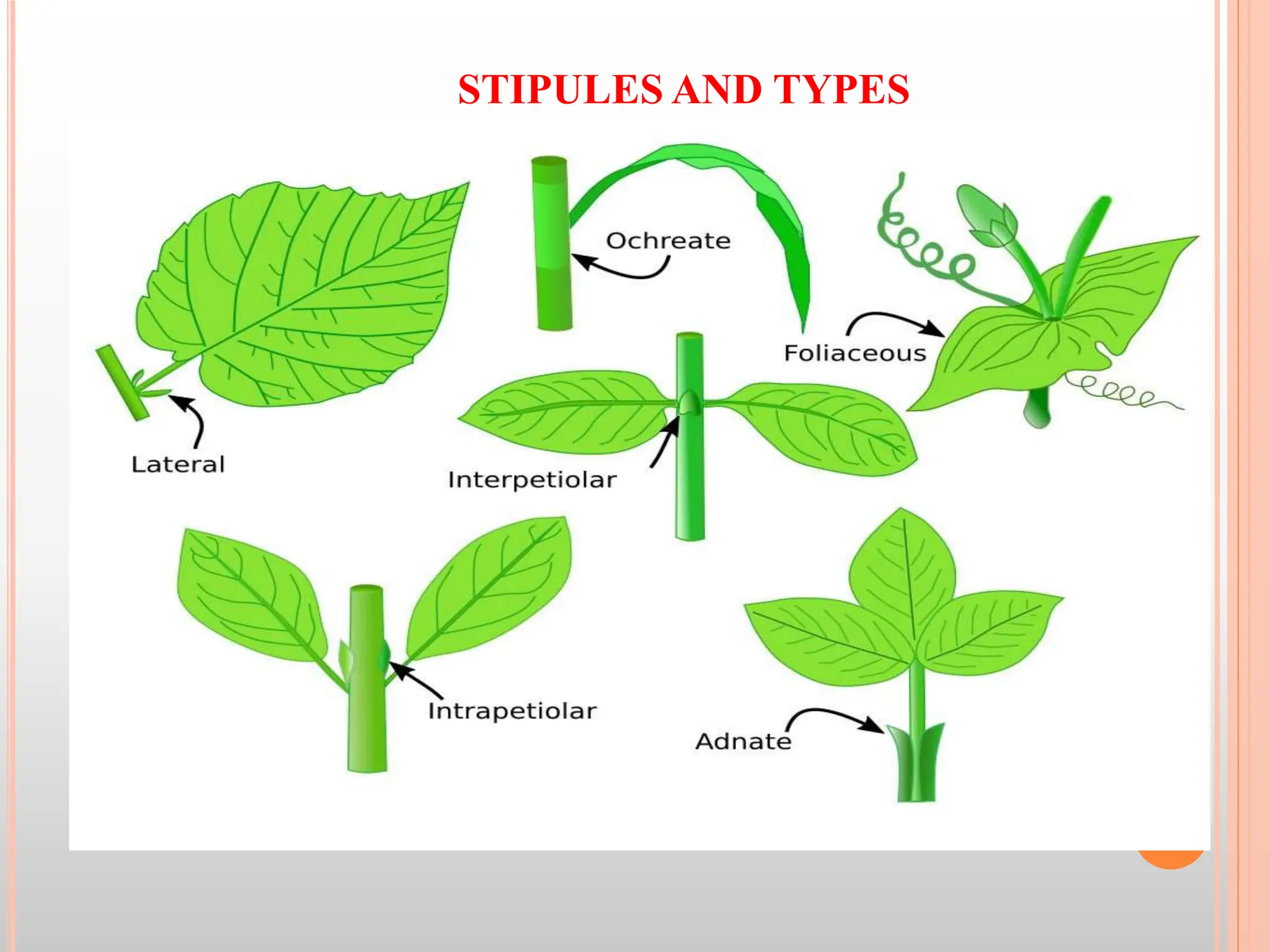
STIPULES AND TYPES
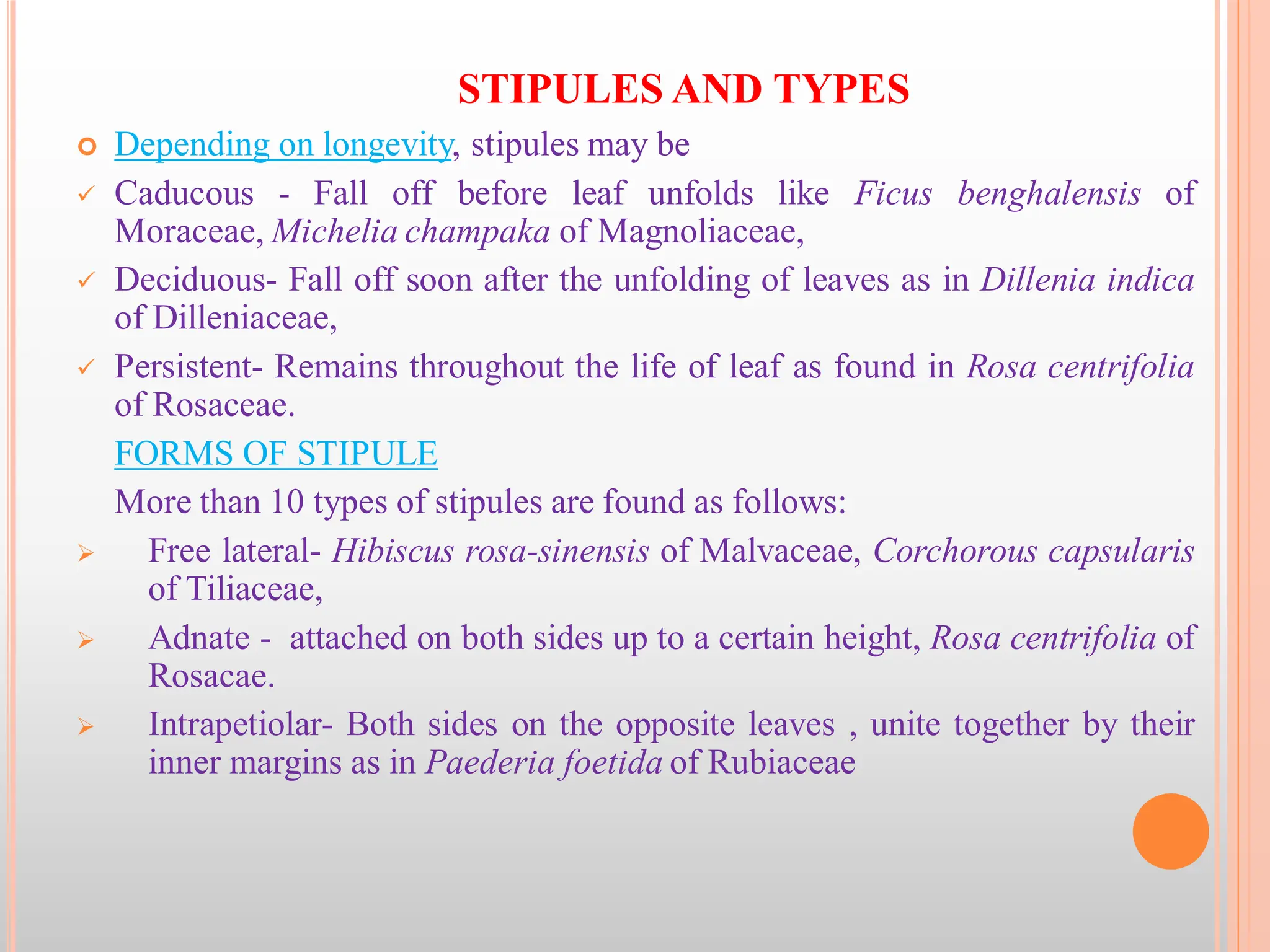
 Depending on longevity, stipules may be
 Caducous - Fall off before leaf unfolds like Ficus benghalensis of
Moraceae, Michelia champaka of Magnoliaceae,
 Deciduous- Fall off soon after the unfolding of leaves as in Dillenia indica
of Dilleniaceae,
 Persistent- Remains throughout the life of leaf as found in Rosa centrifolia
of Rosaceae.
FORMS OF STIPULE
More than 10 types of stipules are found as follows:
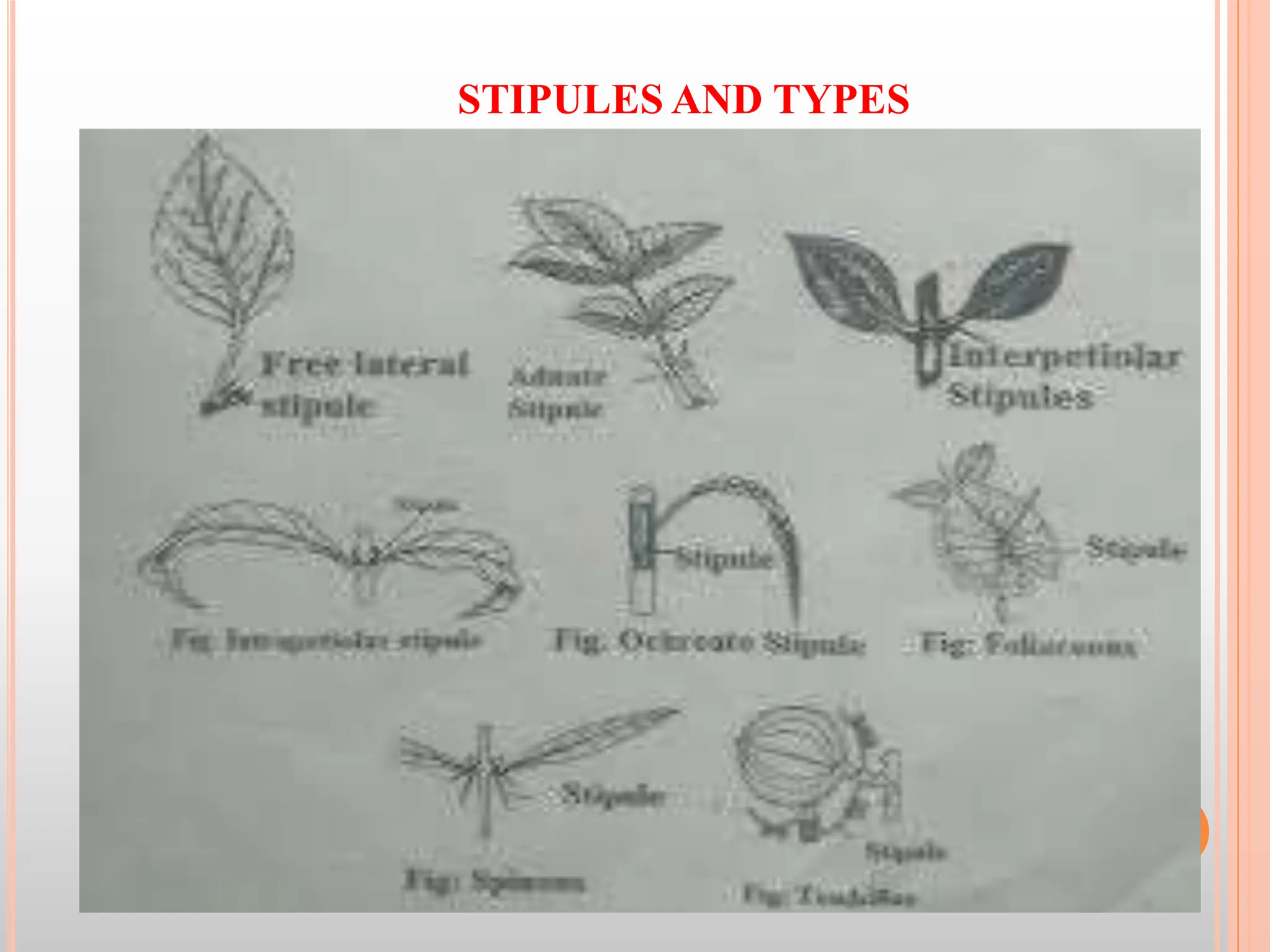
 Free lateral- Hibiscus rosa-sinensis of Malvaceae, Corchorous capsularis
of Tiliaceae,
 Adnate - attached on both sides up to a certain height, Rosa centrifolia of
Rosacae.
 Intrapetiolar- Both sides on the opposite leaves , unite together by their
inner margins as in Paederia foetida of Rubiaceae
STIPULES AND TYPES
STIPULES AND TYPES
 Interpetiolar- Union takes placer between stipules of opposite leaves by
their outer margins , four stipules are transformed into two fused stipules
as in Anthocephalus indicus. Ixora coccinia of Rubiaceae,
 Ocherate- Two stipules developed at the base fuse to form a tube like
structure enclosing a portion of internode as found in Polygonum
orientale of Polygoniaceae, Calamus rotang of Arecaceae etc.
 Foliaceous - stipules are modified into green, large leaf like structures
serve the function of foliage leaf as found in the members of Fabaceae
like Lathyrus aphaca, Pisum sativum.
 Tendrillar- Stipule is modified into tendril as sarsaparilla, Smilax
macrophylla of Liliaceae,
 Spiny- Stipules are modified into spines as in Ziziphus mauritianas of
Rhmnaceae, Acacia arabica of Fabaceae,
 Convolute- Membranous bud coverings but fall off after unfolding of
leaves like Ficus religiosa of Moraceae,
 Winged- wing like structure as in Crotalaria alata of Fabaceae.
STIPULES AND TYPES
MODIFICATIONS OF PETIOLE
 In a compound leaf, leafy growth develops at the base of each leaflet called
stipels as found in Vicia faba, Dolichos lablab , Desmodium gangeticum of
Fabaceae.
 PETIOLE- that connects leaf blade and leaf base; leaf without petiole
called sessile like glory lily, Gloriosa superba of Liliaceae, Mexican poppy,
Argemone mexicana or leaf with petiole called petiolate as found in
Mangifera indica of Anacardiaceae.
 MODIFIED PETIOLE
 WINGED PETIOLE: winged and flattened looks like lamina as in Citrus
sp of Rutaceae, Nepenthes sp. of Nepenthaceae,
 BULBOUS PETIOLE- become swollen and bulbous in aquatic plants
for floating as in water chestnut, Trapa bispinosa of Onagraceae, Eichornia
crassipes of Pontederiaceae.
 PHYLLODE- petiole flattened in vertical plane appear like leaf blade
called phyllode like Acacia moniliformis of Fabaceae,
 SPINE-lamina falls off, petiole turn into spine as in Quisqualis
malabaricum of Combretaceae.
LEAF BLADE OR EPIPODIUM OR LAMINA
 TENDRILAR PETIOLE-Petiole coils around the support and helps the
plant in climbing as Aristolochia indica of Aristolochiaceae, Clematis
gouriana of Ranunculaceae.
 LEAF BLADE OR EPIPODIUM OR LAMINA:
 The flattened part of the leaf comprises a lot of parts; midrib comprises a
mid vein from base to apex; it divides the lamina into two equal halves ,
symmetrical leaf as in mango or the lateral haves are unequal as in Mirabilis
jalapa of Nyctaginaceae called asymmetrical leaf.
 Lamina bears a lot of distinguishing features like shape, base, apex, margin,
surface, texture, venation and many more that speaks about its
morphological diversity.
 SHAPE:
 Lamina with almost same width throughout-
 Acicular- Pinus sp,
 Linear- Polyanthus tuberosa, rice, wheat and many grasses,
LEAF BLADE OR EPIPODIUM OR LAMINA
 Lamina with widest middle:
 Lanceolate - like lance as in Narium indicum of Apocynaceae, Polygonum
orientale of Polygonaceae, Butomopsis lanceolata of Alismataceae,
 Oblong- almost rectangular as in Musa paradisiaca of Musaceae.
 Lamina with widest base:
 Subulate – long and narrow, tapering from base to apex as in Chenopodium
sp of Chenopodiaceae,
 Ovate- Base of lamina wider than apex as in Ficus benghalensis of
Moraceae, Solanum nigrum of Solanaceae, members of Malvaceae,
 Cordate - Heart shaped as in Piper betel of Piperaceae, Members of
Malvaceae
 Sagittate - Arrow shaped like Sagittaria sagittifolia of Alismataceae,
Ipomea aquatica of Convolvulaceae,
 Reniform -Kidney shaped as in Centella asatica of Apiaceae,
 Lunate - Half moon like as in Passiflora lunata of Passifloraceae.
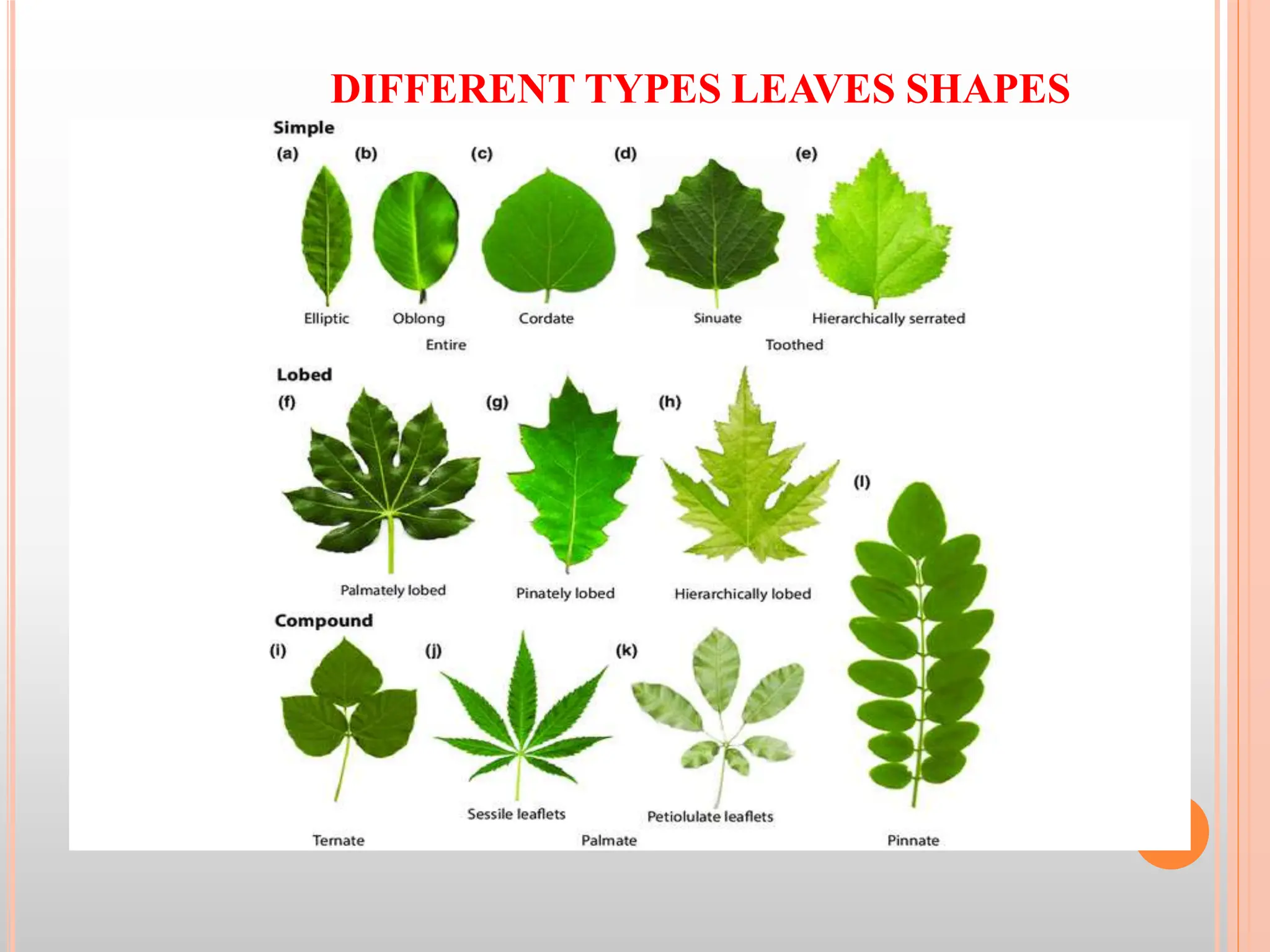
DIFFERENT TYPES LEAVES SHAPES
LEAF BLADE OR EPIPODIUM OR LAMINA
 LAMINA WITH WIDEST APEX:
 Obovate - Lamina like inverted egg as in Jackfruit, Artocarpus
heterophyllus of Moraceae, Cassia obovate in Fabaceae etc.
 Obcordate -Lamina like inverted heart like Bauhinia varigata of Fabaceae,
Oxalis corniculata of Oxalidaceae.
 Spathulate- Lamina is broad and rounded at the apex and gradually tapers
toward the base as in found in Phyla nodiflora and Duranta repens of
Verbenaceae, Drosera burmanii of Droseraceae.
 Cuneate- Lamina looks like hood of a snake as in water lettuce , Pistia
straiotes of Araceae.
 Lyrate- Lamina looks like lyre having large oval terminal lobe and two or
more smaller lobes as in found in Raphanus sativus , Brassica nigra of
Brassicaceae.
LAMINA SYMMETRICAL
Elliptical-Lamina like ellipse as in Indian rubber, Ficus elastica of
Moraceae, Guava, Psidium guajava of Myrtacae
LEAF BLADE OR EPIPODIUM OR LAMINA
 Orbicular: Lamina is circular and petiole is attached below the centre and
the leaf looks like umbrella as found in Nelumbo nucifra of Nymphaceae.
 BASE OF LAMINA
 Auriculate : Leaf base of the sessile leaves form two lobes like that of wings
partially round the stem as found in Argemone mexicana of Papaveraceae,
Calotropis procera of Asclepiadaceae,
 Perfoliate - Lobes of sessile leaf become fused together and the leaf
completely surrounds stem as found in Aloe perfoliata of Liliaceae,
 Connate- Bases of two sessile leaves with opposite phylotaxy are
completely fused together in Canscora diffusa and Swertia chirata of
Gentianaceae.
 Decurrent - Leaf base is winged and fused with the stem as found in
Laggera alata , Sphaeranthus indicus of Asteraceae.
SURFACE OF LAMINA
 GLABROUS: surface smooth without hairs as in Pongamia glabra of
Fabaceae, Dianthus chinensis of Caryophyllaceae.
 GLAUCUS: Surface with waxy coating , shiny as Solanum glaucum of
Solanaceae.
 VISCOSE: surface sticky due to sugary exudation as Cleome viscosa ,
Polanisia icosandra of Capparidaceae.
 SCABROUS: Rough due to some short rigid points as Ficus hispida of
Moraceae,
 RUGOSE: Surface is somewhat wrinkled as Rubus rugosus of Rosaceae.
 GLAND-DOTTED: Lamina becomes covered with glands as Lemon,
Citrus aurantifolia of Rutaceae.
 HAIIRY: Surface with different type of hairs like
 Pilose- Long, soft, scattered hairs as Grewia flavescens of Tiliaceae,
 Hispid-Rigid scattered hairs as Cucurbitis sp.
 Hirsute-Stiff, fine scattered hairs in Eclipta alba of Asteraceae.
SURFACE OF LAMINA
 Tomentose - Covered with stiff, fine and scattered hairs in Calotropis
procera of Asclepiadaceae, Guazuma tomentosa of Sterculiaceae.
 Wooly- Surface with long and interwoven hairs like wool as in Solanum
verbescifolium of Solanaceae.
 MARGIN OF LAMINA
 Entire: Margin is smooth like Mangifera indica , Ficus benghalensis ,
 Repend: Wavy with indentations like Polyalthia longiofolia of Annonaceae,
 Serrate: Margin is like teeth of a saw pointed upwards like Hibiscus rosa-
sinensis,
 Biserrate: Margin toothed but teeth becomes serrated like elm tree , Ulmus
sp. Of Ulmaceae,
 Retroserrate: Toothed and pointed downwards .
 Dentate: Margin dentate but pointed downward at right angles to midrib like
water-lily.
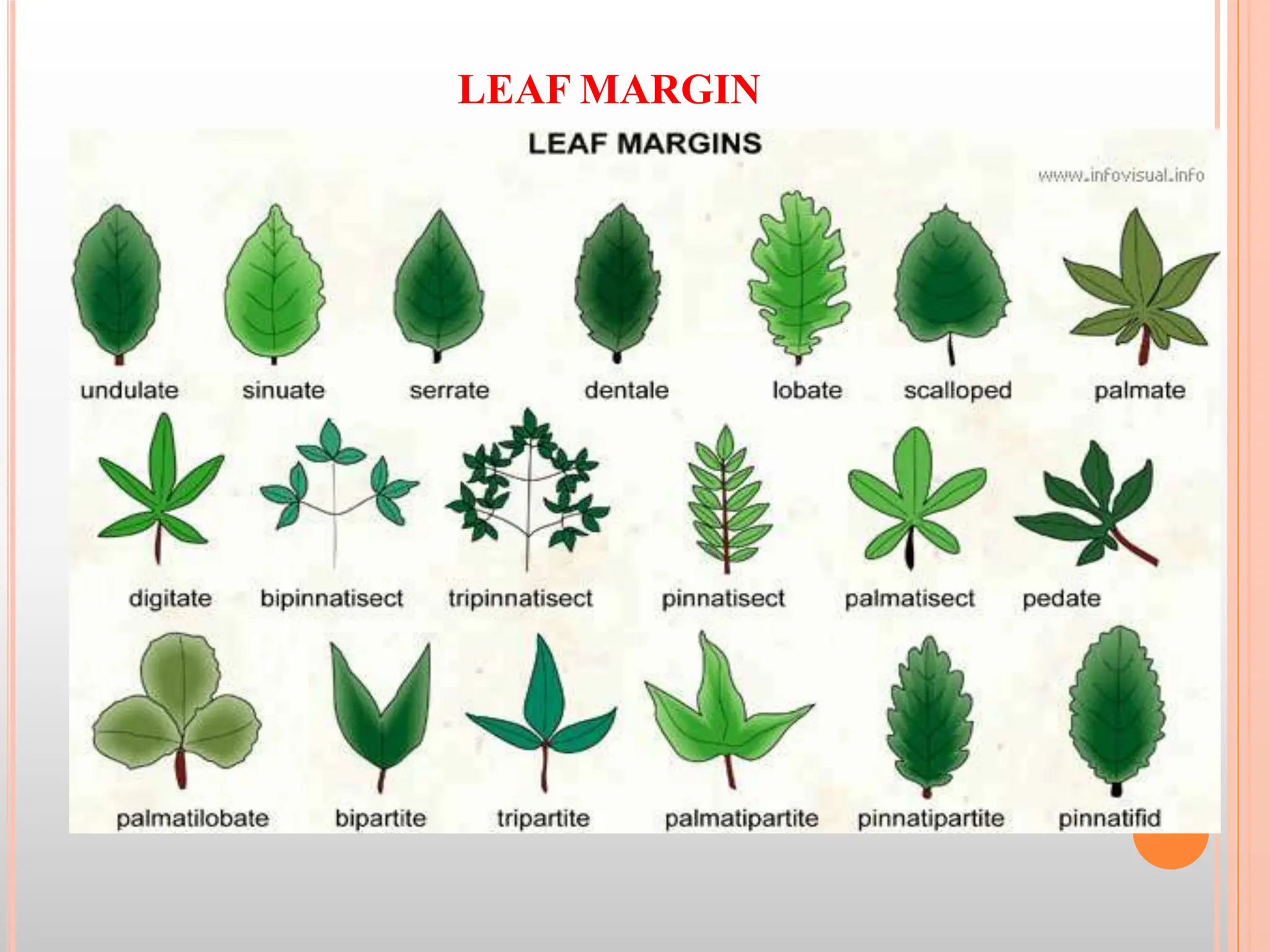
LEAF MARGIN
LEAF MARGIN
 Bi-dentate - Margin is toothed and teeth are again dentate,
 Crenate- Margin is toothed and teeth are rounded like Centella asiatica of
Apiaceae,
 Spiny- toothed margin and teeth are pointed to form spines as in Mexican
poppy , Argemone mexicana of Papaveraceae, Solanum xanthocarpum of
Solanaceae,
 Lobed- Margin incised into various depths and divided into small
lobes like Brassica niger, Raphanus sativus of Brassicaceae.
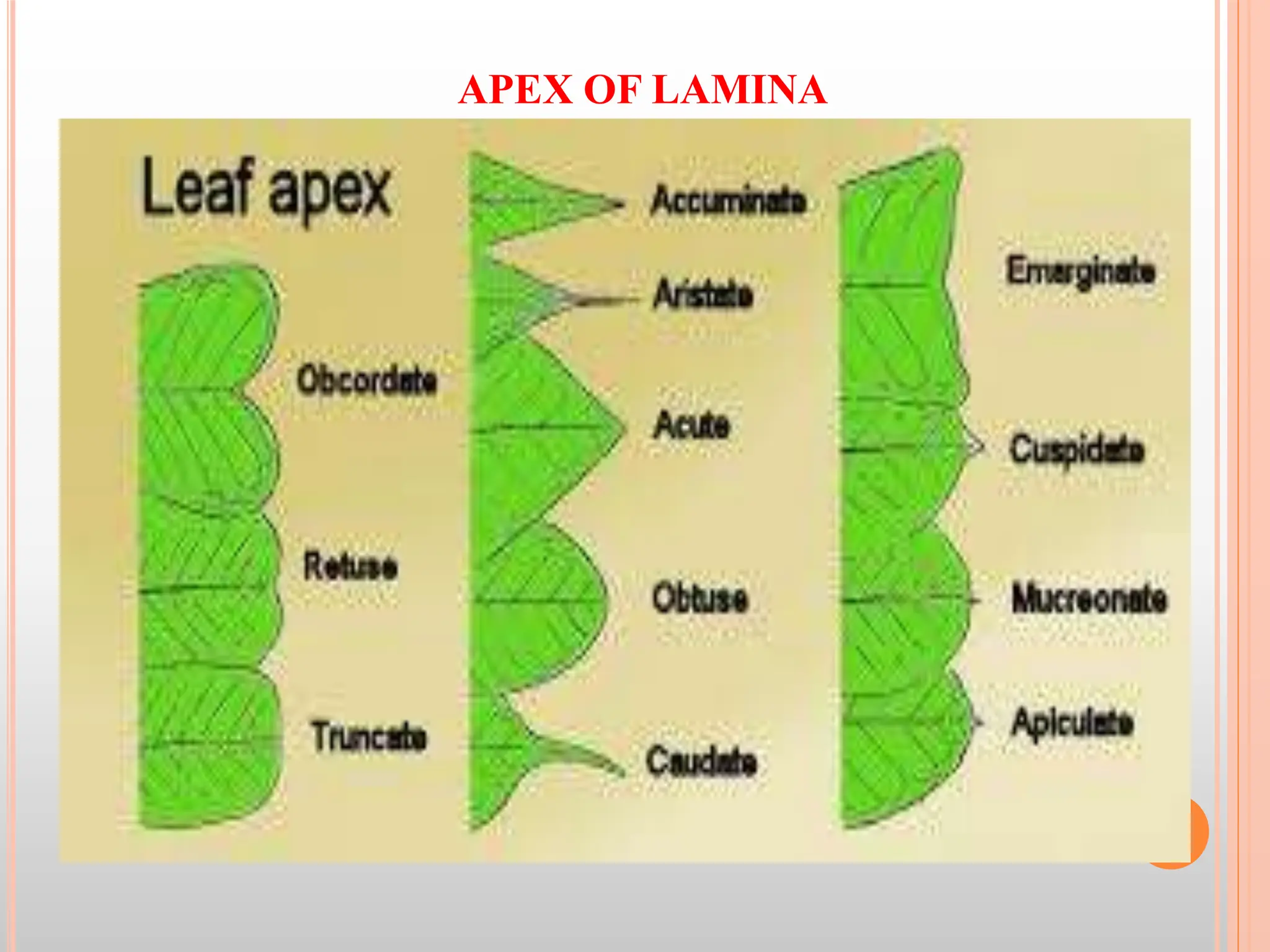
APEX OF LAMINA
 The apex of the lamina may be of different types and it plays a significant
role in plant taxonomy. These are as follows:
 ACUTE- Apex is pointed forming a terminal angle of 45º-90º like
Mangifera indica, Hibiscus rosa-sinensis and many more.
 ACUMINATE- Slender, much prolonged like a tapering tail; forming aq
terminal angle of <45º like Ficus religiosa, Bauhinia acuminata etc.
 OBTUSE- Apex broad >90º and blunt as in Ficus benghalensis,
 MUCRONATE- Apex is broad as a broader than long and forms a sharp
point like Catharanthus roseus,
 CUSPIDATE / SPINY- apex ends in a hard and pointed structure like
Phoenix sylvestris , Agave cantula etc.
 TENDRILLAR- Apex becomes narrowed and forms a tendril like Gloriosa
superba of Liliaceae,
 CIRRHOSE- Apex ends in a fine thread like structure like Musa paradisica
etc.
APEX OF LAMINA
TEXTURE OF LAMINA
 TRUNCATE- Apex is cut across abruptly, almost right angle to midrib as in
Indigofera linifolia of Fabaceae, Paris polyphylla of Liliaceae,
 RETUSE-Obtuse apex is slightly notched like Clitorea ternetea of
Fabaceae, water lettuce, Pistia stratiotes of Araceae etc.
 EMARGINATE- Obtuse apex is deeply notched as in Bauhinia variegata of
Fabaceae.
 TEXTURE OF LAMINA
 Texture is one of the indicative taxonomic characters and it plays significant
role in plant identification. These are as follows:
 CORIACEOUS- Lamina thick and leathery as in Mangifra indica, Ficus
elastica, Vanda roxburghii etc.
 HERBACEOUS- Lamina thin and membranous as in Hibiscus rosa-
sinensis, Rosa centifolia etc.
 SUCCULENT- Fleshy and more or less brittle as in Aloe indica,
Bryophyllum calycinum etc.
TEXTURE OF LAMINA
 GLANDULAR-Lamina is dotted with glands and filled with essential oils
as in Citrus limon of Rutaceae, Custard apple, Annona squamosa of
Annonaceae etc.
 SIGNIFICANCE OF LEAF MORPHOLOGY:
 Classical taxonomy or alpha taxonomy mainly based on the morphological
characters,
 The leaf character like Shape, texture, base, apex, margins and many more
become important information to a plant taxonomists for the identification
of plant at the rank of genera and species,
 These characters are very important to address the different taxonomic
problems in the classical plant biology.
BE FEARLESS IN PURSING YOUR DREAMS EVEN IF THEY SEEM
IMPOSSIBLE”
THANKS TO VISIT THE CONTENT
 References:
 Google for different images incorporated into this PPT,
 Different WebPages for reference and content,
 Disclaimer:
 This presentation has been made and designed as the free open source of
study materials intended for the academic fraternity. The presenter does not
claim any kind of financial interest for this work. It is completely free for
use.

Morphology of Leaf with special reference to leaf shape, surface, margin, apex, base.

  • 1.
    VEGETATIVE MORPHOLOGY- AGENERAL ACCOUNT OF LEAVES WITH SPECIAL REFERENCE TO LAMINA, BASE, APEX, MARGIN & SURFACE. Dr. N. Sannigrahi, Associate Professor, Department of Botany, Nistarini College, Purulia, D.B.Road, Purulia 723101, India PRESENTED BY GO GREEN----------------
  • 2.
    LEAVES-STRUCTURE  Expanded lateralmembers of stem, exogenous in origin, develop on stem or branches in acropetal order bearing buds at their axis is known as leaf.  Depending on duration, it may be as follows:  Caducous - leaves fall off very soon as Acacia recurva of Mimosaceae,  Deciduous- Fall off after one growing season as Ficus benghalensis of Moraceae, Bombyx ceiba of Bombacaceae, Ficus religiosa of Moraceae,  Persistent- Remain more than one season as evergreen texture as Artocarpus heterophyllus of Moraceae, Mangifera indica of Anacardiaceae,  According to functions, the leaves are-  Cotyledonary leaves- First embryonic leaf,  Scale leaves or Cataphylls-thin, scaly, membranous, non-green leaves as in Zingiber officinale; Scales in Magnolia grandiflora of Magnoliaceae; green color develop in the aerial shoots of Bambusa tulda of Poaceae, Asparagus racrmosus etc.  Prophylls -Few leaves differ from other leaves like Citus sp of Rutaceae
  • 3.
    LEAVES-STRUCTURE  Bract leavesor Hypsophylls -Either in individual flower or at the base of inflorescence, some leaves of different color may develop like leafy in Acalypha indica of Euphorbiaceae, petaloid in Bougainvillea spectabilis of Nyctaginaceae. Ponsettia pulcherrima of Euphorbiaceae, spathe in Colocasia antiquorum of Araceae, Glume in Triticum aestivum of Poaceae, Epicalyxes in Hibiscus rosa-sinensis of Malvaceae, involucres in Helianthus annus in Asteraceae, or cupule in Quercus spicata in Fagaceae etc.  Floral leaves-Floral leaves like sepal, petal, stamen and carpel,  Foliage leaves- Common green, leaves with different functions. 
  • 4.
  • 5.
    PARTS OF LEAF A typical leaf consists of the three main regions-  Leaf base or Hypopodium - Lowermost part attached to the stem or branch,  Petiole or Mesopodium-More or less cylindrical and elongated structure, extending from leaf base to the base of leaf blade,  Epipodium or Lamina- apical region of the leaf, normally green, thin and expanded  All the three parts together constitute Phyllopodium.  HYPOPODIUM- it may be diverse types having taxonomic significance. i. Pulvinus -Swollen, forms of cushion structure as found in Mimosa pudica of Fabaceae, Mangifera indica of Anacardiaceae, ii. Amplexicaul -Forms a sheath around the stem as found in Polygonum sp. Of Polygonaceae, iii. Semi- amplexicaul - Sheath around the stem partially as found in different members of Rananculaceae, Apiaceae, Musaceae etc, iv. Decurrent -Leaf-base and petiole becomes flat, broad and winged as found in Symphytum officinale of Boraginaceae
  • 6.
  • 7.
    LIGULE, AURICLE &STIPULES  At the junction of petiole and lamina, the membranous outgrowth appears called ligules.  May be scaly or hairy,  Found in the members of Zingiberaceae and Poaceae.  AURICLE  It is the winged expansion of hypopodium continuous with lamina, appears to be overlapped by such expanded leaf base,  Found in the members of Oryza sativa of Poaceae, Aegetlitis outundifolia of Plumbaginaceae  STIPULES  Lateral growth of the leaf bases , usually occurs in pairs  Mostly found in Dicotyledons but rare in monocotyledons,  With stipule called stipulate as in Hibiscus rosa-sinensis but exstipulate in Mangifera indica of Anacardiaceae, Psidium guajava of Myrtaceae
  • 8.
    STIPULES AND TYPES Depending on longevity, stipules may be  Caducous - Fall off before leaf unfolds like Ficus benghalensis of Moraceae, Michelia champaka of Magnoliaceae,  Deciduous- Fall off soon after the unfolding of leaves as in Dillenia indica of Dilleniaceae,  Persistent- Remains throughout the life of leaf as found in Rosa centrifolia of Rosaceae. FORMS OF STIPULE More than 10 types of stipules are found as follows:  Free lateral- Hibiscus rosa-sinensis of Malvaceae, Corchorous capsularis of Tiliaceae,  Adnate - attached on both sides up to a certain height, Rosa centrifolia of Rosacae.  Intrapetiolar- Both sides on the opposite leaves , unite together by their inner margins as in Paederia foetida of Rubiaceae
  • 9.
  • 10.
    STIPULES AND TYPES Interpetiolar- Union takes placer between stipules of opposite leaves by their outer margins , four stipules are transformed into two fused stipules as in Anthocephalus indicus. Ixora coccinia of Rubiaceae,  Ocherate- Two stipules developed at the base fuse to form a tube like structure enclosing a portion of internode as found in Polygonum orientale of Polygoniaceae, Calamus rotang of Arecaceae etc.  Foliaceous - stipules are modified into green, large leaf like structures serve the function of foliage leaf as found in the members of Fabaceae like Lathyrus aphaca, Pisum sativum.  Tendrillar- Stipule is modified into tendril as sarsaparilla, Smilax macrophylla of Liliaceae,  Spiny- Stipules are modified into spines as in Ziziphus mauritianas of Rhmnaceae, Acacia arabica of Fabaceae,  Convolute- Membranous bud coverings but fall off after unfolding of leaves like Ficus religiosa of Moraceae,  Winged- wing like structure as in Crotalaria alata of Fabaceae.
  • 11.
  • 12.
    MODIFICATIONS OF PETIOLE In a compound leaf, leafy growth develops at the base of each leaflet called stipels as found in Vicia faba, Dolichos lablab , Desmodium gangeticum of Fabaceae.  PETIOLE- that connects leaf blade and leaf base; leaf without petiole called sessile like glory lily, Gloriosa superba of Liliaceae, Mexican poppy, Argemone mexicana or leaf with petiole called petiolate as found in Mangifera indica of Anacardiaceae.  MODIFIED PETIOLE  WINGED PETIOLE: winged and flattened looks like lamina as in Citrus sp of Rutaceae, Nepenthes sp. of Nepenthaceae,  BULBOUS PETIOLE- become swollen and bulbous in aquatic plants for floating as in water chestnut, Trapa bispinosa of Onagraceae, Eichornia crassipes of Pontederiaceae.  PHYLLODE- petiole flattened in vertical plane appear like leaf blade called phyllode like Acacia moniliformis of Fabaceae,  SPINE-lamina falls off, petiole turn into spine as in Quisqualis malabaricum of Combretaceae.
  • 13.
    LEAF BLADE OREPIPODIUM OR LAMINA  TENDRILAR PETIOLE-Petiole coils around the support and helps the plant in climbing as Aristolochia indica of Aristolochiaceae, Clematis gouriana of Ranunculaceae.  LEAF BLADE OR EPIPODIUM OR LAMINA:  The flattened part of the leaf comprises a lot of parts; midrib comprises a mid vein from base to apex; it divides the lamina into two equal halves , symmetrical leaf as in mango or the lateral haves are unequal as in Mirabilis jalapa of Nyctaginaceae called asymmetrical leaf.  Lamina bears a lot of distinguishing features like shape, base, apex, margin, surface, texture, venation and many more that speaks about its morphological diversity.  SHAPE:  Lamina with almost same width throughout-  Acicular- Pinus sp,  Linear- Polyanthus tuberosa, rice, wheat and many grasses,
  • 14.
    LEAF BLADE OREPIPODIUM OR LAMINA  Lamina with widest middle:  Lanceolate - like lance as in Narium indicum of Apocynaceae, Polygonum orientale of Polygonaceae, Butomopsis lanceolata of Alismataceae,  Oblong- almost rectangular as in Musa paradisiaca of Musaceae.  Lamina with widest base:  Subulate – long and narrow, tapering from base to apex as in Chenopodium sp of Chenopodiaceae,  Ovate- Base of lamina wider than apex as in Ficus benghalensis of Moraceae, Solanum nigrum of Solanaceae, members of Malvaceae,  Cordate - Heart shaped as in Piper betel of Piperaceae, Members of Malvaceae  Sagittate - Arrow shaped like Sagittaria sagittifolia of Alismataceae, Ipomea aquatica of Convolvulaceae,  Reniform -Kidney shaped as in Centella asatica of Apiaceae,  Lunate - Half moon like as in Passiflora lunata of Passifloraceae.
  • 15.
  • 16.
    LEAF BLADE OREPIPODIUM OR LAMINA  LAMINA WITH WIDEST APEX:  Obovate - Lamina like inverted egg as in Jackfruit, Artocarpus heterophyllus of Moraceae, Cassia obovate in Fabaceae etc.  Obcordate -Lamina like inverted heart like Bauhinia varigata of Fabaceae, Oxalis corniculata of Oxalidaceae.  Spathulate- Lamina is broad and rounded at the apex and gradually tapers toward the base as in found in Phyla nodiflora and Duranta repens of Verbenaceae, Drosera burmanii of Droseraceae.  Cuneate- Lamina looks like hood of a snake as in water lettuce , Pistia straiotes of Araceae.  Lyrate- Lamina looks like lyre having large oval terminal lobe and two or more smaller lobes as in found in Raphanus sativus , Brassica nigra of Brassicaceae. LAMINA SYMMETRICAL Elliptical-Lamina like ellipse as in Indian rubber, Ficus elastica of Moraceae, Guava, Psidium guajava of Myrtacae
  • 17.
    LEAF BLADE OREPIPODIUM OR LAMINA  Orbicular: Lamina is circular and petiole is attached below the centre and the leaf looks like umbrella as found in Nelumbo nucifra of Nymphaceae.  BASE OF LAMINA  Auriculate : Leaf base of the sessile leaves form two lobes like that of wings partially round the stem as found in Argemone mexicana of Papaveraceae, Calotropis procera of Asclepiadaceae,  Perfoliate - Lobes of sessile leaf become fused together and the leaf completely surrounds stem as found in Aloe perfoliata of Liliaceae,  Connate- Bases of two sessile leaves with opposite phylotaxy are completely fused together in Canscora diffusa and Swertia chirata of Gentianaceae.  Decurrent - Leaf base is winged and fused with the stem as found in Laggera alata , Sphaeranthus indicus of Asteraceae.
  • 18.
    SURFACE OF LAMINA GLABROUS: surface smooth without hairs as in Pongamia glabra of Fabaceae, Dianthus chinensis of Caryophyllaceae.  GLAUCUS: Surface with waxy coating , shiny as Solanum glaucum of Solanaceae.  VISCOSE: surface sticky due to sugary exudation as Cleome viscosa , Polanisia icosandra of Capparidaceae.  SCABROUS: Rough due to some short rigid points as Ficus hispida of Moraceae,  RUGOSE: Surface is somewhat wrinkled as Rubus rugosus of Rosaceae.  GLAND-DOTTED: Lamina becomes covered with glands as Lemon, Citrus aurantifolia of Rutaceae.  HAIIRY: Surface with different type of hairs like  Pilose- Long, soft, scattered hairs as Grewia flavescens of Tiliaceae,  Hispid-Rigid scattered hairs as Cucurbitis sp.  Hirsute-Stiff, fine scattered hairs in Eclipta alba of Asteraceae.
  • 19.
    SURFACE OF LAMINA Tomentose - Covered with stiff, fine and scattered hairs in Calotropis procera of Asclepiadaceae, Guazuma tomentosa of Sterculiaceae.  Wooly- Surface with long and interwoven hairs like wool as in Solanum verbescifolium of Solanaceae.  MARGIN OF LAMINA  Entire: Margin is smooth like Mangifera indica , Ficus benghalensis ,  Repend: Wavy with indentations like Polyalthia longiofolia of Annonaceae,  Serrate: Margin is like teeth of a saw pointed upwards like Hibiscus rosa- sinensis,  Biserrate: Margin toothed but teeth becomes serrated like elm tree , Ulmus sp. Of Ulmaceae,  Retroserrate: Toothed and pointed downwards .  Dentate: Margin dentate but pointed downward at right angles to midrib like water-lily.
  • 20.
  • 21.
    LEAF MARGIN  Bi-dentate- Margin is toothed and teeth are again dentate,  Crenate- Margin is toothed and teeth are rounded like Centella asiatica of Apiaceae,  Spiny- toothed margin and teeth are pointed to form spines as in Mexican poppy , Argemone mexicana of Papaveraceae, Solanum xanthocarpum of Solanaceae,  Lobed- Margin incised into various depths and divided into small lobes like Brassica niger, Raphanus sativus of Brassicaceae.
  • 22.
    APEX OF LAMINA The apex of the lamina may be of different types and it plays a significant role in plant taxonomy. These are as follows:  ACUTE- Apex is pointed forming a terminal angle of 45º-90º like Mangifera indica, Hibiscus rosa-sinensis and many more.  ACUMINATE- Slender, much prolonged like a tapering tail; forming aq terminal angle of <45º like Ficus religiosa, Bauhinia acuminata etc.  OBTUSE- Apex broad >90º and blunt as in Ficus benghalensis,  MUCRONATE- Apex is broad as a broader than long and forms a sharp point like Catharanthus roseus,  CUSPIDATE / SPINY- apex ends in a hard and pointed structure like Phoenix sylvestris , Agave cantula etc.  TENDRILLAR- Apex becomes narrowed and forms a tendril like Gloriosa superba of Liliaceae,  CIRRHOSE- Apex ends in a fine thread like structure like Musa paradisica etc.
  • 23.
  • 24.
    TEXTURE OF LAMINA TRUNCATE- Apex is cut across abruptly, almost right angle to midrib as in Indigofera linifolia of Fabaceae, Paris polyphylla of Liliaceae,  RETUSE-Obtuse apex is slightly notched like Clitorea ternetea of Fabaceae, water lettuce, Pistia stratiotes of Araceae etc.  EMARGINATE- Obtuse apex is deeply notched as in Bauhinia variegata of Fabaceae.  TEXTURE OF LAMINA  Texture is one of the indicative taxonomic characters and it plays significant role in plant identification. These are as follows:  CORIACEOUS- Lamina thick and leathery as in Mangifra indica, Ficus elastica, Vanda roxburghii etc.  HERBACEOUS- Lamina thin and membranous as in Hibiscus rosa- sinensis, Rosa centifolia etc.  SUCCULENT- Fleshy and more or less brittle as in Aloe indica, Bryophyllum calycinum etc.
  • 25.
    TEXTURE OF LAMINA GLANDULAR-Lamina is dotted with glands and filled with essential oils as in Citrus limon of Rutaceae, Custard apple, Annona squamosa of Annonaceae etc.  SIGNIFICANCE OF LEAF MORPHOLOGY:  Classical taxonomy or alpha taxonomy mainly based on the morphological characters,  The leaf character like Shape, texture, base, apex, margins and many more become important information to a plant taxonomists for the identification of plant at the rank of genera and species,  These characters are very important to address the different taxonomic problems in the classical plant biology.
  • 26.
    BE FEARLESS INPURSING YOUR DREAMS EVEN IF THEY SEEM IMPOSSIBLE”
  • 27.
    THANKS TO VISITTHE CONTENT  References:  Google for different images incorporated into this PPT,  Different WebPages for reference and content,  Disclaimer:  This presentation has been made and designed as the free open source of study materials intended for the academic fraternity. The presenter does not claim any kind of financial interest for this work. It is completely free for use.