Development of
embryo
Dambar Singh Khatri
Behavioral objectives
• At the end of season, students will be able to
• Define the term embryogenesis.
• Understand the concept of development of dicot embryo.
• Describe the development of dicot embryo.
• Explain the development of monocot embryo.
What is embryogenesis..
• Embryogenesis is a process that occurs after the fertilization of an ovule to
produce a fully developed plant embryo.
Development of dicot embryo
• The zygote divides transversely forming two cells, a terminal cell and basal
cell.
• The cell towards the micropylar end of the embryo sac is the suspensor cell
(i.e., basal cell) and the other one makes to the embryo cell (i.e., terminal
cell).
• The terminal cell by subsequent divisions gives rise to the embryo while the
basal cell contributes the formation of suspensor.
Cont …
• The terminal cell divides by a vertical division forming a 4-celled shaped
embryo.
• The terminal cells of the four-celled pro-embryo divide vertically at right
angle to the first vertical wall forming four cells.
• Now each of the four cells divides transversely forming the octant stage (8-
celled) of the embryo.
Conti ….
• The octant cell divides in many tires of cell.
• The upper tires gives epidermis.
• Next to this, the layer of cell gives, plumule and cotyledons.
• The layer of cells, which are connected with suspensor gives hypocotyl.
• At the same time, the cell of suspensor which is connected to proembro called
hypophysis.
• It divides into 8 cell. Lower 4 cell forms root tip and upper 4 cell forms cortex of
root.
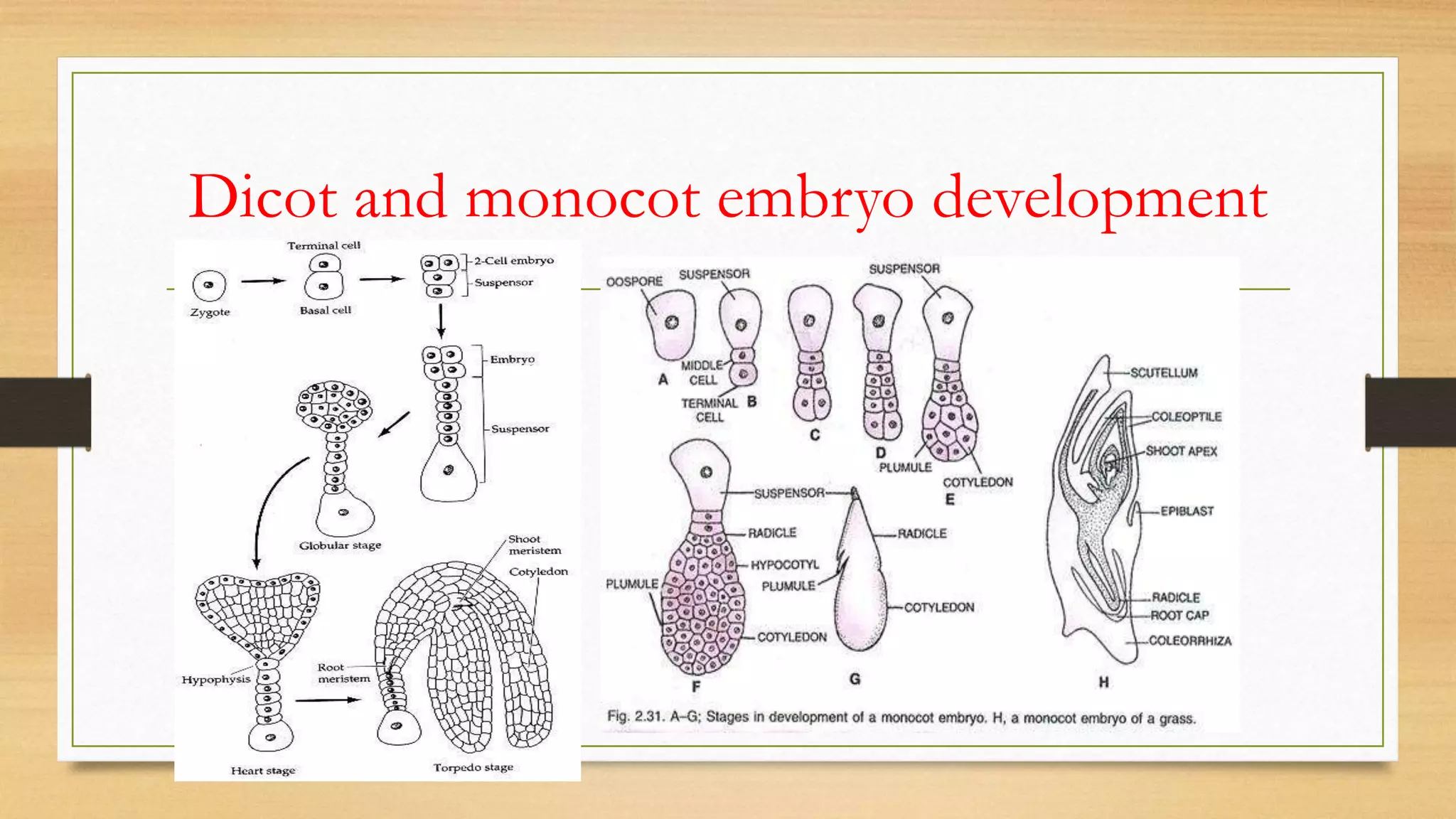
Dicot and monocot embryo development
Development of monocot embryo
• The zygote divides transversely forming the terminal cell and the basal cell.
• The basal cell, which is the larger and lies towards the micropylar end, does not
divide again but becomes transformed directly into a large vesicular cell.
• The terminal cell divides transversely forming the two cells. of these, the lower cell
divides vertically into two cell and the middle cell divides transversely into two cells.
• After that, a repeated division takes in both top cell and middle cell.
• The top cell forms the cotyledon and plumule while repeated division of middle
layer gives the hypocotyle and radicle.
Thank you

Development of embryo/class12 biology

  • 1.
  • 2.
    Behavioral objectives • Atthe end of season, students will be able to • Define the term embryogenesis. • Understand the concept of development of dicot embryo. • Describe the development of dicot embryo. • Explain the development of monocot embryo.
  • 3.
    What is embryogenesis.. •Embryogenesis is a process that occurs after the fertilization of an ovule to produce a fully developed plant embryo.
  • 4.
    Development of dicotembryo • The zygote divides transversely forming two cells, a terminal cell and basal cell. • The cell towards the micropylar end of the embryo sac is the suspensor cell (i.e., basal cell) and the other one makes to the embryo cell (i.e., terminal cell). • The terminal cell by subsequent divisions gives rise to the embryo while the basal cell contributes the formation of suspensor.
  • 5.
    Cont … • Theterminal cell divides by a vertical division forming a 4-celled shaped embryo. • The terminal cells of the four-celled pro-embryo divide vertically at right angle to the first vertical wall forming four cells. • Now each of the four cells divides transversely forming the octant stage (8- celled) of the embryo.
  • 6.
    Conti …. • Theoctant cell divides in many tires of cell. • The upper tires gives epidermis. • Next to this, the layer of cell gives, plumule and cotyledons. • The layer of cells, which are connected with suspensor gives hypocotyl. • At the same time, the cell of suspensor which is connected to proembro called hypophysis. • It divides into 8 cell. Lower 4 cell forms root tip and upper 4 cell forms cortex of root.
  • 7.
    Dicot and monocotembryo development
  • 8.
    Development of monocotembryo • The zygote divides transversely forming the terminal cell and the basal cell. • The basal cell, which is the larger and lies towards the micropylar end, does not divide again but becomes transformed directly into a large vesicular cell. • The terminal cell divides transversely forming the two cells. of these, the lower cell divides vertically into two cell and the middle cell divides transversely into two cells. • After that, a repeated division takes in both top cell and middle cell. • The top cell forms the cotyledon and plumule while repeated division of middle layer gives the hypocotyle and radicle.
  • 9.