Dr. Nandadulal Sannigrahi,
Associate Professor,
Department of Botany,
Nistarini college, Purulia
D.B. Road, Purulia,
INDIA (W.B)
 The “environment” connotes all external conditions affecting the life and
development of an organism but very often, the alteration of any factors can
cause extra load for the normal physiological process upon its stakeholders.
 Plants are subjected to a wide range of environmental stresses which reduces
and limits the productivity of agricultural crops.
 Stress is unavoidable irrespective to the organisms,
 Two types of environmental stresses are encountered to plants which can be
categorized as (1) Abiotic stress and (2) Biotic stress.
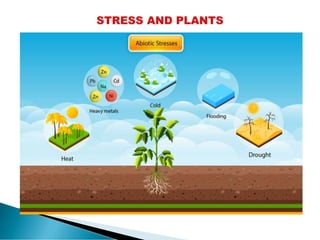
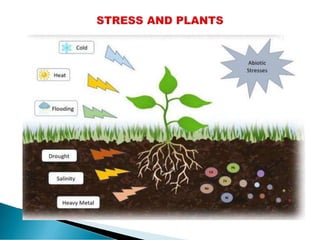
 The abiotic stress causes the loss of major crop plants worldwide and includes
radiation, salinity, floods, drought, extremes in temperature, heavy metals, etc.
 On the other hand, attacks by various pathogens such as fungi, bacteria,
Oomycetes, nematodes and herbivores are included in biotic stresses. As plants
are sessile in nature, they have no choice to escape from these environmental
cues.
 Plants have developed various mechanisms in order to overcome these threats
of biotic and abiotic stresses.
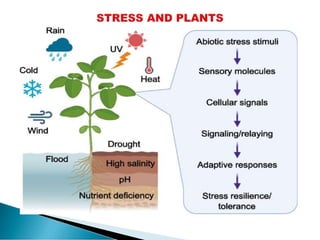
 They sense the external stress environment, get stimulated and then generate
appropriate cellular responses.
 They do this by stimuli received from the sensors located on the cell
surface or cytoplasm and transferred to the transcriptional machinery
situated in the nucleus, with the help of various signal transduction
pathways.
 This leads to differential transcriptional changes making the plant tolerant
against the stress.
 The signaling pathways act as a connecting link and play an important role
between sensing the stress environment and generating an appropriate
biochemical and physiological response.
 Some stresses to the plants injured them as such that plants exhibit several
metabolic dysfunctions .
 The plants can be recovered from injuries if the stress is mild or of short
term as the effect is temporary while as severe stresses leads to death of
crop plants by preventing flowering, seed formation and induce
senescence. Such plants will be considered to be stress susceptible.
However several plants like desert plants (Ephemerals) can escape the
stress altogether.
 Plants respond in many ways to abiotic stresses, from gene expression to
physiology, from plant architecture to primary, and secondary metabolism.
These complex changes allow plants to tolerate and/or adapt to adverse
conditions.
 The complexity of plant response can be further influenced by the duration
and intensity of stress, the plant genotype, the combination of different
stresses, the exposed tissue and cell type, and the developmental stage at
which plants perceive the stress.
 It is therefore important to understand more about how plants perceive
stress conditions and how they respond and adapt (both in natural and
anthropogenic environments).
 The different influences and the occurrences of the different stress factors
are very important one to address the different kind of adverse changes
found to occur in the plants .
 The stress is an unavoidable issue irrespective of the nature of
organisms starting from unicellular prokaryotes to multicellular
eukaryotes including plants and animals including human life.
 As far as stress management is concerned, the different types of
stress management strategies are adopted by plants to address them
in the quest of sustainability.
 The plant uses multiple methods of biochemical and genetically
methods garnished with molecular pathways to address and
acclimatize them. The min stress induced causes of plants are as
followed:
 Temperature stress
 Drought stress
 Salt and osmotic stress
 Ozone, UV and light stress
 Nutrient stress
 Heavy metal stress
 Hypoxia stress
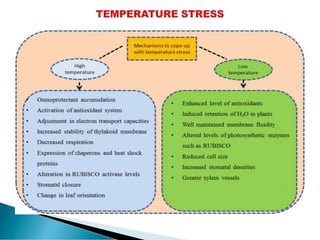
 Temperature stress is a significant factor influencing the sustainable growth
and production of crop plants. Temperature stress includes both the high
temperature (HT) stress, and low temperature (LT) stress (cold stress or
chilling stress and freezing stress).
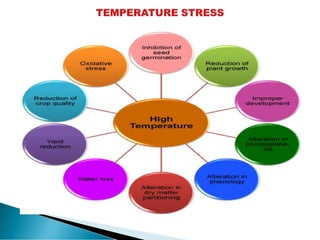
 High temperature stress is the rise in temperature beyond a critical
threshold for a period of time sufficient to cause irreversible damage to
plant growth and development (Wahid, 2007).
 However, cold stress (0–15 °C) is caused by the temperature cool enough
to produce injury without forming ice crystals in plant tissues, while
freezing stress (<0 °C) results in the formation of ice crystals in plant
tissues (Hasanuzzaman et al., 2013).
 Loss of fluidity of membranes and leakage of solutes are the distinct effects
of cold stress. Plants exposed to cold stress show poor growth and
germination and reduced crop yield (Welti et al., 2002; Suzuki et al., 2008).
However, susceptibility to cold stress varies among the plants as well as
within the species and plants with higher tolerance levels show less
membrane injury than the sensitive species (Maali Amiri et al., 2010;
Heidarvand et al., 2011).
 Whereas, irrespective of tolerance and sensitivity of genotypes to cold
stress, NMs such as TiO2 possess the capability to alleviate the harmful
effects of cold stress by lessening the membrane damages and electrolyte
leakage but sensitive genotype accumulate more TiO2 than the tolerant one
(Mohammadi et al., 2013) this is because of thinner epidermis and large
and more opened stoma in sensitive genotypes than that of tolerant
(Giacomo et al., 2010).
 Plants possess a number of adaptive, avoidance, or acclimation
mechanisms to cope with HT situations.
 In addition, major tolerance mechanisms that employ ion transporters,
proteins, osmoprotectants, antioxidants, and other factors involved in
signaling cascades and transcriptional control are activated to offset stress-
induced biochemical and physiological alterations.
 Plant survival under HT stress depends on the ability to perceive the HT
stimulus, generate and transmit the signal, and initiate appropriate
physiological and biochemical changes. HT-induced gene expression and
metabolite synthesis also substantially improve tolerance.
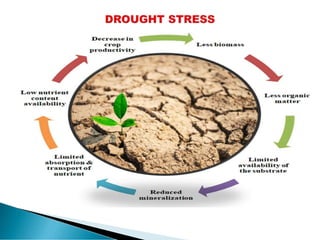
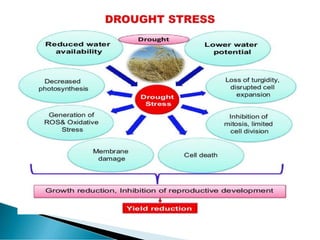
 A prolonged period of abnormally low rainfall leading to severe and
temporary shortage of water in the soil with wide degree of impact to be
treated as drought,
 Drought stress, being the inevitable factor that exists in various
environments without recognizing borders and no clear warning thereby
hampering plant biomass production, quality, and energy.
 It is the key important environmental stress that occurs due to temperature
dynamics, light intensity, and low rainfall.
 Despite this, its cumulative, not obvious impact and multidimensional
nature severely affects the plant morphological, physiological, biochemical
and molecular attributes with adverse impact on photosynthetic capacity.
Coping with water scarcity, plants evolve various complex resistance and
adaptation mechanisms including physiological and biochemical responses,
which differ with species level.
 The sophisticated adaptation mechanisms and regularity network that
improves the water stress tolerance and adaptation in plants are some of the
practices exercise by the plants to overcome this stress issue.
 Growth pattern and structural dynamics, reduction in transpiration loss through
altering stomata conductance and distribution, leaf rolling, root to shoot ratio
dynamics, root length increment, accumulation of compatible solutes,
enhancement in transpiration efficiency, osmotic and hormonal regulation, and
delayed senescence are the strategies that are adopted by plants under water
deficit condition.
 Approaches for drought stress alleviations are breeding strategies, molecular
and genomics perspectives with special emphasis on the omics technology
alteration i.e., metabolomics, proteomics, genomics, transcriptomics, glyomics
and phenomics that improve the stress tolerance in plants.
 For drought stress induction, seed priming, growth hormones,
osmoprotectants, silicon (Si), selenium (Se) and potassium application are
worth using under drought stress conditions in plant.
 In addition, drought adaptation through microbes, hydrogel, nanoparticles
applications and metabolic engineering techniques that regulate the antioxidant
enzymes activity for adaptation to drought stress in plants, enhancing plant
tolerance through maintenance in cell homeostasis and ameliorates the adverse
effects of water stress are of great potential in agriculture.
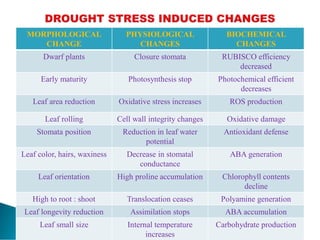
MORPHOLOGICAL
CHANGE
PHYSIOLOGICAL
CHANGES
BIOCHEMICAL
CHANGES
Dwarf plants Closure stomata RUBISCO efficiency
decreased
Early maturity Photosynthesis stop Photochemical efficient
decreases
Leaf area reduction Oxidative stress increases ROS production
Leaf rolling Cell wall integrity changes Oxidative damage
Stomata position Reduction in leaf water
potential
Antioxidant defense
Leaf color, hairs, waxiness Decrease in stomatal
conductance
ABA generation
Leaf orientation High proline accumulation Chlorophyll contents
decline
High to root : shoot Translocation ceases Polyamine generation
Leaf longevity reduction Assimilation stops ABA accumulation
Leaf small size Internal temperature
increases
Carbohydrate production
 Soil salinization inhibits plant growth and seriously restricts food security
and agricultural development.
 Excessive salt can cause ionic stress, osmotic stress, and ultimately
oxidative stress in plants.
 Plants exclude excess salt from their cells to help maintain ionic
homeostasis and stimulate phytohormone signaling pathways, thereby
balancing growth and stress tolerance to enhance their survival.
 Plants are classified as halophytic or glycophytic according to their salt
tolerance. Most crops are glycophytic and sensitive to high salt
concentrations in the soil.
 Improper use of fertilizers, excess irrigation, and industrial pollution are
the primary causes of widespread soil salinity , which poses a serious threat
to agricultural productivity and food security for both humans and
livestock.
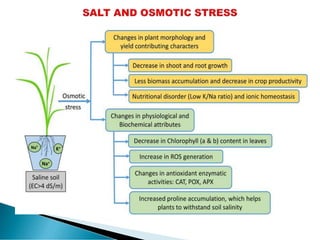
 High concentrations of Na+ and Cl− in the soil result in both osmotic and
ionic stress, which decrease plants’ capacity to take up water and nutrients.
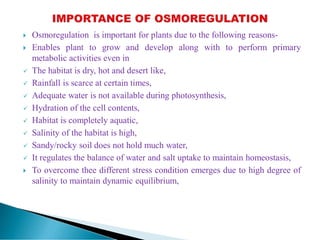
 Osmoregulation is important for plants due to the following reasons-
 Enables plant to grow and develop along with to perform primary
metabolic activities even in
 The habitat is dry, hot and desert like,
 Rainfall is scarce at certain times,
 Adequate water is not available during photosynthesis,
 Hydration of the cell contents,
 Habitat is completely aquatic,
 Salinity of the habitat is high,
 Sandy/rocky soil does not hold much water,
 It regulates the balance of water and salt uptake to maintain homeostasis,
 To overcome thee different stress condition emerges due to high degree of
salinity to maintain dynamic equilibrium,
 According to osmoregulatory activities, the plants are broadly classified
under four categories as follows:
 Halophytes-Mangroves
 Hydrophytes- Water lily
 Xerophytes- Cactus
 Mesophytes – Mango.
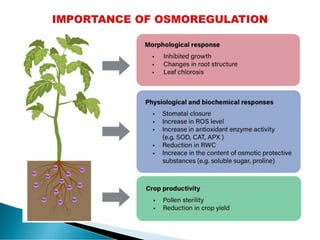
 The stress arises due to osmo-regulation issues may produce multiple
effects on the plants irrespective of morphological, biochemical and
qualitative and quantitative effects of crop productivity by the following
methods-
 Inhibited growth due to root structures and lack of the chlorophyll like
pigments synthesis,
 Stomata closure, increase ROS activity, increase antioxidant activity,
 Pollen sterility and reduction in crop yeild.
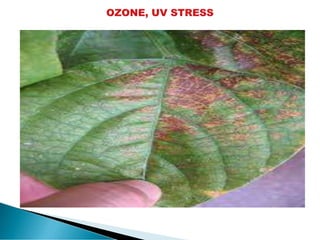
 Ozone and UV-B stress are significant environmental factors that
negatively affect plant health, particularly by inducing oxidative stress,
reducing photosynthesis, and suppressing crop yields.
 While stratospheric "good" ozone shields the Earth, ground-level
(troposphere) ozone is a "bad" pollutant that enters plants through stomata,
leading to chlorosis, necrosis, and premature senescence.
 Ozone is deposited from the atmosphere onto plant canopies by diffusion
and enters the leaf through stomata. Environmental, biological, and cultural
(e.g., irrigation) factors that promote stomata opening in crease the risk of
O3 injury to plants .
 Ozone causes negative effects on a number of plant processes, including
photosynthesis, water use efficiency, rate of senescence, dry matter
production, flowering, pollen tube extension, and yield.
 Mechanism of Damage:
 Upon entering the leaf, is converted into reactive oxygen species (ROS) in
the apoplast , damaging chloroplasts and blocking photosynthetic electron
transport.
 Physiological Effects:
 Disrupts the antioxidant defense system, leading to lipid per oxidation and
ion leakage. It causes stomata closure, which reduces fixation
 Impact on Yield:
 Chronic exposure causes growth reduction, reduced root biomass, and
premature leaf senescence. This is particularly damaging to crops like
soybeans, wheat, and rice, causing significant yield losses.
 Defense Mechanisms: Plants defend themselves by activating enzymatic
(SOD, CAT) and non-enzymatic (ascorbate, glutathione) antioxidant
defenses.
 Mitigation:
 Strategies to reduce impact include using chemical protectants like
ethylenediurea (EDU) to boost antioxidant activity, managing nutrient
levels (e.g., proper Nitrogen/Phosphorus ratios), and selecting resistant
crop varieties.
 Nutrients are obtained from the soil through plant roots, but there are many
factors that might affect nutrient acquisition, including soil texture and
moisture, pH, temperature and organic matter.
 Both nutrient limitation (or low bioavailability) and nutrient excess might
cause stress to the plant and negatively affect physiological and metabolic
processes essential for plant growth, development, reproduction and yield.
In this scenario, plants must actively respond to maintain nutrient levels
within the optimal range.
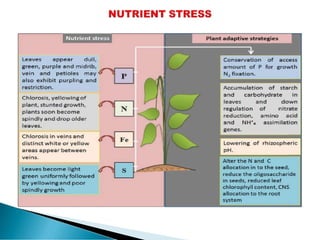
 Plants adapt to nutrient stress, i.e., a deficiency or excess of nutrients, by
altering numerous physiological, biochemical, and molecular processes.
 Plant nutrients include macronutrients, which are required in relatively
large amounts, and micronutrients, which are required in much smaller
amounts. The macronutrients that plants need include nitrogen (N),
phosphorus (P), and potassium (K).
 N serves as a fundamental constituent in key molecules, like amino acids,
nucleic acids, and proteins. The efficiency of N acquisition (or nitrogen use
efficiency, NUE) is determined by the activity of Ntransporters involved in
N uptake and by the root architecture.
 Regarding P, it is a component in key molecules, such as nucleic acids,
phospholipids, and adenosine triphosphate (ATP).
 It also plays vital roles in enzymatic reactions and signal transduction
cascades, particularly protein phosphorylation. P is absorbed through the
roots in the form of inorganic phosphate (Pi), and although the overall
content of P in the soil is generally high, its low bioavailability represents a
limiting factor for plant growth in most agricultural soils.
 Furthermore, although considerable progress has been made in our
understanding of the mechanisms underlying the adaptation of plants to Pi
limiting conditions during the past few years, less is known about adaptive
mechanisms to Pi excess conditions.
 As for K, it is involved in different cellular processes controlling
photosynthesis and chloroplast function, stomata-opening control, and
turgor pressure regulation.
 Despite the abundance of K in most soils, only a small portion can be
readily absorbed by plants. Detection of K deficiency triggers the
activation of K channels and transporters in the plant, which is sometimes
accompanied by the induction of other cellular processes that are also
regulated by Ca2+, hormones, and ROS.
 Anthropogenic perturbations of biosphere manifested in a broad array of
global phenomena including accelerated rate of industrialization, intensive
agriculture, and extensive mining accompanied by burgeoning population
and rapid urbanization have not only wreaked the havoc on the availability
of natural resources but also caused widespread and grave contamination of
essential components of life on the plane
 Human-induced disturbance of natural biogeochemical cycles, accentuated
accumulation of heavy metals (HMs) is a problem of paramount
importance for ecological, nutritional, and environmental reasons
 Unprecedented bioaccumulation and biomagnifications of heavy metals
(HMs) in the environment have become a dilemma for all living organisms
including plants.
 HMs at toxic levels have the capability to interact with several vital
cellular biomolecules such as nuclear proteins and DNA, leading to
excessive augmentation of reactive oxygen species (ROS).
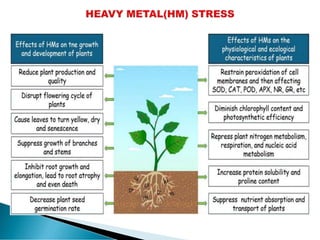
 This would inflict serious morphological, metabolic, and physiological
anomalies in plants ranging from chlorosis of shoot to lipid peroxidation
and protein degradation. In response, plants are equipped with a repertoire
of mechanisms to counteract heavy metal (HM) toxicity.
 Ms belong to group of non-biodegradable, persistent inorganic chemical
constituents with the atomic mass over 20 and the density higher than
5 g·cm−3 that have cytotoxic, genotoxic, and mutagenic effects on humans
or animals and plants through influencing and tainting food chains, soil,
irrigation or potable water, aquifers, and surrounding atmosphere.
 There are two kinds of metals found in soils, which are referred to as
essential micronutrients for normal plant growth (Fe, Mn, Zn, Cu, Mg, Mo,
and Ni) and nonessential elements with unknown biological and
physiological function (Cd, Sb, Cr, Pb, As, Co, Ag, Se, and Hg).
 The essential elements play a pivotal role in the structure of enzymes and
proteins. Plants require them in tiny quantities for their growth,
metabolism, and development; however, the concentration of both essential
and nonessential metals is one single important factor in the growing
process of plants so that their presence in excess can lead to the reduction
and inhibition of growth in plants.
 HMs at toxic levels hamper normal plant functioning and act as an
impediment to metabolic processes.
 Disturbance or displacement of building blocks of protein structure, which
arises from the formation of bonds between HMs and Sulf-hydryl groups ,
 hindering functional groups of important cellular molecules , superseding
or disrupting functionality of essential metals in biomolecules such as
pigments or enzymes , and adversely affecting the integrity of the
cytoplasmic membrane , resulting in the repression of vital events in plants
such as photosynthesis, respiration, and enzymatic activities.
 On the other hand, elevated levels of HMs are associated with the
increased generation of reactive oxygen species (ROS), such as superoxide
free radicals (O2
•−), hydroxyl free radicals (OH•−), or non-free radical
species (molecular forms) such as singlet oxygen (O2) and hydrogen
peroxide (H2O2) as well as cytotoxic compounds like methylglyoxal (MG),
which can cause oxidative stress via disturbing the equilibrium between
pro-oxidant and antioxidant homeostasis within the plant cells,
 This condition implicates the causation of multiple deteriorative disorders
such as, oxidation of protein and lipids, ion leakage, oxidative DNA attack,
red-ox imbalance, and denature of cell structure and membrane, ultimately
resulting in the activation of programmed cell death (PCD) pathways.
 Plants employ various inherent and extrinsic defense strategies for
tolerance or detoxification whenever confronted with the stressful
condition caused by the high concentrations of HMs.
 As a first step towards dealing with metal intoxication, plants adopt
avoidance strategy to preclude the onset of stress via restricting metal
uptake from soil or excluding it, preventing metal entry into plant root,
 This can be achieved by some mechanisms such as immobilization of
metals by mycorrhizal association, metal sequestration, or complexation by
exuding organic compounds from root ,
 One of the mechanisms adopted by plants to detoxify HMs is the
production of short-chain thiol-rich repetitions of peptides of low-
molecular weight synthesized from sulfur-rich glutathione (GSH) by the
enzyme phytochelatin synthase (PCS) with the general structure of (γ-
glutamyl-cysteinyl) n-glycine (n = 2 to 11) that have a high affinity to bind
to HMs when they are at toxic levels, by metal homeostasis and
detoxification,
 Metallothionins, small cysteine-rich, low-molecular-weight cytoplasmic
metal-binding proteins or polypeptides that are found in a wide variety of
eukaryotic organisms including fungi, invertebrates, mammals, and plants
and plants in particular for Cd detoxification,
 Proline, is a proteinogenic five-carbon α-amino acid that acts as a
compatible and metabolic osmolyte, a constituent of cell wall, free radical
scavenger, antioxidant, and macromolecules stabilizer that promoting
embryo/seed evolvement, extending stem length as well as moving plants
from vegetative growth to reproductive stage,
 Symbiotic mycorrhizal fungi such as AM form a mutualistic symbiosis
with roots of most vascular plant species under different climatic
conditions in which they are beneficiary of photosynthetic assimilations
provided by plants and in return they improve the mineral nutrition status
of plants and can also enhance their tolerance towards some stresses and
pollutants, adopted by mycorrhizal fungi to cancel out impacts of HM
stress on plants include acting as a barrier by depositing metals within
cortical cells,
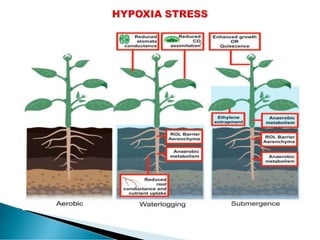
 Plants are aerobic organisms that require oxygen for their respiration.
Hypoxia arises due to the insufficient availability of oxygen, and is sensed
by plants, which adapt their growth and metabolism accordingly.
 Plant hypoxia can occur as a result of excessive rain and soil water logging,
thus constraining plant growth.
 In order to keep the level of oxygen under control, cells sense
the oxygen levels and react to insufficient oxygen (hypoxia) by adopting
survival strategies ranging from gene regulation to morphological adaptive
responses,
 Hypoxia occurs when the oxygen level limits aerobic respiration (usually
between 1% and 5%), while anoxia takes place when oxygen is absent in
the environment . It is also important to highlight the difference between
acute and chronic hypoxia,
 The term acute hypoxia is used when the drop in oxygen availability is
transitory in plants, which can be due to adverse environmental conditions
such as flooding events or when unusual, transient increases in oxygen
consumption occur in a plant tissue.
 Acute hypoxia is perceived by the plants as stressful. On the other hand,
chronic hypoxia is a constitutive and, usually, non-stressful condition
where the oxygen level is maintained low only in a given group of cells
and not in the entire plant.
 In other words, chronic hypoxia can be a physiological condition in
specific plant tissues.
 In plants, proteins belonging to group VII of the Ethylene Response
Factors (ERF-VIIs) are destabilized by oxygen and become stable only
under hypoxia, with a mechanism conceptually similar to the one that
regulating HIF-1. ERF-VIIs are transcription factors characterized by a Cys
residue at their N-terminal,
 The plants always try to adapt in the changing circumstances irrespective
to oxygen deficiency by altering the biochemical pathways to ensure
sustainability in the long run.
 ACKNOWLEDGEMENTS:
a. Google for images,
b. Different websites for enriching the course content,
c. Science Direct pages,
d. Plant Pathology- Dr. B. P. Pandey,
e. Plant diseases, insects and pests- NCBI-NH,
f. Topics in Mycology and Pathology-L.N. Nair
g. www.nature.com
h. www.spruce.com
i. www.aphis.usda.gov
j. Puregreensaz.com
k. www.fao.org
l. Many more websites for references.
 This presentation has been designed to address the academic fraternity
without any financial interest. This is absolutely free to use . The author does
not claim any kind of financial benefits from this content.