The Ideal Rankine Cycle
Conventional Vapor Power Cycles
Complete Steam Power Plant
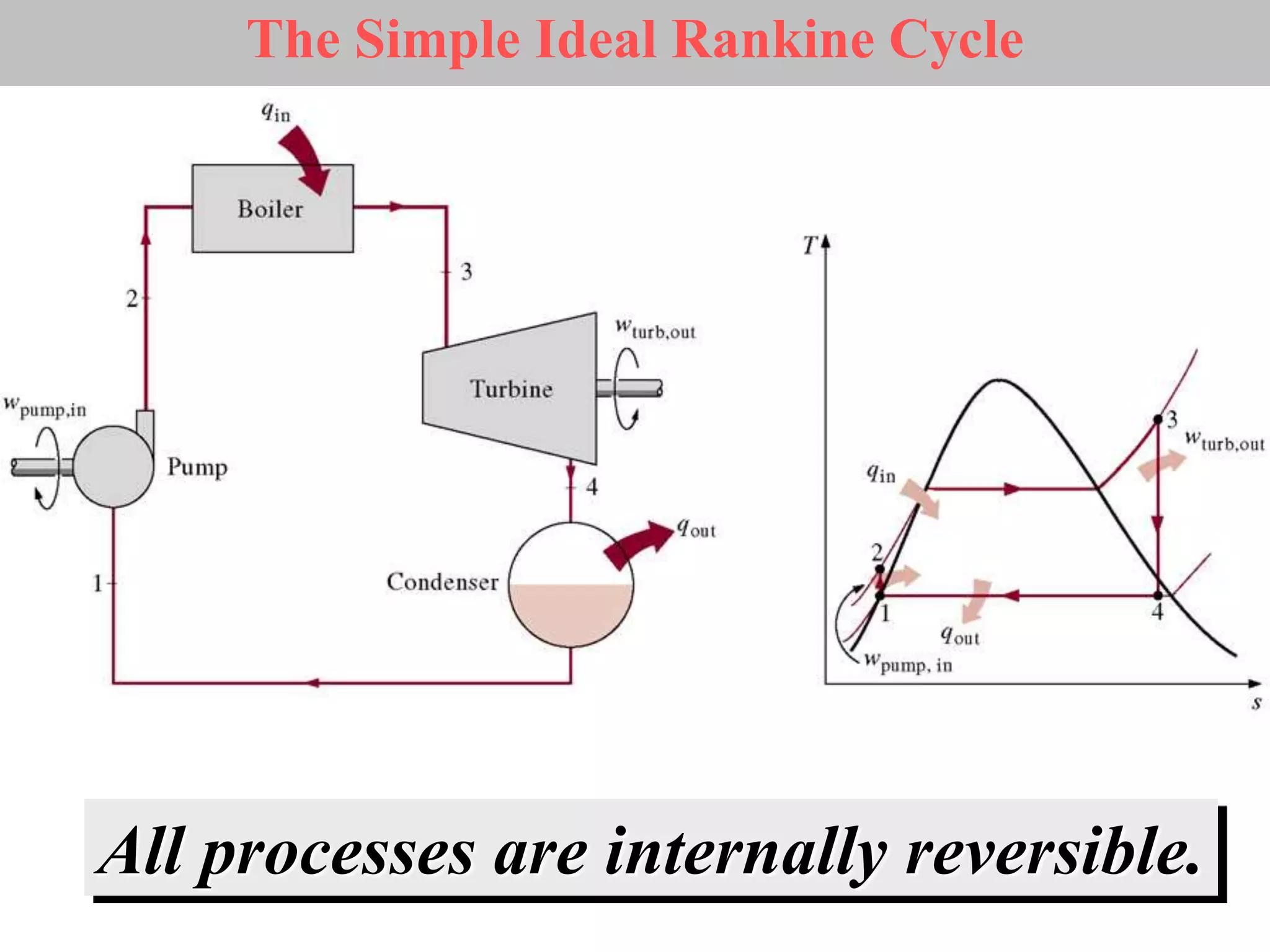
All processes are internally reversible.
The Simple Ideal Rankine Cycle
All processes are internally reversible.
s
T
1
2
3
4
Reversible constant
pressure heat rejection
(4  1)
Reversible constant
pressure heat addition
(2  3)
Isentropic
compression
(1  2)
Isentropic
expansion to
produce work
(3  4)
The ideal Rankine cycle
1
4
4
3
2
3
@
1
@
1
1
2
1
2
1
1
&
)
(
h
h
Q
h
h
W
W
h
h
Q
v
v
v
h
h
P
P
v
or
h
h
W
W
L
T
OUT
H
P
f
P
f
P
IN














NET
H
NET
W
x
rate
flow
Mass
W
Power
Q
W




 (4)
Boiler & condenser do not involve any work and the pump &
turbine are assumed to be isentropic.
Pump (q=0):
where
Boiler (w=0):
Turbine (q=0):
Condenser (w=0):
The thermal efficiency (of the Rankine cycle), back work ratio and
the power produced by the cycle is given by
(3)
(5)
Energy Analysis of Ideal Rankine Cycle
T
P W
W
bwr /
 (6)
Another parameter used to describe power plant performance is the
back work ratio which is defined as the ratio of pump work input
to turbine work:
An important parameter that needs to be determined is the mass
flow rate of the cooling water .
)
(
)
(
,
,
1
4
i
cw
o
cw
cw
h
h
h
h
m
m




 (7)
)
( cw
m

Energy Analysis of Ideal Rankine Cycle
Actual vs. Ideal
cycle
A Brief look
Deviation Of Actual Vapor Power Cycle From Idealized
Cycle
Overview
• As a result of irreversibilities, actual power cycles deviate from
the ideal Rankine cycle
• Fluid friction and heat loss to the surroundings are two common
sources of irreversibilities
• An example of an actual and ideal Rankine cycle is shown below
(b) The effect of pump and turbine irreversibilities on the ideal Rankine cycle
1
2
1
2
h
h
h
h
a
s
P




s
a
T
h
h
h
h
4
3
4
3




--- Isentropic efficiencies ---
Note: WP<<WT
h
s
4s
3
2s
WOUT
QH
QC
1
WIN
4a
2a
Deviation Of Actual Vapor Power Cycle From Idealized
Cycle
Improving the Rankine Cycle
How can we Increase the Efficiency of
the Rankine Cycle?
Improving the Rankine Cycle
Overview
• Steam power plants are responsible for the production of most
electric power in the world
• Even small increases in thermal efficiency can mean large savings
from the fuel requirements
• The basic idea behind all modifications to increase the thermal
efficiency of a power cycle is the same:
 increase the average temperature at which heat is
transferred to the working fluid in the boiler, or decrease the
average temperature at which heat is rejected from the
working fluid in the condenser
• The average temperature should be as high as possible during
heat addition and as low as possible during heat rejection
The effect of lowering the
condenser pressure on the
ideal Rankine cycle.
Side effects:
1. Possible air leakage
into condenser
2. Increases moisture
content at turbine exit
Note: Limited by
temperature of the
cooling medium
Improving the Rankine Cycle
The effect of superheating the
steam to higher temperatures
on the ideal Rankine cycle.
Note: Superheating
limited by metallurgical
considerations.
Improving the Rankine Cycle
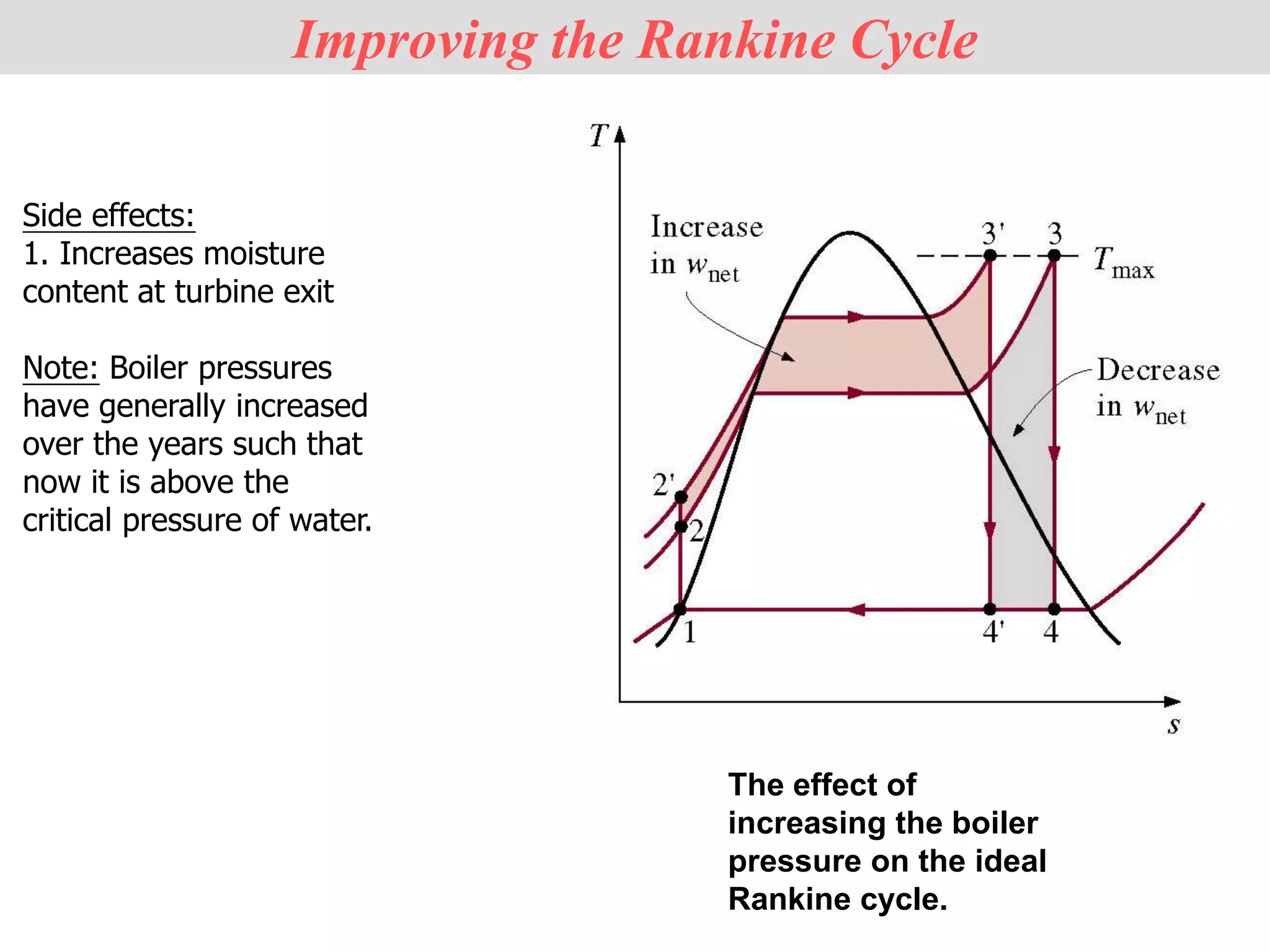
The effect of
increasing the boiler
pressure on the ideal
Rankine cycle.
Side effects:
1. Increases moisture
content at turbine exit
Note: Boiler pressures
have generally increased
over the years such that
now it is above the
critical pressure of water.
Improving the Rankine Cycle
A supercritical
Rankine cycle.
Note: Now, Boiler
pressures have generally
increased to over 30
MPa.
Pcr = 22.09 MPa
Cavitation
Assignment # 1
1.In Example 2-3 (on pp. 46) of your book, there is
one quantity which is erroneously calculated.
Identify and correct this by giving reason.
Ideal rankine cycle

  • 1.
    The Ideal RankineCycle Conventional Vapor Power Cycles
  • 2.
  • 3.
    All processes areinternally reversible. The Simple Ideal Rankine Cycle
  • 4.
    All processes areinternally reversible. s T 1 2 3 4 Reversible constant pressure heat rejection (4  1) Reversible constant pressure heat addition (2  3) Isentropic compression (1  2) Isentropic expansion to produce work (3  4) The ideal Rankine cycle
  • 5.
    1 4 4 3 2 3 @ 1 @ 1 1 2 1 2 1 1 & ) ( h h Q h h W W h h Q v v v h h P P v or h h W W L T OUT H P f P f P IN               NET H NET W x rate flow Mass W Power Q W      (4) Boiler &condenser do not involve any work and the pump & turbine are assumed to be isentropic. Pump (q=0): where Boiler (w=0): Turbine (q=0): Condenser (w=0): The thermal efficiency (of the Rankine cycle), back work ratio and the power produced by the cycle is given by (3) (5) Energy Analysis of Ideal Rankine Cycle
  • 6.
    T P W W bwr / (6) Another parameter used to describe power plant performance is the back work ratio which is defined as the ratio of pump work input to turbine work: An important parameter that needs to be determined is the mass flow rate of the cooling water . ) ( ) ( , , 1 4 i cw o cw cw h h h h m m      (7) ) ( cw m  Energy Analysis of Ideal Rankine Cycle
  • 7.
  • 8.
    Deviation Of ActualVapor Power Cycle From Idealized Cycle Overview • As a result of irreversibilities, actual power cycles deviate from the ideal Rankine cycle • Fluid friction and heat loss to the surroundings are two common sources of irreversibilities • An example of an actual and ideal Rankine cycle is shown below
  • 9.
    (b) The effectof pump and turbine irreversibilities on the ideal Rankine cycle 1 2 1 2 h h h h a s P     s a T h h h h 4 3 4 3     --- Isentropic efficiencies --- Note: WP<<WT h s 4s 3 2s WOUT QH QC 1 WIN 4a 2a Deviation Of Actual Vapor Power Cycle From Idealized Cycle
  • 10.
    Improving the RankineCycle How can we Increase the Efficiency of the Rankine Cycle?
  • 11.
    Improving the RankineCycle Overview • Steam power plants are responsible for the production of most electric power in the world • Even small increases in thermal efficiency can mean large savings from the fuel requirements • The basic idea behind all modifications to increase the thermal efficiency of a power cycle is the same:  increase the average temperature at which heat is transferred to the working fluid in the boiler, or decrease the average temperature at which heat is rejected from the working fluid in the condenser • The average temperature should be as high as possible during heat addition and as low as possible during heat rejection
  • 12.
    The effect oflowering the condenser pressure on the ideal Rankine cycle. Side effects: 1. Possible air leakage into condenser 2. Increases moisture content at turbine exit Note: Limited by temperature of the cooling medium Improving the Rankine Cycle
  • 13.
    The effect ofsuperheating the steam to higher temperatures on the ideal Rankine cycle. Note: Superheating limited by metallurgical considerations. Improving the Rankine Cycle
  • 14.
    The effect of increasingthe boiler pressure on the ideal Rankine cycle. Side effects: 1. Increases moisture content at turbine exit Note: Boiler pressures have generally increased over the years such that now it is above the critical pressure of water. Improving the Rankine Cycle
  • 15.
    A supercritical Rankine cycle. Note:Now, Boiler pressures have generally increased to over 30 MPa. Pcr = 22.09 MPa
  • 16.
  • 17.
    Assignment # 1 1.InExample 2-3 (on pp. 46) of your book, there is one quantity which is erroneously calculated. Identify and correct this by giving reason.