Fossil Fuels
Fuel and Combustion
Primary fuels are coal, oil and natural gas; although industrial wastes
like sawmill wood dust etc. are often used to boost a primary fuel.
According to geological order of formation, class maybe of the
following types: i) Peat ii) Lignite iii) Sub-bituminous iv) Bituminous
v) Anthracite (Note: After Anthracite, graphite is formed.)
Coal
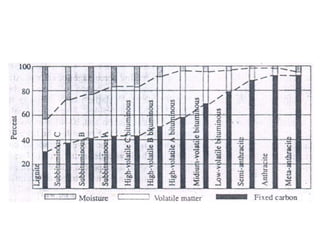
Bituminous contains 46-86% fixed carbon and 20-40% volatile
matter. Can be low-, medium- and high-volatile (A,B,C). Carbon is
max. in low-volatile type and within high-volatile, its max in A.
Sub-bituminous is divided into 3 groups: A, B and C. Carbon is
max. in A. Has relatively higher moister content (15-30%).
Anthracite contains 86-98% fixed carbon and 2-14% volatile matter
(helps in ignition of coal).
Lignite is high in moisture (30-45 %). Is lowest grade of coal.
Peat contains upto 90% moisture. Sometimes used in district heating.
Coal Analysis
Fuel and Combustion
Two types of analysis: Proximate and Ultimate analysis, that determines mass
percentages of different components.
Coal Analysis: Proximate and Ultimate analysis
Ultimate Analysis: The analysis shows the following components on mass basis:
C, H, O, N, S, M, A. Therefore, C+H+O+N+S+M+A = 100%
Proximate analysis is easier of the two and determines the mass percentages of
fixed carbon (FC), volatile matter (VM), moisture (M) and ash (A).
FC: Determination is approx. by assuming it to be the difference between the
original sample and sum of VM, M and A. However, this does not represent all the
carbon (see VM below).
M: When 1 g sample of coal is subjected to a temperature of 105 °C for a period of
1 hr, the loss in weight of the sample gives the moisture content of the coal.
VM: When 1 g sample of coal is heated to 950 °C for 7 min in the absence of
oxygen, the loss in weight due to other than water vapor, is the volatile matter. It
consists of H2 and certain hydro-carbons.
A: When 1 g sample of coal is heated to 720 °C until the coal is completely burned
and a constant weight is reached, this indicates that only ash is left behind.
Types
Combustion Equipment for Burning Coal
Coal may be fed in lump pieces or powder form. Combustion may occur in
Combustion Equipment: Types
a) Fuel bed furnaces
b) Pulverized coal furnaces
c) Cyclone furnaces
d) Fluidized bed furnaces
A grate is used at the furnace bottom to hold a bed of fuel. There are
Two ways of feeding coal on the grate:
a) Overfeeding and b) Underfeeding
Mechanical Stokers
Combustion Equipment
For uniform operating conditions, higher burning rate and greater
efficiency, moving grates are employed. Stoker types are:
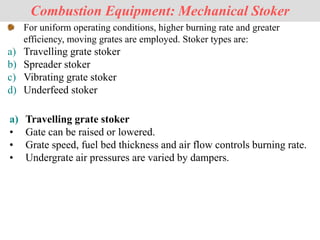
a) Travelling grate stoker
b) Spreader stoker
c) Vibrating grate stoker
d) Underfeed stoker
Combustion Equipment: Mechanical Stoker
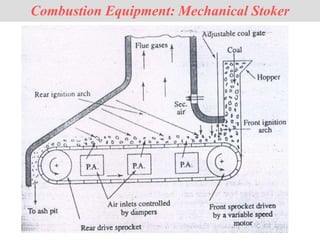
a) Travelling grate stoker
• Gate can be raised or lowered.
• Grate speed, fuel bed thickness and air flow controls burning rate.
• Undergrate air pressures are varied by dampers.
Combustion Equipment: Mechanical Stoker
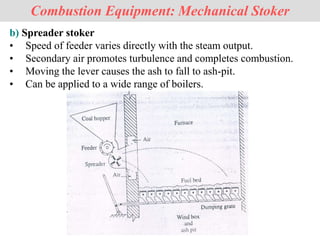
b) Spreader stoker
• Speed of feeder varies directly with the steam output.
• Secondary air promotes turbulence and completes combustion.
• Moving the lever causes the ash to fall to ash-pit.
• Can be applied to a wide range of boilers.
Combustion Equipment: Mechanical Stoker
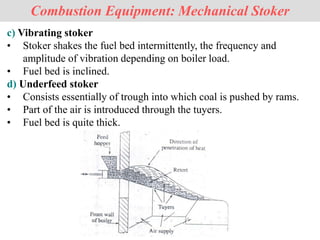
c) Vibrating stoker
• Stoker shakes the fuel bed intermittently, the frequency and
amplitude of vibration depending on boiler load.
• Fuel bed is inclined.
d) Underfeed stoker
• Consists essentially of trough into which coal is pushed by rams.
• Part of the air is introduced through the tuyers.
• Fuel bed is quite thick.
Combustion Equipment: Mechanical Stoker
In all mechanical stokers, forced draft fans are used for primary as
well as secondary air.
Stoker firing is limited to 50 kg/s of steam due to low efficiency
and physical size of stoker. However, in their size range, they
remain important in steam generation systems.
Modern boilers tend to grow vertically upward than horizontally,
adopting pulverized coal firing through burners.
Pulverized Coal Furnaces
Combustion Equipment
Due to its many advantages, it has become almost universal in central
utility stations using coal as fuel.
Coal is ground to dust like size and then carried in a stream of air to be
fed through burners into the furnace.
VM ignites and burns quickly.
Oxygen reacts with carbon surface to release energy.
Proper burning of fuel requires: correct proportion of air, mixing of fuel
and air, high temperature and adequate residence time.
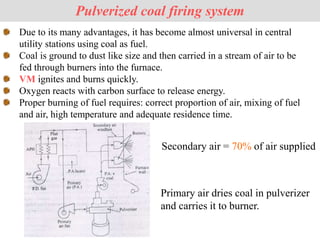
Pulverized coal firing system
Secondary air = 70% of air supplied
Primary air dries coal in pulverizer
and carries it to burner.
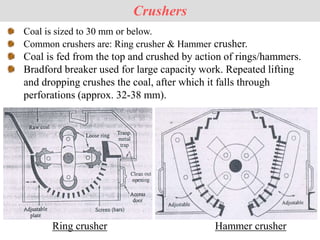
Coal is sized to 30 mm or below.
Common crushers are: Ring crusher & Hammer crusher.
Coal is fed from the top and crushed by action of rings/hammers.
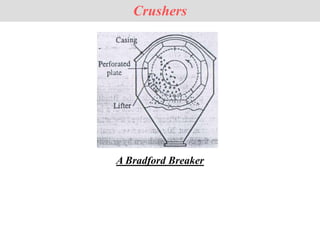
Bradford breaker used for large capacity work. Repeated lifting
and dropping crushes the coal, after which it falls through
perforations (approx. 32-38 mm).
Crushers
Ring crusher Hammer crusher
A Bradford Breaker
Crushers
There are 3 stages in this process: feeding, drying and grinding.
Feeding system controls the fuel feed rate according to many factors
such as boiler demand.
Varying moisture content and using lower-rank coals dictates drying.
Primary air forced in by fan is about 350 °C.
Grinding is done by impact, attrition, crushing or both.
Are classified by speed: a) low speed (< 75 rpm) b) medium speed
(75-225 rpm) c) high speed (> 225 rpm)
Its performance depends upon the coal’s grindability, moisture and
fineness of the grind needed.
Pulverizers
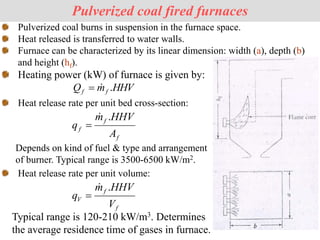
Pulverized coal burns in suspension in the furnace space.
Heat released is transferred to water walls.
Furnace can be characterized by its linear dimension: width (a), depth (b)
and height (hf).
Heating power (kW) of furnace is given by:
Pulverized coal fired furnaces
HHV
m
Q f
f .


Heat release rate per unit bed cross-section:
f
f
f
A
HHV
m
q
.


Heat release rate per unit volume:
f
f
V
V
HHV
m
q
.


Depends on kind of fuel & type and arrangement
of burner. Typical range is 3500-6500 kW/m2.
Typical range is 120-210 kW/m3. Determines
the average residence time of gases in furnace.
Pulverized coal fired furnaces
Factors that influence the determination of these
quantities?
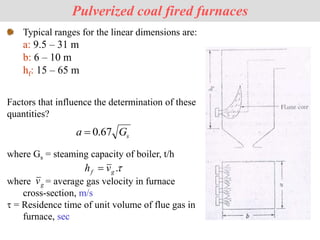
Typical ranges for the linear dimensions are:
a: 9.5 – 31 m
b: 6 – 10 m
hf: 15 – 65 m
s
G
a 67
.
0

where Gs = steaming capacity of boiler, t/h

.
g
f v
h 
where = average gas velocity in furnace
cross-section, m/s
 = Residence time of unit volume of flue gas in
furnace, sec
g
v
Pulverized coal fired furnaces
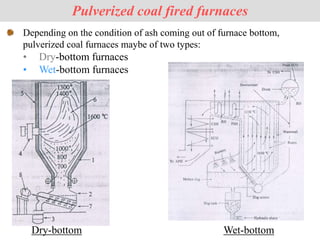
Depending on the condition of ash coming out of furnace bottom,
pulverized coal furnaces maybe of two types:
• Dry-bottom furnaces
• Wet-bottom furnaces
Dry-bottom Wet-bottom
Pulverized coal burners
Efficient use of pulverized coal largely depends upon burners to produce
uniform mixture of coal and air.
Primary Air (PA): for what?
Secondary air (SA): for what?
Burners should satisfy the following requirements:
• Prepare two flows for ignition
• Control flame propagation
• Prevent flash-back
• Control SA quantity
Can be divided into 2 main groups: circular and slot type.
Can be divided into 2 types depending on method of mixing:
• Straight-flow burner (external mixing)
• Turbulent/vortex burner (internal mixing)
Note: VSA > VPA
Cyclone Furnace
Combustion Equipment
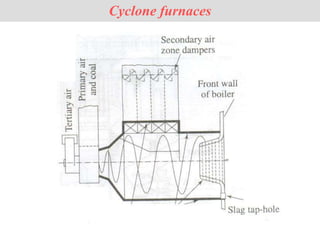
Connected to boiler so that combustion completely occurs in the cyclone
furnace and only the hot gases enter the boiler for heat transfer.
Widely used to burn poorer grades of coal with high M and A content.
Biofuels can also be used.
Uses crushed coal (60 mm or less)
Cylinder diameter is 1.8 - 4 m and length is 1.2 – 1.3 times dia.
PA is about 20% of SA.
Tertiary air is also admitted at the center.
Large volumetric heat release rate: 4.7 – 8.3 MW/m3.
High temperature (1650 °C) melt the ash into slag but can be as
high as 1900 °C. Thus, also called Slagging-type furnace.
Only 15 - 40% ash leaves with flue gas. This reduces erosion and
fouling.
Obviously no pulverization equipment needed.
Higher power requirement.
Relatively more NOx.
Heating power: 150 – 400 MW.
Cyclone furnaces
Cyclone furnaces
Fluidized Bed Furnace
Combustion Equipment
What is a fixed (packed) and fluidized bed?
Contact in a fluidized turbulent state increases heat and mass transfer,
and reduces reaction time, plant size and power requirement.
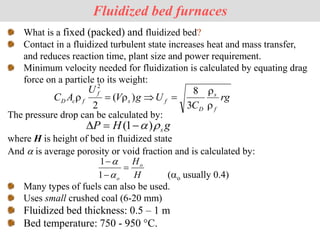
Minimum velocity needed for fluidization is calculated by equating drag
force on a particle to its weight:
The pressure drop can be calculated by:
where H is height of bed in fluidized state
And a is average porosity or void fraction and is calculated by:
(ao usually 0.4)
Many types of fuels can also be used.
Uses small crushed coal (6-20 mm)
Fluidized bed thickness: 0.5 – 1 m
Bed temperature: 750 - 950 °C.
Fluidized bed furnaces
rg
C
U
g
V
U
A
C
f
s
D
f
s
f
f
c
D







3
8
)
(
2
2
g
H
P s

a)
1
( 


H
Ho
o



a
a
1
1
Air flow through a distributor in the bottom of the bed.
Unburnt carbon is collected in cyclone separator & returned.
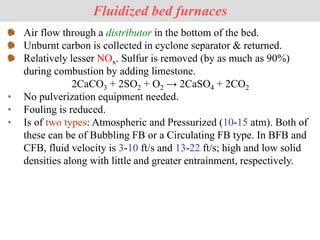
Relatively lesser NOx. Sulfur is removed (by as much as 90%)
during combustion by adding limestone.
2CaCO3 + 2SO2 + O2 → 2CaSO4 + 2CO2
• No pulverization equipment needed.
• Fouling is reduced.
• Is of two types: Atmospheric and Pressurized (10-15 atm). Both of
these can be of Bubbling FB or a Circulating FB type. In BFB and
CFB, fluid velocity is 3-10 ft/s and 13-22 ft/s; high and low solid
densities along with little and greater entrainment, respectively.
Fluidized bed furnaces

Fuels and combustion (Thermal Power Systems)

  • 1.
  • 2.
    Primary fuels arecoal, oil and natural gas; although industrial wastes like sawmill wood dust etc. are often used to boost a primary fuel. According to geological order of formation, class maybe of the following types: i) Peat ii) Lignite iii) Sub-bituminous iv) Bituminous v) Anthracite (Note: After Anthracite, graphite is formed.) Coal Bituminous contains 46-86% fixed carbon and 20-40% volatile matter. Can be low-, medium- and high-volatile (A,B,C). Carbon is max. in low-volatile type and within high-volatile, its max in A. Sub-bituminous is divided into 3 groups: A, B and C. Carbon is max. in A. Has relatively higher moister content (15-30%). Anthracite contains 86-98% fixed carbon and 2-14% volatile matter (helps in ignition of coal). Lignite is high in moisture (30-45 %). Is lowest grade of coal. Peat contains upto 90% moisture. Sometimes used in district heating.
  • 4.
  • 5.
    Two types ofanalysis: Proximate and Ultimate analysis, that determines mass percentages of different components. Coal Analysis: Proximate and Ultimate analysis Ultimate Analysis: The analysis shows the following components on mass basis: C, H, O, N, S, M, A. Therefore, C+H+O+N+S+M+A = 100% Proximate analysis is easier of the two and determines the mass percentages of fixed carbon (FC), volatile matter (VM), moisture (M) and ash (A). FC: Determination is approx. by assuming it to be the difference between the original sample and sum of VM, M and A. However, this does not represent all the carbon (see VM below). M: When 1 g sample of coal is subjected to a temperature of 105 °C for a period of 1 hr, the loss in weight of the sample gives the moisture content of the coal. VM: When 1 g sample of coal is heated to 950 °C for 7 min in the absence of oxygen, the loss in weight due to other than water vapor, is the volatile matter. It consists of H2 and certain hydro-carbons. A: When 1 g sample of coal is heated to 720 °C until the coal is completely burned and a constant weight is reached, this indicates that only ash is left behind.
  • 6.
  • 7.
    Coal may befed in lump pieces or powder form. Combustion may occur in Combustion Equipment: Types a) Fuel bed furnaces b) Pulverized coal furnaces c) Cyclone furnaces d) Fluidized bed furnaces A grate is used at the furnace bottom to hold a bed of fuel. There are Two ways of feeding coal on the grate: a) Overfeeding and b) Underfeeding
  • 8.
  • 9.
    For uniform operatingconditions, higher burning rate and greater efficiency, moving grates are employed. Stoker types are: a) Travelling grate stoker b) Spreader stoker c) Vibrating grate stoker d) Underfeed stoker Combustion Equipment: Mechanical Stoker a) Travelling grate stoker • Gate can be raised or lowered. • Grate speed, fuel bed thickness and air flow controls burning rate. • Undergrate air pressures are varied by dampers.
  • 10.
  • 11.
    Combustion Equipment: MechanicalStoker b) Spreader stoker • Speed of feeder varies directly with the steam output. • Secondary air promotes turbulence and completes combustion. • Moving the lever causes the ash to fall to ash-pit. • Can be applied to a wide range of boilers.
  • 12.
    Combustion Equipment: MechanicalStoker c) Vibrating stoker • Stoker shakes the fuel bed intermittently, the frequency and amplitude of vibration depending on boiler load. • Fuel bed is inclined. d) Underfeed stoker • Consists essentially of trough into which coal is pushed by rams. • Part of the air is introduced through the tuyers. • Fuel bed is quite thick.
  • 13.
    Combustion Equipment: MechanicalStoker In all mechanical stokers, forced draft fans are used for primary as well as secondary air. Stoker firing is limited to 50 kg/s of steam due to low efficiency and physical size of stoker. However, in their size range, they remain important in steam generation systems. Modern boilers tend to grow vertically upward than horizontally, adopting pulverized coal firing through burners.
  • 14.
  • 15.
    Due to itsmany advantages, it has become almost universal in central utility stations using coal as fuel. Coal is ground to dust like size and then carried in a stream of air to be fed through burners into the furnace. VM ignites and burns quickly. Oxygen reacts with carbon surface to release energy. Proper burning of fuel requires: correct proportion of air, mixing of fuel and air, high temperature and adequate residence time. Pulverized coal firing system Secondary air = 70% of air supplied Primary air dries coal in pulverizer and carries it to burner.
  • 16.
    Coal is sizedto 30 mm or below. Common crushers are: Ring crusher & Hammer crusher. Coal is fed from the top and crushed by action of rings/hammers. Bradford breaker used for large capacity work. Repeated lifting and dropping crushes the coal, after which it falls through perforations (approx. 32-38 mm). Crushers Ring crusher Hammer crusher
  • 17.
  • 18.
    There are 3stages in this process: feeding, drying and grinding. Feeding system controls the fuel feed rate according to many factors such as boiler demand. Varying moisture content and using lower-rank coals dictates drying. Primary air forced in by fan is about 350 °C. Grinding is done by impact, attrition, crushing or both. Are classified by speed: a) low speed (< 75 rpm) b) medium speed (75-225 rpm) c) high speed (> 225 rpm) Its performance depends upon the coal’s grindability, moisture and fineness of the grind needed. Pulverizers
  • 19.
    Pulverized coal burnsin suspension in the furnace space. Heat released is transferred to water walls. Furnace can be characterized by its linear dimension: width (a), depth (b) and height (hf). Heating power (kW) of furnace is given by: Pulverized coal fired furnaces HHV m Q f f .   Heat release rate per unit bed cross-section: f f f A HHV m q .   Heat release rate per unit volume: f f V V HHV m q .   Depends on kind of fuel & type and arrangement of burner. Typical range is 3500-6500 kW/m2. Typical range is 120-210 kW/m3. Determines the average residence time of gases in furnace.
  • 20.
    Pulverized coal firedfurnaces Factors that influence the determination of these quantities? Typical ranges for the linear dimensions are: a: 9.5 – 31 m b: 6 – 10 m hf: 15 – 65 m s G a 67 . 0  where Gs = steaming capacity of boiler, t/h  . g f v h  where = average gas velocity in furnace cross-section, m/s  = Residence time of unit volume of flue gas in furnace, sec g v
  • 21.
    Pulverized coal firedfurnaces Depending on the condition of ash coming out of furnace bottom, pulverized coal furnaces maybe of two types: • Dry-bottom furnaces • Wet-bottom furnaces Dry-bottom Wet-bottom
  • 22.
    Pulverized coal burners Efficientuse of pulverized coal largely depends upon burners to produce uniform mixture of coal and air. Primary Air (PA): for what? Secondary air (SA): for what? Burners should satisfy the following requirements: • Prepare two flows for ignition • Control flame propagation • Prevent flash-back • Control SA quantity Can be divided into 2 main groups: circular and slot type. Can be divided into 2 types depending on method of mixing: • Straight-flow burner (external mixing) • Turbulent/vortex burner (internal mixing) Note: VSA > VPA
  • 23.
  • 24.
    Connected to boilerso that combustion completely occurs in the cyclone furnace and only the hot gases enter the boiler for heat transfer. Widely used to burn poorer grades of coal with high M and A content. Biofuels can also be used. Uses crushed coal (60 mm or less) Cylinder diameter is 1.8 - 4 m and length is 1.2 – 1.3 times dia. PA is about 20% of SA. Tertiary air is also admitted at the center. Large volumetric heat release rate: 4.7 – 8.3 MW/m3. High temperature (1650 °C) melt the ash into slag but can be as high as 1900 °C. Thus, also called Slagging-type furnace. Only 15 - 40% ash leaves with flue gas. This reduces erosion and fouling. Obviously no pulverization equipment needed. Higher power requirement. Relatively more NOx. Heating power: 150 – 400 MW. Cyclone furnaces
  • 25.
  • 26.
  • 27.
    What is afixed (packed) and fluidized bed? Contact in a fluidized turbulent state increases heat and mass transfer, and reduces reaction time, plant size and power requirement. Minimum velocity needed for fluidization is calculated by equating drag force on a particle to its weight: The pressure drop can be calculated by: where H is height of bed in fluidized state And a is average porosity or void fraction and is calculated by: (ao usually 0.4) Many types of fuels can also be used. Uses small crushed coal (6-20 mm) Fluidized bed thickness: 0.5 – 1 m Bed temperature: 750 - 950 °C. Fluidized bed furnaces rg C U g V U A C f s D f s f f c D        3 8 ) ( 2 2 g H P s  a) 1 (    H Ho o    a a 1 1
  • 28.
    Air flow througha distributor in the bottom of the bed. Unburnt carbon is collected in cyclone separator & returned. Relatively lesser NOx. Sulfur is removed (by as much as 90%) during combustion by adding limestone. 2CaCO3 + 2SO2 + O2 → 2CaSO4 + 2CO2 • No pulverization equipment needed. • Fouling is reduced. • Is of two types: Atmospheric and Pressurized (10-15 atm). Both of these can be of Bubbling FB or a Circulating FB type. In BFB and CFB, fluid velocity is 3-10 ft/s and 13-22 ft/s; high and low solid densities along with little and greater entrainment, respectively. Fluidized bed furnaces

Editor's Notes

  • #16 Advantages: Ability to use highly preheated air reducing exhaust losses, Higher boiler eff., Ability to burn a wide variety of coals etc. Disadvantages: Added investment in coal preparation unit, Added power needed for pulverizing coal etc.
  • #29 The ash carryover in the flue gases doesnt teach temps at which they become soft and foul heat transfer surfaces.