VAPOUR COMPRESSION REFRIGERATION SYSTEM
Introduction:
Thermodynamic cycles can be categorized into gas cycles and vapour cycles. In
gas cycles, heat rejection and refrigeration take place as the gas undergoes sensible
cooling and heating. In a vapour cycle the working fluid undergoes phase change
and refrigeration effect is due to the vaporization of refrigerant liquid. If the
refrigerant is a pure substance then its temperature remains constant during the
phase change processes.Sincethe refrigeration effect is produced during phase
change, large amount of heat (latent heat) can be transferred per kilogram of
refrigerant at a near constant temperature. Hence, the required mass flow rates for a
given refrigeration capacity will be much smaller compared to a gas cycle. Vapour
cycles can be subdivided into vapour compressionsystems, vapour absorption
systems, vapour jet systems etc. Among these the vapour compressionrefrigeration
systems are predominant.
Vapour compression refrigeration system:
Vapour compressionrefrigeration systems are the mostcommonly used among all
refrigeration systems. As the name implies, these systems belong to the general
class of vapour cycles, where in the working fluid (refrigerant) undergoes phase
change at least during one process.In a vapour compressionrefrigeration system,
refrigeration is obtained as the refrigerant evaporates at low temperatures. The
input to the system is in the form of mechanical energy required to run the
compressor. Hence these systems are also called as mechanical refrigeration
systems. Vapour compressionrefrigeration systems are available to suit almost all
applications with the refrigeration capacities ranging from few Watts to few
megawatts.
DESCRIPTION OF V.C.R.S:
The vapor-compressionuses a circulating liquid refrigerent as the medium which
absorbs and removes heat from the spaceto be cooled and subsequently rejects that
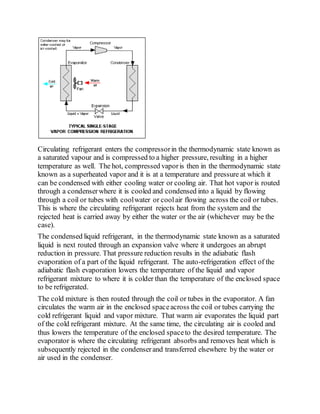
heat elsewhere. The below Figure depicts a typical, single-stage vapor-
compressionsystem. All such systems have four components:
a compressor,condensor, a thermal expansion valve, and an evaporator.
Circulating refrigerant enters the compressorin the thermodynamic state known as
a saturated vapour and is compressed to a higher pressure, resulting in a higher
temperature as well. The hot, compressed vaporis then in the thermodynamic state
known as a superheated vapor and it is at a temperature and pressure at which it
can be condensed with either cooling water or cooling air. That hot vapor is routed
through a condenserwhere it is cooled and condensed into a liquid by flowing
through a coil or tubes with coolwater or coolair flowing across the coil or tubes.
This is where the circulating refrigerant rejects heat from the system and the
rejected heat is carried away by either the water or the air (whichever may be the
case).
The condensed liquid refrigerant, in the thermodynamic state known as a saturated
liquid is next routed through an expansion valve where it undergoes an abrupt
reduction in pressure. That pressure reduction results in the adiabatic flash
evaporation of a part of the liquid refrigerant. The auto-refrigeration effect of the
adiabatic flash evaporation lowers the temperature of the liquid and vapor
refrigerant mixture to where it is colder than the temperature of the enclosed space
to be refrigerated.
The cold mixture is then routed through the coil or tubes in the evaporator. A fan
circulates the warm air in the enclosed spaceacross the coil or tubes carrying the
cold refrigerant liquid and vapor mixture. That warm air evaporates the liquid part
of the cold refrigerant mixture. At the same time, the circulating air is cooled and
thus lowers the temperature of the enclosed spaceto the desired temperature. The
evaporator is where the circulating refrigerant absorbs and removes heat which is
subsequently rejected in the condenserand transferred elsewhere by the water or
air used in the condenser.
To complete the refrigeration cycle, the refrigerant vapor from the evaporator is
again a saturated vapour and is routed back into the compressor.
THERMODYNAMIC ANALYSIS :
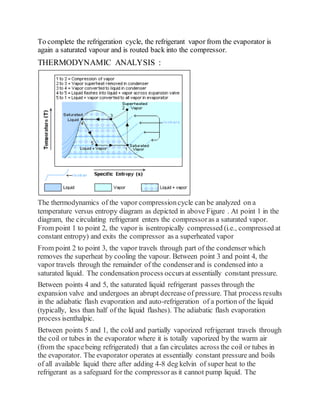
The thermodynamics of the vapor compressioncycle can be analyzed on a
temperature versus entropy diagram as depicted in above Figure . At point 1 in the
diagram, the circulating refrigerant enters the compressoras a saturated vapor.
From point 1 to point 2, the vapor is isentropically compressed (i.e., compressed at
constant entropy) and exits the compressor as a superheated vapor
From point 2 to point 3, the vapor travels through part of the condenser which
removes the superheat by cooling the vapour. Between point 3 and point 4, the
vapor travels through the remainder of the condenserand is condensed into a
saturated liquid. The condensation process occursat essentially constant pressure.
Between points 4 and 5, the saturated liquid refrigerant passes through the
expansion valve and undergoes an abrupt decrease of pressure. That process results
in the adiabatic flash evaporation and auto-refrigeration of a portion of the liquid
(typically, less than half of the liquid flashes). The adiabatic flash evaporation
process isenthalpic.
Between points 5 and 1, the cold and partially vaporized refrigerant travels through
the coil or tubes in the evaporator where it is totally vaporized by the warm air
(from the spacebeing refrigerated) that a fan circulates across the coil or tubes in
the evaporator. The evaporator operates at essentially constant pressure and boils
of all available liquid there after adding 4-8 deg kelvin of super heat to the
refrigerant as a safeguard for the compressoras it cannot pump liquid. The
resulting refrigerant vapor returns to the compressorinlet at point 1 to complete the
thermodynamic cycle.
It should be noted that the above discussion is based on the ideal vapor-
compressionrefrigeration cycle which does not take into account real world items
like frictional pressure drop in the system, slight internal irreversibility during the
compressionof the refrigerant vapor, or non-ideal gas behavior (if any).
Advantage:
1. It has smaller size for given capacity of refrigeration.
2. It has less running cost.
3. It can be employed over a large range of temperatures
4. The coefficient of performance is quite high.
Disadvantages:
1. The initial costis high
2. The prevention of leakage of refrigerant is the major problem in vapour
compressionsystem.

Vcrs

  • 1.
    VAPOUR COMPRESSION REFRIGERATIONSYSTEM Introduction: Thermodynamic cycles can be categorized into gas cycles and vapour cycles. In gas cycles, heat rejection and refrigeration take place as the gas undergoes sensible cooling and heating. In a vapour cycle the working fluid undergoes phase change and refrigeration effect is due to the vaporization of refrigerant liquid. If the refrigerant is a pure substance then its temperature remains constant during the phase change processes.Sincethe refrigeration effect is produced during phase change, large amount of heat (latent heat) can be transferred per kilogram of refrigerant at a near constant temperature. Hence, the required mass flow rates for a given refrigeration capacity will be much smaller compared to a gas cycle. Vapour cycles can be subdivided into vapour compressionsystems, vapour absorption systems, vapour jet systems etc. Among these the vapour compressionrefrigeration systems are predominant. Vapour compression refrigeration system: Vapour compressionrefrigeration systems are the mostcommonly used among all refrigeration systems. As the name implies, these systems belong to the general class of vapour cycles, where in the working fluid (refrigerant) undergoes phase change at least during one process.In a vapour compressionrefrigeration system, refrigeration is obtained as the refrigerant evaporates at low temperatures. The input to the system is in the form of mechanical energy required to run the compressor. Hence these systems are also called as mechanical refrigeration systems. Vapour compressionrefrigeration systems are available to suit almost all applications with the refrigeration capacities ranging from few Watts to few megawatts. DESCRIPTION OF V.C.R.S: The vapor-compressionuses a circulating liquid refrigerent as the medium which absorbs and removes heat from the spaceto be cooled and subsequently rejects that heat elsewhere. The below Figure depicts a typical, single-stage vapor- compressionsystem. All such systems have four components: a compressor,condensor, a thermal expansion valve, and an evaporator.
  • 2.
    Circulating refrigerant entersthe compressorin the thermodynamic state known as a saturated vapour and is compressed to a higher pressure, resulting in a higher temperature as well. The hot, compressed vaporis then in the thermodynamic state known as a superheated vapor and it is at a temperature and pressure at which it can be condensed with either cooling water or cooling air. That hot vapor is routed through a condenserwhere it is cooled and condensed into a liquid by flowing through a coil or tubes with coolwater or coolair flowing across the coil or tubes. This is where the circulating refrigerant rejects heat from the system and the rejected heat is carried away by either the water or the air (whichever may be the case). The condensed liquid refrigerant, in the thermodynamic state known as a saturated liquid is next routed through an expansion valve where it undergoes an abrupt reduction in pressure. That pressure reduction results in the adiabatic flash evaporation of a part of the liquid refrigerant. The auto-refrigeration effect of the adiabatic flash evaporation lowers the temperature of the liquid and vapor refrigerant mixture to where it is colder than the temperature of the enclosed space to be refrigerated. The cold mixture is then routed through the coil or tubes in the evaporator. A fan circulates the warm air in the enclosed spaceacross the coil or tubes carrying the cold refrigerant liquid and vapor mixture. That warm air evaporates the liquid part of the cold refrigerant mixture. At the same time, the circulating air is cooled and thus lowers the temperature of the enclosed spaceto the desired temperature. The evaporator is where the circulating refrigerant absorbs and removes heat which is subsequently rejected in the condenserand transferred elsewhere by the water or air used in the condenser.
  • 3.
    To complete therefrigeration cycle, the refrigerant vapor from the evaporator is again a saturated vapour and is routed back into the compressor. THERMODYNAMIC ANALYSIS : The thermodynamics of the vapor compressioncycle can be analyzed on a temperature versus entropy diagram as depicted in above Figure . At point 1 in the diagram, the circulating refrigerant enters the compressoras a saturated vapor. From point 1 to point 2, the vapor is isentropically compressed (i.e., compressed at constant entropy) and exits the compressor as a superheated vapor From point 2 to point 3, the vapor travels through part of the condenser which removes the superheat by cooling the vapour. Between point 3 and point 4, the vapor travels through the remainder of the condenserand is condensed into a saturated liquid. The condensation process occursat essentially constant pressure. Between points 4 and 5, the saturated liquid refrigerant passes through the expansion valve and undergoes an abrupt decrease of pressure. That process results in the adiabatic flash evaporation and auto-refrigeration of a portion of the liquid (typically, less than half of the liquid flashes). The adiabatic flash evaporation process isenthalpic. Between points 5 and 1, the cold and partially vaporized refrigerant travels through the coil or tubes in the evaporator where it is totally vaporized by the warm air (from the spacebeing refrigerated) that a fan circulates across the coil or tubes in the evaporator. The evaporator operates at essentially constant pressure and boils of all available liquid there after adding 4-8 deg kelvin of super heat to the refrigerant as a safeguard for the compressoras it cannot pump liquid. The
  • 4.
    resulting refrigerant vaporreturns to the compressorinlet at point 1 to complete the thermodynamic cycle. It should be noted that the above discussion is based on the ideal vapor- compressionrefrigeration cycle which does not take into account real world items like frictional pressure drop in the system, slight internal irreversibility during the compressionof the refrigerant vapor, or non-ideal gas behavior (if any). Advantage: 1. It has smaller size for given capacity of refrigeration. 2. It has less running cost. 3. It can be employed over a large range of temperatures 4. The coefficient of performance is quite high. Disadvantages: 1. The initial costis high 2. The prevention of leakage of refrigerant is the major problem in vapour compressionsystem.