Citation Database and Use of
Plagiarism Software
Dr. Utpal Das
Dibrugarh University
8486140679
utpaldas@dibru.ac.in
What is a Database?
A database is an organized collection of structured
information, or data, typically stored electronically in a
computer system with the help of components/tools
like:
i. Database Management System (DBMS)
(MySQL, Microsoft Access, Microsoft SQL
Server, FileMaker Pro, Oracle Database, and
dBASE)
iii. Set or combination of sets of LMS
(conditional)
Types of Database according tools/technology:
• Open source databases: whose source code is open source
• Cloud databases: collection of data resides on a private, public, or
hybrid cloud computing platform where administrative tasks and
maintenance are performed by a service provider
• Multimodel database: combine different types of database models into
a single, integrated back
• Document/JSON database: designed for storing, retrieving, and
managing document-oriented information
• Self-driving databases: The newest and self-driving databases are
cloud-based and use machine learning to automate database tuning,
security, backups, updates, and other routine management tasks
traditionally performed by database administrators
What is a citation database?
Citation databases are collections of referenced papers/
articles/ books and other material entered into an online
system (database) in a structured and consistent way.
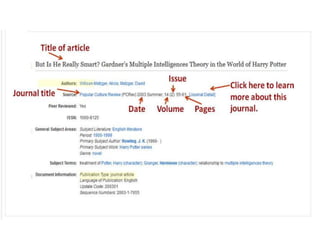
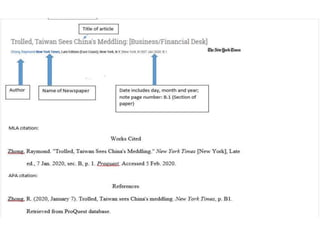
All the information relating to a single document, such
as author, title, publication details, abstract, and
perhaps the full text make up the ‘record’ for that
document.
Each of these items of information becomes a separate
‘field’ in that record and enables the document to be
retrieved via any of these items, or by keywords.
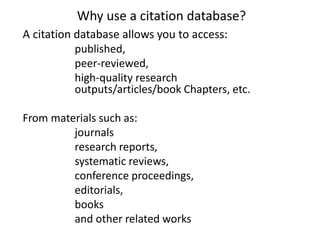
Why use a citation database?
A citation database allows you to access:
published,
peer-reviewed,
high-quality research
outputs/articles/book Chapters, etc.
From materials such as:
journals
research reports,
systematic reviews,
conference proceedings,
editorials,
books
and other related works
Indexing Mechanism
When a document is originally entered into a
database it is analysed for its key subjects, and
descriptors (MeSH terms in MEDLINE, PubMed,
SLSH etc.) are assigned to it as metadata. Subject
Headings are controlled vocabulary thesaurus
used for indexing and cataloguing articles. These
SH terms are ‘search terms’ or ‘indexing terms’
that allow precise searching and retrieving the
record precisely.
Searches can then be limited, for example, by author
or title fields, or year/s of publication, and keywords
can be focused and searched separately. Searches
undertaken in citation databases are therefore more
precise and comprehensive than searches on general
internet search engines and the results are of
consistently higer quality, reliability with precision.
Database challenges
• Absorbing significant increases in data volume.
• Ensuring data security.
• Keeping up with demand real time access.
• Managing and maintaining the database and
infrastructure with software upgrades
• Removing limits on scalability with growth for
sustainability
• Ensuring data residency, data sovereignty, or latency
requirements that are better suited to run on-premises.
Thanks

Citation Database

  • 1.
    Citation Database andUse of Plagiarism Software Dr. Utpal Das Dibrugarh University 8486140679 utpaldas@dibru.ac.in
  • 2.
    What is aDatabase? A database is an organized collection of structured information, or data, typically stored electronically in a computer system with the help of components/tools like: i. Database Management System (DBMS) (MySQL, Microsoft Access, Microsoft SQL Server, FileMaker Pro, Oracle Database, and dBASE) iii. Set or combination of sets of LMS (conditional)
  • 3.
    Types of Databaseaccording tools/technology: • Open source databases: whose source code is open source • Cloud databases: collection of data resides on a private, public, or hybrid cloud computing platform where administrative tasks and maintenance are performed by a service provider • Multimodel database: combine different types of database models into a single, integrated back • Document/JSON database: designed for storing, retrieving, and managing document-oriented information • Self-driving databases: The newest and self-driving databases are cloud-based and use machine learning to automate database tuning, security, backups, updates, and other routine management tasks traditionally performed by database administrators
  • 4.
    What is acitation database? Citation databases are collections of referenced papers/ articles/ books and other material entered into an online system (database) in a structured and consistent way. All the information relating to a single document, such as author, title, publication details, abstract, and perhaps the full text make up the ‘record’ for that document. Each of these items of information becomes a separate ‘field’ in that record and enables the document to be retrieved via any of these items, or by keywords.
  • 5.
    Why use acitation database? A citation database allows you to access: published, peer-reviewed, high-quality research outputs/articles/book Chapters, etc. From materials such as: journals research reports, systematic reviews, conference proceedings, editorials, books and other related works
  • 6.
    Indexing Mechanism When adocument is originally entered into a database it is analysed for its key subjects, and descriptors (MeSH terms in MEDLINE, PubMed, SLSH etc.) are assigned to it as metadata. Subject Headings are controlled vocabulary thesaurus used for indexing and cataloguing articles. These SH terms are ‘search terms’ or ‘indexing terms’ that allow precise searching and retrieving the record precisely.
  • 7.
    Searches can thenbe limited, for example, by author or title fields, or year/s of publication, and keywords can be focused and searched separately. Searches undertaken in citation databases are therefore more precise and comprehensive than searches on general internet search engines and the results are of consistently higer quality, reliability with precision.
  • 11.
    Database challenges • Absorbingsignificant increases in data volume. • Ensuring data security. • Keeping up with demand real time access. • Managing and maintaining the database and infrastructure with software upgrades • Removing limits on scalability with growth for sustainability • Ensuring data residency, data sovereignty, or latency requirements that are better suited to run on-premises.
  • 12.