PAPER  PRESENTATION ONApplication Of Graphene In Modern ElectronicsPresented By-ChinmayChepurwarG.H Raisoni College Of Engineering(An Autonomous Institute under UGC act 1956,affilated to RTMNU, Nagpur)Department of Electronics Engineering
OverviewLets know Graphene
History
Structure
Properties
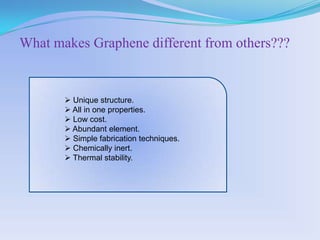
What makes Graphene different from others?
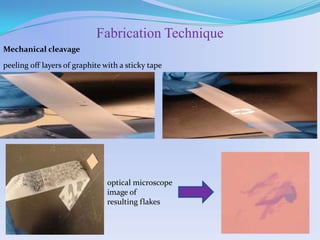
Fabrication technique
Applications
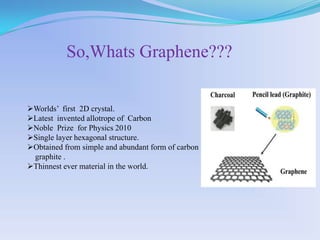
How it will change electronics??So,WhatsGraphene???Worlds’  first  2D crystal.
Latest  invented allotrope of  Carbon
Noble  Prize  for Physics 2010
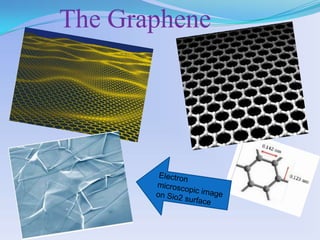
Single layer hexagonal structure.
Obtained from simple and abundant form of carbon     graphite . Thinnest ever material in the world.The GrapheneElectron microscopic image on Sio2 surface
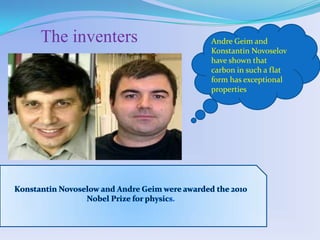
The inventersAndre Geim and Konstantin Novoselov have shown that carbon in such a flat form has exceptional propertiesKonstantin Novoselow and Andre Geim were awarded the 2010 Nobel Prize for physics.
HistoryThe theory behind the substance graphene was first explored by theoretical physicist Philip Wallace in 1947.
In 1960’s it was believed that  physically graphene cannot  exist abecause of thermodynamic unstability
Graphene in itself however wasn't discovered until 2004 in its full observable and testable form
Since then, in the past 6 years, scientists have discovered that the substance retains some amazing properties.
Single layers of graphite were previously (starting from the 1970s) grown epitaxially on top of other materials.
There have also been a number of efforts to make very thin films of graphite by mechanical exfoliation
A key advance in the science of graphene was brought  by  Andre Geim and Konstantin Novoselov at Manchester University 
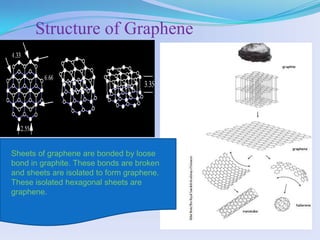
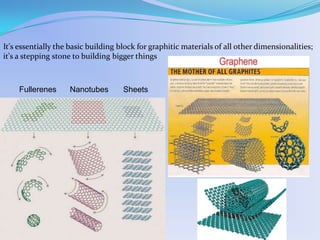
Scotch tape techniqueStructure of GrapheneSheets of graphene are bonded by loose bond in graphite. These bonds are broken and sheets are isolated to form graphene. These isolated hexagonal sheets are graphene.
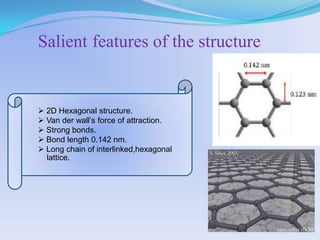
Salientfeatures of the structure 2D Hexagonal structure.
 Van der wall’s force of attraction.
 Strong bonds.
 Bond length 0.142 nm.
 Long chain of interlinked,hexagonal    lattice.
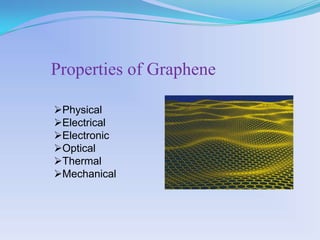
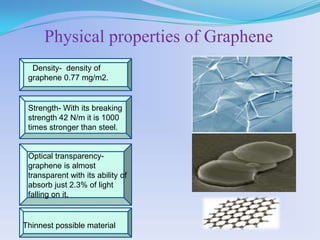
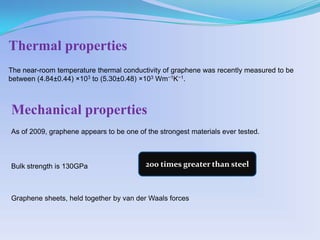
Properties of GraphenePhysical

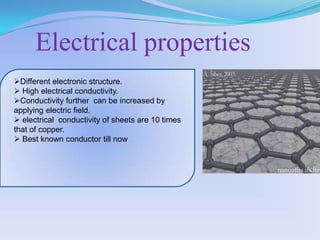
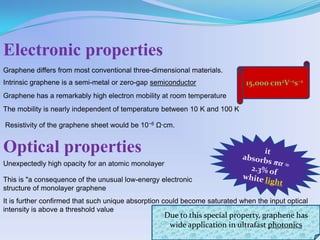
Application of Graphene in electronics