Publication ethics
Roger Watson
Editor-in-Chief, Journal of Advanced Nursing
Editor, Nursing Open
Ethical Issues in Publication
1. Duplicate Publication
2. Authorship and Order
3. Scientific Misconduct (including plagiarism)
4. Conflict of interest
Why do ethical issues arise?
Journals exist to enhance the scientific database
…and enhance seniority and income
…and pharmaceutical company profits
…and publishers’ profits
(Courtesy of Harvey Marcovitch, COPE)
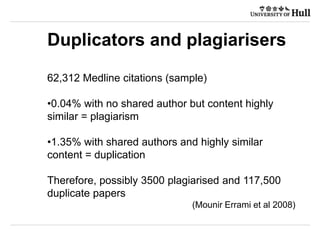
Duplicators and plagiarisers
62,312 Medline citations (sample)
•0.04% with no shared author but content highly
similar = plagiarism
•1.35% with shared authors and highly similar
content = duplication
Therefore, possibly 3500 plagiarised and 117,500
duplicate papers
(Mounir Errami et al 2008)
Duplicate Publication
Not republishing the same findings
Not submitting the same manuscript to two
or more journals at once
Not dividing one research project into many
little papers (“salami slicing”)
Duplication..
If in doubt...always seek editorial advice
Authorship
• Who can be an author?
• Authorship order
• Issues and problems with authorship
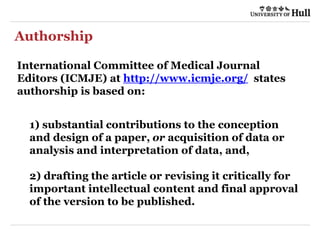
Authorship
International Committee of Medical Journal
Editors (ICMJE) at http://www.icmje.org/ states
authorship is based on:
1) substantial contributions to the conception
and design of a paper, or acquisition of data or
analysis and interpretation of data, and,
2) drafting the article or revising it critically for
important intellectual content and final approval
of the version to be published.
Best Practices for Authorship
• Discuss the order of authorship at
beginning
• Revisit decisions on authorship during
project – especially if responsibilities
changes
• Disclose if any writing done by
professional writers
• Document everything in writing
• All authors take responsibility for
content
Plagiarism
Plagiarism ranges from the
unreferenced use of others’ published
and unpublished ideas, including
research grant applications to
submission under “new” authorship of
a complete paper, sometimes in a
different language.
It may occur at any stage of planning,
research, writing, or publication: it
applies to print and electronic
versions.
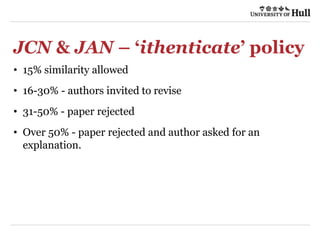
JCN & JAN – ‘ithenticate’ policy
• 15% similarity allowed
• 16-30% - authors invited to revise
• 31-50% - paper rejected
• Over 50% - paper rejected and author asked for an
explanation.
What is Fraud?
Fabrication: Invention of data or
cases
Falsification: Wilful distortion of data
– Ignoring outliers
– Not admitting that some data are
missing.
– Post hoc analyses that are not admitted
– Not including data on side effects in a
clinical trial
What is Conflict of Interest?
• Conflict of interest
– a set of conditions in which professional
judgement concerning a primary interest
(such as the validity of a research study)
tends to be unduly influenced by a
secondary interest (such as financial gain).
– ....or may give that impression
Conflicts of Interest
• They have been described as those
which, when revealed later, ‘would
make a reasonable reader feel misled or
deceived’.
• They may be personal, commercial,
political, academic or financial.
• “Financial” interests may include
employment, research funding, stock or
share ownership, payment for lectures
or travel, consultancies and company
support for staff.
Other Conflicts of Interest
• Strong personal beliefs – in papers related
to emotionally charged areas such as stem
cells, abortion, or evolution
• Other scientific conflicts of interest
– Studies so closely related to your own that you
are in competition with the authors
– Labs/groups with ongoing real or apparent
competitions in a general area of research
Committee on Publication
Ethics (COPE)
• Founded in 1997 as a response to growing anxiety
about the integrity of authors submitting studies to
medical journals.
• Founded by British Medical Journal & Lancet editors
THANK YOU
Email: r.watson@hull.ac.uk
@rwatson1955

Publication ethics

  • 1.
    Publication ethics Roger Watson Editor-in-Chief,Journal of Advanced Nursing Editor, Nursing Open
  • 2.
    Ethical Issues inPublication 1. Duplicate Publication 2. Authorship and Order 3. Scientific Misconduct (including plagiarism) 4. Conflict of interest
  • 3.
    Why do ethicalissues arise? Journals exist to enhance the scientific database …and enhance seniority and income …and pharmaceutical company profits …and publishers’ profits (Courtesy of Harvey Marcovitch, COPE)
  • 4.
    Duplicators and plagiarisers 62,312Medline citations (sample) •0.04% with no shared author but content highly similar = plagiarism •1.35% with shared authors and highly similar content = duplication Therefore, possibly 3500 plagiarised and 117,500 duplicate papers (Mounir Errami et al 2008)
  • 5.
    Duplicate Publication Not republishingthe same findings Not submitting the same manuscript to two or more journals at once Not dividing one research project into many little papers (“salami slicing”)
  • 6.
  • 7.
    Authorship • Who canbe an author? • Authorship order • Issues and problems with authorship
  • 8.
    Authorship International Committee ofMedical Journal Editors (ICMJE) at http://www.icmje.org/ states authorship is based on: 1) substantial contributions to the conception and design of a paper, or acquisition of data or analysis and interpretation of data, and, 2) drafting the article or revising it critically for important intellectual content and final approval of the version to be published.
  • 9.
    Best Practices forAuthorship • Discuss the order of authorship at beginning • Revisit decisions on authorship during project – especially if responsibilities changes • Disclose if any writing done by professional writers • Document everything in writing • All authors take responsibility for content
  • 10.
    Plagiarism Plagiarism ranges fromthe unreferenced use of others’ published and unpublished ideas, including research grant applications to submission under “new” authorship of a complete paper, sometimes in a different language. It may occur at any stage of planning, research, writing, or publication: it applies to print and electronic versions.
  • 11.
    JCN & JAN– ‘ithenticate’ policy • 15% similarity allowed • 16-30% - authors invited to revise • 31-50% - paper rejected • Over 50% - paper rejected and author asked for an explanation.
  • 12.
    What is Fraud? Fabrication:Invention of data or cases Falsification: Wilful distortion of data – Ignoring outliers – Not admitting that some data are missing. – Post hoc analyses that are not admitted – Not including data on side effects in a clinical trial
  • 13.
    What is Conflictof Interest? • Conflict of interest – a set of conditions in which professional judgement concerning a primary interest (such as the validity of a research study) tends to be unduly influenced by a secondary interest (such as financial gain). – ....or may give that impression
  • 14.
    Conflicts of Interest •They have been described as those which, when revealed later, ‘would make a reasonable reader feel misled or deceived’. • They may be personal, commercial, political, academic or financial. • “Financial” interests may include employment, research funding, stock or share ownership, payment for lectures or travel, consultancies and company support for staff.
  • 15.
    Other Conflicts ofInterest • Strong personal beliefs – in papers related to emotionally charged areas such as stem cells, abortion, or evolution • Other scientific conflicts of interest – Studies so closely related to your own that you are in competition with the authors – Labs/groups with ongoing real or apparent competitions in a general area of research
  • 16.
    Committee on Publication Ethics(COPE) • Founded in 1997 as a response to growing anxiety about the integrity of authors submitting studies to medical journals. • Founded by British Medical Journal & Lancet editors
  • 17.