CHEMISTRY      PROJECT  ON: DIFFUSION
Diffusion
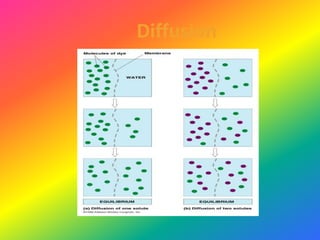
DiffusionMovement of molecules from an area of high concentration to an area of low concentration.Movement from one side of a membrane to another, un-facilitated.
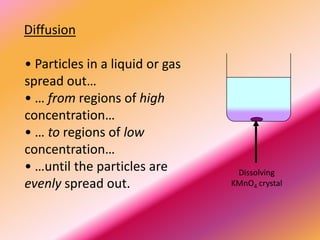
Dissolving KMnO4 crystalDiffusion Particles in a liquid or gas spread out…
 … from regions of high concentration…
 … to regions of low concentration…
 …until the particles are evenly spread out.Diffusion
All substances are made up of sub-microscopic particles called molecules.In gases (like air) the molecules can move freely.In liquids (like water) the molecules can also move.In solids the molecules are more or less stationary.
Representation of molecules in a gas(a)(b)As a result of their random movements the molecules become evenly distributed.
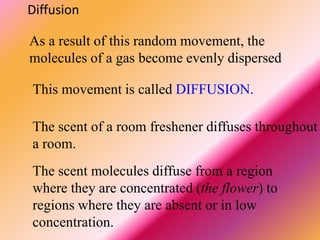
DiffusionAs a result of this random movement, themolecules of a gas become evenly dispersedThis movement is called DIFFUSION.The scent of a room freshener diffuses throughout a room.The scent molecules diffuse from a region where they are concentrated (the flower) to regions where they are absent or in low concentration.
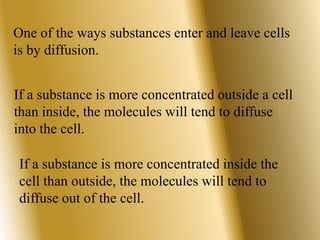
One of the ways substances enter and leave cellsis by diffusion.If a substance is more concentrated outside a cell than inside, the molecules will tend to diffuseinto the cell.If a substance is more concentrated inside thecell than outside, the molecules will tend todiffuse out of the cell.
If all kinds of substance could diffuse into a cellthere would be a danger that poisonous substances could diffuse in and kill the cell.If all the substances in a cell could diffuse outthe cell would lose essential substances (e.g. glucose) needed to keep the cell alive.In fact, although the cell membrane does allowsome substances (e.g. oxygen and carbon dioxide) to diffuse freely, it controls the exit and entry of nearly all other substances.
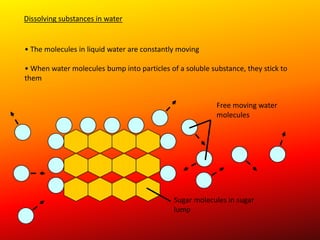
 Diffusion occurs because of the moving particles in gases and liquids .Free moving water moleculesSugar molecules in sugar lumpDissolving substances in water The molecules in liquid water are constantly moving
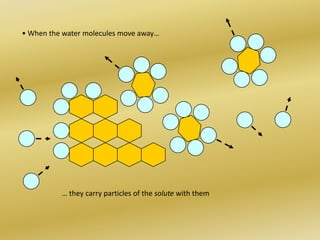
 When water molecules bump into particles of a soluble substance, they stick to them When the water molecules move away…… they carry particles of the solute with them
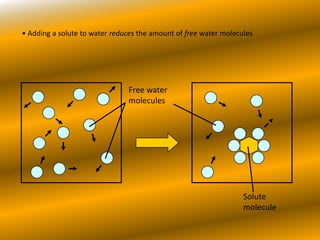
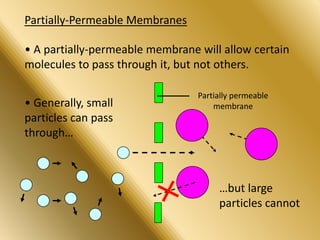
Solutemolecule Free water molecules Adding a solute to water reduces the amount of free water moleculesPartially permeable membrane Generally, small particles can pass through……but large particles cannotPartially-Permeable Membranes A partially-permeable membrane will allow certain molecules to pass through it, but not others.Partially-permeable membraneWater-solute particle is too large to pass through membraneMore free water molecules on this side of membraneFree water molecules diffuse in this direction
THANK YOU
Diffusion

Diffusion

  • 1.
    CHEMISTRY PROJECT ON: DIFFUSION
  • 2.
  • 3.
    DiffusionMovement of moleculesfrom an area of high concentration to an area of low concentration.Movement from one side of a membrane to another, un-facilitated.
  • 4.
    Dissolving KMnO4 crystalDiffusionParticles in a liquid or gas spread out…
  • 5.
    … fromregions of high concentration…
  • 6.
    … toregions of low concentration…
  • 7.
    …until theparticles are evenly spread out.Diffusion
  • 8.
    All substances aremade up of sub-microscopic particles called molecules.In gases (like air) the molecules can move freely.In liquids (like water) the molecules can also move.In solids the molecules are more or less stationary.
  • 9.
    Representation of moleculesin a gas(a)(b)As a result of their random movements the molecules become evenly distributed.
  • 10.
    DiffusionAs a resultof this random movement, themolecules of a gas become evenly dispersedThis movement is called DIFFUSION.The scent of a room freshener diffuses throughout a room.The scent molecules diffuse from a region where they are concentrated (the flower) to regions where they are absent or in low concentration.
  • 11.
    One of theways substances enter and leave cellsis by diffusion.If a substance is more concentrated outside a cell than inside, the molecules will tend to diffuseinto the cell.If a substance is more concentrated inside thecell than outside, the molecules will tend todiffuse out of the cell.
  • 12.
    If all kindsof substance could diffuse into a cellthere would be a danger that poisonous substances could diffuse in and kill the cell.If all the substances in a cell could diffuse outthe cell would lose essential substances (e.g. glucose) needed to keep the cell alive.In fact, although the cell membrane does allowsome substances (e.g. oxygen and carbon dioxide) to diffuse freely, it controls the exit and entry of nearly all other substances.
  • 13.
    Diffusion occursbecause of the moving particles in gases and liquids .Free moving water moleculesSugar molecules in sugar lumpDissolving substances in water The molecules in liquid water are constantly moving
  • 14.
    When watermolecules bump into particles of a soluble substance, they stick to them When the water molecules move away…… they carry particles of the solute with them
  • 15.
    Solutemolecule Free watermolecules Adding a solute to water reduces the amount of free water moleculesPartially permeable membrane Generally, small particles can pass through……but large particles cannotPartially-Permeable Membranes A partially-permeable membrane will allow certain molecules to pass through it, but not others.Partially-permeable membraneWater-solute particle is too large to pass through membraneMore free water molecules on this side of membraneFree water molecules diffuse in this direction
  • 16.