
What is
GST ?
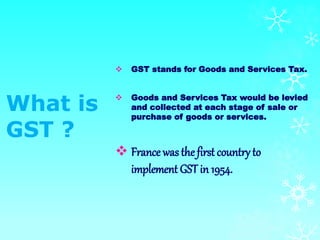
 GST stands for Goods and Services Tax.
 Goods and Services Tax would be levied
and collected at each stage of sale or
purchase of goods or services.
 France wasthefirst country to
implement GST in 1954.
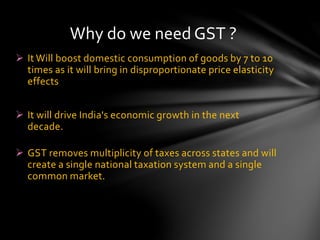
 It Will boost domestic consumption of goods by 7 to 10
times as it will bring in disproportionate price elasticity
effects
 It will drive India's economic growth in the next
decade.
 GST removes multiplicity of taxes across states and will
create a single national taxation system and a single
common market.
Why do we need GST ?
The Goods and Services Tax, one of the biggest reforms in
India's indirect tax structure, is likely to revolutionize the
Indian economy in an unprecedented manner .
GST will propel GDP growth to newer heights, lower
income disparity and simplify decision making of
businesses.
The GST rollout will be a milestone for the nation as its
implementation will have a far-reaching impact on the
Indian economy.
Existing Tax structure in India
Tax Structure
Direct Tax
Income Tax
Wealth Tax
Indirect Tax
Central Tax
Excise Service Tax Custome
State Tax
VAT
Entry Tax,
luxury tax,
Lottery Tax, etc.
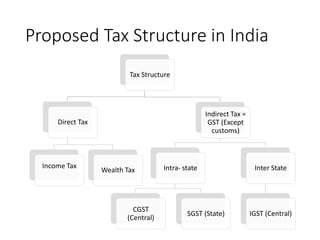
Proposed Tax Structure in India
Tax Structure
Direct Tax
Income Tax
Wealth Tax
Indirect Tax =
GST (Except
customs)
Intra- state
CGST
(Central)
SGST (State)
Inter State
IGST (Central)
Asian
countries
having GST
North
Korea
-Saudi
Arabia
United
Arab
Emirates
Qatar
WHAT OTHER COUNTRIES SAY
• The US has welcomed the passage of the landmark Goods
and Services Tax (GST) bill, saying it would have far-
reaching benefits for expanding bilateral trade and
investment partnership with India
 The US Ambassador believes it is "an important reform and
boost to growth in India“.
 "This should be seen as a win for economics over politics, a
very refreshing change from the norm. This could very well
be a defining economic moment for the Modi government,“
Trudeau Said.
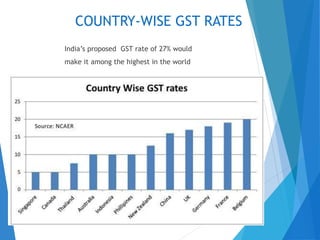
COUNTRY-WISE GST RATES
India’s proposed GST rate of 27% would
make it among the highest in the world
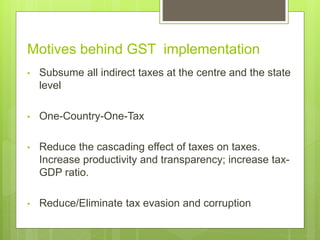
• Subsume all indirect taxes at the centre and the state
level
• One-Country-One-Tax
• Reduce the cascading effect of taxes on taxes.
Increase productivity and transparency; increase tax-
GDP ratio.
• Reduce/Eliminate tax evasion and corruption
Motives behind GST implementation
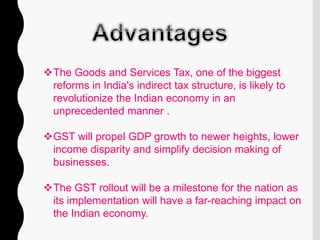
The Goods and Services Tax, one of the biggest
reforms in India's indirect tax structure, is likely to
revolutionize the Indian economy in an
unprecedented manner .
GST will propel GDP growth to newer heights, lower
income disparity and simplify decision making of
businesses.
The GST rollout will be a milestone for the nation as
its implementation will have a far-reaching impact on
the Indian economy.
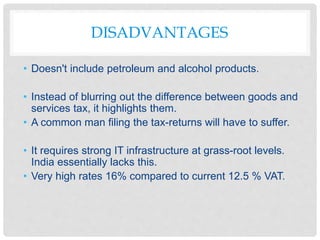
DISADVANTAGES
• Doesn't include petroleum and alcohol products.
• Instead of blurring out the difference between goods and
services tax, it highlights them.
• A common man filing the tax-returns will have to suffer.
• It requires strong IT infrastructure at grass-root levels.
India essentially lacks this.
• Very high rates 16% compared to current 12.5 % VAT.
Ppt on need for gst in india

Ppt on need for gst in india

  • 2.
    What is GST ? GST stands for Goods and Services Tax.  Goods and Services Tax would be levied and collected at each stage of sale or purchase of goods or services.  France wasthefirst country to implement GST in 1954.
  • 3.
     It Willboost domestic consumption of goods by 7 to 10 times as it will bring in disproportionate price elasticity effects  It will drive India's economic growth in the next decade.  GST removes multiplicity of taxes across states and will create a single national taxation system and a single common market. Why do we need GST ?
  • 4.
    The Goods andServices Tax, one of the biggest reforms in India's indirect tax structure, is likely to revolutionize the Indian economy in an unprecedented manner . GST will propel GDP growth to newer heights, lower income disparity and simplify decision making of businesses. The GST rollout will be a milestone for the nation as its implementation will have a far-reaching impact on the Indian economy.
  • 5.
    Existing Tax structurein India Tax Structure Direct Tax Income Tax Wealth Tax Indirect Tax Central Tax Excise Service Tax Custome State Tax VAT Entry Tax, luxury tax, Lottery Tax, etc.
  • 6.
    Proposed Tax Structurein India Tax Structure Direct Tax Income Tax Wealth Tax Indirect Tax = GST (Except customs) Intra- state CGST (Central) SGST (State) Inter State IGST (Central)
  • 7.
  • 8.
    WHAT OTHER COUNTRIESSAY • The US has welcomed the passage of the landmark Goods and Services Tax (GST) bill, saying it would have far- reaching benefits for expanding bilateral trade and investment partnership with India  The US Ambassador believes it is "an important reform and boost to growth in India“.  "This should be seen as a win for economics over politics, a very refreshing change from the norm. This could very well be a defining economic moment for the Modi government,“ Trudeau Said.
  • 9.
    COUNTRY-WISE GST RATES India’sproposed GST rate of 27% would make it among the highest in the world
  • 10.
    • Subsume allindirect taxes at the centre and the state level • One-Country-One-Tax • Reduce the cascading effect of taxes on taxes. Increase productivity and transparency; increase tax- GDP ratio. • Reduce/Eliminate tax evasion and corruption Motives behind GST implementation
  • 11.
    The Goods andServices Tax, one of the biggest reforms in India's indirect tax structure, is likely to revolutionize the Indian economy in an unprecedented manner . GST will propel GDP growth to newer heights, lower income disparity and simplify decision making of businesses. The GST rollout will be a milestone for the nation as its implementation will have a far-reaching impact on the Indian economy.
  • 12.
    DISADVANTAGES • Doesn't includepetroleum and alcohol products. • Instead of blurring out the difference between goods and services tax, it highlights them. • A common man filing the tax-returns will have to suffer. • It requires strong IT infrastructure at grass-root levels. India essentially lacks this. • Very high rates 16% compared to current 12.5 % VAT.