OXIDATION STATES OF
LANTHANIDES
OXIDATION STATE
The total number of electrons that an atom either gains or loses in order
to form a chemical bond with another atom.
 The underlying principle for oxidation state is conservation of mass.
Since electrons cannot be created or destroyed a proper accounting of
where electrons go is central to understanding chemical reactions.
 It also determines the ability of an atom to oxidise (to lose electrons) or
to reduce (to gain electrons) other atoms or species.
 If we assign oxidation states before and after a reaction, the we can
understand where the electrons flowed during the reaction.
Electrons are where all the action is in chemical reactions.
Oxidation results in an increase in the oxidation state and reduction
result in a decrease in the oxidation state.
LANTHANIDES
Rare Earth Element
Occurrence: 3×10⁻⁴ .
% of earth crust
Available in monzite
sand as lanthanide
orthophophates
Norwegain
mineralogist victor
Gold schmidt in 1925
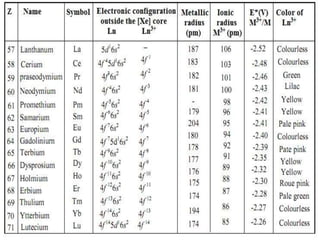
Z= 58 to 71
Fifteen metallic elements
( La to Lu)
Highly dense elements
(6.1 to 9.8g per cc)
Mp: 800 – 1600
Bp: 1200 - 3500
Valance electrons lies in
4f orbitals
Electronic configuration
[Xe]4f1-145d0-16s2
All of the elements in the series closely resemble lanthanum and each
another in their chemical and physical properties.
 They have a lustre and are silvery in appearance.
They are soft metals and can even be cut with a knife
The elements have different reaction tendencies depending on basicity.
Some are very reactive while some take time to react.
Lanthanides can corrode or become brittle if they are contaminated with
other metals or non-metals.
They all mostly form a trivalent compound. Sometimes they can also form
divalent or tetravalent compounds.
They are magnetic.
OXIDATION STATES
OF
LANTHANIDES
 All the elements in the lanthanide series show an oxidation state of +3
 Lanthanides show variable oxidation states. They also show +2, +3, and +4
oxidation states
 But the most stable oxidation state of Lanthanides is +3. Elements in other
states hence try to lose or gain electrons to get +3 state
By that those ions become strong reducing or oxidizing agents respectively
 Uneven distribution of oxidation state among the metals is attributed to the
high stability of empty, half-filled or fully filled f-sub shells
Ln, Pm, Ho, Eb, Lu +3
Ce, Pr, Tb, Dy +3,+4
Sm, Eu, Tm, Yb +2,+3
Nd +2,+3,+4
 Greater stabilization of the 4f orbitals compared to 5d and 6s
The order of penetration of the orbitals into the inner electron
core is 4f>5d>6S
 The 4f electrons are the closest to nucleus and attracted by it the
most.
 Now as successive ionisation increases the net charge on the
lanthanide cation being closest to the nucleus,4f electrons are
pulled even more closer than 5d and 6s electrons.
Thus is Ln3+,4f electrons are just too strongly pulled by the
nucleus to be ionised further as it requires huge energy for it
So states higher than +3 is generally not seen.
OCCURRENCE OF +4 OXIDATION STATE
 Ce4+ noble gas configuration
 but it reverts to a +3 oxidation state and thus acts as a strong oxidant and can
even oxidize water, although the reaction will be slow.
 Pr4+, Nd4+ Earlier in the lanthanide series
 so the effective nuclear charge is not so high to be able to attract the 4f
electrons much more than 5d and 6s
 Tb4+, Dy4+ (4f7 valence shell) Half shell effect
 more stable than other filled orbitals.
Ce4+, Pr4+, Nd4+, Tb4+, Dy4+
OCCURRENCE OF +2 OXIDATION STATE
 Eu2+ [4f7 ], Sm2+ [4f6 ], Yb2+ [4f14] clear influences of
electronic shell structure
 Europium (Z=63) [Xe] 4f7 6s2 half-filled
4f7 configuration and hence it readily forms Eu2+ion.
 Eu2+ then changes to the common oxidation states of lanthanides (+3) and
forms Eu3+, acting as a strong reducing agent.
 Ytterbium (Z=70) fully filled f-orbital
It has similar reasons for being a strong reducing agent, in the Yb2+ state.
Oxidation state in Aqueous Solution
In aqueous solution, Sm2+, Eu2+ and Yb2+ loose electron, i.e get
oxidized and are good reducing agents.
On the other hand Ce4+, Pr4+, Tb4+ gain electron – gets reduced and
are good oxidizing agents.
Higher oxidation states (+4) of elements are possible only with oxides.
Example: Pr, Nd, Tb and Dy.
CONSEQUENSES OF OXIDATION STATES
 Colour of the ions
 Ionization energy
 Lanthanide contraction
Separation of lanthanides
 Basic strength of hydroxides
 complex formation
COLOUR OF IONS
 Lanthanides ions can have electrons in f-orbital and also empty orbitals like
the d-block elements.
When a frequency of light is absorbed, the light transmitted exhibit a colour
complementary to the frequency absorbed.
Inner transition element ions can absorb the frequency in the visible region
to use it for f-f electron transition and produce visible colour.
Many of the lanthanide metals are silver-white.
 The lanthanide ions with +3 oxidation state
are coloured both in solid-state and in aqueous solution.
The colour of a cation depends on
the number of unpaired f electrons Lanthanides,
with xf electrons, have the same colour as of (14-x) electron elements.
IONISATION ENERGY
 Ionization energy Energy needed to remove the valence electron from
the atom/ion and is directly related to the force of attraction on the electron.
 Across the periodic table,
 Also, the ionization energy will be
more for half-filled and fully filled orbitals.
Atomic no: Nuclear charge: Size:
Ionization Energy:
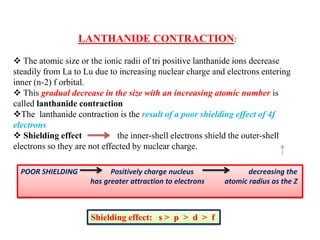
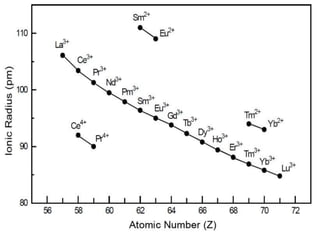
LANTHANIDE CONTRACTION:
 The atomic size or the ionic radii of tri positive lanthanide ions decrease
steadily from La to Lu due to increasing nuclear charge and electrons entering
inner (n-2) f orbital.
 This gradual decrease in the size with an increasing atomic number is
called lanthanide contraction
The lanthanide contraction is the result of a poor shielding effect of 4f
electrons
 Shielding effect the inner-shell electrons shield the outer-shell
electrons so they are not effected by nuclear charge.
POOR SHIELDING Positively charge nucleus decreasing the
has greater attraction to electrons atomic radius as the Z
Shielding effect: s > p > d > f
SEPERATION OF LANTHANIDES
 Since all the elements exhibit the +3 oxidation state as common,
they have similar properties
Thus, the separation of elements in its pure state is difficult.
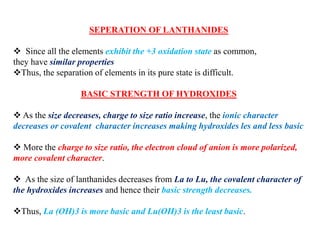
BASIC STRENGTH OF HYDROXIDES
 As the size decreases, charge to size ratio increase, the ionic character
decreases or covalent character increases making hydroxides les and less basic
 More the charge to size ratio, the electron cloud of anion is more polarized,
more covalent character.
 As the size of lanthanides decreases from La to Lu, the covalent character of
the hydroxides increases and hence their basic strength decreases.
Thus, La (OH)3 is more basic and Lu(OH)3 is the least basic.
COMPLEX FORMATION
 Lanthanides exhibiting 3+ oxidation state is the larger and hence low
charge to radius ratio.
This reduces the complex-forming ability of lanthanides compared to d-
block elements.
 Still they, form complexes with strong chelating agents like EDTA, β-
diketones, oxime etc. They do not form Pπ-complexes.
ELECTRODE POTENTIAL
 Formation Ce4+ of is favoured by the noble gas configuration.
 E0 value for Ce4+ / Ce3+ is +1.74 V which is enough to oxidize the water.
 Thus the reduction potential ( tendency to accept electrons) is more
 They act as a good oxidant and the reaction rate is slow
 Thus act as a Good analytical reagent
Lanthanide oxidation..

Lanthanide oxidation..

  • 1.
  • 2.
    OXIDATION STATE The totalnumber of electrons that an atom either gains or loses in order to form a chemical bond with another atom.  The underlying principle for oxidation state is conservation of mass. Since electrons cannot be created or destroyed a proper accounting of where electrons go is central to understanding chemical reactions.  It also determines the ability of an atom to oxidise (to lose electrons) or to reduce (to gain electrons) other atoms or species.  If we assign oxidation states before and after a reaction, the we can understand where the electrons flowed during the reaction. Electrons are where all the action is in chemical reactions. Oxidation results in an increase in the oxidation state and reduction result in a decrease in the oxidation state.
  • 3.
    LANTHANIDES Rare Earth Element Occurrence:3×10⁻⁴ . % of earth crust Available in monzite sand as lanthanide orthophophates Norwegain mineralogist victor Gold schmidt in 1925 Z= 58 to 71 Fifteen metallic elements ( La to Lu) Highly dense elements (6.1 to 9.8g per cc) Mp: 800 – 1600 Bp: 1200 - 3500 Valance electrons lies in 4f orbitals Electronic configuration [Xe]4f1-145d0-16s2
  • 4.
    All of theelements in the series closely resemble lanthanum and each another in their chemical and physical properties.  They have a lustre and are silvery in appearance. They are soft metals and can even be cut with a knife The elements have different reaction tendencies depending on basicity. Some are very reactive while some take time to react. Lanthanides can corrode or become brittle if they are contaminated with other metals or non-metals. They all mostly form a trivalent compound. Sometimes they can also form divalent or tetravalent compounds. They are magnetic.
  • 5.
  • 7.
     All theelements in the lanthanide series show an oxidation state of +3  Lanthanides show variable oxidation states. They also show +2, +3, and +4 oxidation states  But the most stable oxidation state of Lanthanides is +3. Elements in other states hence try to lose or gain electrons to get +3 state By that those ions become strong reducing or oxidizing agents respectively  Uneven distribution of oxidation state among the metals is attributed to the high stability of empty, half-filled or fully filled f-sub shells Ln, Pm, Ho, Eb, Lu +3 Ce, Pr, Tb, Dy +3,+4 Sm, Eu, Tm, Yb +2,+3 Nd +2,+3,+4
  • 9.
     Greater stabilizationof the 4f orbitals compared to 5d and 6s The order of penetration of the orbitals into the inner electron core is 4f>5d>6S  The 4f electrons are the closest to nucleus and attracted by it the most.  Now as successive ionisation increases the net charge on the lanthanide cation being closest to the nucleus,4f electrons are pulled even more closer than 5d and 6s electrons. Thus is Ln3+,4f electrons are just too strongly pulled by the nucleus to be ionised further as it requires huge energy for it So states higher than +3 is generally not seen.
  • 11.
    OCCURRENCE OF +4OXIDATION STATE  Ce4+ noble gas configuration  but it reverts to a +3 oxidation state and thus acts as a strong oxidant and can even oxidize water, although the reaction will be slow.  Pr4+, Nd4+ Earlier in the lanthanide series  so the effective nuclear charge is not so high to be able to attract the 4f electrons much more than 5d and 6s  Tb4+, Dy4+ (4f7 valence shell) Half shell effect  more stable than other filled orbitals. Ce4+, Pr4+, Nd4+, Tb4+, Dy4+
  • 12.
    OCCURRENCE OF +2OXIDATION STATE  Eu2+ [4f7 ], Sm2+ [4f6 ], Yb2+ [4f14] clear influences of electronic shell structure  Europium (Z=63) [Xe] 4f7 6s2 half-filled 4f7 configuration and hence it readily forms Eu2+ion.  Eu2+ then changes to the common oxidation states of lanthanides (+3) and forms Eu3+, acting as a strong reducing agent.  Ytterbium (Z=70) fully filled f-orbital It has similar reasons for being a strong reducing agent, in the Yb2+ state.
  • 13.
    Oxidation state inAqueous Solution In aqueous solution, Sm2+, Eu2+ and Yb2+ loose electron, i.e get oxidized and are good reducing agents. On the other hand Ce4+, Pr4+, Tb4+ gain electron – gets reduced and are good oxidizing agents. Higher oxidation states (+4) of elements are possible only with oxides. Example: Pr, Nd, Tb and Dy. CONSEQUENSES OF OXIDATION STATES  Colour of the ions  Ionization energy  Lanthanide contraction Separation of lanthanides  Basic strength of hydroxides  complex formation
  • 14.
    COLOUR OF IONS Lanthanides ions can have electrons in f-orbital and also empty orbitals like the d-block elements. When a frequency of light is absorbed, the light transmitted exhibit a colour complementary to the frequency absorbed. Inner transition element ions can absorb the frequency in the visible region to use it for f-f electron transition and produce visible colour. Many of the lanthanide metals are silver-white.  The lanthanide ions with +3 oxidation state are coloured both in solid-state and in aqueous solution. The colour of a cation depends on the number of unpaired f electrons Lanthanides, with xf electrons, have the same colour as of (14-x) electron elements.
  • 16.
    IONISATION ENERGY  Ionizationenergy Energy needed to remove the valence electron from the atom/ion and is directly related to the force of attraction on the electron.  Across the periodic table,  Also, the ionization energy will be more for half-filled and fully filled orbitals. Atomic no: Nuclear charge: Size: Ionization Energy:
  • 17.
    LANTHANIDE CONTRACTION:  Theatomic size or the ionic radii of tri positive lanthanide ions decrease steadily from La to Lu due to increasing nuclear charge and electrons entering inner (n-2) f orbital.  This gradual decrease in the size with an increasing atomic number is called lanthanide contraction The lanthanide contraction is the result of a poor shielding effect of 4f electrons  Shielding effect the inner-shell electrons shield the outer-shell electrons so they are not effected by nuclear charge. POOR SHIELDING Positively charge nucleus decreasing the has greater attraction to electrons atomic radius as the Z Shielding effect: s > p > d > f
  • 19.
    SEPERATION OF LANTHANIDES Since all the elements exhibit the +3 oxidation state as common, they have similar properties Thus, the separation of elements in its pure state is difficult. BASIC STRENGTH OF HYDROXIDES  As the size decreases, charge to size ratio increase, the ionic character decreases or covalent character increases making hydroxides les and less basic  More the charge to size ratio, the electron cloud of anion is more polarized, more covalent character.  As the size of lanthanides decreases from La to Lu, the covalent character of the hydroxides increases and hence their basic strength decreases. Thus, La (OH)3 is more basic and Lu(OH)3 is the least basic.
  • 20.
    COMPLEX FORMATION  Lanthanidesexhibiting 3+ oxidation state is the larger and hence low charge to radius ratio. This reduces the complex-forming ability of lanthanides compared to d- block elements.  Still they, form complexes with strong chelating agents like EDTA, β- diketones, oxime etc. They do not form Pπ-complexes. ELECTRODE POTENTIAL  Formation Ce4+ of is favoured by the noble gas configuration.  E0 value for Ce4+ / Ce3+ is +1.74 V which is enough to oxidize the water.  Thus the reduction potential ( tendency to accept electrons) is more  They act as a good oxidant and the reaction rate is slow  Thus act as a Good analytical reagent