

KINETICS OF STABILITY
&
STABILITY TESTING
SUBMITTED TO -
Dr. MEENAKSHI
BHATIA MAM
SUBMITTED BY-
SIDHARTH
ROLL NO. 190121220005
M.PHARM. (CEUTICS)
1st SEMESTER
DEPARTMENT OF PHARMACEUTICAL SCIENCES,
GURU JAMBHESHWAR UNIVERSITY OF SCIENCES & TECHNOLOGY, HISAR
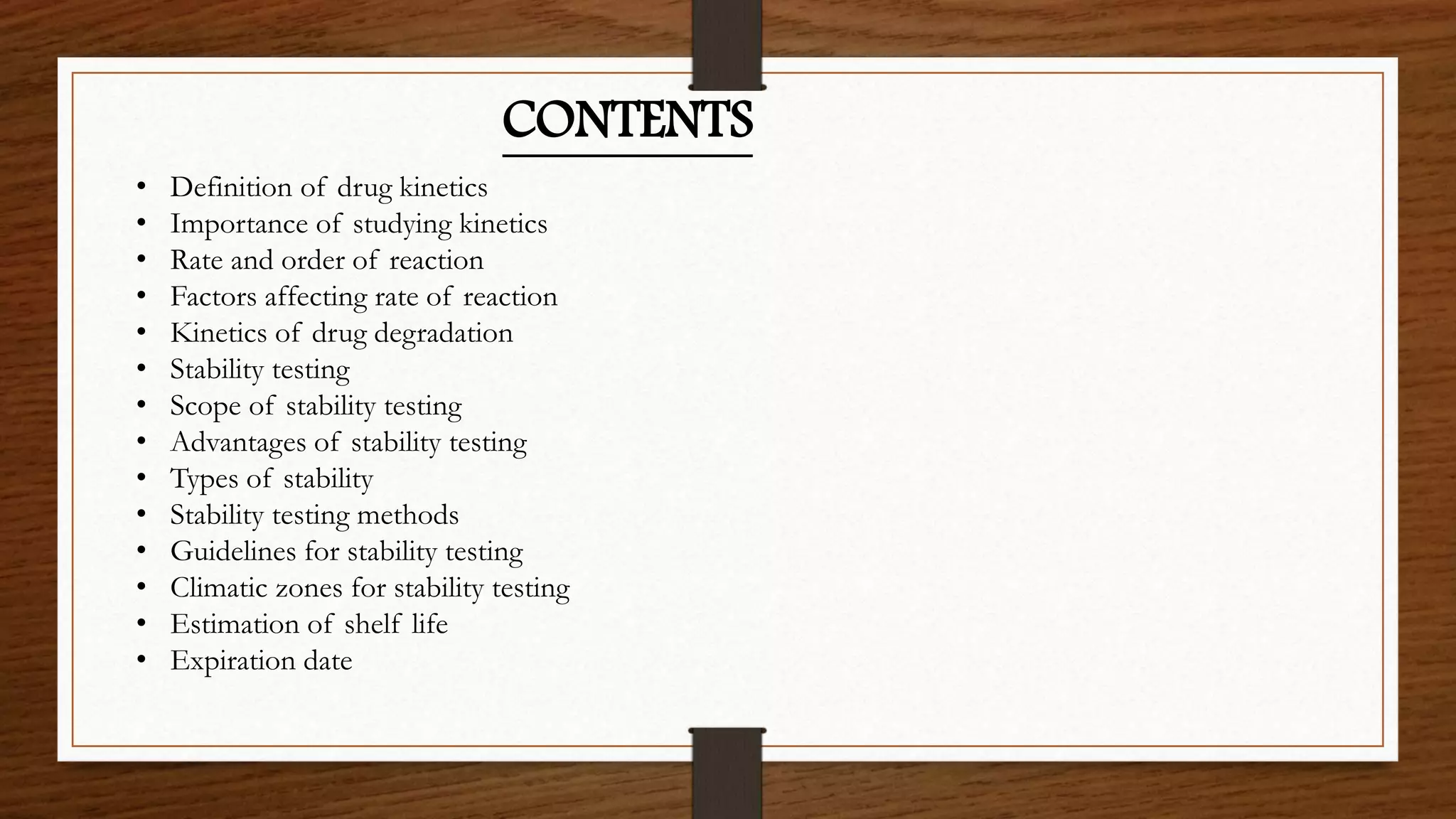
CONTENTS
• Definition of drug kinetics
• Importance of studying kinetics
• Rate and order of reaction
• Factors affecting rate of reaction
• Kinetics of drug degradation
• Stability testing
• Scope of stability testing
• Advantages of stability testing
• Types of stability
• Stability testing methods
• Guidelines for stability testing
• Climatic zones for stability testing
• Estimation of shelf life
• Expiration date
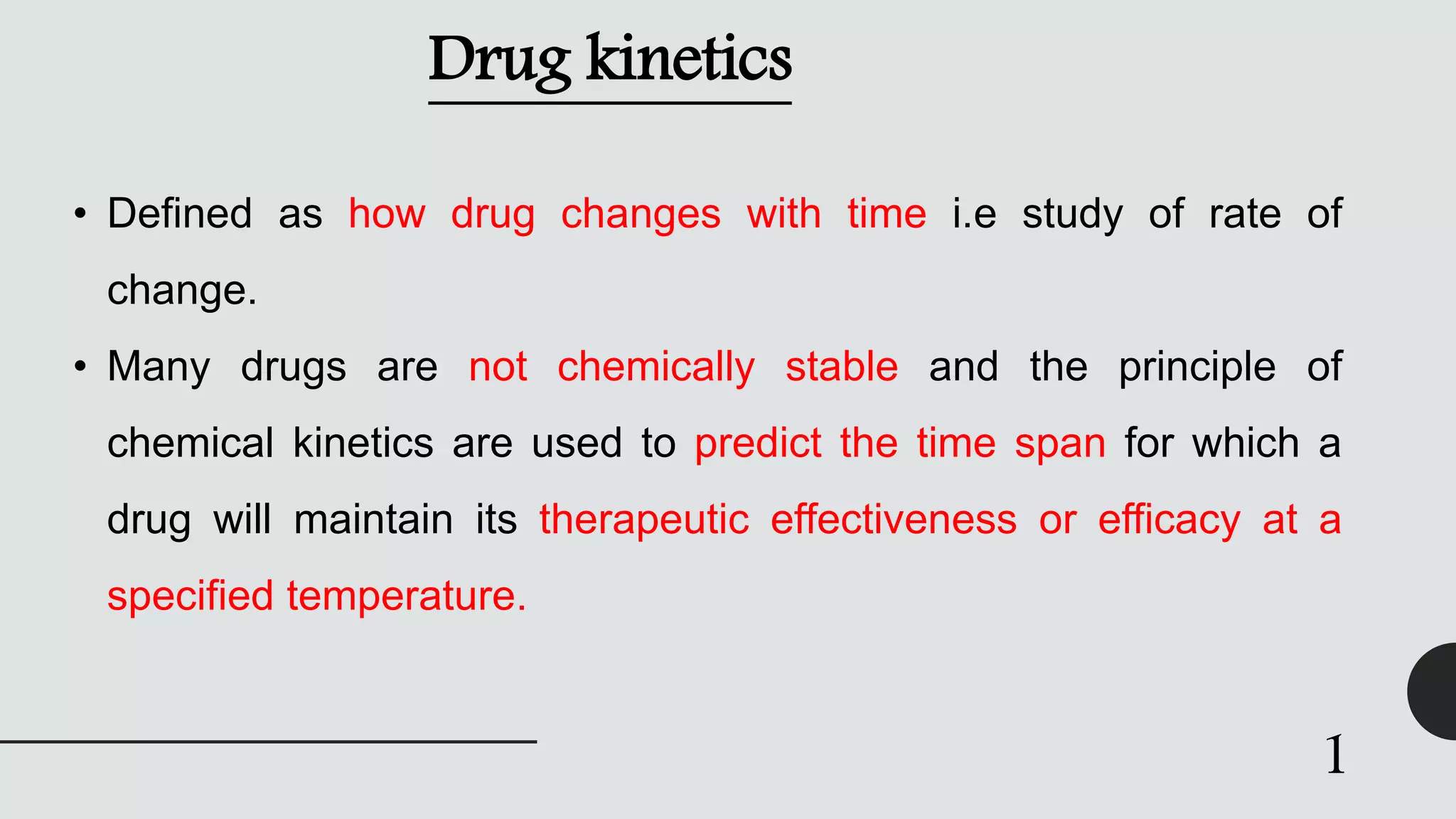
Drug kinetics
• Defined as how drug changes with time i.e study of rate of
change.
• Many drugs are not chemically stable and the principle of
chemical kinetics are used to predict the time span for which a
drug will maintain its therapeutic effectiveness or efficacy at a
specified temperature.
1
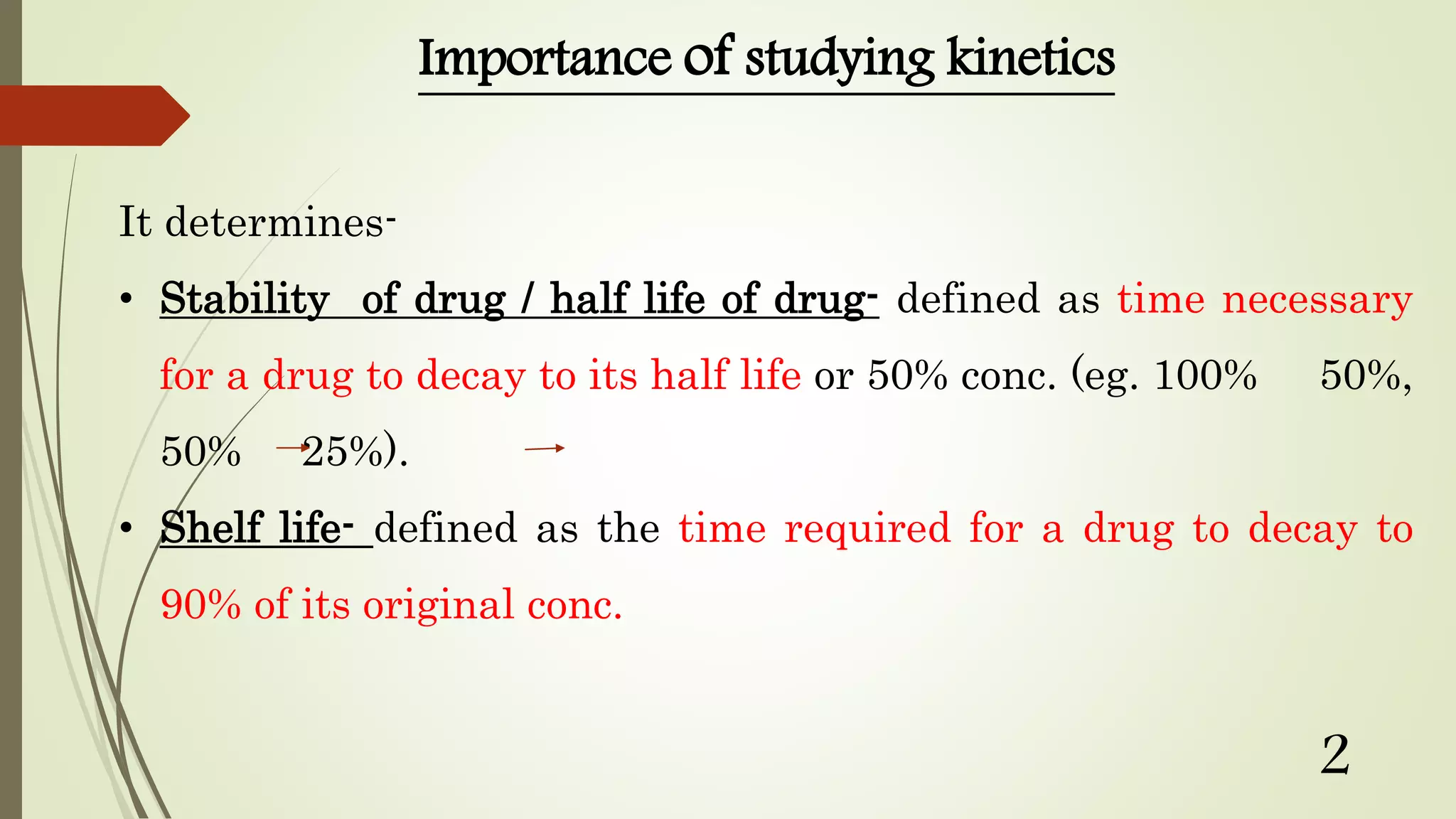
Importance of studying kinetics
It determines-
• Stability of drug / half life of drug- defined as time necessary
for a drug to decay to its half life or 50% conc. (eg. 100% 50%,
50% 25%).
• Shelf life- defined as the time required for a drug to decay to
90% of its original conc.
2
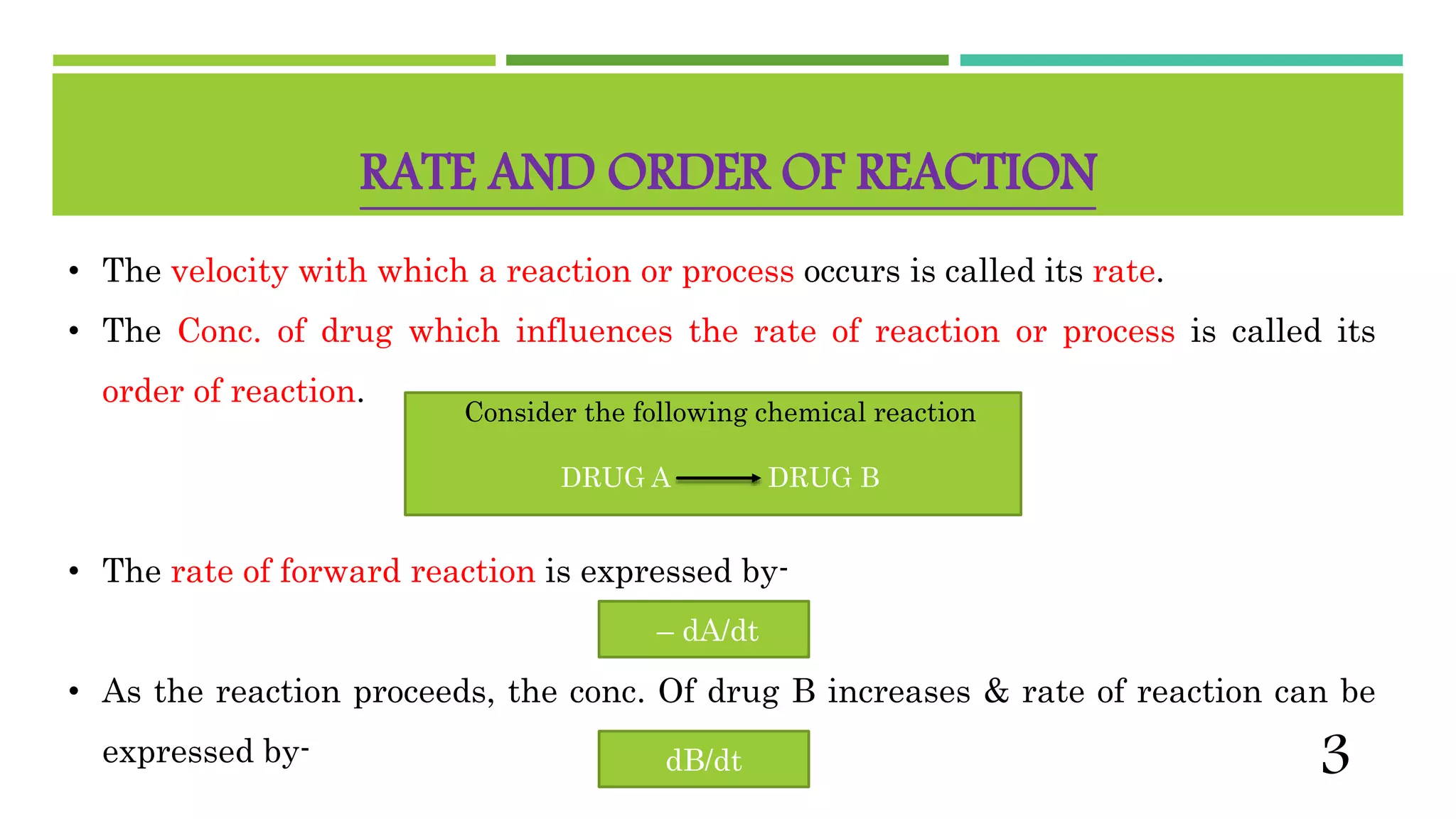
RATE AND ORDER OF REACTION
• The velocity with which a reaction or process occurs is called its rate.
• The Conc. of drug which influences the rate of reaction or process is called its
order of reaction.
• The rate of forward reaction is expressed by-
• As the reaction proceeds, the conc. Of drug B increases & rate of reaction can be
expressed by-
Consider the following chemical reaction
DRUG A DRUG B
– dA/dt
dB/dt 3
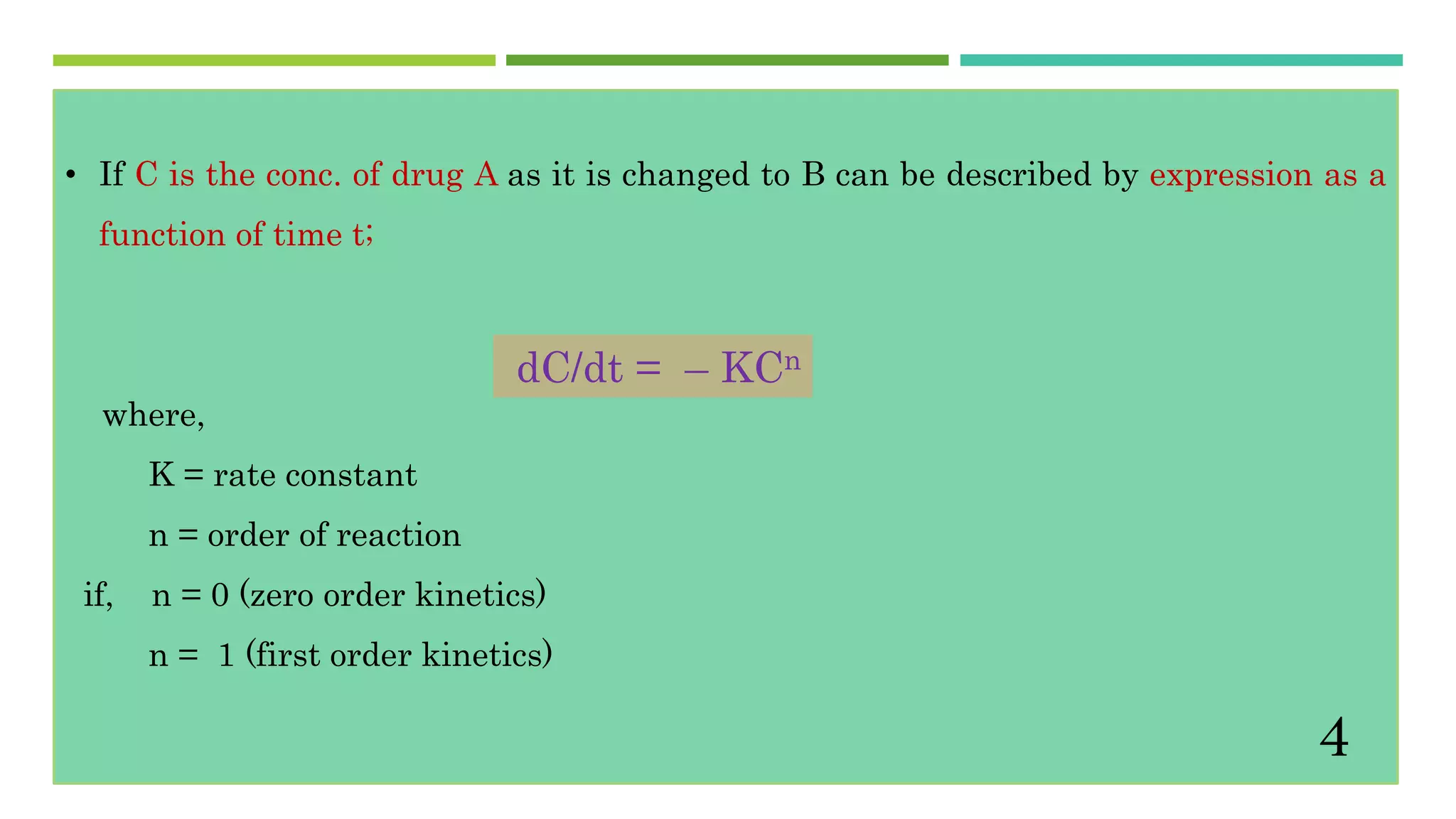
• If C is the conc. of drug A as it is changed to B can be described by expression as a
function of time t;
where,
K = rate constant
n = order of reaction
if, n = 0 (zero order kinetics)
n = 1 (first order kinetics)
dC/dt = – KCn
4
The two commonly encountered rate processes are:
1. ZERO ORDER REACTION
2. FIRST ORDER REACTION
5
ZERO ORDER REACTION
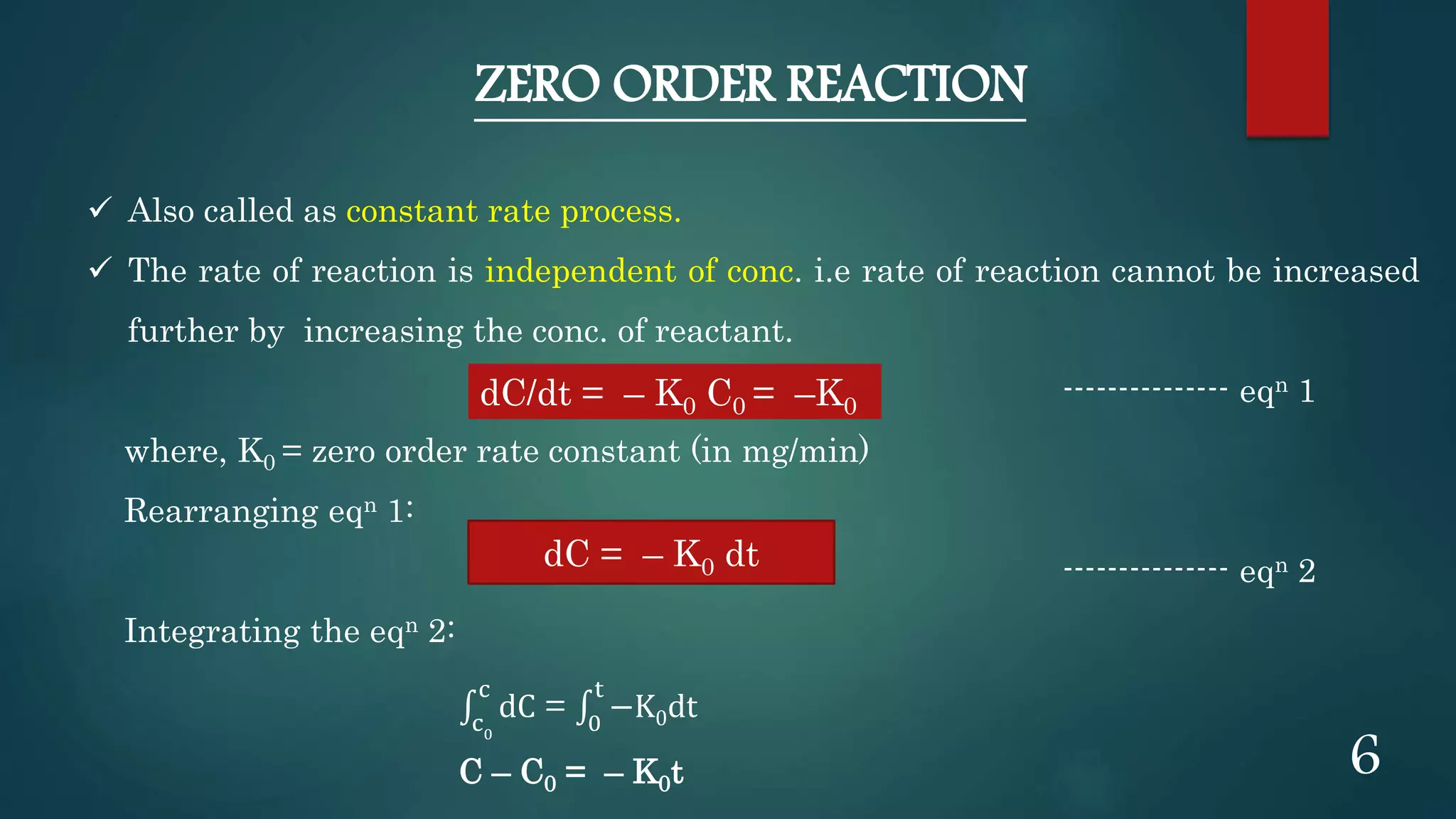
 Also called as constant rate process.
 The rate of reaction is independent of conc. i.e rate of reaction cannot be increased
further by increasing the conc. of reactant.
--------------- eqn 1
where, K0 = zero order rate constant (in mg/min)
Rearranging eqn 1:
--------------- eqn 2
Integrating the eqn 2:
c0
c
dC = 0
t
−K0dt
C – C0 = – K0t
dC/dt = – K0 C0 = –K0
dC = – K0 dt
6
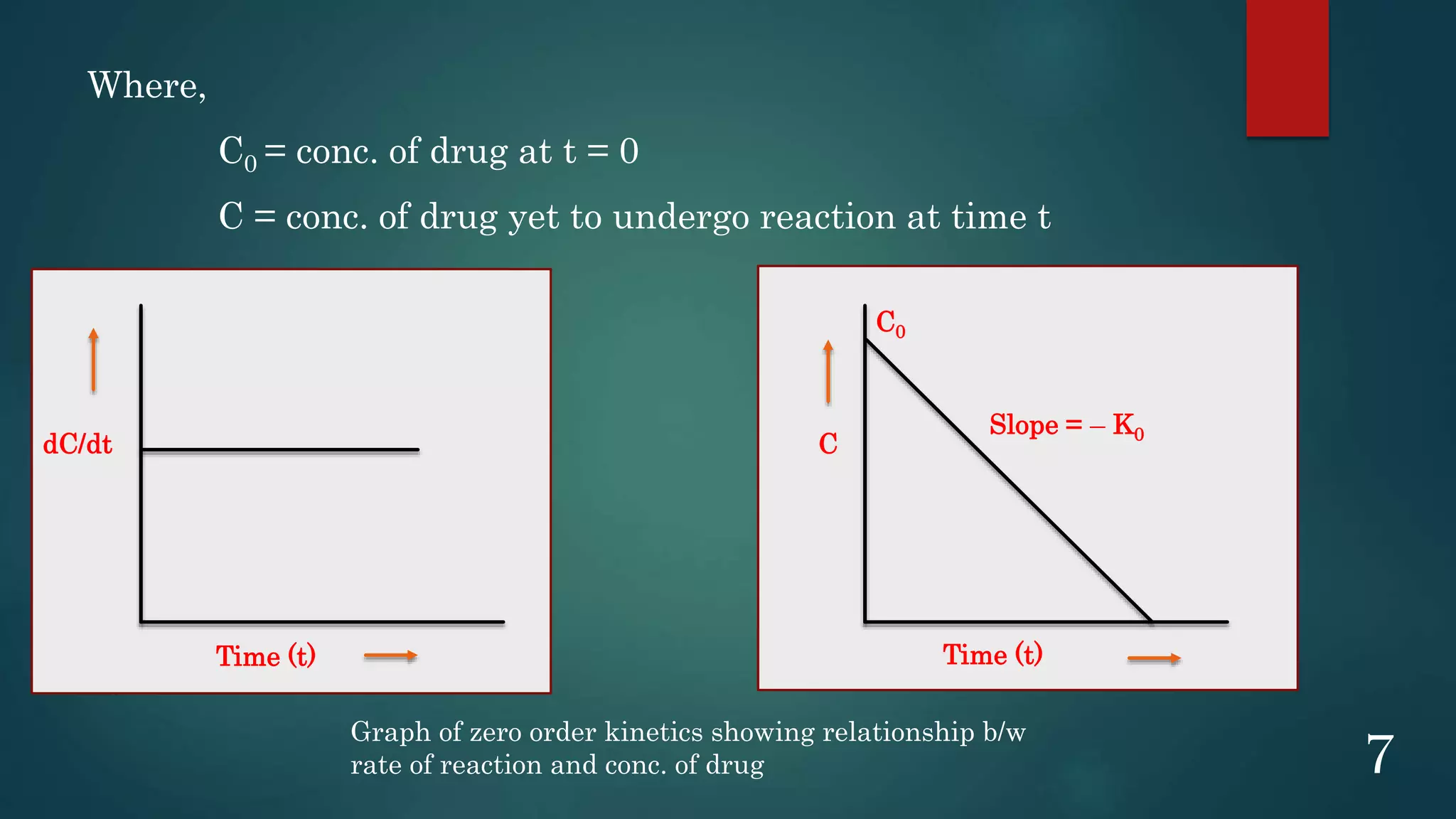
Where,
C0 = conc. of drug at t = 0
C = conc. of drug yet to undergo reaction at time t
dC/dt
Time (t) Time (t)
C
C0
Slope = – K0
Graph of zero order kinetics showing relationship b/w
rate of reaction and conc. of drug 7
FIRST ORDER REACTION
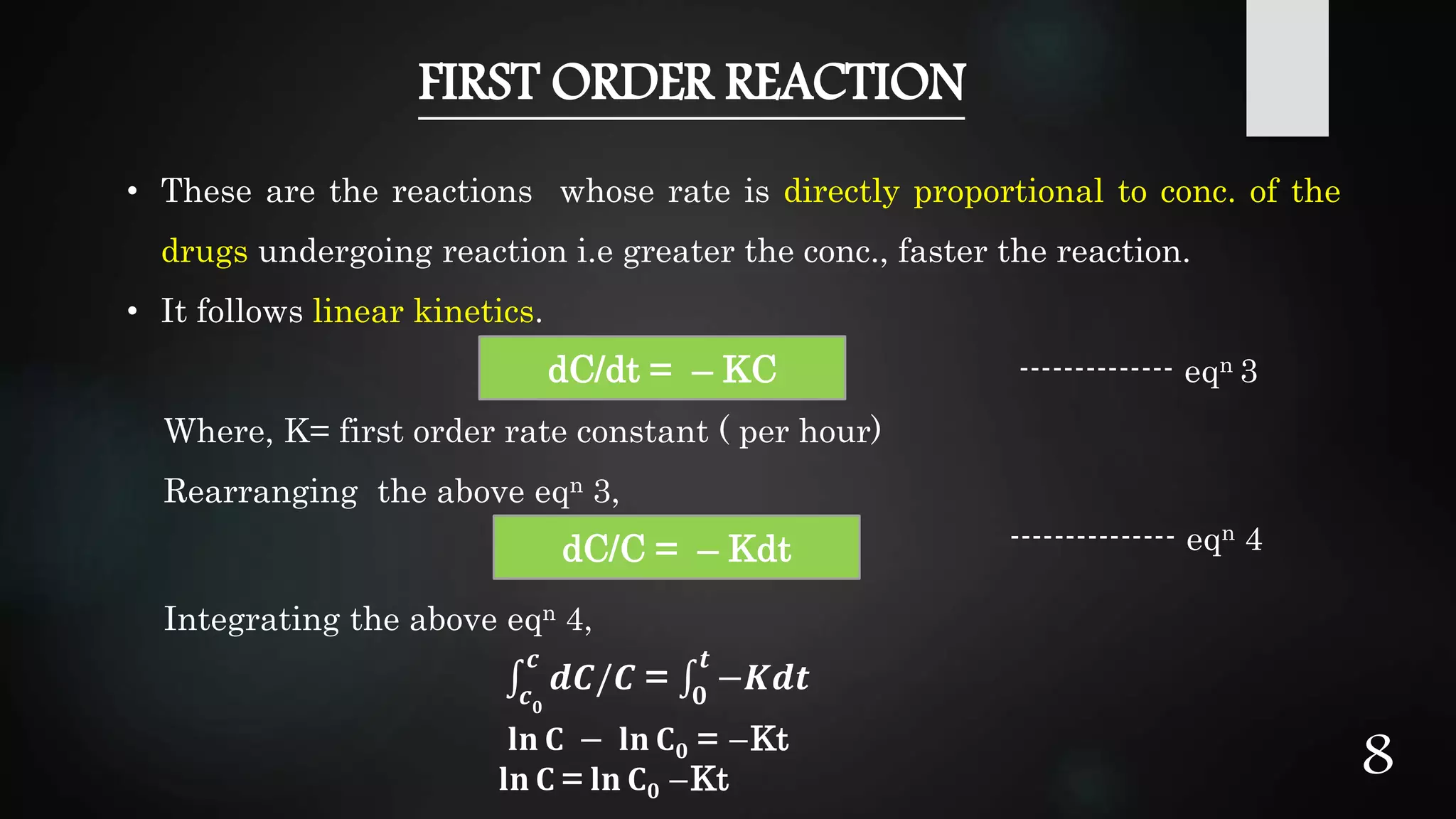
• These are the reactions whose rate is directly proportional to conc. of the
drugs undergoing reaction i.e greater the conc., faster the reaction.
• It follows linear kinetics.
-------------- eqn 3
Where, K= first order rate constant ( per hour)
Rearranging the above eqn 3,
--------------- eqn 4
Integrating the above eqn 4,
𝐥𝐧 𝐂 − 𝐥𝐧 𝐂 𝟎 = −Kt
𝐥𝐧 𝐂 = 𝐥𝐧 𝐂 𝟎 −Kt
dC/dt = – KC
dC/C = – Kdt
𝒄 𝟎
𝒄
𝒅𝑪/𝑪 = 𝟎
𝒕
−𝑲𝒅𝒕
8
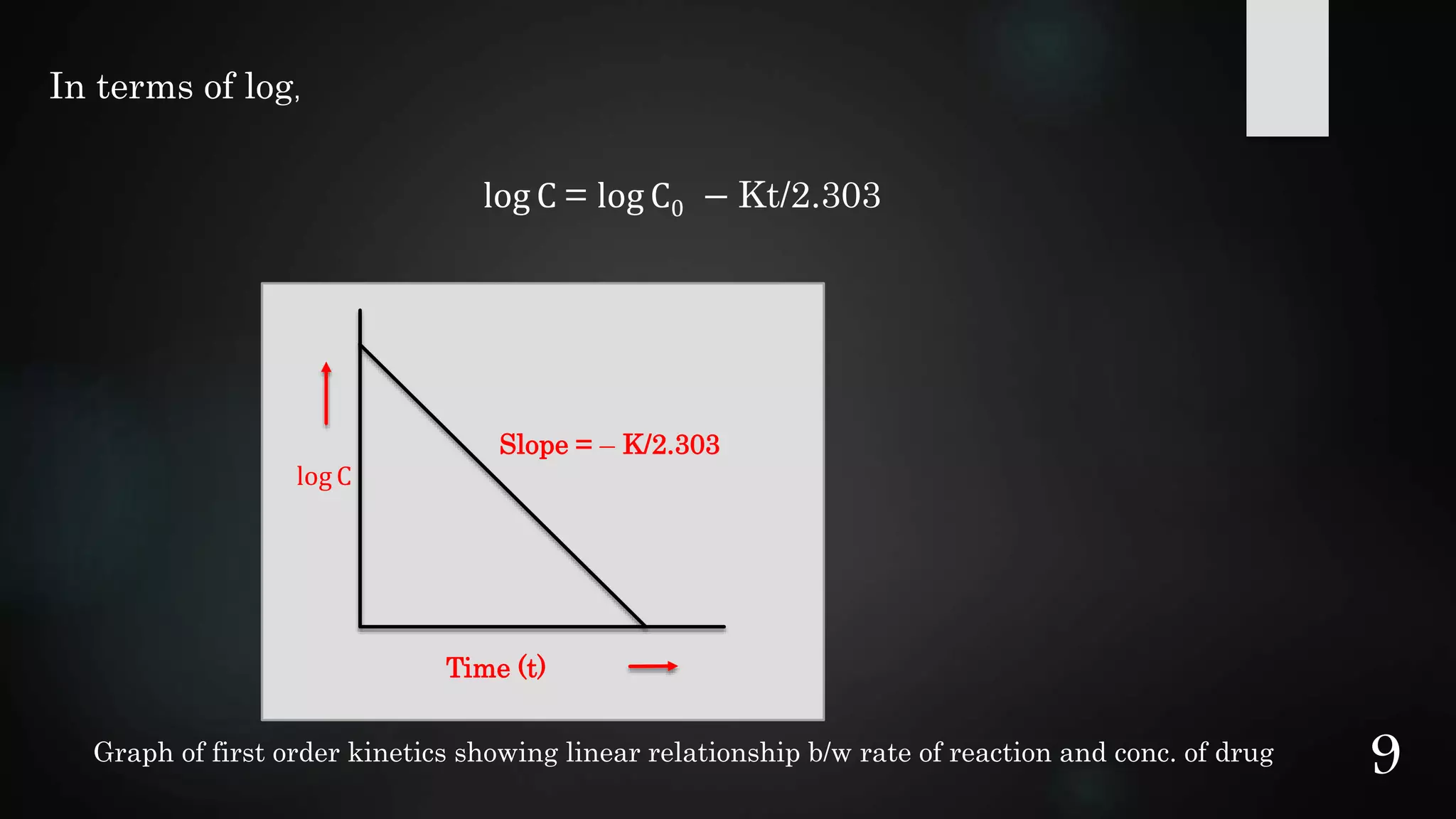
In terms of log,
log C = log C0 − Kt/2.303
Time (t)
Slope = – K/2.303
log C
Graph of first order kinetics showing linear relationship b/w rate of reaction and conc. of drug
9
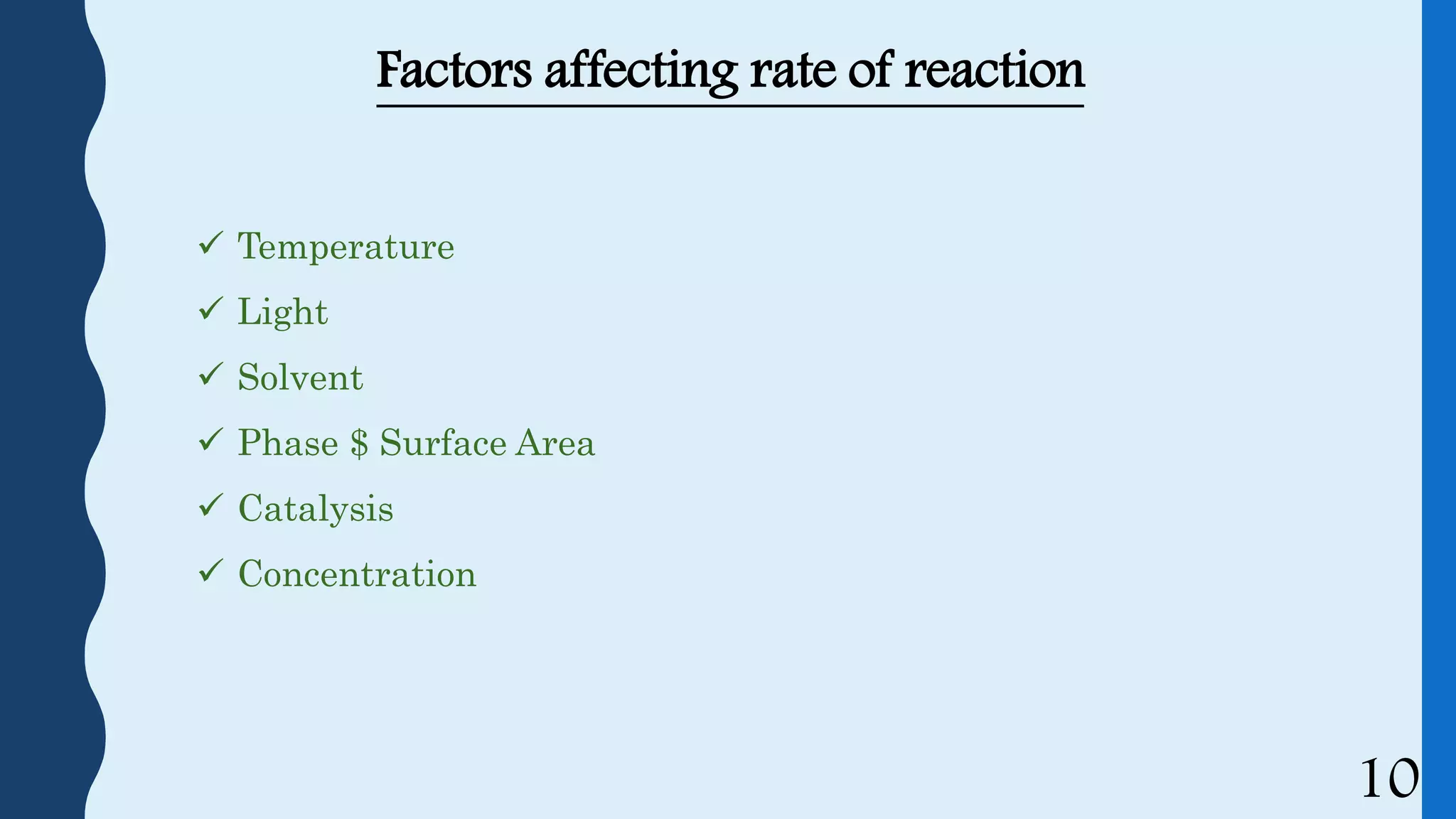
Factors affecting rate of reaction
 Temperature
 Light
 Solvent
 Phase $ Surface Area
 Catalysis
 Concentration
10
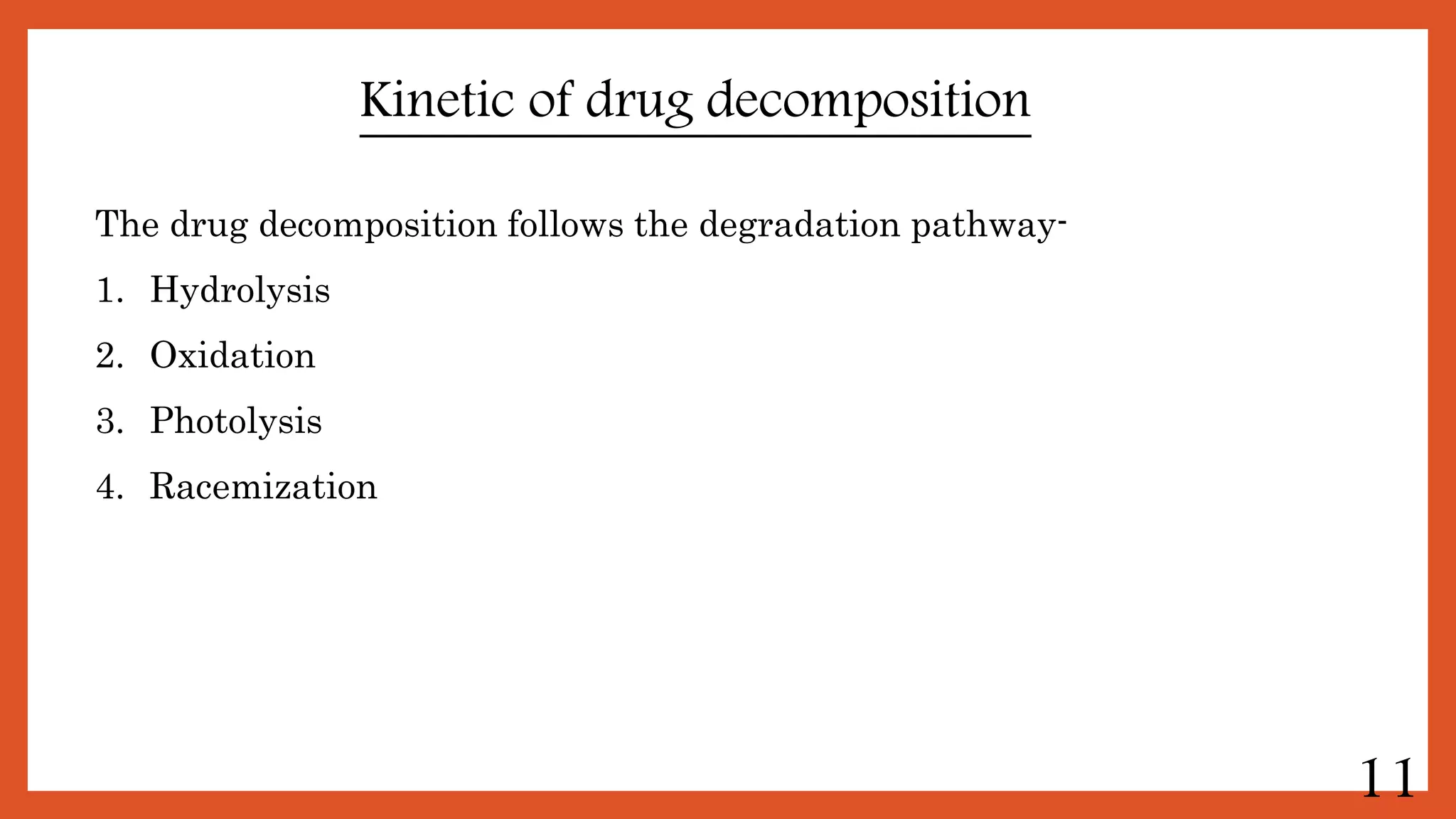
Kinetic of drug decomposition
The drug decomposition follows the degradation pathway-
1. Hydrolysis
2. Oxidation
3. Photolysis
4. Racemization
11
• Many pharmaceuticals ester or amide hydrolysis in solution. e.g.
anesthetics, antibiotics, vitamins, & barbiturates.
• The hydrolysis of an ester acid & alcohol rupture of a covalent linkage
b/w C & O2 atom. e.g. Aspirin.
• The hydrolysis of amide acid & amine. e.g.barbiturates, chloramphenicol.
HYDROLYSIS
in
gives
Prevention:
 pH
 Type of solvent (ethanol, mannitol)
 Reduction to salts.
12
Oxidation
• The oxidative decomposition instability of preparations such as
steroids, vitamins, antibiotics, & epinephrine.
• Reaction mediated either by free radicals or by molecular oxygen.
• Autoxidation involves a free radical chain process.
AB A*+ B
• These radicals are highly unstable & readily take electrons from other
substances, causing oxidation.
13
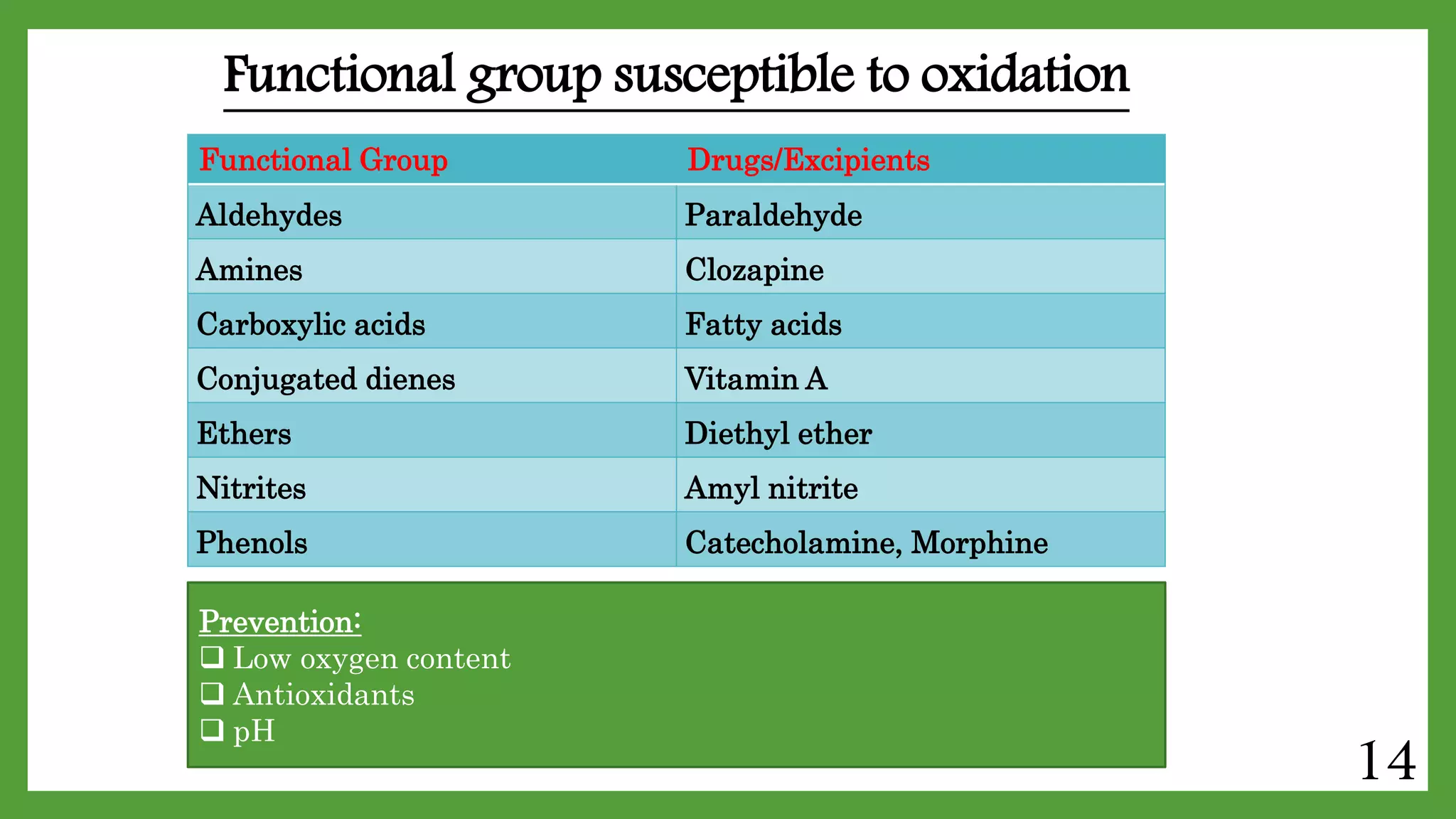
Functional group susceptible to oxidation
Functional Group Drugs/Excipients
Aldehydes Paraldehyde
Amines Clozapine
Carboxylic acids Fatty acids
Conjugated dienes Vitamin A
Ethers Diethyl ether
Nitrites Amyl nitrite
Phenols Catecholamine, Morphine
Prevention:
 Low oxygen content
 Antioxidants
 pH
14
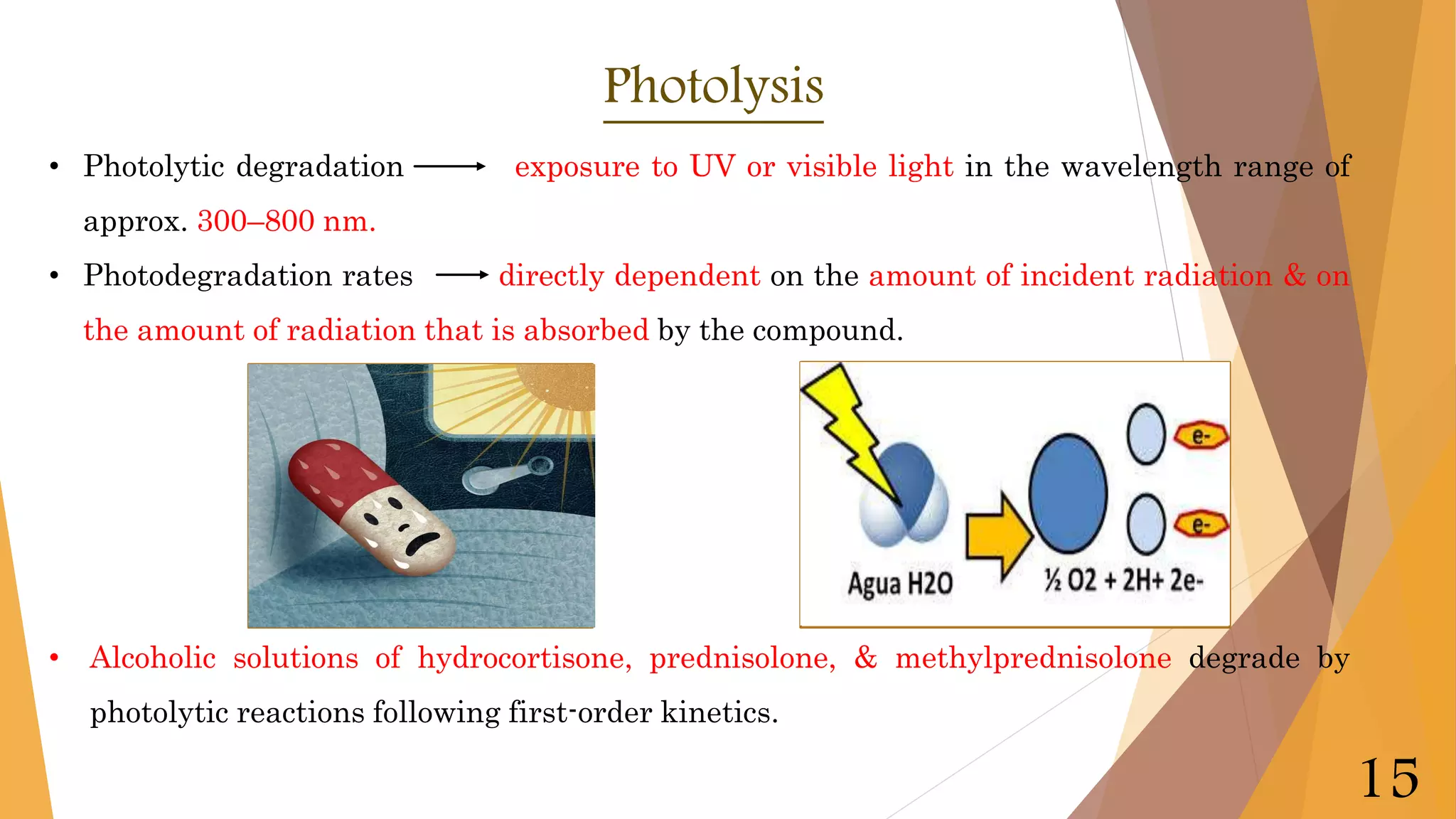
• Photolytic degradation exposure to UV or visible light in the wavelength range of
approx. 300–800 nm.
• Photodegradation rates directly dependent on the amount of incident radiation & on
the amount of radiation that is absorbed by the compound.
• Alcoholic solutions of hydrocortisone, prednisolone, & methylprednisolone degrade by
photolytic reactions following first-order kinetics.
Photolysis
15
• An optically active substance loses its optical activity without
changing its chemical composition.
• Dextro form generally therapeutically less active than levo form.
e.g. levo form of adrenaline is 20 times active than dextro.
Racemization
16
STABILITY TESTING
Stability : defined as capability of a particular formulation in a specific
container/closure system to remain within its physical, chemical,
microbiological, toxicological, protective and informational
specifications.
It is the extent to which a product retains, within the specified limits,
throughout its period of storage and use, the same properties and
characteristics possessed at the time of its packaging.
1
2
17
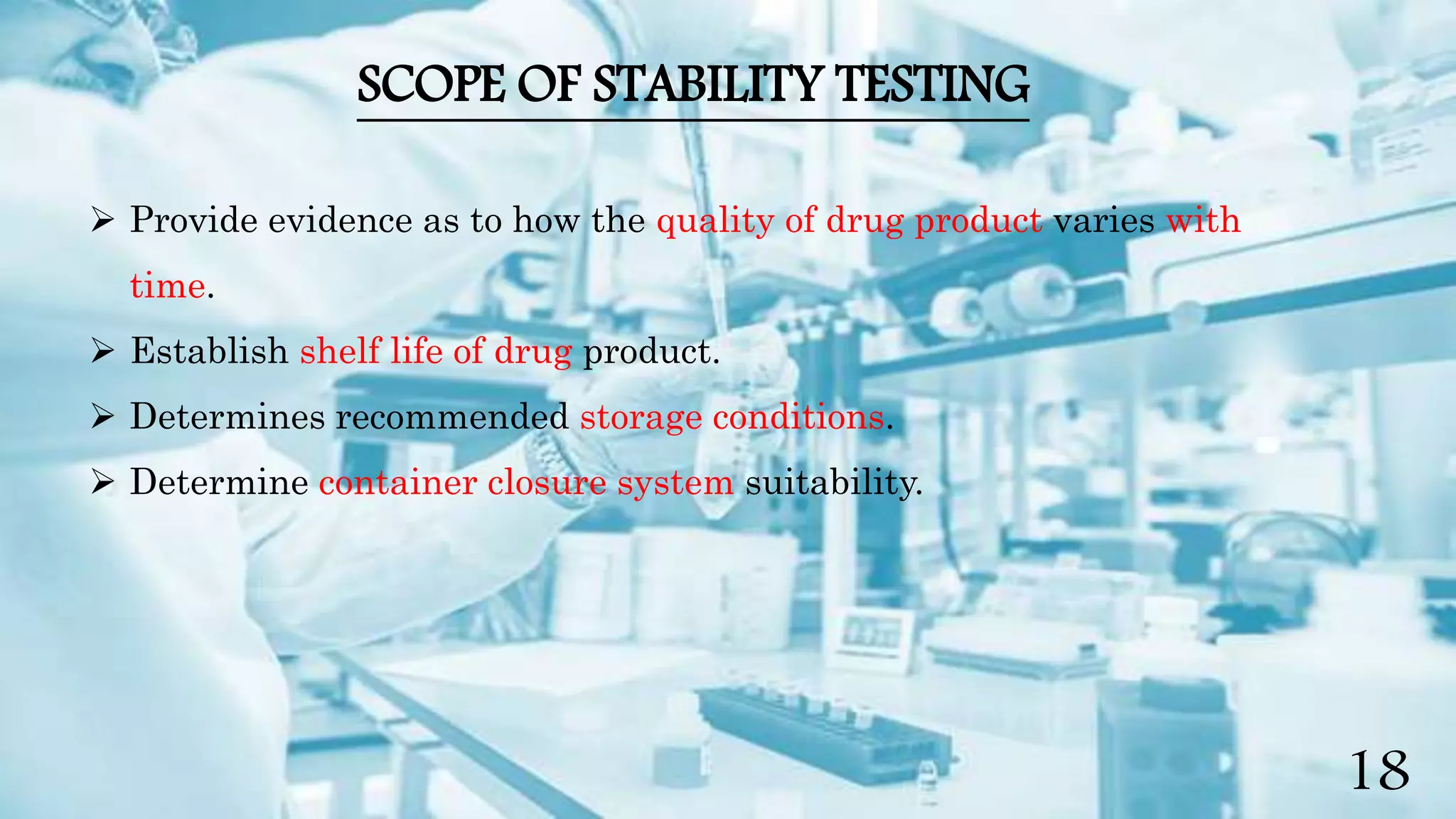
SCOPE OF STABILITY TESTING
 Provide evidence as to how the quality of drug product varies with
time.
 Establish shelf life of drug product.
 Determines recommended storage conditions.
 Determine container closure system suitability.
18
IMPORTANCE OF STABILITY TESTING
Assurance to patient that drug is safe.
legal requirement to provide data.
to protect the reputation of the manufacturer.
to provide a database.
to determine shelf life and storage conditions.
to verify that no changes have been introduced in the formulation or
manufacturing process that can adversely affect the stability of the
product.
19
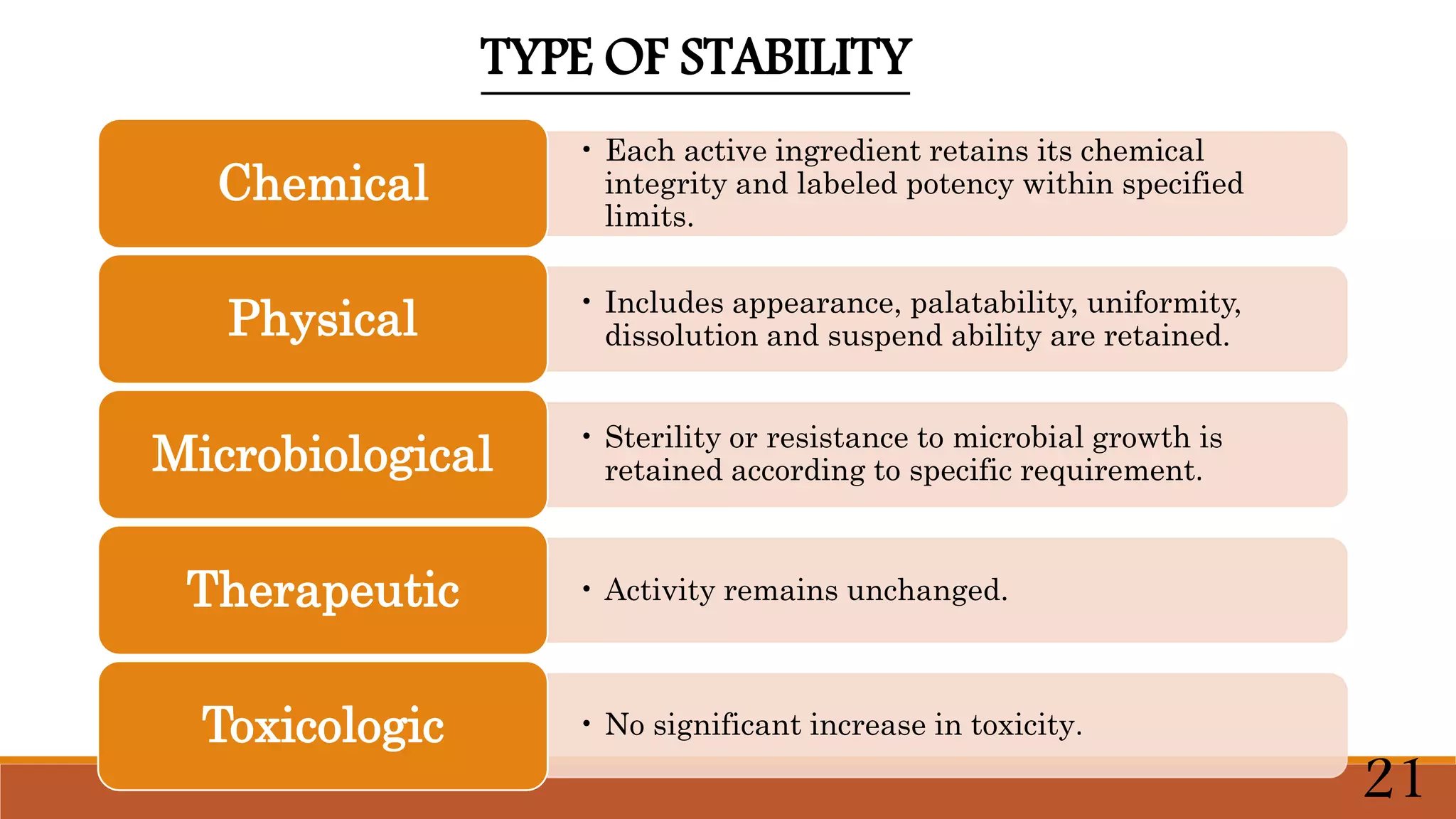
• Each active ingredient retains its chemical
integrity and labeled potency within specified
limits.
Chemical
• Includes appearance, palatability, uniformity,
dissolution and suspend ability are retained.Physical
• Sterility or resistance to microbial growth is
retained according to specific requirement.Microbiological
• Activity remains unchanged.Therapeutic
• No significant increase in toxicity.Toxicologic
TYPE OF STABILITY
21
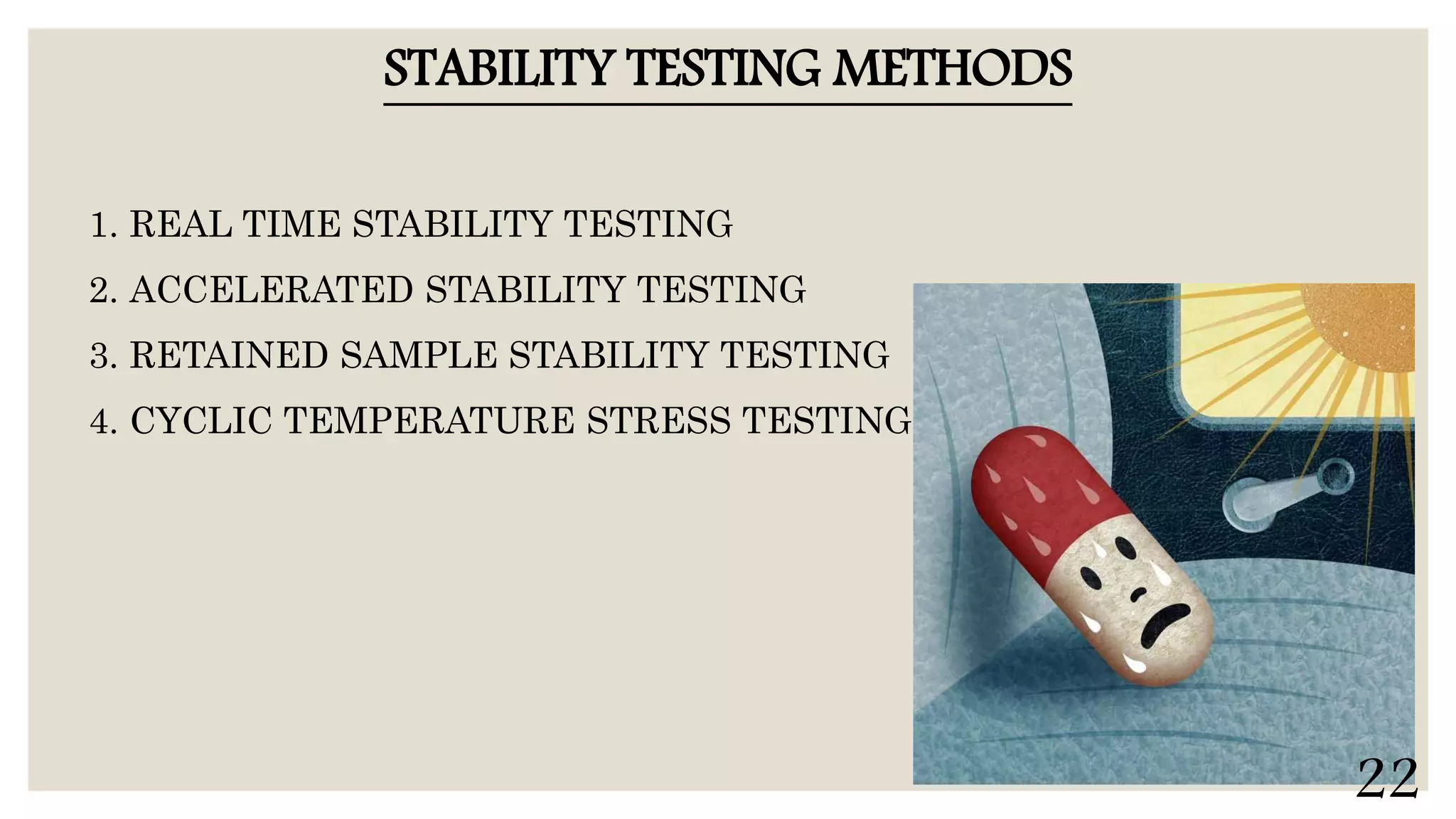
STABILITY TESTING METHODS
1. REAL TIME STABILITY TESTING
2. ACCELERATED STABILITY TESTING
3. RETAINED SAMPLE STABILITY TESTING
4. CYCLIC TEMPERATURE STRESS TESTING
22
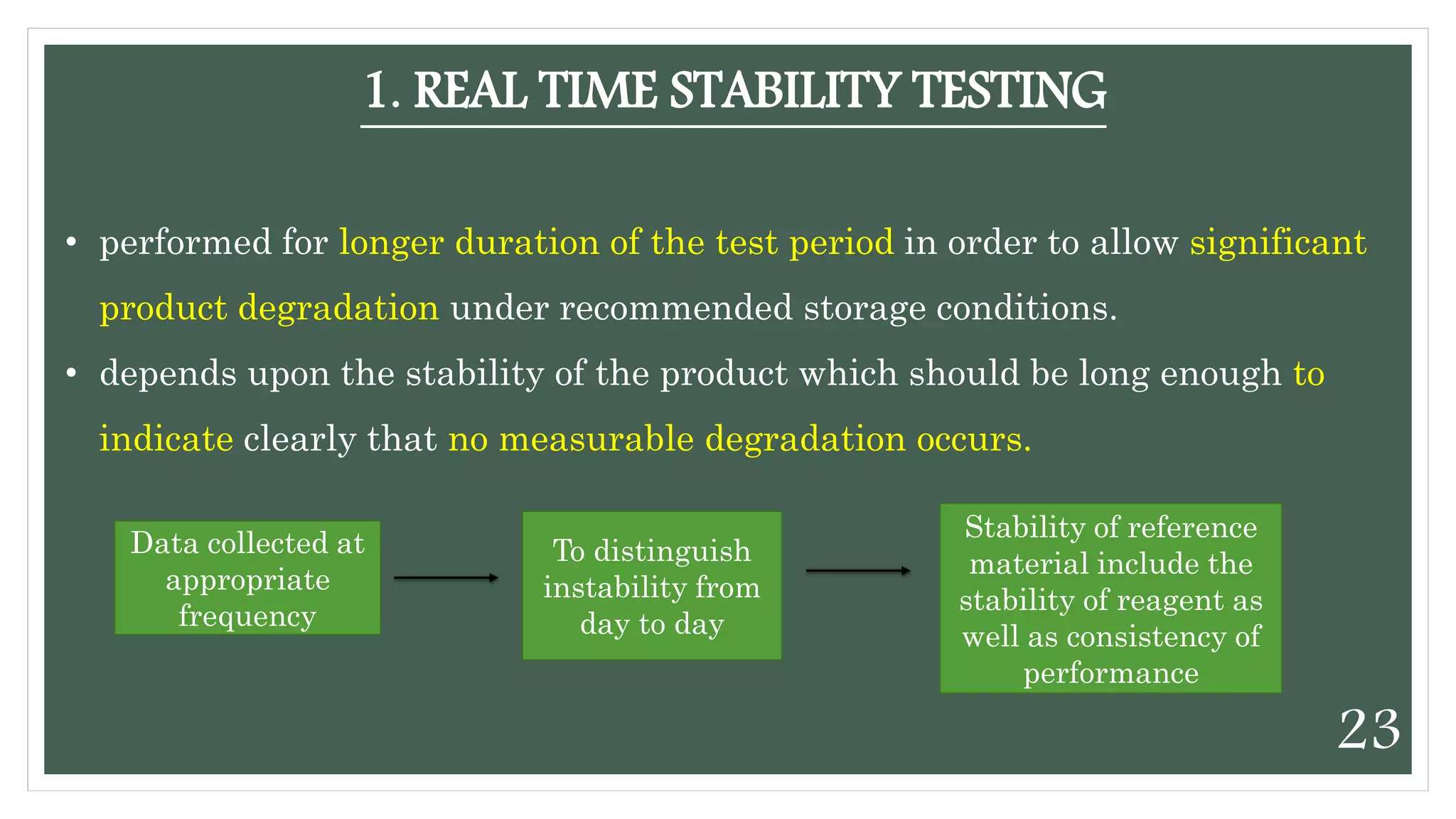
• performed for longer duration of the test period in order to allow significant
product degradation under recommended storage conditions.
• depends upon the stability of the product which should be long enough to
indicate clearly that no measurable degradation occurs.
Data collected at
appropriate
frequency
To distinguish
instability from
day to day
Stability of reference
material include the
stability of reagent as
well as consistency of
performance
1. REAL TIME STABILITY TESTING
23
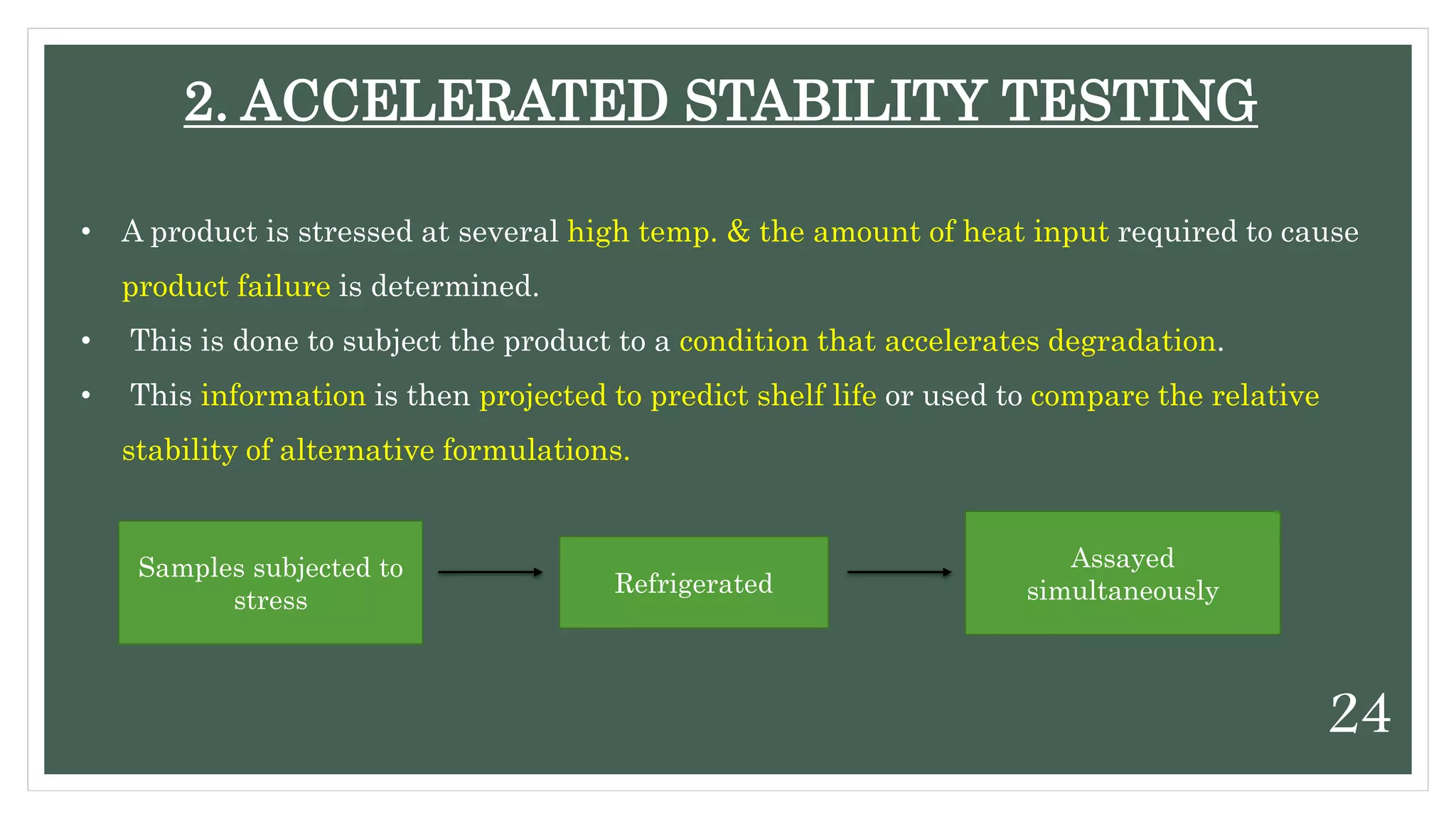
2. ACCELERATED STABILITY TESTING
• A product is stressed at several high temp. & the amount of heat input required to cause
product failure is determined.
• This is done to subject the product to a condition that accelerates degradation.
• This information is then projected to predict shelf life or used to compare the relative
stability of alternative formulations.
Samples subjected to
stress
Refrigerated
Assayed
simultaneously
24
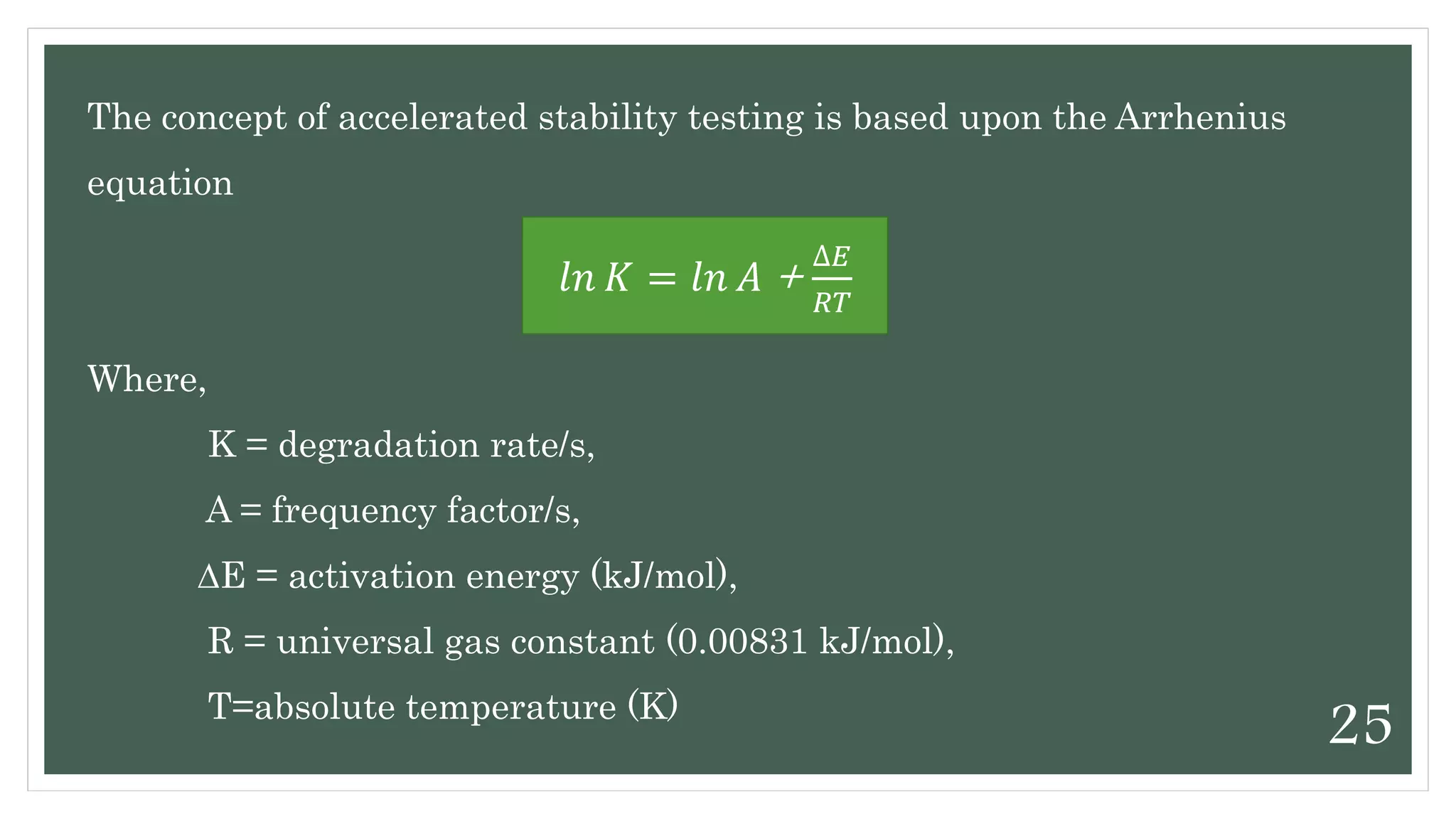
The concept of accelerated stability testing is based upon the Arrhenius
equation
Where,
K = degradation rate/s,
A = frequency factor/s,
∆E = activation energy (kJ/mol),
R = universal gas constant (0.00831 kJ/mol),
T=absolute temperature (K)
𝑙𝑛 𝐾 = 𝑙𝑛 𝐴 +
∆𝐸
𝑅𝑇
25
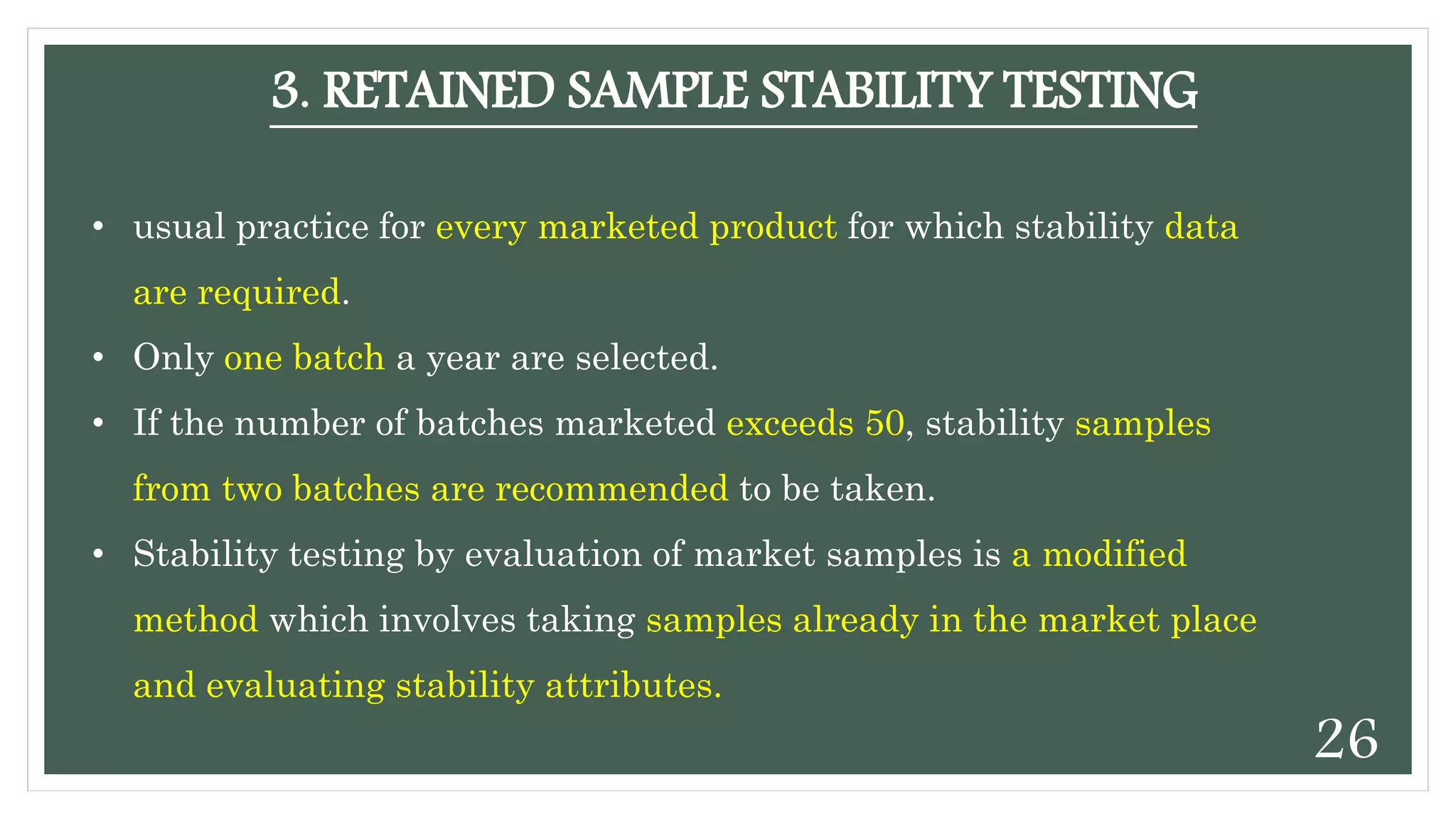
• usual practice for every marketed product for which stability data
are required.
• Only one batch a year are selected.
• If the number of batches marketed exceeds 50, stability samples
from two batches are recommended to be taken.
• Stability testing by evaluation of market samples is a modified
method which involves taking samples already in the market place
and evaluating stability attributes.
3. RETAINED SAMPLE STABILITY TESTING
26
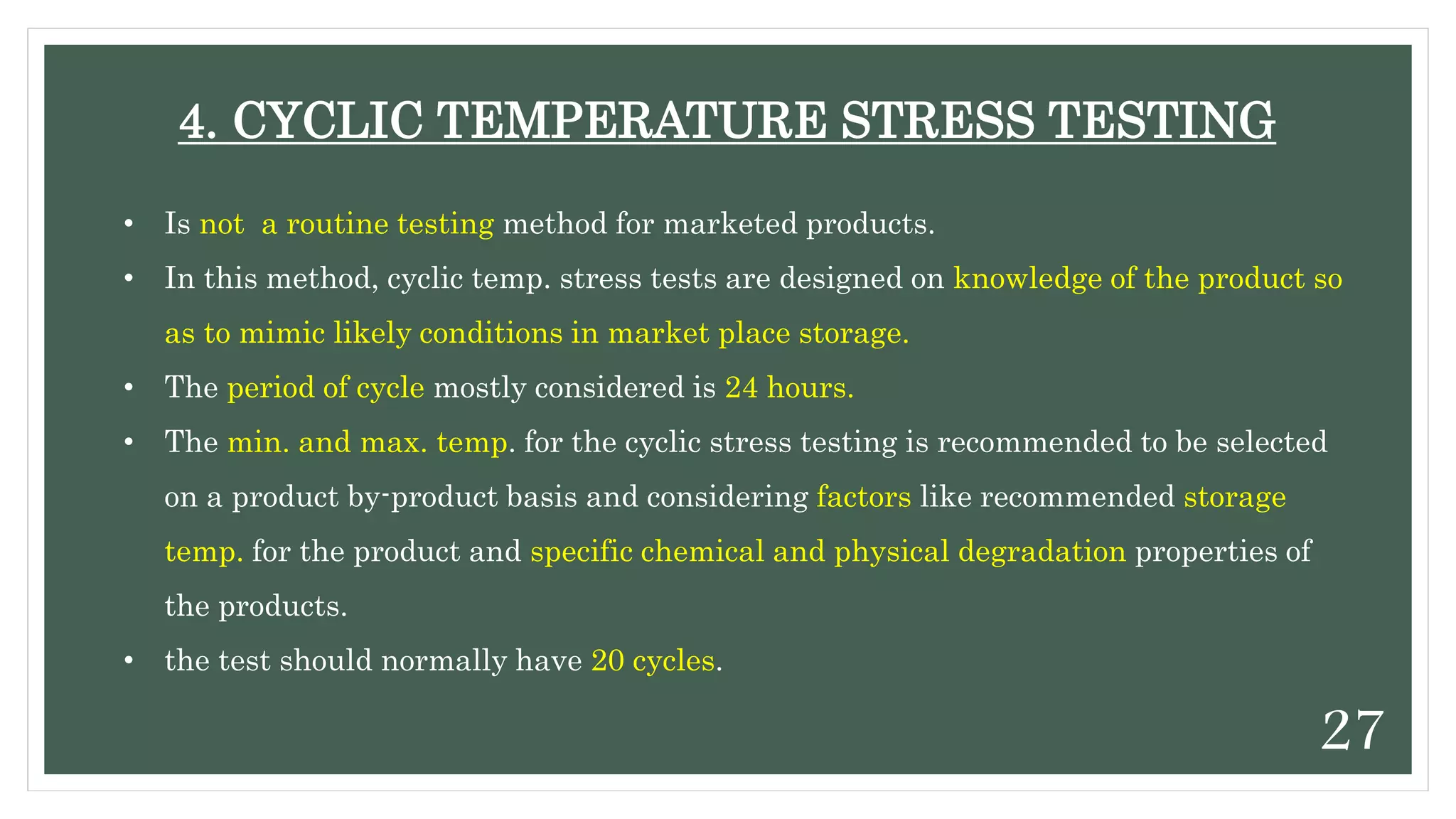
• Is not a routine testing method for marketed products.
• In this method, cyclic temp. stress tests are designed on knowledge of the product so
as to mimic likely conditions in market place storage.
• The period of cycle mostly considered is 24 hours.
• The min. and max. temp. for the cyclic stress testing is recommended to be selected
on a product by-product basis and considering factors like recommended storage
temp. for the product and specific chemical and physical degradation properties of
the products.
• the test should normally have 20 cycles.
4. CYCLIC TEMPERATURE STRESS TESTING
27
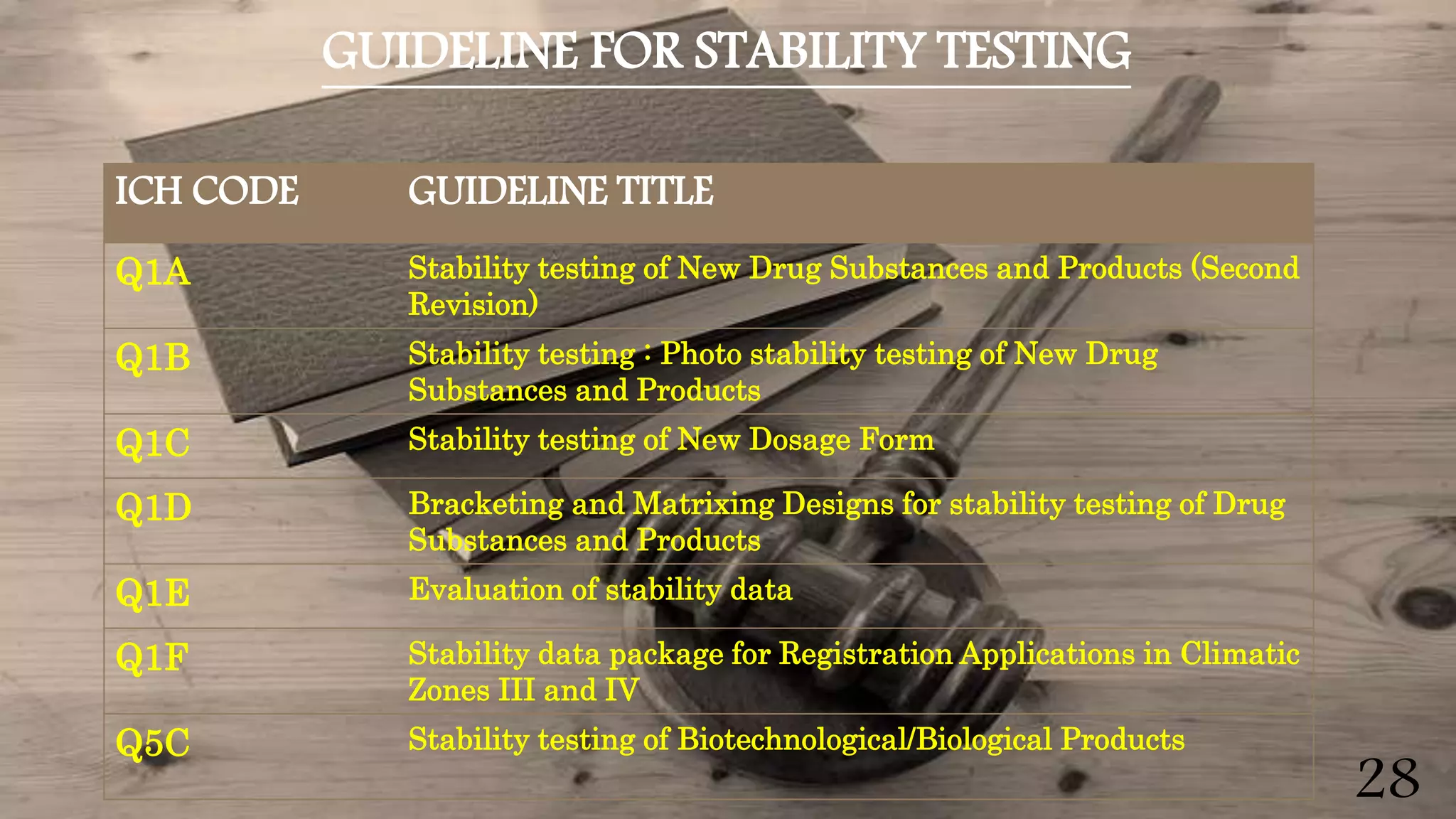
ICH CODE GUIDELINE TITLE
Q1A Stability testing of New Drug Substances and Products (Second
Revision)
Q1B Stability testing : Photo stability testing of New Drug
Substances and Products
Q1C Stability testing of New Dosage Form
Q1D Bracketing and Matrixing Designs for stability testing of Drug
Substances and Products
Q1E Evaluation of stability data
Q1F Stability data package for Registration Applications in Climatic
Zones III and IV
Q5C Stability testing of Biotechnological/Biological Products
GUIDELINE FOR STABILITY TESTING
28
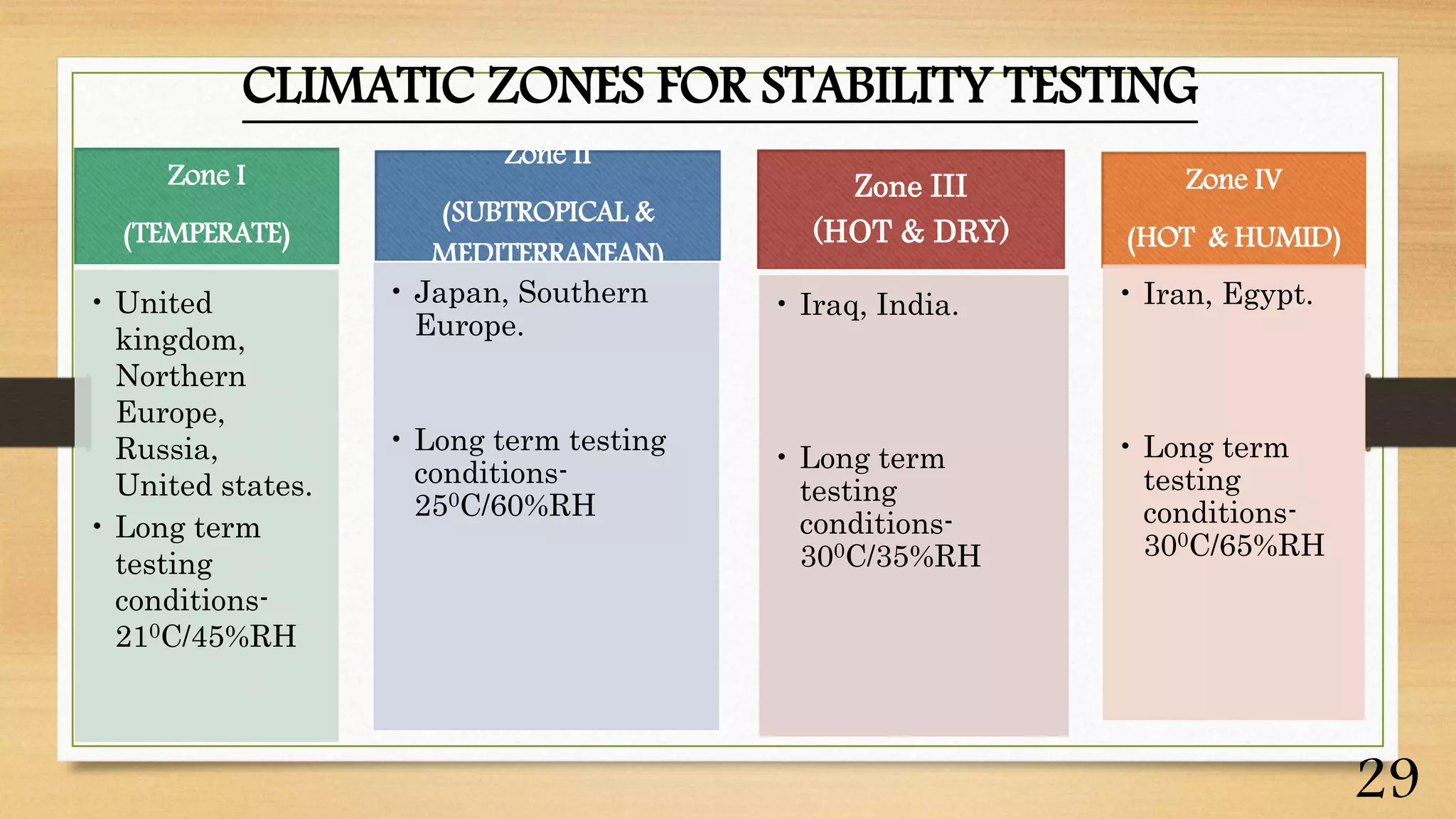
Zone I
(TEMPERATE)
• United
kingdom,
Northern
Europe,
Russia,
United states.
• Long term
testing
conditions-
210C/45%RH
Zone II
(SUBTROPICAL &
MEDITERRANEAN)
• Japan, Southern
Europe.
• Long term testing
conditions-
250C/60%RH
Zone III
(HOT & DRY)
• Iraq, India.
• Long term
testing
conditions-
300C/35%RH
Zone IV
(HOT & HUMID)
• Iran, Egypt.
• Long term
testing
conditions-
300C/65%RH
CLIMATIC ZONES FOR STABILITY TESTING
29
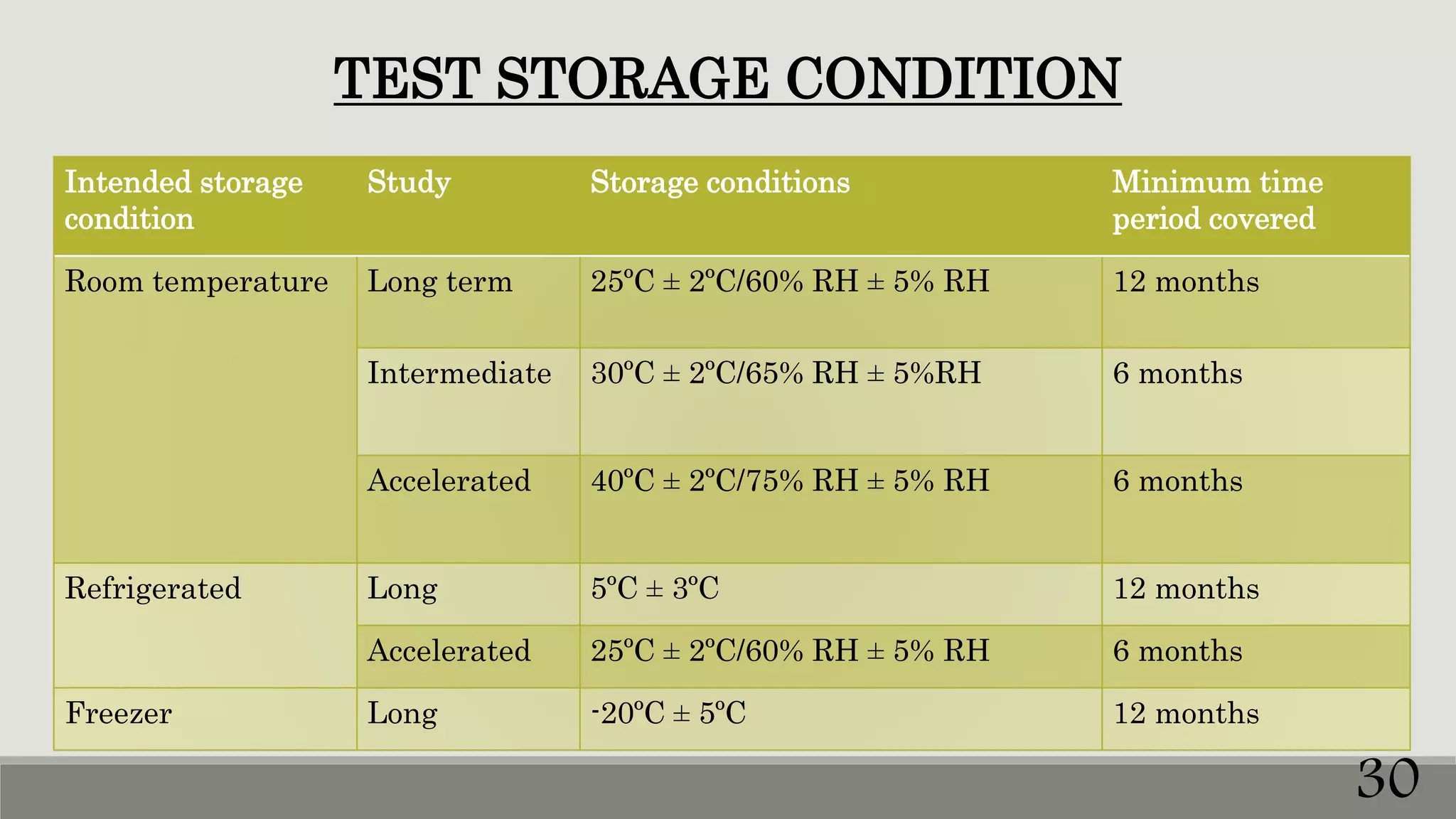
TEST STORAGE CONDITION
Intended storage
condition
Study Storage conditions Minimum time
period covered
Room temperature Long term 25ºC ± 2ºC/60% RH ± 5% RH 12 months
Intermediate 30ºC ± 2ºC/65% RH ± 5%RH 6 months
Accelerated 40ºC ± 2ºC/75% RH ± 5% RH 6 months
Refrigerated Long 5ºC ± 3ºC 12 months
Accelerated 25ºC ± 2ºC/60% RH ± 5% RH 6 months
Freezer Long -20ºC ± 5ºC 12 months
30
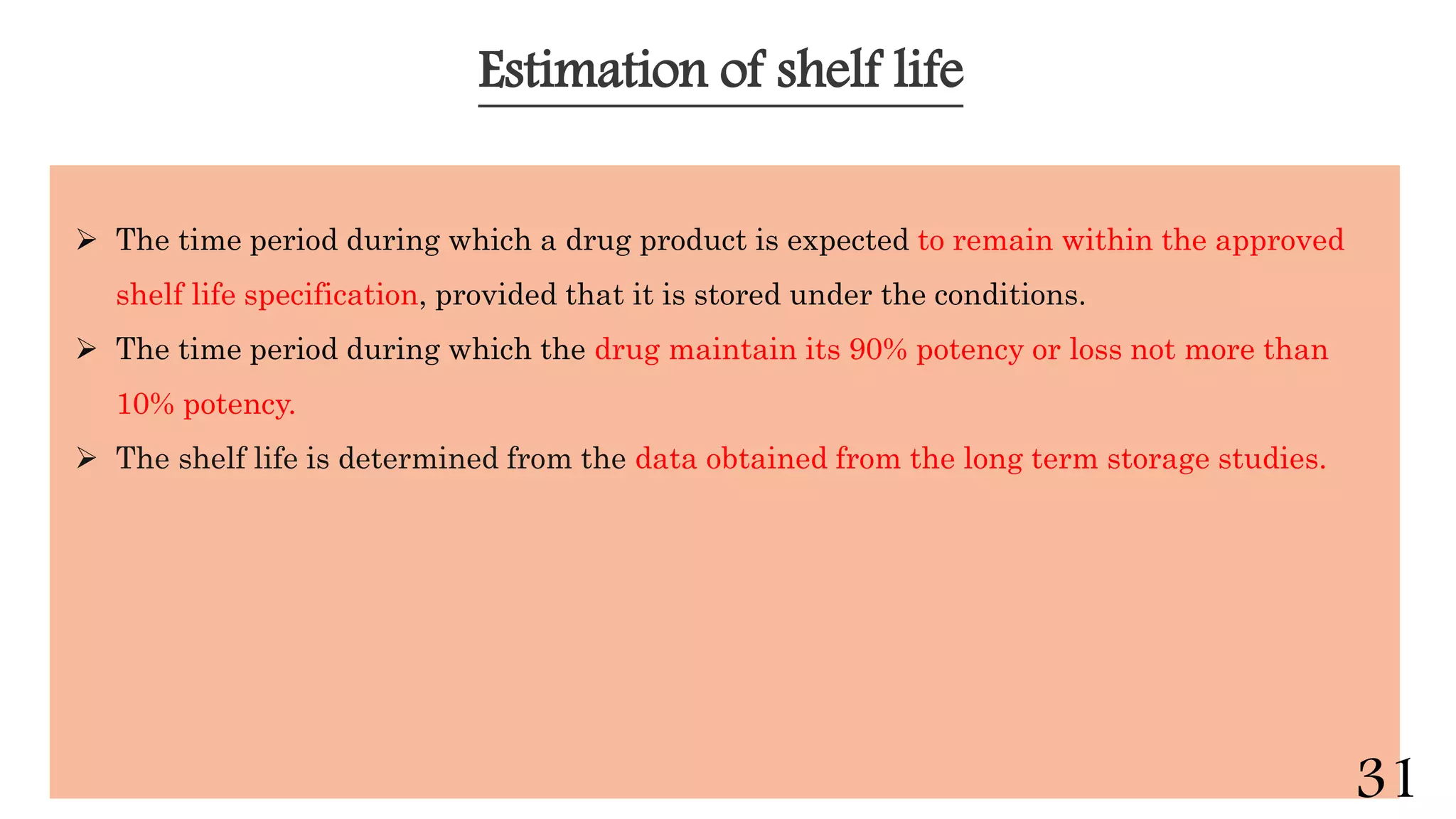
Estimation of shelf life
 The time period during which a drug product is expected to remain within the approved
shelf life specification, provided that it is stored under the conditions.
 The time period during which the drug maintain its 90% potency or loss not more than
10% potency.
 The shelf life is determined from the data obtained from the long term storage studies.
31
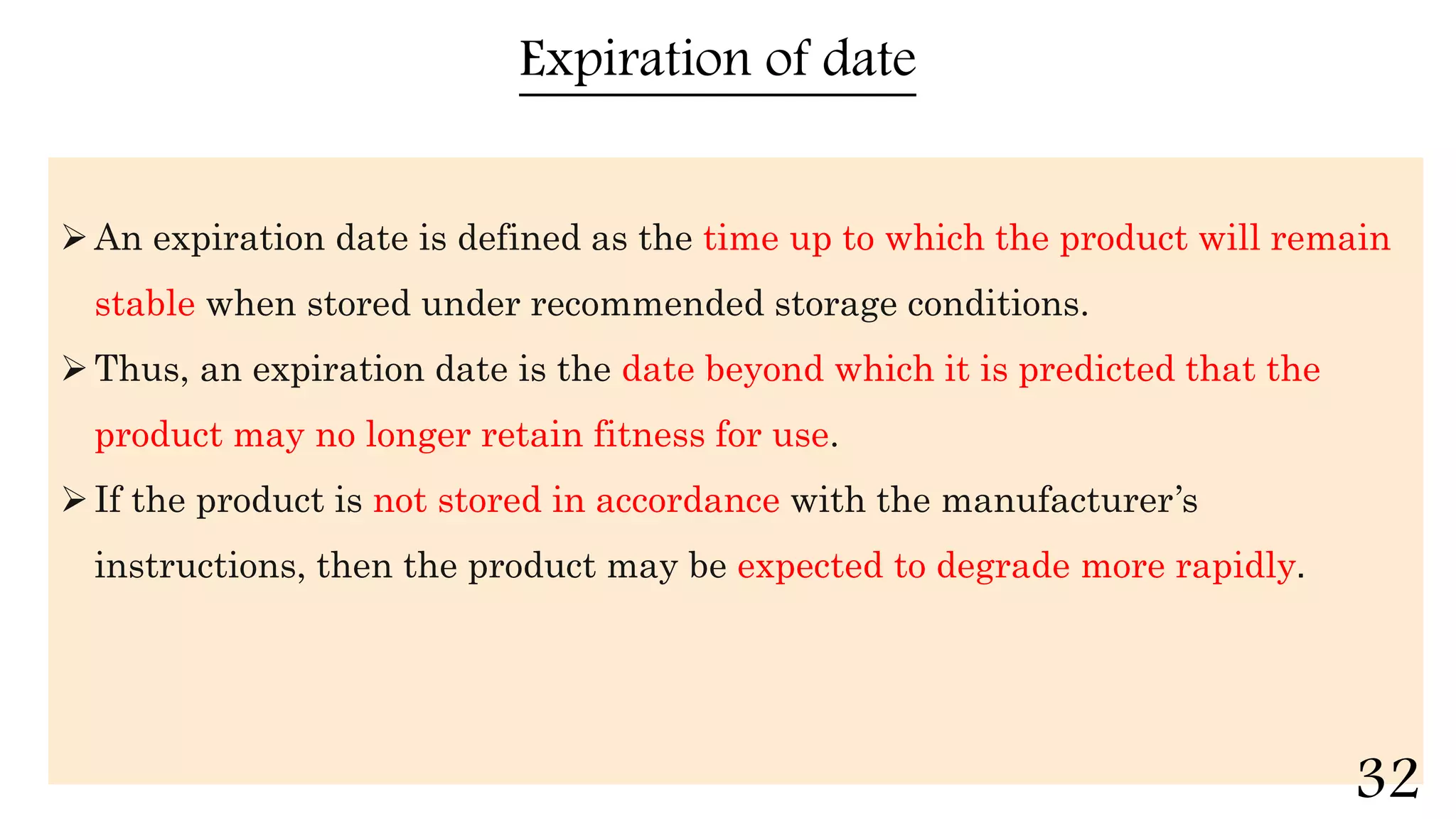
Expiration of date
An expiration date is defined as the time up to which the product will remain
stable when stored under recommended storage conditions.
Thus, an expiration date is the date beyond which it is predicted that the
product may no longer retain fitness for use.
If the product is not stored in accordance with the manufacturer’s
instructions, then the product may be expected to degrade more rapidly.
32
Kinetics of Stability & Stability Testing

Kinetics of Stability & Stability Testing

  • 1.
    KINETICS OF STABILITY & STABILITYTESTING SUBMITTED TO - Dr. MEENAKSHI BHATIA MAM SUBMITTED BY- SIDHARTH ROLL NO. 190121220005 M.PHARM. (CEUTICS) 1st SEMESTER DEPARTMENT OF PHARMACEUTICAL SCIENCES, GURU JAMBHESHWAR UNIVERSITY OF SCIENCES & TECHNOLOGY, HISAR
  • 2.
    CONTENTS • Definition ofdrug kinetics • Importance of studying kinetics • Rate and order of reaction • Factors affecting rate of reaction • Kinetics of drug degradation • Stability testing • Scope of stability testing • Advantages of stability testing • Types of stability • Stability testing methods • Guidelines for stability testing • Climatic zones for stability testing • Estimation of shelf life • Expiration date
  • 3.
    Drug kinetics • Definedas how drug changes with time i.e study of rate of change. • Many drugs are not chemically stable and the principle of chemical kinetics are used to predict the time span for which a drug will maintain its therapeutic effectiveness or efficacy at a specified temperature. 1
  • 4.
    Importance of studyingkinetics It determines- • Stability of drug / half life of drug- defined as time necessary for a drug to decay to its half life or 50% conc. (eg. 100% 50%, 50% 25%). • Shelf life- defined as the time required for a drug to decay to 90% of its original conc. 2
  • 5.
    RATE AND ORDEROF REACTION • The velocity with which a reaction or process occurs is called its rate. • The Conc. of drug which influences the rate of reaction or process is called its order of reaction. • The rate of forward reaction is expressed by- • As the reaction proceeds, the conc. Of drug B increases & rate of reaction can be expressed by- Consider the following chemical reaction DRUG A DRUG B – dA/dt dB/dt 3
  • 6.
    • If Cis the conc. of drug A as it is changed to B can be described by expression as a function of time t; where, K = rate constant n = order of reaction if, n = 0 (zero order kinetics) n = 1 (first order kinetics) dC/dt = – KCn 4
  • 7.
    The two commonlyencountered rate processes are: 1. ZERO ORDER REACTION 2. FIRST ORDER REACTION 5
  • 8.
    ZERO ORDER REACTION Also called as constant rate process.  The rate of reaction is independent of conc. i.e rate of reaction cannot be increased further by increasing the conc. of reactant. --------------- eqn 1 where, K0 = zero order rate constant (in mg/min) Rearranging eqn 1: --------------- eqn 2 Integrating the eqn 2: c0 c dC = 0 t −K0dt C – C0 = – K0t dC/dt = – K0 C0 = –K0 dC = – K0 dt 6
  • 9.
    Where, C0 = conc.of drug at t = 0 C = conc. of drug yet to undergo reaction at time t dC/dt Time (t) Time (t) C C0 Slope = – K0 Graph of zero order kinetics showing relationship b/w rate of reaction and conc. of drug 7
  • 10.
    FIRST ORDER REACTION •These are the reactions whose rate is directly proportional to conc. of the drugs undergoing reaction i.e greater the conc., faster the reaction. • It follows linear kinetics. -------------- eqn 3 Where, K= first order rate constant ( per hour) Rearranging the above eqn 3, --------------- eqn 4 Integrating the above eqn 4, 𝐥𝐧 𝐂 − 𝐥𝐧 𝐂 𝟎 = −Kt 𝐥𝐧 𝐂 = 𝐥𝐧 𝐂 𝟎 −Kt dC/dt = – KC dC/C = – Kdt 𝒄 𝟎 𝒄 𝒅𝑪/𝑪 = 𝟎 𝒕 −𝑲𝒅𝒕 8
  • 11.
    In terms oflog, log C = log C0 − Kt/2.303 Time (t) Slope = – K/2.303 log C Graph of first order kinetics showing linear relationship b/w rate of reaction and conc. of drug 9
  • 12.
    Factors affecting rateof reaction  Temperature  Light  Solvent  Phase $ Surface Area  Catalysis  Concentration 10
  • 13.
    Kinetic of drugdecomposition The drug decomposition follows the degradation pathway- 1. Hydrolysis 2. Oxidation 3. Photolysis 4. Racemization 11
  • 14.
    • Many pharmaceuticalsester or amide hydrolysis in solution. e.g. anesthetics, antibiotics, vitamins, & barbiturates. • The hydrolysis of an ester acid & alcohol rupture of a covalent linkage b/w C & O2 atom. e.g. Aspirin. • The hydrolysis of amide acid & amine. e.g.barbiturates, chloramphenicol. HYDROLYSIS in gives Prevention:  pH  Type of solvent (ethanol, mannitol)  Reduction to salts. 12
  • 15.
    Oxidation • The oxidativedecomposition instability of preparations such as steroids, vitamins, antibiotics, & epinephrine. • Reaction mediated either by free radicals or by molecular oxygen. • Autoxidation involves a free radical chain process. AB A*+ B • These radicals are highly unstable & readily take electrons from other substances, causing oxidation. 13
  • 16.
    Functional group susceptibleto oxidation Functional Group Drugs/Excipients Aldehydes Paraldehyde Amines Clozapine Carboxylic acids Fatty acids Conjugated dienes Vitamin A Ethers Diethyl ether Nitrites Amyl nitrite Phenols Catecholamine, Morphine Prevention:  Low oxygen content  Antioxidants  pH 14
  • 17.
    • Photolytic degradationexposure to UV or visible light in the wavelength range of approx. 300–800 nm. • Photodegradation rates directly dependent on the amount of incident radiation & on the amount of radiation that is absorbed by the compound. • Alcoholic solutions of hydrocortisone, prednisolone, & methylprednisolone degrade by photolytic reactions following first-order kinetics. Photolysis 15
  • 18.
    • An opticallyactive substance loses its optical activity without changing its chemical composition. • Dextro form generally therapeutically less active than levo form. e.g. levo form of adrenaline is 20 times active than dextro. Racemization 16
  • 19.
    STABILITY TESTING Stability :defined as capability of a particular formulation in a specific container/closure system to remain within its physical, chemical, microbiological, toxicological, protective and informational specifications. It is the extent to which a product retains, within the specified limits, throughout its period of storage and use, the same properties and characteristics possessed at the time of its packaging. 1 2 17
  • 20.
    SCOPE OF STABILITYTESTING  Provide evidence as to how the quality of drug product varies with time.  Establish shelf life of drug product.  Determines recommended storage conditions.  Determine container closure system suitability. 18
  • 21.
    IMPORTANCE OF STABILITYTESTING Assurance to patient that drug is safe. legal requirement to provide data. to protect the reputation of the manufacturer. to provide a database. to determine shelf life and storage conditions. to verify that no changes have been introduced in the formulation or manufacturing process that can adversely affect the stability of the product. 19
  • 22.
    • Each activeingredient retains its chemical integrity and labeled potency within specified limits. Chemical • Includes appearance, palatability, uniformity, dissolution and suspend ability are retained.Physical • Sterility or resistance to microbial growth is retained according to specific requirement.Microbiological • Activity remains unchanged.Therapeutic • No significant increase in toxicity.Toxicologic TYPE OF STABILITY 21
  • 23.
    STABILITY TESTING METHODS 1.REAL TIME STABILITY TESTING 2. ACCELERATED STABILITY TESTING 3. RETAINED SAMPLE STABILITY TESTING 4. CYCLIC TEMPERATURE STRESS TESTING 22
  • 24.
    • performed forlonger duration of the test period in order to allow significant product degradation under recommended storage conditions. • depends upon the stability of the product which should be long enough to indicate clearly that no measurable degradation occurs. Data collected at appropriate frequency To distinguish instability from day to day Stability of reference material include the stability of reagent as well as consistency of performance 1. REAL TIME STABILITY TESTING 23
  • 25.
    2. ACCELERATED STABILITYTESTING • A product is stressed at several high temp. & the amount of heat input required to cause product failure is determined. • This is done to subject the product to a condition that accelerates degradation. • This information is then projected to predict shelf life or used to compare the relative stability of alternative formulations. Samples subjected to stress Refrigerated Assayed simultaneously 24
  • 26.
    The concept ofaccelerated stability testing is based upon the Arrhenius equation Where, K = degradation rate/s, A = frequency factor/s, ∆E = activation energy (kJ/mol), R = universal gas constant (0.00831 kJ/mol), T=absolute temperature (K) 𝑙𝑛 𝐾 = 𝑙𝑛 𝐴 + ∆𝐸 𝑅𝑇 25
  • 27.
    • usual practicefor every marketed product for which stability data are required. • Only one batch a year are selected. • If the number of batches marketed exceeds 50, stability samples from two batches are recommended to be taken. • Stability testing by evaluation of market samples is a modified method which involves taking samples already in the market place and evaluating stability attributes. 3. RETAINED SAMPLE STABILITY TESTING 26
  • 28.
    • Is nota routine testing method for marketed products. • In this method, cyclic temp. stress tests are designed on knowledge of the product so as to mimic likely conditions in market place storage. • The period of cycle mostly considered is 24 hours. • The min. and max. temp. for the cyclic stress testing is recommended to be selected on a product by-product basis and considering factors like recommended storage temp. for the product and specific chemical and physical degradation properties of the products. • the test should normally have 20 cycles. 4. CYCLIC TEMPERATURE STRESS TESTING 27
  • 29.
    ICH CODE GUIDELINETITLE Q1A Stability testing of New Drug Substances and Products (Second Revision) Q1B Stability testing : Photo stability testing of New Drug Substances and Products Q1C Stability testing of New Dosage Form Q1D Bracketing and Matrixing Designs for stability testing of Drug Substances and Products Q1E Evaluation of stability data Q1F Stability data package for Registration Applications in Climatic Zones III and IV Q5C Stability testing of Biotechnological/Biological Products GUIDELINE FOR STABILITY TESTING 28
  • 30.
    Zone I (TEMPERATE) • United kingdom, Northern Europe, Russia, Unitedstates. • Long term testing conditions- 210C/45%RH Zone II (SUBTROPICAL & MEDITERRANEAN) • Japan, Southern Europe. • Long term testing conditions- 250C/60%RH Zone III (HOT & DRY) • Iraq, India. • Long term testing conditions- 300C/35%RH Zone IV (HOT & HUMID) • Iran, Egypt. • Long term testing conditions- 300C/65%RH CLIMATIC ZONES FOR STABILITY TESTING 29
  • 31.
    TEST STORAGE CONDITION Intendedstorage condition Study Storage conditions Minimum time period covered Room temperature Long term 25ºC ± 2ºC/60% RH ± 5% RH 12 months Intermediate 30ºC ± 2ºC/65% RH ± 5%RH 6 months Accelerated 40ºC ± 2ºC/75% RH ± 5% RH 6 months Refrigerated Long 5ºC ± 3ºC 12 months Accelerated 25ºC ± 2ºC/60% RH ± 5% RH 6 months Freezer Long -20ºC ± 5ºC 12 months 30
  • 32.
    Estimation of shelflife  The time period during which a drug product is expected to remain within the approved shelf life specification, provided that it is stored under the conditions.  The time period during which the drug maintain its 90% potency or loss not more than 10% potency.  The shelf life is determined from the data obtained from the long term storage studies. 31
  • 33.
    Expiration of date Anexpiration date is defined as the time up to which the product will remain stable when stored under recommended storage conditions. Thus, an expiration date is the date beyond which it is predicted that the product may no longer retain fitness for use. If the product is not stored in accordance with the manufacturer’s instructions, then the product may be expected to degrade more rapidly. 32