Downloaded 22 times


![• The Equation Of Higuchi model:
Q= [D(2A-Cs)Cs x t]1/2 or
Q=(2ADCst)¹/2
• By differentiating the above equation we get,
dQ/dt=(ADCs/2t)1/2
• Release of the drug is proportional to the square root of time.
• The Drug release from the granular matrix is given by](https://image.slidesharecdn.com/thehiguchiandpeppasplot-230402112820-e591c8b3/85/Higuchi-And-Peppas-Plot-3-320.jpg)


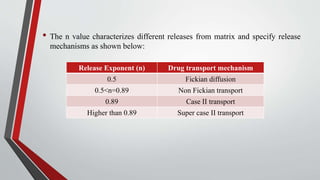
The document presents the Higuchi and Peppas models for drug release from polymer matrices, highlighting their mathematical formulations and applications. The Higuchi plot, developed in 1961, describes drug release as a diffusion process that is proportional to the square root of time, while the Korsmeyer-Peppas model, introduced in 1983, categorizes drug release mechanisms based on the release exponent. Both models are utilized to analyze the kinetics of drug release from various pharmaceutical formulations, particularly for water-soluble and poorly soluble drugs.


![• The Equation Of Higuchi model:
Q= [D(2A-Cs)Cs x t]1/2 or
Q=(2ADCst)¹/2
• By differentiating the above equation we get,
dQ/dt=(ADCs/2t)1/2
• Release of the drug is proportional to the square root of time.
• The Drug release from the granular matrix is given by](https://image.slidesharecdn.com/thehiguchiandpeppasplot-230402112820-e591c8b3/85/Higuchi-And-Peppas-Plot-3-320.jpg)