Masters of pharmacy, Pharmaceutical technology (Pharmaceutics)
Subject- Modern pharmaceutics (MPH-103T)
Lesion no- 1, Preformulation concepts By- Drx JAYESH M.RAJPUT
Points:-
1) Drug excipient interactions:-
Excipients play an important role in formulating a dosage form.
These are ingredients which along with active pharmaceutical ingredients make up the dosage
forms.
Excipients act as protective agents, bulking agents and can also be used to improve
bioavailability of drug.
Excipients as like other active pharmaceutical ingredients need to be stabilized and
standardized
An excipient is a substance formulated alongside the active ingredient of a medication, included
for the purpose of long-term stabilization, bulking up solid formulations that contain potent active
ingredients in small amounts
Consistency of drug release and bioavailability.
Stability including protection from degradation.
Ease of administration to the target patient population(s) bythe intended route.
Excipients are inactive ingredients sed as carriers for the active ingredients in a pharmaceutical
product. These may be classified into the following categories:-
 Binders
 Disintegrants
 Fillers (diluents)
 Lubricants
 Glidants
 Compression aids
 Colors
 Sweeteners
 Preservatives
 Flavors
 Film formers/ coatings
 Suspending/ dispersing agents/ surfactants
 Anti-adherents
 Sorbents
 Antioxidants
 Buffering agent
 Chelating agent
 Viscosity imparting agents
 Humectants

In pharmaceutical dosage forms the active pharmaceutical ingredients are in intimate
contact with the excipient which are greater quantity excipient and drugs may have certain
incompatibility which lead to drug excipient interaction.
Types of drug excipient interactions:-
1. Physical interactions
2. Chemical interactions
3. Biopharmaceutical interactions
4. Excipient-excipient interactions
Physical interaction:-
Physical interactions alter the rate of dissolution, dosage uniformity, etc
Physical interactions do not involve chemical changes thus permitting the components in the
formulation to retain their molecular structure. Physical interactions are difficult to detect.
Interaction
Complexation:-
1. Usually binds reversibly with drugs to form complex.
2. Insoluble complexes are formed which lead to slower dissolution.
3. Decreased absorption of drug.
Chemical interaction:-
Active pharmaceutical ingredients are excipients react with each other to form unstable
compounds. Chemical interaction involves chemical reaction between drugs and excipients or
drugs and impurities/ residues present in the excipients to form different molecules. Chemical
interactions are almost detrimental to the product because they produce degradation products.
Biopharmaceutical interaction:-
These are the interactions which are observed after administration of medicine. These interactions
occur in the form of :-
The interaction is between (drug substance and excipients) and the body fluids
The interactions have the tendency to influence the rate of absorption of the drug.
Ex:- 1. Premature breakdown of enteric coat.
2. increase in gastrointestinal motility.
3. effect on p-glycoprotein efflux transporter
Excipient-excipient interaction:-
This type of interaction occurs between two or more excipients in a drug molecule.
Example:- in proper addition of electrolyte such as ca++ or mg++ ion in suspension containing
sodium carboxymethyl cellulose (Na CMC) which will cause formation of calcium/magnesium
CMC
The suspending agent will be destroyed and cannot perform its function
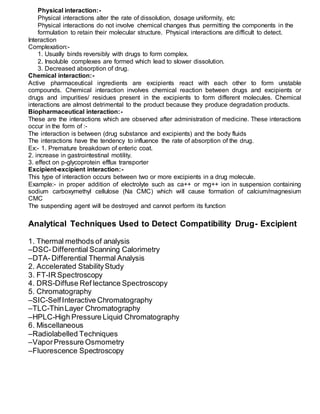
Analytical Techniques Used to Detect Compatibility Drug- Excipient
1. Thermal methods of analysis
–DSC-Differential Scanning Calorimetry
–DTA-Differential Thermal Analysis
2. Accelerated StabilityStudy
3. FT-IR Spectroscopy
4. DRS-Diffuse Ref lectance Spectroscopy
5. Chromatography
–SIC-SelfInteractive Chromatography
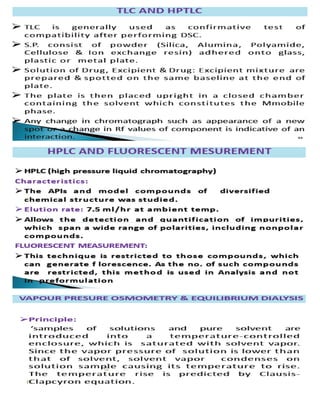
–TLC-ThinLayer Chromatography
–HPLC-High Pressure Liquid Chromatography
6. Miscellaneous
–Radiolabelled Techniques
–VaporPressure Osmometry
–Fluorescence Spectroscopy
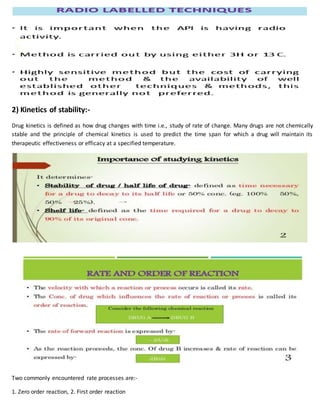
2) Kinetics of stability:-
Drug kinetics is defined as how drug changes with time i.e., study of rate of change. Many drugs are not chemically
stable and the principle of chemical kinetics is used to predict the time span for which a drug will maintain its
therapeutic effectiveness or efficacy at a specified temperature.
Two commonly encountered rate processes are:-
1. Zero order reaction, 2. First order reaction
Factors affecting rate of reaction:-
 Temperature
 Light
 Solvent
 Phase and surface area
 Catalysis
 Concentration `
Kinetic of drug decomposition:-
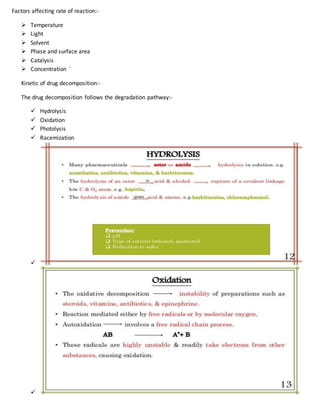
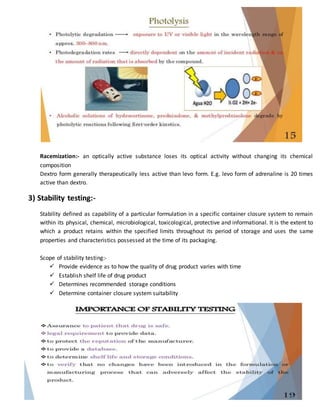
The drug decomposition follows the degradation pathway:-
 Hydrolysis
 Oxidation
 Photolysis
 Racemization


Racemization:- an optically active substance loses its optical activity without changing its chemical
composition
Dextro form generally therapeutically less active than levo form. E.g. levo form of adrenaline is 20 times
active than dextro.
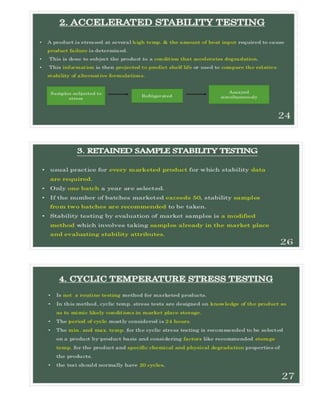
3) Stability testing:-
Stability defined as capability of a particular formulation in a specific container closure system to remain
within its physical, chemical, microbiological, toxicological, protective and informational. It is the extent to
which a product retains within the specified limits throughout its period of storage and uses the same
properties and characteristics possessed at the time of its packaging.
Scope of stability testing:-
 Provide evidence as to how the quality of drug product varies with time
 Establish shelf life of drug product
 Determines recommended storage conditions
 Determine container closure system suitability
4) Theories of dispersions and pharmaceutical dispersions:-
Pharmaceutical dispersions consists of particulate matter, known as the dispersed phase, distributed throughout
a continuous or dispersion medium. The dispersed material may range in size from particles of atomic and
molecular dimensions to particles whose size is measured in millimeters.
Coarse dispersion systems:-
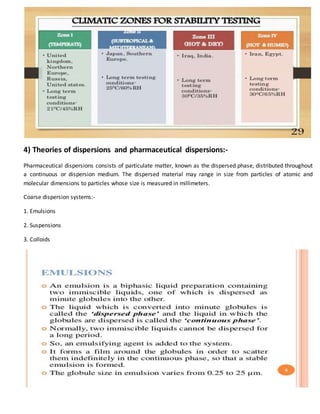
1. Emulsions
2. Suspensions
3. Colloids
Theories of dispersion:-
There are mainly 4 theories
1. viscosity theory:- as per this theory, an increase in viscosity of emulsion will lead to an
increase in stability, limitations are- this theory failed to explain about the milk, which shows
considerable stability even though its viscosity is less.
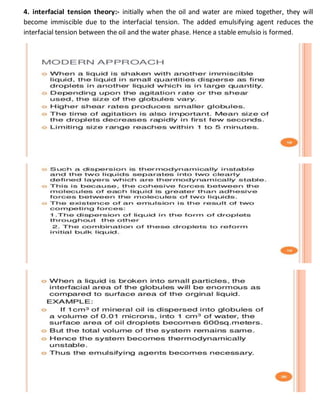
2. film theory or adsorption theory:- as per this theory, the added emulsifying agent forms a
mechanical film by getting adsorbed at the interface of the liquids (i.e., at the interface between
the dispersed globules and the dispersion medium) this offers stability to the emulsion,
limitations are- this theory could not explain the formulation of type of emulsion.
3. wedge theory:- according to this theory, monovalent soaps like sodium stearate gives o/w
type emulsion and divalent soaps like calcium stearate gives w/o type emulsion. This was
explained by the successfulaccomodation of the soap molecules at the interface and subsequent
possible orientation of the soap molecules to give the type of emulsion.
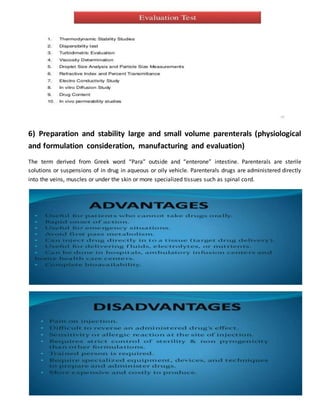
4. interfacial tension theory:- initially when the oil and water are mixed together, they will
become immiscible due to the interfacial tension. The added emulsifying agent reduces the
interfacial tension between the oil and the water phase. Hence a stable emulsio is formed.
Based on the nature of the films formed at the interface, mechanism of action of the emulsifying
agents has been divided into:-
1. Monomolecular adsorption and film formation
2. Multimolecular adsorption
3. Solid particle adsorption
5) SMEDDS (self micro emulsifying drug delivery system):-
Are defined as isotropic mixtures of natural or synthetic oils, solid and liquid surfactants.
Alternatively, one or morehydrophilic solvents and co-solvents/surfactants thathavea
unique ability of forming fine oil-in-water (o/w) micro emulsions upon mild agitation
followed by dilution in aqueous media, such as GI fluids. The basic differenceself
emulsifying drug delivery systems (SEDDS) also called as self emulsifying oil formulation
(SOEF).
Types of self-micro emulsion
1. O/W micro emulsion
2. W/O micro emulsion
Most of the new drug candidates in development today are sparingly soluble and
associated with poor bioavailability, the main purposeis to prepareSMEDDS for “oral
bioavailability enhancement of a poorly water soluble drug”.
Composition of SMEDDS:-
Oils, surfactants, co-solvents, co-surfactant.
6) Preparation and stability large and small volume parenterals (physiological
and formulation consideration, manufacturing and evaluation)
The term derived from Greek word “Para” outside and “enterone” intestine. Parenterals are sterile
solutions or suspensions of in drug in aqueous or oily vehicle. Parenterals drugs are administered directly
into the veins, muscles or under the skin or more specialized tissues such as spinal cord.
Classification:-
1. Small volume parenterals (SVP):- an injection that is packed in containers labeled as containing 100 ml
or less are called as small volume parenterals.
2. Large volume parenterals (LVP):- are parenterals designed to provide
 Fluid
 Calories (dextrose solution)
 Electrolytes
 Combination of these
 Volume (101-1000 ml)
Types of large volume parenterals:-
1) Hyper alimentation solutions
2) Cardiolpagic solutions
3) Peritoneal dialysis solution
4) Irritating solutions
Types of small volume parenterals:-
1) Suspensions
2) Emulsions
3) Solution
4) Dry powder
Preparation of LVP and SVP:-
Aqueous vehicle:-
Water for injection (WFI) USP:-
Highly purified water used as a vehicle for injective preparations which will be subsequently sterilized. USP
requirement include not more than 10 parts per million of total solids. pH of 5.0 to 7.0, WFI may be
prepared by either distillation or reverse osmosis.
Bacteriostatic water for injection:-
This type of water used for making parenterals solutions prepared under aseptic conditions and not
terminally sterilized. Need to meet USP sterility test. It can contain an added Bacteriostatic agent when in
containers of 30 ml or less.
Sterile water for injection:-
SWFI containing one or more suitable Bacteriostatic agent, multiple, dose containers not exceeding 30 ml.
they are permitted to contain higher levels of solid than WFI because of possible leaching, used for
washing wounds, surgical incisions, or body tissues.
Water miscible vehicles:-
The number of solvents that are miscible with water has been used as a portion of a vehicle. Primarily to
affect solubility of drugs and to reduce hydrolysis, example- ethyl alcohol, liquid propylene glycol, glycerin,
ethyl alcohol used in the case of cardiac glycoside.
Non-aqueous vehicles;-
Fixed oils (vegetable origin, liquid, and rancid resistance unsaturated, free fatty acid contents),
Peanut oil, corn oil, cotton seed oil, sesame oil, ethyl oleate, isopropyl myristate.
Other additives:-
Antibacterial agents
These are added in multiple dose containers, to prevent microorganism growth, limited concentrations of
agents are used. Examples:- phenyl mercuric nitrate and thiomersol 0.01%, phenol and cresol 0.05%,
chlorobutanol 0.05%.
Buffers:-
Added to maintain pH, to stabilize a solution from chemical degradation, example- citrate and acetate
buffer, sodium benzoate and benzoic acid, sodium tartarate and tartaric acid, phosphate buffer.
Antioxidant:-
To protect the formulation from oxidation
Two types:- 1, reducing agents example- ascorbic acid, sodium bisulphide 0.01%, thiourea.
2, blocking agents example- tocoopherol.
Surfactants
Solubilise the active ingredient. Examples- polyoxythylene sorbitan monooleate, sorbiton monooleate.
Tonicity agents:-
Need isotonic solution to avoid destruction of red blood cells, irritation and tissue damage. More
important for large volumes rapidly administered and extravascular injections. Reduces the pain on
injection, examples- sorbiton monooleate, NaCl and KCl, dextrose solution.
Chelating agents:-
To remove trace elements that catalyses oxidative degeneration. Example- ethylene Diamine tetra acetic
acid 26.
Co-solvent- improve solubility, prevent potential for hydrolysis.
Emulsifying agents:- lecithin, polysorbate 80.
Bulking agents:-
For freeze dried preparations (solids). Examples- mannitol, lactose, sucrose, dextran.
Suspending agents:-
Examples- CMC, methyl cellulose, gelatin.
Stability testing for SVP and LVP:-
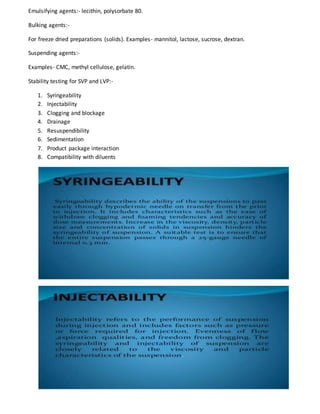
1. Syringeability
2. Injectability
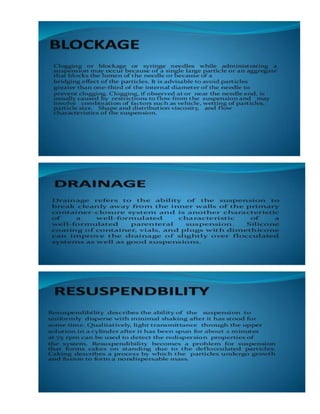
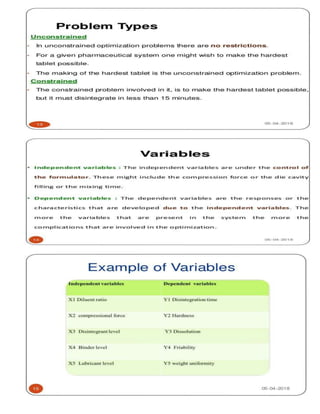
3. Clogging and blockage
4. Drainage
5. Resuspendibility
6. Sedimentation
7. Product package interaction
8. Compatibility with diluents
7) Optimization techniques in pharmaceutical formulations:-
Choosing the best element from some set of available alternatives are optimization.
The term Optimize is defined as “to make perfect”.
It is used in pharmacy relative to formulation and processing
Involved in formulating drug products in various forms
It is the process of finding the best way of using the existing resources while taking in to the
account of all the factors that influences decisions in any experiment
Final product not only meets the requirements from the bio-availability but also from the
practical mass production criteria
Pharmaceutical scientist- to understand theoretical formulation.
Target processing parameters – ranges for each excipients & processing factors
8) Optimization techniques in pharmaceutical formulation and processing:-
Considering the changes in input and effect on output, the optimization techniques are categorized into five
types:-
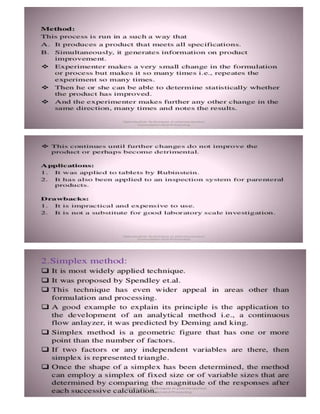
1. Evolutionary operations
2. Simplex method
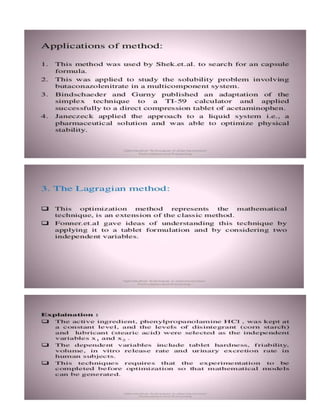
3. Lagrangian method
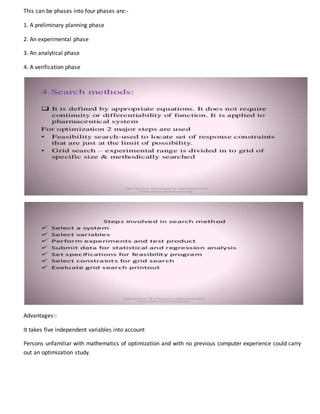
4. Search method
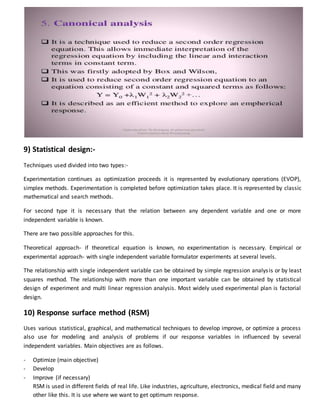
5. Canonical analysis
This can be phases into four phases are:-
1. A preliminary planning phase
2. An experimental phase
3. An analytical phase
4. A verification phase
Advantages:-
It takes five independent variables into account
Persons unfamiliar with mathematics of optimization and with no previous computer experience could carry
out an optimization study.
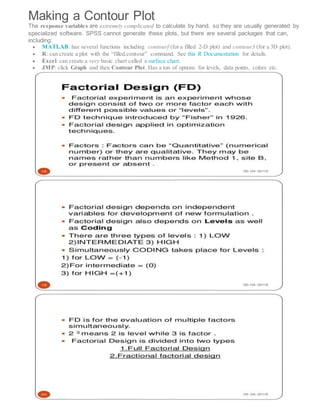
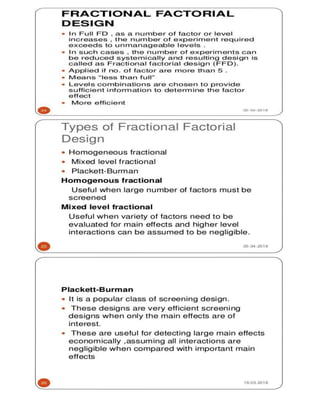
9) Statistical design:-
Techniques used divided into two types:-
Experimentation continues as optimization proceeds it is represented by evolutionary operations (EVOP),
simplex methods. Experimentation is completed before optimization takes place. It is represented by classic
mathematical and search methods.
For second type it is necessary that the relation between any dependent variable and one or more
independent variable is known.
There are two possible approaches for this.
Theoretical approach- if theoretical equation is known, no experimentation is necessary. Empirical or
experimental approach- with single independent variable formulator experiments at several levels.
The relationship with single independent variable can be obtained by simple regression analysis or by least
squares method. The relationship with more than one important variable can be obtained by statistical
design of experiment and multi linear regression analysis. Most widely used experimental plan is factorial
design.
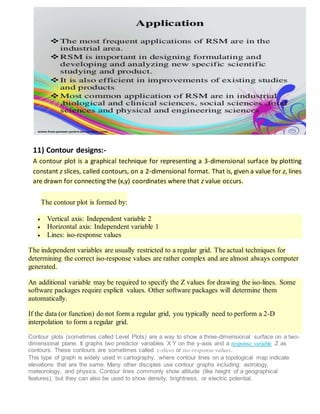
10) Response surface method (RSM)
Uses various statistical, graphical, and mathematical techniques to develop improve, or optimize a process
also use for modeling and analysis of problems if our response variables in influenced by several
independent variables. Main objectives are as follows.
- Optimize (main objective)
- Develop
- Improve (if necessary)
RSM is used in different fields of real life. Like industries, agriculture, electronics, medical field and many
other like this. It is use where we want to get optimum response.
A single tablet is introduced in market after large number of experiments. Suppose a company want to
introduce a new pain killer tablet in market. The pharmacist will make the table that will be more
effective and has rapid action to kill the pain, will have low price at market for patient.
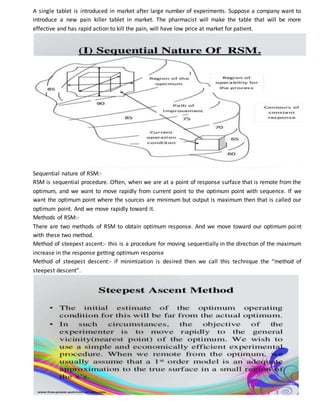
Sequential nature of RSM:-
RSM is sequential procedure. Often, when we are at a point of response surface that is remote from the
optimum, and we want to move rapidly from current point to the optimum point with sequence. If we
want the optimum point where the sources are minimum but output is maximum then that is called our
optimum point. And we move rapidly toward it.
Methods of RSM:-
There are two methods of RSM to obtain optimum response. And we move toward our optimum point
with these two method.
Method of steepest ascent:- this is a procedure for moving sequentially in the direction of the maximum
increase in the response getting optimum response
Method of steepest descent:- if minimization is desired then we call this technique the “method of
steepest descent”.
11) Contour designs:-
A contour plot is a graphical technique for representing a 3-dimensional surface by plotting
constant z slices, called contours, on a 2-dimensional format. That is, given a value for z, lines
are drawn for connecting the (x,y) coordinates where that z value occurs.
The contour plot is formed by:
 Vertical axis: Independent variable 2
 Horizontal axis: Independent variable 1
 Lines: iso-response values
The independent variables are usually restricted to a regular grid. The actual techniques for
determining the correct iso-response values are rather complex and are almost always computer
generated.
An additional variable may be required to specify the Z values for drawing the iso-lines. Some
software packages require explicit values. Other software packages will determine them
automatically.
If the data (or function) do not form a regular grid, you typically need to perform a 2-D
interpolation to form a regular grid.
Contour plots (sometimes called Level Plots) are a way to show a three-dimensional surface on a two-
dimensional plane. It graphs two predictor variables X Y on the y-axis and a response variable Z as
contours. These contours are sometimes called z-slices or iso-response values.
This type of graph is widely used in cartography, where contour lines on a topological map indicate
elevations that are the same. Many other disciples use contour graphs including: astrology,
meteorology, and physics. Contour lines commonly show altitude (like height of a geographical
features), but they can also be used to show density, brightness, or electric potential.
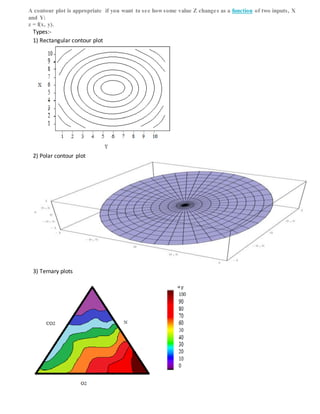
A contour plot is appropriate if you want to see howsome value Z changes as a function of two inputs, X
and Y:
z = f(x, y).
Types:-
1) Rectangular contour plot
2) Polar contour plot
3) Ternary plots
Making a Contour Plot
The response variables are extremely complicated to calculate by hand, so they are usually generated by
specialized software. SPSS cannot generate these plots, but there are several packages that can,
including:
 MATLAB: has several functions including contourf (for a filled 2-D plot) and contour3 (for a 3D plot).
 R: can create a plot with the “filled.contour” command. See this R Documentation for details.
 Excel: can create a very basic chart called a surface chart.
 JMP: click Graph and then Contour Plot. Has a ton of options for levels, data points, colors etc.
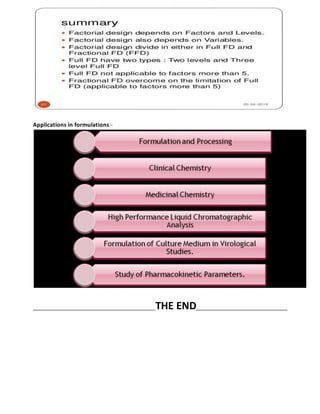
Applications in formulations:-
_______________________________________THE END_____________________________