UV Visible Spectroscopy involves the study of interaction between electromagnetic radiation and matter. It is used to measure absorption or transmission of light passing through a sample. The technique utilizes wavelengths in the UV and visible range from 200-800 nm. Key aspects covered include Beer's law, electronic transitions involved, instrumentation components, and applications such as determining impurities, functional groups, and drug assay.



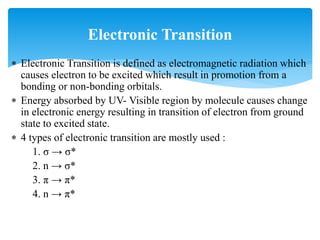

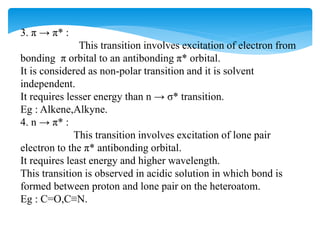


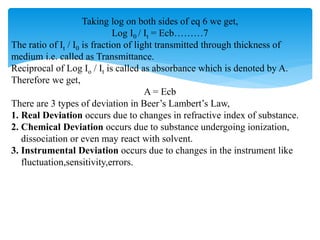


![5) Detector :
Detector used in UV Visible spectrophotometer help to convert the EMR into
current which can be visualize in read out system.
It should be highly sensitive and have fast response time.
It should provide quantitative response in wide spectrum of radiation.
It should generate sufficient signal or electric current which can be measured.
There are different types of Detector used in UV Visible Spectroscopy but 3 are
mostly used which are :
1. Barrier Layer Cell [ Photovoltaic Cell]
2. Photoemmissive cell [ Phototube]
3. Photomultiplier [ Vacuum Phototube]
6) Read Out System :
The read out system is gives the readings of the radiation in visual form on the
display.](https://image.slidesharecdn.com/uvvisiblespectroscopy-231027142054-b443977d/85/UV-Visible-Spectroscopy-pptx-16-320.jpg)