How to use the Library
Introduction
Bunda College Library is the heart of teaching, learning, research and consultancy activities
of the College. As part of your studies you are required to supplement whatever you learn
in class, field, laboratories, etc with information available in the Library. Users, especially
students, need to know how best to use the Library.

OUTCOMES
At the end of the chapter it is expected that you will be able to:
       •     dentify the various sections of the Library and their contents
       •     describe the University of Malawi regulations
       •     identify the various information sources
       •     describe the information searching process
       •     describe information searching tools


Library Staff and Sections
The Library comprises a College Librarian, Assistant Librarians, a Secretary, Library
Assistants, Library Guards and Messengers/Cleaners. The College Librarian is the overall in
charge of the Library. Library staff assists users in:
     1. Searching and retrieving information
     2. Issuing out and receiving Library materials
     3. Provision of special services such as printing, scanning, lamination, photocopying,
          ID production and Internet/email access.
     4. Allocating Library equipment, such as computers; audio-visual materials and study
          carrels.


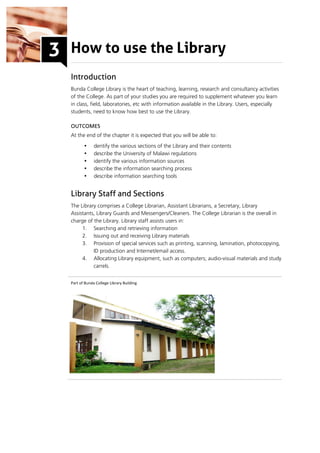
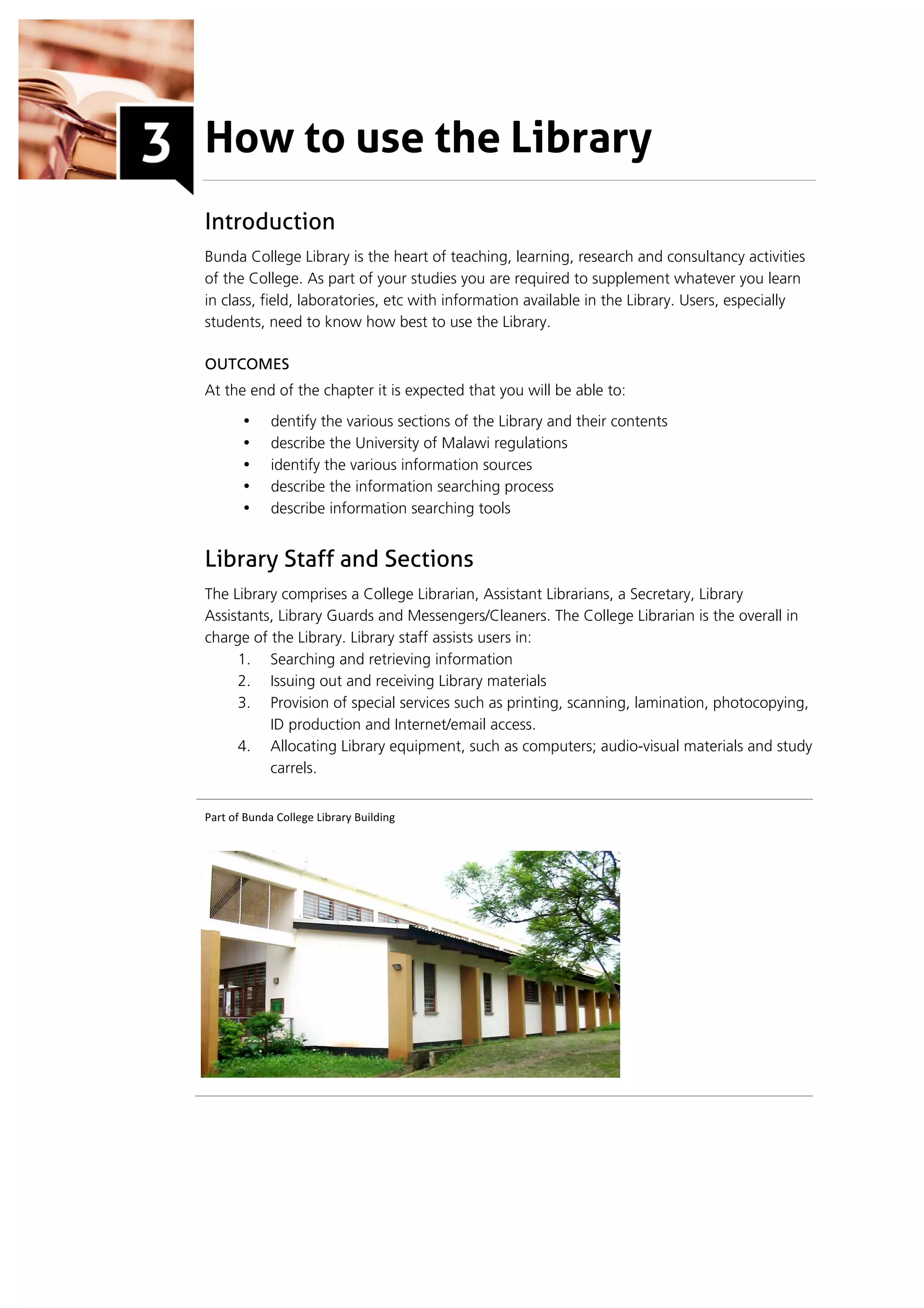
Part of Bunda College Library Building 
BUNDA COLLEGE OF AGRICULTURE | COMMUNICATION SKILLS


The Library is composed of the following sections/areas:
    •   Entrance foyer
    •   Guard’s desk
    •   Offices
    •   Information desk
    •   Long term/short loans desk
    •   Malawiana collection
    •   Audio-visual
    •   Food and Agricultural Organization (FAO) collection
    •   General books collection
    •   Bound periodicals section
    •   New periodicals display rack
    •   References
    •   Computer room
    •   Maps and atlases section
    •   Study carrels
    •   Open study/reading areas
    •   Newspaper reading area

Library users are free to visit or take an available seat or reading desk in any of the Library
sections/areas.

All registered Library users are issued with pockets to be used for borrowing Library
materials. The number of pockets and the period a user can borrow items before returning,
depends on the category of the user as stipulated in the University of Malawi Libraries’
regulations.


SELF STUDY ACTIVITY:
Library Sections

Pay a visit to the Library and familiarize yourself with each section and area as outlined
above. Take note of their contents and/or activities.
   1.   Describe what you do if you want to take a book out the Library.
   2.    What are the two major differences between Malawiana and general books
         collections?
   3.   From which section(s) are you allowed to take out Library materials?


Library Regulations
Bunda College of Agriculture Library is part of the University of Malawi (UNIMA) Libraries.
University of Malawi has a library in each of the five constituent colleges. As such all UNIMA
libraries follow the same regulations. All Library users must know these regulations and
follow them; otherwise there are stipulated penalties for not doing so. The following are
some of the regulations:

    •   No eating or drinking in the Library
    •   Library materials must be handled with care; no scribbling, soiling or tearing or
        turning down pages


                                               27
•   Noise must be minimized to maintain a good study environment.
    •   Cell phone use in the Library is not permitted.
    •   Games or offensive materials on Library computers are prohibited
    •   Leave hats, bags, umbrellas at the Guard’s desk
    •   Some Library collections which are appropriately marked ‘Not To Be Taken Away’
        or ‘Malawiana’ or ‘Thesis’ shall not be removed from the Library, except under very
        special circumstances and at the discretion of the College Librarian.
    •   The Librarian reserves the right to withdraw or refuse Library facilities to anyone
        who contravenes the Library Regulations.

In summary, treat the Library and its contents with care and respect and it will serve you
and future students well!

SELF STUDY ACTIVITY:
Library Regulations

Go through University of Malawi Libraries Regulations posted on the Library Guard’s Desk.
    •   How long are you allowed to borrow a Library material from the Reference section
        for?
    •   What are penalties for users who lose books or delay in returning a book?


Types of Information Sources
    •    Printed materials
        - Books
        - Periodicals
        - Unpublished materials

    •    Electronic Resources
        - Electronic journals
        - Online databases
        - Computer/local databases
        - CD-ROM
        - Electronic books


SELF STUDY ACTIVITY:
Book & Periodical Details

1. Get any book from the shelves and write down the author(s)/ editor(s) (if any), title,
   publisher, date of publication, index pages (if any) and glossary (if any).
2. What is the difference between a book and a periodical?


Information Searching Process
Searching information in the Library involves having an idea of what one is looking for. A
Library user has to plan before doing the searching. The plan should include knowledge of
the information source, tool(s) to use, section(s) of the Library holding the information
source and what steps to take if you don’t find the information you are looking for.


                                            28
BUNDA COLLEGE OF AGRICULTURE | COMMUNICATION SKILLS


Tools for Information Searching
LIBRARY CATALOGUES
Library catalogues are a listing of all what is contained in the Library in a certain order.
Bunda College of Agriculture Library uses classified and alphabetical order. The Library has
two types of catalogues namely card catalogues and online public access catalogues
(OPACs) that uses computers. Card catalogues situated near the main entrance, contain
records for books acquired from Bunda College of Agriculture inception to 1990 when
computers were first used. The card catalogue is in two parts: Author/Title and Subject
catalogues. The cards contain bibliographical details of an item such as author(s)/editor(s),
publisher, place of publication, date, imprint, physical description, class mark and subject(s)
the item covers. Class mark is the location of an item in the Library. Cards in the catalogue
are filed in alphabetical order.


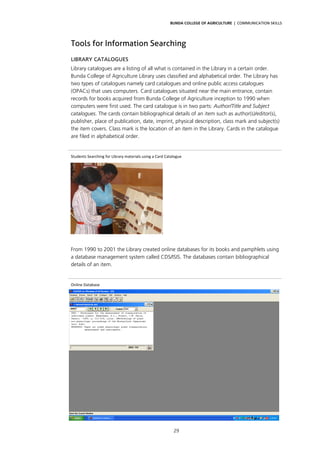
Students Searching for Library materials using a Card Catalogue 


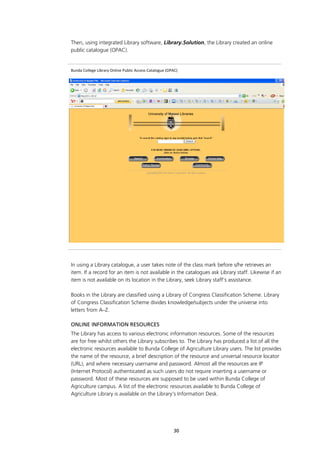
From 1990 to 2001 the Library created online databases for its books and pamphlets using
a database management system called CDS/ISIS. The databases contain bibliographical
details of an item.


Online Database 


                                                          29
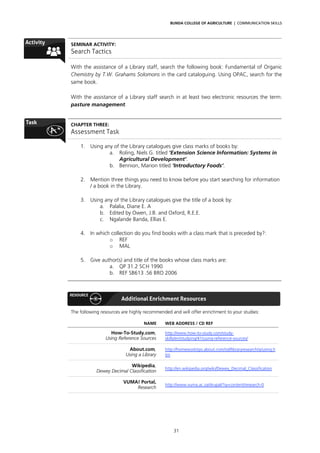
Then, using integrated Library software, Library.Solution, the Library created an online
public catalogue (OPAC).


Bunda College Library Online Public Access Catalogue (OPAC) 


In using a Library catalogue, a user takes note of the class mark before s/he retrieves an
item. If a record for an item is not available in the catalogues ask Library staff. Likewise if an
item is not available on its location in the Library, seek Library staff’s assistance.

Books in the Library are classified using a Library of Congress Classification Scheme. Library
of Congress Classification Scheme divides knowledge/subjects under the universe into
letters from A–Z.

ONLINE INFORMATION RESOURCES
The Library has access to various electronic information resources. Some of the resources
are for free whilst others the Library subscribes to. The Library has produced a list of all the
electronic resources available to Bunda College of Agriculture Library users. The list provides
the name of the resource, a brief description of the resource and universal resource locator
(URL), and where necessary username and password. Almost all the resources are IP
(Internet Protocol) authenticated as such users do not require inserting a username or
password. Most of these resources are supposed to be used within Bunda College of
Agriculture campus. A list of the electronic resources available to Bunda College of
Agriculture Library is available on the Library’s Information Desk.


                                                         30
BUNDA COLLEGE OF AGRICULTURE | COMMUNICATION SKILLS


SEMINAR ACTIVITY:
Search Tactics

With the assistance of a Library staff, search the following book: Fundamental of Organic
Chemistry by T.W. Grahams Solomons in the card cataloguing. Using OPAC, search for the
same book.

With the assistance of a Library staff search in at least two electronic resources the term:
pasture management.


CHAPTER THREE:
Assessment Task

    1. Using any of the Library catalogues give class marks of books by:
               a. Roling, Niels G. titled ‘Extension Science Information: Systems in
                   Agricultural Development’.
               b. Bennion, Marion titled ‘Introductory Foods’.

    2. Mention three things you need to know before you start searching for information
       / a book in the Library.

    3. Using any of the Library catalogues give the title of a book by:
           a. Palalia, Diane E. A
           b. Edited by Owen, J.B. and Oxford, R.E.E.
           c. Ngalande Banda, Ellias E.

    4. In which collection do you find books with a class mark that is preceded by?:
               o REF
               o MAL

    5. Give author(s) and title of the books whose class marks are:
               a. QP 31.2 SCH 1990
               b. REF SB613 .S6 BRO 2006


Additional Enrichment Resources
The following resources are highly recommended and will offer enrichment to your studies:

                                  NAME      WEB ADDRESS / CD REF

                   How-To-Study.com,        http://www.how-to-study.com/study-
                Using Reference Sources     skills/en/studying/41/using-reference-sources/

                          About.com,        http://homeworktips.about.com/od/libraryresearch/a/using.h
                         Using a Library    tm

                           Wikipedia,
                                            http://en.wikipedia.org/wiki/Dewey_Decimal_Classification
            Dewey Decimal Classification

                        VUMA! Portal,
                                            http://www.vuma.ac.za/drupal/?q=content/research-0
                            Research


                                                31

Using the Library (PDF)

  • 1.
    How to usethe Library Introduction Bunda College Library is the heart of teaching, learning, research and consultancy activities of the College. As part of your studies you are required to supplement whatever you learn in class, field, laboratories, etc with information available in the Library. Users, especially students, need to know how best to use the Library. OUTCOMES At the end of the chapter it is expected that you will be able to: • dentify the various sections of the Library and their contents • describe the University of Malawi regulations • identify the various information sources • describe the information searching process • describe information searching tools Library Staff and Sections The Library comprises a College Librarian, Assistant Librarians, a Secretary, Library Assistants, Library Guards and Messengers/Cleaners. The College Librarian is the overall in charge of the Library. Library staff assists users in: 1. Searching and retrieving information 2. Issuing out and receiving Library materials 3. Provision of special services such as printing, scanning, lamination, photocopying, ID production and Internet/email access. 4. Allocating Library equipment, such as computers; audio-visual materials and study carrels. Part of Bunda College Library Building 
  • 2.
    BUNDA COLLEGE OFAGRICULTURE | COMMUNICATION SKILLS The Library is composed of the following sections/areas: • Entrance foyer • Guard’s desk • Offices • Information desk • Long term/short loans desk • Malawiana collection • Audio-visual • Food and Agricultural Organization (FAO) collection • General books collection • Bound periodicals section • New periodicals display rack • References • Computer room • Maps and atlases section • Study carrels • Open study/reading areas • Newspaper reading area Library users are free to visit or take an available seat or reading desk in any of the Library sections/areas. All registered Library users are issued with pockets to be used for borrowing Library materials. The number of pockets and the period a user can borrow items before returning, depends on the category of the user as stipulated in the University of Malawi Libraries’ regulations. SELF STUDY ACTIVITY: Library Sections Pay a visit to the Library and familiarize yourself with each section and area as outlined above. Take note of their contents and/or activities. 1. Describe what you do if you want to take a book out the Library. 2. What are the two major differences between Malawiana and general books collections? 3. From which section(s) are you allowed to take out Library materials? Library Regulations Bunda College of Agriculture Library is part of the University of Malawi (UNIMA) Libraries. University of Malawi has a library in each of the five constituent colleges. As such all UNIMA libraries follow the same regulations. All Library users must know these regulations and follow them; otherwise there are stipulated penalties for not doing so. The following are some of the regulations: • No eating or drinking in the Library • Library materials must be handled with care; no scribbling, soiling or tearing or turning down pages 27
  • 3.
    Noise must be minimized to maintain a good study environment. • Cell phone use in the Library is not permitted. • Games or offensive materials on Library computers are prohibited • Leave hats, bags, umbrellas at the Guard’s desk • Some Library collections which are appropriately marked ‘Not To Be Taken Away’ or ‘Malawiana’ or ‘Thesis’ shall not be removed from the Library, except under very special circumstances and at the discretion of the College Librarian. • The Librarian reserves the right to withdraw or refuse Library facilities to anyone who contravenes the Library Regulations. In summary, treat the Library and its contents with care and respect and it will serve you and future students well! SELF STUDY ACTIVITY: Library Regulations Go through University of Malawi Libraries Regulations posted on the Library Guard’s Desk. • How long are you allowed to borrow a Library material from the Reference section for? • What are penalties for users who lose books or delay in returning a book? Types of Information Sources • Printed materials - Books - Periodicals - Unpublished materials • Electronic Resources - Electronic journals - Online databases - Computer/local databases - CD-ROM - Electronic books SELF STUDY ACTIVITY: Book & Periodical Details 1. Get any book from the shelves and write down the author(s)/ editor(s) (if any), title, publisher, date of publication, index pages (if any) and glossary (if any). 2. What is the difference between a book and a periodical? Information Searching Process Searching information in the Library involves having an idea of what one is looking for. A Library user has to plan before doing the searching. The plan should include knowledge of the information source, tool(s) to use, section(s) of the Library holding the information source and what steps to take if you don’t find the information you are looking for. 28
  • 4.
    BUNDA COLLEGE OFAGRICULTURE | COMMUNICATION SKILLS Tools for Information Searching LIBRARY CATALOGUES Library catalogues are a listing of all what is contained in the Library in a certain order. Bunda College of Agriculture Library uses classified and alphabetical order. The Library has two types of catalogues namely card catalogues and online public access catalogues (OPACs) that uses computers. Card catalogues situated near the main entrance, contain records for books acquired from Bunda College of Agriculture inception to 1990 when computers were first used. The card catalogue is in two parts: Author/Title and Subject catalogues. The cards contain bibliographical details of an item such as author(s)/editor(s), publisher, place of publication, date, imprint, physical description, class mark and subject(s) the item covers. Class mark is the location of an item in the Library. Cards in the catalogue are filed in alphabetical order. Students Searching for Library materials using a Card Catalogue  From 1990 to 2001 the Library created online databases for its books and pamphlets using a database management system called CDS/ISIS. The databases contain bibliographical details of an item. Online Database  29
  • 5.
    Then, using integratedLibrary software, Library.Solution, the Library created an online public catalogue (OPAC). Bunda College Library Online Public Access Catalogue (OPAC)  In using a Library catalogue, a user takes note of the class mark before s/he retrieves an item. If a record for an item is not available in the catalogues ask Library staff. Likewise if an item is not available on its location in the Library, seek Library staff’s assistance. Books in the Library are classified using a Library of Congress Classification Scheme. Library of Congress Classification Scheme divides knowledge/subjects under the universe into letters from A–Z. ONLINE INFORMATION RESOURCES The Library has access to various electronic information resources. Some of the resources are for free whilst others the Library subscribes to. The Library has produced a list of all the electronic resources available to Bunda College of Agriculture Library users. The list provides the name of the resource, a brief description of the resource and universal resource locator (URL), and where necessary username and password. Almost all the resources are IP (Internet Protocol) authenticated as such users do not require inserting a username or password. Most of these resources are supposed to be used within Bunda College of Agriculture campus. A list of the electronic resources available to Bunda College of Agriculture Library is available on the Library’s Information Desk. 30
  • 6.
    BUNDA COLLEGE OFAGRICULTURE | COMMUNICATION SKILLS SEMINAR ACTIVITY: Search Tactics With the assistance of a Library staff, search the following book: Fundamental of Organic Chemistry by T.W. Grahams Solomons in the card cataloguing. Using OPAC, search for the same book. With the assistance of a Library staff search in at least two electronic resources the term: pasture management. CHAPTER THREE: Assessment Task 1. Using any of the Library catalogues give class marks of books by: a. Roling, Niels G. titled ‘Extension Science Information: Systems in Agricultural Development’. b. Bennion, Marion titled ‘Introductory Foods’. 2. Mention three things you need to know before you start searching for information / a book in the Library. 3. Using any of the Library catalogues give the title of a book by: a. Palalia, Diane E. A b. Edited by Owen, J.B. and Oxford, R.E.E. c. Ngalande Banda, Ellias E. 4. In which collection do you find books with a class mark that is preceded by?: o REF o MAL 5. Give author(s) and title of the books whose class marks are: a. QP 31.2 SCH 1990 b. REF SB613 .S6 BRO 2006 Additional Enrichment Resources The following resources are highly recommended and will offer enrichment to your studies: NAME WEB ADDRESS / CD REF How-To-Study.com, http://www.how-to-study.com/study- Using Reference Sources skills/en/studying/41/using-reference-sources/ About.com, http://homeworktips.about.com/od/libraryresearch/a/using.h Using a Library tm Wikipedia, http://en.wikipedia.org/wiki/Dewey_Decimal_Classification Dewey Decimal Classification VUMA! Portal, http://www.vuma.ac.za/drupal/?q=content/research-0 Research 31