CATALOGUING Dr. Sarika Siddharth Sawant Asst. Professor, SHPT School of Library Science, SNDT Women’s University, Churchgate, Mumbai 400 020
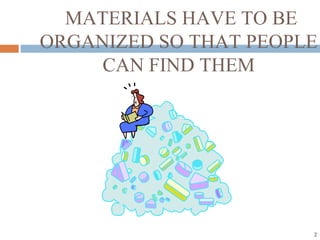
MATERIALS HAVE TO BE ORGANIZED SO THAT PEOPLE CAN FIND THEM
A CATALOG IS A list of library materials contained in a collection, a library, or a group of libraries, arranged according to some definite plan. The catalog forms the basis for access to the library’s collection
Why do we need catalogs? For retrieval Most collections are too large for someone to remember every item in the collection For inventory Catalogs serve as a record of what is owned and as a reminder of what has been acquired, lost, replaced, etc.
Cataloguing  refers to the activities connected with the bibliographic description of library materials and the assigning of access points (also called headings) to those descriptions.  purpose to create a library catalogue.  functions as an index to the items in the library’s  collection (books, magazines, cassettes and other materials).  It enables patrons and staff to quickly determine: 1. if the wanted item is owned by the library, and if so, where in the collection the item will be found 2. which works by an author or on a particular subject are in the collection Cataloguing
Cataloguing : Two Types Descriptive Cataloguing: Describing the items and allocating the access points to it that have nothing to do with subjective matter. It comprises of  Description  Access Points Subjective Cataloguing: It comprises of  Classification Subject Headings
Catalog Record  A catalog record is a surrogate (substitute) for the item itself.  Description  (Identification)  •  Identify a specific item  Is this the work I’m looking for?  •  Evaluate an item  Will this item meet my information need?  Is this the same work as that?
Access Access  (Location and Collocation)  Locate a specific item Do you have _____?  •  Gather the works of an author  What do you have by _____?  •  Gather works on a subject  What do you have on _____?  •  Gather all editions of a work
Rules for descriptive cataloging come from AACR2R AACR2R tells us such things as: Where to take the title from What to do if there is no publisher How to count pages How to make consistent headings for things such as names and places
bibliographic information  is recorded into a  bibliographic record . This  bibliographic record  forms the basis of the catalog. The catalog could be a card catalog or an online catalog
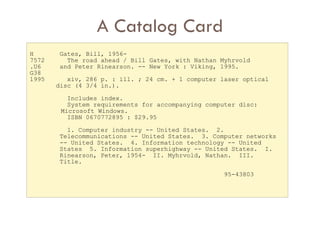
H  Gates, Bill, 1956- 7572  The road ahead / Bill Gates, with Nathan Myhrvold  .U6  and Peter Rinearson. -- New York : Viking, 1995. G38 1995  xiv, 286 p. : ill. ; 24 cm. + 1 computer laser optical  disc (4 3/4 in.).  Includes index. System requirements for accompanying computer disc:   Microsoft Windows. ISBN 0670772895 : $29.95 1. Computer industry -- United States.  2.  Telecommunications -- United States.  3. Computer networks -- United States.  4. Information technology -- United  States  5. Information superhighway -- United States.  I.  Rinearson, Peter, 1954-  II. Myhrvold, Nathan.  III.  Title.  95-43803 A Catalog Card
A MARC Record 008 960221s1995  nyuam  001 0 eng  010  $a  95043803  020  $a 0670772895 : $c $29.95 040  $a DLC $c DLC $d DLC 043  $a n-us--- 050 00 $a HE7572.U6 $b G38 1995 082 00 $a 004.6/7 $2 20 100 1  $a Gates, Bill, $d 1956- 245 14 $a The road ahead / $c Bill Gates, with Nathan Myhrvold and Peter Rinearson. 260  $a New York : $b Viking, $c 1995. 300  $a xiv, 286 p. : $b ill. ; $c 24 cm. + $e 1 computer laser optical disc (4 3/4 in.) 500  $a Includes index. 538  $a System requirements for accompanying computer disc: Microsoft Windows. 650  0 $a Computer industry $z United States. 650  0 $a Telecommunication $z United States. 650  0 $a Computer networks $z United States. 650  0 $a Information technology $z United States. 650  1 $a Information superhighway $z United States. 700 1  $a Rinearson, Peter, $d 1954- 700 1  $a Myhrvold, Nathan.
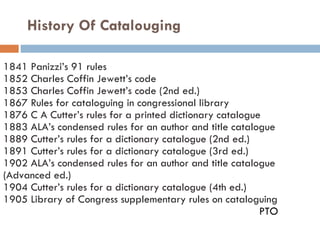
1841 Panizzi’s 91 rules 1852 Charles Coffin Jewett’s code 1853 Charles Coffin Jewett’s code (2nd ed.) 1867 Rules for cataloguing in congressional library 1876 C A Cutter’s rules for a printed dictionary catalogue 1883 ALA’s condensed rules for an author and title catalogue 1889 Cutter’s rules for a dictionary catalogue (2nd ed.) 1891 Cutter’s rules for a dictionary catalogue (3rd ed.) 1902 ALA’s condensed rules for an author and title catalogue (Advanced ed.) 1904 Cutter’s rules for a dictionary catalogue (4th ed.) 1905 Library of Congress supplementary rules on cataloguing PTO History Of Catalouging
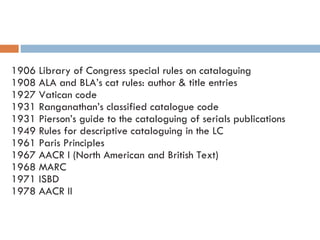
1906 Library of Congress special rules on cataloguing 1908 ALA and BLA’s cat rules: author & title entries 1927 Vatican code 1931 Ranganathan’s classified catalogue code 1931 Pierson’s guide to the cataloguing of serials publications 1949 Rules for descriptive cataloguing in the LC 1961 Paris Principles 1967 AACR I (North American and British Text) 1968 MARC 1971 ISBD 1978 AACR II
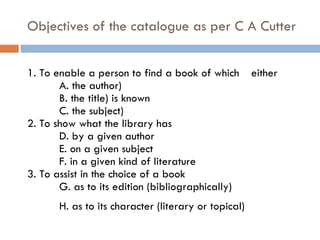
1. To enable a person to find a book of which  either  A. the author)  B. the title) is known C. the subject) 2. To show what the library has  D. by a given author E. on a given subject F. in a given kind of literature 3. To assist in the choice of a book  G. as to its edition (bibliographically) H. as to its character (literary or topical)   O bjectives of the catalogue  as per C A Cutter
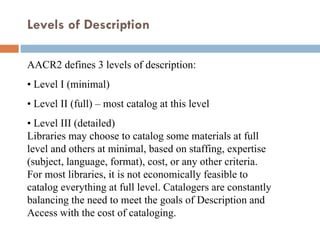
AACR2 defines 3 levels of description:  •  Level I (minimal)  •  Level II (full) – most catalog at this level  •  Level III (detailed)  Libraries may choose to catalog some materials at full level and others at minimal, based on staffing, expertise (subject, language, format), cost, or any other criteria.  For most libraries, it is not economically feasible to catalog everything at full level. Catalogers are constantly balancing the need to meet the goals of Description and Access with the cost of cataloging.  Levels of Description
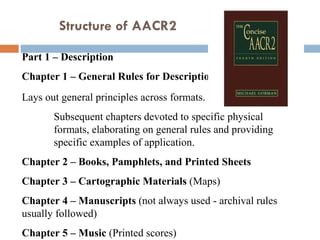
Part 1 – Description  Chapter 1 – General Rules for Description  Lays out general principles across formats.  Subsequent chapters devoted to specific physical formats, elaborating on general rules and providing specific examples of application.  Chapter 2 – Books, Pamphlets, and Printed Sheets  Chapter 3 – Cartographic Materials  (Maps)  Chapter 4 – Manuscripts  (not always used - archival rules usually followed)  Chapter 5 – Music  (Printed scores)  Structure of AACR2
Chapter 6 – Sound Recordings  Chapter 7 – Motion Pictures and Video recordings  Chapter 8 – Graphic Materials  (Filmstrips, Art, Photographs)  Chapter 9 – Electronic Resources  (including CD-ROMS, Internet resources)  Chapter 10 – Three Dimensional Artefacts and Realia  Chapter 11 – Microforms  (LC does not follow)  Chapter 12 – Continuing Resources  (including Serials and Integrating Resources)  Chapter 13 – Analysis  (LC does not do “In” analytics)
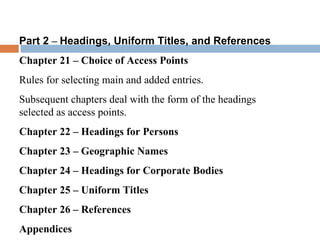
Part 2  –  Headings, Uniform Titles, and References  Chapter 21 – Choice of Access Points  Rules for selecting main and added entries.  Subsequent chapters deal with the form of the headings selected as access points.  Chapter 22 – Headings for Persons  Chapter 23 – Geographic Names  Chapter 24 – Headings for Corporate Bodies  Chapter 25 – Uniform Titles  Chapter 26 – References  Appendices
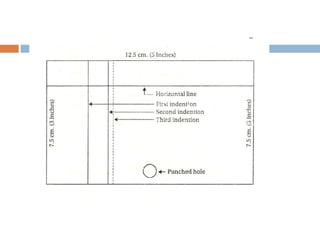
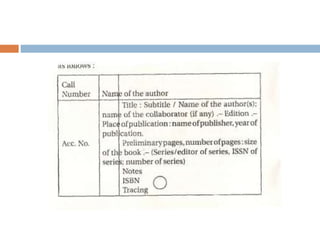
Elements of bibliographic description Title proper  =  Parallel title  :  Other title information  [ GMD ]   /  Statement of responsibility  ;  Other statements of responsibility.  –  Edition area.  –  Special area for serials, maps, music.  –  Publication area.  –  Physical description.  –   ( Series information ) .  –  Notes area.  –  Standard number. Note the special punctuation (in  red ). This is the traditional layout for a catalog card


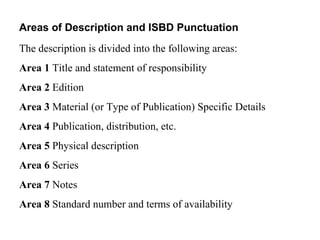
Areas of Description and ISBD Punctuation  The description is divided into the following areas:  Area 1  Title and statement of responsibility  Area 2  Edition  Area 3  Material (or Type of Publication) Specific Details  Area 4  Publication, distribution, etc.  Area 5  Physical description  Area 6  Series  Area 7  Notes  Area 8  Standard number and terms of availability
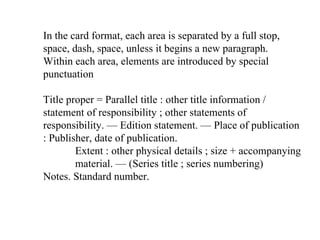
In the card format, each area is separated by a full stop, space, dash, space, unless it begins a new paragraph.  Within each area, elements are introduced by special punctuation  Title proper = Parallel title : other title information / statement of responsibility ; other statements of responsibility. — Edition statement. — Place of publication : Publisher, date of publication.  Extent : other physical details ; size + accompanying material. — (Series title ; series numbering)  Notes. Standard number.
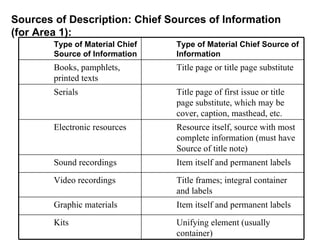
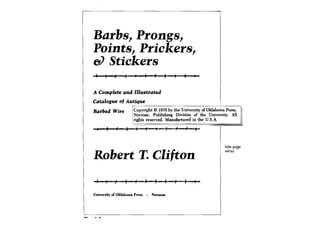
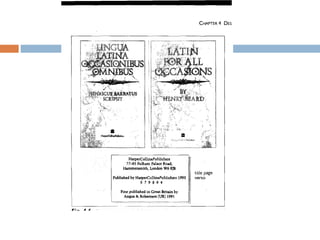
Sources of Description: Chief Sources of Information (for Area 1): Type of Material Chief Source of Information  Type of Material Chief Source of Information  Books, pamphlets, printed texts  Title page or title page substitute  Serials  Title page of first issue or title page substitute, which may be cover, caption, masthead, etc. Electronic resources  Resource itself, source with most complete information (must have Source of title note)  Sound recordings  Item itself and permanent labels Video recordings  Title frames; integral container and labels Graphic materials Item itself and permanent labels  Kits  Unifying element (usually container)
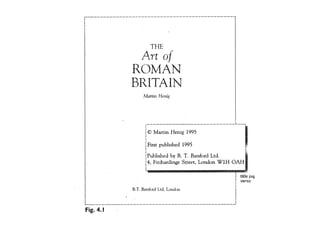
Prescribed Sources of Information for (Books)  When an element of description comes from outside the prescribed sources, must enclose the element in  [ ].  Area  Prescribed Sources of Information  Title and statement of responsibility Title page Edition Title page, other preliminaries, colophon Publication, distribution, etc. Title page, other preliminaries, colophon  Physical description The whole publication  Series  Series title page, monograph title page, cover, rest of publication  Note  Any source Standard number Any source


Bib Exchange Formats   To facilitate the transfer of bibliographic data between computer systems.  To achieve economies by reducing the duplication of effort implicit in different libraries acquiring and cataloguing the same material   To facilitate the international exchange of bibliographic data in machine-readable form between national bibliographic agencies
MARC ( Ma chine- R eadable  C ataloging Record )   Is a format standard for the storage and exchange of bibliographic records and related information in machine-readable form   Information that goes in the MARC record is determined by various cataloging tools: AACR2R Library of Congress Subject Headings (LCSH) Dewey Decimal Classification System (DDC) and Library of Congress Classification System (LCC)
MARC was designed by a group of 16 people in the middle 60’s. Designed by computer programmers, not librarians!  Was designed to print card sets, not to be used as the basis for online catalogs Is not intuitive or user-friendly! Was not designed with AACR2R in mind
Versions of MARC MARC 21 format for bibliographic data , 1999 ed. is the latest edition of the standard used in the United States. Combines USMARC and CANMARC Is constantly being updated and revised to keep up with changes in the cataloging world
MARC  The record includes (not necessarily in this order):  1) a description of the item,  2) main entry and added entries,  3) subject headings, and  4) the classification or call number. (MARC records often contain much additional information.)
 

Cataloguing

  • 1.
    CATALOGUING Dr. SarikaSiddharth Sawant Asst. Professor, SHPT School of Library Science, SNDT Women’s University, Churchgate, Mumbai 400 020
  • 2.
    MATERIALS HAVE TOBE ORGANIZED SO THAT PEOPLE CAN FIND THEM
  • 3.
    A CATALOG ISA list of library materials contained in a collection, a library, or a group of libraries, arranged according to some definite plan. The catalog forms the basis for access to the library’s collection
  • 4.
    Why do weneed catalogs? For retrieval Most collections are too large for someone to remember every item in the collection For inventory Catalogs serve as a record of what is owned and as a reminder of what has been acquired, lost, replaced, etc.
  • 5.
    Cataloguing refersto the activities connected with the bibliographic description of library materials and the assigning of access points (also called headings) to those descriptions. purpose to create a library catalogue. functions as an index to the items in the library’s collection (books, magazines, cassettes and other materials). It enables patrons and staff to quickly determine: 1. if the wanted item is owned by the library, and if so, where in the collection the item will be found 2. which works by an author or on a particular subject are in the collection Cataloguing
  • 6.
    Cataloguing : TwoTypes Descriptive Cataloguing: Describing the items and allocating the access points to it that have nothing to do with subjective matter. It comprises of Description Access Points Subjective Cataloguing: It comprises of Classification Subject Headings
  • 7.
    Catalog Record A catalog record is a surrogate (substitute) for the item itself. Description (Identification) • Identify a specific item Is this the work I’m looking for? • Evaluate an item Will this item meet my information need? Is this the same work as that?
  • 8.
    Access Access (Location and Collocation) Locate a specific item Do you have _____? • Gather the works of an author What do you have by _____? • Gather works on a subject What do you have on _____? • Gather all editions of a work
  • 9.
    Rules for descriptivecataloging come from AACR2R AACR2R tells us such things as: Where to take the title from What to do if there is no publisher How to count pages How to make consistent headings for things such as names and places
  • 10.
    bibliographic information is recorded into a bibliographic record . This bibliographic record forms the basis of the catalog. The catalog could be a card catalog or an online catalog
  • 11.
    H Gates,Bill, 1956- 7572 The road ahead / Bill Gates, with Nathan Myhrvold .U6 and Peter Rinearson. -- New York : Viking, 1995. G38 1995 xiv, 286 p. : ill. ; 24 cm. + 1 computer laser optical disc (4 3/4 in.). Includes index. System requirements for accompanying computer disc: Microsoft Windows. ISBN 0670772895 : $29.95 1. Computer industry -- United States. 2. Telecommunications -- United States. 3. Computer networks -- United States. 4. Information technology -- United States 5. Information superhighway -- United States. I. Rinearson, Peter, 1954- II. Myhrvold, Nathan. III. Title. 95-43803 A Catalog Card
  • 12.
    A MARC Record008 960221s1995 nyuam 001 0 eng 010 $a 95043803 020 $a 0670772895 : $c $29.95 040 $a DLC $c DLC $d DLC 043 $a n-us--- 050 00 $a HE7572.U6 $b G38 1995 082 00 $a 004.6/7 $2 20 100 1 $a Gates, Bill, $d 1956- 245 14 $a The road ahead / $c Bill Gates, with Nathan Myhrvold and Peter Rinearson. 260 $a New York : $b Viking, $c 1995. 300 $a xiv, 286 p. : $b ill. ; $c 24 cm. + $e 1 computer laser optical disc (4 3/4 in.) 500 $a Includes index. 538 $a System requirements for accompanying computer disc: Microsoft Windows. 650 0 $a Computer industry $z United States. 650 0 $a Telecommunication $z United States. 650 0 $a Computer networks $z United States. 650 0 $a Information technology $z United States. 650 1 $a Information superhighway $z United States. 700 1 $a Rinearson, Peter, $d 1954- 700 1 $a Myhrvold, Nathan.
  • 13.
    1841 Panizzi’s 91rules 1852 Charles Coffin Jewett’s code 1853 Charles Coffin Jewett’s code (2nd ed.) 1867 Rules for cataloguing in congressional library 1876 C A Cutter’s rules for a printed dictionary catalogue 1883 ALA’s condensed rules for an author and title catalogue 1889 Cutter’s rules for a dictionary catalogue (2nd ed.) 1891 Cutter’s rules for a dictionary catalogue (3rd ed.) 1902 ALA’s condensed rules for an author and title catalogue (Advanced ed.) 1904 Cutter’s rules for a dictionary catalogue (4th ed.) 1905 Library of Congress supplementary rules on cataloguing PTO History Of Catalouging
  • 14.
    1906 Library ofCongress special rules on cataloguing 1908 ALA and BLA’s cat rules: author & title entries 1927 Vatican code 1931 Ranganathan’s classified catalogue code 1931 Pierson’s guide to the cataloguing of serials publications 1949 Rules for descriptive cataloguing in the LC 1961 Paris Principles 1967 AACR I (North American and British Text) 1968 MARC 1971 ISBD 1978 AACR II
  • 15.
    1. To enablea person to find a book of which either A. the author) B. the title) is known C. the subject) 2. To show what the library has D. by a given author E. on a given subject F. in a given kind of literature 3. To assist in the choice of a book G. as to its edition (bibliographically) H. as to its character (literary or topical) O bjectives of the catalogue as per C A Cutter
  • 16.
    AACR2 defines 3levels of description: • Level I (minimal) • Level II (full) – most catalog at this level • Level III (detailed) Libraries may choose to catalog some materials at full level and others at minimal, based on staffing, expertise (subject, language, format), cost, or any other criteria. For most libraries, it is not economically feasible to catalog everything at full level. Catalogers are constantly balancing the need to meet the goals of Description and Access with the cost of cataloging. Levels of Description
  • 17.
    Part 1 –Description Chapter 1 – General Rules for Description Lays out general principles across formats. Subsequent chapters devoted to specific physical formats, elaborating on general rules and providing specific examples of application. Chapter 2 – Books, Pamphlets, and Printed Sheets Chapter 3 – Cartographic Materials (Maps) Chapter 4 – Manuscripts (not always used - archival rules usually followed) Chapter 5 – Music (Printed scores) Structure of AACR2
  • 18.
    Chapter 6 –Sound Recordings Chapter 7 – Motion Pictures and Video recordings Chapter 8 – Graphic Materials (Filmstrips, Art, Photographs) Chapter 9 – Electronic Resources (including CD-ROMS, Internet resources) Chapter 10 – Three Dimensional Artefacts and Realia Chapter 11 – Microforms (LC does not follow) Chapter 12 – Continuing Resources (including Serials and Integrating Resources) Chapter 13 – Analysis (LC does not do “In” analytics)
  • 19.
    Part 2 – Headings, Uniform Titles, and References Chapter 21 – Choice of Access Points Rules for selecting main and added entries. Subsequent chapters deal with the form of the headings selected as access points. Chapter 22 – Headings for Persons Chapter 23 – Geographic Names Chapter 24 – Headings for Corporate Bodies Chapter 25 – Uniform Titles Chapter 26 – References Appendices
  • 20.
    Elements of bibliographicdescription Title proper = Parallel title : Other title information [ GMD ] / Statement of responsibility ; Other statements of responsibility. – Edition area. – Special area for serials, maps, music. – Publication area. – Physical description. – ( Series information ) . – Notes area. – Standard number. Note the special punctuation (in red ). This is the traditional layout for a catalog card
  • 21.
  • 22.
  • 23.
  • 24.
    Areas of Descriptionand ISBD Punctuation The description is divided into the following areas: Area 1 Title and statement of responsibility Area 2 Edition Area 3 Material (or Type of Publication) Specific Details Area 4 Publication, distribution, etc. Area 5 Physical description Area 6 Series Area 7 Notes Area 8 Standard number and terms of availability
  • 25.
    In the cardformat, each area is separated by a full stop, space, dash, space, unless it begins a new paragraph. Within each area, elements are introduced by special punctuation Title proper = Parallel title : other title information / statement of responsibility ; other statements of responsibility. — Edition statement. — Place of publication : Publisher, date of publication. Extent : other physical details ; size + accompanying material. — (Series title ; series numbering) Notes. Standard number.
  • 26.
    Sources of Description:Chief Sources of Information (for Area 1): Type of Material Chief Source of Information Type of Material Chief Source of Information Books, pamphlets, printed texts Title page or title page substitute Serials Title page of first issue or title page substitute, which may be cover, caption, masthead, etc. Electronic resources Resource itself, source with most complete information (must have Source of title note) Sound recordings Item itself and permanent labels Video recordings Title frames; integral container and labels Graphic materials Item itself and permanent labels Kits Unifying element (usually container)
  • 27.
    Prescribed Sources ofInformation for (Books) When an element of description comes from outside the prescribed sources, must enclose the element in [ ]. Area Prescribed Sources of Information Title and statement of responsibility Title page Edition Title page, other preliminaries, colophon Publication, distribution, etc. Title page, other preliminaries, colophon Physical description The whole publication Series Series title page, monograph title page, cover, rest of publication Note Any source Standard number Any source
  • 28.
  • 29.
  • 30.
  • 31.
  • 32.
    Bib Exchange Formats To facilitate the transfer of bibliographic data between computer systems. To achieve economies by reducing the duplication of effort implicit in different libraries acquiring and cataloguing the same material To facilitate the international exchange of bibliographic data in machine-readable form between national bibliographic agencies
  • 33.
    MARC ( Machine- R eadable C ataloging Record ) Is a format standard for the storage and exchange of bibliographic records and related information in machine-readable form Information that goes in the MARC record is determined by various cataloging tools: AACR2R Library of Congress Subject Headings (LCSH) Dewey Decimal Classification System (DDC) and Library of Congress Classification System (LCC)
  • 34.
    MARC was designedby a group of 16 people in the middle 60’s. Designed by computer programmers, not librarians! Was designed to print card sets, not to be used as the basis for online catalogs Is not intuitive or user-friendly! Was not designed with AACR2R in mind
  • 35.
    Versions of MARCMARC 21 format for bibliographic data , 1999 ed. is the latest edition of the standard used in the United States. Combines USMARC and CANMARC Is constantly being updated and revised to keep up with changes in the cataloging world
  • 36.
    MARC Therecord includes (not necessarily in this order): 1) a description of the item, 2) main entry and added entries, 3) subject headings, and 4) the classification or call number. (MARC records often contain much additional information.)
  • 37.