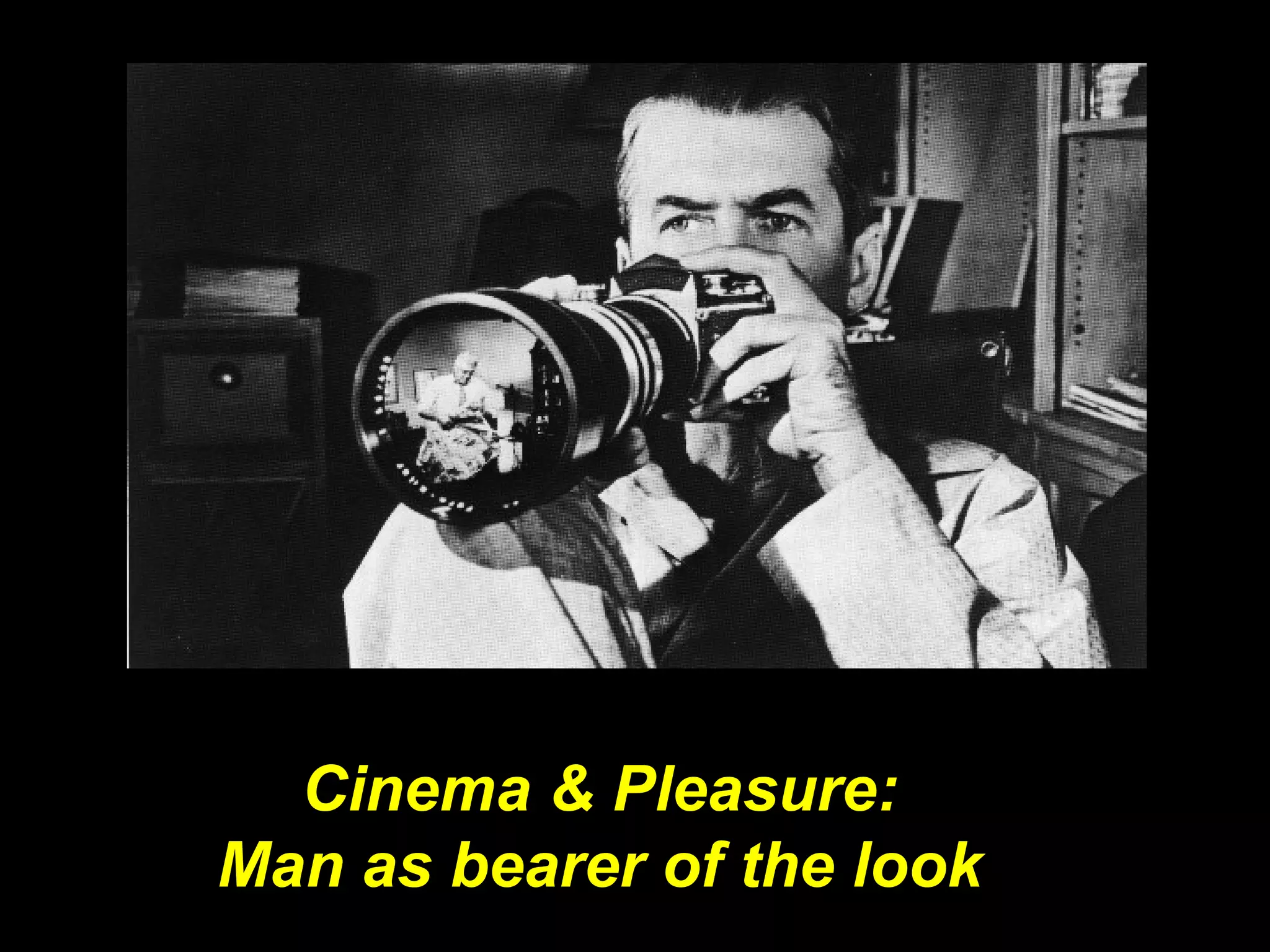
Cinema & Pleasure:  Man as bearer of the look
Fascination and film Film fascinates us (engages our emotions), through images and spectacle Mulvey uses psychoanalysis ‘to discover where and how the fascination of film is reinforced by pre-existing patterns of fascination already at work within the individual subject’ (= spectator) She says she is using psychoanalytic theory ‘as a political weapon’
Cinema and pleasure Hollywood/mainstream/narrative cinema  manipulates visual pleasure . It ‘codes the erotic into the language of the dominant patriarchal order’.
Scopophilia Scopophilia = pleasure in looking (Sigmund Freud 1905, in ‘Three Essays’) examples of the private and curious gaze: children’s voyeurism,  cinematic looking the most pleasurable looking = looking at the human form and the human face,  figural  looking (corresponds to psychic patterns)
‘ Woman as image, man as bearer of the look’ pleasure in looking split between active/male and passive/female women connote ‘to-be-looked-at-ness’ the visual presence of women ‘works against the development of a story-line, freezes the flow of action in moments of erotic contemplation’
‘ Woman as image, man as bearer of the look’ (cont…) the woman functions as both erotic object for the characters within the screen story  and  erotic object for the spectator within the auditorium (object of  fantasy ) the spectator is led to identify with the main male protagonist ‘ the power of the male protagonist as he controls events coincides with the active power of the erotic look’
Fetishistic scopophilia the image of the woman also carries a  threat  there are two avenues of escape from fear of femininity for the male spectator investigate the woman, demystify her mystery disavow (deny) castration by turning the woman into a reassuring fetish. The image of the woman > overvalued: this is the cult of the (beautiful) female star.
The male gaze and fetishistic scopophilia in Hitchcock films scopophilia is the force driving the movements and positioning of the camera the gaze is male, and the spectator is led to identify with this male gaze the cinematic apparatus is not gender-neutral

Mulvey powerpoint

  • 1.
    Cinema & Pleasure: Man as bearer of the look
  • 2.
    Fascination and filmFilm fascinates us (engages our emotions), through images and spectacle Mulvey uses psychoanalysis ‘to discover where and how the fascination of film is reinforced by pre-existing patterns of fascination already at work within the individual subject’ (= spectator) She says she is using psychoanalytic theory ‘as a political weapon’
  • 3.
    Cinema and pleasureHollywood/mainstream/narrative cinema manipulates visual pleasure . It ‘codes the erotic into the language of the dominant patriarchal order’.
  • 4.
    Scopophilia Scopophilia =pleasure in looking (Sigmund Freud 1905, in ‘Three Essays’) examples of the private and curious gaze: children’s voyeurism, cinematic looking the most pleasurable looking = looking at the human form and the human face, figural looking (corresponds to psychic patterns)
  • 5.
    ‘ Woman asimage, man as bearer of the look’ pleasure in looking split between active/male and passive/female women connote ‘to-be-looked-at-ness’ the visual presence of women ‘works against the development of a story-line, freezes the flow of action in moments of erotic contemplation’
  • 6.
    ‘ Woman asimage, man as bearer of the look’ (cont…) the woman functions as both erotic object for the characters within the screen story and erotic object for the spectator within the auditorium (object of fantasy ) the spectator is led to identify with the main male protagonist ‘ the power of the male protagonist as he controls events coincides with the active power of the erotic look’
  • 7.
    Fetishistic scopophilia theimage of the woman also carries a threat there are two avenues of escape from fear of femininity for the male spectator investigate the woman, demystify her mystery disavow (deny) castration by turning the woman into a reassuring fetish. The image of the woman > overvalued: this is the cult of the (beautiful) female star.
  • 8.
    The male gazeand fetishistic scopophilia in Hitchcock films scopophilia is the force driving the movements and positioning of the camera the gaze is male, and the spectator is led to identify with this male gaze the cinematic apparatus is not gender-neutral