Oshilalu, H. Adeyinka CLN
GST 121 - USE OF LIBRARY AND STUDY SKILLS
INTRODUCTORY CLASS
DAY 1 – Friday 28 OCTOBER, 2016
VENUE – Lecture Room 201, Augustine University, Ilara-Epe
Course Introduction
Use of Library and Study Skills
- Its a 2 units course and its Required
- As such, we will be spending 2 hours on the course per week
- Classes will be held in classrooms and sometimes outside the
lecture rooms
- Continuous Assessment is 30% while the exam is 70%
Course Title / Code
About the Course
Course Objectives
to equip users with knowledge and skills
required to attain academic excellent
- to facilitate effective use of library facilities
- to simplify study and learning processes
- to develop library use skills
- to maximize time spent on academic activities
Main Objective
Others
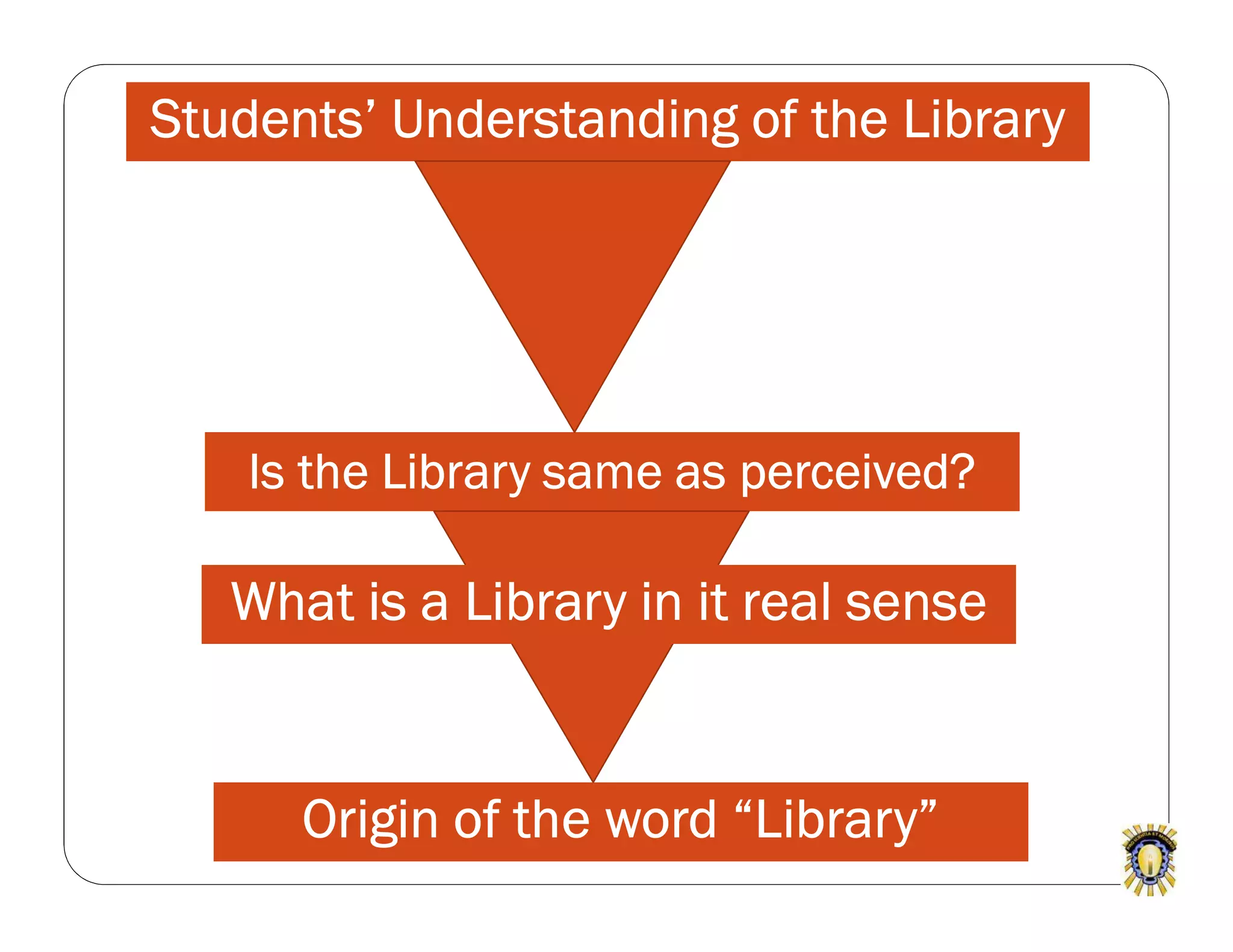
Students’ Understanding of the Library
Is the Library same as perceived?
Origin of the word “Library”
What is a Library in it real sense
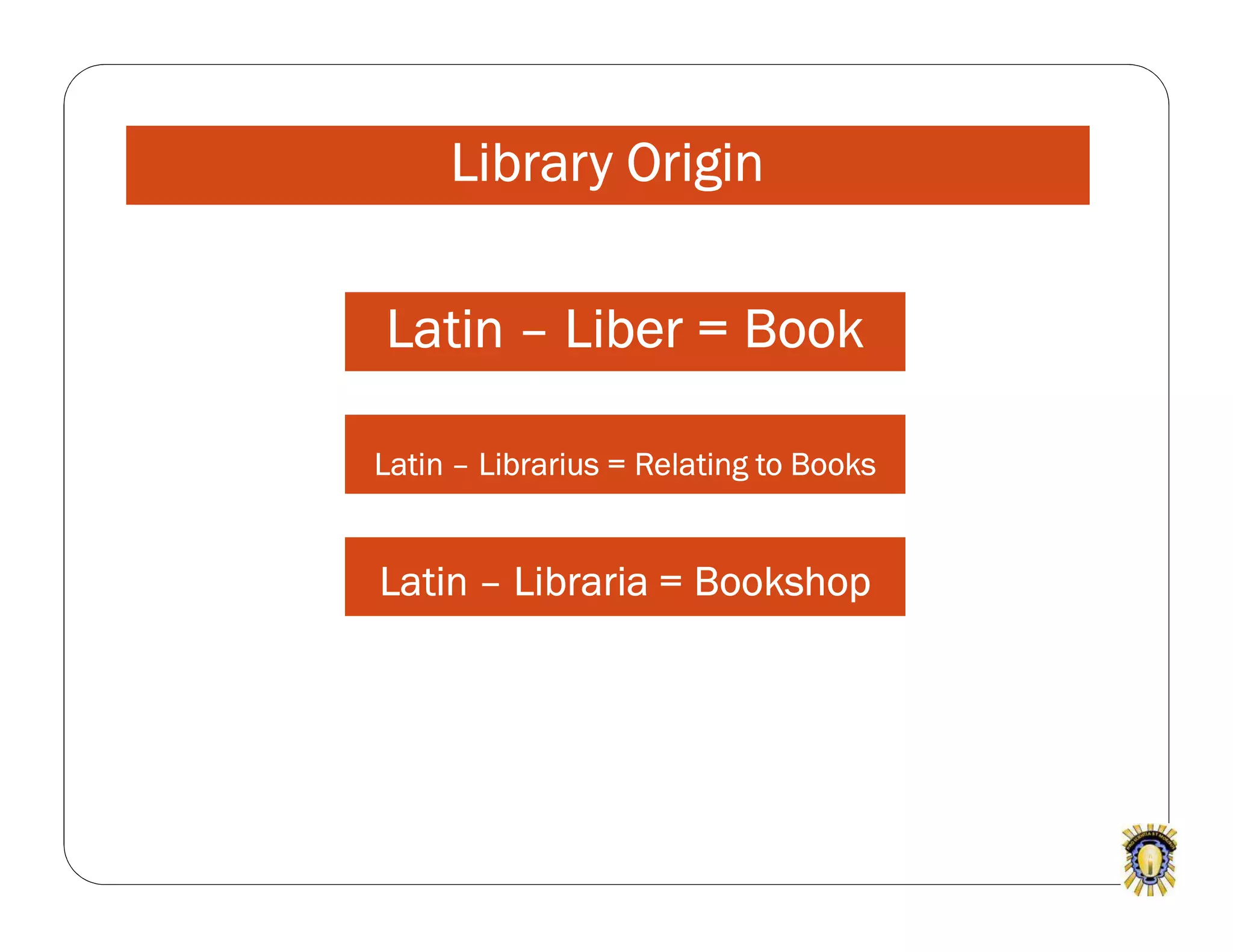
Library Origin
Latin – Liber = Book
Latin – Librarius = Relating to Books
Latin – Libraria = Bookshop
Back to –What is a Library?
Let’s build our working definition
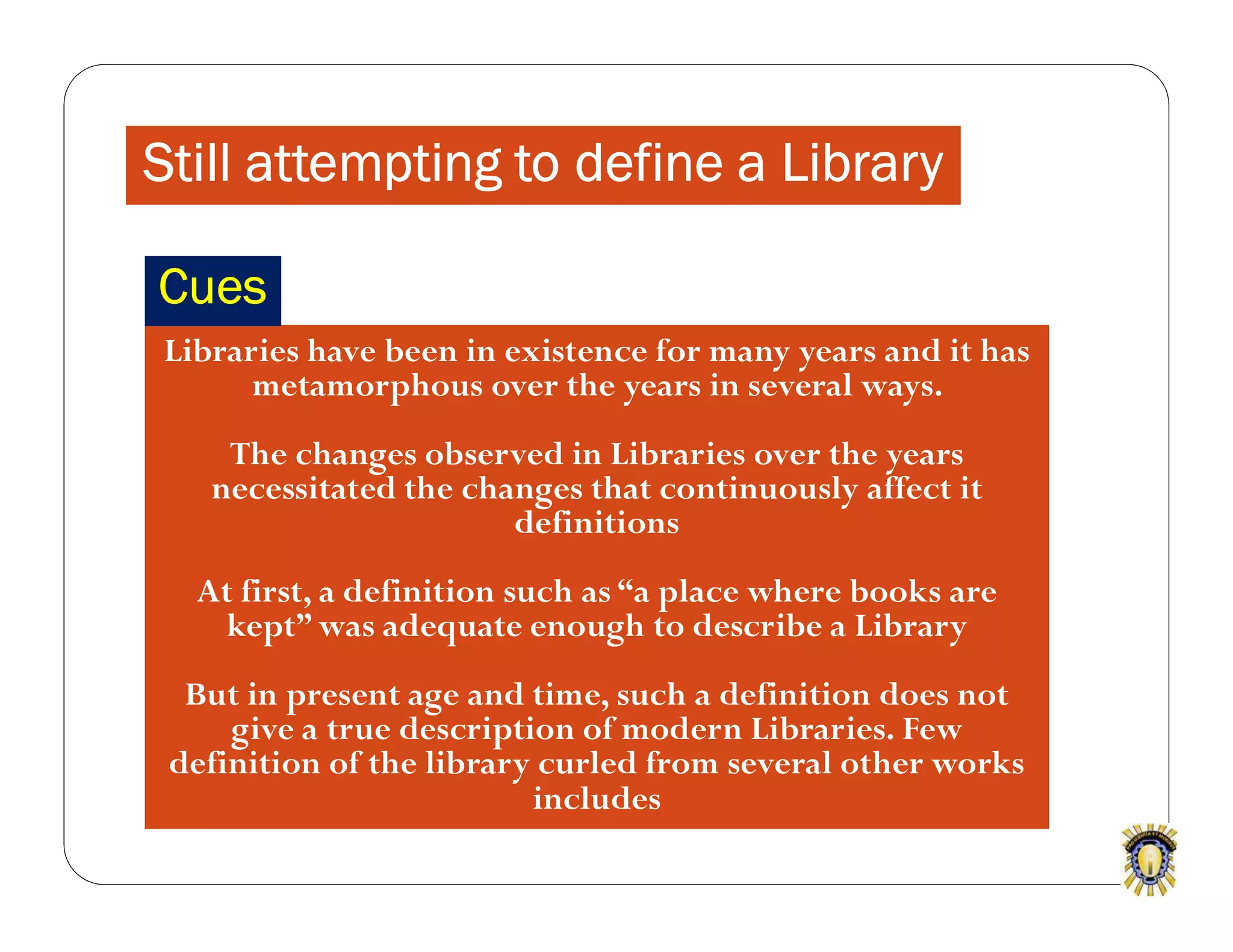
Still attempting to define a Library
Libraries have been in existence for many years and it has
metamorphous over the years in several ways.
The changes observed in Libraries over the years
necessitated the changes that continuously affect it
definitions
At first, a definition such as “a place where books are
kept” was adequate enough to describe a Library
But in present age and time, such a definition does not
give a true description of modern Libraries. Few
definition of the library curled from several other works
includes
Cues
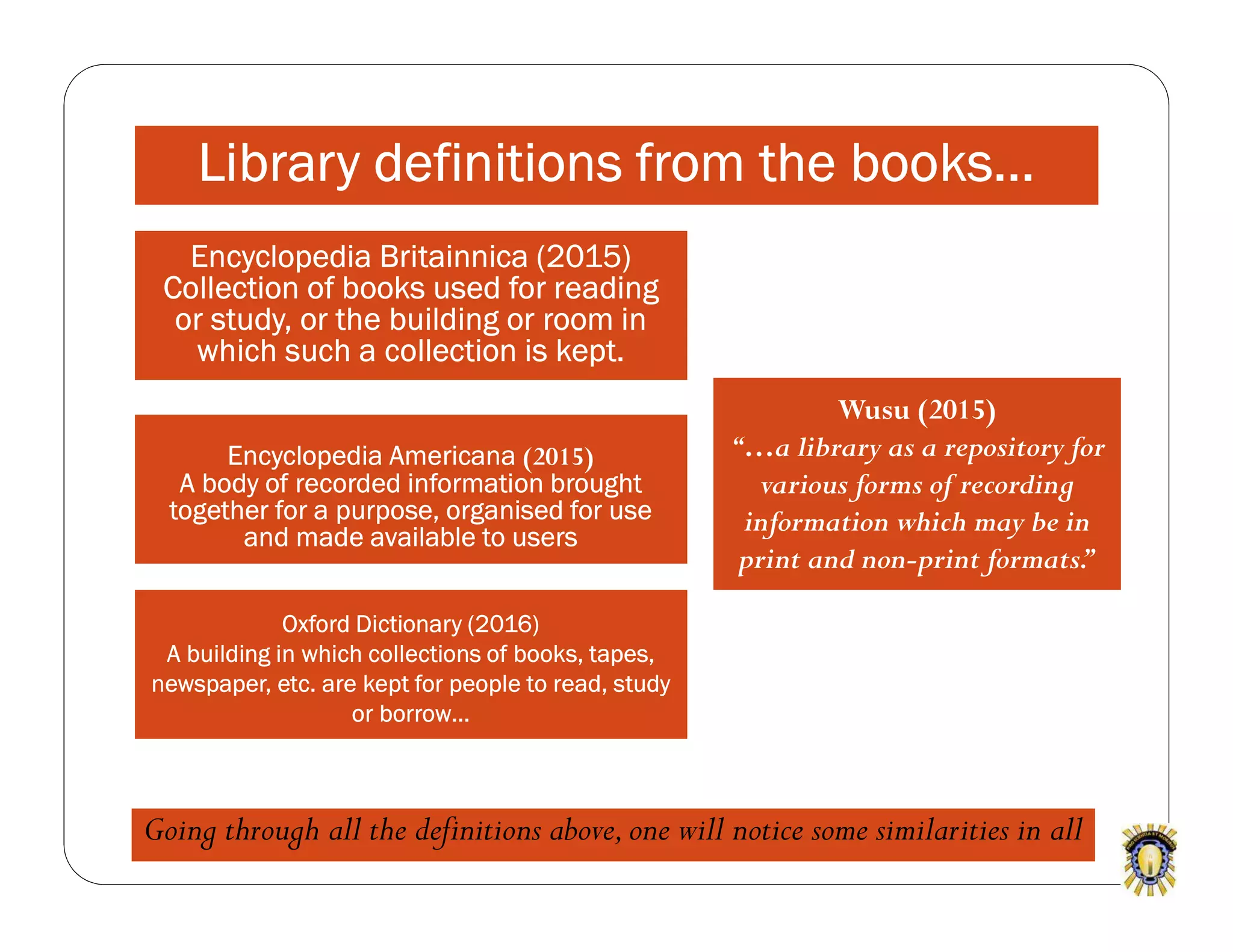
Encyclopedia Americana (2015)
A body of recorded information brought
together for a purpose, organised for use
and made available to users
Wusu (2015)
“…a library as a repository for
various forms of recording
information which may be in
print and non-print formats.”
Oxford Dictionary (2016)
A building in which collections of books, tapes,
newspaper, etc. are kept for people to read, study
or borrow…
Encyclopedia Britainnica (2015)
Collection of books used for reading
or study, or the building or room in
which such a collection is kept.
Library definitions from the books...
Going through all the definitions above,one will notice some similarities in all
A well grafted definition
An institution set aside for systematical acquisition, processing,
sorting, storing and sharing of information and information
materials.
Components of a well-grafted definition
1. As an institution set aside: a library is a purposely built unit
2. Systematical acquisition: materials are acquired following a
standard
3. Systematical processing: materials are processed following a
standard
4. Systematical sorting: materials are sorted following a
standard
5. Systematical storing: materials are stored following a
standard
6. Systematical sharing: materials are shared following a
standard
7. Information: the institutions deals with information
8. Information Resources / Materials: the institutions also
deals with information resources
Objectives of Libraries in Institution...
Library's main function is to support their parent
body in achieving its aim and objectives.
Pearce (1976) posited that… the most important
purpose of a University education is to teach the
student to think for himself
This involves knowing where information may be
found and in particular, how to use the literature of his
subject effectively.
….Libraries in institutions thereby proffer Users with
the opportunity to augment their classroom /
laboratory experience with the wealth of experience
of others from far and wide
AUI LIBRRAY MISSION STATEMENT
To facilitate and enhance the vision of the
University by exposing members of the
community to pertinent information and
information resources required for academic
excellence.
Academic excellence is the demonstrated ability to perform,
achieve, and/or excel in scholastic activities
GENERAL FUNCTIONS OF LIBRARIES
Let’s generate some from
the previous discussion
and definition of Libraries
GENERAL FUNCTIONS OF LIBRARIES
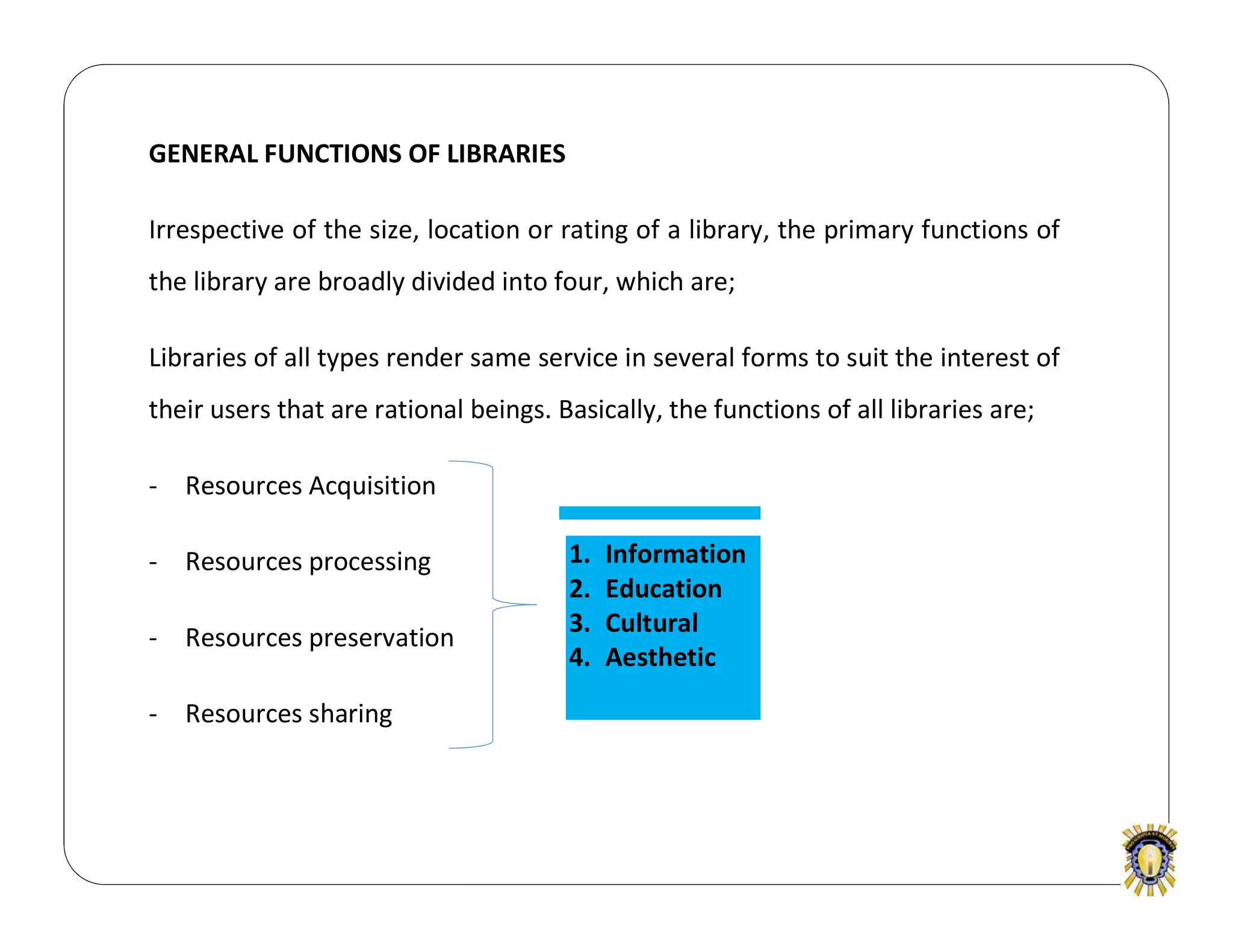
Irrespective of the size, location or rating of a library, the primary functions of
the library are broadly divided into four, which are;
Libraries of all types render same service in several forms to suit the interest of
their users that are rational beings. Basically, the functions of all libraries are;
- Resources Acquisition
- Resources processing
- Resources preservation
- Resources sharing
1. Information
2. Education
3. Cultural
4. Aesthetic
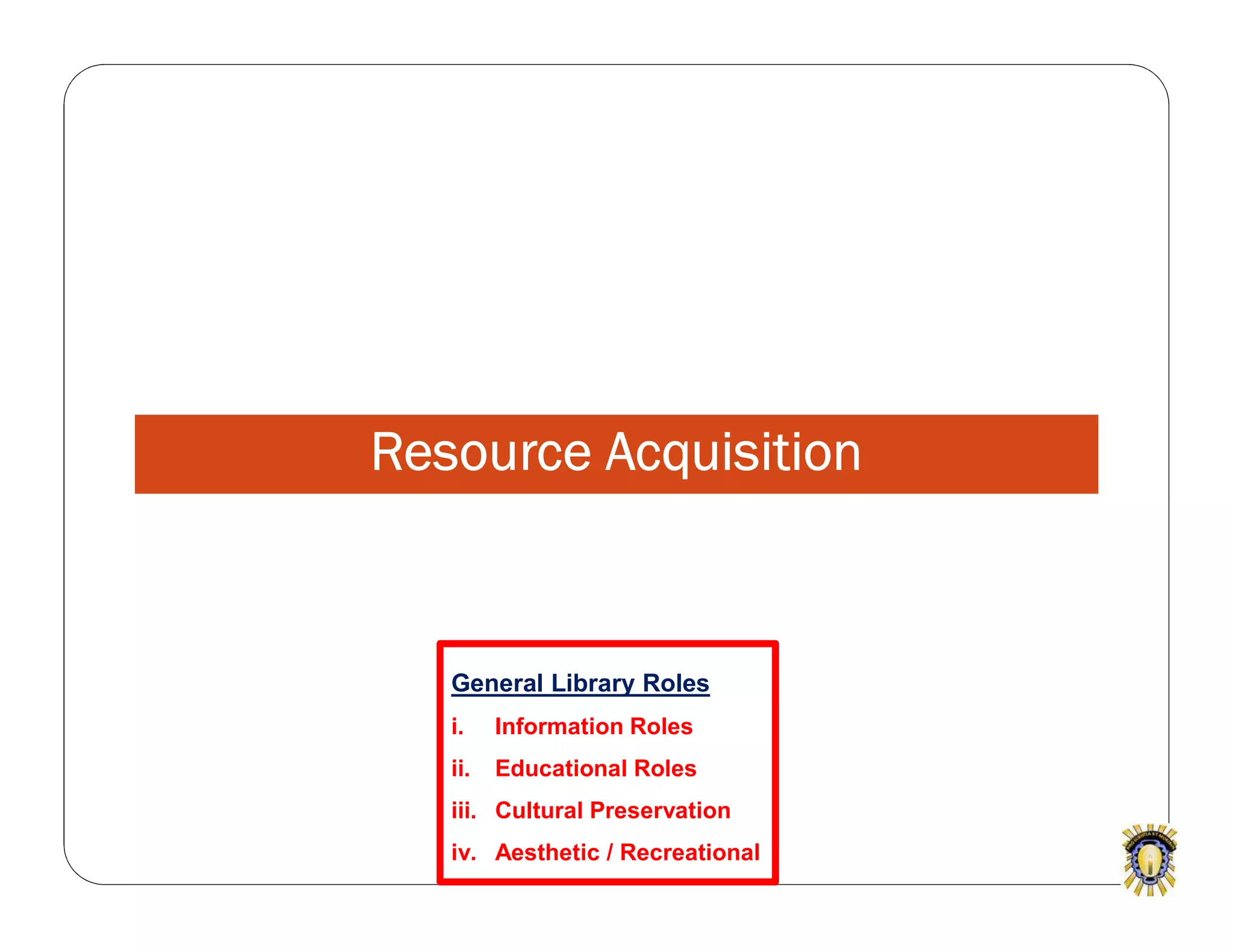
Resource Acquisition
General Library Roles
i. Information Roles
ii. Educational Roles
iii. Cultural Preservation
iv. Aesthetic / Recreational
Resource Processing
General Library Roles
i. Information Roles
ii. Educational Roles
iii. Cultural Preservation
iv. Aesthetic / Recreational
Resource Preservation and Conservation
General Library Roles
i. Information Roles
ii. Educational Roles
iii. Cultural Preservation
iv. Aesthetic / Recreational
Resource Sharing
General Library Roles
i. Information Roles
ii. Educational Roles
iii. Cultural Preservation
iv. Aesthetic / Recreational
Principles Guiding Library Operations
Much like every system, the Library is guided by
some standing principles that is expected to serve as a
reflection of the effectiveness of it operation.
The generally accepted principle guiding Library
operations was propounded by Dr. R. S. Ranganathan
in 1931
Dr. Ramamrita Siyali Ranganathan (1892 – 1972) was
a Librarian / Mathematician from India
His principles is the foundation upon which other
principles in the Information professions are
formulated
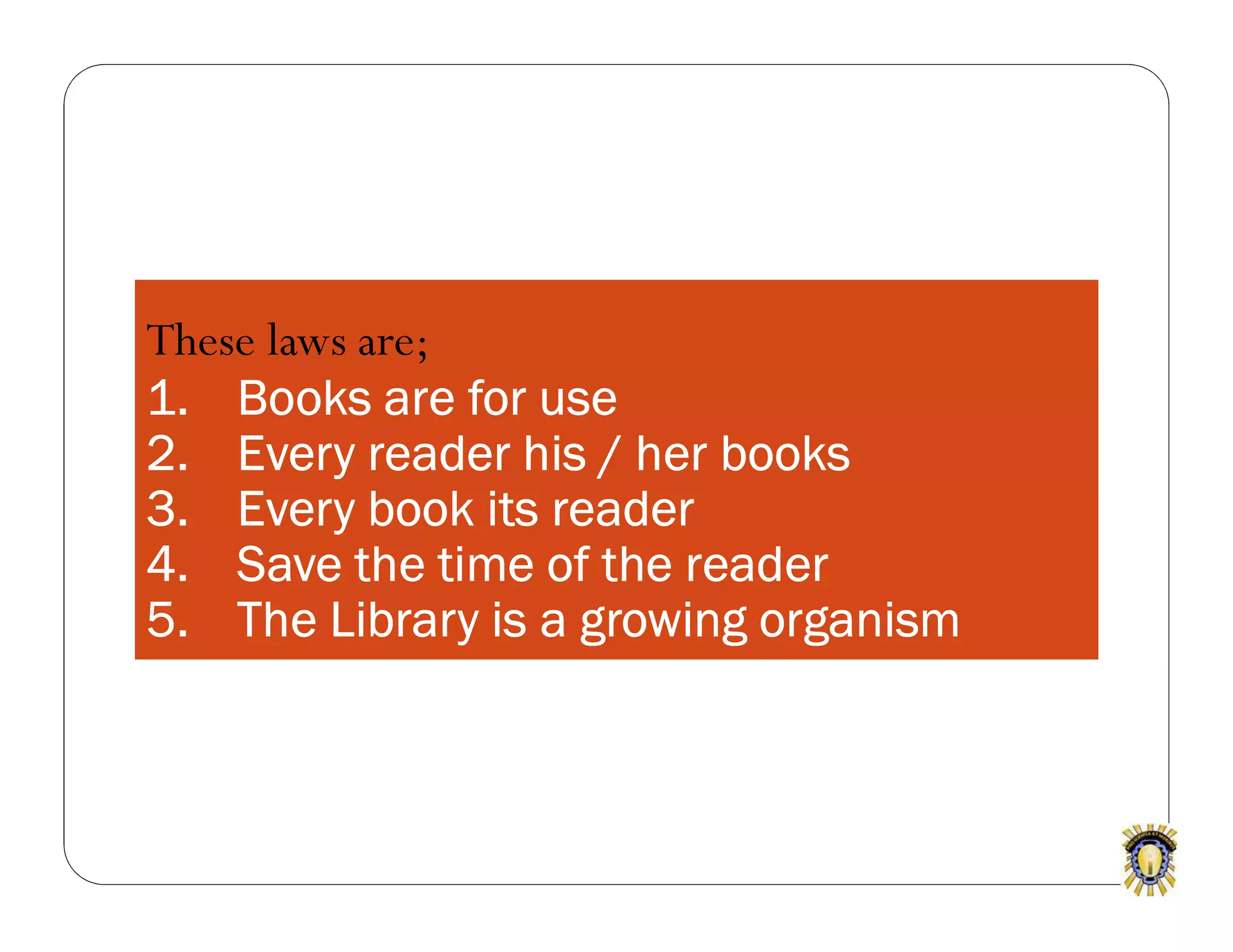
These laws are;
1. Books are for use
2. Every reader his / her books
3. Every book its reader
4. Save the time of the reader
5. The Library is a growing organism

Class 1 - Use of Library and Study Skills

  • 1.
    Oshilalu, H. AdeyinkaCLN GST 121 - USE OF LIBRARY AND STUDY SKILLS INTRODUCTORY CLASS DAY 1 – Friday 28 OCTOBER, 2016 VENUE – Lecture Room 201, Augustine University, Ilara-Epe
  • 2.
    Course Introduction Use ofLibrary and Study Skills - Its a 2 units course and its Required - As such, we will be spending 2 hours on the course per week - Classes will be held in classrooms and sometimes outside the lecture rooms - Continuous Assessment is 30% while the exam is 70% Course Title / Code About the Course
  • 3.
    Course Objectives to equipusers with knowledge and skills required to attain academic excellent - to facilitate effective use of library facilities - to simplify study and learning processes - to develop library use skills - to maximize time spent on academic activities Main Objective Others
  • 4.
    Students’ Understanding ofthe Library Is the Library same as perceived? Origin of the word “Library” What is a Library in it real sense
  • 5.
    Library Origin Latin –Liber = Book Latin – Librarius = Relating to Books Latin – Libraria = Bookshop
  • 6.
    Back to –Whatis a Library? Let’s build our working definition
  • 7.
    Still attempting todefine a Library Libraries have been in existence for many years and it has metamorphous over the years in several ways. The changes observed in Libraries over the years necessitated the changes that continuously affect it definitions At first, a definition such as “a place where books are kept” was adequate enough to describe a Library But in present age and time, such a definition does not give a true description of modern Libraries. Few definition of the library curled from several other works includes Cues
  • 8.
    Encyclopedia Americana (2015) Abody of recorded information brought together for a purpose, organised for use and made available to users Wusu (2015) “…a library as a repository for various forms of recording information which may be in print and non-print formats.” Oxford Dictionary (2016) A building in which collections of books, tapes, newspaper, etc. are kept for people to read, study or borrow… Encyclopedia Britainnica (2015) Collection of books used for reading or study, or the building or room in which such a collection is kept. Library definitions from the books... Going through all the definitions above,one will notice some similarities in all
  • 9.
    A well grafteddefinition An institution set aside for systematical acquisition, processing, sorting, storing and sharing of information and information materials.
  • 10.
    Components of awell-grafted definition 1. As an institution set aside: a library is a purposely built unit 2. Systematical acquisition: materials are acquired following a standard 3. Systematical processing: materials are processed following a standard 4. Systematical sorting: materials are sorted following a standard 5. Systematical storing: materials are stored following a standard 6. Systematical sharing: materials are shared following a standard 7. Information: the institutions deals with information 8. Information Resources / Materials: the institutions also deals with information resources
  • 11.
    Objectives of Librariesin Institution... Library's main function is to support their parent body in achieving its aim and objectives. Pearce (1976) posited that… the most important purpose of a University education is to teach the student to think for himself This involves knowing where information may be found and in particular, how to use the literature of his subject effectively. ….Libraries in institutions thereby proffer Users with the opportunity to augment their classroom / laboratory experience with the wealth of experience of others from far and wide
  • 12.
    AUI LIBRRAY MISSIONSTATEMENT To facilitate and enhance the vision of the University by exposing members of the community to pertinent information and information resources required for academic excellence. Academic excellence is the demonstrated ability to perform, achieve, and/or excel in scholastic activities
  • 13.
  • 14.
    GENERAL FUNCTIONS OFLIBRARIES Let’s generate some from the previous discussion and definition of Libraries
  • 15.
    GENERAL FUNCTIONS OFLIBRARIES Irrespective of the size, location or rating of a library, the primary functions of the library are broadly divided into four, which are; Libraries of all types render same service in several forms to suit the interest of their users that are rational beings. Basically, the functions of all libraries are; - Resources Acquisition - Resources processing - Resources preservation - Resources sharing 1. Information 2. Education 3. Cultural 4. Aesthetic
  • 16.
    Resource Acquisition General LibraryRoles i. Information Roles ii. Educational Roles iii. Cultural Preservation iv. Aesthetic / Recreational
  • 17.
    Resource Processing General LibraryRoles i. Information Roles ii. Educational Roles iii. Cultural Preservation iv. Aesthetic / Recreational
  • 18.
    Resource Preservation andConservation General Library Roles i. Information Roles ii. Educational Roles iii. Cultural Preservation iv. Aesthetic / Recreational
  • 19.
    Resource Sharing General LibraryRoles i. Information Roles ii. Educational Roles iii. Cultural Preservation iv. Aesthetic / Recreational
  • 20.
  • 21.
    Much like everysystem, the Library is guided by some standing principles that is expected to serve as a reflection of the effectiveness of it operation. The generally accepted principle guiding Library operations was propounded by Dr. R. S. Ranganathan in 1931 Dr. Ramamrita Siyali Ranganathan (1892 – 1972) was a Librarian / Mathematician from India His principles is the foundation upon which other principles in the Information professions are formulated
  • 22.
    These laws are; 1.Books are for use 2. Every reader his / her books 3. Every book its reader 4. Save the time of the reader 5. The Library is a growing organism