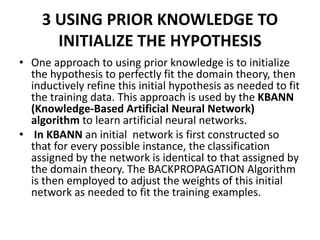
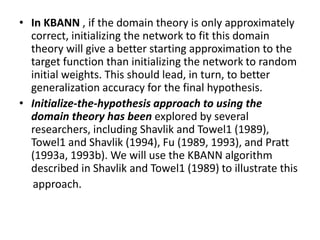
1) The KBANN algorithm uses a domain theory represented as Horn clauses to initialize an artificial neural network before training it with examples. This helps the network generalize better than random initialization when training data is limited.
2) KBANN constructs a network matching the domain theory's predictions exactly, then refines it with backpropagation to fit examples. This balances theory and data when they disagree.
3) In experiments on promoter recognition, KBANN achieved a 4% error rate compared to 8% for backpropagation alone, showing the benefit of prior knowledge.




![Ch 9-2.Machine Learning: Symbol-based[new]](https://cdn.slidesharecdn.com/ss_thumbnails/ch-92machine-learning-symbolbasednew4415-thumbnail.jpg?width=640&height=640&fit=bounds)


