By: Sagar Rai P
IMSc Computer Science
St Philomena PG Centre
SDN and NFV for IOT
Contents
 About the network.
 Limitations of conventional network architectre.
 Software Defined Networking.
 Open flow.
 Network Function Virtualization.
 Summary.
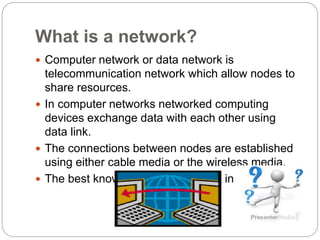
What is a network?
 Computer network or data network is
telecommunication network which allow nodes to
share resources.
 In computer networks networked computing
devices exchange data with each other using
data link.
 The connections between nodes are established
using either cable media or the wireless media.
 The best known computer network in Internet.
The limitations of the conventional network
architecture.
 Complex Network Devices: The conventional
networks are getting increasingly complex with
more and ore protocols being implemented to
improve link speeds and reliability.
 Management Overhead: Conventional networks
involve significant management overhead.
Network managers find it increasingly difficult to
manage multiple network devices and interfaces
from multiple vendors.
 Limited Scalability: The virtualization
technologies used in cloud computing
environments has increased the number of virtual
hosts requiring network access.
What is Software Defined
Networking?
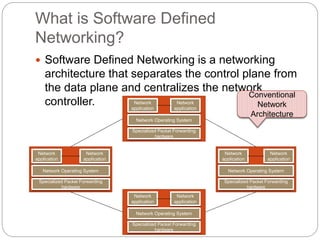
 Software Defined Networking is a networking
architecture that separates the control plane from
the data plane and centralizes the network
controller. Network
application
Network
application
Network Operating System
Specialized Packet Forwarding
hardware
Network
application
Network
application
Network
application
Network
application
Network
application
Network
application
Network Operating System
Specialized Packet Forwarding
hardware
Specialized Packet Forwarding
hardware
Specialized Packet Forwarding
hardware
Conventional
Network
Architecture
Key element of the SDN
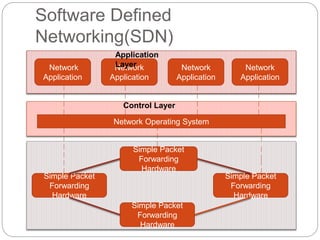
 Centralized Network Controller: With decoupled
control and dataplanes and centralized network
controller, the network administrators can rapidly
configure the network.
 Programmable Open APIs: SDN architecture
supports programmable open API for interface
between the SDN application and control
layers(Northbound interface).
 Standard Communication
Interface(OpenFlow): SDN architecture uses a
standard communication interface between the
control and infrastructure layers(Southbound
interface).
Software Defined
Networking(SDN)
Network
Application
Network
Application
Network
Application
Network
Application
Network Operating System
Application
Layer
Control Layer
Simple Packet
Forwarding
Hardware
Simple Packet
Forwarding
Hardware
Simple Packet
Forwarding
Hardware
Simple Packet
Forwarding
Hardware
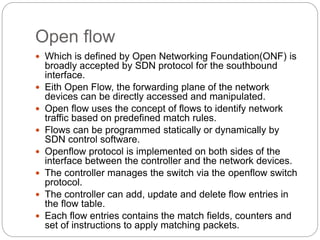
Open flow
 Which is defined by Open Networking Foundation(ONF) is
broadly accepted by SDN protocol for the southbound
interface.
 Eith Open Flow, the forwarding plane of the network
devices can be directly accessed and manipulated.
 Open flow uses the concept of flows to identify network
traffic based on predefined match rules.
 Flows can be programmed statically or dynamically by
SDN control software.
 Openflow protocol is implemented on both sides of the
interface between the controller and the network devices.
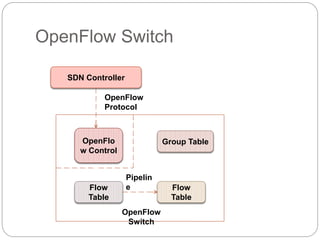
 The controller manages the switch via the openflow switch
protocol.
 The controller can add, update and delete flow entries in
the flow table.
 Each flow entries contains the match fields, counters and
set of instructions to apply matching packets.
OpenFlow Switch
SDN Controller
OpenFlo
w Control
Group Table
Flow
Table
Flow
Table
Pipelin
e
OpenFlow
Switch
OpenFlow
Protocol
Network Function Virtualization:
 NFV is a technology that leverages virtualization
to consolidate the heterogeneous network
devices onto industry standard hish volume
servers, switches and storage.
 NFV is complementory to SDN as NFV can
provide the infrastucture on which SDN can run.
 NFV and SDN are mutually beneficial to
eachother but not dependent.
 Network functions can be virtualized without SDN,
similarly, SDN can run without NFV.
NFV Architecture:-
Virtual Network
Function
Key element of NFV:-
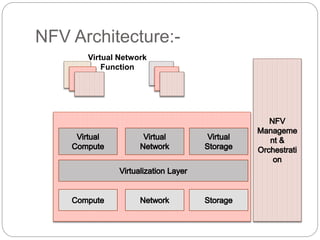
 Virtualized Network Function (VNF): VNF is a
software implementation of a network function
which is capable of running over the NFV
Infrastucture (NFVI).
 NFV Infrastructure (NFVI): NFVI includes
compute, network and storage resources that are
virtualized.
 NFV Management and Orchestration: NFV
Management and Orchestration focuses on all
virtualization-specific management tasks and
covers the orchestration and life cycle
management of physical and/or software
resources that supports the infrastructure
virtualization, and life cycle management of
Something about NFV….
 NFV comprises of network functions implemented
in software that run virtualized resources in the
cloud.
 NFV enables separation of network functions
which are implemented in software from
underlying hardware.
 Thus network functions can be easily tested and
upgraded by installing new software while the
hardware remains the same.
 Vitalizing network functions reduces the
equipment costs and also reduces power
consumption
SDN( Software Defined Network) and NFV(Network Function Virtualization) for Internet of Things

SDN( Software Defined Network) and NFV(Network Function Virtualization) for Internet of Things

  • 1.
    By: Sagar RaiP IMSc Computer Science St Philomena PG Centre SDN and NFV for IOT
  • 2.
    Contents  About thenetwork.  Limitations of conventional network architectre.  Software Defined Networking.  Open flow.  Network Function Virtualization.  Summary.
  • 3.
    What is anetwork?  Computer network or data network is telecommunication network which allow nodes to share resources.  In computer networks networked computing devices exchange data with each other using data link.  The connections between nodes are established using either cable media or the wireless media.  The best known computer network in Internet.
  • 4.
    The limitations ofthe conventional network architecture.  Complex Network Devices: The conventional networks are getting increasingly complex with more and ore protocols being implemented to improve link speeds and reliability.  Management Overhead: Conventional networks involve significant management overhead. Network managers find it increasingly difficult to manage multiple network devices and interfaces from multiple vendors.  Limited Scalability: The virtualization technologies used in cloud computing environments has increased the number of virtual hosts requiring network access.
  • 5.
    What is SoftwareDefined Networking?  Software Defined Networking is a networking architecture that separates the control plane from the data plane and centralizes the network controller. Network application Network application Network Operating System Specialized Packet Forwarding hardware Network application Network application Network application Network application Network application Network application Network Operating System Network Operating System Network Operating System Specialized Packet Forwarding hardware Specialized Packet Forwarding hardware Specialized Packet Forwarding hardware Conventional Network Architecture
  • 6.
    Key element ofthe SDN  Centralized Network Controller: With decoupled control and dataplanes and centralized network controller, the network administrators can rapidly configure the network.  Programmable Open APIs: SDN architecture supports programmable open API for interface between the SDN application and control layers(Northbound interface).  Standard Communication Interface(OpenFlow): SDN architecture uses a standard communication interface between the control and infrastructure layers(Southbound interface).
  • 7.
    Software Defined Networking(SDN) Network Application Network Application Network Application Network Application Network OperatingSystem Application Layer Control Layer Simple Packet Forwarding Hardware Simple Packet Forwarding Hardware Simple Packet Forwarding Hardware Simple Packet Forwarding Hardware
  • 8.
    Open flow  Whichis defined by Open Networking Foundation(ONF) is broadly accepted by SDN protocol for the southbound interface.  Eith Open Flow, the forwarding plane of the network devices can be directly accessed and manipulated.  Open flow uses the concept of flows to identify network traffic based on predefined match rules.  Flows can be programmed statically or dynamically by SDN control software.  Openflow protocol is implemented on both sides of the interface between the controller and the network devices.  The controller manages the switch via the openflow switch protocol.  The controller can add, update and delete flow entries in the flow table.  Each flow entries contains the match fields, counters and set of instructions to apply matching packets.
  • 9.
    OpenFlow Switch SDN Controller OpenFlo wControl Group Table Flow Table Flow Table Pipelin e OpenFlow Switch OpenFlow Protocol
  • 10.
    Network Function Virtualization: NFV is a technology that leverages virtualization to consolidate the heterogeneous network devices onto industry standard hish volume servers, switches and storage.  NFV is complementory to SDN as NFV can provide the infrastucture on which SDN can run.  NFV and SDN are mutually beneficial to eachother but not dependent.  Network functions can be virtualized without SDN, similarly, SDN can run without NFV.
  • 11.
  • 12.
    Key element ofNFV:-  Virtualized Network Function (VNF): VNF is a software implementation of a network function which is capable of running over the NFV Infrastucture (NFVI).  NFV Infrastructure (NFVI): NFVI includes compute, network and storage resources that are virtualized.  NFV Management and Orchestration: NFV Management and Orchestration focuses on all virtualization-specific management tasks and covers the orchestration and life cycle management of physical and/or software resources that supports the infrastructure virtualization, and life cycle management of
  • 13.
    Something about NFV…. NFV comprises of network functions implemented in software that run virtualized resources in the cloud.  NFV enables separation of network functions which are implemented in software from underlying hardware.  Thus network functions can be easily tested and upgraded by installing new software while the hardware remains the same.  Vitalizing network functions reduces the equipment costs and also reduces power consumption