 Instruction involving only register operands are shorter and
faster then those involving memory operands. This also
means that proper use of register help in generating the good
code. This section presents various strategies for deciding
what values in a program should reside in registers(register
allocation)and in which register each value should reside
(register assignment).
 One approach to register allocation and assignment is to
assign specific value in an object program to certain registers.
 This approach has the advantage that it simplifies the design
of a compiler.
Register Allocation and Assignment
 Disadvantage is that , applied too strictly , it uses registers
inefficiently; certain registers may go unused over substantial
portions of code, while unnecessary loads and stores are
generated.
 Now we will discuss various strategies used in register and
assignment and those
› Global Register Allocation
› Usage Counts
› Register Assignment for Outer Loops
› Register Allocation by Graph Coloring
Global Register Allocation
 Generating the code the registers are used to hold the value
for the duration of single block.
 All the live variables are stored at the end of each block.
 For the variables that are used consistently we can allocate
specific set of registers.
 Hence allocation of variables to specific registers that is
consistent across the block boundaries is called global register
allocation.
 The global register allocation has a strategy of storing the
most frequently used variables in fixed registers throughout
the loop
 Another strategy is to assign some fixed number of global
registers to hold the most active value in each inner loop.
 The registers not already allocated may be used to hold values
local to one block
 In certain language like C or Bliss programmer can do the
register allocation by using register declaration.
Usage Counts
 The usage count is the count for the use of some variable x in
some register used in any basic block.
 The usage count gives the idea about how many units of cost
can be saved by selecting a specific variable for global
register allocation.
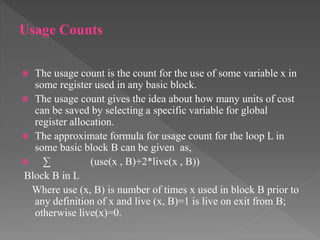
 The approximate formula for usage count for the loop L in
some basic block B can be given as,
 ∑ (use(x , B)+2*live(x , B))
Block B in L
Where use (x, B) is number of times x used in block B prior to
any definition of x and live (x, B)=1 is live on exit from B;
otherwise live(x)=0.
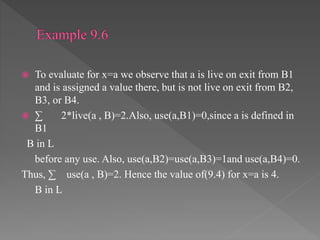
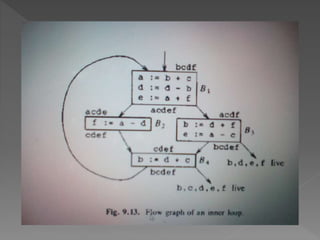
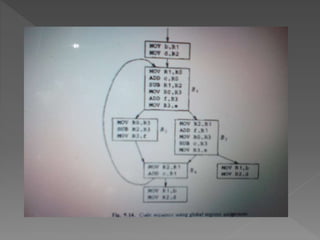
 To evaluate for x=a we observe that a is live on exit from B1
and is assigned a value there, but is not live on exit from B2,
B3, or B4.
 ∑ 2*live(a , B)=2.Also, use(a,B1)=0,since a is defined in
B1
B in L
before any use. Also, use(a,B2)=use(a,B3)=1and use(a,B4)=0.
Thus, ∑ use(a , B)=2. Hence the value of(9.4) for x=a is 4.
B in L
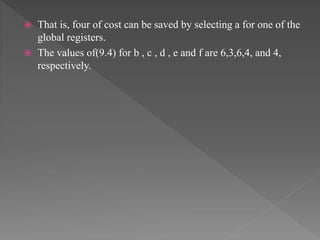
 That is, four of cost can be saved by selecting a for one of the
global registers.
 The values of(9.4) for b , c , d , e and f are 6,3,6,4, and 4,
respectively.
 Having assigned registers and generated code for inner loops,
we may apply the same idea to progressively loops.
 If an outer loop L1, contains an inner loop L2, the names
allocated registers in L2 need not be allocated registers in L1-
L2.
 However, if name x is allocated a register in loop L1 but not
L2, we must store x on entrance to L2 and load x if we leave
L2, and enter a block of L1-L2.
 Similarly, if we choose to allocate x a register in L2, but not
L1 must load x on entrance to L2 and store x on exit from L2.
 We leave as an exercise the derivation of a criterion for
selecting names to be allocated registers in an outer loop L,
given that choices have already been made for all loops
nested within L.
 A register is needed for a computation but all available
registers are in use, the contents of one of the used registers
must be stored (Spilled)into a memory location in order to
free up register.
 Graph coloring is a simple systematic technique for allocating
registers and managing register spills.
 In this method, two passes are used.
 In first , target-machine instruction are selected as though
there were as infinite number of symbolic registers; in effect,
names used un the intermediate code become names of
registers and the three-address statements become machine-
language statements.
 In the second pass, for each procedure a register-interference
graph is constructed in which the nodes are symbolic registers
and an edge connects two nodes if one is live at a point where
the other is defined.
 An attempt is made to color the register-interference graph
using k colors, where k is the number of assignable registers.
Thank you

Register allocation and assignment

  • 2.
     Instruction involvingonly register operands are shorter and faster then those involving memory operands. This also means that proper use of register help in generating the good code. This section presents various strategies for deciding what values in a program should reside in registers(register allocation)and in which register each value should reside (register assignment).  One approach to register allocation and assignment is to assign specific value in an object program to certain registers.  This approach has the advantage that it simplifies the design of a compiler. Register Allocation and Assignment
  • 3.
     Disadvantage isthat , applied too strictly , it uses registers inefficiently; certain registers may go unused over substantial portions of code, while unnecessary loads and stores are generated.  Now we will discuss various strategies used in register and assignment and those › Global Register Allocation › Usage Counts › Register Assignment for Outer Loops › Register Allocation by Graph Coloring
  • 4.
    Global Register Allocation Generating the code the registers are used to hold the value for the duration of single block.  All the live variables are stored at the end of each block.  For the variables that are used consistently we can allocate specific set of registers.  Hence allocation of variables to specific registers that is consistent across the block boundaries is called global register allocation.
  • 5.
     The globalregister allocation has a strategy of storing the most frequently used variables in fixed registers throughout the loop  Another strategy is to assign some fixed number of global registers to hold the most active value in each inner loop.  The registers not already allocated may be used to hold values local to one block  In certain language like C or Bliss programmer can do the register allocation by using register declaration.
  • 6.
    Usage Counts  Theusage count is the count for the use of some variable x in some register used in any basic block.  The usage count gives the idea about how many units of cost can be saved by selecting a specific variable for global register allocation.  The approximate formula for usage count for the loop L in some basic block B can be given as,  ∑ (use(x , B)+2*live(x , B)) Block B in L Where use (x, B) is number of times x used in block B prior to any definition of x and live (x, B)=1 is live on exit from B; otherwise live(x)=0.
  • 7.
     To evaluatefor x=a we observe that a is live on exit from B1 and is assigned a value there, but is not live on exit from B2, B3, or B4.  ∑ 2*live(a , B)=2.Also, use(a,B1)=0,since a is defined in B1 B in L before any use. Also, use(a,B2)=use(a,B3)=1and use(a,B4)=0. Thus, ∑ use(a , B)=2. Hence the value of(9.4) for x=a is 4. B in L
  • 8.
     That is,four of cost can be saved by selecting a for one of the global registers.  The values of(9.4) for b , c , d , e and f are 6,3,6,4, and 4, respectively.
  • 10.
     Having assignedregisters and generated code for inner loops, we may apply the same idea to progressively loops.  If an outer loop L1, contains an inner loop L2, the names allocated registers in L2 need not be allocated registers in L1- L2.  However, if name x is allocated a register in loop L1 but not L2, we must store x on entrance to L2 and load x if we leave L2, and enter a block of L1-L2.  Similarly, if we choose to allocate x a register in L2, but not L1 must load x on entrance to L2 and store x on exit from L2.
  • 11.
     We leaveas an exercise the derivation of a criterion for selecting names to be allocated registers in an outer loop L, given that choices have already been made for all loops nested within L.
  • 13.
     A registeris needed for a computation but all available registers are in use, the contents of one of the used registers must be stored (Spilled)into a memory location in order to free up register.  Graph coloring is a simple systematic technique for allocating registers and managing register spills.  In this method, two passes are used.  In first , target-machine instruction are selected as though there were as infinite number of symbolic registers; in effect, names used un the intermediate code become names of registers and the three-address statements become machine- language statements.
  • 14.
     In thesecond pass, for each procedure a register-interference graph is constructed in which the nodes are symbolic registers and an edge connects two nodes if one is live at a point where the other is defined.  An attempt is made to color the register-interference graph using k colors, where k is the number of assignable registers.
  • 15.