Using Graph and Transformer
Embeddings for Vector based
retrieval
Sujit Pal
Tony Scerri
4 November 2020
Agenda
• Term vs Vector vs Graph Search
• Problem Formulation
• Experiments and Results
• Conclusions and Future Work
2
Term vs Vector vs Graph Search
3
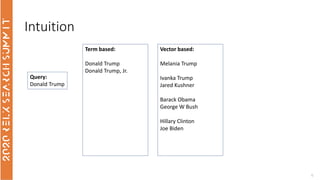
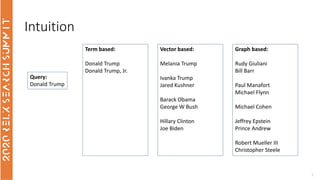
Intuition
4
Query:
Donald Trump
Intuition
5
Query:
Donald Trump
Term based:
Donald Trump
Donald Trump, Jr.
Intuition
6
Query:
Donald Trump
Term based:
Donald Trump
Donald Trump, Jr.
Vector based:
Melania Trump
Ivanka Trump
Jared Kushner
Barack Obama
George W Bush
Hillary Clinton
Joe Biden
Intuition
7
Query:
Donald Trump
Term based:
Donald Trump
Donald Trump, Jr.
Vector based:
Melania Trump
Ivanka Trump
Jared Kushner
Barack Obama
George W Bush
Hillary Clinton
Joe Biden
Graph based:
Rudy Giuliani
Bill Barr
Paul Manafort
Michael Flynn
Michael Cohen
Jeffrey Epstein
Prince Andrew
Robert Mueller III
Christopher Steele
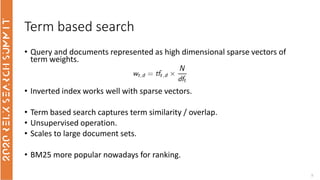
Term based search
• Query and documents represented as high dimensional sparse vectors of
term weights.
• Inverted index works well with sparse vectors.
• Term based search captures term similarity / overlap.
• Unsupervised operation.
• Scales to large document sets.
• BM25 more popular nowadays for ranking.
8
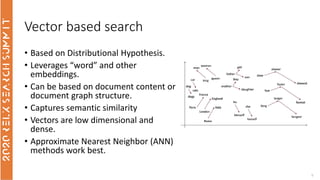
Vector based search
• Based on Distributional Hypothesis.
• Leverages “word” and other
embeddings.
• Can be based on document content or
document graph structure.
• Captures semantic similarity
• Vectors are low dimensional and
dense.
• Approximate Nearest Neighbor (ANN)
methods work best.
9
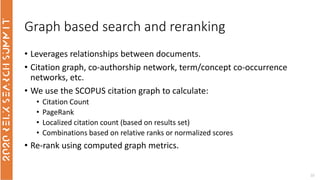
Graph based search and reranking
10
• Leverages relationships between documents.
• Citation graph, co-authorship network, term/concept co-occurrence
networks, etc.
• We use the SCOPUS citation graph to calculate:
• Citation Count
• PageRank
• Localized citation count (based on results set)
• Combinations based on relative ranks or normalized scores
• Re-rank using computed graph metrics.
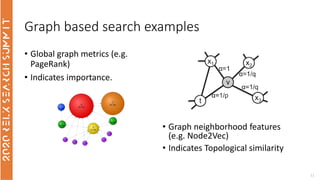
Graph based search examples
• Global graph metrics (e.g.
PageRank)
• Indicates importance.
11
• Graph neighborhood features
(e.g. Node2Vec)
• Indicates Topological similarity
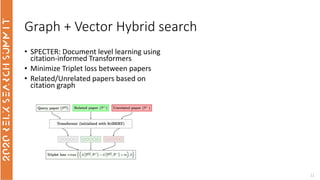
Graph + Vector Hybrid search
• SPECTER: Document level learning using
citation-informed Transformers
• Minimize Triplet loss between papers
• Related/Unrelated papers based on
citation graph
12
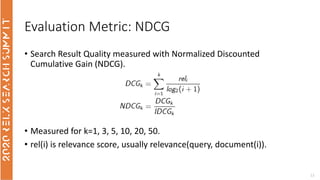
Evaluation Metric: NDCG
• Search Result Quality measured with Normalized Discounted
Cumulative Gain (NDCG).
• Measured for k=1, 3, 5, 10, 20, 50.
• rel(i) is relevance score, usually relevance(query, document(i)).
13
Problem Formulation
14
Reformulating the Problem
• Objective – quantitatively compare various search approaches on SCOPUS.​
• Needed labeled data, i.e., judgement lists, which weren't available.​
• TREC-COVID has (incomplete) judgement lists (35 queries so far)​
• TREC-COVID uses CORD-19 data (from 01-May-2020), some of which are available in
SCOPUS.​
• Some degree of duplication within corpus causes minor discrepancies
• Using subset of SCOPUS papers from May 1 CORD-19 dataset.​
• Using subset of TREC-COVID judgement lists for these papers.​
• Promising candidate solutions applied back to SCOPUS.
15
Setup
• SOLR index created from CORD-19 corpus (Scopus subset only)
• Original plus stemmed fields
• Baseline created using eDismax query applied to original and

stemmed fields
• NDCG measured with filtered (to Scopus) judgements
• Various reranking schemes applied to eDismax results
• Alternative query methods (SOLR MLT, vector based query) tried
16
Experiments and Results
17
Conditions
• Unless otherwise stated:
• Use of query from CORD-19 (not question or narrative descriptions)
• NDCG based on Scopus matched records only
• NDCG reported is the average across all 35 queries
18
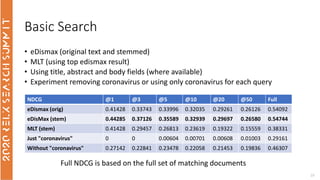
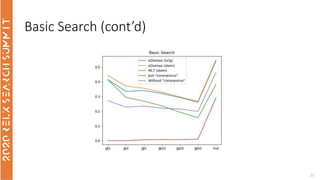
Basic Search
• eDismax (original text and stemmed)
• MLT (using top edismax result)
• Using title, abstract and body fields (where available)
• Experiment removing coronavirus or using only coronavirus for each query
19
Full NDCG is based on the full set of matching documents
NDCG @1 @3 @5 @10 @20 @50 Full
eDismax (orig) 0.41428 0.33743 0.33996 0.32035 0.29261 0.26126 0.54092
eDisMax (stem) 0.44285 0.37126 0.35589 0.32939 0.29697 0.26580 0.54744
MLT (stem) 0.41428 0.29457 0.26813 0.23619 0.19322 0.15559 0.38331
Just "coronavirus" 0 0 0.00604 0.00701 0.00608 0.01003 0.29161
Without "coronavirus" 0.27142 0.22841 0.23478 0.22058 0.21453 0.19836 0.46307
Basic Search (cont’d)
20
Reranking
• As previously mentioned, various reranking schemes were tried -
• Cited By (descending)
• PageRank (descending)
• Localized Cited By (descending)
• Combination included -
• Relevancy + PageRank (ranks, ascending)
• Relevancy * PageRank (normalized inverse ranks, ascending)
• Cited By + Localized Cited By (ranks, ascending)
• Relevancy + Cited By (ranks, ascending)
• Relevancy + Localized Cited By (ranks, ascending)
• Relevancy + (10%) Localized Cited By (normalized scores, descending)
• Relevancy + (10%) PageRank (normalized scores, descending)
21
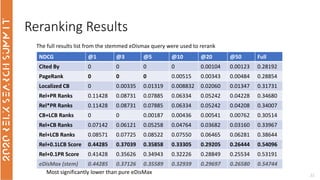
Reranking Results
22
NDCG @1 @3 @5 @10 @20 @50 Full
Cited By 0 0 0 0 0.00104 0.00123 0.28192
PageRank 0 0 0 0.00515 0.00343 0.00484 0.28854
Localized CB 0 0.00335 0.01319 0.008832 0.02060 0.01347 0.31731
Rel+PR Ranks 0.11428 0.08731 0.07885 0.06334 0.05242 0.04228 0.34680
Rel*PR Ranks 0.11428 0.08731 0.07885 0.06334 0.05242 0.04208 0.34007
CB+LCB Ranks 0 0 0.00187 0.00436 0.00541 0.00762 0.30514
Rel+CB Ranks 0.07142 0.06121 0.05258 0.04764 0.03682 0.03160 0.33967
Rel+LCB Ranks 0.08571 0.07725 0.08522 0.07550 0.06465 0.06281 0.38644
Rel+0.1LCB Score 0.44285 0.37039 0.35858 0.33305 0.29205 0.26444 0.54096
Rel+0.1PR Score 0.41428 0.35626 0.34943 0.32226 0.28849 0.25534 0.53191
eDisMax (stem) 0.44285 0.37126 0.35589 0.32939 0.29697 0.26580 0.54744
The full results list from the stemmed eDismax query were used to rerank
Most significantly lower than pure eDisMax
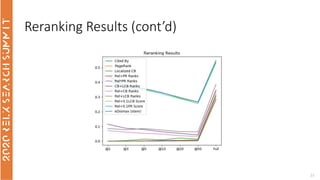
Reranking Results (cont’d)
23
(Searching) Ranking
• Sorting of the full corpus, no cut-off applied
• Vector based reranking including:
• BERT embedding
• Node2Vec embeddings
• SPECTER embeddings
• Compare BERT embedding vector distance of query to title and abstract
• Cosine distance and Euclidean distance
• Query vs
• Title
• Title + Abstract (max or mean pooling)
• Also tried best eDismax result document per query
24
Extra Embedding
• Also looked at the question and narrative compared to the query, eg
• Query : coronavirus origin
• Question : what is the origin of COVID-19
• Narrative : seeking range of information about the SARS-CoV-2 virus's origin,
including its evolution, animal source, and first transmission into humans
• Question and narratives work better
• Likely due to longer text with words (including synonyms and
concepts) in context (more natural)
25
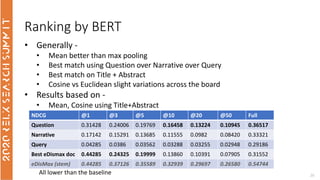
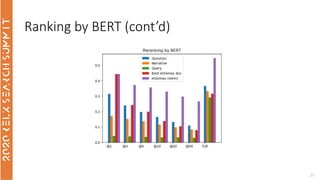
Ranking by BERT
26
NDCG @1 @3 @5 @10 @20 @50 Full
Question 0.31428 0.24006 0.19769 0.16458 0.13224 0.10945 0.36517
Narrative 0.17142 0.15291 0.13685 0.11555 0.0982 0.08420 0.33321
Query 0.04285 0.0386 0.03562 0.03288 0.03255 0.02948 0.29186
Best eDismax doc 0.44285 0.24325 0.19999 0.13860 0.10391 0.07905 0.31552
eDisMax (stem) 0.44285 0.37126 0.35589 0.32939 0.29697 0.26580 0.54744
• Generally -
• Mean better than max pooling
• Best match using Question over Narrative over Query
• Best match on Title + Abstract
• Cosine vs Euclidean slight variations across the board

• Results based on -
• Mean, Cosine using Title+Abstract
All lower than the baseline
Ranking by BERT (cont’d)
27
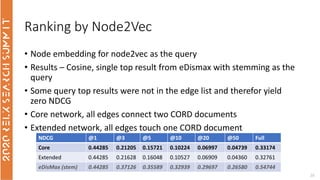
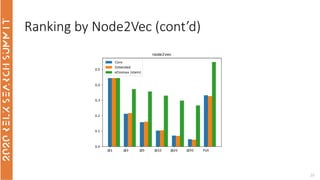
Ranking by Node2Vec
• Node embedding for node2vec as the query
• Results – Cosine, single top result from eDismax with stemming as the
query
• Some query top results were not in the edge list and therefor yield
zero NDCG
• Core network, all edges connect two CORD documents
• Extended network, all edges touch one CORD document
28
NDCG @1 @3 @5 @10 @20 @50 Full
Core 0.44285 0.21205 0.15721 0.10224 0.06997 0.04739 0.33174
Extended 0.44285 0.21628 0.16048 0.10527 0.06909 0.04360 0.32761
eDisMax (stem) 0.44285 0.37126 0.35589 0.32939 0.29697 0.26580 0.54744
Ranking by Node2Vec (cont’d)
29
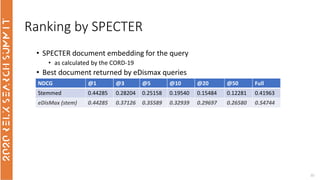
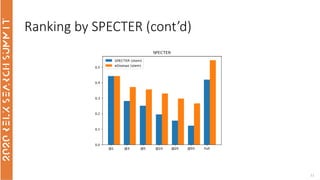
Ranking by SPECTER
• SPECTER document embedding for the query
• as calculated by the CORD-19
• Best document returned by eDismax queries
30
NDCG @1 @3 @5 @10 @20 @50 Full
Stemmed 0.44285 0.28204 0.25158 0.19540 0.15484 0.12281 0.41963
eDisMax (stem) 0.44285 0.37126 0.35589 0.32939 0.29697 0.26580 0.54744
Ranking by SPECTER (cont’d)
31
Training Embedding
• Short experiment to look at training query – document for improved
ranking
• We did not try this with question or narrative, limiting to query
• Poor results assumed to be caused by:
• Lack of variability in query preventing generalisation
• Nearly all queries contain "coronavirus"
32
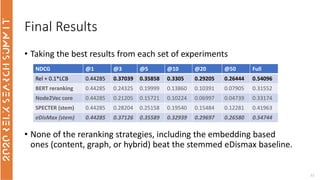
Final Results
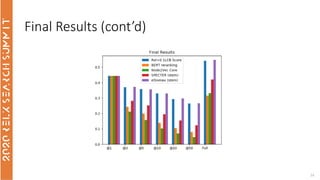
• Taking the best results from each set of experiments
• None of the reranking strategies, including the embedding based
ones (content, graph, or hybrid) beat the stemmed eDismax baseline.
33
NDCG @1 @3 @5 @10 @20 @50 Full
Rel + 0.1*LCB 0.44285 0.37039 0.35858 0.3305 0.29205 0.26444 0.54096
BERT reranking 0.44285 0.24325 0.19999 0.13860 0.10391 0.07905 0.31552
Node2Vec core 0.44285 0.21205 0.15721 0.10224 0.06997 0.04739 0.33174
SPECTER (stem) 0.44285 0.28204 0.25158 0.19540 0.15484 0.12281 0.41963
eDisMax (stem) 0.44285 0.37126 0.35589 0.32939 0.29697 0.26580 0.54744
Final Results (cont’d)
34
Conclusions and Future Work
35
Summary
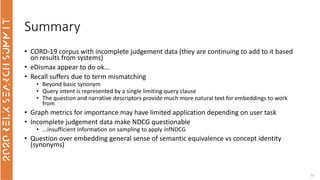
• CORD-19 corpus with incomplete judgement data (they are continuing to add to it based
on results from systems)
• eDismax appear to do ok...
• Recall suffers due to term mismatching
• Beyond basic synonym
• Query intent is represented by a single limiting query clause
• The question and narrative descriptors provide much more natural text for embeddings to work
from
• Graph metrics for importance may have limited application depending on user task
• Incomplete judgement data make NDCG questionable
• ...insufficient information on sampling to apply infNDCG
• Question over embedding general sense of semantic equivalence vs concept identity
(synonyms)
36
Future Work
• Experiments based on Scopus and our own judgement data
• Application of graph metrics, including more than just basic citation
graph
• Investigation of fine-tuned embeddings combining text and graph
• Apply ML based reranking
• Investigate the balance between concept, semantic, freshness and
importance
37
Questions?
38

Using Graph and Transformer Embeddings for Vector Based Retrieval

  • 1.
    Using Graph andTransformer Embeddings for Vector based retrieval Sujit Pal Tony Scerri 4 November 2020
  • 2.
    Agenda • Term vsVector vs Graph Search • Problem Formulation • Experiments and Results • Conclusions and Future Work 2
  • 3.
    Term vs Vectorvs Graph Search 3
  • 4.
  • 5.
  • 6.
    Intuition 6 Query: Donald Trump Term based: DonaldTrump Donald Trump, Jr. Vector based: Melania Trump Ivanka Trump Jared Kushner Barack Obama George W Bush Hillary Clinton Joe Biden
  • 7.
    Intuition 7 Query: Donald Trump Term based: DonaldTrump Donald Trump, Jr. Vector based: Melania Trump Ivanka Trump Jared Kushner Barack Obama George W Bush Hillary Clinton Joe Biden Graph based: Rudy Giuliani Bill Barr Paul Manafort Michael Flynn Michael Cohen Jeffrey Epstein Prince Andrew Robert Mueller III Christopher Steele
  • 8.
    Term based search •Query and documents represented as high dimensional sparse vectors of term weights. • Inverted index works well with sparse vectors. • Term based search captures term similarity / overlap. • Unsupervised operation. • Scales to large document sets. • BM25 more popular nowadays for ranking. 8
  • 9.
    Vector based search •Based on Distributional Hypothesis. • Leverages “word” and other embeddings. • Can be based on document content or document graph structure. • Captures semantic similarity • Vectors are low dimensional and dense. • Approximate Nearest Neighbor (ANN) methods work best. 9
  • 10.
    Graph based searchand reranking 10 • Leverages relationships between documents. • Citation graph, co-authorship network, term/concept co-occurrence networks, etc. • We use the SCOPUS citation graph to calculate: • Citation Count • PageRank • Localized citation count (based on results set) • Combinations based on relative ranks or normalized scores • Re-rank using computed graph metrics.
  • 11.
    Graph based searchexamples • Global graph metrics (e.g. PageRank) • Indicates importance. 11 • Graph neighborhood features (e.g. Node2Vec) • Indicates Topological similarity
  • 12.
    Graph + VectorHybrid search • SPECTER: Document level learning using citation-informed Transformers • Minimize Triplet loss between papers • Related/Unrelated papers based on citation graph 12
  • 13.
    Evaluation Metric: NDCG •Search Result Quality measured with Normalized Discounted Cumulative Gain (NDCG). • Measured for k=1, 3, 5, 10, 20, 50. • rel(i) is relevance score, usually relevance(query, document(i)). 13
  • 14.
  • 15.
    Reformulating the Problem •Objective – quantitatively compare various search approaches on SCOPUS.​ • Needed labeled data, i.e., judgement lists, which weren't available.​ • TREC-COVID has (incomplete) judgement lists (35 queries so far)​ • TREC-COVID uses CORD-19 data (from 01-May-2020), some of which are available in SCOPUS.​ • Some degree of duplication within corpus causes minor discrepancies • Using subset of SCOPUS papers from May 1 CORD-19 dataset.​ • Using subset of TREC-COVID judgement lists for these papers.​ • Promising candidate solutions applied back to SCOPUS. 15
  • 16.
    Setup • SOLR indexcreated from CORD-19 corpus (Scopus subset only) • Original plus stemmed fields • Baseline created using eDismax query applied to original and stemmed fields • NDCG measured with filtered (to Scopus) judgements • Various reranking schemes applied to eDismax results • Alternative query methods (SOLR MLT, vector based query) tried 16
  • 17.
  • 18.
    Conditions • Unless otherwisestated: • Use of query from CORD-19 (not question or narrative descriptions) • NDCG based on Scopus matched records only • NDCG reported is the average across all 35 queries 18
  • 19.
    Basic Search • eDismax(original text and stemmed) • MLT (using top edismax result) • Using title, abstract and body fields (where available) • Experiment removing coronavirus or using only coronavirus for each query 19 Full NDCG is based on the full set of matching documents NDCG @1 @3 @5 @10 @20 @50 Full eDismax (orig) 0.41428 0.33743 0.33996 0.32035 0.29261 0.26126 0.54092 eDisMax (stem) 0.44285 0.37126 0.35589 0.32939 0.29697 0.26580 0.54744 MLT (stem) 0.41428 0.29457 0.26813 0.23619 0.19322 0.15559 0.38331 Just "coronavirus" 0 0 0.00604 0.00701 0.00608 0.01003 0.29161 Without "coronavirus" 0.27142 0.22841 0.23478 0.22058 0.21453 0.19836 0.46307
  • 20.
  • 21.
    Reranking • As previouslymentioned, various reranking schemes were tried - • Cited By (descending) • PageRank (descending) • Localized Cited By (descending) • Combination included - • Relevancy + PageRank (ranks, ascending) • Relevancy * PageRank (normalized inverse ranks, ascending) • Cited By + Localized Cited By (ranks, ascending) • Relevancy + Cited By (ranks, ascending) • Relevancy + Localized Cited By (ranks, ascending) • Relevancy + (10%) Localized Cited By (normalized scores, descending) • Relevancy + (10%) PageRank (normalized scores, descending) 21
  • 22.
    Reranking Results 22 NDCG @1@3 @5 @10 @20 @50 Full Cited By 0 0 0 0 0.00104 0.00123 0.28192 PageRank 0 0 0 0.00515 0.00343 0.00484 0.28854 Localized CB 0 0.00335 0.01319 0.008832 0.02060 0.01347 0.31731 Rel+PR Ranks 0.11428 0.08731 0.07885 0.06334 0.05242 0.04228 0.34680 Rel*PR Ranks 0.11428 0.08731 0.07885 0.06334 0.05242 0.04208 0.34007 CB+LCB Ranks 0 0 0.00187 0.00436 0.00541 0.00762 0.30514 Rel+CB Ranks 0.07142 0.06121 0.05258 0.04764 0.03682 0.03160 0.33967 Rel+LCB Ranks 0.08571 0.07725 0.08522 0.07550 0.06465 0.06281 0.38644 Rel+0.1LCB Score 0.44285 0.37039 0.35858 0.33305 0.29205 0.26444 0.54096 Rel+0.1PR Score 0.41428 0.35626 0.34943 0.32226 0.28849 0.25534 0.53191 eDisMax (stem) 0.44285 0.37126 0.35589 0.32939 0.29697 0.26580 0.54744 The full results list from the stemmed eDismax query were used to rerank Most significantly lower than pure eDisMax
  • 23.
  • 24.
    (Searching) Ranking • Sortingof the full corpus, no cut-off applied • Vector based reranking including: • BERT embedding • Node2Vec embeddings • SPECTER embeddings • Compare BERT embedding vector distance of query to title and abstract • Cosine distance and Euclidean distance • Query vs • Title • Title + Abstract (max or mean pooling) • Also tried best eDismax result document per query 24
  • 25.
    Extra Embedding • Alsolooked at the question and narrative compared to the query, eg • Query : coronavirus origin • Question : what is the origin of COVID-19 • Narrative : seeking range of information about the SARS-CoV-2 virus's origin, including its evolution, animal source, and first transmission into humans • Question and narratives work better • Likely due to longer text with words (including synonyms and concepts) in context (more natural) 25
  • 26.
    Ranking by BERT 26 NDCG@1 @3 @5 @10 @20 @50 Full Question 0.31428 0.24006 0.19769 0.16458 0.13224 0.10945 0.36517 Narrative 0.17142 0.15291 0.13685 0.11555 0.0982 0.08420 0.33321 Query 0.04285 0.0386 0.03562 0.03288 0.03255 0.02948 0.29186 Best eDismax doc 0.44285 0.24325 0.19999 0.13860 0.10391 0.07905 0.31552 eDisMax (stem) 0.44285 0.37126 0.35589 0.32939 0.29697 0.26580 0.54744 • Generally - • Mean better than max pooling • Best match using Question over Narrative over Query • Best match on Title + Abstract • Cosine vs Euclidean slight variations across the board • Results based on - • Mean, Cosine using Title+Abstract All lower than the baseline
  • 27.
    Ranking by BERT(cont’d) 27
  • 28.
    Ranking by Node2Vec •Node embedding for node2vec as the query • Results – Cosine, single top result from eDismax with stemming as the query • Some query top results were not in the edge list and therefor yield zero NDCG • Core network, all edges connect two CORD documents • Extended network, all edges touch one CORD document 28 NDCG @1 @3 @5 @10 @20 @50 Full Core 0.44285 0.21205 0.15721 0.10224 0.06997 0.04739 0.33174 Extended 0.44285 0.21628 0.16048 0.10527 0.06909 0.04360 0.32761 eDisMax (stem) 0.44285 0.37126 0.35589 0.32939 0.29697 0.26580 0.54744
  • 29.
    Ranking by Node2Vec(cont’d) 29
  • 30.
    Ranking by SPECTER •SPECTER document embedding for the query • as calculated by the CORD-19 • Best document returned by eDismax queries 30 NDCG @1 @3 @5 @10 @20 @50 Full Stemmed 0.44285 0.28204 0.25158 0.19540 0.15484 0.12281 0.41963 eDisMax (stem) 0.44285 0.37126 0.35589 0.32939 0.29697 0.26580 0.54744
  • 31.
    Ranking by SPECTER(cont’d) 31
  • 32.
    Training Embedding • Shortexperiment to look at training query – document for improved ranking • We did not try this with question or narrative, limiting to query • Poor results assumed to be caused by: • Lack of variability in query preventing generalisation • Nearly all queries contain "coronavirus" 32
  • 33.
    Final Results • Takingthe best results from each set of experiments • None of the reranking strategies, including the embedding based ones (content, graph, or hybrid) beat the stemmed eDismax baseline. 33 NDCG @1 @3 @5 @10 @20 @50 Full Rel + 0.1*LCB 0.44285 0.37039 0.35858 0.3305 0.29205 0.26444 0.54096 BERT reranking 0.44285 0.24325 0.19999 0.13860 0.10391 0.07905 0.31552 Node2Vec core 0.44285 0.21205 0.15721 0.10224 0.06997 0.04739 0.33174 SPECTER (stem) 0.44285 0.28204 0.25158 0.19540 0.15484 0.12281 0.41963 eDisMax (stem) 0.44285 0.37126 0.35589 0.32939 0.29697 0.26580 0.54744
  • 34.
  • 35.
  • 36.
    Summary • CORD-19 corpuswith incomplete judgement data (they are continuing to add to it based on results from systems) • eDismax appear to do ok... • Recall suffers due to term mismatching • Beyond basic synonym • Query intent is represented by a single limiting query clause • The question and narrative descriptors provide much more natural text for embeddings to work from • Graph metrics for importance may have limited application depending on user task • Incomplete judgement data make NDCG questionable • ...insufficient information on sampling to apply infNDCG • Question over embedding general sense of semantic equivalence vs concept identity (synonyms) 36
  • 37.
    Future Work • Experimentsbased on Scopus and our own judgement data • Application of graph metrics, including more than just basic citation graph • Investigation of fine-tuned embeddings combining text and graph • Apply ML based reranking • Investigate the balance between concept, semantic, freshness and importance 37
  • 38.