Can Short Queries Be Even
Shorter?
University of Delaware
1
Long/Verbose Queries
Had Been Extensively Studied
2
• Example long query here …
3
However …
Can short queries have the similar
property?
4
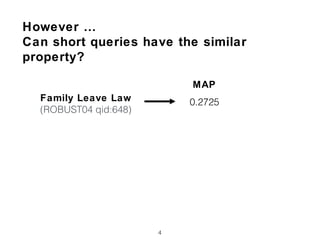
Family Leave Law
(ROBUST04 qid:648)
0.2725
MAP
However …
Can short queries have the similar
property?
5
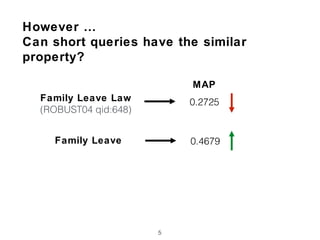
Family Leave Law
(ROBUST04 qid:648)
0.2725
MAP
Family Leave 0.4679
However …
Can short queries have the similar
property?
6
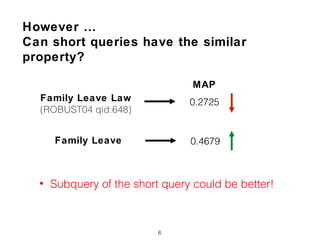
Family Leave Law
(ROBUST04 qid:648)
0.2725
MAP
Family Leave 0.4679
However …
Can short queries have the similar
property?
• Subquery of the short query could be better!
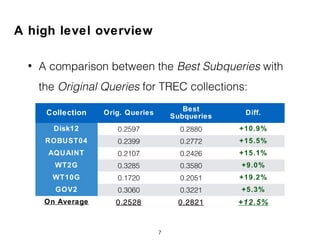
A high level overview
• A comparison between the Best Subqueries with
the Original Queries for TREC collections:
7
Collection Orig. Queries
Best
Subqueries
Diff.
Disk12 0.2597 0.2880 +10.9%
ROBUST04 0.2399 0.2772 +15.5%
AQUAINT 0.2107 0.2426 +15.1%
WT2G 0.3285 0.3580 +9.0%
WT10G 0.1720 0.2051 +19.2%
GOV2 0.3060 0.3221 +5.3%
On Average 0.2528 0.2821 +12.5%
8
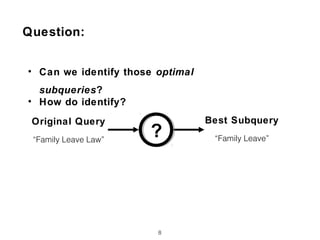
Question:
“Family Leave Law”
Original Query
“Family Leave”
Best Subquery
?
• Can we identify those optimal
subqueries?
• How do identify?
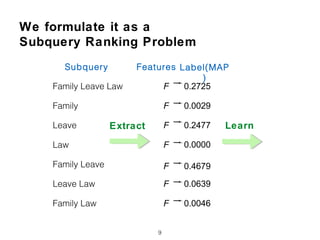
We formulate it as a
Subquery Ranking Problem
Family Leave Law
9
Family
Leave
Law
Family Leave
Leave Law
Family Law
F
F
F
F
F
F
F
0.2725
0.0029
0.2477
0.0000
0.4679
0.0639
0.0046
LearnExtract
Subquery Features Label(MAP
)
Then the key is the Features
10
Family Leave Features
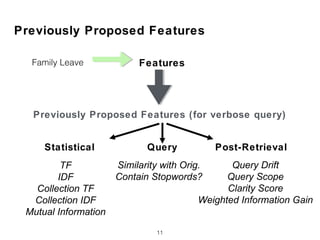
Previously Proposed Features
11
Previously Proposed Features (for verbose query)
Statistical Query Post-Retrieval
TF
IDF
Collection TF
Collection IDF
Mutual Information
Similarity with Orig.
Contain Stopwords?
Query Drift
Query Scope
Clarity Score
Weighted Information Gain
Family Leave Features
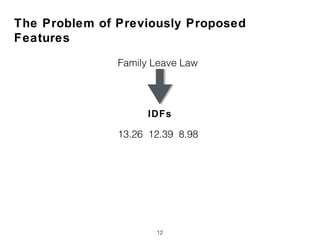
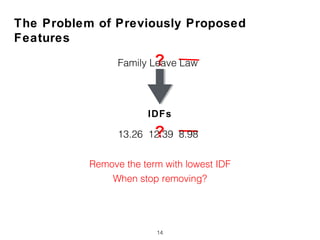
The Problem of Previously Proposed
Features
12
Family Leave Law
IDFs
13.26 12.39 8.98
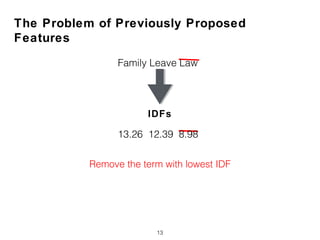
The Problem of Previously Proposed
Features
13
Remove the term with lowest IDF
Family Leave Law
IDFs
13.26 12.39 8.98
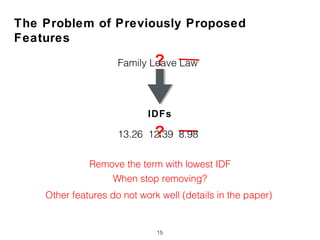
The Problem of Previously Proposed
Features
14
?
?
When stop removing?
Remove the term with lowest IDF
Family Leave Law
IDFs
13.26 12.39 8.98
The Problem of Previously Proposed
Features
15
Other features do not work well (details in the paper)
?
?
When stop removing?
Remove the term with lowest IDF
Family Leave Law
IDFs
13.26 12.39 8.98
New futures are proposed to tackle the
problem
• Post-retrieval
• Focus on term relationship
• document level features term level features
16
New futures are proposed to tackle the
problem
• Post-retrieval
• Focus on term relationship
• document level features term level features
• 3 Categories of features
• Term Proximity based Features
• Term Score based Features
• Compactness and Positions of Term Score
Tensors
17
Term Proximity based Features (PXM)
• Term Dependency Model [Metzler05]
18
Family Leave Law
Term Proximity based Features (PXM)
• Term Dependency Model [Metzler05]
19
Family Leave Law
• Already know it is a law code
• Occur together
• In that order
Term Proximity based Features (PXM)
• Term Dependency Model [Metzler05]
20
• Already know it is a law code
• Occur together
• In that order
How to capture the feature?
Family Leave Law
How to Capture PXM?
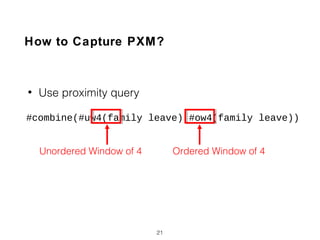
• Use proximity query
21
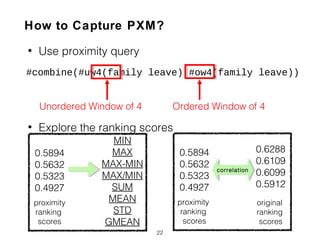
#combine(#uw4(family leave) #ow4(family leave))
Unordered Window of 4 Ordered Window of 4
• Use proximity query
22
#combine(#uw4(family leave) #ow4(family leave))
Unordered Window of 4 Ordered Window of 4
• Explore the ranking scores
0.5894
0.5632
0.5323
0.4927
How to Capture PXM?
MIN
MAX
MAX-MIN
MAX/MIN
SUM
MEAN
STD
GMEAN
proximity
ranking
scores
0.5894
0.5632
0.5323
0.4927
proximity
ranking
scores
0.6288
0.6109
0.6099
0.5912
original
ranking
scores
correlationcorrelation
Term Score based Features (TS)
• TF-IDF Constraint [Fang2011]
23
SVM Tutorial SVM Tutorial
99 1 50 50
Counter Intuitive
• TF-IDF Constraint [Fang2011]
24
• We instead look at the term scores…
SVM Tutorial SVM Tutorial
99 1 50 50
Counter Intuitive
Term Score based Features (TS)
25
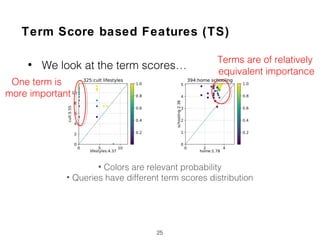
• We look at the term scores…
• Colors are relevant probability
• Queries have different term scores distribution
One term is
more important
Terms are of relatively
equivalent importance
Term Score based Features (TS)
26
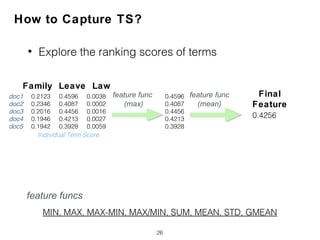
• Explore the ranking scores of terms
0.2123 0.4596 0.0038
0.2346 0.4087 0.0002
0.2016 0.4456 0.0016
0.1946 0.4213 0.0027
0.1942 0.3928 0.0059
How to Capture TS?
Family Leave Law
feature func
(max)
feature funcs
MIN, MAX, MAX-MIN, MAX/MIN, SUM, MEAN, STD, GMEAN
0.4596
0.4087
0.4456
0.4213
0.3928
feature func
(mean)
0.4256
Final
Feature
doc1
doc2
doc3
doc4
doc5
Individual Term Score
Compactness and Positions of Term Score Tensors
(TCP)
• Normalized Query Commitment (NQC) [Shtok2012]
27
0.5894
0.5632
0.5323
0.4927
document ranking scores
0.6678
0.5632
0.4896
Quote:
“Higher deviation value was
correlated with potentially lower
query drift, and thus indicating the
better effectiveness"
Larger
Gap
Larger
Gap
28
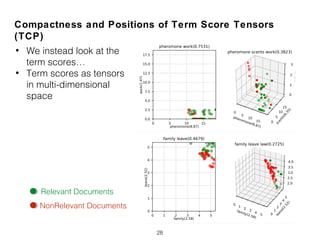
Compactness and Positions of Term Score Tensors
(TCP)
• We instead look at the
term scores…
• Term scores as tensors
in multi-dimensional
space
Relevant Documents
NonRelevant Documents
29
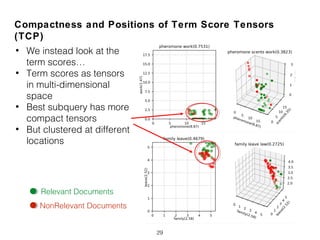
Compactness and Positions of Term Score Tensors
(TCP)
• We instead look at the
term scores…
• Term scores as tensors
in multi-dimensional
space
• Best subquery has more
compact tensors
• But clustered at different
locations
Relevant Documents
NonRelevant Documents
30
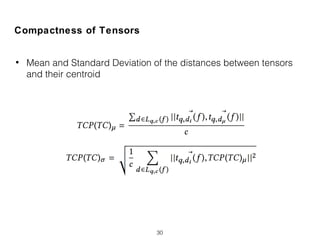
Compactness of Tensors
• Mean and Standard Deviation of the distances between tensors
and their centroid
31
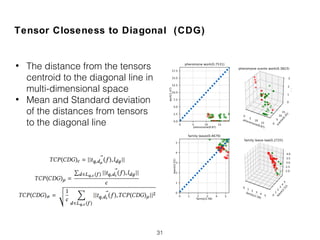
Tensor Closeness to Diagonal (CDG)
• The distance from the tensors
centroid to the diagonal line in
multi-dimensional space
• Mean and Standard deviation
of the distances from tensors
to the diagonal line
32
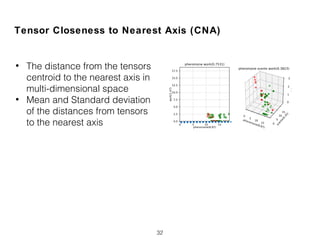
Tensor Closeness to Nearest Axis (CNA)
• The distance from the tensors
centroid to the nearest axis in
multi-dimensional space
• Mean and Standard deviation
of the distances from tensors
to the nearest axis
33
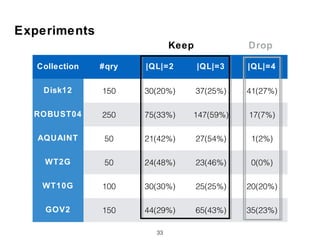
Experiments
Collection #qry |QL|=2 |QL|=3 |QL|=4
Disk12 150 30(20%) 37(25%) 41(27%)
ROBUST04 250 75(33%) 147(59%) 17(7%)
AQUAINT 50 21(42%) 27(54%) 1(2%)
WT2G 50 24(48%) 23(46%) 0(0%)
WT10G 100 30(30%) 25(25%) 20(20%)
GOV2 150 44(29%) 65(43%) 35(23%)
Keep Drop
34
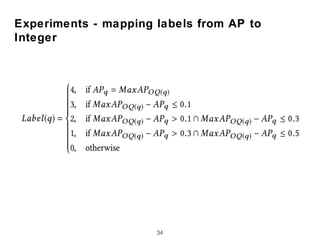
Experiments - mapping labels from AP to
Integer
35
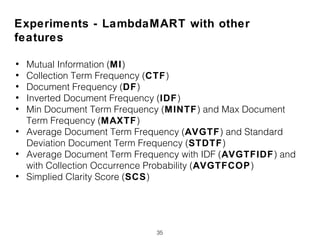
Experiments - LambdaMART with other
features
• Mutual Information (MI)
• Collection Term Frequency (CTF)
• Document Frequency (DF)
• Inverted Document Frequency (IDF)
• Min Document Term Frequency (MINTF) and Max Document
Term Frequency (MAXTF)
• Average Document Term Frequency (AVGTF) and Standard
Deviation Document Term Frequency (STDTF)
• Average Document Term Frequency with IDF (AVGTFIDF) and
with Collection Occurrence Probability (AVGTFCOP)
• Simplied Clarity Score (SCS)
36
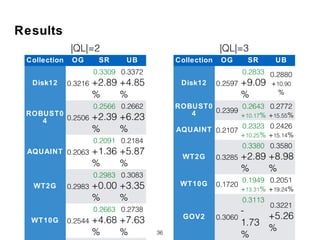
Results
Collection OG SR UB
Disk12 0.3216
0.3309
+2.89
%
0.3372
+4.85
%
ROBUST0
4 0.2506
0.2566
+2.39
%
0.2662
+6.23
%
AQUAINT 0.2063
0.2091
+1.36
%
0.2184
+5.87
%
WT2G 0.2983
0.2983
+0.00
%
0.3083
+3.35
%
WT10G 0.2544
0.2663
+4.68
%
0.2738
+7.63
%
Collection OG SR UB
Disk12 0.2597
0.2833
+9.09
%
0.2880
+10.90
%
ROBUST0
4 0.2399
0.2643
+10.17%
0.2772
+15.55%
AQUAINT 0.2107
0.2323
+10.25%
0.2426
+15.14%
WT2G 0.3285
0.3380
+2.89
%
0.3580
+8.98
%
WT10G 0.1720
0.1949
+13.31%
0.2051
+19.24%
GOV2 0.3060
0.3113
-
1.73
%
0.3221
+5.26
%
|QL|=2 |QL|=3
37
Feature Analysis
BasicBasic PXMPXM TSTS TCPTCP
BasicBasic PXMPXM TS TCPTCP
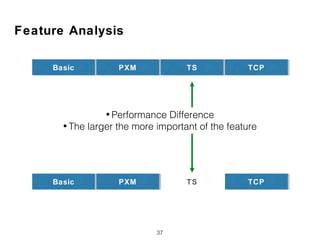
• Performance Difference
• The larger the more important of the feature
38
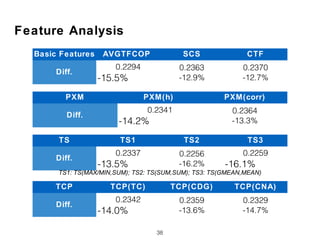
Feature Analysis
Basic Features AVGTFCOP SCS CTF
Diff.
0.2294
-15.5%
0.2363
-12.9%
0.2370
-12.7%
TCP TCP(TC) TCP(CDG) TCP(CNA)
Diff.
0.2342
-14.0%
0.2359
-13.6%
0.2329
-14.7%
PXM PXM(h) PXM(corr)
Diff.
0.2341
-14.2%
0.2364
-13.3%
TS TS1 TS2 TS3
Diff.
0.2337
-13.5%
0.2256
-16.2%
0.2259
-16.1%
TS1: TS(MAX/MIN,SUM); TS2: TS(SUM,SUM); TS3: TS(GMEAN,MEAN)
39
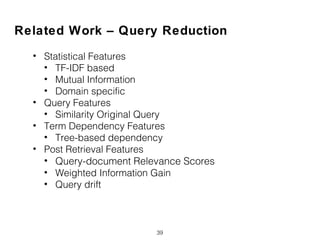
Related Work – Query Reduction
• Statistical Features
• TF-IDF based
• Mutual Information
• Domain specific
• Query Features
• Similarity Original Query
• Term Dependency Features
• Tree-based dependency
• Post Retrieval Features
• Query-document Relevance Scores
• Weighted Information Gain
• Query drift
Thank You!
Q & A
40

Can Short Queries be Even Shorter?

  • 1.
    Can Short QueriesBe Even Shorter? University of Delaware 1
  • 2.
    Long/Verbose Queries Had BeenExtensively Studied 2 • Example long query here …
  • 3.
    3 However … Can shortqueries have the similar property?
  • 4.
    4 Family Leave Law (ROBUST04qid:648) 0.2725 MAP However … Can short queries have the similar property?
  • 5.
    5 Family Leave Law (ROBUST04qid:648) 0.2725 MAP Family Leave 0.4679 However … Can short queries have the similar property?
  • 6.
    6 Family Leave Law (ROBUST04qid:648) 0.2725 MAP Family Leave 0.4679 However … Can short queries have the similar property? • Subquery of the short query could be better!
  • 7.
    A high leveloverview • A comparison between the Best Subqueries with the Original Queries for TREC collections: 7 Collection Orig. Queries Best Subqueries Diff. Disk12 0.2597 0.2880 +10.9% ROBUST04 0.2399 0.2772 +15.5% AQUAINT 0.2107 0.2426 +15.1% WT2G 0.3285 0.3580 +9.0% WT10G 0.1720 0.2051 +19.2% GOV2 0.3060 0.3221 +5.3% On Average 0.2528 0.2821 +12.5%
  • 8.
    8 Question: “Family Leave Law” OriginalQuery “Family Leave” Best Subquery ? • Can we identify those optimal subqueries? • How do identify?
  • 9.
    We formulate itas a Subquery Ranking Problem Family Leave Law 9 Family Leave Law Family Leave Leave Law Family Law F F F F F F F 0.2725 0.0029 0.2477 0.0000 0.4679 0.0639 0.0046 LearnExtract Subquery Features Label(MAP )
  • 10.
    Then the keyis the Features 10 Family Leave Features
  • 11.
    Previously Proposed Features 11 PreviouslyProposed Features (for verbose query) Statistical Query Post-Retrieval TF IDF Collection TF Collection IDF Mutual Information Similarity with Orig. Contain Stopwords? Query Drift Query Scope Clarity Score Weighted Information Gain Family Leave Features
  • 12.
    The Problem ofPreviously Proposed Features 12 Family Leave Law IDFs 13.26 12.39 8.98
  • 13.
    The Problem ofPreviously Proposed Features 13 Remove the term with lowest IDF Family Leave Law IDFs 13.26 12.39 8.98
  • 14.
    The Problem ofPreviously Proposed Features 14 ? ? When stop removing? Remove the term with lowest IDF Family Leave Law IDFs 13.26 12.39 8.98
  • 15.
    The Problem ofPreviously Proposed Features 15 Other features do not work well (details in the paper) ? ? When stop removing? Remove the term with lowest IDF Family Leave Law IDFs 13.26 12.39 8.98
  • 16.
    New futures areproposed to tackle the problem • Post-retrieval • Focus on term relationship • document level features term level features 16
  • 17.
    New futures areproposed to tackle the problem • Post-retrieval • Focus on term relationship • document level features term level features • 3 Categories of features • Term Proximity based Features • Term Score based Features • Compactness and Positions of Term Score Tensors 17
  • 18.
    Term Proximity basedFeatures (PXM) • Term Dependency Model [Metzler05] 18 Family Leave Law
  • 19.
    Term Proximity basedFeatures (PXM) • Term Dependency Model [Metzler05] 19 Family Leave Law • Already know it is a law code • Occur together • In that order
  • 20.
    Term Proximity basedFeatures (PXM) • Term Dependency Model [Metzler05] 20 • Already know it is a law code • Occur together • In that order How to capture the feature? Family Leave Law
  • 21.
    How to CapturePXM? • Use proximity query 21 #combine(#uw4(family leave) #ow4(family leave)) Unordered Window of 4 Ordered Window of 4
  • 22.
    • Use proximityquery 22 #combine(#uw4(family leave) #ow4(family leave)) Unordered Window of 4 Ordered Window of 4 • Explore the ranking scores 0.5894 0.5632 0.5323 0.4927 How to Capture PXM? MIN MAX MAX-MIN MAX/MIN SUM MEAN STD GMEAN proximity ranking scores 0.5894 0.5632 0.5323 0.4927 proximity ranking scores 0.6288 0.6109 0.6099 0.5912 original ranking scores correlationcorrelation
  • 23.
    Term Score basedFeatures (TS) • TF-IDF Constraint [Fang2011] 23 SVM Tutorial SVM Tutorial 99 1 50 50 Counter Intuitive
  • 24.
    • TF-IDF Constraint[Fang2011] 24 • We instead look at the term scores… SVM Tutorial SVM Tutorial 99 1 50 50 Counter Intuitive Term Score based Features (TS)
  • 25.
    25 • We lookat the term scores… • Colors are relevant probability • Queries have different term scores distribution One term is more important Terms are of relatively equivalent importance Term Score based Features (TS)
  • 26.
    26 • Explore theranking scores of terms 0.2123 0.4596 0.0038 0.2346 0.4087 0.0002 0.2016 0.4456 0.0016 0.1946 0.4213 0.0027 0.1942 0.3928 0.0059 How to Capture TS? Family Leave Law feature func (max) feature funcs MIN, MAX, MAX-MIN, MAX/MIN, SUM, MEAN, STD, GMEAN 0.4596 0.4087 0.4456 0.4213 0.3928 feature func (mean) 0.4256 Final Feature doc1 doc2 doc3 doc4 doc5 Individual Term Score
  • 27.
    Compactness and Positionsof Term Score Tensors (TCP) • Normalized Query Commitment (NQC) [Shtok2012] 27 0.5894 0.5632 0.5323 0.4927 document ranking scores 0.6678 0.5632 0.4896 Quote: “Higher deviation value was correlated with potentially lower query drift, and thus indicating the better effectiveness" Larger Gap Larger Gap
  • 28.
    28 Compactness and Positionsof Term Score Tensors (TCP) • We instead look at the term scores… • Term scores as tensors in multi-dimensional space Relevant Documents NonRelevant Documents
  • 29.
    29 Compactness and Positionsof Term Score Tensors (TCP) • We instead look at the term scores… • Term scores as tensors in multi-dimensional space • Best subquery has more compact tensors • But clustered at different locations Relevant Documents NonRelevant Documents
  • 30.
    30 Compactness of Tensors •Mean and Standard Deviation of the distances between tensors and their centroid
  • 31.
    31 Tensor Closeness toDiagonal (CDG) • The distance from the tensors centroid to the diagonal line in multi-dimensional space • Mean and Standard deviation of the distances from tensors to the diagonal line
  • 32.
    32 Tensor Closeness toNearest Axis (CNA) • The distance from the tensors centroid to the nearest axis in multi-dimensional space • Mean and Standard deviation of the distances from tensors to the nearest axis
  • 33.
    33 Experiments Collection #qry |QL|=2|QL|=3 |QL|=4 Disk12 150 30(20%) 37(25%) 41(27%) ROBUST04 250 75(33%) 147(59%) 17(7%) AQUAINT 50 21(42%) 27(54%) 1(2%) WT2G 50 24(48%) 23(46%) 0(0%) WT10G 100 30(30%) 25(25%) 20(20%) GOV2 150 44(29%) 65(43%) 35(23%) Keep Drop
  • 34.
    34 Experiments - mappinglabels from AP to Integer
  • 35.
    35 Experiments - LambdaMARTwith other features • Mutual Information (MI) • Collection Term Frequency (CTF) • Document Frequency (DF) • Inverted Document Frequency (IDF) • Min Document Term Frequency (MINTF) and Max Document Term Frequency (MAXTF) • Average Document Term Frequency (AVGTF) and Standard Deviation Document Term Frequency (STDTF) • Average Document Term Frequency with IDF (AVGTFIDF) and with Collection Occurrence Probability (AVGTFCOP) • Simplied Clarity Score (SCS)
  • 36.
    36 Results Collection OG SRUB Disk12 0.3216 0.3309 +2.89 % 0.3372 +4.85 % ROBUST0 4 0.2506 0.2566 +2.39 % 0.2662 +6.23 % AQUAINT 0.2063 0.2091 +1.36 % 0.2184 +5.87 % WT2G 0.2983 0.2983 +0.00 % 0.3083 +3.35 % WT10G 0.2544 0.2663 +4.68 % 0.2738 +7.63 % Collection OG SR UB Disk12 0.2597 0.2833 +9.09 % 0.2880 +10.90 % ROBUST0 4 0.2399 0.2643 +10.17% 0.2772 +15.55% AQUAINT 0.2107 0.2323 +10.25% 0.2426 +15.14% WT2G 0.3285 0.3380 +2.89 % 0.3580 +8.98 % WT10G 0.1720 0.1949 +13.31% 0.2051 +19.24% GOV2 0.3060 0.3113 - 1.73 % 0.3221 +5.26 % |QL|=2 |QL|=3
  • 37.
    37 Feature Analysis BasicBasic PXMPXMTSTS TCPTCP BasicBasic PXMPXM TS TCPTCP • Performance Difference • The larger the more important of the feature
  • 38.
    38 Feature Analysis Basic FeaturesAVGTFCOP SCS CTF Diff. 0.2294 -15.5% 0.2363 -12.9% 0.2370 -12.7% TCP TCP(TC) TCP(CDG) TCP(CNA) Diff. 0.2342 -14.0% 0.2359 -13.6% 0.2329 -14.7% PXM PXM(h) PXM(corr) Diff. 0.2341 -14.2% 0.2364 -13.3% TS TS1 TS2 TS3 Diff. 0.2337 -13.5% 0.2256 -16.2% 0.2259 -16.1% TS1: TS(MAX/MIN,SUM); TS2: TS(SUM,SUM); TS3: TS(GMEAN,MEAN)
  • 39.
    39 Related Work –Query Reduction • Statistical Features • TF-IDF based • Mutual Information • Domain specific • Query Features • Similarity Original Query • Term Dependency Features • Tree-based dependency • Post Retrieval Features • Query-document Relevance Scores • Weighted Information Gain • Query drift
  • 40.