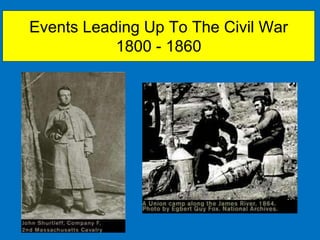
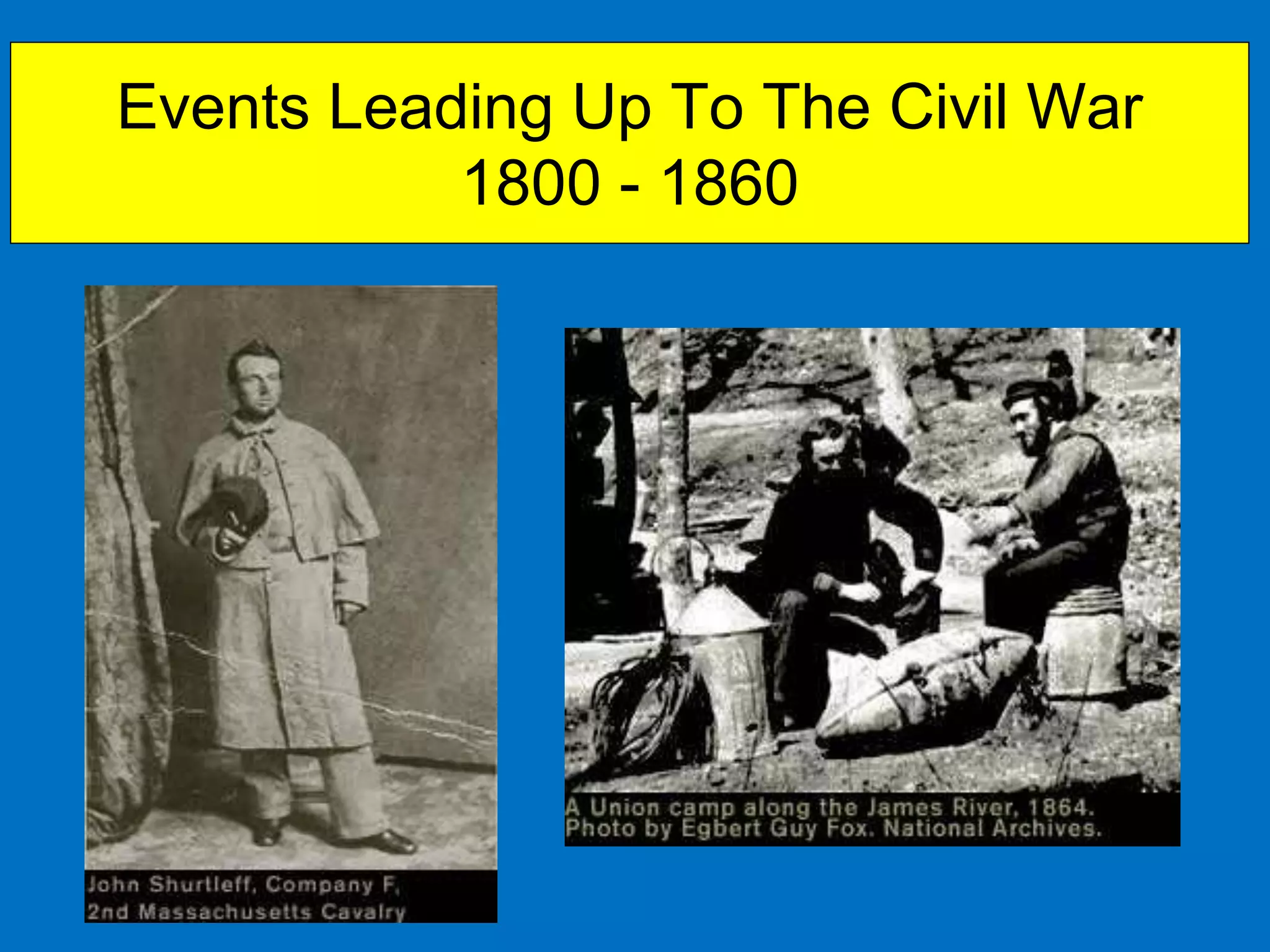
Events Leading Up To The Civil War
1800 - 1860
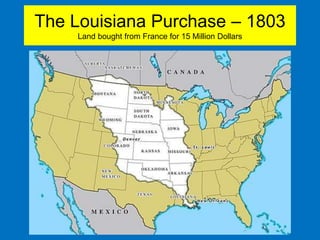
The Louisiana Purchase – 1803
Land bought from France for 15 Million Dollars
Florida - 1819
The Adams–Onís Treaty of 1819, also
known as the Florida Purchase Treaty, was
a deal between the US and Spain in 1819
that gave Florida to the U.S.
THE MISSOURI
COMPROMISE
(1820)
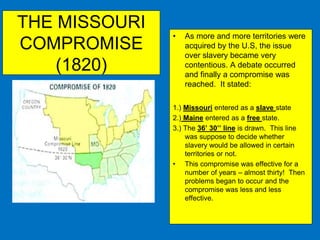
• As more and more territories were
acquired by the U.S, the issue
over slavery became very
contentious. A debate occurred
and finally a compromise was
reached. It stated:
1.) Missouri entered as a slave state
2.) Maine entered as a free state.
3.) The 36’ 30’’ line is drawn. This line
was suppose to decide whether
slavery would be allowed in certain
territories or not.
• This compromise was effective for a
number of years – almost thirty! Then
problems began to occur and the
compromise was less and less
effective.
Nullification Crisis
The nullification crisis was the confrontation between the
state of South Carolina and the federal government in
1832–33.
The state declared null and void the federal Tariffs of 1828
and 1832. These were seen as an attack on the South by the
North.
The matter was resolved in favour of the federal
government.
Rise of Abolitionist Cause
The abolitionist movement began to become more organized
and radical in the North around 1830.
Historians believe ideas set forth during the Second Great
Awakening inspired abolitionists to rise up against slavery.
This Protestant revival encouraged the adopting of renewed
morals, which centred around the idea that all men are
created equal in the eyes of God.
Treaty of Guadalupe Hidalgo - 1848
In 1847 the Mexican army was defeated by US forces and the
Mexican government surrendered.
On February 2, 1848, Mexico signed the Treaty of
Guadalupe Hidalgo.
The treaty gave the land that now makes up all or parts of
present-day Arizona, California, Colorado, Nevada, New
Mexico, Utah and Wyoming.
Mexico also gave up all claims to Texas and recognized the
Rio Grande as America’s southern boundary.
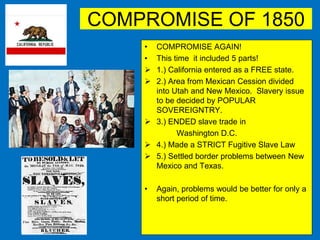
COMPROMISE OF 1850
• COMPROMISE AGAIN!
• This time it included 5 parts!
 1.) California entered as a FREE state.
 2.) Area from Mexican Cession divided
into Utah and New Mexico. Slavery issue
to be decided by POPULAR
SOVEREIGNTRY.
 3.) ENDED slave trade in
Washington D.C.
 4.) Made a STRICT Fugitive Slave Law
 5.) Settled border problems between New
Mexico and Texas.
• Again, problems would be better for only a
short period of time.
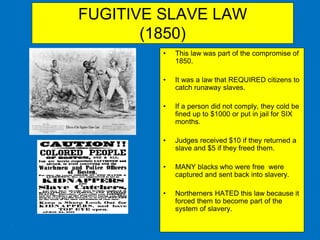
FUGITIVE SLAVE LAW
(1850)
• This law was part of the compromise of
1850.
• It was a law that REQUIRED citizens to
catch runaway slaves.
• If a person did not comply, they cold be
fined up to $1000 or put in jail for SIX
months.
• Judges received $10 if they returned a
slave and $5 if they freed them.
• MANY blacks who were free were
captured and sent back into slavery.
• Northerners HATED this law because it
forced them to become part of the
system of slavery.
/
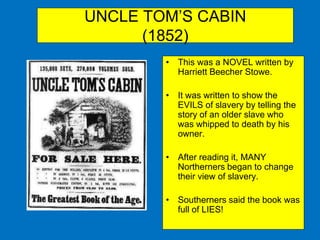
UNCLE TOM’S CABIN
(1852)
• This was a NOVEL written by
Harriett Beecher Stowe.
• It was written to show the
EVILS of slavery by telling the
story of an older slave who
was whipped to death by his
owner.
• After reading it, MANY
Northerners began to change
their view of slavery.
• Southerners said the book was
full of LIES!
KANSAS-NEBRASKA ACT
(1854)
• Divided lands into Kansas and Nebraska
territories.
• Decided that SLAVERY issue would be decided
by POPULAR SOVREIGNTY (issues voted on
by the people in the territory/state).
• Led to violence in the Senate. Preston Brooks
and Charles Sumner.
• Pro-slavery and Anti-slavery settlers in ONE
AREA and this led to conflict!
• Northerners believe this REPEALED the
Missouri Compromise.
• Bleeding Kansas – Gov. John Geary sends out
1,300 federal troops to stop violence
Democratic senator Stephen A.
Douglas of Illinois sponsored this
bill.
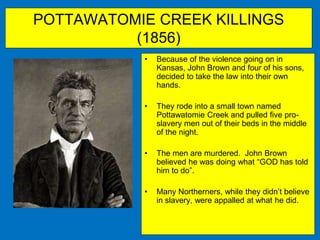
POTTAWATOMIE CREEK KILLINGS
(1856)
• Because of the violence going on in
Kansas, John Brown and four of his sons,
decided to take the law into their own
hands.
• They rode into a small town named
Pottawatomie Creek and pulled five pro-
slavery men out of their beds in the middle
of the night.
• The men are murdered. John Brown
believed he was doing what “GOD has told
him to do”.
• Many Northerners, while they didn’t believe
in slavery, were appalled at what he did.
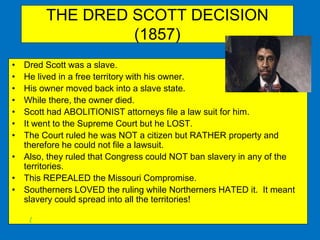
THE DRED SCOTT DECISION
(1857)
• Dred Scott was a slave.
• He lived in a free territory with his owner.
• His owner moved back into a slave state.
• While there, the owner died.
• Scott had ABOLITIONIST attorneys file a law suit for him.
• It went to the Supreme Court but he LOST.
• The Court ruled he was NOT a citizen but RATHER property and
therefore he could not file a lawsuit.
• Also, they ruled that Congress could NOT ban slavery in any of the
territories.
• This REPEALED the Missouri Compromise.
• Southerners LOVED the ruling while Northerners HATED it. It meant
slavery could spread into all the territories!
/
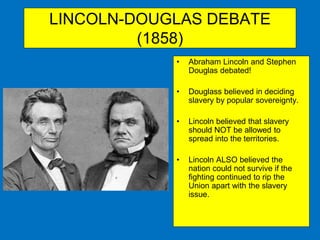
LINCOLN-DOUGLAS DEBATE
(1858)
• Abraham Lincoln and Stephen
Douglas debated!
• Douglass believed in deciding
slavery by popular sovereignty.
• Lincoln believed that slavery
should NOT be allowed to
spread into the territories.
• Lincoln ALSO believed the
nation could not survive if the
fighting continued to rip the
Union apart with the slavery
issue.
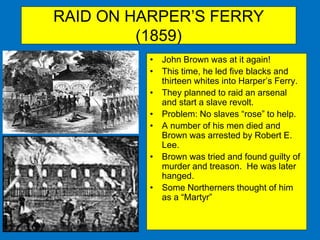
RAID ON HARPER’S FERRY
(1859)
• John Brown was at it again!
• This time, he led five blacks and
thirteen whites into Harper’s Ferry.
• They planned to raid an arsenal
and start a slave revolt.
• Problem: No slaves “rose” to help.
• A number of his men died and
Brown was arrested by Robert E.
Lee.
• Brown was tried and found guilty of
murder and treason. He was later
hanged.
• Some Northerners thought of him
as a “Martyr”
http://www.pbs.org/wgbh/amex/brown/peopleevents/pande09.html
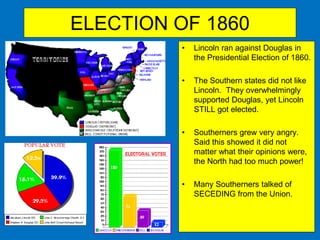
ELECTION OF 1860
• Lincoln ran against Douglas in
the Presidential Election of 1860.
• The Southern states did not like
Lincoln. They overwhelmingly
supported Douglas, yet Lincoln
STILL got elected.
• Southerners grew very angry.
Said this showed it did not
matter what their opinions were,
the North had too much power!
• Many Southerners talked of
SECEDING from the Union.
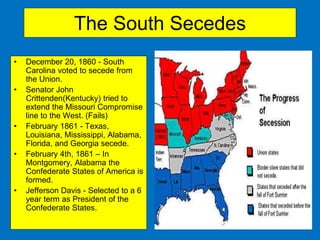
The South Secedes
• December 20, 1860 - South
Carolina voted to secede from
the Union.
• Senator John
Crittenden(Kentucky) tried to
extend the Missouri Compromise
line to the West. (Fails)
• February 1861 - Texas,
Louisiana, Mississippi, Alabama,
Florida, and Georgia secede.
• February 4th, 1861 – In
Montgomery, Alabama the
Confederate States of America is
formed.
• Jefferson Davis - Selected to a 6
year term as President of the
Confederate States.
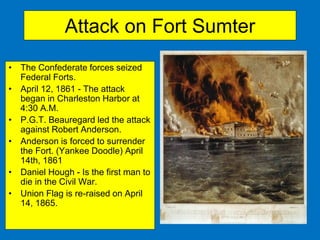
Attack on Fort Sumter
• The Confederate forces seized
Federal Forts.
• April 12, 1861 - The attack
began in Charleston Harbor at
4:30 A.M.
• P.G.T. Beauregard led the attack
against Robert Anderson.
• Anderson is forced to surrender
the Fort. (Yankee Doodle) April
14th, 1861
• Daniel Hough - Is the first man to
die in the Civil War.
• Union Flag is re-raised on April
14, 1865.
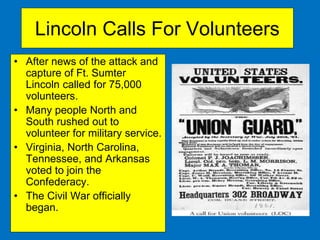
Lincoln Calls For Volunteers
• After news of the attack and
capture of Ft. Sumter
Lincoln called for 75,000
volunteers.
• Many people North and
South rushed out to
volunteer for military service.
• Virginia, North Carolina,
Tennessee, and Arkansas
voted to join the
Confederacy.
• The Civil War officially
began.

Grade 11 Causes-of-the-Civil-War.ppt

  • 1.
    Events Leading UpTo The Civil War 1800 - 1860
  • 2.
    The Louisiana Purchase– 1803 Land bought from France for 15 Million Dollars
  • 3.
    Florida - 1819 TheAdams–Onís Treaty of 1819, also known as the Florida Purchase Treaty, was a deal between the US and Spain in 1819 that gave Florida to the U.S.
  • 4.
    THE MISSOURI COMPROMISE (1820) • Asmore and more territories were acquired by the U.S, the issue over slavery became very contentious. A debate occurred and finally a compromise was reached. It stated: 1.) Missouri entered as a slave state 2.) Maine entered as a free state. 3.) The 36’ 30’’ line is drawn. This line was suppose to decide whether slavery would be allowed in certain territories or not. • This compromise was effective for a number of years – almost thirty! Then problems began to occur and the compromise was less and less effective.
  • 5.
    Nullification Crisis The nullificationcrisis was the confrontation between the state of South Carolina and the federal government in 1832–33. The state declared null and void the federal Tariffs of 1828 and 1832. These were seen as an attack on the South by the North. The matter was resolved in favour of the federal government.
  • 6.
    Rise of AbolitionistCause The abolitionist movement began to become more organized and radical in the North around 1830. Historians believe ideas set forth during the Second Great Awakening inspired abolitionists to rise up against slavery. This Protestant revival encouraged the adopting of renewed morals, which centred around the idea that all men are created equal in the eyes of God.
  • 7.
    Treaty of GuadalupeHidalgo - 1848 In 1847 the Mexican army was defeated by US forces and the Mexican government surrendered. On February 2, 1848, Mexico signed the Treaty of Guadalupe Hidalgo. The treaty gave the land that now makes up all or parts of present-day Arizona, California, Colorado, Nevada, New Mexico, Utah and Wyoming. Mexico also gave up all claims to Texas and recognized the Rio Grande as America’s southern boundary.
  • 8.
    COMPROMISE OF 1850 •COMPROMISE AGAIN! • This time it included 5 parts!  1.) California entered as a FREE state.  2.) Area from Mexican Cession divided into Utah and New Mexico. Slavery issue to be decided by POPULAR SOVEREIGNTRY.  3.) ENDED slave trade in Washington D.C.  4.) Made a STRICT Fugitive Slave Law  5.) Settled border problems between New Mexico and Texas. • Again, problems would be better for only a short period of time.
  • 9.
    FUGITIVE SLAVE LAW (1850) •This law was part of the compromise of 1850. • It was a law that REQUIRED citizens to catch runaway slaves. • If a person did not comply, they cold be fined up to $1000 or put in jail for SIX months. • Judges received $10 if they returned a slave and $5 if they freed them. • MANY blacks who were free were captured and sent back into slavery. • Northerners HATED this law because it forced them to become part of the system of slavery. /
  • 10.
    UNCLE TOM’S CABIN (1852) •This was a NOVEL written by Harriett Beecher Stowe. • It was written to show the EVILS of slavery by telling the story of an older slave who was whipped to death by his owner. • After reading it, MANY Northerners began to change their view of slavery. • Southerners said the book was full of LIES!
  • 11.
    KANSAS-NEBRASKA ACT (1854) • Dividedlands into Kansas and Nebraska territories. • Decided that SLAVERY issue would be decided by POPULAR SOVREIGNTY (issues voted on by the people in the territory/state). • Led to violence in the Senate. Preston Brooks and Charles Sumner. • Pro-slavery and Anti-slavery settlers in ONE AREA and this led to conflict! • Northerners believe this REPEALED the Missouri Compromise. • Bleeding Kansas – Gov. John Geary sends out 1,300 federal troops to stop violence Democratic senator Stephen A. Douglas of Illinois sponsored this bill.
  • 12.
    POTTAWATOMIE CREEK KILLINGS (1856) •Because of the violence going on in Kansas, John Brown and four of his sons, decided to take the law into their own hands. • They rode into a small town named Pottawatomie Creek and pulled five pro- slavery men out of their beds in the middle of the night. • The men are murdered. John Brown believed he was doing what “GOD has told him to do”. • Many Northerners, while they didn’t believe in slavery, were appalled at what he did.
  • 13.
    THE DRED SCOTTDECISION (1857) • Dred Scott was a slave. • He lived in a free territory with his owner. • His owner moved back into a slave state. • While there, the owner died. • Scott had ABOLITIONIST attorneys file a law suit for him. • It went to the Supreme Court but he LOST. • The Court ruled he was NOT a citizen but RATHER property and therefore he could not file a lawsuit. • Also, they ruled that Congress could NOT ban slavery in any of the territories. • This REPEALED the Missouri Compromise. • Southerners LOVED the ruling while Northerners HATED it. It meant slavery could spread into all the territories! /
  • 14.
    LINCOLN-DOUGLAS DEBATE (1858) • AbrahamLincoln and Stephen Douglas debated! • Douglass believed in deciding slavery by popular sovereignty. • Lincoln believed that slavery should NOT be allowed to spread into the territories. • Lincoln ALSO believed the nation could not survive if the fighting continued to rip the Union apart with the slavery issue.
  • 15.
    RAID ON HARPER’SFERRY (1859) • John Brown was at it again! • This time, he led five blacks and thirteen whites into Harper’s Ferry. • They planned to raid an arsenal and start a slave revolt. • Problem: No slaves “rose” to help. • A number of his men died and Brown was arrested by Robert E. Lee. • Brown was tried and found guilty of murder and treason. He was later hanged. • Some Northerners thought of him as a “Martyr” http://www.pbs.org/wgbh/amex/brown/peopleevents/pande09.html
  • 16.
    ELECTION OF 1860 •Lincoln ran against Douglas in the Presidential Election of 1860. • The Southern states did not like Lincoln. They overwhelmingly supported Douglas, yet Lincoln STILL got elected. • Southerners grew very angry. Said this showed it did not matter what their opinions were, the North had too much power! • Many Southerners talked of SECEDING from the Union.
  • 17.
    The South Secedes •December 20, 1860 - South Carolina voted to secede from the Union. • Senator John Crittenden(Kentucky) tried to extend the Missouri Compromise line to the West. (Fails) • February 1861 - Texas, Louisiana, Mississippi, Alabama, Florida, and Georgia secede. • February 4th, 1861 – In Montgomery, Alabama the Confederate States of America is formed. • Jefferson Davis - Selected to a 6 year term as President of the Confederate States.
  • 18.
    Attack on FortSumter • The Confederate forces seized Federal Forts. • April 12, 1861 - The attack began in Charleston Harbor at 4:30 A.M. • P.G.T. Beauregard led the attack against Robert Anderson. • Anderson is forced to surrender the Fort. (Yankee Doodle) April 14th, 1861 • Daniel Hough - Is the first man to die in the Civil War. • Union Flag is re-raised on April 14, 1865.
  • 19.
    Lincoln Calls ForVolunteers • After news of the attack and capture of Ft. Sumter Lincoln called for 75,000 volunteers. • Many people North and South rushed out to volunteer for military service. • Virginia, North Carolina, Tennessee, and Arkansas voted to join the Confederacy. • The Civil War officially began.