QUIZ CH 9 S 4
1. Name the city and state where gold was found
2. Name the 11th
President
3. Founded a colony in Texas
4. Name one hero from the Battle that they
fought for Independence
5. Name the treaty that completed United States
6. Name the safe path that led settlers to the west
7. Name the Battle in Texas where they fought for
Independence
8. Term for US expansion ocean to ocean
9. Name the Mexican president
10. Name the boundary of Texas
Chapter 10 Section 1
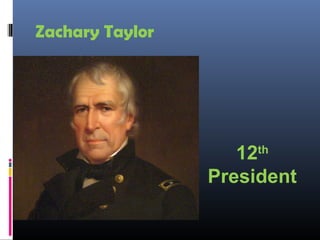
Zachary Taylor
12th
President
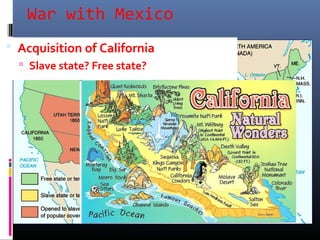
War with Mexico
 Acquisition of California
 Slave state? Free state?
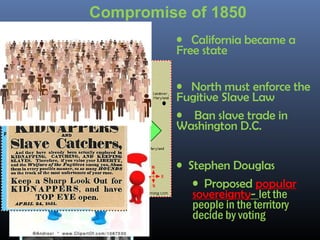
• California became a
Free state
• North must enforce the
Fugitive Slave Law
• Ban slave trade in
Washington D.C.
• Stephen Douglas
• Proposed popular
sovereignty- let the
people in the territory
decide by voting
•Henry ClayHenry Clay
Compromise of 1850
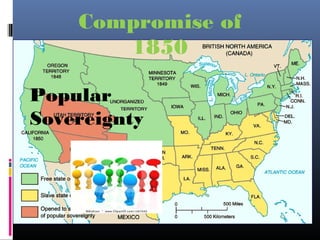
Compromise of
1850
Popular
Sovereignty
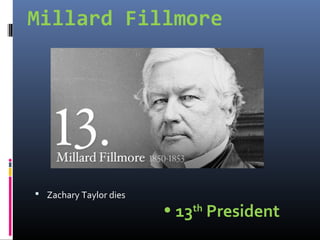
Millard Fillmore
 Zachary Taylor dies
• 13th
President
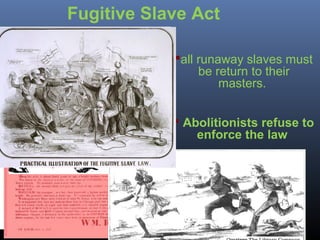
all runaway slaves must
be return to their
masters.
 Abolitionists refuse to
enforce the law
Fugitive Slave Act
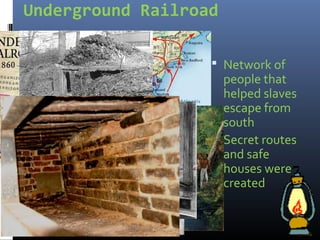
Underground Railroad
 Network of
people that
helped slaves
escape from
south
 Secret routes
and safe
houses were
created
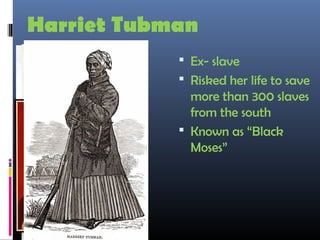
Harriet Tubman
 Ex- slave
 Risked her life to save
more than 300 slaves
from the south
 Known as “Black
Moses”
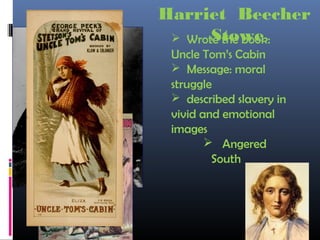
Harriet Beecher
Stowe Wrote the book:
Uncle Tom’s Cabin
 Message: moral
struggle
 described slavery in
vivid and emotional
images
 Angered
South
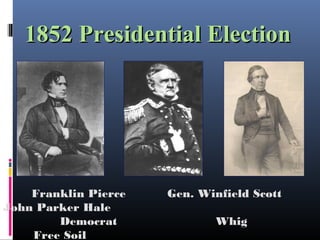
1852 Presidential Election1852 Presidential Election
Franklin Pierce Gen. Winfield Scott
John Parker Hale
Democrat Whig
Free Soil
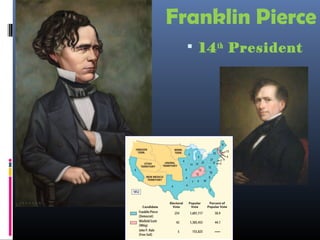
Franklin Pierce
 14th
President
Birth of the Republican
Party, 1854
Birth of Republican
 Founded by anti-slavery, Whigs and Free-
Soiler
 Major goal: keep slavery out of WEST
 Also known as GOP (Grand Old Party)
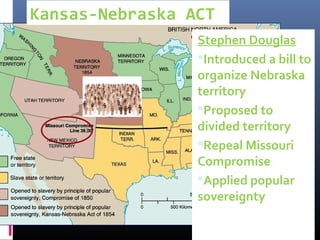
Kansas-Nebraska ACT
Stephen Douglas
Introduced a bill to
organize Nebraska
territory
Proposed to
divided territory
Repeal Missouri
Compromise
Applied popular
sovereignty
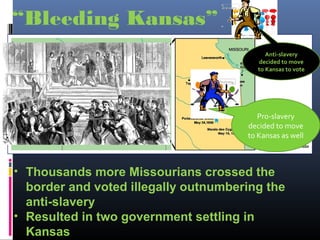
“Bleeding Kansas”
Anti-slavery
decided to move
to Kansas to vote
Popular
Sovereignty
Pro-slavery
decided to move
to Kansas as well
• Thousands more Missourians crossed the
border and voted illegally outnumbering the
anti-slavery
• Resulted in two government settling in
Kansas
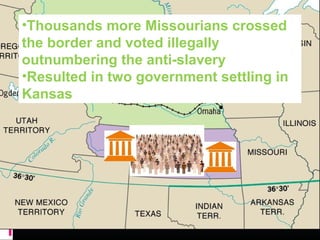
•Thousands more Missourians crossed
the border and voted illegally
outnumbering the anti-slavery
•Resulted in two government settling in
Kansas
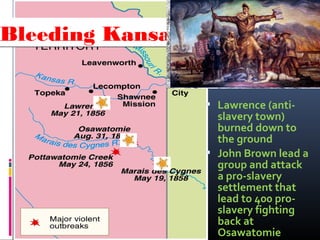
 Lawrence (anti-
slavery town)
burned down to
the ground
 John Brown lead a
group and attack
a pro-slavery
settlement that
lead to 400 pro-
slavery fighting
back at
Osawatomie
“Bleeding Kansas”Bleeding Kansas”
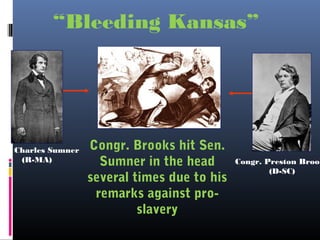
Congr. Brooks hit Sen.
Sumner in the head
several times due to his
remarks against pro-
slavery
Congr. Preston Brook
(D-SC)
en. Charles Sumner
(R-MA)
“Bleeding Kansas”
 Chapter 10 Section 2
 Copy EXACTLY what you see. Including the
three boxes on top
 Questions and answers
Chapter 10 Section 3
CHAPTER 10
SEC 3-4
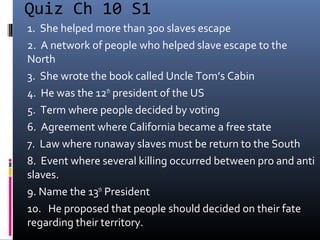
Quiz Ch 10 S1
1. She helped more than 300 slaves escape
2. A network of people who helped slave escape to the
North
3. She wrote the book called Uncle Tom’s Cabin
4. He was the 12th
president of the US
5. Term where people decided by voting
6. Agreement where California became a free state
7. Law where runaway slaves must be return to the South
8. Event where several killing occurred between pro and anti
slaves.
9. Name the 13th
President
10. He proposed that people should decided on their fate
regarding their territory.
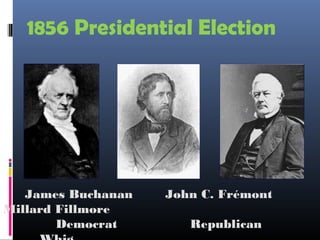
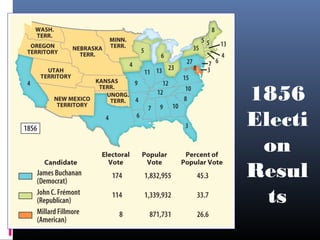
1856 Presidential Election
James Buchanan John C. Frémont
Millard Fillmore
Democrat Republican
1856
Electi
on
Resul
ts
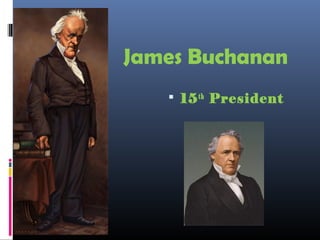
James Buchanan
 15th
President
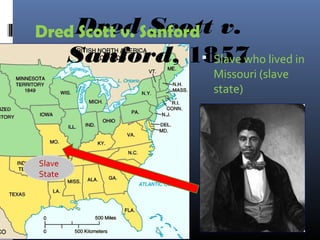
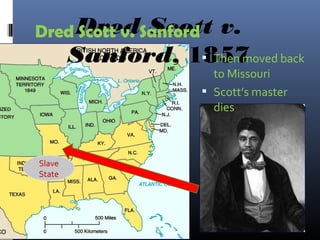
Dred Scott v.
Sanford, 1857
Dred Scott v. Sanford
 Slave who lived in
Missouri (slave
state)
Slave
State
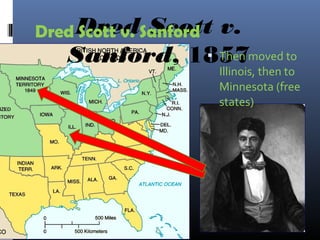
Dred Scott v.
Sanford, 1857 Then moved to
Illinois, then to
Minnesota (free
states)
Dred Scott v. Sanford
Dred Scott v.
Sanford, 1857 Then moved back
to Missouri
 Scott’s master
dies
Slave
State
Dred Scott v. Sanford
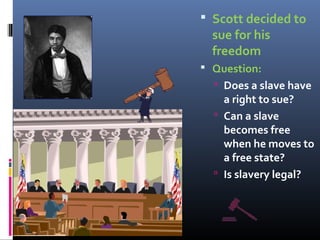
 Scott decided to
sue for his
freedom
 Question:
 Does a slave have
a right to sue?
 Can a slave
becomes free
when he moves to
a free state?
 Is slavery legal?
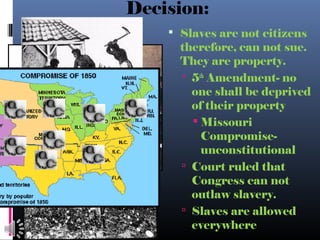
Decision:
 Slaves are not citizens
therefore, can not sue.
They are property.
 5th
Amendment- no
one shall be deprived
of their property
 Missouri
Compromise-
unconstitutional
 Court ruled that
Congress can not
outlaw slavery.
 Slaves are allowed
everywhere
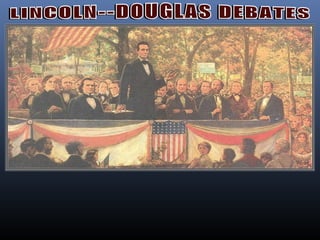
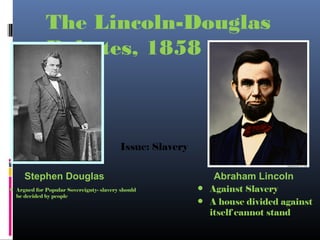
The Lincoln-Douglas
Debates, 1858
Stephen Douglas Abraham Lincoln
Issue: Slavery
• Against Slavery
• A house divided against
itself cannot stand
• Argued for Popular Sovereignty- slavery should
be decided by people
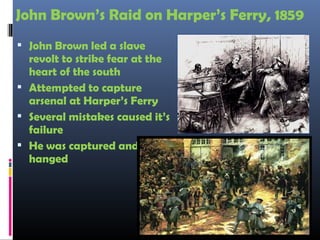
John Brown’s Raid on Harper’s Ferry, 1859
 John Brown led a slave
revolt to strike fear at the
heart of the south
 Attempted to capture
arsenal at Harper’s Ferry
 Several mistakes caused it’s
failure
 He was captured and
hanged
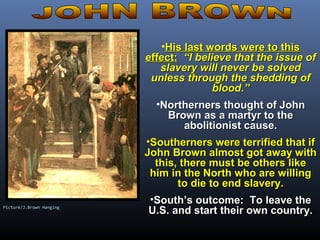
•His last words were to thisHis last words were to this
effect:effect: “I believe that the issue of“I believe that the issue of
slavery will never be solvedslavery will never be solved
unless through the shedding ofunless through the shedding of
blood.”blood.”
•Northerners thought of JohnNortherners thought of John
Brown as a martyr to theBrown as a martyr to the
abolitionist cause.abolitionist cause.
•Southerners were terrified that ifSoutherners were terrified that if
John Brown almost got away withJohn Brown almost got away with
this, there must be others likethis, there must be others like
him in the North who are willinghim in the North who are willing
to die to end slavery.to die to end slavery.
•South’s outcome: To leave theSouth’s outcome: To leave the
U.S. and start their own country.U.S. and start their own country.Picture/J.Brown Hanging
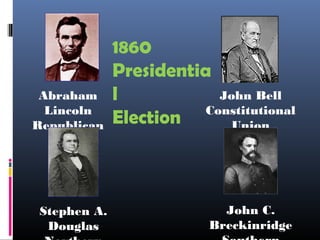
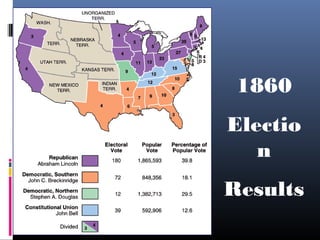
1860
Presidentia
l
Election
Abraham
Lincoln
Republican
John Bell
Constitutional
Union
Stephen A.
Douglas
John C.
Breckinridge
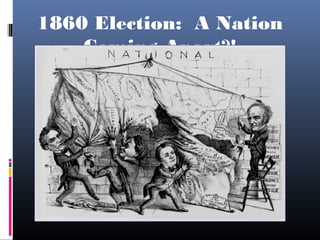
1860 Election: A Nation
Coming Apart?!
1860
Electio
n
Results
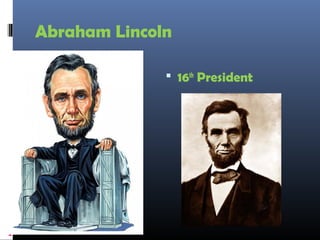
Abraham Lincoln
 16th
President
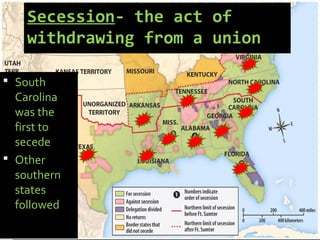
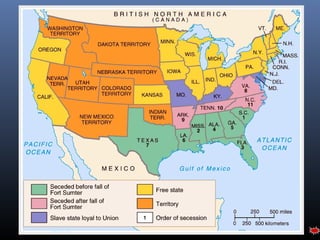
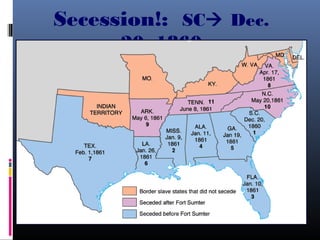
Secession- the act of
withdrawing from a union
 South
Carolina
was the
first to
secede
 Other
southern
states
followed
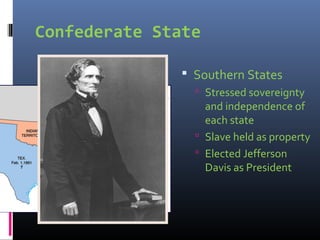
Confederate State
 Southern States
 Stressed sovereignty
and independence of
each state
 Slave held as property
 Elected Jefferson
Davis as President
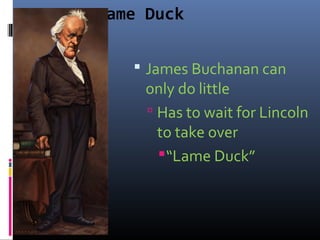
Lame Duck
 James Buchanan can
only do little
 Has to wait for Lincoln
to take over
“Lame Duck”
TEXTBOOK )(Questions and
Answers Main Ideas
 Pg 319 main idea: A
 Pg 320 Skillbuilder
 Pg 321 main idea : C
 Pg 325 main idea: A
 Pg 327 main idea: C
 Pg 328 main idea: D
 Pg 329 main idea: E
 Pg 330 main idea: F
Secession
Secession!: SC Dec.
20, 1860
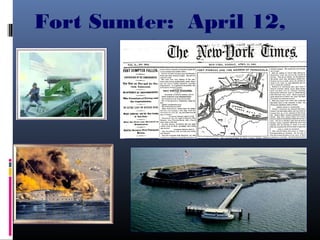
Fort Sumter: April 12,
1861

the Union in Peril

  • 1.
    QUIZ CH 9S 4 1. Name the city and state where gold was found 2. Name the 11th President 3. Founded a colony in Texas 4. Name one hero from the Battle that they fought for Independence 5. Name the treaty that completed United States 6. Name the safe path that led settlers to the west 7. Name the Battle in Texas where they fought for Independence 8. Term for US expansion ocean to ocean 9. Name the Mexican president 10. Name the boundary of Texas
  • 2.
  • 3.
  • 4.
    War with Mexico Acquisition of California  Slave state? Free state?
  • 5.
    • California becamea Free state • North must enforce the Fugitive Slave Law • Ban slave trade in Washington D.C. • Stephen Douglas • Proposed popular sovereignty- let the people in the territory decide by voting •Henry ClayHenry Clay Compromise of 1850
  • 6.
  • 7.
    Millard Fillmore  ZacharyTaylor dies • 13th President
  • 8.
    all runaway slavesmust be return to their masters.  Abolitionists refuse to enforce the law Fugitive Slave Act
  • 9.
    Underground Railroad  Networkof people that helped slaves escape from south  Secret routes and safe houses were created
  • 10.
    Harriet Tubman  Ex-slave  Risked her life to save more than 300 slaves from the south  Known as “Black Moses”
  • 11.
    Harriet Beecher Stowe Wrotethe book: Uncle Tom’s Cabin  Message: moral struggle  described slavery in vivid and emotional images  Angered South
  • 12.
    1852 Presidential Election1852Presidential Election Franklin Pierce Gen. Winfield Scott John Parker Hale Democrat Whig Free Soil
  • 13.
  • 14.
    Birth of theRepublican Party, 1854 Birth of Republican  Founded by anti-slavery, Whigs and Free- Soiler  Major goal: keep slavery out of WEST  Also known as GOP (Grand Old Party)
  • 15.
    Kansas-Nebraska ACT Stephen Douglas Introduceda bill to organize Nebraska territory Proposed to divided territory Repeal Missouri Compromise Applied popular sovereignty
  • 16.
    “Bleeding Kansas” Anti-slavery decided tomove to Kansas to vote Popular Sovereignty Pro-slavery decided to move to Kansas as well • Thousands more Missourians crossed the border and voted illegally outnumbering the anti-slavery • Resulted in two government settling in Kansas
  • 17.
    •Thousands more Missourianscrossed the border and voted illegally outnumbering the anti-slavery •Resulted in two government settling in Kansas
  • 18.
     Lawrence (anti- slaverytown) burned down to the ground  John Brown lead a group and attack a pro-slavery settlement that lead to 400 pro- slavery fighting back at Osawatomie “Bleeding Kansas”Bleeding Kansas”
  • 19.
    Congr. Brooks hitSen. Sumner in the head several times due to his remarks against pro- slavery Congr. Preston Brook (D-SC) en. Charles Sumner (R-MA) “Bleeding Kansas”
  • 20.
     Chapter 10Section 2  Copy EXACTLY what you see. Including the three boxes on top  Questions and answers
  • 21.
    Chapter 10 Section3 CHAPTER 10 SEC 3-4
  • 22.
    Quiz Ch 10S1 1. She helped more than 300 slaves escape 2. A network of people who helped slave escape to the North 3. She wrote the book called Uncle Tom’s Cabin 4. He was the 12th president of the US 5. Term where people decided by voting 6. Agreement where California became a free state 7. Law where runaway slaves must be return to the South 8. Event where several killing occurred between pro and anti slaves. 9. Name the 13th President 10. He proposed that people should decided on their fate regarding their territory.
  • 23.
    1856 Presidential Election JamesBuchanan John C. Frémont Millard Fillmore Democrat Republican
  • 24.
  • 25.
  • 26.
    Dred Scott v. Sanford,1857 Dred Scott v. Sanford  Slave who lived in Missouri (slave state) Slave State
  • 27.
    Dred Scott v. Sanford,1857 Then moved to Illinois, then to Minnesota (free states) Dred Scott v. Sanford
  • 28.
    Dred Scott v. Sanford,1857 Then moved back to Missouri  Scott’s master dies Slave State Dred Scott v. Sanford
  • 29.
     Scott decidedto sue for his freedom  Question:  Does a slave have a right to sue?  Can a slave becomes free when he moves to a free state?  Is slavery legal?
  • 30.
    Decision:  Slaves arenot citizens therefore, can not sue. They are property.  5th Amendment- no one shall be deprived of their property  Missouri Compromise- unconstitutional  Court ruled that Congress can not outlaw slavery.  Slaves are allowed everywhere
  • 32.
    The Lincoln-Douglas Debates, 1858 StephenDouglas Abraham Lincoln Issue: Slavery • Against Slavery • A house divided against itself cannot stand • Argued for Popular Sovereignty- slavery should be decided by people
  • 33.
    John Brown’s Raidon Harper’s Ferry, 1859  John Brown led a slave revolt to strike fear at the heart of the south  Attempted to capture arsenal at Harper’s Ferry  Several mistakes caused it’s failure  He was captured and hanged
  • 34.
    •His last wordswere to thisHis last words were to this effect:effect: “I believe that the issue of“I believe that the issue of slavery will never be solvedslavery will never be solved unless through the shedding ofunless through the shedding of blood.”blood.” •Northerners thought of JohnNortherners thought of John Brown as a martyr to theBrown as a martyr to the abolitionist cause.abolitionist cause. •Southerners were terrified that ifSoutherners were terrified that if John Brown almost got away withJohn Brown almost got away with this, there must be others likethis, there must be others like him in the North who are willinghim in the North who are willing to die to end slavery.to die to end slavery. •South’s outcome: To leave theSouth’s outcome: To leave the U.S. and start their own country.U.S. and start their own country.Picture/J.Brown Hanging
  • 35.
  • 36.
    1860 Election: ANation Coming Apart?!
  • 37.
  • 38.
  • 39.
    Secession- the actof withdrawing from a union  South Carolina was the first to secede  Other southern states followed
  • 40.
    Confederate State  SouthernStates  Stressed sovereignty and independence of each state  Slave held as property  Elected Jefferson Davis as President
  • 41.
    Lame Duck  JamesBuchanan can only do little  Has to wait for Lincoln to take over “Lame Duck”
  • 42.
    TEXTBOOK )(Questions and AnswersMain Ideas  Pg 319 main idea: A  Pg 320 Skillbuilder  Pg 321 main idea : C  Pg 325 main idea: A  Pg 327 main idea: C  Pg 328 main idea: D  Pg 329 main idea: E  Pg 330 main idea: F
  • 43.
  • 44.
  • 45.