The Union in PerilThe Union in Peril
CHAPTER 10CHAPTER 10
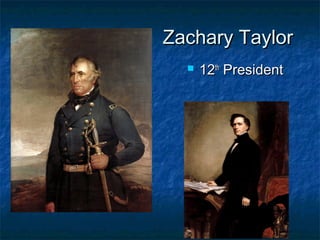
Zachary TaylorZachary Taylor
 1212thth
PresidentPresident
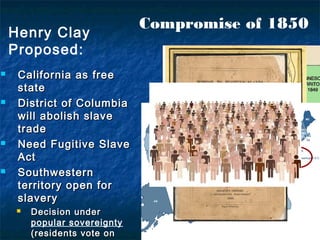
Compromise of 1850
 California as freeCalifornia as free
statestate
 District of ColumbiaDistrict of Columbia
will abolish slavewill abolish slave
tradetrade
 Need Fugitive SlaveNeed Fugitive Slave
ActAct
 SouthwesternSouthwestern
territory open forterritory open for
slaveryslavery
 Decision underDecision under
popular sovereignty
(residents vote on(residents vote on
Henry Clay
Proposed:
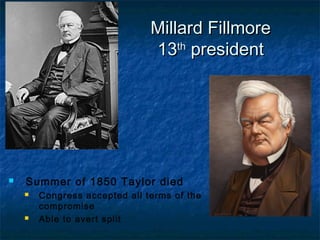
Millard FillmoreMillard Fillmore
1313thth
presidentpresident
 Summer of 1850 Taylor died
 Congress accepted all terms of the
compromise
 Able to avert split
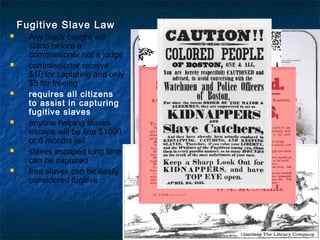
 Fugitive Slave LawFugitive Slave Law
 Any black caught will
stand before a
commissioner not a judge
 commissioner receive
$10 for capturing and only
$5 for freeing
 requires all citizens
to assist in capturing
fugitive slaves
 anyone helping slaves
escape will be fine $1000
or 6 months jail
 slaves escaped long time
can be captured
 free slaves can be easily
considered fugitive
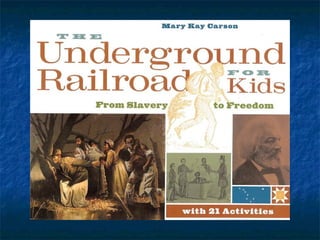
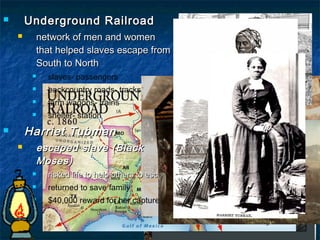
 Underground RailroadUnderground Railroad
 network of men and womennetwork of men and women
that helped slaves escape fromthat helped slaves escape from
South to NorthSouth to North
 slaves- passengers
 backcountry roads- tracks
 farm wagons- trains
 shelter- station
 Harriet TubmanHarriet Tubman
 escaped slave (Blackescaped slave (Black
Moses)Moses)
 risked life to help others to escaperisked life to help others to escape
 returned to save family
 $40,000 reward for her capture
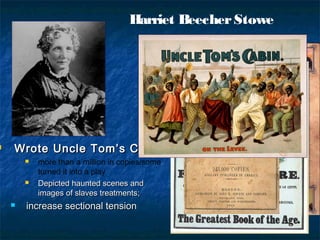
Harriet BeecherStowe
 Wrote Uncle Tom’s CabinWrote Uncle Tom’s Cabin
 more than a million in copies/some
turned it into a play
 Depicted haunted scenes andDepicted haunted scenes and
images of slaves treatments;images of slaves treatments;
 increase sectional tensionincrease sectional tension
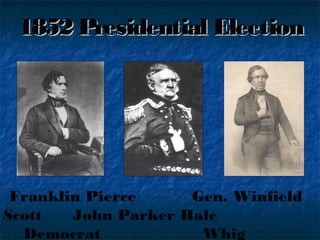
1852 Presidential Election1852 Presidential Election
Franklin Pierce Gen. Winfield
Scott John Parker Hale
Democrat Whig
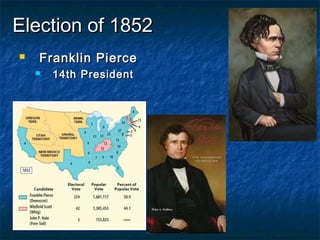
Election of 1852Election of 1852
 Franklin PierceFranklin Pierce
 14th President14th President
The birth of RepublicanThe birth of Republican
Party 1854Party 1854
 Wanted slavery outWanted slavery out
of territoriesof territories
 Diverse group withDiverse group with
wide range ofwide range of
opinion (Whigs,opinion (Whigs,
Free Soiler)Free Soiler)
 From conservativeFrom conservative
to radicalto radical
abolitionistabolitionist
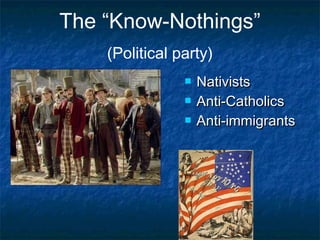
The “Know-Nothings”
(Political party)
 NativistsNativists
 Anti-CatholicsAnti-Catholics
 Anti-immigrantsAnti-immigrants
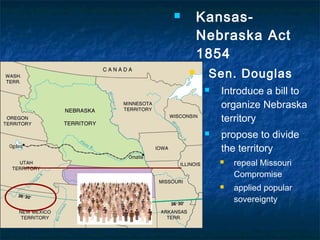
 Kansas-
Nebraska Act
1854
 Sen. Douglas
 Introduce a bill to
organize Nebraska
territory
 propose to divide
the territory
 repeal Missouri
Compromise
 applied popular
sovereignty
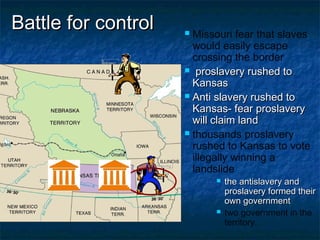
Battle for controlBattle for control  Missouri fear that slaves
would easily escape
crossing the border
 proslavery rushed toproslavery rushed to
KansasKansas
 Anti slavery rushed toAnti slavery rushed to
Kansas- fear proslaveryKansas- fear proslavery
will claim landwill claim land
 thousands proslavery
rushed to Kansas to vote
illegally winning a
landslide
 the antislavery andthe antislavery and
proslavery formed theirproslavery formed their
own governmentown government
 two government in the
territory.
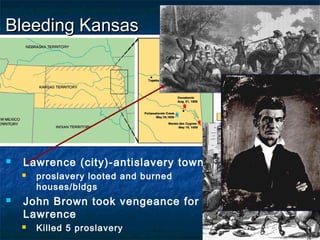
Bleeding KansasBleeding Kansas
 Lawrence (city)-antislavery town
 proslavery looted and burned
houses/bldgs
 John Brown took vengeance for
Lawrence
 Killed 5 proslavery
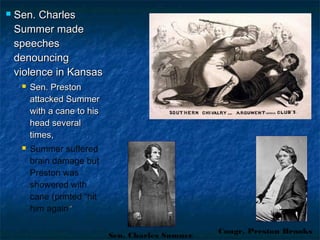
 Sen. CharlesSen. Charles
Summer madeSummer made
speechesspeeches
denouncingdenouncing
violence in Kansasviolence in Kansas
 Sen. PrestonSen. Preston
attacked Summerattacked Summer
with a cane to hiswith a cane to his
head severalhead several
times,times,
 Summer suffered
brain damage but
Preston was
showered with
cane (printed “hit
him again””
Sen. Charles Sumner
Congr. Preston Brooks
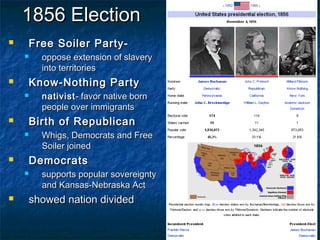
1856 Election1856 Election
 Free Soiler Party-Free Soiler Party-
 oppose extension of slaveryoppose extension of slavery
into territoriesinto territories
 Know-Nothing PartyKnow-Nothing Party
 nativistnativist- favor native born- favor native born
people over immigrantspeople over immigrants
 Birth of RepublicanBirth of Republican
 Whigs, Democrats and FreeWhigs, Democrats and Free
Soiler joinedSoiler joined
 DemocratsDemocrats
 supports popular sovereigntysupports popular sovereignty
and Kansas-Nebraska Actand Kansas-Nebraska Act
 showed nation dividedshowed nation divided
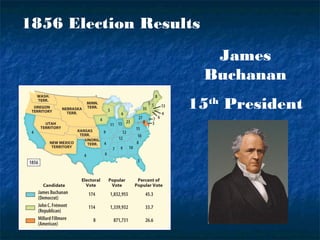
1856 Election Results
James
Buchanan
15th
President
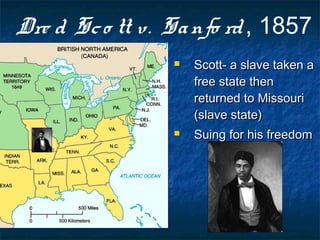
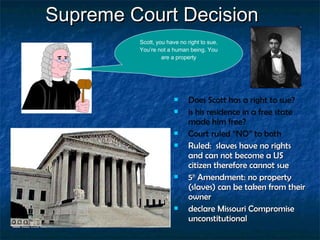
Dre d Sco tt v. Sanfo rd, 1857
 Scott- a slave taken aScott- a slave taken a
free state thenfree state then
returned to Missourireturned to Missouri
(slave state)(slave state)
 Suing for his freedomSuing for his freedom
 Does Scott has a right to sue?
 is his residence in a free state
made him free?
 Court ruled “NO” to both
 Ruled: slaves have no rightsRuled: slaves have no rights
and can not become a USand can not become a US
citizen therefore cannot suecitizen therefore cannot sue
 55thth
Amendment: no propertyAmendment: no property
(slaves) can be taken from their(slaves) can be taken from their
ownerowner
 declare Missouri Compromisedeclare Missouri Compromise
unconstitutionalunconstitutional
Supreme Court DecisionSupreme Court Decision
Scott, you have no right to sue.
You’re not a human being. You
are a property
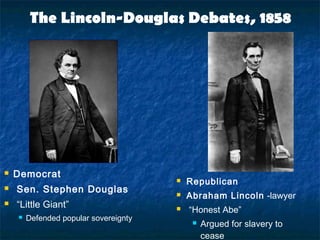
The Lincoln-Douglas Debates, 1858
 Democrat
 Sen. Stephen Douglas
 “Little Giant”
 Defended popular sovereignty
 Republican
 Abraham Lincoln -lawyer
 “Honest Abe”
 Argued for slavery to
cease
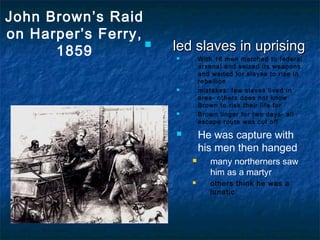
John Brown’s Raid
on Harper’s Ferry,
1859
 led slaves in uprisingled slaves in uprising
 With 16 men marched to federal
arsenal and seized its weapons
and waited for slaves to rise in
rebellion
 mistakes: few slaves lived in
area- others does not know
Brown to risk their life for
 Brown linger for two days- all
escape route was cut off
 He was capture with
his men then hanged
 many northerners saw
him as a martyr
 others think he was a
lunatic
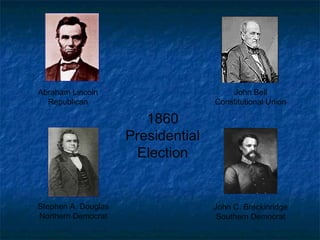
1860
Presidential
Election
Abraham Lincoln
Republican
John Bell
Constitutional Union
Stephen A. Douglas
Northern Democrat
John C. Breckinridge
Southern Democrat
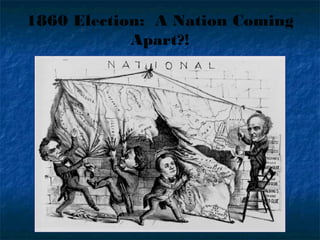
1860 Election: A Nation Coming
Apart?!
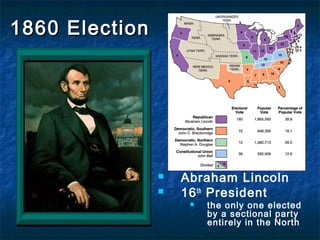
1860 Election1860 Election
 Abraham Lincoln
 16th
President
 the only one elected
by a sectional party
entirely in the North
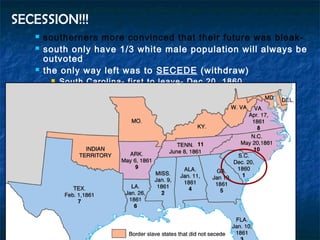
 southerners more convinced that their future was bleak-
 south only have 1/3 white male population will always be
outvoted
 the only way left was to SECEDE (withdraw)
 South Carolina- first to leave- Dec 20, 1860
SECESSION!!!
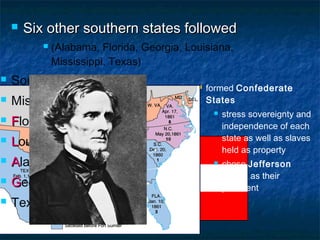
 formed Confederate
States
 stress sovereignty and
independence of each
state as well as slaves
held as property
 chose Jefferson
Davis as their
president
 Six other southern states followedSix other southern states followed
 (Alabama, Florida, Georgia, Louisiana,
Mississippi, Texas)
 South Carolina
 Mississippi
 FFlorida
 LLouisiana
 AAlabama
 GGeorgia
 Texas
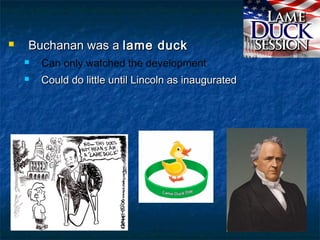
 Buchanan was aBuchanan was a lame ducklame duck
 Can only watched the development
 Could do little until Lincoln as inauguratedCould do little until Lincoln as inaugurated
The Union in Peril (CH 10 S 2)

The Union in Peril (CH 10 S 2)

  • 1.
    The Union inPerilThe Union in Peril CHAPTER 10CHAPTER 10
  • 2.
    Zachary TaylorZachary Taylor 1212thth PresidentPresident
  • 3.
    Compromise of 1850 California as freeCalifornia as free statestate  District of ColumbiaDistrict of Columbia will abolish slavewill abolish slave tradetrade  Need Fugitive SlaveNeed Fugitive Slave ActAct  SouthwesternSouthwestern territory open forterritory open for slaveryslavery  Decision underDecision under popular sovereignty (residents vote on(residents vote on Henry Clay Proposed:
  • 4.
    Millard FillmoreMillard Fillmore 1313thth presidentpresident Summer of 1850 Taylor died  Congress accepted all terms of the compromise  Able to avert split
  • 5.
     Fugitive SlaveLawFugitive Slave Law  Any black caught will stand before a commissioner not a judge  commissioner receive $10 for capturing and only $5 for freeing  requires all citizens to assist in capturing fugitive slaves  anyone helping slaves escape will be fine $1000 or 6 months jail  slaves escaped long time can be captured  free slaves can be easily considered fugitive
  • 7.
     Underground RailroadUndergroundRailroad  network of men and womennetwork of men and women that helped slaves escape fromthat helped slaves escape from South to NorthSouth to North  slaves- passengers  backcountry roads- tracks  farm wagons- trains  shelter- station  Harriet TubmanHarriet Tubman  escaped slave (Blackescaped slave (Black Moses)Moses)  risked life to help others to escaperisked life to help others to escape  returned to save family  $40,000 reward for her capture
  • 8.
    Harriet BeecherStowe  WroteUncle Tom’s CabinWrote Uncle Tom’s Cabin  more than a million in copies/some turned it into a play  Depicted haunted scenes andDepicted haunted scenes and images of slaves treatments;images of slaves treatments;  increase sectional tensionincrease sectional tension
  • 9.
    1852 Presidential Election1852Presidential Election Franklin Pierce Gen. Winfield Scott John Parker Hale Democrat Whig
  • 10.
    Election of 1852Electionof 1852  Franklin PierceFranklin Pierce  14th President14th President
  • 11.
    The birth ofRepublicanThe birth of Republican Party 1854Party 1854  Wanted slavery outWanted slavery out of territoriesof territories  Diverse group withDiverse group with wide range ofwide range of opinion (Whigs,opinion (Whigs, Free Soiler)Free Soiler)  From conservativeFrom conservative to radicalto radical abolitionistabolitionist
  • 12.
    The “Know-Nothings” (Political party) NativistsNativists  Anti-CatholicsAnti-Catholics  Anti-immigrantsAnti-immigrants
  • 13.
     Kansas- Nebraska Act 1854 Sen. Douglas  Introduce a bill to organize Nebraska territory  propose to divide the territory  repeal Missouri Compromise  applied popular sovereignty
  • 14.
    Battle for controlBattlefor control  Missouri fear that slaves would easily escape crossing the border  proslavery rushed toproslavery rushed to KansasKansas  Anti slavery rushed toAnti slavery rushed to Kansas- fear proslaveryKansas- fear proslavery will claim landwill claim land  thousands proslavery rushed to Kansas to vote illegally winning a landslide  the antislavery andthe antislavery and proslavery formed theirproslavery formed their own governmentown government  two government in the territory.
  • 15.
    Bleeding KansasBleeding Kansas Lawrence (city)-antislavery town  proslavery looted and burned houses/bldgs  John Brown took vengeance for Lawrence  Killed 5 proslavery
  • 16.
     Sen. CharlesSen.Charles Summer madeSummer made speechesspeeches denouncingdenouncing violence in Kansasviolence in Kansas  Sen. PrestonSen. Preston attacked Summerattacked Summer with a cane to hiswith a cane to his head severalhead several times,times,  Summer suffered brain damage but Preston was showered with cane (printed “hit him again”” Sen. Charles Sumner Congr. Preston Brooks
  • 18.
    1856 Election1856 Election Free Soiler Party-Free Soiler Party-  oppose extension of slaveryoppose extension of slavery into territoriesinto territories  Know-Nothing PartyKnow-Nothing Party  nativistnativist- favor native born- favor native born people over immigrantspeople over immigrants  Birth of RepublicanBirth of Republican  Whigs, Democrats and FreeWhigs, Democrats and Free Soiler joinedSoiler joined  DemocratsDemocrats  supports popular sovereigntysupports popular sovereignty and Kansas-Nebraska Actand Kansas-Nebraska Act  showed nation dividedshowed nation divided
  • 19.
  • 20.
    Dre d Scott v. Sanfo rd, 1857  Scott- a slave taken aScott- a slave taken a free state thenfree state then returned to Missourireturned to Missouri (slave state)(slave state)  Suing for his freedomSuing for his freedom
  • 21.
     Does Scotthas a right to sue?  is his residence in a free state made him free?  Court ruled “NO” to both  Ruled: slaves have no rightsRuled: slaves have no rights and can not become a USand can not become a US citizen therefore cannot suecitizen therefore cannot sue  55thth Amendment: no propertyAmendment: no property (slaves) can be taken from their(slaves) can be taken from their ownerowner  declare Missouri Compromisedeclare Missouri Compromise unconstitutionalunconstitutional Supreme Court DecisionSupreme Court Decision Scott, you have no right to sue. You’re not a human being. You are a property
  • 22.
    The Lincoln-Douglas Debates,1858  Democrat  Sen. Stephen Douglas  “Little Giant”  Defended popular sovereignty  Republican  Abraham Lincoln -lawyer  “Honest Abe”  Argued for slavery to cease
  • 23.
    John Brown’s Raid onHarper’s Ferry, 1859  led slaves in uprisingled slaves in uprising  With 16 men marched to federal arsenal and seized its weapons and waited for slaves to rise in rebellion  mistakes: few slaves lived in area- others does not know Brown to risk their life for  Brown linger for two days- all escape route was cut off  He was capture with his men then hanged  many northerners saw him as a martyr  others think he was a lunatic
  • 24.
    1860 Presidential Election Abraham Lincoln Republican John Bell ConstitutionalUnion Stephen A. Douglas Northern Democrat John C. Breckinridge Southern Democrat
  • 25.
    1860 Election: ANation Coming Apart?!
  • 26.
    1860 Election1860 Election Abraham Lincoln  16th President  the only one elected by a sectional party entirely in the North
  • 27.
     southerners moreconvinced that their future was bleak-  south only have 1/3 white male population will always be outvoted  the only way left was to SECEDE (withdraw)  South Carolina- first to leave- Dec 20, 1860 SECESSION!!!
  • 28.
     formed Confederate States stress sovereignty and independence of each state as well as slaves held as property  chose Jefferson Davis as their president  Six other southern states followedSix other southern states followed  (Alabama, Florida, Georgia, Louisiana, Mississippi, Texas)  South Carolina  Mississippi  FFlorida  LLouisiana  AAlabama  GGeorgia  Texas
  • 29.
     Buchanan wasaBuchanan was a lame ducklame duck  Can only watched the development  Could do little until Lincoln as inauguratedCould do little until Lincoln as inaugurated