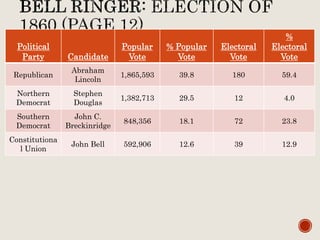
Political
Party Candidate
Popular
Vote
% Popular
Vote
Electoral
Vote
%
Electoral
Vote
Republican
Abraham
Lincoln
1,865,593 39.8 180 59.4
Northern
Democrat
Stephen
Douglas
1,382,713 29.5 12 4.0
Southern
Democrat
John C.
Breckinridge
848,356 18.1 72 23.8
Constitutiona
l Union
John Bell 592,906 12.6 39 12.9
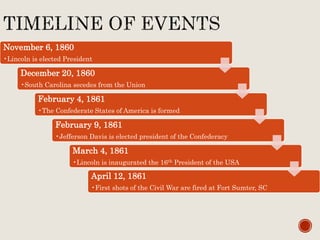
November 6, 1860
•Lincoln is elected President
December 20, 1860
•South Carolina secedes from the Union
February 4, 1861
•The Confederate States of America is formed
February 9, 1861
•Jefferson Davis is elected president of the Confederacy
March 4, 1861
•Lincoln is inaugurated the 16th President of the USA
April 12, 1861
•First shots of the Civil War are fired at Fort Sumter, SC
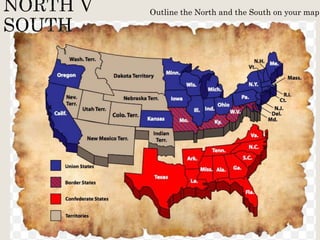
Outline the North and the South on your map.
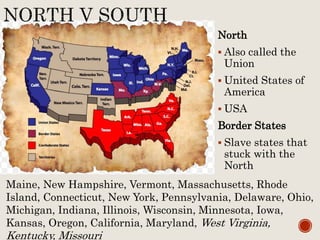
North
 Also called the
Union
 United States of
America
 USA
Border States
 Slave states that
stuck with the
North
Maine, New Hampshire, Vermont, Massachusetts, Rhode
Island, Connecticut, New York, Pennsylvania, Delaware, Ohio,
Michigan, Indiana, Illinois, Wisconsin, Minnesota, Iowa,
Kansas, Oregon, California, Maryland, West Virginia,
Kentucky, Missouri
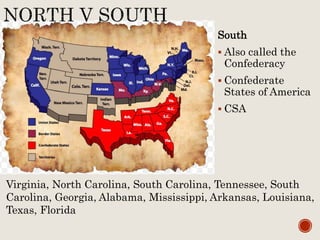
South
 Also called the
Confederacy
 Confederate
States of America
 CSA
Virginia, North Carolina, South Carolina, Tennessee, South
Carolina, Georgia, Alabama, Mississippi, Arkansas, Louisiana,
Texas, Florida
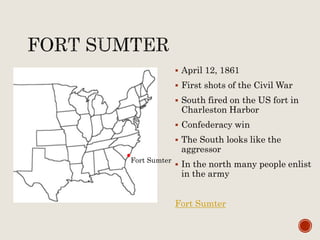
 April 12, 1861
 First shots of the Civil War
 South fired on the US fort in
Charleston Harbor
 Confederacy win
 The South looks like the
aggressor
 In the north many people enlist
in the army
Fort Sumter
Fort Sumter
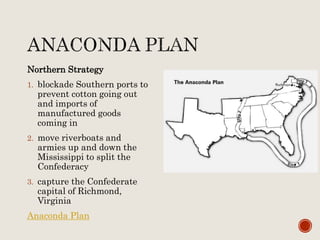
Northern Strategy
1. blockade Southern ports to
prevent cotton going out
and imports of
manufactured goods
coming in
2. move riverboats and
armies up and down the
Mississippi to split the
Confederacy
3. capture the Confederate
capital of Richmond,
Virginia
Anaconda Plan
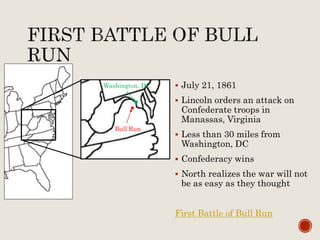
 July 21, 1861
 Lincoln orders an attack on
Confederate troops in
Manassas, Virginia
 Less than 30 miles from
Washington, DC
 Confederacy wins
 North realizes the war will not
be as easy as they thought
First Battle of Bull Run
Bull Run
Washington, DC
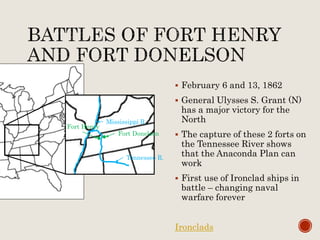
 February 6 and 13, 1862
 General Ulysses S. Grant (N)
has a major victory for the
North
 The capture of these 2 forts on
the Tennessee River shows
that the Anaconda Plan can
work
 First use of Ironclad ships in
battle – changing naval
warfare forever
Ironclads
Mississippi R.
Tennessee R.
Fort Henry
Fort Donelson
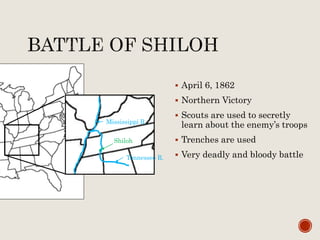
 April 6, 1862
 Northern Victory
 Scouts are used to secretly
learn about the enemy’s troops
 Trenches are used
 Very deadly and bloody battle
Shiloh
Mississippi R.
Tennessee R.
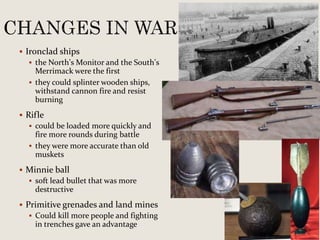
 Ironclad ships
 the North’s Monitor and the South’s
Merrimack were the first
 they could splinter wooden ships,
withstand cannon fire and resist
burning
 Rifle
 could be loaded more quickly and
fire more rounds during battle
 they were more accurate than old
muskets
 Minnie ball
 soft lead bullet that was more
destructive
 Primitive grenades and land mines
 Could kill more people and fighting
in trenches gave an advantage
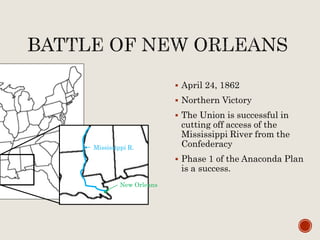
 April 24, 1862
 Northern Victory
 The Union is successful in
cutting off access of the
Mississippi River from the
Confederacy
 Phase 1 of the Anaconda Plan
is a success.
New Orleans
Mississippi R.
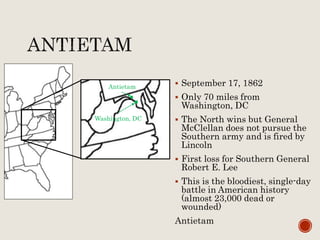
 September 17, 1862
 Only 70 miles from
Washington, DC
 The North wins but General
McClellan does not pursue the
Southern army and is fired by
Lincoln
 First loss for Southern General
Robert E. Lee
 This is the bloodiest, single-day
battle in American history
(almost 23,000 dead or
wounded)
Antietam
Antietam
Washington, DC
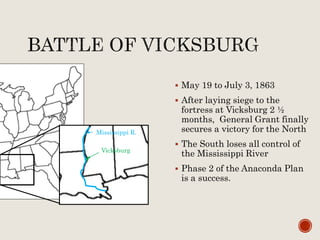
 May 19 to July 3, 1863
 After laying siege to the
fortress at Vicksburg 2 ½
months, General Grant finally
secures a victory for the North
 The South loses all control of
the Mississippi River
 Phase 2 of the Anaconda Plan
is a success.
Vicksburg
Mississippi R.
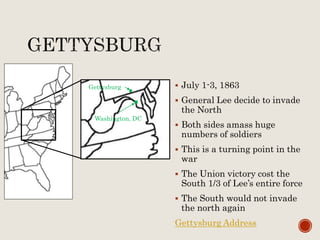
 July 1-3, 1863
 General Lee decide to invade
the North
 Both sides amass huge
numbers of soldiers
 This is a turning point in the
war
 The Union victory cost the
South 1/3 of Lee’s entire force
 The South would not invade
the north again
Gettysburg Address
Gettysburg
Washington, DC
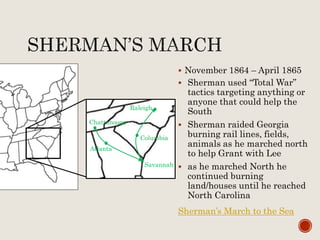
 November 1864 – April 1865
 Sherman used “Total War”
tactics targeting anything or
anyone that could help the
South
 Sherman raided Georgia
burning rail lines, fields,
animals as he marched north
to help Grant with Lee
 as he marched North he
continued burning
land/houses until he reached
North Carolina
Sherman’s March to the Sea
Chattanooga
Atlanta
Savannah
Columbia
Raleigh
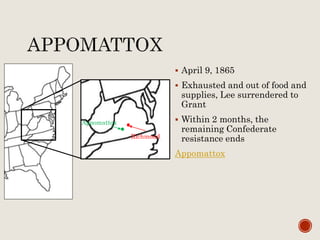
 April 9, 1865
 Exhausted and out of food and
supplies, Lee surrendered to
Grant
 Within 2 months, the
remaining Confederate
resistance ends
Appomattox
Appomattox
Richmond

The Civil War

  • 2.
    Political Party Candidate Popular Vote % Popular Vote Electoral Vote % Electoral Vote Republican Abraham Lincoln 1,865,59339.8 180 59.4 Northern Democrat Stephen Douglas 1,382,713 29.5 12 4.0 Southern Democrat John C. Breckinridge 848,356 18.1 72 23.8 Constitutiona l Union John Bell 592,906 12.6 39 12.9
  • 4.
    November 6, 1860 •Lincolnis elected President December 20, 1860 •South Carolina secedes from the Union February 4, 1861 •The Confederate States of America is formed February 9, 1861 •Jefferson Davis is elected president of the Confederacy March 4, 1861 •Lincoln is inaugurated the 16th President of the USA April 12, 1861 •First shots of the Civil War are fired at Fort Sumter, SC
  • 5.
    Outline the Northand the South on your map.
  • 6.
    North  Also calledthe Union  United States of America  USA Border States  Slave states that stuck with the North Maine, New Hampshire, Vermont, Massachusetts, Rhode Island, Connecticut, New York, Pennsylvania, Delaware, Ohio, Michigan, Indiana, Illinois, Wisconsin, Minnesota, Iowa, Kansas, Oregon, California, Maryland, West Virginia, Kentucky, Missouri
  • 7.
    South  Also calledthe Confederacy  Confederate States of America  CSA Virginia, North Carolina, South Carolina, Tennessee, South Carolina, Georgia, Alabama, Mississippi, Arkansas, Louisiana, Texas, Florida
  • 8.
     April 12,1861  First shots of the Civil War  South fired on the US fort in Charleston Harbor  Confederacy win  The South looks like the aggressor  In the north many people enlist in the army Fort Sumter Fort Sumter
  • 9.
    Northern Strategy 1. blockadeSouthern ports to prevent cotton going out and imports of manufactured goods coming in 2. move riverboats and armies up and down the Mississippi to split the Confederacy 3. capture the Confederate capital of Richmond, Virginia Anaconda Plan
  • 10.
     July 21,1861  Lincoln orders an attack on Confederate troops in Manassas, Virginia  Less than 30 miles from Washington, DC  Confederacy wins  North realizes the war will not be as easy as they thought First Battle of Bull Run Bull Run Washington, DC
  • 11.
     February 6and 13, 1862  General Ulysses S. Grant (N) has a major victory for the North  The capture of these 2 forts on the Tennessee River shows that the Anaconda Plan can work  First use of Ironclad ships in battle – changing naval warfare forever Ironclads Mississippi R. Tennessee R. Fort Henry Fort Donelson
  • 12.
     April 6,1862  Northern Victory  Scouts are used to secretly learn about the enemy’s troops  Trenches are used  Very deadly and bloody battle Shiloh Mississippi R. Tennessee R.
  • 13.
     Ironclad ships the North’s Monitor and the South’s Merrimack were the first  they could splinter wooden ships, withstand cannon fire and resist burning  Rifle  could be loaded more quickly and fire more rounds during battle  they were more accurate than old muskets  Minnie ball  soft lead bullet that was more destructive  Primitive grenades and land mines  Could kill more people and fighting in trenches gave an advantage
  • 14.
     April 24,1862  Northern Victory  The Union is successful in cutting off access of the Mississippi River from the Confederacy  Phase 1 of the Anaconda Plan is a success. New Orleans Mississippi R.
  • 15.
     September 17,1862  Only 70 miles from Washington, DC  The North wins but General McClellan does not pursue the Southern army and is fired by Lincoln  First loss for Southern General Robert E. Lee  This is the bloodiest, single-day battle in American history (almost 23,000 dead or wounded) Antietam Antietam Washington, DC
  • 16.
     May 19to July 3, 1863  After laying siege to the fortress at Vicksburg 2 ½ months, General Grant finally secures a victory for the North  The South loses all control of the Mississippi River  Phase 2 of the Anaconda Plan is a success. Vicksburg Mississippi R.
  • 17.
     July 1-3,1863  General Lee decide to invade the North  Both sides amass huge numbers of soldiers  This is a turning point in the war  The Union victory cost the South 1/3 of Lee’s entire force  The South would not invade the north again Gettysburg Address Gettysburg Washington, DC
  • 18.
     November 1864– April 1865  Sherman used “Total War” tactics targeting anything or anyone that could help the South  Sherman raided Georgia burning rail lines, fields, animals as he marched north to help Grant with Lee  as he marched North he continued burning land/houses until he reached North Carolina Sherman’s March to the Sea Chattanooga Atlanta Savannah Columbia Raleigh
  • 19.
     April 9,1865  Exhausted and out of food and supplies, Lee surrendered to Grant  Within 2 months, the remaining Confederate resistance ends Appomattox Appomattox Richmond