Ch. 23.1: An Era of Activism
Feminism
Feminism
 Theory favoring the political,
economic, and social equality
of men and women
 Examples of modern feminist
causes???
The Feminist
Movement
 The feminist movements of
the late 1800s & early 1900s
did NOT achieve full equality
that women sought
 Stereotype of a meek
housewife persisted
 Reality: In 1960, 38% of
women had jobs away from
home
Background to
the movement
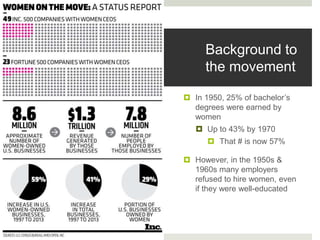
 In 1950, 25% of bachelor’s
degrees were earned by
women
 Up to 43% by 1970
 That # is now 57%
 However, in the 1950s &
1960s many employers
refused to hire women, even
if they were well-educated
Background to the Movement
 Employers expected women to leave
the job after a few years to start a
family & didn’t want to invest money in
hiring them
 Limited daycare options
 Even if hired, women earned less while
doing the same job
 Women still struggle to becomes CEOs
& other upper level positions
 “Glass Ceiling”
 Wage gap between men &
women
 1963—Women $0.59 to
every dollar a man earned
 1973—$0.57 to every
dollar
 Today—Around $0.80
Income Disparity By Industry
Median Weekly Earnings of Full-Time Wage & Salary Workers
Civil Rights & Women
 The Civil Rights Movement of the 1950s & 1960s did not just
help African Americans
 Title VII of the Civil Rights Act of 1964 added gender
discrimination to the list of illegal acts
 Gave women a legal framework to challenge discrimination
 The movement also provided inspiration & a “how-to” model for
action
The Feminine Mystique
 Book written by Betty Friedan in 1963
 Created a sensation in the suburbs of America
 Often credited w/ sparking the feminist movement
 Over 3 million copies sold by 2000
 Addressed to women who supposedly had everything (nice
house, healthy kids, middle to upper-class lifestyle)
 Despite all of this, these women were NOT happy!
 Friedan called it “the problem that had no name”
 The dissatisfaction of not being able to realize one’s full potential
 Friedan gave these women the courage to ask “Is this all?”
NOW
 National Organization for Women (NOW)—Est. in 1966 to promote the
full participation of women in American society
 Attacked false images of women in the media
 Called for balance in marriage responsibilities
 Sharing of cooking, cleaning, parenting, etc.
 Pushed for fair pay & equal job opportunities
 Had 15K members by 1970
 500K today, w/ 500+ local chapters & affiliates in all 50 states
 Many viewed NOW as too extreme
 Others felt it didn’t go far enough
Miss America, 1968
 Protest organized by New York Radical Women (NYRW)
 400 protesters assembled on the boardwalk of Atlantic City
 Published a manifesto titled “No More Miss America!”
 Little boys dreamed of being president, but what about little girls?
 Signs read “Welcome to the Cattle Auction”
 Threw items in “Freedom Trash Can”
 Wigs, fake eyelashes, dish detergent, high heels, bras, etc.
 Led to reporters coining the phrase “bra burners”
 Criticized the “ludicrous beauty standards we ourselves are conditioned to
take seriously”
 Also, attacked pageant’s beauty standards as racist
 As of that year there had never been an African American finalist
Shifting Attitudes
 Movement came of age in early 70s
 Our Bodies, Ourselves, published in 1970
 Sold 3 million copies by 1990
 Encouraged women to understood their own health issues
 Gloria Steinem & others founded Ms. magazine in 1972
 Tackled feminist issues
 Much different than Good Housekeeping or Ladies’ Home Journal
Shifting Attitudes
 In 1972, Congress passed a prohibition against sex
discrimination as part of the Higher Education Act
 Title IX—allowed for an explosion in women’s athletics
 More women entered law school & medical school
 Women were finally admitted to military academies to be trained
as officers
 National Women’s Political Caucus was est. in 1971
 Shirley Chisholm ran, one of NWP’s founders, ran for president in
‘72
 Served in House from 1969-1983
Shifting Attitudes
 Radical feminists emphasized the need to end male domination
 Some even went as far as rejecting men, marriage, & childbearing
 Supreme Court struck down law that prohibited the sale of birth control
in Griswold v. Connecticut, 1965
 Based on the “right to marital privacy”
 Use of contraception became more socially acceptable
 Supreme Court legalized abortion in controversial Roe v. Wade decision
in 1973
 Decision based on constitutional right of privacy
 Issue of abortion is still extremely polarizing today
Shifting Attitudes
 In 1972 Congress approved passage of the Equal Rights
Amendment (ERA)
 But 38 states were needed, only 35 ratified the amendment
 By 1982, the deadline, ratification had failed
 It reads:
 “Equality of rights under the law shall not be denied or abridged by
the United States or by any State on account of sex.”
“Battle of the Sexes”
 September 20, 1973 at the Astrodome in Houston, TX
 Attendance=30K+
 Nationally televised
 90 million watched worldwide
 Bobby Riggs (55 y.o.) vs. Billie Jean King (26 y.o.)
 King won in 3 straight sets
“Battle of the Sexes”
Odds & Ends
 Perfect family shows of 50s &
60s were replaced by new
shows
 Mary Tyler Moore show,
about a never-married,
independent career
woman
 Barbara Walters of ABC
became the highest paid TV
anchor & 1st woman to co-
host the evening news in
1976
Opposition
 Phyllis Schlafly led movement to stop
ratification of the ERA
 “It won’t do anything to help women, and
it will take away from women the rights
they already have, such as the right of a
wife to be supported by her husband, the
right of a woman to be exempted from
military combat and the the right...to go
to a single-sex college.”
 Many men were also hostile towards
the women’s liberation movement
 Some women desired to remain at
home and raise children
Women Today

2nd Wave Feminism

  • 1.
    Ch. 23.1: AnEra of Activism Feminism
  • 2.
    Feminism  Theory favoringthe political, economic, and social equality of men and women  Examples of modern feminist causes???
  • 3.
    The Feminist Movement  Thefeminist movements of the late 1800s & early 1900s did NOT achieve full equality that women sought  Stereotype of a meek housewife persisted  Reality: In 1960, 38% of women had jobs away from home
  • 6.
    Background to the movement In 1950, 25% of bachelor’s degrees were earned by women  Up to 43% by 1970  That # is now 57%  However, in the 1950s & 1960s many employers refused to hire women, even if they were well-educated
  • 7.
    Background to theMovement  Employers expected women to leave the job after a few years to start a family & didn’t want to invest money in hiring them  Limited daycare options  Even if hired, women earned less while doing the same job  Women still struggle to becomes CEOs & other upper level positions  “Glass Ceiling”  Wage gap between men & women  1963—Women $0.59 to every dollar a man earned  1973—$0.57 to every dollar  Today—Around $0.80
  • 9.
  • 10.
    Median Weekly Earningsof Full-Time Wage & Salary Workers
  • 12.
    Civil Rights &Women  The Civil Rights Movement of the 1950s & 1960s did not just help African Americans  Title VII of the Civil Rights Act of 1964 added gender discrimination to the list of illegal acts  Gave women a legal framework to challenge discrimination  The movement also provided inspiration & a “how-to” model for action
  • 13.
    The Feminine Mystique Book written by Betty Friedan in 1963  Created a sensation in the suburbs of America  Often credited w/ sparking the feminist movement  Over 3 million copies sold by 2000  Addressed to women who supposedly had everything (nice house, healthy kids, middle to upper-class lifestyle)  Despite all of this, these women were NOT happy!  Friedan called it “the problem that had no name”  The dissatisfaction of not being able to realize one’s full potential  Friedan gave these women the courage to ask “Is this all?”
  • 15.
    NOW  National Organizationfor Women (NOW)—Est. in 1966 to promote the full participation of women in American society  Attacked false images of women in the media  Called for balance in marriage responsibilities  Sharing of cooking, cleaning, parenting, etc.  Pushed for fair pay & equal job opportunities  Had 15K members by 1970  500K today, w/ 500+ local chapters & affiliates in all 50 states  Many viewed NOW as too extreme  Others felt it didn’t go far enough
  • 17.
    Miss America, 1968 Protest organized by New York Radical Women (NYRW)  400 protesters assembled on the boardwalk of Atlantic City  Published a manifesto titled “No More Miss America!”  Little boys dreamed of being president, but what about little girls?  Signs read “Welcome to the Cattle Auction”  Threw items in “Freedom Trash Can”  Wigs, fake eyelashes, dish detergent, high heels, bras, etc.  Led to reporters coining the phrase “bra burners”  Criticized the “ludicrous beauty standards we ourselves are conditioned to take seriously”  Also, attacked pageant’s beauty standards as racist  As of that year there had never been an African American finalist
  • 19.
    Shifting Attitudes  Movementcame of age in early 70s  Our Bodies, Ourselves, published in 1970  Sold 3 million copies by 1990  Encouraged women to understood their own health issues  Gloria Steinem & others founded Ms. magazine in 1972  Tackled feminist issues  Much different than Good Housekeeping or Ladies’ Home Journal
  • 21.
    Shifting Attitudes  In1972, Congress passed a prohibition against sex discrimination as part of the Higher Education Act  Title IX—allowed for an explosion in women’s athletics  More women entered law school & medical school  Women were finally admitted to military academies to be trained as officers  National Women’s Political Caucus was est. in 1971  Shirley Chisholm ran, one of NWP’s founders, ran for president in ‘72  Served in House from 1969-1983
  • 22.
    Shifting Attitudes  Radicalfeminists emphasized the need to end male domination  Some even went as far as rejecting men, marriage, & childbearing  Supreme Court struck down law that prohibited the sale of birth control in Griswold v. Connecticut, 1965  Based on the “right to marital privacy”  Use of contraception became more socially acceptable  Supreme Court legalized abortion in controversial Roe v. Wade decision in 1973  Decision based on constitutional right of privacy  Issue of abortion is still extremely polarizing today
  • 23.
    Shifting Attitudes  In1972 Congress approved passage of the Equal Rights Amendment (ERA)  But 38 states were needed, only 35 ratified the amendment  By 1982, the deadline, ratification had failed  It reads:  “Equality of rights under the law shall not be denied or abridged by the United States or by any State on account of sex.”
  • 25.
    “Battle of theSexes”  September 20, 1973 at the Astrodome in Houston, TX  Attendance=30K+  Nationally televised  90 million watched worldwide  Bobby Riggs (55 y.o.) vs. Billie Jean King (26 y.o.)  King won in 3 straight sets
  • 26.
  • 27.
    Odds & Ends Perfect family shows of 50s & 60s were replaced by new shows  Mary Tyler Moore show, about a never-married, independent career woman  Barbara Walters of ABC became the highest paid TV anchor & 1st woman to co- host the evening news in 1976
  • 28.
    Opposition  Phyllis Schlaflyled movement to stop ratification of the ERA  “It won’t do anything to help women, and it will take away from women the rights they already have, such as the right of a wife to be supported by her husband, the right of a woman to be exempted from military combat and the the right...to go to a single-sex college.”  Many men were also hostile towards the women’s liberation movement  Some women desired to remain at home and raise children
  • 29.