Prepared by: Submitted to:
Muhahmmad Ali Sir Ali Mubasher Sb
Roll # Course Coordinator
BI 591436 ICMS 6th Road
Rawalpindi
Introduction
 The rapidly growing markets, information and
awareness in the world demand organizations to
change their operational processes to compete
globally. People have more knowledge, more
information in these days and this has compelled
banks of many countries to advance the quality of their
customer service, lessen their operating cost and
improve their performance especially in the
developing countries
Introduction
Today customers demand low prices and better quality
services due to which organizations are facing stiff
challenges. Focus of the organizations should be not
only to lessen the cost of the operations but also to
provide better and unique services to attract the new
and retain the existing customers. Rapid
improvements in the technology have forced the
organizations to change their strategy, policies and
capacities. For the last few decades banks are doing
mergers and acquisitions because of changes in their
strategies to become more efficient, effective and
attractive.
Introduction
 Organizations are taking initiatives to provide better and
different services to their customers in different ways to
meet the expectations of the customers. Organizations
need satisfied and loyal customers to survive and operate
in the long run. Mergers and acquisitions are also playing
their role as an important tool to enhance the resources,
skills, abilities, operations, market access and performance
and to meet the global requirements. Business Process
Reengineering (BPR) is also important and organizations
are using this approach now days to improve their
performances, to become more efficient and effective.
Topic Review
 This research study has tried to measure the impact of
business process reengineering on the performance of
banks in Pakistan. Banking sector is the part of financial
sector which has its own importance. Financial sectors
always play an important role in the progress of any
country. Pakistan is one of those developing countries
which are facing problems in economic growth therefore
business process reengineering has more importance for
the banking sector of Pakistan. Organizations can perform
in a better way, satisfy the customers, satisfy the employees
and enhance the quality of their products through business
process reengineering.
Important Sub-topicsIntroduction
Topic Review
Important sub-topics
Definition’s
(i) What is process?
(ii)What is BPR?
Practical study of the organization
(i) Why re-engineer?
(ii) Why bank’s don’t re-engineer?
Important Sub-topics
Review of theoretical and practical situation
Analysis of BPR implementation
Merits , Demerits , deficiencies or strengths of the
organization
Findings
(i) Critical success factor’s
Conclusions
Annex
BUSINESS PROCESS RE-
ENGINEERING
What is a Process?
A specific ordering of work activities across time and
space, with a beginning, an end, and clearly identified
inputs and outputs: a structure for action.
(Davenport, 1993)
BUSINESS PROCESS RE-
ENGINEERING
What is a Business Process?
(i) A group of logically related tasks that use the firm's
resources to provide customer-oriented results in
support of the organization's objectives.
(ii) BPR is radical redesign and reorganization of an
enterprise is necessary to lower costs and increase
quality of service and that information technology is
the key enabler for that radical change. (Michael
Hammer's 1990 & James Champy)
BUSINESS PROCESS RE-
ENGINEERING
Reengineering is the fundamental rethinking and
redesign of business processes to achieve dramatic
improvements in critical, contemporary measures of
performance, such as cost, quality, service and speed.
(Hammer & Champy, 1993)
Practical Study of the Organization
Why Reengineer?
Customers
Demanding
Sophistication
Changing Needs
Competition
Local
Global
Practical Study of the Organization
Change
Technology
Customer Preferences
Practical Study of the Organization
Why Banks Don’t Reengineer?
Complacency
Political Resistance
New Developments
Fear of Unknown and Failure
Practical Study of the Organization
BPR seeks improvements of
Quality
Service
Speed
Cost
Practical Study of the Organization
Added Value
BPR Initiatives must add-value over and above the
existing process.
Customer-Led
BPR Initiatives must meet the needs of the customer.
Practical Study of the Organization
Focus on End-Customers
Process improvements must relate to the needs of the
organization and be relevant to the end-customers to
which they are designed to serve.
Review of Theoretical and
Practical situations
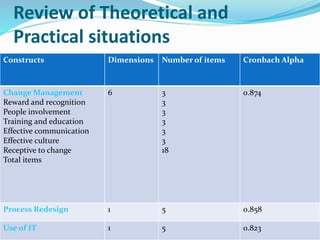
Constructs Dimensions Number of items Cronbach Alpha
Change Management
Reward and recognition
People involvement
Training and education
Effective communication
Effective culture
Receptive to change
Total items
6 3
3
3
3
3
3
18
0.874
Process Redesign 1 5 0.858
Use of IT 1 5 0.823
Review of Theoretical and
Practical situations
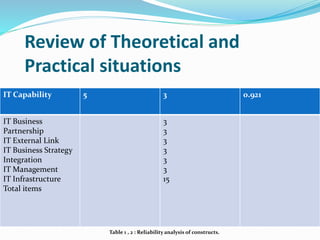
IT Capability 5 3 0.921
IT Business
Partnership
IT External Link
IT Business Strategy
Integration
IT Management
IT Infrastructure
Total items
3
3
3
3
3
3
15
Table 1 , 2 : Reliability analysis of constructs.
Review of Theoretical and
Practical situations
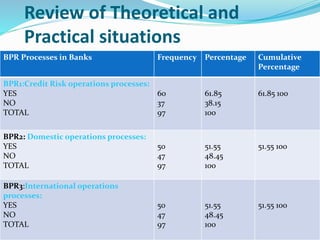
BPR Processes in Banks Frequency Percentage Cumulative
Percentage
BPR1:Credit Risk operations processes:
YES
NO
TOTAL
60
37
97
61.85
38.15
100
61.85 100
BPR2: Domestic operations processes:
YES
NO
TOTAL
50
47
97
51.55
48.45
100
51.55 100
BPR3:International operations
processes:
YES
NO
TOTAL
50
47
97
51.55
48.45
100
51.55 100
Review of Theoretical and
Practical situations
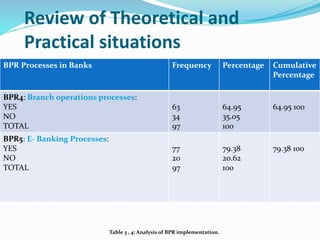
BPR Processes in Banks Frequency Percentage Cumulative
Percentage
BPR4: Branch operations processes:
YES
NO
TOTAL
63
34
97
64.95
35.05
100
64.95 100
BPR5: E- Banking Processes:
YES
NO
TOTAL
77
20
97
79.38
20.62
100
79.38 100
Table 3 , 4: Analysis of BPR implementation.
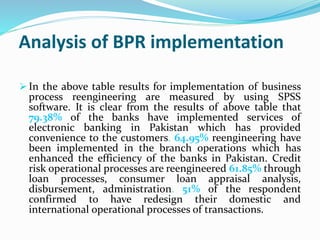
Analysis of BPR implementation
 In the above table results for implementation of business
process reengineering are measured by using SPSS
software. It is clear from the results of above table that
79.38% of the banks have implemented services of
electronic banking in Pakistan which has provided
convenience to the customers. 64.95% reengineering have
been implemented in the branch operations which has
enhanced the efficiency of the banks in Pakistan. Credit
risk operational processes are reengineered 61.85% through
loan processes, consumer loan appraisal analysis,
disbursement, administration. 51% of the respondent
confirmed to have redesign their domestic and
international operational processes of transactions.
Advantages and disadvantages of
BPR
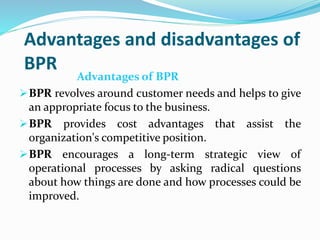
Advantages of BPR
BPR revolves around customer needs and helps to give
an appropriate focus to the business.
BPR provides cost advantages that assist the
organization's competitive position.
BPR encourages a long-term strategic view of
operational processes by asking radical questions
about how things are done and how processes could be
improved.
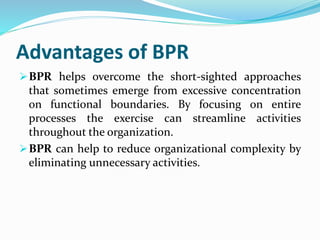
Advantages of BPR
BPR helps overcome the short-sighted approaches
that sometimes emerge from excessive concentration
on functional boundaries. By focusing on entire
processes the exercise can streamline activities
throughout the organization.
BPR can help to reduce organizational complexity by
eliminating unnecessary activities.
Disadvantages of BPR
BPR was sometimes seen (incorrectly) as a means of
making small improvements in existing practices. In
reality, it should be a more radical approach that
questions whether existing practices make any sense in
their present form.
BPR was often perceived (incorrectly) as a single,
once-for-all cost-cutting exercise. In reality, it is not
primarily
Disadvantages of BPR
concerned with cost cutting (though cost reductions
often result), and should be regarded as on-going rather
than once-for-all. This misconception often creates
hostility in the minds of staff who see the exercise as a
threat to their security.
BPR requires a far-reaching and long-term
commitment by management and staff. Securing this
is not an easy task, and many organizations have
rejected the whole idea as not worth the effort.
Disadvantages of BPR
In many cases business processes were not redesigned
but merely automated.
In some cases the efficiency of one department was
improved at the expense of the overall process. To
make BPR work requires a focus on integrated
processes that often involves obliterating existing
processes and creating new ones.
Disadvantages of BPR
Some companies became so focused on improving
internal processes that they failed to keep up with
competitors' activities in the market.
Most companies are now more likely to talk about
'business process redesign' instead.
Findings
The objective of this qualitative study was to
determine factors that contribute towards successful
implementation of business process reengineering and
also examine the impact of BPR on organizational
performance. Data collected by using interviewing
from top management of banks that applied BPR
process. Results revealed that business process
reengineering has strong positive and significance
effect on organizational performance.
Findings
IT capabilities also positively and significantly
association with banks performance. Results also
indicated that banks in Pakistan have been
implementing BPR in different operational processes.
Most of the banks implemented e-banking services
e.g. operational transactions of cheques or cash,
received and payments through POS, ATM and other
operations. Findings showed that banks restructured,
reprocesses and improved their operations processes
which enhance the effectiveness an efficiency of
banking services
Critical Success Factors
Following are some critical factors that contribute to the
successful implementation of business process reengineering
in banking sector. We found these factors during interviews.
Following factors presenting clear picture of practically. We
highlighted our study results in form of point.
 Change Management & Culture
(i) Communication Expertise
(ii) Effective motivation and reward mechanism
(iii) Employees‟ Empowerment
(iv) Training & Development
(v)Collaborative working environment
Critical Success Factors
Management Competency & Support
(i) Strong leadership & Commitment
(ii) Risk Management
(iii) Top management commitment and
Support.
Critical Success Factors
 Organizational Structure
(i) Efficient teams for BPR implementation
(ii)Appropriate job definitions and allocation of
responsibilities
 BPR Process
(i) Alignment between BPR Strategies and Corporate
Strategies
(ii)Effective planning and Efficient use of project
management techniques.
(iii)Effective usage of methodology
(iv)Effective Consultancy
(v)Developing BPR Vision
Critical Success Factors
IT Capabilities
(i) Infrastructure.
(ii)Effective I.T Infrastructure
(iii) Increasing the IT Functions Competency
(iv)Alignment of BPR Strategies with I.T
Infrastructure.
Critical Success Factors
Effect On Organizational
Performance.
IT capabilities also have positive and significance association with
banks performance. These findings also highly supported by previous
research studies (Guimaraes,1999; Attaran, 2003; Reijers & Mansar,
2003; Dennis et al.,2003; Salimifard et al.,2010; Lal & Chavan, 2012).
Results also indicated that banks in Pakistan have been implementing
BPR in different operational processes. Most of the banks implemented e-
banking services e.g. operational transactions of cheques or cash, received
and payments through POS, ATM and other operations. Banks
restructured, reprocesses and improved their operations processes which
enhance the effectiveness and efficiency of banking services. We
concluded that informational technology and IT capacities are enabler of
BPR and IT makes it possible for having improvement in business process
reengineering.
Critical Success Factors
Future Directions
 In future researchers can expand this concept by adding
some more valuable dimensions of BPR and can produce
more refined results. In future researchers can do research
on following areas.
(i) Explore relationship among BPR, organizational
objectives and organizational change
management
mechanism.
(ii)Researchers can explore that how effective BPR
process can be linked up with organizational
strategies and organizational
performance.
Critical Success Factors
(iii) Relationship of BPR with organizational
structure and tom management commitment.
(iv) How total quality management can facilitate
the successful implementation of BPR within the
organization.
(v) Researcher can study the role of suppliers,
customers and process owners in effective BPR
implementation.
(vi) Risk Management tools and techniques during
pre-implementation and post implementation phases
Conclusion
The objective of this research study is to measure the
impact of business process re-engineering on the
performance of banks in Pakistan. It is clear from the
above results and discussion that banks in Pakistan are
implementing the business process re-engineering in
their different operations and results are significant.
Conclusion
Innovation, information technology use and Change
of management have increased the performance;
attitude and effectiveness of the banks in Pakistan.
Efficiency and performance of the banks have been
increased due to implementation of the business
process re-engineering. In future this research study
can further be explored in other sectors of Pakistan as
well.
Annex
(Hammer & Champy, 1993) Define the business
process re-engineering
(Davenport, 1993) Give the concept of BPR
(Michael Hammer's 1990 & James Champy)
(Guimaraes,1999; Attaran, 2003; Reijers & Mansar,
2003; Dennis et al.,2003; Salimifard et al.,2010; Lal &
Chavan, 2012) Analyze the BPR on performance of
the organization
Business process re  engineering in a bank

Business process re engineering in a bank

  • 1.
    Prepared by: Submittedto: Muhahmmad Ali Sir Ali Mubasher Sb Roll # Course Coordinator BI 591436 ICMS 6th Road Rawalpindi
  • 2.
    Introduction  The rapidlygrowing markets, information and awareness in the world demand organizations to change their operational processes to compete globally. People have more knowledge, more information in these days and this has compelled banks of many countries to advance the quality of their customer service, lessen their operating cost and improve their performance especially in the developing countries
  • 3.
    Introduction Today customers demandlow prices and better quality services due to which organizations are facing stiff challenges. Focus of the organizations should be not only to lessen the cost of the operations but also to provide better and unique services to attract the new and retain the existing customers. Rapid improvements in the technology have forced the organizations to change their strategy, policies and capacities. For the last few decades banks are doing mergers and acquisitions because of changes in their strategies to become more efficient, effective and attractive.
  • 4.
    Introduction  Organizations aretaking initiatives to provide better and different services to their customers in different ways to meet the expectations of the customers. Organizations need satisfied and loyal customers to survive and operate in the long run. Mergers and acquisitions are also playing their role as an important tool to enhance the resources, skills, abilities, operations, market access and performance and to meet the global requirements. Business Process Reengineering (BPR) is also important and organizations are using this approach now days to improve their performances, to become more efficient and effective.
  • 5.
    Topic Review  Thisresearch study has tried to measure the impact of business process reengineering on the performance of banks in Pakistan. Banking sector is the part of financial sector which has its own importance. Financial sectors always play an important role in the progress of any country. Pakistan is one of those developing countries which are facing problems in economic growth therefore business process reengineering has more importance for the banking sector of Pakistan. Organizations can perform in a better way, satisfy the customers, satisfy the employees and enhance the quality of their products through business process reengineering.
  • 6.
    Important Sub-topicsIntroduction Topic Review Importantsub-topics Definition’s (i) What is process? (ii)What is BPR? Practical study of the organization (i) Why re-engineer? (ii) Why bank’s don’t re-engineer?
  • 7.
    Important Sub-topics Review oftheoretical and practical situation Analysis of BPR implementation Merits , Demerits , deficiencies or strengths of the organization Findings (i) Critical success factor’s Conclusions Annex
  • 8.
    BUSINESS PROCESS RE- ENGINEERING Whatis a Process? A specific ordering of work activities across time and space, with a beginning, an end, and clearly identified inputs and outputs: a structure for action. (Davenport, 1993)
  • 9.
    BUSINESS PROCESS RE- ENGINEERING Whatis a Business Process? (i) A group of logically related tasks that use the firm's resources to provide customer-oriented results in support of the organization's objectives. (ii) BPR is radical redesign and reorganization of an enterprise is necessary to lower costs and increase quality of service and that information technology is the key enabler for that radical change. (Michael Hammer's 1990 & James Champy)
  • 10.
    BUSINESS PROCESS RE- ENGINEERING Reengineeringis the fundamental rethinking and redesign of business processes to achieve dramatic improvements in critical, contemporary measures of performance, such as cost, quality, service and speed. (Hammer & Champy, 1993)
  • 11.
    Practical Study ofthe Organization Why Reengineer? Customers Demanding Sophistication Changing Needs Competition Local Global
  • 12.
    Practical Study ofthe Organization Change Technology Customer Preferences
  • 13.
    Practical Study ofthe Organization Why Banks Don’t Reengineer? Complacency Political Resistance New Developments Fear of Unknown and Failure
  • 14.
    Practical Study ofthe Organization BPR seeks improvements of Quality Service Speed Cost
  • 15.
    Practical Study ofthe Organization Added Value BPR Initiatives must add-value over and above the existing process. Customer-Led BPR Initiatives must meet the needs of the customer.
  • 16.
    Practical Study ofthe Organization Focus on End-Customers Process improvements must relate to the needs of the organization and be relevant to the end-customers to which they are designed to serve.
  • 17.
    Review of Theoreticaland Practical situations Constructs Dimensions Number of items Cronbach Alpha Change Management Reward and recognition People involvement Training and education Effective communication Effective culture Receptive to change Total items 6 3 3 3 3 3 3 18 0.874 Process Redesign 1 5 0.858 Use of IT 1 5 0.823
  • 18.
    Review of Theoreticaland Practical situations IT Capability 5 3 0.921 IT Business Partnership IT External Link IT Business Strategy Integration IT Management IT Infrastructure Total items 3 3 3 3 3 3 15 Table 1 , 2 : Reliability analysis of constructs.
  • 19.
    Review of Theoreticaland Practical situations BPR Processes in Banks Frequency Percentage Cumulative Percentage BPR1:Credit Risk operations processes: YES NO TOTAL 60 37 97 61.85 38.15 100 61.85 100 BPR2: Domestic operations processes: YES NO TOTAL 50 47 97 51.55 48.45 100 51.55 100 BPR3:International operations processes: YES NO TOTAL 50 47 97 51.55 48.45 100 51.55 100
  • 20.
    Review of Theoreticaland Practical situations BPR Processes in Banks Frequency Percentage Cumulative Percentage BPR4: Branch operations processes: YES NO TOTAL 63 34 97 64.95 35.05 100 64.95 100 BPR5: E- Banking Processes: YES NO TOTAL 77 20 97 79.38 20.62 100 79.38 100 Table 3 , 4: Analysis of BPR implementation.
  • 21.
    Analysis of BPRimplementation  In the above table results for implementation of business process reengineering are measured by using SPSS software. It is clear from the results of above table that 79.38% of the banks have implemented services of electronic banking in Pakistan which has provided convenience to the customers. 64.95% reengineering have been implemented in the branch operations which has enhanced the efficiency of the banks in Pakistan. Credit risk operational processes are reengineered 61.85% through loan processes, consumer loan appraisal analysis, disbursement, administration. 51% of the respondent confirmed to have redesign their domestic and international operational processes of transactions.
  • 22.
    Advantages and disadvantagesof BPR Advantages of BPR BPR revolves around customer needs and helps to give an appropriate focus to the business. BPR provides cost advantages that assist the organization's competitive position. BPR encourages a long-term strategic view of operational processes by asking radical questions about how things are done and how processes could be improved.
  • 23.
    Advantages of BPR BPRhelps overcome the short-sighted approaches that sometimes emerge from excessive concentration on functional boundaries. By focusing on entire processes the exercise can streamline activities throughout the organization. BPR can help to reduce organizational complexity by eliminating unnecessary activities.
  • 24.
    Disadvantages of BPR BPRwas sometimes seen (incorrectly) as a means of making small improvements in existing practices. In reality, it should be a more radical approach that questions whether existing practices make any sense in their present form. BPR was often perceived (incorrectly) as a single, once-for-all cost-cutting exercise. In reality, it is not primarily
  • 25.
    Disadvantages of BPR concernedwith cost cutting (though cost reductions often result), and should be regarded as on-going rather than once-for-all. This misconception often creates hostility in the minds of staff who see the exercise as a threat to their security. BPR requires a far-reaching and long-term commitment by management and staff. Securing this is not an easy task, and many organizations have rejected the whole idea as not worth the effort.
  • 26.
    Disadvantages of BPR Inmany cases business processes were not redesigned but merely automated. In some cases the efficiency of one department was improved at the expense of the overall process. To make BPR work requires a focus on integrated processes that often involves obliterating existing processes and creating new ones.
  • 27.
    Disadvantages of BPR Somecompanies became so focused on improving internal processes that they failed to keep up with competitors' activities in the market. Most companies are now more likely to talk about 'business process redesign' instead.
  • 28.
    Findings The objective ofthis qualitative study was to determine factors that contribute towards successful implementation of business process reengineering and also examine the impact of BPR on organizational performance. Data collected by using interviewing from top management of banks that applied BPR process. Results revealed that business process reengineering has strong positive and significance effect on organizational performance.
  • 29.
    Findings IT capabilities alsopositively and significantly association with banks performance. Results also indicated that banks in Pakistan have been implementing BPR in different operational processes. Most of the banks implemented e-banking services e.g. operational transactions of cheques or cash, received and payments through POS, ATM and other operations. Findings showed that banks restructured, reprocesses and improved their operations processes which enhance the effectiveness an efficiency of banking services
  • 30.
    Critical Success Factors Followingare some critical factors that contribute to the successful implementation of business process reengineering in banking sector. We found these factors during interviews. Following factors presenting clear picture of practically. We highlighted our study results in form of point.  Change Management & Culture (i) Communication Expertise (ii) Effective motivation and reward mechanism (iii) Employees‟ Empowerment (iv) Training & Development (v)Collaborative working environment
  • 31.
    Critical Success Factors ManagementCompetency & Support (i) Strong leadership & Commitment (ii) Risk Management (iii) Top management commitment and Support.
  • 32.
    Critical Success Factors Organizational Structure (i) Efficient teams for BPR implementation (ii)Appropriate job definitions and allocation of responsibilities  BPR Process (i) Alignment between BPR Strategies and Corporate Strategies (ii)Effective planning and Efficient use of project management techniques. (iii)Effective usage of methodology (iv)Effective Consultancy (v)Developing BPR Vision
  • 33.
    Critical Success Factors ITCapabilities (i) Infrastructure. (ii)Effective I.T Infrastructure (iii) Increasing the IT Functions Competency (iv)Alignment of BPR Strategies with I.T Infrastructure.
  • 34.
    Critical Success Factors EffectOn Organizational Performance. IT capabilities also have positive and significance association with banks performance. These findings also highly supported by previous research studies (Guimaraes,1999; Attaran, 2003; Reijers & Mansar, 2003; Dennis et al.,2003; Salimifard et al.,2010; Lal & Chavan, 2012). Results also indicated that banks in Pakistan have been implementing BPR in different operational processes. Most of the banks implemented e- banking services e.g. operational transactions of cheques or cash, received and payments through POS, ATM and other operations. Banks restructured, reprocesses and improved their operations processes which enhance the effectiveness and efficiency of banking services. We concluded that informational technology and IT capacities are enabler of BPR and IT makes it possible for having improvement in business process reengineering.
  • 35.
    Critical Success Factors FutureDirections  In future researchers can expand this concept by adding some more valuable dimensions of BPR and can produce more refined results. In future researchers can do research on following areas. (i) Explore relationship among BPR, organizational objectives and organizational change management mechanism. (ii)Researchers can explore that how effective BPR process can be linked up with organizational strategies and organizational performance.
  • 36.
    Critical Success Factors (iii)Relationship of BPR with organizational structure and tom management commitment. (iv) How total quality management can facilitate the successful implementation of BPR within the organization. (v) Researcher can study the role of suppliers, customers and process owners in effective BPR implementation. (vi) Risk Management tools and techniques during pre-implementation and post implementation phases
  • 37.
    Conclusion The objective ofthis research study is to measure the impact of business process re-engineering on the performance of banks in Pakistan. It is clear from the above results and discussion that banks in Pakistan are implementing the business process re-engineering in their different operations and results are significant.
  • 38.
    Conclusion Innovation, information technologyuse and Change of management have increased the performance; attitude and effectiveness of the banks in Pakistan. Efficiency and performance of the banks have been increased due to implementation of the business process re-engineering. In future this research study can further be explored in other sectors of Pakistan as well.
  • 39.
    Annex (Hammer & Champy,1993) Define the business process re-engineering (Davenport, 1993) Give the concept of BPR (Michael Hammer's 1990 & James Champy) (Guimaraes,1999; Attaran, 2003; Reijers & Mansar, 2003; Dennis et al.,2003; Salimifard et al.,2010; Lal & Chavan, 2012) Analyze the BPR on performance of the organization