Sally Gonzalez
Director
Baker Robbins & Company
Tom Baldwin
Chief Knowledge Officer
Reed Smith
Agenda
•   Definitions & pedigree
•   Alignment of information and processes
•   Specialized design methodologies
•   Real world examples in legal
What is Business Process Management?
•   Management field focused on aligning organizations with
    the wants and needs of clients
•   Holistic management approach that promotes business
    effectiveness and efficiency while striving for innovation,
    flexibility, and integration with technology
     – Transition from “build-to-last” to “built for change”
•   Attempts to improve processes continuously
•   Sometimes described as a "process optimization process“

                                       Sources: Wikipedia & Gartner Group
Trends and Directions
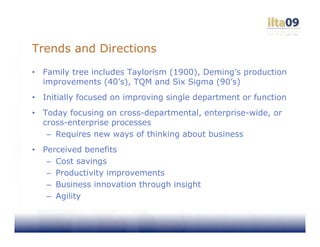
•   Family tree includes Taylorism (1900), Deming’s production
    improvements (40’s), TQM and Six Sigma (90’s)
•   Initially focused on improving single department or function
•   Today focusing on cross-departmental, enterprise-wide, or
    cross-enterprise processes
     – Requires new ways of thinking about business
•   Perceived benefits
     – Cost savings
     – Productivity improvements
     – Business innovation through insight
     – Agility
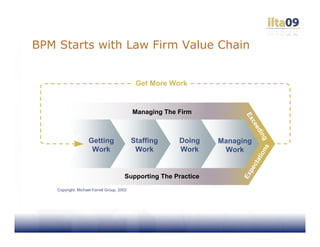
BPM Starts with Law Firm Value Chain


                                              Get More Work


                                             Managing The Firm


                                                                         Ex
                                                                           ce
                                                                              ed
                                                                                ing
                     Getting
                      Getting                Staffing
                                              Staffing    Doing
                                                           Doing   Managing
                       Work                    Work        Work


                                                                                   ns
                      Work                    Work        Work      Work


                                                                                tio
                                                                            ct a
                                                                          pe
                                                                        Ex
                                        Supporting The Practice
    Copyright, Michael Farrell Group, 2002
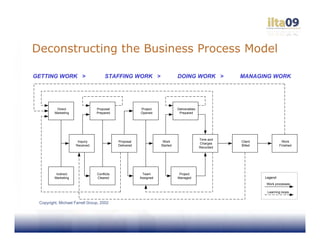
Deconstructing the Business Process Model

GETTING WORK >                       STAFFING WORK >                         DOING WORK >              MANAGING WORK


          Direct                Proposal                Project              Deliverables
         Marketing              Prepared                Opened                Prepared


                                                                                            Time and
                      Inquiry               Proposal                Work                               Client               Work
                                                                                            Charges
                     Received               Delivered              Started                             Billed             Finished
                                                                                            Recorded


          Indirect              Conflicts                Team                 Project
         Marketing              Cleared                 Assigned             Managed                            Legend:
                                                                                                                Work processes

                                                                                                                 Learning loops


 Copyright, Michael Farrell Group, 2002
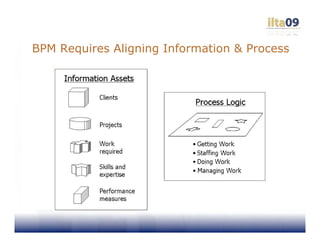
BPM Requires Aligning Information & Process
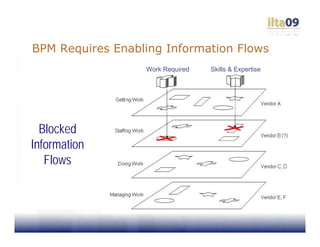
BPM Requires Enabling Information Flows
                  Work Required   Skills & Expertise


  Blocked
Information
   Flows
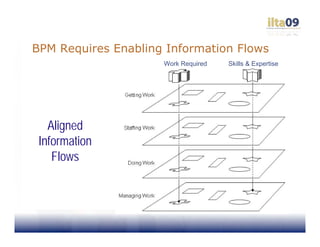
BPM Requires Enabling Information Flows
                     Work Required   Skills & Expertise


   Aligned
 Information
    Flows
BPM – Examples
•   New Business Intake
•   New Joiners/Leavers
•   Matter Management
•   E-Mail Management
Key Success Factors
•   Leadership to drive change across multiple business
    segments
•   Effective partnership between IT and the business
     – Change seen as business goal, not technology change
     – Design enabled by consistent policy and standards
     – Strong vision in technology and business solution
•   IT adoption of specialized development methods
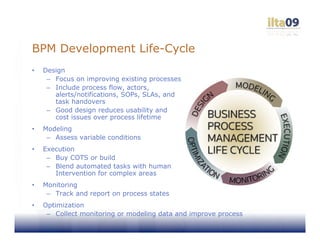
BPM Development Life-Cycle
•   Design
     – Focus on improving existing processes
     – Include process flow, actors,
       alerts/notifications, SOPs, SLAs, and
       task handovers
     – Good design reduces usability and
       cost issues over process lifetime
•   Modeling
     – Assess variable conditions
•   Execution
     – Buy COTS or build
     – Blend automated tasks with human
       Intervention for complex areas
•   Monitoring
     – Track and report on process states
•   Optimization
     – Collect monitoring or modeling data and improve process
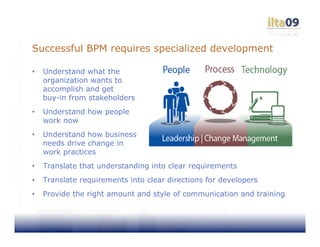
Successful BPM requires specialized development

•   Understand what the
    organization wants to
    accomplish and get
    buy-in from stakeholders
•   Understand how people
    work now
•   Understand how business
    needs drive change in
    work practices
•   Translate that understanding into clear requirements
•   Translate requirements into clear directions for developers
•   Provide the right amount and style of communication and training
Design Goals
•   Any system embodies a way of working
•   A system’s function and structure force users to accept
    particular strategies, language, and work flow
•   Successful systems offer a way of working that users want
    to adopt and addresses the way they think about things
    (their “mental model.”)
•   There needs to be a way for a cross-functional team to
    come to agreement on what users need and how to design
    a system for them
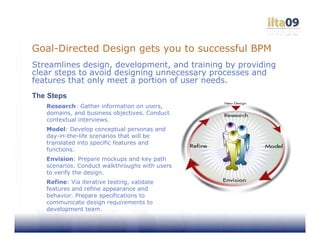
Goal-Directed Design gets you to successful BPM
Streamlines design, development, and training by providing
clear steps to avoid designing unnecessary processes and
features that only meet a portion of user needs.
The Steps
   Research: Gather information on users,
   domains, and business objectives. Conduct
   contextual interviews.
   Model: Develop conceptual personas and
   day-in-the-life scenarios that will be
   translated into specific features and
   functions.
   Envision: Prepare mockups and key path
   scenarios. Conduct walkthroughs with users
   to verify the design.
   Refine: Via iterative testing, validate
   features and refine appearance and
   behavior. Prepare specifications to
   communicate design requirements to
   development team.
“Personas” are key elements
•   Represents goals and behaviors of a real group of users
•   Synthesized from interviews
•   Captured in 1–2 page descriptions including:
     – Behavior patterns
     – Goals
     – Skills
     – Attitude
     – Environment
     – … and a few fictional personal details to make the
       persona vibrant
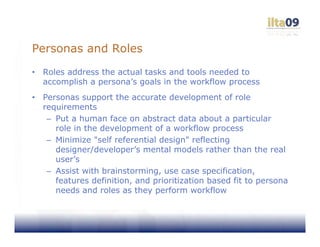
Personas and Roles
•   Roles address the actual tasks and tools needed to
    accomplish a persona’s goals in the workflow process
•   Personas support the accurate development of role
    requirements
     – Put a human face on abstract data about a particular
       role in the development of a workflow process
     – Minimize "self referential design" reflecting
       designer/developer’s mental models rather than the real
       user’s
     – Assist with brainstorming, use case specification,
       features definition, and prioritization based fit to persona
       needs and roles as they perform workflow
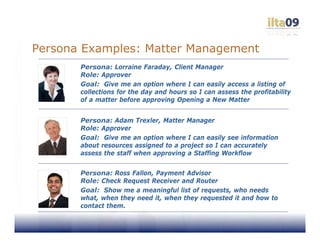
Persona Examples: Matter Management
       Persona: Lorraine Faraday, Client Manager
       Role: Approver
       Goal: Give me an option where I can easily access a listing of
       collections for the day and hours so I can assess the profitability
       of a matter before approving Opening a New Matter


       Persona: Adam Trexler, Matter Manager
       Role: Approver
       Goal: Give me an option where I can easily see information
       about resources assigned to a project so I can accurately
       assess the staff when approving a Staffing Workflow


       Persona: Ross Fallon, Payment Advisor
       Role: Check Request Receiver and Router
       Goal: Show me a meaningful list of requests, who needs
       what, when they need it, when they requested it and how to
       contact them.
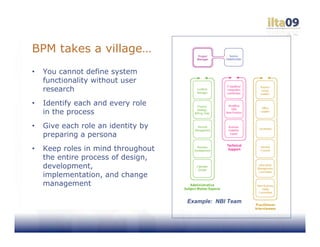
BPM takes a village…
•   You cannot define system
    functionality without user
    research
•   Identify each and every role
    in the process
•   Give each role an identity by
    preparing a persona
•   Keep roles in mind throughout
    the entire process of design,
    development,
    implementation, and change
    management

                                    Example: NBI Team
BPM in Law Firms


Real World Examples

Ilta09 Business Process Management S Gonzalez

  • 1.
    Sally Gonzalez Director Baker Robbins& Company Tom Baldwin Chief Knowledge Officer Reed Smith
  • 2.
    Agenda • Definitions & pedigree • Alignment of information and processes • Specialized design methodologies • Real world examples in legal
  • 3.
    What is BusinessProcess Management? • Management field focused on aligning organizations with the wants and needs of clients • Holistic management approach that promotes business effectiveness and efficiency while striving for innovation, flexibility, and integration with technology – Transition from “build-to-last” to “built for change” • Attempts to improve processes continuously • Sometimes described as a "process optimization process“ Sources: Wikipedia & Gartner Group
  • 4.
    Trends and Directions • Family tree includes Taylorism (1900), Deming’s production improvements (40’s), TQM and Six Sigma (90’s) • Initially focused on improving single department or function • Today focusing on cross-departmental, enterprise-wide, or cross-enterprise processes – Requires new ways of thinking about business • Perceived benefits – Cost savings – Productivity improvements – Business innovation through insight – Agility
  • 5.
    BPM Starts withLaw Firm Value Chain Get More Work Managing The Firm Ex ce ed ing Getting Getting Staffing Staffing Doing Doing Managing Work Work Work ns Work Work Work Work tio ct a pe Ex Supporting The Practice Copyright, Michael Farrell Group, 2002
  • 6.
    Deconstructing the BusinessProcess Model GETTING WORK > STAFFING WORK > DOING WORK > MANAGING WORK Direct Proposal Project Deliverables Marketing Prepared Opened Prepared Time and Inquiry Proposal Work Client Work Charges Received Delivered Started Billed Finished Recorded Indirect Conflicts Team Project Marketing Cleared Assigned Managed Legend: Work processes Learning loops Copyright, Michael Farrell Group, 2002
  • 7.
    BPM Requires AligningInformation & Process
  • 8.
    BPM Requires EnablingInformation Flows Work Required Skills & Expertise Blocked Information Flows
  • 9.
    BPM Requires EnablingInformation Flows Work Required Skills & Expertise Aligned Information Flows
  • 10.
    BPM – Examples • New Business Intake • New Joiners/Leavers • Matter Management • E-Mail Management
  • 11.
    Key Success Factors • Leadership to drive change across multiple business segments • Effective partnership between IT and the business – Change seen as business goal, not technology change – Design enabled by consistent policy and standards – Strong vision in technology and business solution • IT adoption of specialized development methods
  • 12.
    BPM Development Life-Cycle • Design – Focus on improving existing processes – Include process flow, actors, alerts/notifications, SOPs, SLAs, and task handovers – Good design reduces usability and cost issues over process lifetime • Modeling – Assess variable conditions • Execution – Buy COTS or build – Blend automated tasks with human Intervention for complex areas • Monitoring – Track and report on process states • Optimization – Collect monitoring or modeling data and improve process
  • 13.
    Successful BPM requiresspecialized development • Understand what the organization wants to accomplish and get buy-in from stakeholders • Understand how people work now • Understand how business needs drive change in work practices • Translate that understanding into clear requirements • Translate requirements into clear directions for developers • Provide the right amount and style of communication and training
  • 14.
    Design Goals • Any system embodies a way of working • A system’s function and structure force users to accept particular strategies, language, and work flow • Successful systems offer a way of working that users want to adopt and addresses the way they think about things (their “mental model.”) • There needs to be a way for a cross-functional team to come to agreement on what users need and how to design a system for them
  • 15.
    Goal-Directed Design getsyou to successful BPM Streamlines design, development, and training by providing clear steps to avoid designing unnecessary processes and features that only meet a portion of user needs. The Steps Research: Gather information on users, domains, and business objectives. Conduct contextual interviews. Model: Develop conceptual personas and day-in-the-life scenarios that will be translated into specific features and functions. Envision: Prepare mockups and key path scenarios. Conduct walkthroughs with users to verify the design. Refine: Via iterative testing, validate features and refine appearance and behavior. Prepare specifications to communicate design requirements to development team.
  • 16.
    “Personas” are keyelements • Represents goals and behaviors of a real group of users • Synthesized from interviews • Captured in 1–2 page descriptions including: – Behavior patterns – Goals – Skills – Attitude – Environment – … and a few fictional personal details to make the persona vibrant
  • 17.
    Personas and Roles • Roles address the actual tasks and tools needed to accomplish a persona’s goals in the workflow process • Personas support the accurate development of role requirements – Put a human face on abstract data about a particular role in the development of a workflow process – Minimize "self referential design" reflecting designer/developer’s mental models rather than the real user’s – Assist with brainstorming, use case specification, features definition, and prioritization based fit to persona needs and roles as they perform workflow
  • 18.
    Persona Examples: MatterManagement Persona: Lorraine Faraday, Client Manager Role: Approver Goal: Give me an option where I can easily access a listing of collections for the day and hours so I can assess the profitability of a matter before approving Opening a New Matter Persona: Adam Trexler, Matter Manager Role: Approver Goal: Give me an option where I can easily see information about resources assigned to a project so I can accurately assess the staff when approving a Staffing Workflow Persona: Ross Fallon, Payment Advisor Role: Check Request Receiver and Router Goal: Show me a meaningful list of requests, who needs what, when they need it, when they requested it and how to contact them.
  • 19.
    BPM takes avillage… • You cannot define system functionality without user research • Identify each and every role in the process • Give each role an identity by preparing a persona • Keep roles in mind throughout the entire process of design, development, implementation, and change management Example: NBI Team
  • 20.
    BPM in LawFirms Real World Examples