


Performance Improvement by Process Change-The simplified
methodology


                                  Dr. Maher Salam
                                  2013-2-23


                                                                              Kepler Consulting ®
                     2013 Dr. Maher Salam Confidential- all rights reserved
Agenda

         Section                                                                               Pages
         1         Introduction
         2         Performance improvement methodology
         3         Outcomes and recommendations of each stage
         Appendix
         1         Performance improvement approaches
         2         Business process maturity levels
         3         Process change methodology
         4         Organization Diagram


Kepler Consulting ®                   2013 Dr. Maher Salam Confidential- all rights reserved           1
Section- 1

 Introduction


Kepler Consulting ®   2
Background
      Since the evolutionary step made by Henry Ford & Alfred Sloan early 20th
      century. The subject of process change went through several waves (BPM
      the Third wave Howard Smith and Peter Fingar- 2003),
       First wave: early 20th century until 1995 the Business Process Re-
         engineering start to crash because of its high risk.
            In 1995 Davenport observed the following: the most profound lesson of reengineering was never the
            reengineering, but the process. Any company that ignores them or fails to improve them risks its future
            In 2002 J. Hagel & J . Seely invented the process renewal term and the lossly coupled architecture that
            comes with process based architecture

       Second wave: In 2004 ERP starts to crash because of its tightly coupled
        architecture, Davenport prefer continues improvement over
        reengineering for government and utility service. Reengineering only for
        companies responding to extreme competitive pressure
       Third wave: In 2005 BPMS started to track attention, one platform for
        all phases, all participants, and all projects with in the organization


Kepler Consulting ®                      2013 Dr. Maher Salam Confidential- all rights reserved                       3
Introduction

         Several process change approaches were discovered to accomplish performance
          improvement , these approaches are but not limited to
           1. Total Quality Management (TQM) W. E. Deming, Joseph M. Juran, and Armand V.
                Feigenbaum.
           2. Incremental Business Process Improvement –Davenport- 1995
           3. Business Process Abstraction
           4. Business Process Reengineering - Hammer and Champy – 1992
           5. Business Process Outsourcing
         Researches identified a relationship between these approaches “Index 2” and the real world
          experience confirmed that selecting a specific approach(s) to accomplish performance
          improvement is related to the current state and future requirements of the business
          processes and related key performance indicators.


Kepler Consulting ®               2013 Dr. Maher Salam Confidential- all rights reserved               4
Section- 2

 Performance Improvement Methodology


Kepler Consulting ®                    5
According to the 1995 observation by Davenport reengineering is risky process change approach.


Kepler Consulting ®                                                                                    6
According to Davenport , Hammar and Champy observation business process reengineering is risky.


            The methodology in a nutshell
       Methodology principles
        adopt one or more process change approach for a whole organization
        It is impossible to reach organization wide performance improvement by going through one project
        Any process change approach must take the three components 1) processes, 2) people and 3)supporting
          systems into consideration
        Adopt a BPMS , such as jBPM, for business process modeling, implementation and monitoring
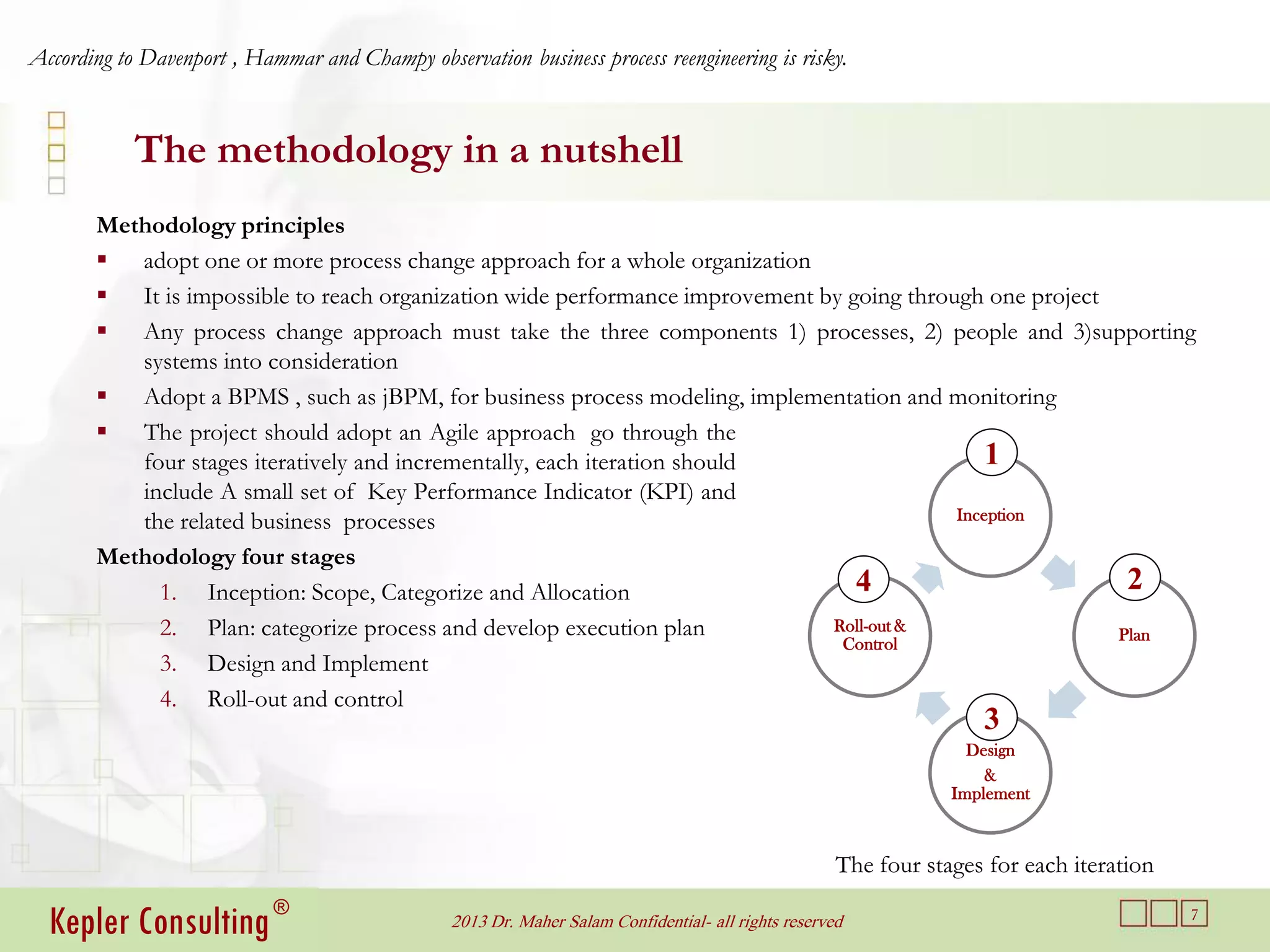
        The project should adopt an Agile approach go through the
          four stages iteratively and incrementally, each iteration should                     1
          include A small set of Key Performance Indicator (KPI) and
          the related business processes                                                   Inception

       Methodology four stages
            1. Inception: Scope, Categorize and Allocation                       4                         2
            2. Plan: categorize process and develop execution plan            Roll-out &
                                                                                                          Plan
                                                                               Control
            3. Design and Implement
            4. Roll-out and control
                                                                                                                    3
                                                                                                                   Design
                                                                                                                     &
                                                                                                                 Implement


                                                                                                     The four stages for each iteration

  Kepler Consulting ®                           2013 Dr. Maher Salam Confidential- all rights reserved                                    7
Section- 3

 Outcomes and recommendations for each stage


Kepler Consulting ®                            8
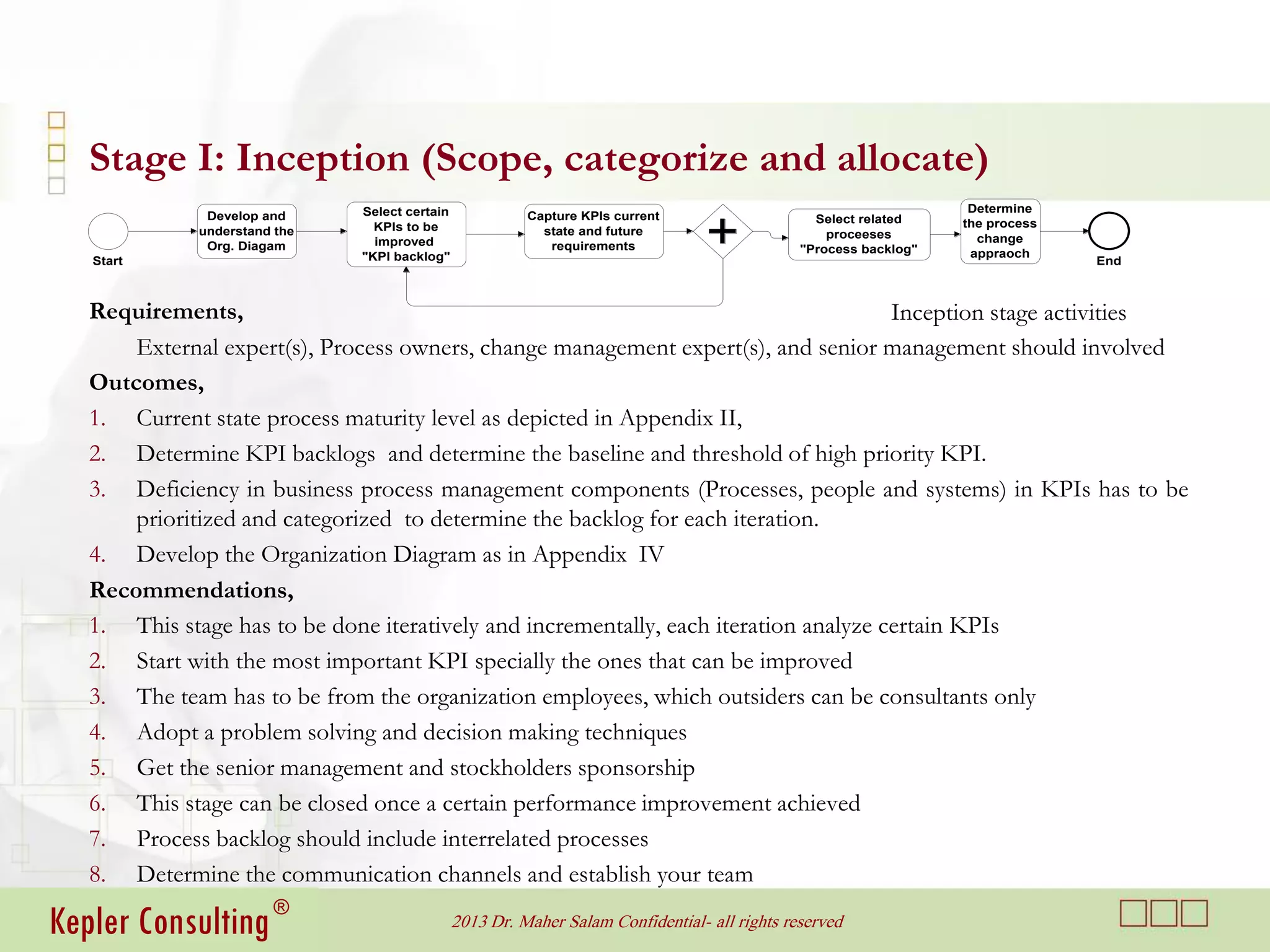
Stage I: Inception (Scope, categorize and allocate)
                              Select certain                                                                        Determine
              Develop and                                Capture KPIs current                    Select related
                                KPIs to be                                                                         the process
             understand the                                state and future                        proceeses
                                improved                                                                             change
              Org. Diagam                                   requirements                       "Process backlog"
                              "KPI backlog"                                                                         appraoch
   Start                                                                                                                         End


   Requirements,                                                                       Inception stage activities
       External expert(s), Process owners, change management expert(s), and senior management should involved
   Outcomes,
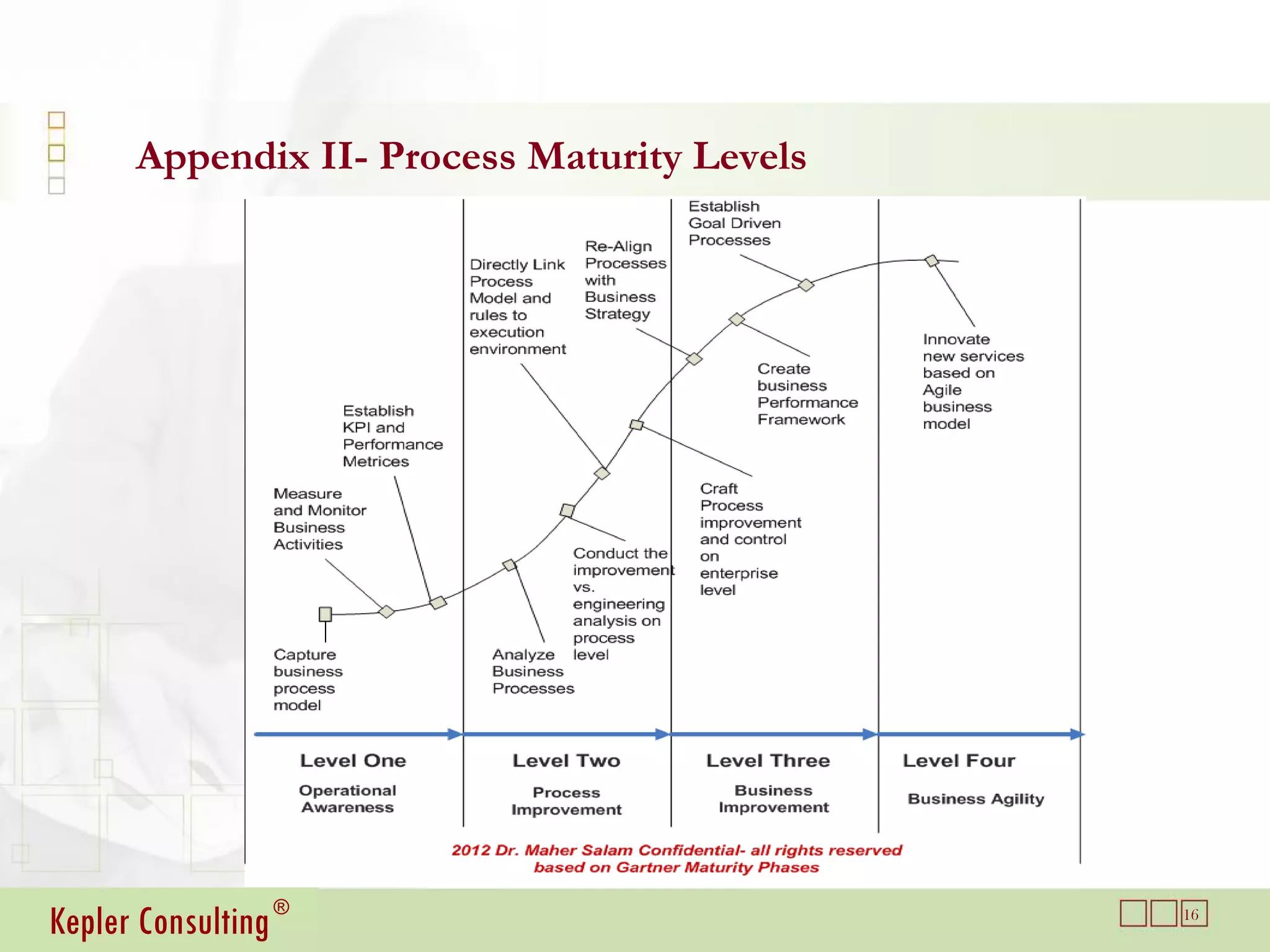
   1. Current state process maturity level as depicted in Appendix II,
   2. Determine KPI backlogs and determine the baseline and threshold of high priority KPI.
   3. Deficiency in business process management components (Processes, people and systems) in KPIs has to be
       prioritized and categorized to determine the backlog for each iteration.
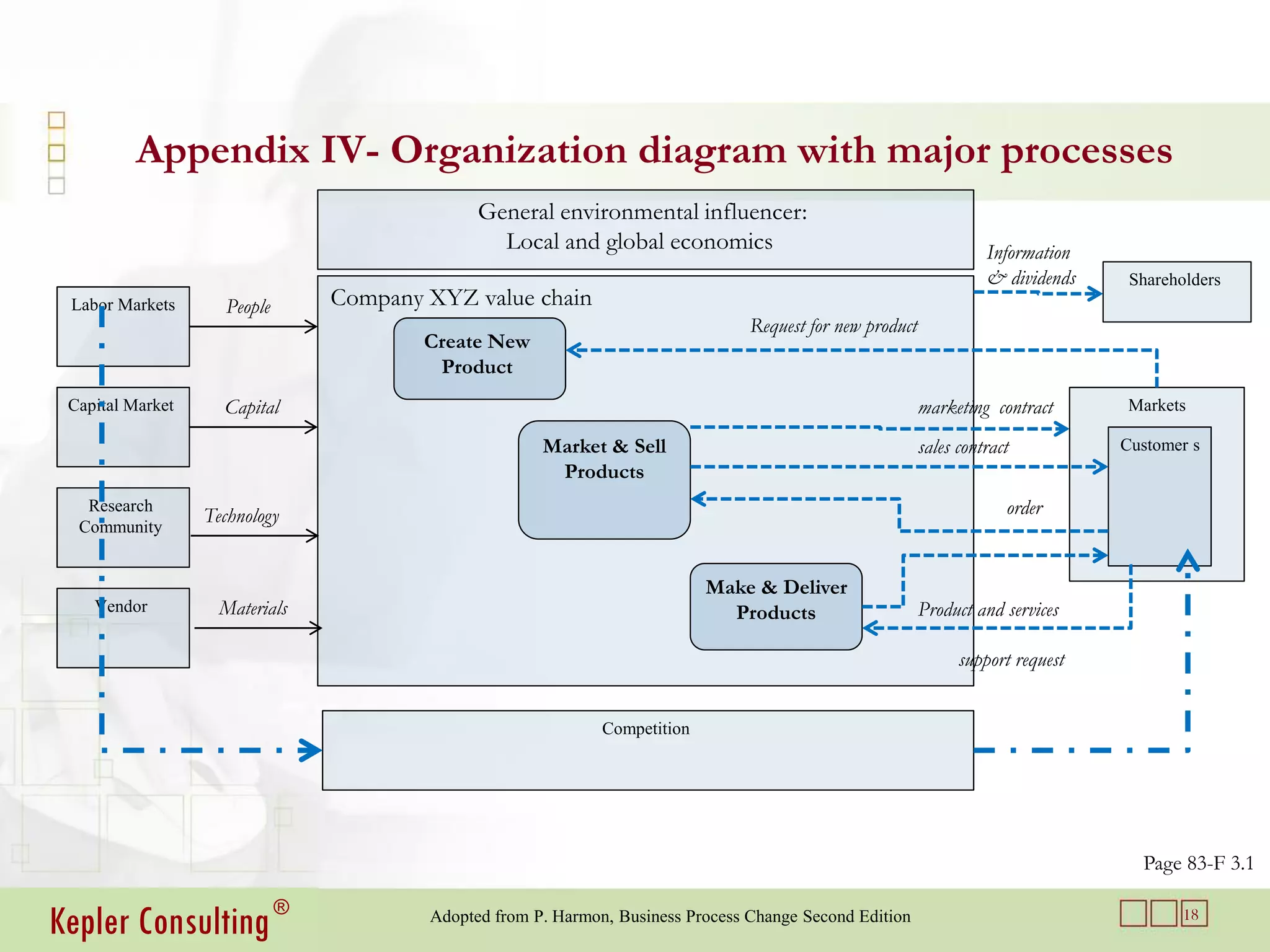
   4. Develop the Organization Diagram as in Appendix IV
   Recommendations,
   1. This stage has to be done iteratively and incrementally, each iteration analyze certain KPIs
   2. Start with the most important KPI specially the ones that can be improved
   3. The team has to be from the organization employees, which outsiders can be consultants only
   4. Adopt a problem solving and decision making techniques
   5. Get the senior management and stockholders sponsorship
   6. This stage can be closed once a certain performance improvement achieved
   7. Process backlog should include interrelated processes
   8. Determine the communication channels and establish your team

Kepler Consulting ®                            2013 Dr. Maher Salam Confidential- all rights reserved
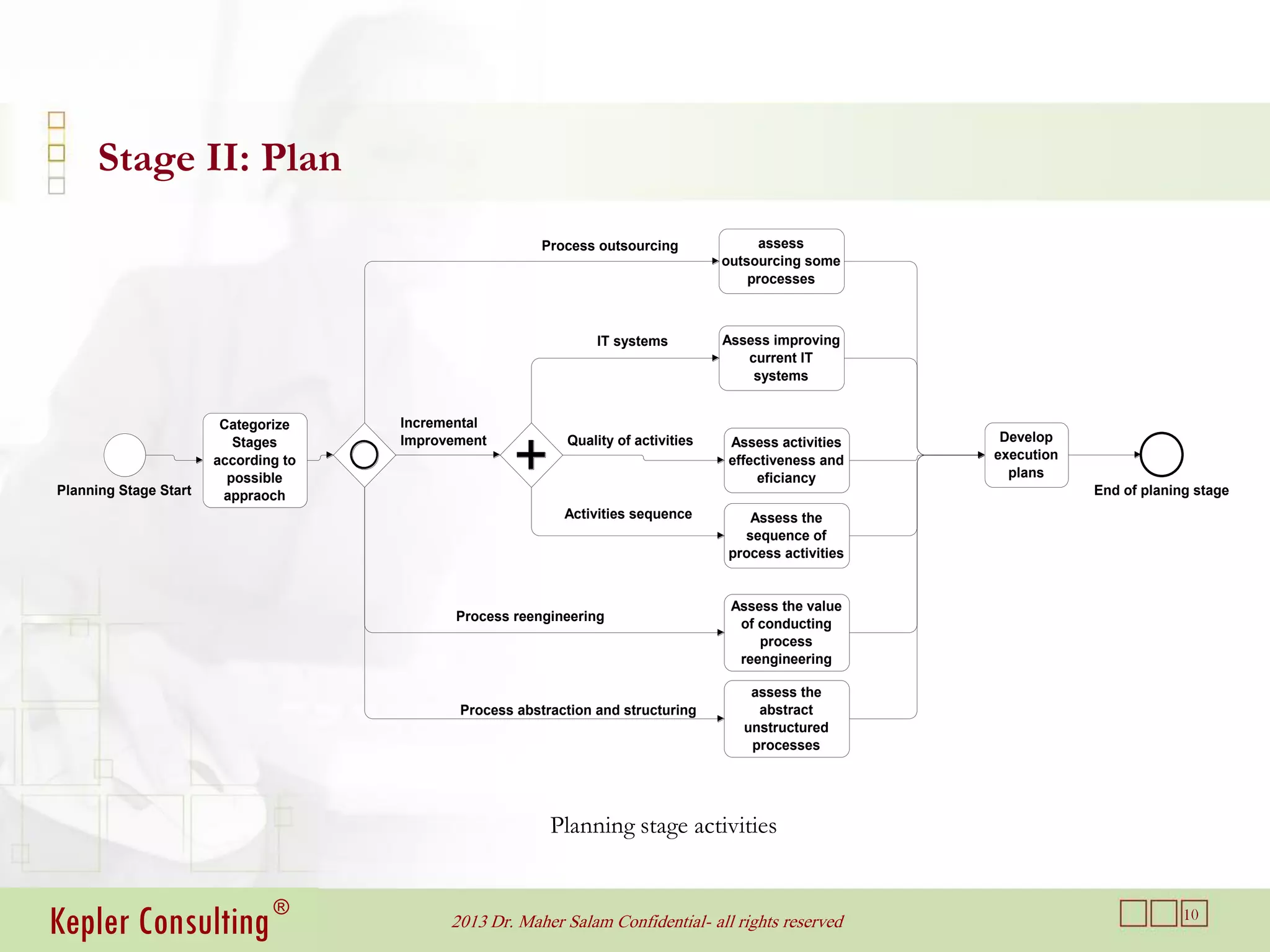
Stage II: Plan
                                                         Process outsourcing             assess
                                                                                    outsourcing some
                                                                                        processes


                                                                 IT systems         Assess improving
                                                                                       current IT
                                                                                        systems


                        Categorize    Incremental
                          Stages      Improvement           Quality of activities   Assess activities     Develop
                       according to                                                 effectiveness and    execution
                         possible                                                        eficiancy         plans
Planning Stage Start    appraoch                                                                                     End of planing stage
                                                            Activities sequence        Assess the
                                                                                      sequence of
                                                                                    process activities


                                                                                     Assess the value
                                             Process reengineering
                                                                                      of conducting
                                                                                         process
                                                                                      reengineering

                                                                                        assess the
                                             Process abstraction and structuring         abstract
                                                                                       unstructured
                                                                                        processes


                                                          Planning stage activities


Kepler Consulting ®                         2013 Dr. Maher Salam Confidential- all rights reserved                                10
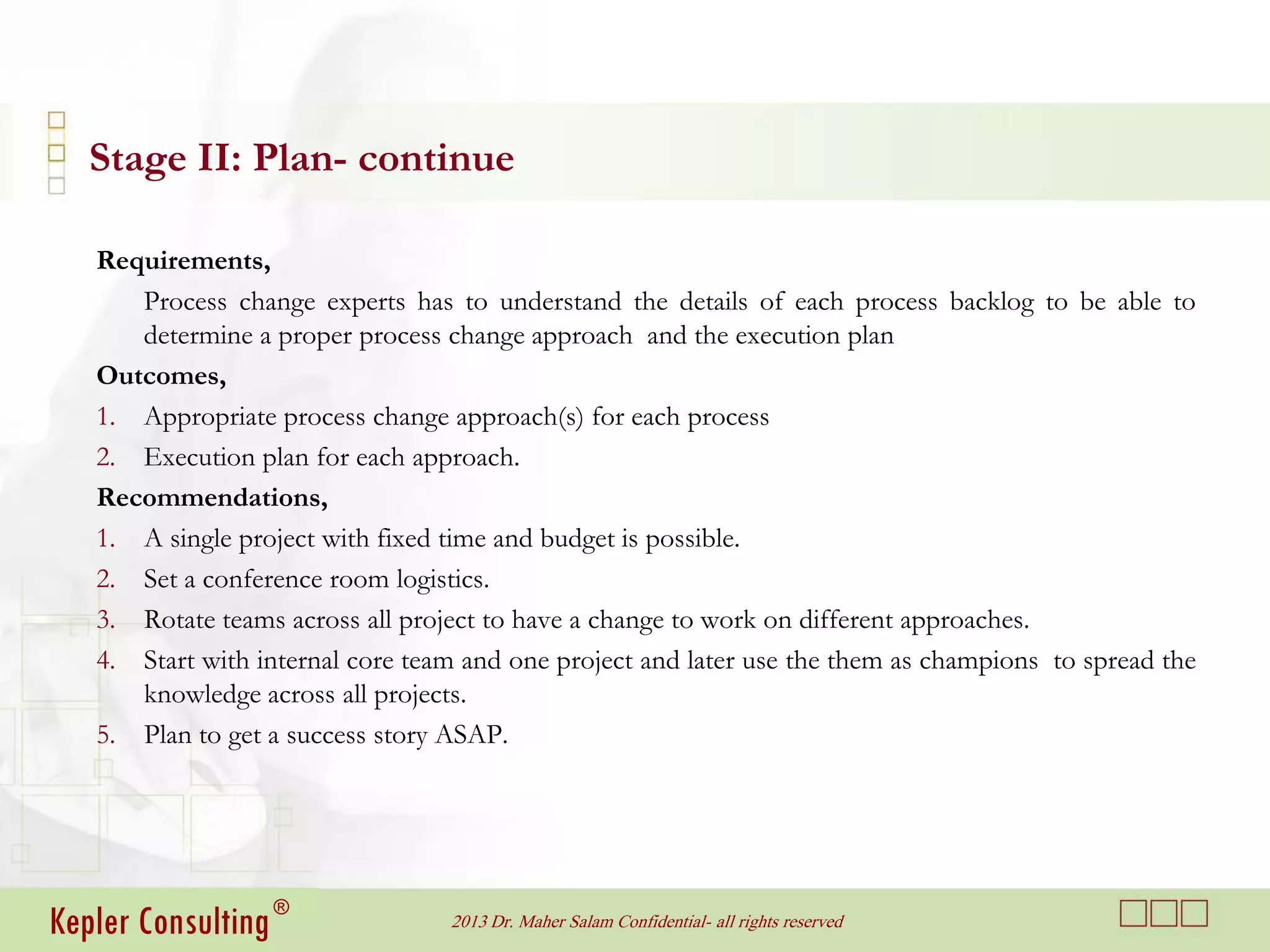
Stage II: Plan- continue

   Requirements,
      Process change experts has to understand the details of each process backlog to be able to
      determine a proper process change approach and the execution plan
   Outcomes,
   1. Appropriate process change approach(s) for each process
   2. Execution plan for each approach.
   Recommendations,
   1. A single project with fixed time and budget is possible.
   2. Set a conference room logistics.
   3. Rotate teams across all project to have a change to work on different approaches.
   4. Start with internal core team and one project and later use the them as champions to spread the
      knowledge across all projects.
   5. Plan to get a success story ASAP.


Kepler Consulting ®               2013 Dr. Maher Salam Confidential- all rights reserved
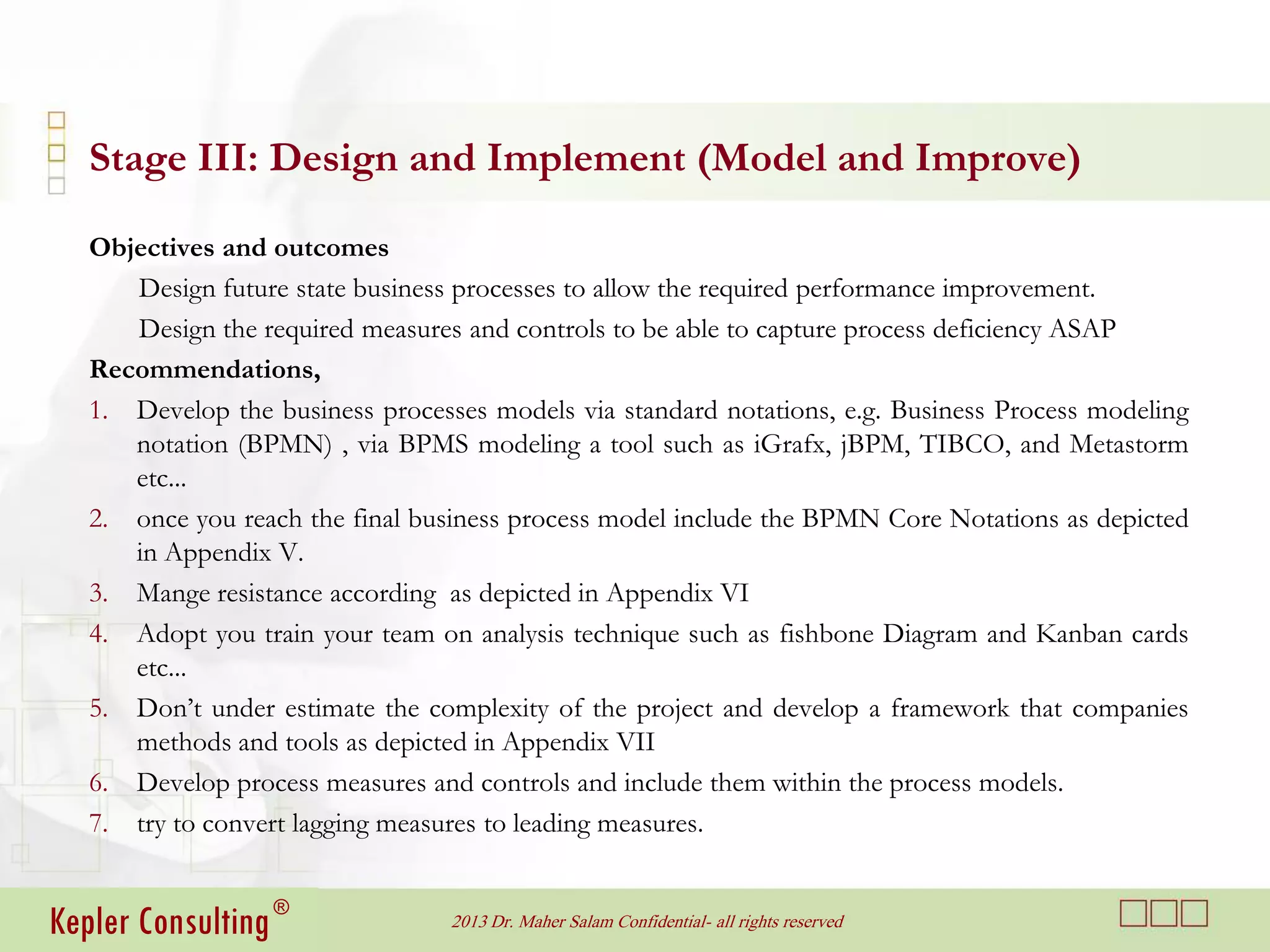
Stage III: Design and Implement (Model and Improve)

   Objectives and outcomes
      Design future state business processes to allow the required performance improvement.
      Design the required measures and controls to be able to capture process deficiency ASAP
   Recommendations,
   1. Develop the business processes models via standard notations, e.g. Business Process modeling
      notation (BPMN) , via BPMS modeling a tool such as iGrafx, jBPM, TIBCO, and Metastorm
      etc...
   2. once you reach the final business process model include the BPMN Core Notations as depicted
      in Appendix V.
   3. Mange resistance according as depicted in Appendix VI
   4. Adopt you train your team on analysis technique such as fishbone Diagram and Kanban cards
      etc...
   5. Don’t under estimate the complexity of the project and develop a framework that companies
      methods and tools as depicted in Appendix VII
   6. Develop process measures and controls and include them within the process models.
   7. try to convert lagging measures to leading measures.


Kepler Consulting ®               2013 Dr. Maher Salam Confidential- all rights reserved
Stage IV: Monitor and Control

   Objectives
   1. Measure the KPIs and audit the process implemented controls.
   2. Evaluate the effectiveness of the measures and controls.
   Outcomes
   1. Process performance and deficiency points.
   Recommendations,
   1. Monitor KPIs as early APSP to develop a success story.
   2. Don’t underestimate the complexity of the implementing controls on a process.
   3. Evaluate the design and the implementation of the process controls.


Kepler Consulting ®               2013 Dr. Maher Salam Confidential- all rights reserved
Section-4

 Appendices


Kepler Consulting ®   14
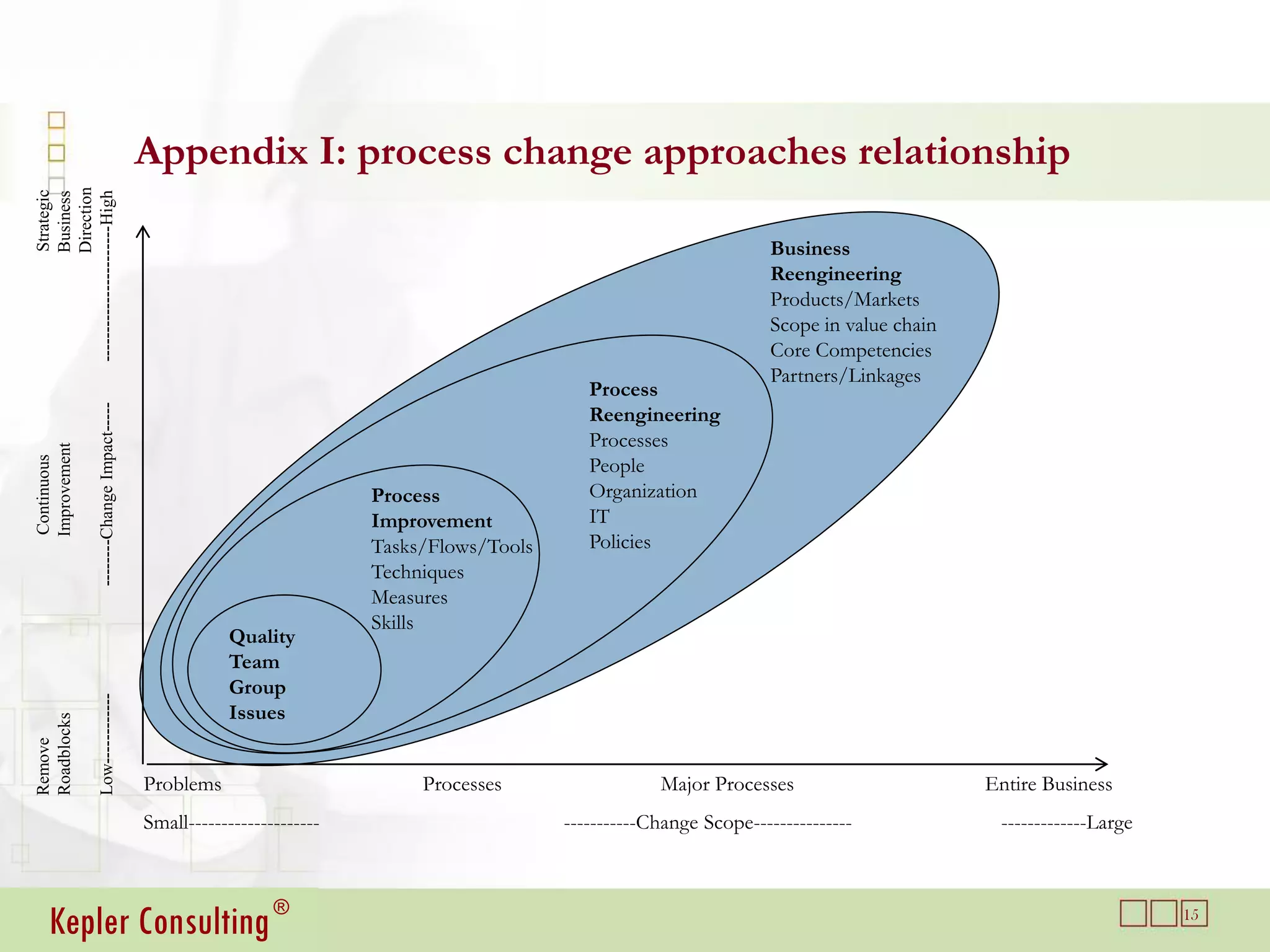
Appendix I: process change approaches relationship
                  Direction
                   Strategic


-----------------------High
                  Business


                                                                                                                              Business
                                                                                                                              Reengineering
                                                                                                                              Products/Markets
                                                                                                                              Scope in value chain
                                                                                                                              Core Competencies
                                                                                                                              Partners/Linkages
                                                                                                      Process
                      --------Change Impact-----


                                                                                                      Reengineering
                                                                                                      Processes
Improvement


                                                                                                      People
Continuous


                                                                               Process                Organization
                                                                               Improvement            IT
                                                                               Tasks/Flows/Tools      Policies
                                                                               Techniques
                                                                               Measures
                                                                               Skills
                                                               Quality
                                                               Team
                                                               Group
                      Low------------


                                                               Issues
Roadblocks
Remove


                                                   Problems                         Processes                  Major Processes                       Entire Business
                                                   Small--------------------                       -----------Change Scope---------------             -------------Large


    Kepler Consulting ®                                                                                                                                                    15
Appendix II- Process Maturity Levels


Kepler Consulting ®                          16
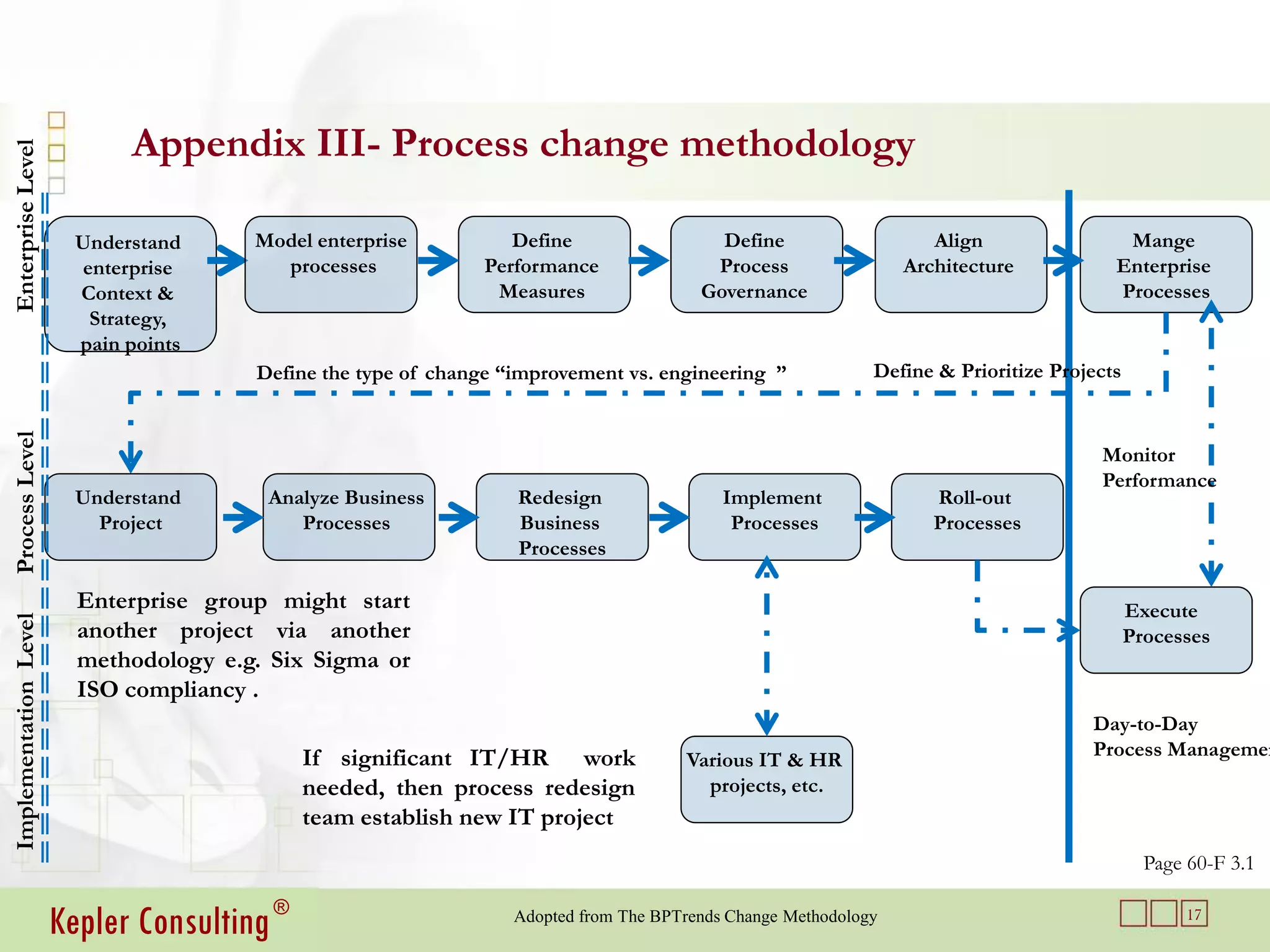
Appendix III- Process change methodology
Enterprise Level


                         Understand     Model enterprise           Define                  Define                    Align                Mange
                          enterprise      processes             Performance               Process                 Architecture           Enterprise
                         Context &                               Measures                Governance                                      Processes
                           Strategy,
                         pain points
                                        Define the type of change “improvement vs. engineering ”              Define & Prioritize Projects
Process Level


                                                                                                                                       Monitor
                                                                                                                                       Performance
                         Understand      Analyze Business          Redesign                 Implement                Roll-out
                           Project          Processes              Business                  Processes               Processes
                                                                   Processes

                         Enterprise group might start                                                                                        Execute
Implementation Level


                         another project via another                                                                                         Processes
                         methodology e.g. Six Sigma or
                         ISO compliancy .
                                                                                                                                      Day-to-Day
                                             If significant IT/HR work                                                                Process Managemen
                                                                                       Various IT & HR
                                             needed, then process redesign               projects, etc.
                                             team establish new IT project
                                                                                                                                               Page 60-F 3.1


                       Kepler Consulting ®                         Adopted from The BPTrends Change Methodology                                     17
Appendix IV- Organization diagram with major processes
                                              General environmental influencer:
                                                Local and global economics                                           Information
                                                                                                                     & dividends    Shareholders
 Labor Markets      People      Company XYZ value chain
                                                                                 Request for new product
                                        Create New
                                         Product
 Capital Market     Capital                                                                                marketing contract      Markets

                                                      Market & Sell                                        sales contract          Customer s
                                                       Products
   Research
                  Technology                                                                                            order
  Community


                                                                            Make & Deliver
    Vendor          Materials                                                 Products                     Product and services

                                                                                                                 support request


                                                              Competition


                                                                                                                                     Page 83-F 3.1


Kepler Consulting ®                     Adopted from P. Harmon, Business Process Change Second Edition                                     18
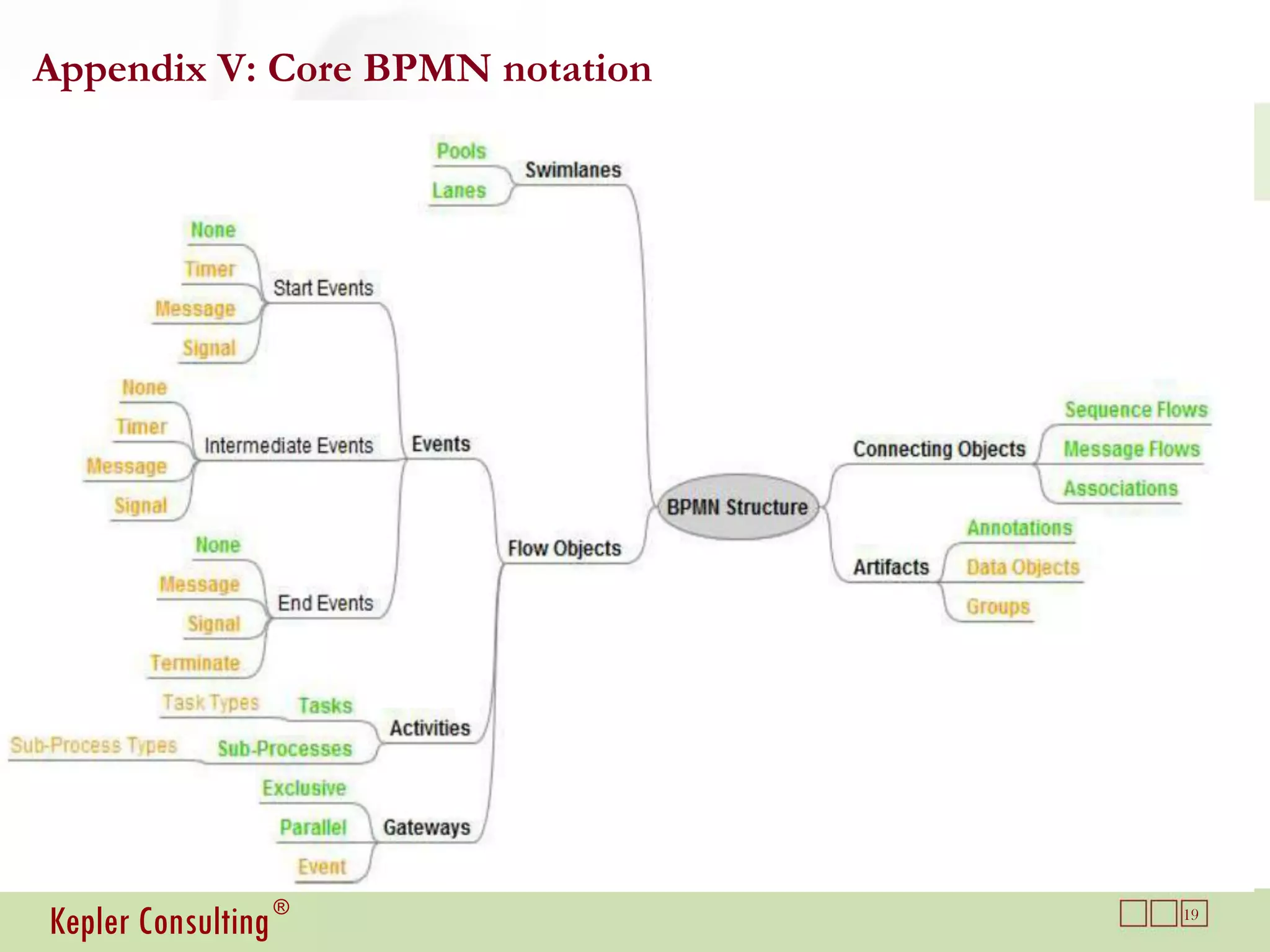
Appendix V: Core BPMN notation


Kepler Consulting ®              19
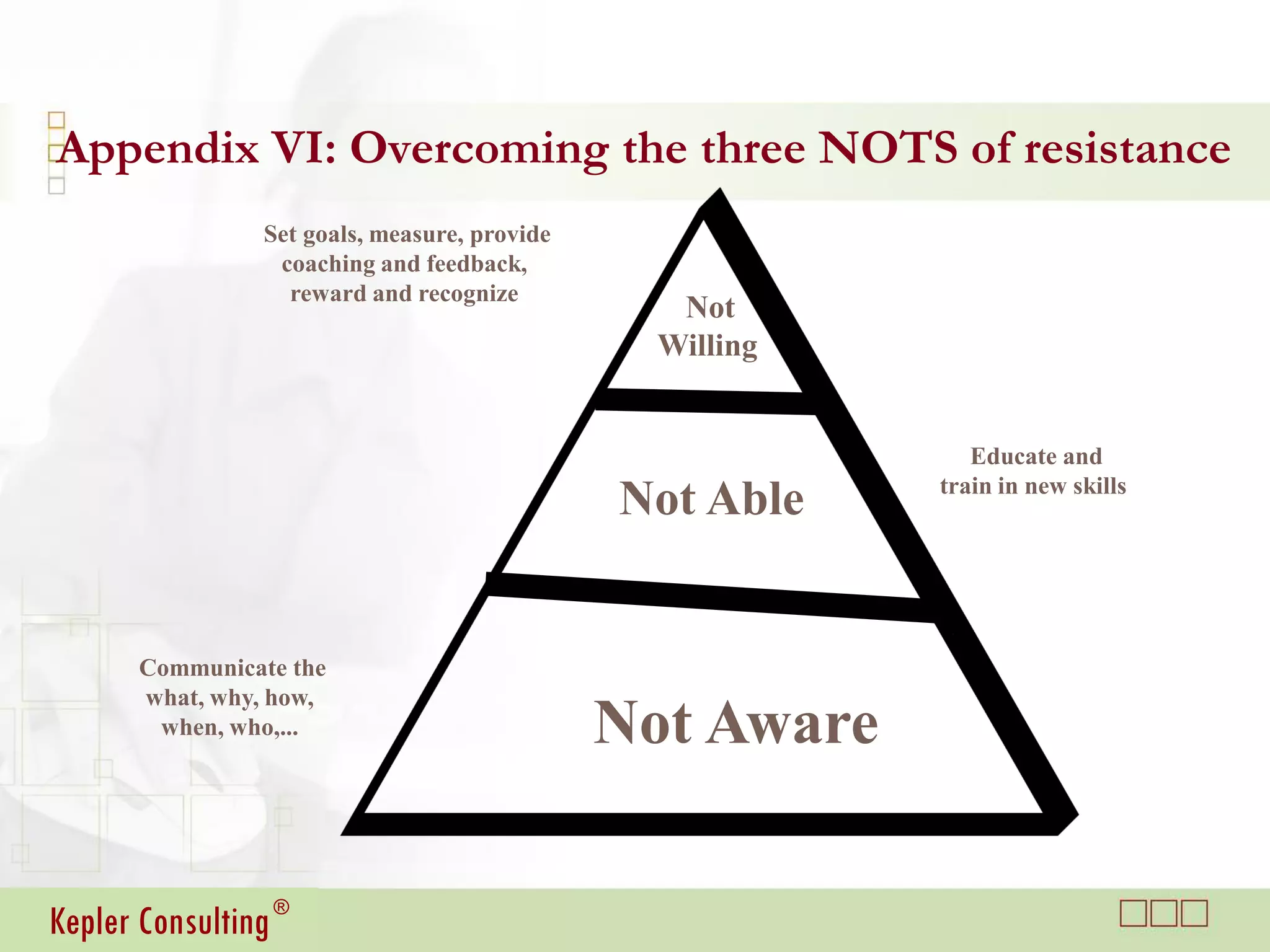
Appendix VI: Overcoming the three NOTS of resistance
                 Set goals, measure, provide
                  coaching and feedback,
                   reward and recognize
                                                  Not
                                                 Willing


                                                              Educate and
                                                           train in new skills
                                               Not Able


       Communicate the
       what, why, how,
        when, who,...                          Not Aware


Kepler Consulting ®
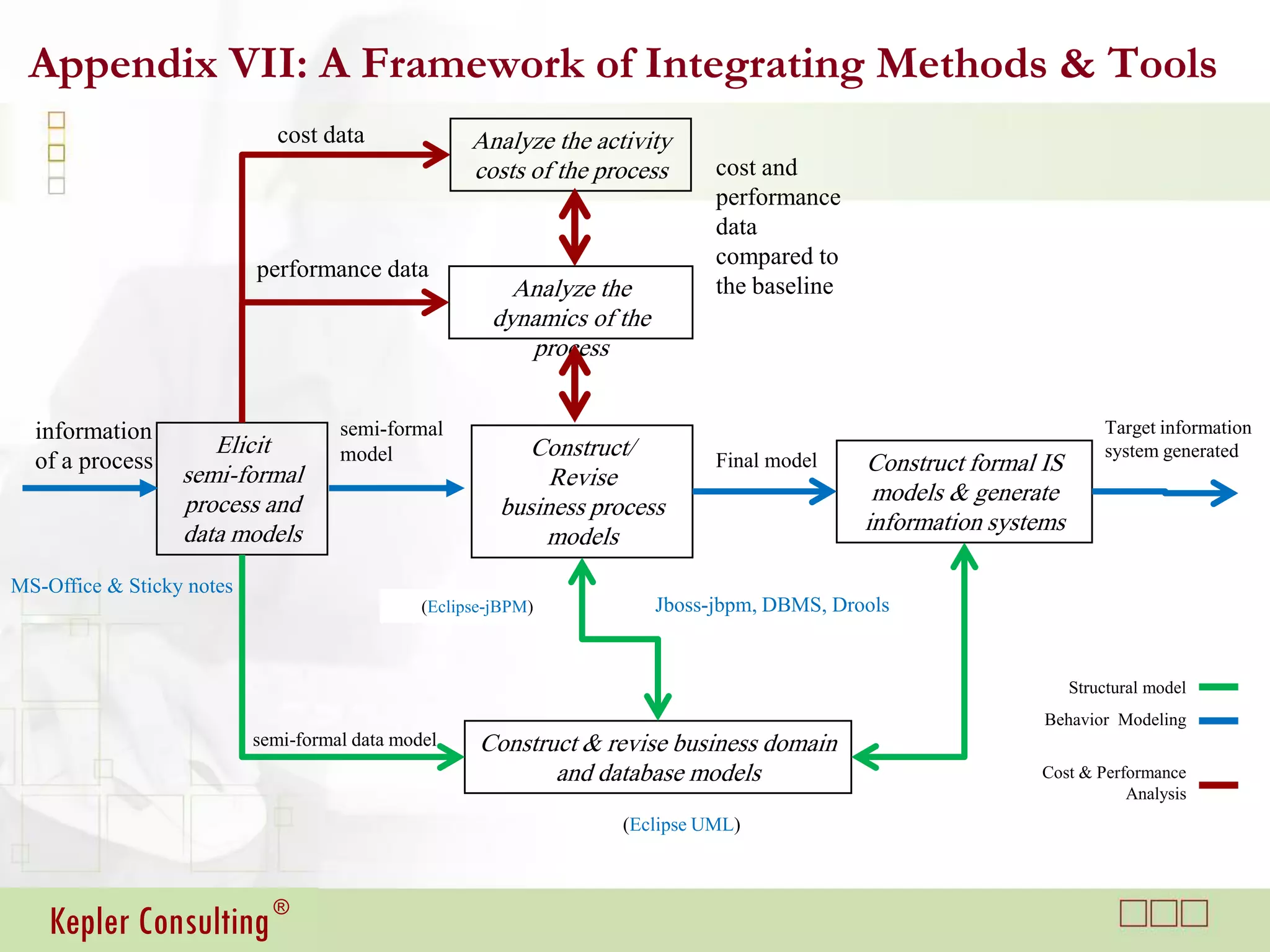
Appendix VII: A Framework of Integrating Methods & Tools
                             cost data               Analyze the activity
                                                     costs of the process      cost and
                                                                               performance
                                                                               data
                                                                               compared to
                           performance data
                                                         Analyze the           the baseline
                                                       dynamics of the
                                                          process


  information                        semi-formal                                                                        Target information
                     Elicit          model                 Construct/                                                   system generated
  of a process                                                                 Final model    Construct formal IS
                  semi-formal                                Revise
                  process and                                                                  models & generate
                                                        business process
                  data models                                                                 information systems
                                                            models
MS-Office & Sticky notes
                                               (Eclipse-jBPM)            Jboss-jbpm, DBMS, Drools


                                                                                                                    Structural model
                                                                                                               Behavior Modeling
                           semi-formal data model     Construct & revise business domain
                                                             and database models                              Cost & Performance
                                                                                                                         Analysis
                                                                    (Eclipse UML)


    Kepler Consulting ®
For more information you can contact us


                      LinkedIn profile ( Dr. Maher Salam)
                      Kepler Consulting
                      Email: m.salam@Keplers.net


Kepler Consulting ®                                         22

Performance improvement methodology

  • 1.
    Performance Improvement byProcess Change-The simplified methodology Dr. Maher Salam 2013-2-23 Kepler Consulting ® 2013 Dr. Maher Salam Confidential- all rights reserved
  • 2.
    Agenda Section Pages 1 Introduction 2 Performance improvement methodology 3 Outcomes and recommendations of each stage Appendix 1 Performance improvement approaches 2 Business process maturity levels 3 Process change methodology 4 Organization Diagram Kepler Consulting ® 2013 Dr. Maher Salam Confidential- all rights reserved 1
  • 3.
  • 4.
    Background Since the evolutionary step made by Henry Ford & Alfred Sloan early 20th century. The subject of process change went through several waves (BPM the Third wave Howard Smith and Peter Fingar- 2003),  First wave: early 20th century until 1995 the Business Process Re- engineering start to crash because of its high risk. In 1995 Davenport observed the following: the most profound lesson of reengineering was never the reengineering, but the process. Any company that ignores them or fails to improve them risks its future In 2002 J. Hagel & J . Seely invented the process renewal term and the lossly coupled architecture that comes with process based architecture  Second wave: In 2004 ERP starts to crash because of its tightly coupled architecture, Davenport prefer continues improvement over reengineering for government and utility service. Reengineering only for companies responding to extreme competitive pressure  Third wave: In 2005 BPMS started to track attention, one platform for all phases, all participants, and all projects with in the organization Kepler Consulting ® 2013 Dr. Maher Salam Confidential- all rights reserved 3
  • 5.
    Introduction  Several process change approaches were discovered to accomplish performance improvement , these approaches are but not limited to 1. Total Quality Management (TQM) W. E. Deming, Joseph M. Juran, and Armand V. Feigenbaum. 2. Incremental Business Process Improvement –Davenport- 1995 3. Business Process Abstraction 4. Business Process Reengineering - Hammer and Champy – 1992 5. Business Process Outsourcing  Researches identified a relationship between these approaches “Index 2” and the real world experience confirmed that selecting a specific approach(s) to accomplish performance improvement is related to the current state and future requirements of the business processes and related key performance indicators. Kepler Consulting ® 2013 Dr. Maher Salam Confidential- all rights reserved 4
  • 6.
    Section- 2 PerformanceImprovement Methodology Kepler Consulting ® 5
  • 7.
    According to the1995 observation by Davenport reengineering is risky process change approach. Kepler Consulting ® 6
  • 8.
    According to Davenport, Hammar and Champy observation business process reengineering is risky. The methodology in a nutshell Methodology principles  adopt one or more process change approach for a whole organization  It is impossible to reach organization wide performance improvement by going through one project  Any process change approach must take the three components 1) processes, 2) people and 3)supporting systems into consideration  Adopt a BPMS , such as jBPM, for business process modeling, implementation and monitoring  The project should adopt an Agile approach go through the four stages iteratively and incrementally, each iteration should 1 include A small set of Key Performance Indicator (KPI) and the related business processes Inception Methodology four stages 1. Inception: Scope, Categorize and Allocation 4 2 2. Plan: categorize process and develop execution plan Roll-out & Plan Control 3. Design and Implement 4. Roll-out and control 3 Design & Implement The four stages for each iteration Kepler Consulting ® 2013 Dr. Maher Salam Confidential- all rights reserved 7
  • 9.
    Section- 3 Outcomesand recommendations for each stage Kepler Consulting ® 8
  • 10.
    Stage I: Inception(Scope, categorize and allocate) Select certain Determine Develop and Capture KPIs current Select related KPIs to be the process understand the state and future proceeses improved change Org. Diagam requirements "Process backlog" "KPI backlog" appraoch Start End Requirements, Inception stage activities External expert(s), Process owners, change management expert(s), and senior management should involved Outcomes, 1. Current state process maturity level as depicted in Appendix II, 2. Determine KPI backlogs and determine the baseline and threshold of high priority KPI. 3. Deficiency in business process management components (Processes, people and systems) in KPIs has to be prioritized and categorized to determine the backlog for each iteration. 4. Develop the Organization Diagram as in Appendix IV Recommendations, 1. This stage has to be done iteratively and incrementally, each iteration analyze certain KPIs 2. Start with the most important KPI specially the ones that can be improved 3. The team has to be from the organization employees, which outsiders can be consultants only 4. Adopt a problem solving and decision making techniques 5. Get the senior management and stockholders sponsorship 6. This stage can be closed once a certain performance improvement achieved 7. Process backlog should include interrelated processes 8. Determine the communication channels and establish your team Kepler Consulting ® 2013 Dr. Maher Salam Confidential- all rights reserved
  • 11.
    Stage II: Plan Process outsourcing assess outsourcing some processes IT systems Assess improving current IT systems Categorize Incremental Stages Improvement Quality of activities Assess activities Develop according to effectiveness and execution possible eficiancy plans Planning Stage Start appraoch End of planing stage Activities sequence Assess the sequence of process activities Assess the value Process reengineering of conducting process reengineering assess the Process abstraction and structuring abstract unstructured processes Planning stage activities Kepler Consulting ® 2013 Dr. Maher Salam Confidential- all rights reserved 10
  • 12.
    Stage II: Plan-continue Requirements, Process change experts has to understand the details of each process backlog to be able to determine a proper process change approach and the execution plan Outcomes, 1. Appropriate process change approach(s) for each process 2. Execution plan for each approach. Recommendations, 1. A single project with fixed time and budget is possible. 2. Set a conference room logistics. 3. Rotate teams across all project to have a change to work on different approaches. 4. Start with internal core team and one project and later use the them as champions to spread the knowledge across all projects. 5. Plan to get a success story ASAP. Kepler Consulting ® 2013 Dr. Maher Salam Confidential- all rights reserved
  • 13.
    Stage III: Designand Implement (Model and Improve) Objectives and outcomes Design future state business processes to allow the required performance improvement. Design the required measures and controls to be able to capture process deficiency ASAP Recommendations, 1. Develop the business processes models via standard notations, e.g. Business Process modeling notation (BPMN) , via BPMS modeling a tool such as iGrafx, jBPM, TIBCO, and Metastorm etc... 2. once you reach the final business process model include the BPMN Core Notations as depicted in Appendix V. 3. Mange resistance according as depicted in Appendix VI 4. Adopt you train your team on analysis technique such as fishbone Diagram and Kanban cards etc... 5. Don’t under estimate the complexity of the project and develop a framework that companies methods and tools as depicted in Appendix VII 6. Develop process measures and controls and include them within the process models. 7. try to convert lagging measures to leading measures. Kepler Consulting ® 2013 Dr. Maher Salam Confidential- all rights reserved
  • 14.
    Stage IV: Monitorand Control Objectives 1. Measure the KPIs and audit the process implemented controls. 2. Evaluate the effectiveness of the measures and controls. Outcomes 1. Process performance and deficiency points. Recommendations, 1. Monitor KPIs as early APSP to develop a success story. 2. Don’t underestimate the complexity of the implementing controls on a process. 3. Evaluate the design and the implementation of the process controls. Kepler Consulting ® 2013 Dr. Maher Salam Confidential- all rights reserved
  • 15.
  • 16.
    Appendix I: processchange approaches relationship Direction Strategic -----------------------High Business Business Reengineering Products/Markets Scope in value chain Core Competencies Partners/Linkages Process --------Change Impact----- Reengineering Processes Improvement People Continuous Process Organization Improvement IT Tasks/Flows/Tools Policies Techniques Measures Skills Quality Team Group Low------------ Issues Roadblocks Remove Problems Processes Major Processes Entire Business Small-------------------- -----------Change Scope--------------- -------------Large Kepler Consulting ® 15
  • 17.
    Appendix II- ProcessMaturity Levels Kepler Consulting ® 16
  • 18.
    Appendix III- Processchange methodology Enterprise Level Understand Model enterprise Define Define Align Mange enterprise processes Performance Process Architecture Enterprise Context & Measures Governance Processes Strategy, pain points Define the type of change “improvement vs. engineering ” Define & Prioritize Projects Process Level Monitor Performance Understand Analyze Business Redesign Implement Roll-out Project Processes Business Processes Processes Processes Enterprise group might start Execute Implementation Level another project via another Processes methodology e.g. Six Sigma or ISO compliancy . Day-to-Day If significant IT/HR work Process Managemen Various IT & HR needed, then process redesign projects, etc. team establish new IT project Page 60-F 3.1 Kepler Consulting ® Adopted from The BPTrends Change Methodology 17
  • 19.
    Appendix IV- Organizationdiagram with major processes General environmental influencer: Local and global economics Information & dividends Shareholders Labor Markets People Company XYZ value chain Request for new product Create New Product Capital Market Capital marketing contract Markets Market & Sell sales contract Customer s Products Research Technology order Community Make & Deliver Vendor Materials Products Product and services support request Competition Page 83-F 3.1 Kepler Consulting ® Adopted from P. Harmon, Business Process Change Second Edition 18
  • 20.
    Appendix V: CoreBPMN notation Kepler Consulting ® 19
  • 21.
    Appendix VI: Overcomingthe three NOTS of resistance Set goals, measure, provide coaching and feedback, reward and recognize Not Willing Educate and train in new skills Not Able Communicate the what, why, how, when, who,... Not Aware Kepler Consulting ®
  • 22.
    Appendix VII: AFramework of Integrating Methods & Tools cost data Analyze the activity costs of the process cost and performance data compared to performance data Analyze the the baseline dynamics of the process information semi-formal Target information Elicit model Construct/ system generated of a process Final model Construct formal IS semi-formal Revise process and models & generate business process data models information systems models MS-Office & Sticky notes (Eclipse-jBPM) Jboss-jbpm, DBMS, Drools Structural model Behavior Modeling semi-formal data model Construct & revise business domain and database models Cost & Performance Analysis (Eclipse UML) Kepler Consulting ®
  • 23.
    For more informationyou can contact us LinkedIn profile ( Dr. Maher Salam) Kepler Consulting Email: m.salam@Keplers.net Kepler Consulting ® 22