Urea Cycle
Dr. Zahid Azeem
Assistant Professor of Biochemistry
AJ&K Medical College Muzaffarabad
For MBBS-batch 2017
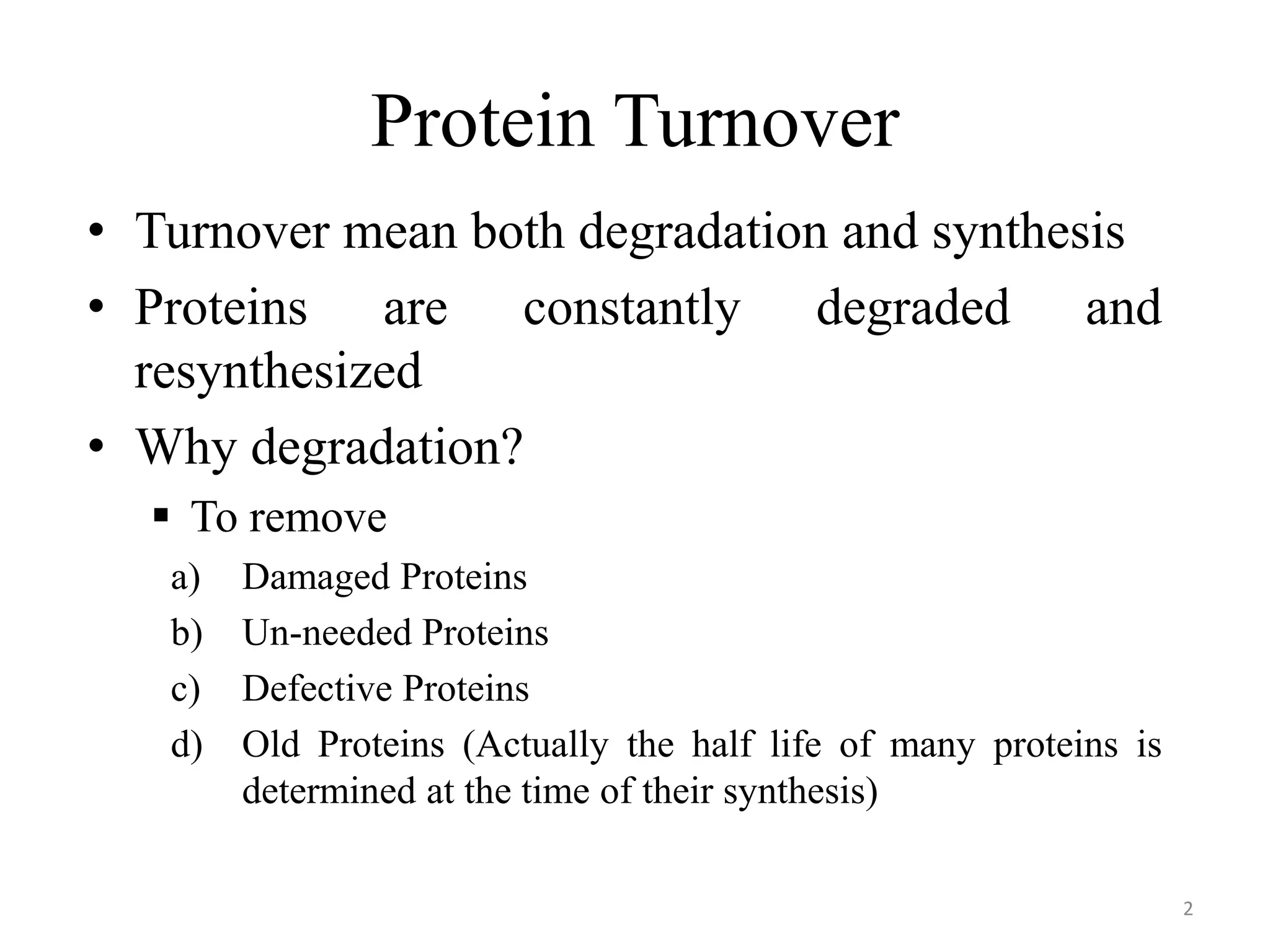
• Turnover mean both degradation and synthesis
• Proteins are constantly degraded and
resynthesized
• Why degradation?
 To remove
a) Damaged Proteins
b) Un-needed Proteins
c) Defective Proteins
d) Old Proteins (Actually the half life of many proteins is
determined at the time of their synthesis)
Protein Turnover
2
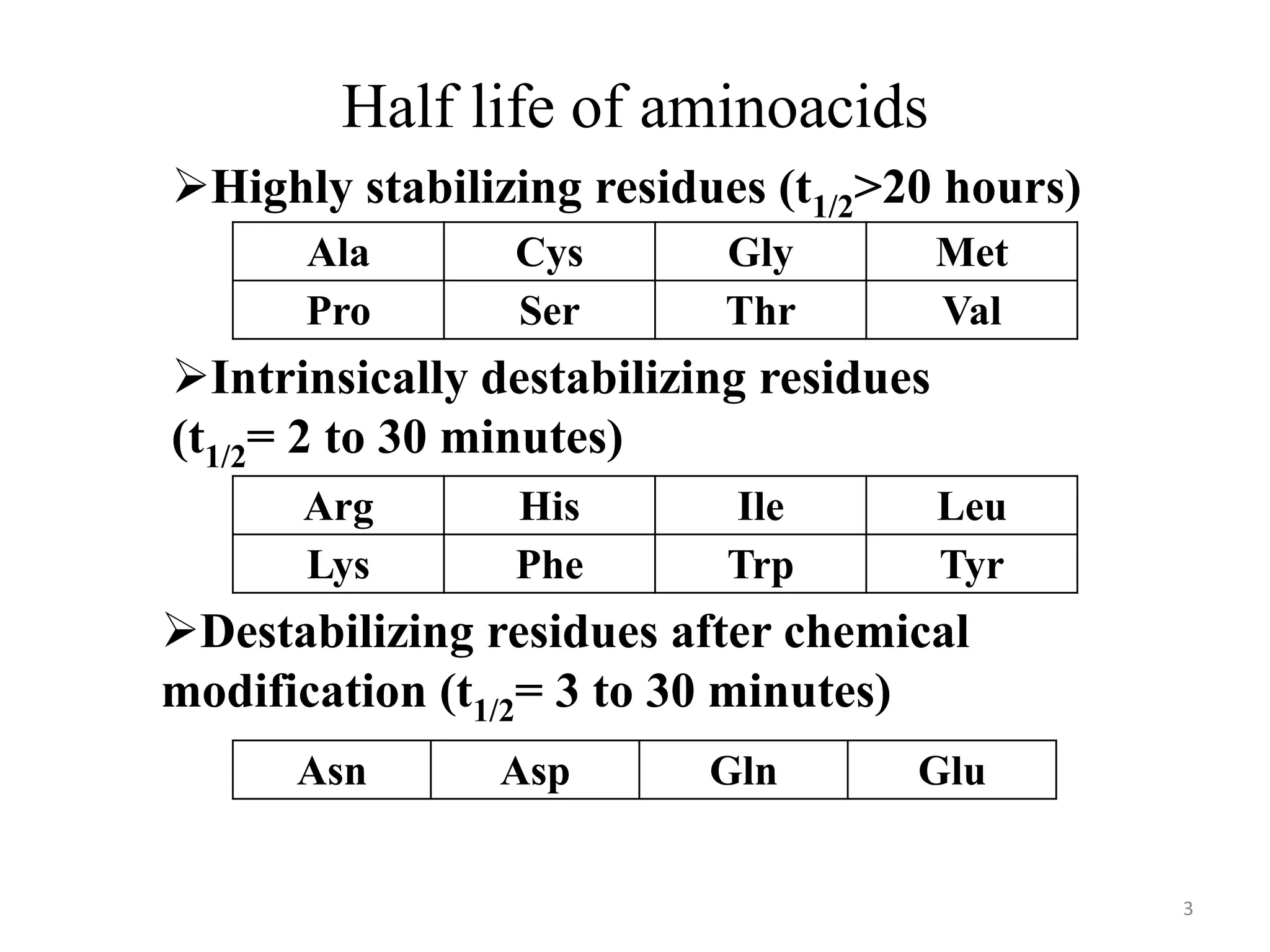
Half life of aminoacids
Highly stabilizing residues (t1/2>20 hours)
Ala Cys Gly Met
Pro Ser Thr Val
Intrinsically destabilizing residues
(t1/2= 2 to 30 minutes)
Arg His Ile Leu
Lys Phe Trp Tyr
Destabilizing residues after chemical
modification (t1/2= 3 to 30 minutes)
Asn Asp Gln Glu
3
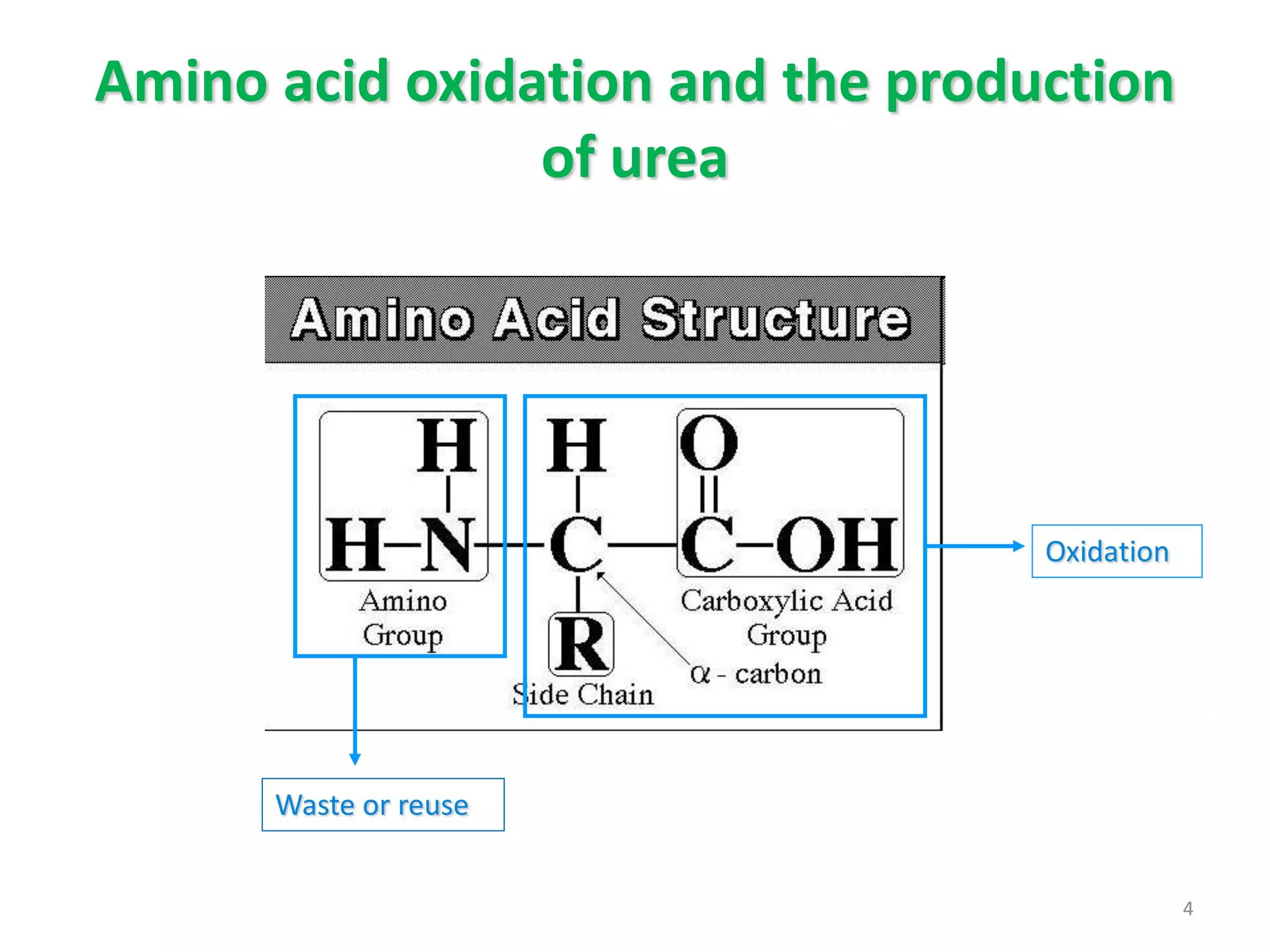
Amino acid oxidation and the production
of urea
Waste or reuse
Oxidation
4
Ammonia has to be eliminated
• Ammonia originates in the catabolism of amino acids
that are primarily produced by the degradation of
proteins – dietary as well as existing within the cell:
digestive enzymes
proteins released by digestion of cells sloughed-
off the walls of the GIT
muscle proteins
hemoglobin
intracellular proteins (damaged, unnecessary)
5
Ammonia has to be eliminated
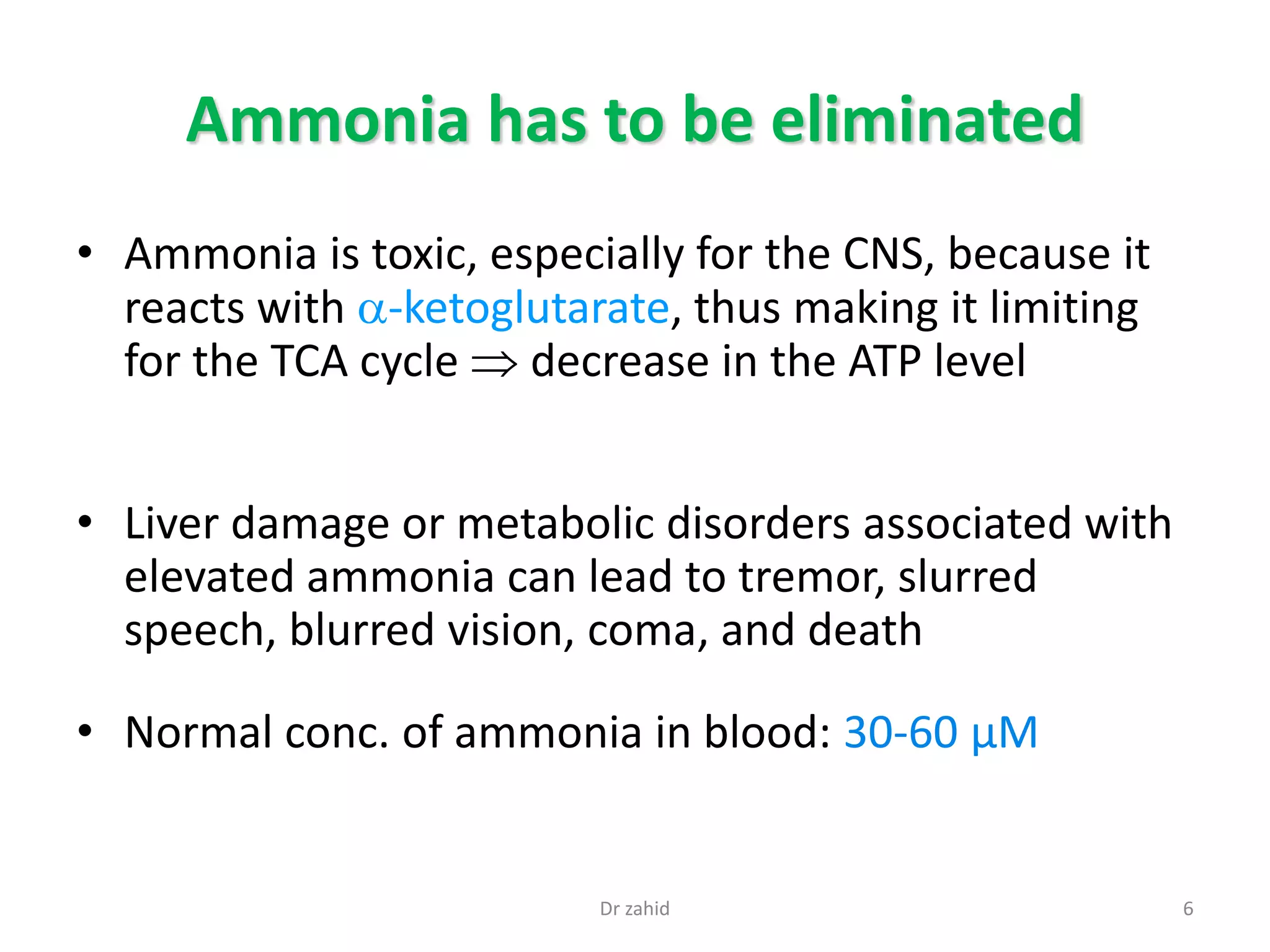
• Ammonia is toxic, especially for the CNS, because it
reacts with -ketoglutarate, thus making it limiting
for the TCA cycle  decrease in the ATP level
• Liver damage or metabolic disorders associated with
elevated ammonia can lead to tremor, slurred
speech, blurred vision, coma, and death
• Normal conc. of ammonia in blood: 30-60 µM
6Dr zahid
Overview of amino acid catabolism in mammals
2 CHOICES
1. Reuse
2. Urea cycle
Fumarate
Oxaloacetate
7Dr. Inayat Abbasi
Nitrogen removal from amino acids
Transamination
Oxidative
deamination
Urea cycle
Aminotransferase
PLP
8
Nitrogen removal from amino acids
Step 1: Remove amino group
Step 2: Take amino group to liver for
nitrogen excretion
Step 3: Entry into mitochondria
Step 4: Prepare nitrogen to enter urea
cycle
Step 5: Urea cycle
9
Step 1. Remove amino group ;
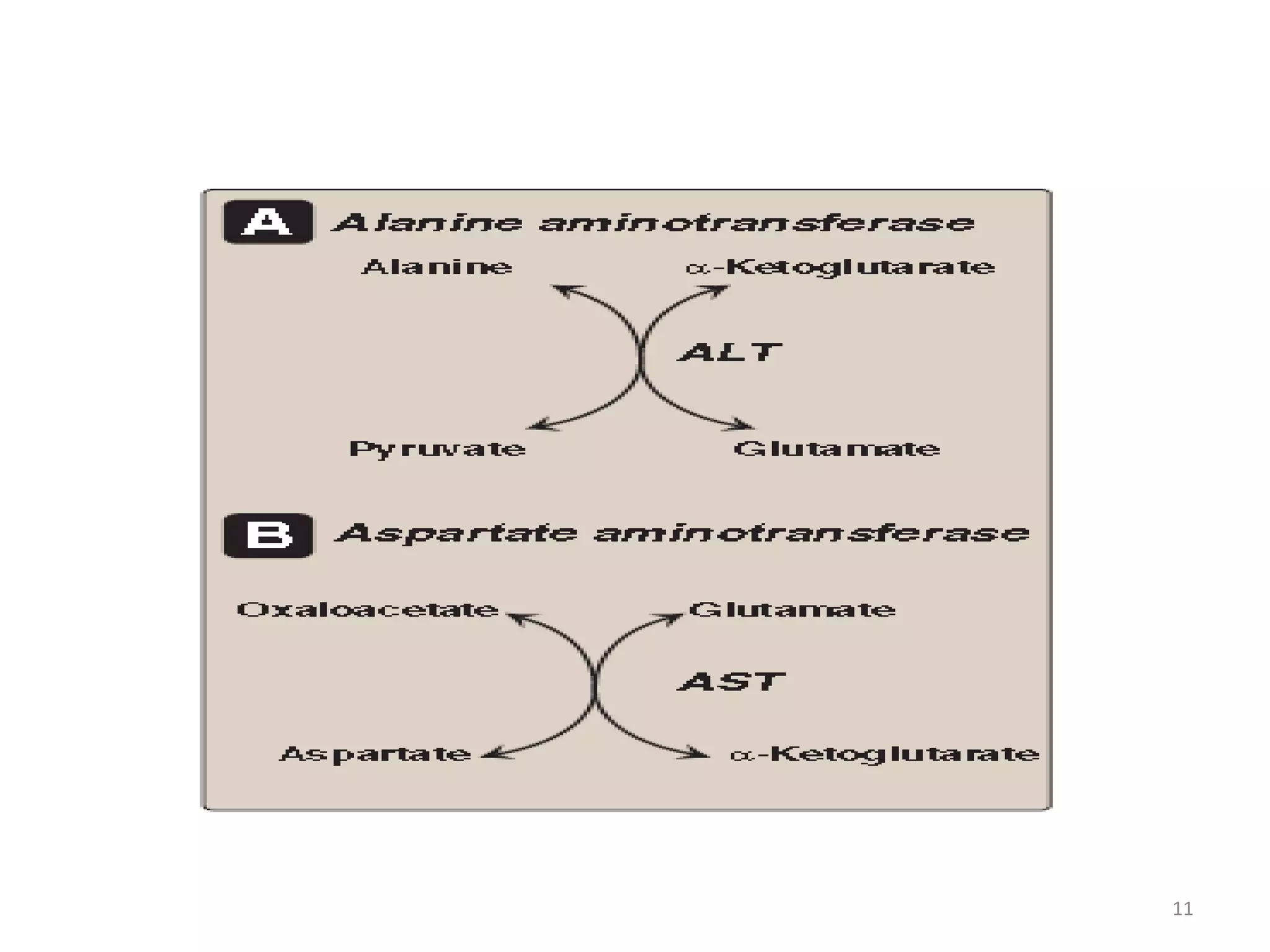
Transamination
• Transfer of the amino group of an amino acid to an -keto
acid  the original AA is converted to the corresponding -
keto acid and vice versa: Transamination is catalyzed by
transaminases (aminotransferases) that require participation
of pyridoxalphosphate
10
11
Step 2: Take amino group to liver for
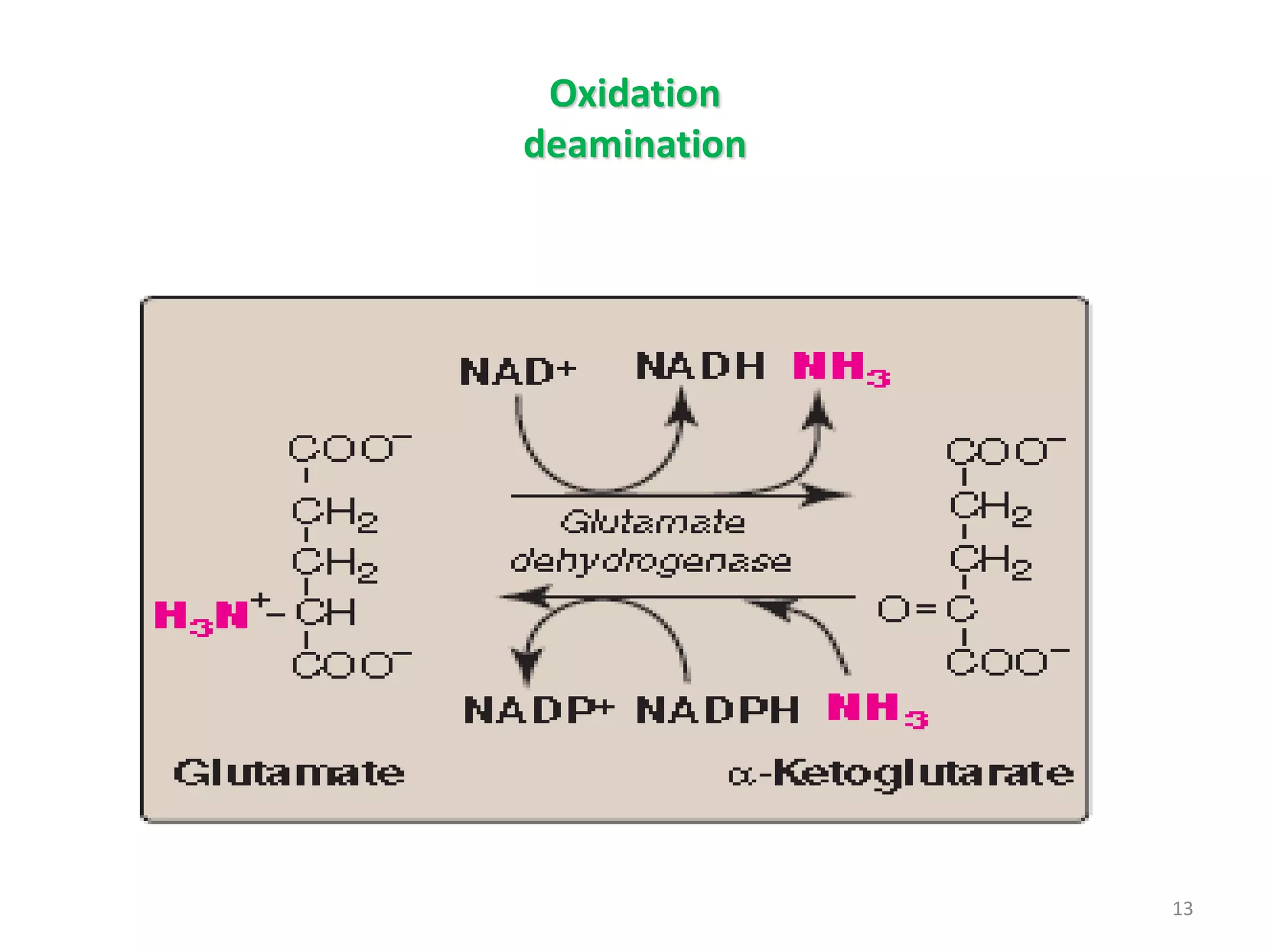
nitrogen excretion; Oxidation
deaminationn
Glutamate
dehydrogenase
The glutamate dehydrogenase of mammalian liver
has the unusual capacity to use either NAD+ or
NADP+ as cofactor
Glutamate releases its amino group as
ammonia in the liver.
The amino groups from many of the
-amino acids are collected in the
liver in the form of the amino group
of L-glutamate molecules.
12
Oxidation
deamination
13
14
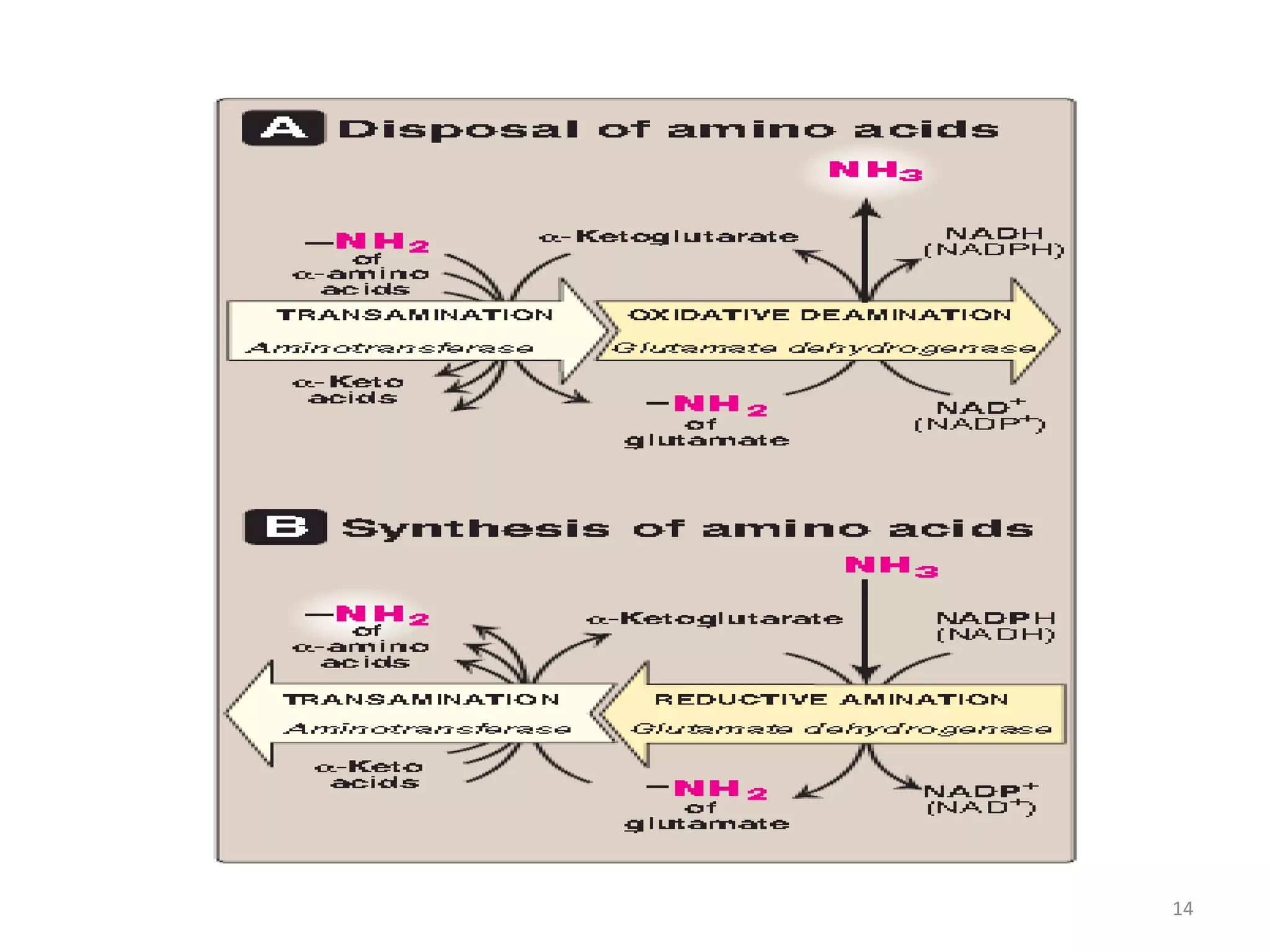
1. Glutamate
transferres one amino group WITHIN cells:
Aminotransferase → makes glutamate from -ketogluta-rate
Glutamate dehydrogenase → opposite
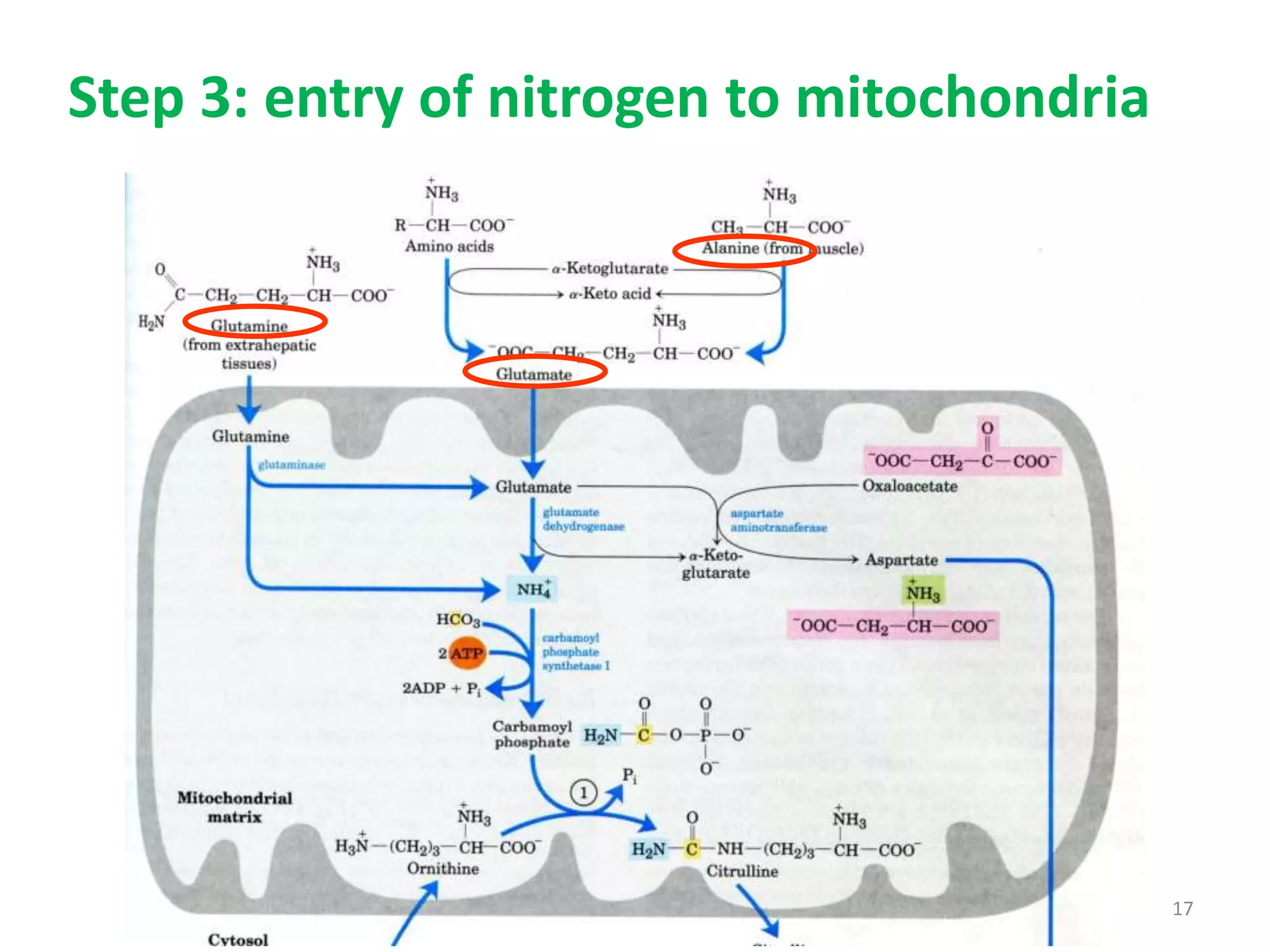
2. Glutamine
transferres two amino group BETWEEN cells → releases its
amino group in the liver
3. Alanine
transferres amino group from tissue (muscle) into the liver
Nitrogen carriers
15
Glucose-alanine cycle
Ala is the carrier of ammonia and of the carbon
skeleton of pyruvate from muscle to liver.
The ammonia is excreted and the pyruvate is used
to produce glucose, which is returned to the
muscle.
Alanine plays a special role in transporting
amino groups to liver.
According to D. L. Nelson, M. M. Cox :LEHNINGER. PRINCIPLES
OF BIOCHEMISTRY Fifth edition
16
Step 3: entry of nitrogen to mitochondria
17
Step 4: prepare nitrogen to enter urea cycle
Regulation
18
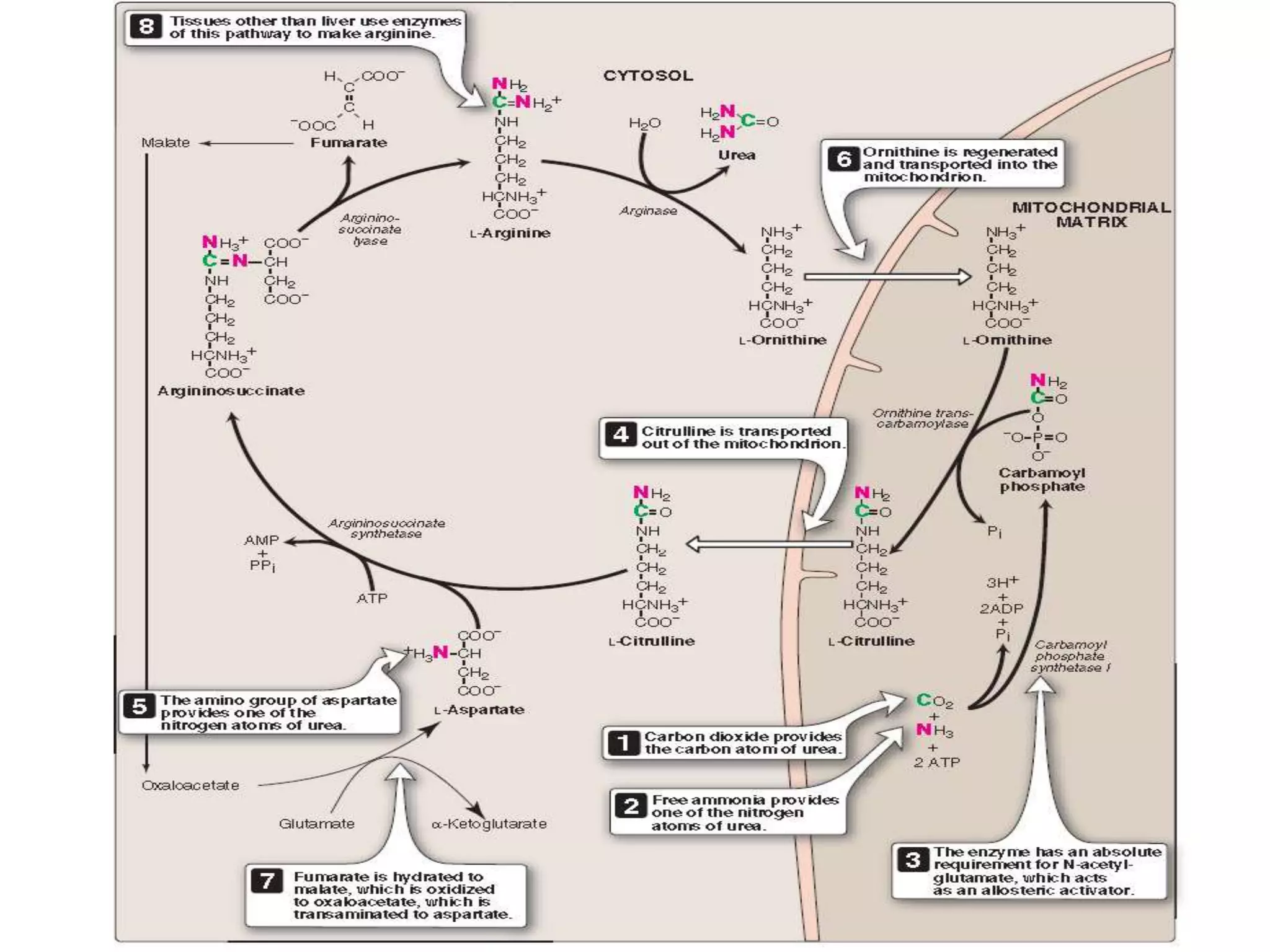
Step 5: Urea cycle aspartate
Ornithine
transcarbamoylase
Argininosuccinate
synthase
Argininosuccinate
lyase
Arginase 1
19Dr. Inayat Abbasi
Dr. Inayat Abbasi 20
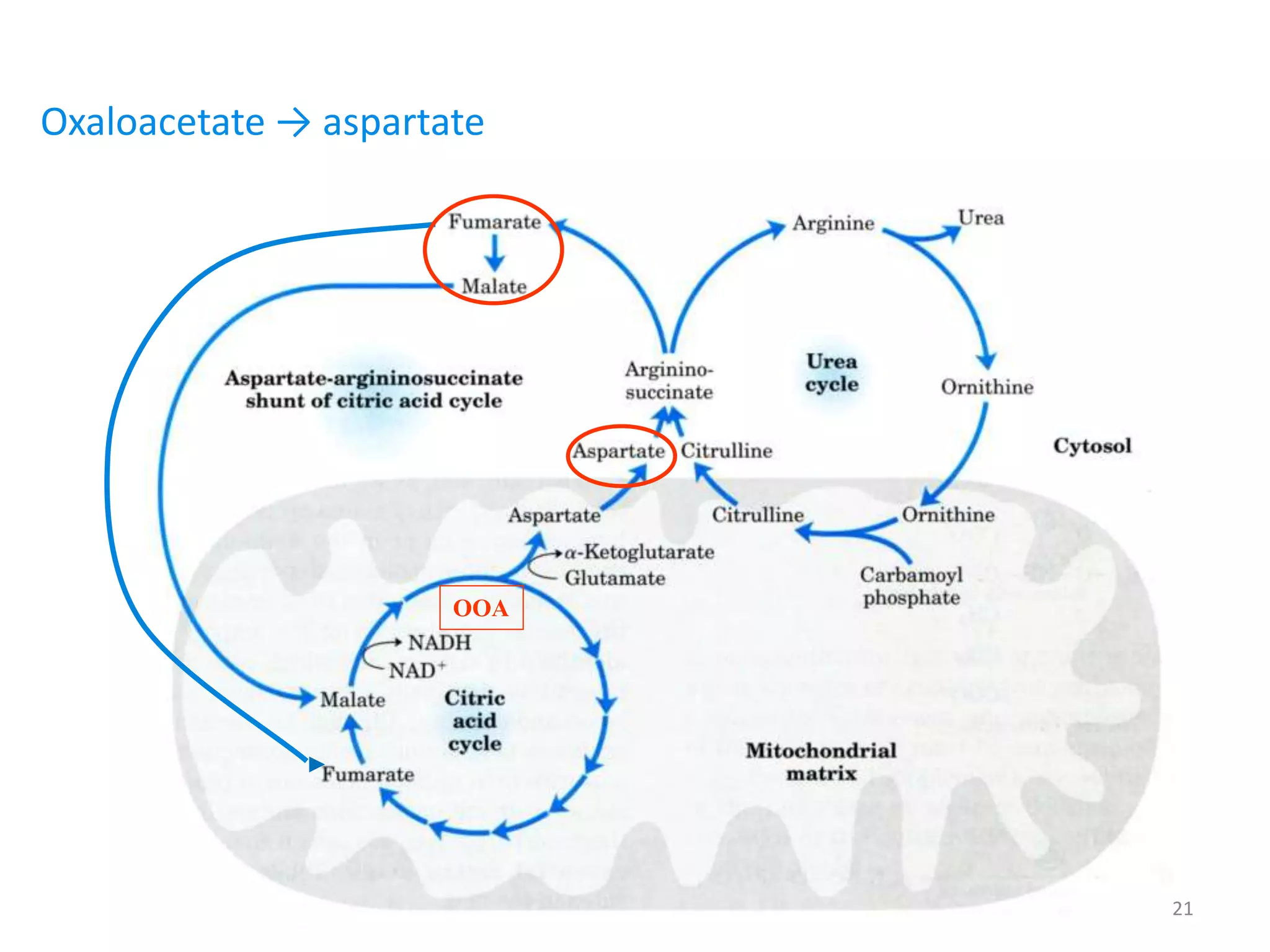
OOA
Oxaloacetate → aspartate
21
The overall chemical balance of the
biosynthesis of urea
NH3 + CO2 + 2ATP → carbamoyl phosphate + 2ADP + Pi
Carbamoyl phosphate + ornithine → citrulline + Pi
Citrulline + ATP + aspartate → argininosuccinate + AMP + PPi
Argininosuccinate → arginine + fumarate
Arginine → urea + ornithine
Sum: 2NH3 + CO2 + 3ATP  urea + 2ADP + AMP + PPi + 2Pi
22
Deficiencies of urea cycle enzymes
Ammonia toxicity
Ammonia encephalopathy
• Increased concentration of ammonia in the blood
and other biological fluids → ammonia difuses into
cells, across blood/brain barrier → increased
synthesis of glutamate from -ketoglutarate,
increased synthesis of glutamine
 -ketoglutarate is depleted from CNS → inhibition of
TCA cycle and production of ATP
• Neurotransmitters – glutamate (excitatory neurotr.)
and GABA (inhibitory neurotr.), may contribute to the
CNS effects – bizarre behaviour
24
Deficiencies of urea cycle enzymes
• Infant born with total deficiency of one or more enzymes
survive at least several days.
• Many enzymes deficiencies are partial → enzymes have
altered Km values.
• Case are known of deficiencies of each enzymes.
• Interruption of the cycle at each point affected nitrogen
metabolism differently - some of the intermediates can
diffuse from hepatocytes → accumulate in the blood → pass
into the urine.
• If symptoms are not detected early enough → severe mental
retardation → brain damage is irreversible.
25
• Urea Level in Blood:
• In clinical practice, blood urea level is taken as
an indicator of renal function. The normal
urea level in plasma is from 20 t0 40 mg/dl.
Blood urea level is increased where renal
function is inadequate.
• Urinary excretion of urea is 15 to 30g/day (6-
15g nitrogen/day). Urea constitutes 80% of
urinary organic solids.
26
• Clinical importance of urea:
• An active man consuming 300grams
carbohydrates, 100grams of fats and 100 grams
of proteins excretes 16.5 grams of N daily. 95%N
is eliminated through kidneys and remaining 5%
through feces.
• Normal Urea level:
• Healthy adult in fasting condition has urea 20-
40mg/100ml of plasma. Pakistani individual
taking less protein may have normal level of urea
15-40mg/100ml of plasma.
27
Causes of Increased Urea Levels
(Uremia):
• Pre-renal Causes:
• Here the plasma volume is mostly reduced
such as salt and water depletion.
• Sever and prolonged diarrhea/dehydration.
• Hemorrhage and shock; shock due to sever
burns.
• Ulcerative colitis with severe chloride loss
28
Thank you for your attention

Urea cycle.. lgis

  • 1.
    Urea Cycle Dr. ZahidAzeem Assistant Professor of Biochemistry AJ&K Medical College Muzaffarabad For MBBS-batch 2017
  • 2.
    • Turnover meanboth degradation and synthesis • Proteins are constantly degraded and resynthesized • Why degradation?  To remove a) Damaged Proteins b) Un-needed Proteins c) Defective Proteins d) Old Proteins (Actually the half life of many proteins is determined at the time of their synthesis) Protein Turnover 2
  • 3.
    Half life ofaminoacids Highly stabilizing residues (t1/2>20 hours) Ala Cys Gly Met Pro Ser Thr Val Intrinsically destabilizing residues (t1/2= 2 to 30 minutes) Arg His Ile Leu Lys Phe Trp Tyr Destabilizing residues after chemical modification (t1/2= 3 to 30 minutes) Asn Asp Gln Glu 3
  • 4.
    Amino acid oxidationand the production of urea Waste or reuse Oxidation 4
  • 5.
    Ammonia has tobe eliminated • Ammonia originates in the catabolism of amino acids that are primarily produced by the degradation of proteins – dietary as well as existing within the cell: digestive enzymes proteins released by digestion of cells sloughed- off the walls of the GIT muscle proteins hemoglobin intracellular proteins (damaged, unnecessary) 5
  • 6.
    Ammonia has tobe eliminated • Ammonia is toxic, especially for the CNS, because it reacts with -ketoglutarate, thus making it limiting for the TCA cycle  decrease in the ATP level • Liver damage or metabolic disorders associated with elevated ammonia can lead to tremor, slurred speech, blurred vision, coma, and death • Normal conc. of ammonia in blood: 30-60 µM 6Dr zahid
  • 7.
    Overview of aminoacid catabolism in mammals 2 CHOICES 1. Reuse 2. Urea cycle Fumarate Oxaloacetate 7Dr. Inayat Abbasi
  • 8.
    Nitrogen removal fromamino acids Transamination Oxidative deamination Urea cycle Aminotransferase PLP 8
  • 9.
    Nitrogen removal fromamino acids Step 1: Remove amino group Step 2: Take amino group to liver for nitrogen excretion Step 3: Entry into mitochondria Step 4: Prepare nitrogen to enter urea cycle Step 5: Urea cycle 9
  • 10.
    Step 1. Removeamino group ; Transamination • Transfer of the amino group of an amino acid to an -keto acid  the original AA is converted to the corresponding - keto acid and vice versa: Transamination is catalyzed by transaminases (aminotransferases) that require participation of pyridoxalphosphate 10
  • 11.
  • 12.
    Step 2: Takeamino group to liver for nitrogen excretion; Oxidation deaminationn Glutamate dehydrogenase The glutamate dehydrogenase of mammalian liver has the unusual capacity to use either NAD+ or NADP+ as cofactor Glutamate releases its amino group as ammonia in the liver. The amino groups from many of the -amino acids are collected in the liver in the form of the amino group of L-glutamate molecules. 12
  • 13.
  • 14.
  • 15.
    1. Glutamate transferres oneamino group WITHIN cells: Aminotransferase → makes glutamate from -ketogluta-rate Glutamate dehydrogenase → opposite 2. Glutamine transferres two amino group BETWEEN cells → releases its amino group in the liver 3. Alanine transferres amino group from tissue (muscle) into the liver Nitrogen carriers 15
  • 16.
    Glucose-alanine cycle Ala isthe carrier of ammonia and of the carbon skeleton of pyruvate from muscle to liver. The ammonia is excreted and the pyruvate is used to produce glucose, which is returned to the muscle. Alanine plays a special role in transporting amino groups to liver. According to D. L. Nelson, M. M. Cox :LEHNINGER. PRINCIPLES OF BIOCHEMISTRY Fifth edition 16
  • 17.
    Step 3: entryof nitrogen to mitochondria 17
  • 18.
    Step 4: preparenitrogen to enter urea cycle Regulation 18
  • 19.
    Step 5: Ureacycle aspartate Ornithine transcarbamoylase Argininosuccinate synthase Argininosuccinate lyase Arginase 1 19Dr. Inayat Abbasi
  • 20.
  • 21.
  • 22.
    The overall chemicalbalance of the biosynthesis of urea NH3 + CO2 + 2ATP → carbamoyl phosphate + 2ADP + Pi Carbamoyl phosphate + ornithine → citrulline + Pi Citrulline + ATP + aspartate → argininosuccinate + AMP + PPi Argininosuccinate → arginine + fumarate Arginine → urea + ornithine Sum: 2NH3 + CO2 + 3ATP  urea + 2ADP + AMP + PPi + 2Pi 22
  • 23.
    Deficiencies of ureacycle enzymes
  • 24.
    Ammonia toxicity Ammonia encephalopathy •Increased concentration of ammonia in the blood and other biological fluids → ammonia difuses into cells, across blood/brain barrier → increased synthesis of glutamate from -ketoglutarate, increased synthesis of glutamine  -ketoglutarate is depleted from CNS → inhibition of TCA cycle and production of ATP • Neurotransmitters – glutamate (excitatory neurotr.) and GABA (inhibitory neurotr.), may contribute to the CNS effects – bizarre behaviour 24
  • 25.
    Deficiencies of ureacycle enzymes • Infant born with total deficiency of one or more enzymes survive at least several days. • Many enzymes deficiencies are partial → enzymes have altered Km values. • Case are known of deficiencies of each enzymes. • Interruption of the cycle at each point affected nitrogen metabolism differently - some of the intermediates can diffuse from hepatocytes → accumulate in the blood → pass into the urine. • If symptoms are not detected early enough → severe mental retardation → brain damage is irreversible. 25
  • 26.
    • Urea Levelin Blood: • In clinical practice, blood urea level is taken as an indicator of renal function. The normal urea level in plasma is from 20 t0 40 mg/dl. Blood urea level is increased where renal function is inadequate. • Urinary excretion of urea is 15 to 30g/day (6- 15g nitrogen/day). Urea constitutes 80% of urinary organic solids. 26
  • 27.
    • Clinical importanceof urea: • An active man consuming 300grams carbohydrates, 100grams of fats and 100 grams of proteins excretes 16.5 grams of N daily. 95%N is eliminated through kidneys and remaining 5% through feces. • Normal Urea level: • Healthy adult in fasting condition has urea 20- 40mg/100ml of plasma. Pakistani individual taking less protein may have normal level of urea 15-40mg/100ml of plasma. 27
  • 28.
    Causes of IncreasedUrea Levels (Uremia): • Pre-renal Causes: • Here the plasma volume is mostly reduced such as salt and water depletion. • Sever and prolonged diarrhea/dehydration. • Hemorrhage and shock; shock due to sever burns. • Ulcerative colitis with severe chloride loss 28
  • 29.
    Thank you foryour attention