Dr Zahid Azeem
Assistant Professor
Biochemistry
AJK Medical College
MBBS-Batch 2019 --- CMB Module
Define Cell Cycle
Cell reproduces by performing orderly sequence of
events in which it duplicates its contents and then
divides in two. This type of duplication and division is
called Cell Cycle.
Major Questions
To explain how cells reproduce, we therefore have to
consider three major questions:
(1) How do cells duplicate their contents?
(2) How do they partition the duplicated contents and
split in two?
(3) How do they coordinate/regulate all the machinery
that is required for these two processes?
1- How do cells duplicate their contents?
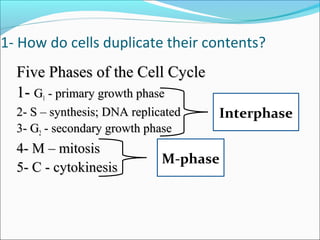
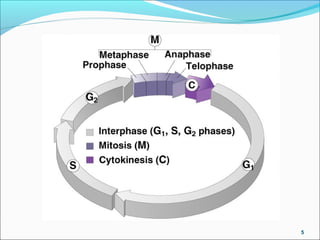
Five Phases of the Cell CycleFive Phases of the Cell Cycle
1-1- GG11 - primary growth phase- primary growth phase
2- S – synthesis; DNA replicated2- S – synthesis; DNA replicated
3- G3- G22 - secondary growth phase- secondary growth phase
4- M – mitosis4- M – mitosis
5- C - cytokinesis5- C - cytokinesis
M-phase
Interphase
5
Interphase
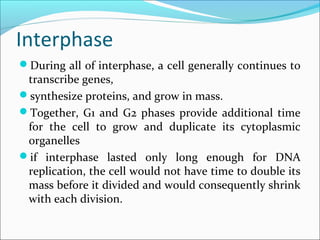
During all of interphase, a cell generally continues to
transcribe genes,
synthesize proteins, and grow in mass.
Together, G1 and G2 phases provide additional time
for the cell to grow and duplicate its cytoplasmic
organelles
if interphase lasted only long enough for DNA
replication, the cell would not have time to double its
mass before it divided and would consequently shrink
with each division.
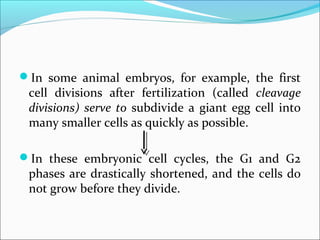
In some animal embryos, for example, the first
cell divisions after fertilization (called cleavage
divisions) serve to subdivide a giant egg cell into
many smaller cells as quickly as possible.
In these embryonic cell cycles, the G1 and G2
phases are drastically shortened, and the cells do
not grow before they divide.
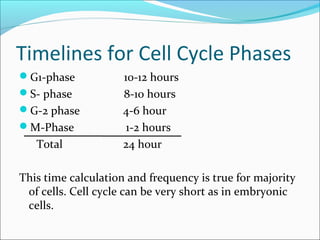
Timelines for Cell Cycle Phases
G1-phase 10-12 hours
S- phase 8-10 hours
G-2 phase 4-6 hour
M-Phase 1-2 hours
Total 24 hour
This time calculation and frequency is true for majority
of cells. Cell cycle can be very short as in embryonic
cells.
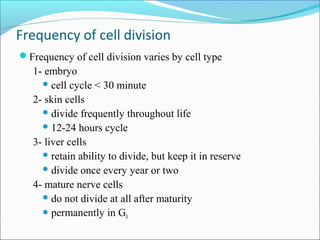
Frequency of cell division
Frequency of cell division varies by cell type
1- embryo
 cell cycle < 30 minute
2- skin cells
 divide frequently throughout life
 12-24 hours cycle
3- liver cells
 retain ability to divide, but keep it in reserve
 divide once every year or two
4- mature nerve cells
 do not divide at all after maturity
 permanently in G0
Interphase - GInterphase - G11
11stst
growth stage after cell divisiongrowth stage after cell division
Cells mature by making more cytoplasm &Cells mature by making more cytoplasm &
organellesorganelles
Cell carries on its normal metabolic activitiesCell carries on its normal metabolic activities
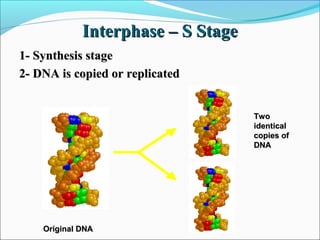
Interphase – S StageInterphase – S Stage
1- Synthesis stage1- Synthesis stage
2- DNA is copied or replicated2- DNA is copied or replicated
TwoTwo
identicalidentical
copies ofcopies of
DNADNA
Original DNAOriginal DNA
Interphase – GInterphase – G22 StageStage
22ndnd
Growth StageGrowth Stage
Occurs after DNA has been copiedOccurs after DNA has been copied
All cell structures needed for division are madeAll cell structures needed for division are made
(e.g. centrioles)(e.g. centrioles)
Both organelles & proteins are synthesizedBoth organelles & proteins are synthesized
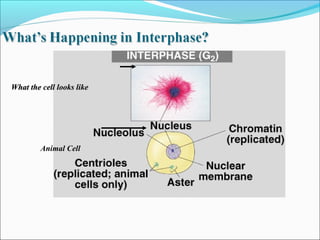
What the cell looks likeWhat the cell looks like
Animal Cell
Second Question
(2) How do they partition the duplicated contents and split in two?
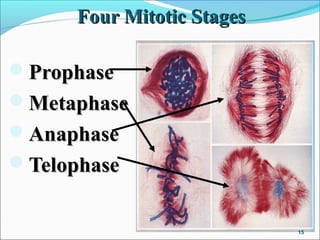
Four Mitotic StagesFour Mitotic Stages
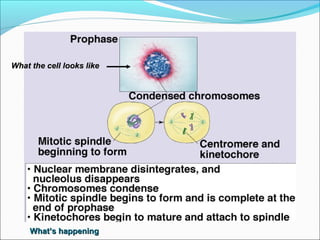
ProphaseProphase
MetaphaseMetaphase
AnaphaseAnaphase
TelophaseTelophase
15
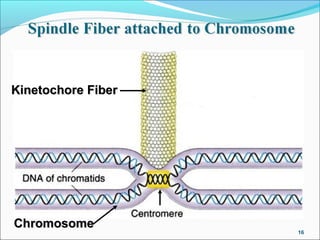
16
Kinetochore FiberKinetochore Fiber
ChromosomeChromosome
What the cell looks likeWhat the cell looks like
What’s happeningWhat’s happening
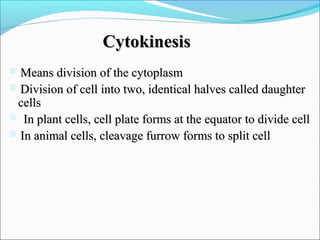
CytokinesisCytokinesis
Means division of the cytoplasmMeans division of the cytoplasm
Division of cell into two, identical halves called daughterDivision of cell into two, identical halves called daughter
cellscells
 In plant cells, cell plate forms at the equator to divide cellIn plant cells, cell plate forms at the equator to divide cell
In animal cells, cleavage furrow forms to split cellIn animal cells, cleavage furrow forms to split cell
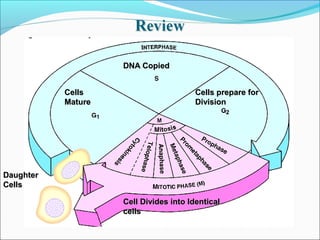
DaughterDaughter
CellsCells
DNA CopiedDNA Copied
CellsCells
MatureMature
Cells prepare forCells prepare for
DivisionDivision
Cell Divides into IdenticalCell Divides into Identical
cellscells
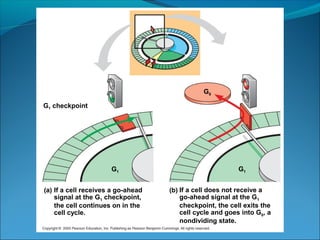
G1
G1 checkpoint
G1
G0
If a cell receives a go-ahead
signal at the G1 checkpoint,
the cell continues on in the
cell cycle.
If a cell does not receive a
go-ahead signal at the G1
checkpoint, the cell exits the
cell cycle and goes into G0, a
nondividing state.
Question -3
How do they coordinate/regulate all the machinery that
is required for these two processes?
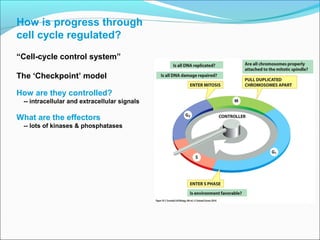
How is progress through
cell cycle regulated?
“Cell-cycle control system”
The ‘Checkpoint’ model
How are they controlled?
-- intracellular and extracellular signals
What are the effectors
-- lots of kinases & phosphatases
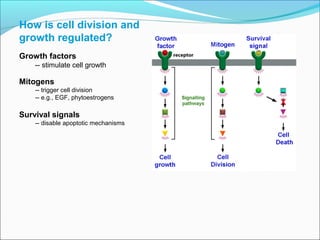
How is cell division and
growth regulated?
Growth factors
-- stimulate cell growth
Mitogens
-- trigger cell division
-- e.g., EGF, phytoestrogens
Survival signals
-- disable apoptotic mechanisms
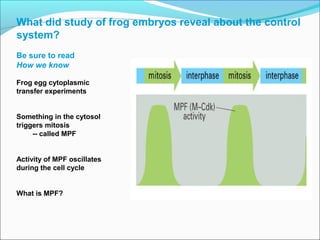
What did study of frog embryos reveal about the control
system?
Be sure to read
How we know
Frog egg cytoplasmic
transfer experiments
Something in the cytosol
triggers mitosis
-- called MPF
Activity of MPF oscillates
during the cell cycle
What is MPF?
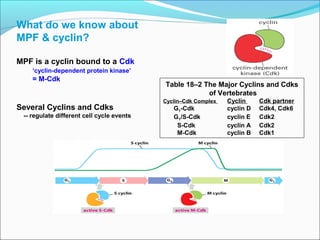
What do we know about
MPF & cyclin?
MPF is a cyclin bound to a Cdk
‘cyclin-dependent protein kinase’
= M-Cdk
Several Cyclins and Cdks
-- regulate different cell cycle events
Table 18–2 The Major Cyclins and Cdks
of Vertebrates
Cyclin–Cdk Complex Cyclin Cdk partner
G1-Cdk cyclin D Cdk4, Cdk6
G1/S-Cdk cyclin E Cdk2
S-Cdk cyclin A Cdk2
M-Cdk cyclin B Cdk1
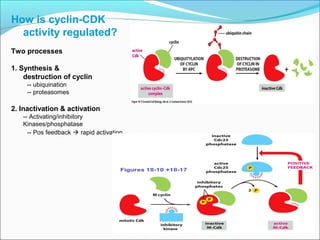
How is cyclin-CDK
activity regulated?
Two processes
1. Synthesis &
destruction of cyclin
-- ubiquination
-- proteasomes
2. Inactivation & activation
-- Activating/inhibitory
Kinases/phosphatase
-- Pos feedback  rapid activation
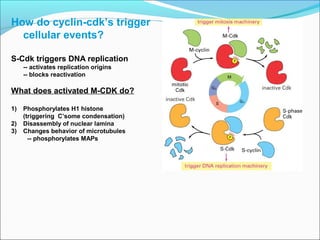
How do cyclin-cdk’s trigger
cellular events?
S-Cdk triggers DNA replication
-- activates replication origins
-- blocks reactivation
What does activated M-CDK do?
1) Phosphorylates H1 histone
(triggering C’some condensation)
2) Disassembly of nuclear lamina
3) Changes behavior of microtubules
-- phosphorylates MAPs
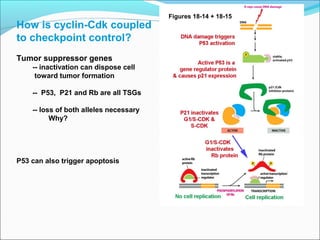
How is cyclin-Cdk coupled
to checkpoint control?
Tumor suppressor genes
-- inactivation can dispose cell
toward tumor formation
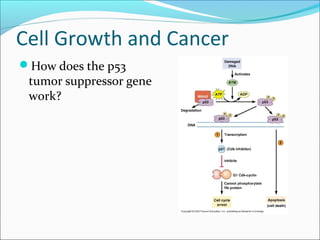
-- P53, P21 and Rb are all TSGs
-- loss of both alleles necessary
Why?
P53 can also trigger apoptosis
Figures 18-14 + 18-15
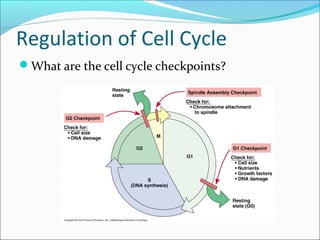
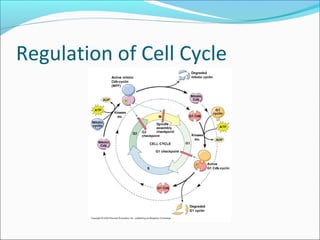
Regulation of Cell Cycle
What are the cell cycle checkpoints?
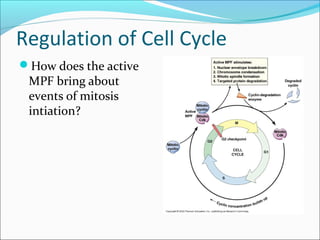
Regulation of Cell Cycle
How does the active
MPF bring about
events of mitosis
intiation?
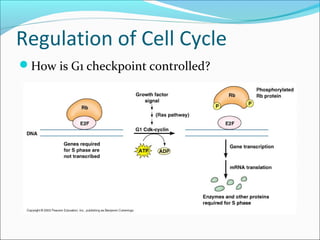
Regulation of Cell Cycle
How is G1 checkpoint controlled?
Regulation of Cell Cycle
Cell Growth and Cancer
How can growth factors inhibit cell division?
Alterations in what kinds of genes lead to
development of cancer?
How do oncogenes cause cancer?
Cell Growth and Cancer
How does the p53
tumor suppressor gene
work?
Thanks
35

Cell cycle. sgd

  • 1.
    Dr Zahid Azeem AssistantProfessor Biochemistry AJK Medical College MBBS-Batch 2019 --- CMB Module
  • 2.
    Define Cell Cycle Cellreproduces by performing orderly sequence of events in which it duplicates its contents and then divides in two. This type of duplication and division is called Cell Cycle.
  • 3.
    Major Questions To explainhow cells reproduce, we therefore have to consider three major questions: (1) How do cells duplicate their contents? (2) How do they partition the duplicated contents and split in two? (3) How do they coordinate/regulate all the machinery that is required for these two processes?
  • 4.
    1- How docells duplicate their contents? Five Phases of the Cell CycleFive Phases of the Cell Cycle 1-1- GG11 - primary growth phase- primary growth phase 2- S – synthesis; DNA replicated2- S – synthesis; DNA replicated 3- G3- G22 - secondary growth phase- secondary growth phase 4- M – mitosis4- M – mitosis 5- C - cytokinesis5- C - cytokinesis M-phase Interphase
  • 5.
  • 6.
    Interphase During all ofinterphase, a cell generally continues to transcribe genes, synthesize proteins, and grow in mass. Together, G1 and G2 phases provide additional time for the cell to grow and duplicate its cytoplasmic organelles if interphase lasted only long enough for DNA replication, the cell would not have time to double its mass before it divided and would consequently shrink with each division.
  • 7.
    In some animalembryos, for example, the first cell divisions after fertilization (called cleavage divisions) serve to subdivide a giant egg cell into many smaller cells as quickly as possible. In these embryonic cell cycles, the G1 and G2 phases are drastically shortened, and the cells do not grow before they divide.
  • 8.
    Timelines for CellCycle Phases G1-phase 10-12 hours S- phase 8-10 hours G-2 phase 4-6 hour M-Phase 1-2 hours Total 24 hour This time calculation and frequency is true for majority of cells. Cell cycle can be very short as in embryonic cells.
  • 9.
    Frequency of celldivision Frequency of cell division varies by cell type 1- embryo  cell cycle < 30 minute 2- skin cells  divide frequently throughout life  12-24 hours cycle 3- liver cells  retain ability to divide, but keep it in reserve  divide once every year or two 4- mature nerve cells  do not divide at all after maturity  permanently in G0
  • 10.
    Interphase - GInterphase- G11 11stst growth stage after cell divisiongrowth stage after cell division Cells mature by making more cytoplasm &Cells mature by making more cytoplasm & organellesorganelles Cell carries on its normal metabolic activitiesCell carries on its normal metabolic activities
  • 11.
    Interphase – SStageInterphase – S Stage 1- Synthesis stage1- Synthesis stage 2- DNA is copied or replicated2- DNA is copied or replicated TwoTwo identicalidentical copies ofcopies of DNADNA Original DNAOriginal DNA
  • 12.
    Interphase – GInterphase– G22 StageStage 22ndnd Growth StageGrowth Stage Occurs after DNA has been copiedOccurs after DNA has been copied All cell structures needed for division are madeAll cell structures needed for division are made (e.g. centrioles)(e.g. centrioles) Both organelles & proteins are synthesizedBoth organelles & proteins are synthesized
  • 13.
    What the celllooks likeWhat the cell looks like Animal Cell
  • 14.
    Second Question (2) Howdo they partition the duplicated contents and split in two?
  • 15.
    Four Mitotic StagesFourMitotic Stages ProphaseProphase MetaphaseMetaphase AnaphaseAnaphase TelophaseTelophase 15
  • 16.
  • 17.
    What the celllooks likeWhat the cell looks like What’s happeningWhat’s happening
  • 18.
    CytokinesisCytokinesis Means division ofthe cytoplasmMeans division of the cytoplasm Division of cell into two, identical halves called daughterDivision of cell into two, identical halves called daughter cellscells  In plant cells, cell plate forms at the equator to divide cellIn plant cells, cell plate forms at the equator to divide cell In animal cells, cleavage furrow forms to split cellIn animal cells, cleavage furrow forms to split cell
  • 19.
    DaughterDaughter CellsCells DNA CopiedDNA Copied CellsCells MatureMature Cellsprepare forCells prepare for DivisionDivision Cell Divides into IdenticalCell Divides into Identical cellscells
  • 20.
    G1 G1 checkpoint G1 G0 If acell receives a go-ahead signal at the G1 checkpoint, the cell continues on in the cell cycle. If a cell does not receive a go-ahead signal at the G1 checkpoint, the cell exits the cell cycle and goes into G0, a nondividing state.
  • 21.
    Question -3 How dothey coordinate/regulate all the machinery that is required for these two processes?
  • 22.
    How is progressthrough cell cycle regulated? “Cell-cycle control system” The ‘Checkpoint’ model How are they controlled? -- intracellular and extracellular signals What are the effectors -- lots of kinases & phosphatases
  • 23.
    How is celldivision and growth regulated? Growth factors -- stimulate cell growth Mitogens -- trigger cell division -- e.g., EGF, phytoestrogens Survival signals -- disable apoptotic mechanisms
  • 24.
    What did studyof frog embryos reveal about the control system? Be sure to read How we know Frog egg cytoplasmic transfer experiments Something in the cytosol triggers mitosis -- called MPF Activity of MPF oscillates during the cell cycle What is MPF?
  • 25.
    What do weknow about MPF & cyclin? MPF is a cyclin bound to a Cdk ‘cyclin-dependent protein kinase’ = M-Cdk Several Cyclins and Cdks -- regulate different cell cycle events Table 18–2 The Major Cyclins and Cdks of Vertebrates Cyclin–Cdk Complex Cyclin Cdk partner G1-Cdk cyclin D Cdk4, Cdk6 G1/S-Cdk cyclin E Cdk2 S-Cdk cyclin A Cdk2 M-Cdk cyclin B Cdk1
  • 26.
    How is cyclin-CDK activityregulated? Two processes 1. Synthesis & destruction of cyclin -- ubiquination -- proteasomes 2. Inactivation & activation -- Activating/inhibitory Kinases/phosphatase -- Pos feedback  rapid activation
  • 27.
    How do cyclin-cdk’strigger cellular events? S-Cdk triggers DNA replication -- activates replication origins -- blocks reactivation What does activated M-CDK do? 1) Phosphorylates H1 histone (triggering C’some condensation) 2) Disassembly of nuclear lamina 3) Changes behavior of microtubules -- phosphorylates MAPs
  • 28.
    How is cyclin-Cdkcoupled to checkpoint control? Tumor suppressor genes -- inactivation can dispose cell toward tumor formation -- P53, P21 and Rb are all TSGs -- loss of both alleles necessary Why? P53 can also trigger apoptosis Figures 18-14 + 18-15
  • 29.
    Regulation of CellCycle What are the cell cycle checkpoints?
  • 30.
    Regulation of CellCycle How does the active MPF bring about events of mitosis intiation?
  • 31.
    Regulation of CellCycle How is G1 checkpoint controlled?
  • 32.
  • 33.
    Cell Growth andCancer How can growth factors inhibit cell division? Alterations in what kinds of genes lead to development of cancer? How do oncogenes cause cancer?
  • 34.
    Cell Growth andCancer How does the p53 tumor suppressor gene work?
  • 35.