ADS 3014
BIOCHEMISTRY
Lecture 5
Protein metabolism
ESSENTIAL AND NON ESSENTIAL AMINO ACIDS
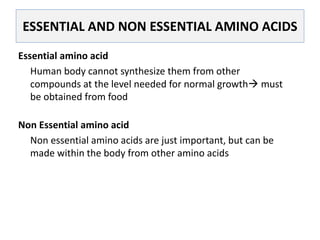
Essential amino acid
Human body cannot synthesize them from other
compounds at the level needed for normal growth must
be obtained from food
Non Essential amino acid
Non essential amino acids are just important, but can be
made within the body from other amino acids
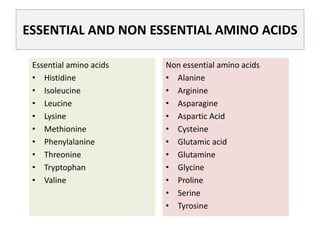
Essential amino acids
• Histidine
• Isoleucine
• Leucine
• Lysine
• Methionine
• Phenylalanine
• Threonine
• Tryptophan
• Valine
ESSENTIAL AND NON ESSENTIAL AMINO ACIDS
Non essential amino acids
• Alanine
• Arginine
• Asparagine
• Aspartic Acid
• Cysteine
• Glutamic acid
• Glutamine
• Glycine
• Proline
• Serine
• Tyrosine
ESSENTIAL AND NON ESSENTIAL AMINO ACIDS
Amino acids are essential varies from species to species, as
different metabolisms are able to synthesize different
substances
e.g.
• Taurine is essential for cats, but not for dogs
• So dog food is not nutritionally sufficient for cats, and taurine is added
to commercial cat food when the base ingredients do not meet the
requirements of the cat, but to dog food
• Food that contain each and every one of the essential amino acids are
called complete sources of protein.
• Foods that lack one or more essential amino acids are called incomplete
sources of protein.
All meat and other animal products are sources of complete protein.
For example:
• chicken, beef, lamb, pork
poultry, eggs
fish, shellfish
milk and milk products
Vegetarian sources:
• Nuts
Soy foods
Sprouted seeds (each type of sprout differs in nutrient proportions, so eat
a variety)
Grains (especially amaranth and quinoa, highest in protein)
Beans and legumes (especially when eaten raw)
ESSENTIAL AMINO ACIDS
The importance of essential amino acid
ESSENTIAL AMINO ACIDS
1. Phenylalanine (Phe)
- In our body, Phe converted to
tyrosine (Tyr)
- Tyr in turn is converted into L-
Dopa, norepinephrine and
epinephrine, 3 key
neurotransmitter
2. Valine (Val)
- Participates in detoxification of
NH3
- Important in prevention of
muscle wasting in diabetes and
prevent NH3 toxicity in elder
people
- Helps in muscle repair in
seriously injured people
3. Lysine (Lys)
- Require for the manufacture of
carnitine-> proper fat
metabolism
- Cross link in collagen and
elastin-> proper collagen and
elastin function
- Depend on lysloxidase, which
require copper
- Copper deficiency can result in
imperfections in collagen or
elastin
NON ESSENTIAL AMINO ACIDS
How a non essential amino acid were
made from essential amino acid
- Essential amino
acids are shown in
purple
- non-essential
amino acids are in
green
Blueprint of amino
acid biosynthesis
PROTEIN METABOLISM
PROTEIN METABOLISM
• Protein or Nitrogen metabolism is as important as carbohydrate and lipid
metabolism.
• Proteins make up the structural tissue for muscles and tendons, transport
oxygen or hemoglobin, catalyze all biochemical reactions as enzymes, and
regulate reactions as hormones.
• Our bodies must be able to synthesize many proteins, amino acids, and
other non-protein nitrogen containing compounds needed for growth,
replacement, and repair. Proteins in excess are used to supply energy or
build reserves of glucose, glycogen, or lipids.
PROTEIN METABOLISM
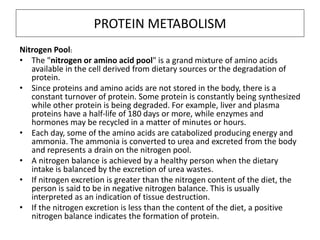
Nitrogen Pool:
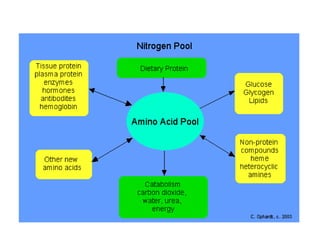
• The "nitrogen or amino acid pool" is a grand mixture of amino acids
available in the cell derived from dietary sources or the degradation of
protein.
• Since proteins and amino acids are not stored in the body, there is a
constant turnover of protein. Some protein is constantly being synthesized
while other protein is being degraded. For example, liver and plasma
proteins have a half-life of 180 days or more, while enzymes and
hormones may be recycled in a matter of minutes or hours.
• Each day, some of the amino acids are catabolized producing energy and
ammonia. The ammonia is converted to urea and excreted from the body
and represents a drain on the nitrogen pool.
• A nitrogen balance is achieved by a healthy person when the dietary
intake is balanced by the excretion of urea wastes.
• If nitrogen excretion is greater than the nitrogen content of the diet, the
person is said to be in negative nitrogen balance. This is usually
interpreted as an indication of tissue destruction.
• If the nitrogen excretion is less than the content of the diet, a positive
nitrogen balance indicates the formation of protein.
PROTEIN METABOLISM
• Protein ingested as part of our diet are not the same proteins
requires by the body
• Protein also a large molecules that cannot be absorbed from
the gut
• Therefore, proteins are digested and their component amino
acids absorbed into the blood stream
Protein digestion
Mouth
• Protein is crushed by chewing and moistened with saliva
• Nothing happens to proteins
Stomach
• Hydrochloric acid denatures protein strands
• Converts pepsinogen into pepsin cleaves polypeptides
Small Intestine
• Protein hydrolysis -> polypeptide hydrolyze into shorter amino acid
sequences
• Two group of enzymes involve: Proteases and Peptidases
• 2 important points of amino acid metabolism
1. The origin and fates of their N atoms
2. The origin and fates of their carbon skeletons
• The ability of organism to synthesis amino acids differ widely
– Some organisms can assimilate N and simple C compounds into amino acids -> totally
self-supporting for proteins
– Others can synthesize the carbon chain of amino acid but require N from ammonia
– Some species cannot synthesize the carbon skeleton of every amino acid -> mammals
only can make half amino acid required, the rest must obtained from diet-> essential
amino acids
– The routes for disposal of N-containing waste products also vary; aquatic animals->
ammonia; birds and reptiles-> urid acid; terrestrial vertebrates-> urea
• Steps of amino acid biosynthesis/catabolism
1. Removal of Nitrogen
2. Formation of another amino acid from catabolised ‘C-skeleton’
AMINO ACID METABOLISM
DIETARY PROTEIN
AMINO ACIDS
Body protein
Carbon skeletons
Other nitrogen
containing compounds
NH4
+
urea
excreted
Acetyl CoA
ATP production OR
Pyruvate or citric acid
cycle intermediates
glucose
• The removal of the amino groups of all twenty amino acids begins
with the transfer of amino groups to just one amino acid - glutamic
acid (or glutamate ion).
• This is catalysed by transaminase enzymes which transfer the
amino group from amino acids to a compound called alpha-
ketoglutarate. The product is an alpha-keto acid formed from the
amino acid and glutamate (formed from the addition of the amino
group to alpha-ketoglutarate.
• Once the amino groups have all been "collected" in the form of the
one amino acid, glutamate, this amino acid has its amino group
removed (termed "oxidative deamination"). This reaction reforms
alpha-ketoglutarate with the other product being ammonia (NH4 +).
AMINO ACID METABOLISM
Oxidative Deamination
• Deamination is also an oxidative reaction that occurs under aerobic
conditions in all tissues but especially the liver.
• During oxidative deamination, an amino acid is converted into the
corresponding keto acid by the removal of the amine functional
group as ammonia and the amine functional group is replaced by
the ketone group. The ammonia eventually goes into the urea cycle.
• Oxidative deamination occurs primarily on glutamic acid because
glutamic acid was the end product of many transamination
reactions.
• The glutamate dehydrogenase is allosterically controlled by ATP and
ADP. ATP acts as an inhibitor whereas ADP is an activator.
Transamination
• Transamination as the name implies, refers to the transfer of an
amine group from one molecule to another.
• This reaction is catalyzed by a family of enzymes called
transaminases.
• The transamination reaction results in the exchange of an amine
group on one acid with a ketone group on another acid. It is
analogous to a double replacement reaction.
• The most usual and major keto acid involved with transamination
reactions is alpha-ketoglutaric acid, an intermediate in the citric acid
cycle. A specific example is the transamination of alanine to make
pyruvic acid and glutamic acid.
• Other amino acids which can be converted after several steps
through transamination into pyruvic acid include serine, cysteine,
and glycine.
TRANSAMINATION
Other Transamination
• Aspartic acid can be converted into oxaloacetic acid, another
intermediate of the citric acid cycle. Other amino acids such as
glutamine, histidine, arginine, and proline are first converted into
glutamic acid.
• Glutamine and asparagine are converted into glutamic acid and
aspartic acid by a simple hydrolysis of the amide group.
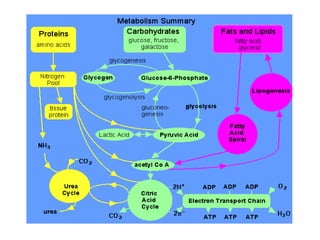
• All of the amino acids can be converted through a variety of
reactions and transamination into a keto acid which is a part of or
feeds into the citric acid cycle. The interrelationships of amino acids
with the citric acid cycle are illustrated in the graphic below.
Amino Acids in Overall Metabolism:
• Once the keto acids have been formed from the appropriate amino
acids by transamination, they may be used for several purposes.
The most obvious is the complete metabolism into carbon dioxide
and water by the citric acid cycle.
• However, if there are excess proteins in the diet those amino acids
converted into pyruvic acid and acetyl CoA can be converted into
lipids by the lipogenesis process. If carbohydrates are lacking in the
diet or if glucose cannot get into the cells (as in diabetes), then
those amino acids converted into pyruvic acid and oxaloacetic acids
can be converted into glucose or glycogen.
• In addition to the catabolic function of transamination reactions,
these reactions can also be used to synthesize amino acids needed
or not present in the diet. An amino acid may be synthesized if there
is an available "root" keto acid with a synthetic connection to the
final amino acid.
• Since an appropriate "root" keto acid does not exist for eight amino
acids, (lys, leu, ile, met, thr, try, val, phe), they are essential and
must be included in the diet because they cannot be synthesized.
Glutamic acid usually serves as the source of the amine group in the
transamination synthesis of new amino acids.
• Several nonessential amino acids are made by processes other than
transamination. Cysteine is made from methionine, and serine and
glycine are synthesized from phosphoglyceric acid - an intermediate
of glycolysis.
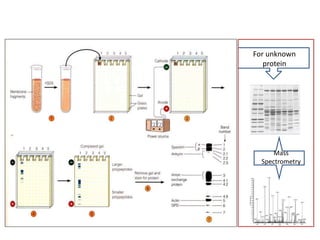
• The same reaction works in reverse for the synthesis of amino
acids. In this situation alpha-ketoglutaric acid first uses
transamination of a different amino acid to make glutamic acid,
which then reacts with a keto acid to make a new amino acid.
• In effect, the interconversion of alpha-ketoglutaric acid and glutamic
acid lies at the very heart of nitrogen metabolism. These molecules
serve as the "collection and receiving agent" for nitrogen. The
subsequent fate of the amino group is in new amino acids, any
nitrogen bases, or any other nitrogen containing compounds.
The Waste: Ammonia and urea
• Ammonia is toxic to the nervous system and its
accumulation rapidly causes death. Therefore it must be
detoxified to a form which can be readily removed from
the body. Ammonia is converted to urea, which is water
soluble and is readily excreted via the kidneys in urine.
• Urea is the major end product of nitrogen metabolism in humans and
mammals. Ammonia, the product of oxidative deamination reactions, is
toxic in even small amounts and must be removed from the body. The
urea cycle or the ornithine cycle describes the conversion reactions
of ammonia into urea. Since these reactions occur in the liver, the urea
is then transported to the kidneys where it is excreted. The overall urea
formation reaction is:
2 Ammonia + carbon dioxide + 3ATP ---> urea + water + 3 ADP
• The step wise process of the urea cycle is summarized in the slide
below. One amine group comes from oxidative deamination of glutamic
acid while the other amine group comes from aspartic acid. Aspartic
acid is regenerated from fumaric acid produced by the urea cycle. The
fumaric acid first undergoes reactions through a portion of the citric acid
cycle to produce oxaloacetic acid which is then changed by
transamination into aspartic acid
ANALYTICAL METHODS IN
PROTEIN CHEMISTRY
Protein purification
Steps in protein purifications
1. Sample preparation
• Suspension of cells/samples in buffer and homogenised
2. Fractionation
• Salt precipitation-> most common is ammonium sulfate.
• Remove the impurities
3. Elution (Column Chromatography)
- Column classified according to the type of matrix
a. Ion-exchange chromatography
b. Gel-filtration chromatography
c. Affinity chromatography
Steps in protein purifications (continue)
4. Analytical Procedures/techniques
1. Polyacrylamide gel electrophoresis (PAGE)
2. Mass spectrometry
5. Amino acid composition of proteins
- Amino acid analysis -> partial hydrolysis
6. Determination of amino acid sequence
- Edman degradation procedure- identify one residue at the from N-
terminus. Others method-> Sanger’ method and Dansyl chloride
For unknown
protein
Mass
Spectrometry

Ads 3014 l5

  • 1.
  • 2.
    ESSENTIAL AND NONESSENTIAL AMINO ACIDS Essential amino acid Human body cannot synthesize them from other compounds at the level needed for normal growth must be obtained from food Non Essential amino acid Non essential amino acids are just important, but can be made within the body from other amino acids
  • 3.
    Essential amino acids •Histidine • Isoleucine • Leucine • Lysine • Methionine • Phenylalanine • Threonine • Tryptophan • Valine ESSENTIAL AND NON ESSENTIAL AMINO ACIDS Non essential amino acids • Alanine • Arginine • Asparagine • Aspartic Acid • Cysteine • Glutamic acid • Glutamine • Glycine • Proline • Serine • Tyrosine
  • 4.
    ESSENTIAL AND NONESSENTIAL AMINO ACIDS Amino acids are essential varies from species to species, as different metabolisms are able to synthesize different substances e.g. • Taurine is essential for cats, but not for dogs • So dog food is not nutritionally sufficient for cats, and taurine is added to commercial cat food when the base ingredients do not meet the requirements of the cat, but to dog food
  • 5.
    • Food thatcontain each and every one of the essential amino acids are called complete sources of protein. • Foods that lack one or more essential amino acids are called incomplete sources of protein. All meat and other animal products are sources of complete protein. For example: • chicken, beef, lamb, pork poultry, eggs fish, shellfish milk and milk products Vegetarian sources: • Nuts Soy foods Sprouted seeds (each type of sprout differs in nutrient proportions, so eat a variety) Grains (especially amaranth and quinoa, highest in protein) Beans and legumes (especially when eaten raw) ESSENTIAL AMINO ACIDS
  • 6.
    The importance ofessential amino acid ESSENTIAL AMINO ACIDS 1. Phenylalanine (Phe) - In our body, Phe converted to tyrosine (Tyr) - Tyr in turn is converted into L- Dopa, norepinephrine and epinephrine, 3 key neurotransmitter 2. Valine (Val) - Participates in detoxification of NH3 - Important in prevention of muscle wasting in diabetes and prevent NH3 toxicity in elder people - Helps in muscle repair in seriously injured people 3. Lysine (Lys) - Require for the manufacture of carnitine-> proper fat metabolism - Cross link in collagen and elastin-> proper collagen and elastin function - Depend on lysloxidase, which require copper - Copper deficiency can result in imperfections in collagen or elastin
  • 7.
    NON ESSENTIAL AMINOACIDS How a non essential amino acid were made from essential amino acid
  • 8.
    - Essential amino acidsare shown in purple - non-essential amino acids are in green Blueprint of amino acid biosynthesis
  • 9.
  • 10.
    PROTEIN METABOLISM • Proteinor Nitrogen metabolism is as important as carbohydrate and lipid metabolism. • Proteins make up the structural tissue for muscles and tendons, transport oxygen or hemoglobin, catalyze all biochemical reactions as enzymes, and regulate reactions as hormones. • Our bodies must be able to synthesize many proteins, amino acids, and other non-protein nitrogen containing compounds needed for growth, replacement, and repair. Proteins in excess are used to supply energy or build reserves of glucose, glycogen, or lipids.
  • 12.
    PROTEIN METABOLISM Nitrogen Pool: •The "nitrogen or amino acid pool" is a grand mixture of amino acids available in the cell derived from dietary sources or the degradation of protein. • Since proteins and amino acids are not stored in the body, there is a constant turnover of protein. Some protein is constantly being synthesized while other protein is being degraded. For example, liver and plasma proteins have a half-life of 180 days or more, while enzymes and hormones may be recycled in a matter of minutes or hours. • Each day, some of the amino acids are catabolized producing energy and ammonia. The ammonia is converted to urea and excreted from the body and represents a drain on the nitrogen pool. • A nitrogen balance is achieved by a healthy person when the dietary intake is balanced by the excretion of urea wastes. • If nitrogen excretion is greater than the nitrogen content of the diet, the person is said to be in negative nitrogen balance. This is usually interpreted as an indication of tissue destruction. • If the nitrogen excretion is less than the content of the diet, a positive nitrogen balance indicates the formation of protein.
  • 14.
    PROTEIN METABOLISM • Proteiningested as part of our diet are not the same proteins requires by the body • Protein also a large molecules that cannot be absorbed from the gut • Therefore, proteins are digested and their component amino acids absorbed into the blood stream
  • 16.
    Protein digestion Mouth • Proteinis crushed by chewing and moistened with saliva • Nothing happens to proteins Stomach • Hydrochloric acid denatures protein strands • Converts pepsinogen into pepsin cleaves polypeptides Small Intestine • Protein hydrolysis -> polypeptide hydrolyze into shorter amino acid sequences • Two group of enzymes involve: Proteases and Peptidases
  • 17.
    • 2 importantpoints of amino acid metabolism 1. The origin and fates of their N atoms 2. The origin and fates of their carbon skeletons • The ability of organism to synthesis amino acids differ widely – Some organisms can assimilate N and simple C compounds into amino acids -> totally self-supporting for proteins – Others can synthesize the carbon chain of amino acid but require N from ammonia – Some species cannot synthesize the carbon skeleton of every amino acid -> mammals only can make half amino acid required, the rest must obtained from diet-> essential amino acids – The routes for disposal of N-containing waste products also vary; aquatic animals-> ammonia; birds and reptiles-> urid acid; terrestrial vertebrates-> urea • Steps of amino acid biosynthesis/catabolism 1. Removal of Nitrogen 2. Formation of another amino acid from catabolised ‘C-skeleton’ AMINO ACID METABOLISM
  • 18.
    AMINO ACID METABOLISM DIETARYPROTEIN AMINO ACIDS Body protein Carbon skeletons Other nitrogen containing compounds NH4 + urea excreted Acetyl CoA ATP production OR Pyruvate or citric acid cycle intermediates glucose
  • 19.
    • The removalof the amino groups of all twenty amino acids begins with the transfer of amino groups to just one amino acid - glutamic acid (or glutamate ion). • This is catalysed by transaminase enzymes which transfer the amino group from amino acids to a compound called alpha- ketoglutarate. The product is an alpha-keto acid formed from the amino acid and glutamate (formed from the addition of the amino group to alpha-ketoglutarate. • Once the amino groups have all been "collected" in the form of the one amino acid, glutamate, this amino acid has its amino group removed (termed "oxidative deamination"). This reaction reforms alpha-ketoglutarate with the other product being ammonia (NH4 +). AMINO ACID METABOLISM
  • 20.
    Oxidative Deamination • Deaminationis also an oxidative reaction that occurs under aerobic conditions in all tissues but especially the liver. • During oxidative deamination, an amino acid is converted into the corresponding keto acid by the removal of the amine functional group as ammonia and the amine functional group is replaced by the ketone group. The ammonia eventually goes into the urea cycle. • Oxidative deamination occurs primarily on glutamic acid because glutamic acid was the end product of many transamination reactions. • The glutamate dehydrogenase is allosterically controlled by ATP and ADP. ATP acts as an inhibitor whereas ADP is an activator.
  • 22.
    Transamination • Transamination asthe name implies, refers to the transfer of an amine group from one molecule to another. • This reaction is catalyzed by a family of enzymes called transaminases. • The transamination reaction results in the exchange of an amine group on one acid with a ketone group on another acid. It is analogous to a double replacement reaction. • The most usual and major keto acid involved with transamination reactions is alpha-ketoglutaric acid, an intermediate in the citric acid cycle. A specific example is the transamination of alanine to make pyruvic acid and glutamic acid. • Other amino acids which can be converted after several steps through transamination into pyruvic acid include serine, cysteine, and glycine.
  • 23.
  • 25.
    Other Transamination • Asparticacid can be converted into oxaloacetic acid, another intermediate of the citric acid cycle. Other amino acids such as glutamine, histidine, arginine, and proline are first converted into glutamic acid. • Glutamine and asparagine are converted into glutamic acid and aspartic acid by a simple hydrolysis of the amide group. • All of the amino acids can be converted through a variety of reactions and transamination into a keto acid which is a part of or feeds into the citric acid cycle. The interrelationships of amino acids with the citric acid cycle are illustrated in the graphic below.
  • 27.
    Amino Acids inOverall Metabolism: • Once the keto acids have been formed from the appropriate amino acids by transamination, they may be used for several purposes. The most obvious is the complete metabolism into carbon dioxide and water by the citric acid cycle. • However, if there are excess proteins in the diet those amino acids converted into pyruvic acid and acetyl CoA can be converted into lipids by the lipogenesis process. If carbohydrates are lacking in the diet or if glucose cannot get into the cells (as in diabetes), then those amino acids converted into pyruvic acid and oxaloacetic acids can be converted into glucose or glycogen.
  • 29.
    • In additionto the catabolic function of transamination reactions, these reactions can also be used to synthesize amino acids needed or not present in the diet. An amino acid may be synthesized if there is an available "root" keto acid with a synthetic connection to the final amino acid. • Since an appropriate "root" keto acid does not exist for eight amino acids, (lys, leu, ile, met, thr, try, val, phe), they are essential and must be included in the diet because they cannot be synthesized. Glutamic acid usually serves as the source of the amine group in the transamination synthesis of new amino acids. • Several nonessential amino acids are made by processes other than transamination. Cysteine is made from methionine, and serine and glycine are synthesized from phosphoglyceric acid - an intermediate of glycolysis.
  • 30.
    • The samereaction works in reverse for the synthesis of amino acids. In this situation alpha-ketoglutaric acid first uses transamination of a different amino acid to make glutamic acid, which then reacts with a keto acid to make a new amino acid. • In effect, the interconversion of alpha-ketoglutaric acid and glutamic acid lies at the very heart of nitrogen metabolism. These molecules serve as the "collection and receiving agent" for nitrogen. The subsequent fate of the amino group is in new amino acids, any nitrogen bases, or any other nitrogen containing compounds.
  • 32.
    The Waste: Ammoniaand urea • Ammonia is toxic to the nervous system and its accumulation rapidly causes death. Therefore it must be detoxified to a form which can be readily removed from the body. Ammonia is converted to urea, which is water soluble and is readily excreted via the kidneys in urine.
  • 33.
    • Urea isthe major end product of nitrogen metabolism in humans and mammals. Ammonia, the product of oxidative deamination reactions, is toxic in even small amounts and must be removed from the body. The urea cycle or the ornithine cycle describes the conversion reactions of ammonia into urea. Since these reactions occur in the liver, the urea is then transported to the kidneys where it is excreted. The overall urea formation reaction is: 2 Ammonia + carbon dioxide + 3ATP ---> urea + water + 3 ADP • The step wise process of the urea cycle is summarized in the slide below. One amine group comes from oxidative deamination of glutamic acid while the other amine group comes from aspartic acid. Aspartic acid is regenerated from fumaric acid produced by the urea cycle. The fumaric acid first undergoes reactions through a portion of the citric acid cycle to produce oxaloacetic acid which is then changed by transamination into aspartic acid
  • 35.
  • 36.
    Protein purification Steps inprotein purifications 1. Sample preparation • Suspension of cells/samples in buffer and homogenised 2. Fractionation • Salt precipitation-> most common is ammonium sulfate. • Remove the impurities 3. Elution (Column Chromatography) - Column classified according to the type of matrix a. Ion-exchange chromatography b. Gel-filtration chromatography c. Affinity chromatography
  • 37.
    Steps in proteinpurifications (continue) 4. Analytical Procedures/techniques 1. Polyacrylamide gel electrophoresis (PAGE) 2. Mass spectrometry 5. Amino acid composition of proteins - Amino acid analysis -> partial hydrolysis 6. Determination of amino acid sequence - Edman degradation procedure- identify one residue at the from N- terminus. Others method-> Sanger’ method and Dansyl chloride
  • 38.