PROTEIN
METABOLISM
Group 3 ^o^
Table of Contents
I
Introduction and
Protein Digestion and
Absorption
II
Amino Acid
Utilization
III
Transaminization and
Oxidative
Deamination
IV
The Urea Cycle and
Chemical
Composition of Urine
V
Amino Acid Carbon
Skeletons and
Arginine, Citruline,
Amino Acid
Biosynthesis
VIII
Interrelationship
among Metabolic
Pathways and B-
vitamins and Proteins
VI VII
Hemoglobin
Catabolism and
Interrelationship
among Carbohydrate
26.1
Protein
Digestion and
Absorption
●Process of protein digestion and absorption
Protein digestion (denaturation and
hydrolysis) starts in the stomach
● Denatured by HCl in gastric juice (pH of 1.5-2.0)
● Enzyme pepsin hydrolyzes about 10% peptide bonds
Large polypeptide chains pass from
stomach into small intestine
● pH in small intestine is 7.0 -8.0 and helps neutralize the
acidified gastric content
● Trypsin, chymotrypsin and carboxypeptidase in pancreatic
juice released into the small intestine help hydrolyze proteins to
smaller peptides
● Aminopeptidase secreted by intestinal mucosal membrane
further hydrolyze the small peptides to amino acids
● Amino acids (aa) liberated are transported into blood stream
via active transport process
●Amino acids formed through digestion process enters the
amino acid pool in the body:
● Amino acid pool: the total supply of free amino acids
available for use in the human body
The amino acid pool is derived from 3 sources:
1. Dietary protein
2. Protein turnover: A repetitive process in which the body
proteins are degraded and resynthesized
3. Biosynthesis of amino acids in the liver
- only non-essential amino acids are synthesized
●proteins are denatured because of the acidity of hydrochloric
acid.
●Enzymatic digestion of proteins begins in the stomach with the
action of the enzyme pepsin.
Amino Acid
Utilization
The amino acid pool is the
total supply of free amino
acids available for use in the
human body.
Protein turnover is the repetitive process
in which proteins are degraded and
resynthesized within the human body.
Nitrogen balance is the state that
results when the amount of
nitrogen taken into the human
body as protein equals the
amount of nitrogen excreted from
the body in waste materials.
Two types of nitrogen imbalance that
can occur.
A negative nitrogen balance
accompanies a state of "tissue
wasting," because more tissue
proteins are being catabolized than
are being replaced by protein
synthess.
A positive nitrogen balance
(nitrogen intake exceeds nitrogen
output) indicates that the rate of
protein anabolism (synthesis)
exceeds that of protein
catabolism.
The amino acids from the body's amino acid pool are used in
four different ways.
1. Protein synthesis. Proteins are continually needed to replace
old tissue (protein turnover) and also to build new tissue
(growth).
2. Synthesis of nonprotein nitrogen-containing compounds.
Amino acids are regularly withdrawn from the amino acid pool for
the synthesis of nonprotein nitrogen-containing compounds.
3. Synthesis of nonessential amino acids. When required, the
body draws on the amino acid pool for raw materials for the
production of nonessential amino acids that are in short supply.
4. Production of energy. Because excess amino acids cannot be
stored for later use, the body's response is to degrade them.
26.3
TRANSAMINATION
AND OXIDATIVE
DEAMINATION
by: Juliet Jumaquio
Degradation of an amino acid takes
place in two stages:
The removal of the -
amino group
The degradation of the
remaining carbon
skeleton
Removal of amino group is a two-step
process
Biochemical reaction in
which the amino group
of an alpha-amino acid
is transferred to an
alpha-keto acid.
is a biochemical reaction in
which an a-amino acid is
converted into an a-keto acid
with release of an ammonium
ion
Transamination Oxidative deamination
General equation for a transamination
reaction
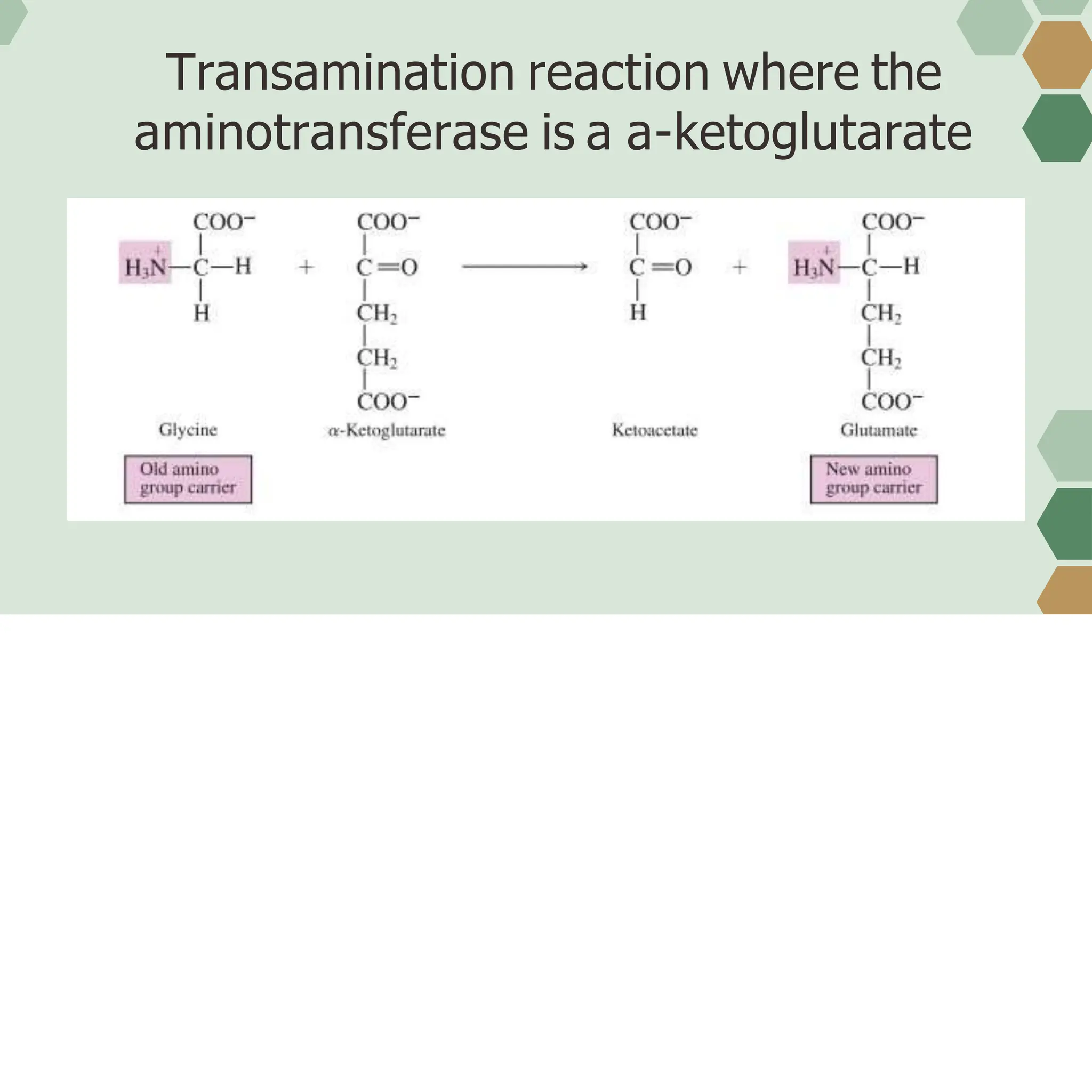
Transamination reaction where the
aminotransferase is a a-ketoglutarate
Transamination reaction where the
aminotransferase is a pyruvate
initial effect of transamination:
is to collect the amino acids from a variety of amino acids into just
two amino acids
Net effect of transamination:
Collection of the amino groups from a variety of amino acids into a
single compound—the amino acid glutamate
is a biochemical reaction catalyzed by glutamate
dehydrogenase in which glutamate is converted
into alpha-keto glutarate with the release of an
ammonium ion
Oxidative deamination reaction
26.4
UREA CYCLE
by: Giovanne Gabriel
URINE
a liquid waste material produced and excreted
in the body.
TYPES OF SOLUTE PRESENT IN URINE:
Organic
Inorganic
Among this solutes urea is the most abundant
around 25 g of urea for a 1400-ml specimen obtained
over a 24-hour period.
URINE
The pale yellow color characteristic of urine, it is
because of the small amount of urobilin present.
Urobilin consist of water, urea, inorganic salts, creatine,
ammonia, and pigmented products of blood
breakdown.
UREA
FACT: A normal adult excretes 1000-1500 mL of urine daily and with a normal
metabolism excretes about 30g of urea daily in urine, exact amount varies per
protein intake.
a white solid with a melting point of 133 degree Celsius. It is
the nitrogen atom source for urea cycle and end product of
protein metabolism.
Properties:
• Very soluble in water
• Odorless
• Colorless
• Salty in taste
WHY IS IT DEPENDENT
ON PROTEIN INTAKE?
As we eat particularly
protein content meals,
Largely high
some of it
becomes excess proteins as it is more
than enough supply that what the body
needs, since excess proteins cannot be
stored since the body has no specialize
cells for it, processing of the nitrogen
content of excess protein increases urea
concentration in urine.
= GLUTAMATE
How does Protein Become Urea?
INGEST PROTEIN
AMINO ACID
Proteolysis
Breakdown
TRANSAMINATION
ALPHAKETOGLUTARATE + AMINO
GROUP
Directly Transported to the Liver
OXIDATIVE
DEAMINATION
UREA CYCLE
Excretion through URINE
UREA CYCLE
a cyclic biochemical pathway in which urea
is produced, for excretion, using
ammonium ions and aspartate molecules
as nitrogen sources.
Described by Hans Krebs and Kurt
Henseleit in 1932.
Process of converting ammonia into urea.
From a nitrogen standpoint, the net effect of
transamination and deamination reactions
is production of ammonium ions and
aspartate molecules.
Ornithine
Carbamoyl Phosphate (Ammonia + Carbon Dioxide)
Citrulline (Carbamoyl Phosphate + Ornithine)
Aspartate (gets combined with citrulline)
Argininosuccinate (Aspartate + Citrulline)
Fumarate (formed by cleavage of Argininosuccinate)
Arginine
Urea (final/end product of urea cycle)
UREA CYCLE
Intermediates Molecules Involved in the
Process:
MNEMONICS:
Orange
Colored
Cats
Always
Ask
For
Awesome
Umbrellas
Carbamoyl Phosphate Synthase 1 (combine
ammonia with carbon dioxide)
Ornithine Transcarbamoylase (enzyme that
combines ornithine and CP)
Argininosuccinate Synthetase (Combine aspartate
and citrulline)
Argininosuccinate Lyase (breaks down
argininosuccinate into fumarate and arginine)
Arginase (splits arginine into urea and ornithine)
UREA CYCLE
ENZYMES INVOLVED IN UREA CYCLE:
MNEMONICS:
Can
Our
Aunts
Aim
Accurately
UREA
CYCLE
UREA
CYCLE
STEP 1: Carbamoyl Group Transfer
The carbamoyl group of carbamoyl phosphate is transferred to
ornithine to form citrulline. with release of Pi in a reaction
catalyzed by ornithine transcarbamoylase.
The breaking of the high-energy phosphate bond in carbamoyl
phosphate drives the transfer process. With the carbamoyl
transfer, the fi rst of the two nitrogen atoms and the carbon
atom needed for the formation of urea have been introduced
into the cycle.
It occurs in the mitochondrial matrix.
UREA
CYCLE
STEP 2: Citrulline-Aspartate Condensation
Citrulline is transported into the cytosol, citrulline reacts with
aspartate to produce arginosuccinate.
In this reaction, the second of two nitrogen atoms of urea is
introduced into the cycle (one nitrogen comes from carbamoyl
phosphate and the other from the aspartate – original source
of both is glutamate.
This condensation process produce argininosuccinate.
UREA
CYCLE
STEP 3: Arginosuccinate Cleavage
The enzyme argininosuccinate lyase catalyzes
the cleavage of argininosuccinate into arginine,
a standard amino acid, and fumarate, a citric
acid cycle intermediate.
UREA
CYCLE STEP 4: Urea from Arginine Hydrolysis
Hydrolysis of arginine produces urea and regenerates ornithine,
one of the cycle’s starting materials. The enzyme involved is
arginase.
The oxygen atom present in the urea comes from the water
involved in the hydrolysis. The ornithine is transported back into
the mitrochondria, where it becomes available to participate in
the urea cycle again.
The equivalent of a total of four ATP molecules is expended in
the production of one urea molecule. Two ATP molecules are
consumed in the production of carbamoyl phosphate, and the
equivalent of two ATP molecules is consumed in Step 2 of the
urea cycle, where an ATP is hydrolyzed to AMP and PPi and the
PPi is then further hydrolyzed to two Pi .
UREA
CYCLE
The net reaction for urea formation, in which all of
the urea cycle intermediates cancel out of the
equation, is:
Linkage Between the Urea and Citric Acid Cycles
The net equation for urea formation shows fumarate, a citric
acid cycle intermediate, as a product. This fumarate enters the
citric acid cycle, where it is converted to malate and then to
oxaloacetate, which can then be converted to aspartate
through transamination. The aspartate then re-enters the urea
cycle at Step 2. Besides undergoing transamination, the
oxaloacetate produced from fumarate of the urea cycle can be
(1) converted to glucose via gluconeogenesis (2) condensed
with acetyl CoA to form citrate or (3)converted to pyruvate.
26.5 Amino
Acid Carbon
Skeleton
Vanessa Mangulabnan
• the first step of any real importance when breaking down amino acids is transamination
--getting that amino group off!
that amino group always goes to a-ketoglutarate (the universal of nitrogen in our bodies) making
glutamate
what’s left behind of the original amino acid is just carbon and is called the CARBON SKELETON
-we will discuss what happens to the carbon skeleton and the amino group separately
- but remember that, initially, these came from the same single amino acid
Breaking Down Amino Acids
-Through metabolic process, proteins transform into amino acids, each
carrying an amino group. After removing these groups, the leftover carbon
structure of amino acids becomes building blocks for the TCA cycle or its
precursors
Breaking Down Amino Acids
The carbon skeletons of amino acids can go down one of two roads :
a GLUCOGENIC amino acid has its carbon skeleton become pyruvate or oxaloacetate
a KETOGENIC amino acid has its carbon skeleton become acetyl-CoA or acetoacetyl-
CoA these will eventually give rise to ketone bodies
Amino acids that are degraded to citric acid cycle intermediates can serve as glucose
precursors and are called glucogenic. A glucogenic amino acid is an amino acid that has a
carbon-containing degradation product that can be used to produce glucose
via gluconeogenesis.
Amino acids that are degraded to acetyl CoA or acetoacetyl CoA can contribute to the
formation of fatty acids or ketone bodies and are called ketogenic. A ketogenic amino acid is an
amino acid that has a carbon-containing degradation product that can be used to produce
ketone bodies
Breaking Down Amino Acids
1. Synthesis of glucose.
2. Synthesis of Pyruvic acid.
3. Synthesis of non-essential amino acids.
4. Formation of lipids—fatty acids and ketone bodies.
5. Synthesis of Acetyl CoA.
The classification of amino acids
are:
1.Glucogenic Amino Acids
2. Ketogenic Amino Acids
3. Both (Glucogenic & Ketogenic)
The carbon skeleton finally has one or more of the following fates :
1.Citric Acid Cycle
KETONE &GLUCOSE
-Our discussion of glucogenicity and ketogenicity for amino acids points out that
ATP production (common metabolic pathway) is not the only fate for amino acid
degradation products. They can also be converted to glucose, ketone bodies, or
fatty acids (via acetyl CoA).
- these compounds go through more metabolic processes, either producing energy
or becoming precursors for making other important molecules in the body.
Arginine, Citrulline, and the Chemical
Messenger Nitric Oxide
A somewhat startling biochemical discovery made during the early 1990s was the
existence within the human body of a gaseous chemical messenger, the simple diatomic
molecule nitric oxide (NO). Its production involves two of the amino acid intermediates of
the urea cycle—arginine and citrulline.
Arginine: When arginine is converted to nitric oxide
by enzymes called nitric oxide synthases (NOS),
Citrulline: It can be converted into arginine in the
body, contributing indirectly to nitric oxide
production
Dietary Sources: Both arginine and citrulline can be obtained from dietary
sources such as meat, fish, dairy, nuts, seeds, and certain fruits.
Arginine, Citrulline, and the Chemical
Messenger Nitric Oxide
Difference between Arginine and Citrulline
·Arginine and citrulline are amino acids. Arginine is a direct precursor to nitric
oxide, aiding in blood vessel dilation. Citrulline converts to arginine in the body,
indirectly supporting nitric oxide production. Both play roles in cardiovascular health
and exercise performance.
NITRIC OXIDE (NO)
Synthesis by nitric oxide synthases.
Nitric oxide (NO) is synthesised when L-arginine is converted to cirtulline by nitric oxide
synthases (NOS) .
NADPH and O2 are the cofactors
-There are three isoforms of NOS (nNOS and eNOS expressed in mammalian cells) Increase in
intracellular calcium level and shear stress trigger NO synthesis iNOS activity not influenced by
calcium level changes, tends to produce more NO and last longer .
Production of NO through iNOS can be controlled by transcription (stimulators e.g. cytokines &
growth factors increase transcription of iNOS gene and increase NO production)
ROLES OF NO
1. NO helps maintain blood pressure by dilating blood vessels.
2. NO is a chemical messenger in the central nervous system.
3. NO is involved in the immune system’s response to invasion
by foreign organisms or materials.
4. NO is found in the brain and may be a major biochemical
component of long-term memory.
NITRIC OXIDE SYNTHASE (NOS)
Nitric Oxide Synthase (NOS) is a heme protein similar to cytochrome. This enzymes are a
family of oxidoreductase that responsible for the synthesis of Nitric Oxide (NO) via the
NADPH and oxygen- dependent consumption of L-arginine with the resultant by-product, L-
citrulline
TYPE OF NITRIC OXIDE SYNTHASE
(NOS)
1. Neuronal Nitric Oxide Synthase (nNOS)
Involved in the development of nervous system.
Calciumion dependent that used for neuronal communication
2. Inducible Nitric Oxide Synthase (INOS)
Most nucleated cells, particularly macrophages - produce large amount of NO as a defense mechanism.
Independent of intracellular calcium ion and its regulation depend upon de novo synthesis.
3. Endothelial Nitric Oxide Synthase (eNOS)
Present on vascular endothelial cells and neuronal cells Calciumion dependent
Electrons are donated by NADPH to the reductase
domain of the enzyme and proceed via FAD and FMN
redox carriers to the oxygenase domain.
They interact with the haem iron and BH4 at the
active site to catalyse the reaction of oxygen with L-
arginine, generating citrulline and NO as products
Electron flow through the reductase domain requires
the presence of bound Ca2+/CaM
1.Smooth muscle cells constrict
HOW NO WORKS IN THE
ENDOTHELIUM?
2. Nerve signal
3. Production of NO by eNOS.
4. NO NO
NO
5. Smooth muscle relaxation
Extra: Nitroglycerin (GTN) is converted
to NO in smooth muscle cell -
vasodilation.
Nitric oxide is the active metabolite from nitroglycerin
AMINO ACID
BIOSYNTHESIS
Zafra, Anne Denise Grande ^o^
refers to the biochemical processes by which living organisms produce amino acids,
the building blocks of proteins. Amino acids are essential for various biological
functions, including the synthesis of proteins, enzymes, hormones, and
neurotransmitters. While some organisms can synthesize all the amino acids they
need, others, including humans, must obtain certain amino acids from their diet
because their bodies cannot produce them in sufficient quantities.
AMINO ACID BIOSYNTHESIS
Overview of amino acid biosynthesis.
The carbon skeleton precursors
derive from three sources: glycolysis
(pink), the citric acid cycle (blue), and
the pentose phosphate pathway
(purple).
3-Phosphoglycerate (3-PG)
3-PG is an important intermediate in the biosynthesis
of serine and glycine.
Phosphoenolpyruvate (PEP)
a high-energy phosphate compound and a precursor
in gluconeogenesis.
Pyruvate
a central intermediate in glycolysis and the starting
point for several biosynthetic pathways.
Acetyl-CoA
a crucial precursor for fatty acid biosynthesis.
Oxaloacetate
an intermediate in the citric acid cycle and serves as a
precursor for the biosynthesis of aspartate and other amino
acids.
Ribose-5-Phosphate:
a precursor for the synthesis of nucleotides (the
building blocks of DNA and RNA)
Erythrose-4-Phosphate:
a precursor for the synthesis of aromatic amino acids,
including phenylalanine, tyrosine, and tryptophan.
Glycerol-3-Phosphate:
a precursor for the glycerol backbone in
phospholipids and triglycerides.
To organize these biosynthetic
pathways is to group them into six
families corresponding to their
metabolic precursors
A notable intermediate in several pathways
of amino acid and nucleotide synthesis—
5-phosphoribosyl-1-pyrophosphate
(PRPP):
PRPP is synthesized from ribose 5-phosphate derived from
the pentose phosphate pathway, in a reaction catalyzed by
ribose phosphate pyrophosphokinase:
α-Ketoglutarate
Gives Rise to
Glutamate,
Glutamine,
Proline, and
Arginine
Proline is a cyclized derivative of
glutamate
carboxyl group
FIRST, ATP reacts with the
of glutamate to
form an acyl phosphate, which is
reduced
by NADPH or NADH to
glutamate
SECOND, glutamate
γ-semialdehyde is cyclized and
reduced.
Arginine is synthesized from glutamate via ornithine and the urea cycle in
animals.
In the first step, the α-amino group of glutamate is blocked by an acetylation
requiring acetyl-CoA; then, after the transamination step, the acetyl group is
removed to yield ornithine.
Proline can be synthesized by the pathway, but it is also formed from arginine
obtained from dietary or tissue protein. Arginase, a urea cycle enzyme, converts
arginine to ornithine and urea. The ornithine is converted to glutamate
semialdehyde by the enzyme ornithine _-aminotransferase
Serine, Glycine, and
Cysteine are Derived
from
3-Phosphoglycerate
The major pathway for the formation
of serine is the same in all
organisms.
In the first step, the hydroxyl group of
3-phosphoglycerate is oxidized by a
dehydrogenase (using NAD+) to yield
3-phosphohydroxypyruvate.
Transamination from glutamate yields
3-phosphoserine, which is hydrolyzed
to free serine by phosphoserine
phosphatase.
Serine (three carbons) is the precursor
of glycine (two carbons) through
removal of a carbon atom by serine
hydroxymethyltransferase
Tetrahydrofolate accepts the 𝛽− carbon (C-3) of serine,
which forms a methylene bridge between N-5 and N-10 to
yield N5,N10-methylenetetrahydrofolate
In the liver of vertebrates, glycine can be made by another
route: the reverse of the reaction, catalyzed by glycine
synthase (also called glycine cleavage enzyme):
Sulfate is activated in two steps to
produce 3'-phosphoadenosine 5'-
phosphosulfate (PAPS), which
undergoes an eight-electron reduction to
sulfide.
This demethylated product is hydrolyzed
to free homocysteine,
which undergoes a reaction with serine,
catalyzed by cystathionine 𝜷-synthase,
to yield cystathionine
Finally, cystathionine 𝜸-lyase, a PLP-requiring
enzyme, catalyzes removal of ammonia and
cleavage of cystathionine to yield free cysteine.
Three Nonessential
and Six Essential
Amino Acids
Are Synthesized from
Oxaloacetate and
Pyruvate
Alanine and aspartate are synthesized from
pyruvate and oxaloacetate, respectively, by
transamination from glutamate.
Asparagine is synthesized by amidation of
aspartate, with glutamine donating the
NH4+.
Aspartate gives rise to methionine, threonine,
and lysine. Branch points occur at aspartate 𝜷-
semialdehyde, an intermediate in all three
pathways, and at homoserine, a precursor of
threonine and methionine.
Threonine, in turn, is one of the precursors of
isoleucine. The valine and isoleucine pathways
share four enzymes.
The 𝛼-ketobutyrate is
derived from threonine in a reaction that
requires pyridoxal phosphate.
An intermediate in the valine pathway, 𝛼-ketoisovalerate, is
the starting point for a four-step branch pathway leading to
leucine.
Chorismate Is a Key
Intermediate in the
Synthesis
of Tryptophan,
Phenylalanine, and
Tyrosine
The first
four steps produce shikimate,
a seven-carbon molecule
derived from erythrose 4-
phosphate and
phosphoenolpyruvate
Chorismate is the first branch
point of the
pathway, with one branch leading
to tryptophan, the
other to phenylalanine and
tyrosine.
In the tryptophan branch ,
chorismate
is converted to anthranilate in a
reaction in which glutamine
donates the nitrogen that will
become part of the
indole ring.
The final reaction in the sequence
is catalyzed by tryptophan synthase.
This enzyme
has an 𝛼2 𝜷2 subunit structure and can be
dissociated into two 𝛼subunits and a 𝜷2 subunit that
catalyze different parts of the overall reaction:
The second part of the
reaction requires
pyridoxal phosphate
In plants and bacteria, phenylalanine and tyrosine
are synthesized from chorismate in pathways much
less complex than the tryptophan pathway. The common
intermediate is prephenate.
Animals can produce tyrosine directly from phenylalanine
through hydroxylation at C-4 of the phenyl
group by phenylalanine hydroxylase
Histidine
Biosynthesis Uses
Precursors
of Purine
Biosynthesis
The key steps are condensation
of ATP and PRPP, in which N-1
of the purine ring is linked to the
activated C-1 of the ribose of
PRPP.
Purine ring opening that ultimately leaves
N-1 and C-2 of adenine linked to the
ribose.
and formation of the
imidazole
ring, a reaction in which
glutamine donates a
nitrogen
SUMMARY
Plants and bacteria synthesize all 20 common amino acids. Mammals can synthesize about
half; the others are required in the diet.
Glutamate is formed by reductive amination of a-ketoglutarate and serves as the precursor
of glutamine, proline, and arginine.
Alanine and aspartate (and thus asparagine) are formed from pyruvate and oxaloacetate,
respectively, by transamination.
The carbon chain of serine is derived from 3-phosphoglycerate.
Serine is a precursor of glycine; the B-carbon atom of serine is transferred to
tetrahydrofolate.
In microorganisms, cysteine is produced from serine and from sulfide produced by the
reduction of environmental sulfate. Mammals produce cysteine from methionine and serine
by a series of reactions requiring S-adenosylmethionine and cystathionine.
SUMMARY
The aromatic amino acids (phenylalanine, tyrosine, and tryptophan) form by a pathway in
which chorismate occupies a key branch point.
Phosphoribosyl pyrophosphate is a precursor of tryptophan and histidine.
The pathway to histidine is interconnected with the purine synthetic pathway.
Tyrosine can also be formed by hydroxylation of phenylalanine (and thus is considered
conditionally essential).
26.7
Hemoglobin
Catabolism
By: Guillermo
Hemoglobin Catabolism
- Hemoglobin catabolism refers to the breakdown or degradation of
hemoglobin, the protein responsible for transporting oxygen in red blood
cells.
-Red blood cells are highly specialized cells whose primary function is to
deliver oxygen to, and remove carbon dioxide from, body tissues. Mature
red blood cells have no nucleus or DNA. Instead, they are filled with the
red pigment hemoglobin.
Hemoglobin Heme Bilirubin
Daily 6g of Hb broken down
Form 250mg of Bilirubin
50mg of Bilirubin is formed from Myoblobin and other heme
containing proteins like cytochromes, catalases, peroxidases, etc
So, a total of 300mg of bilirubin is formed everyday
The oxygen-carrying ability of red blood
cells is due to the protein hemoglobin
present in such cells Hemoglobin is a
conjugated protein; the protein portion is
called globin, and the prosthetic group
(nonprotein portion) is heme. Heme
contains four pyrrole groups joined
together with an iron atom in the center.
It is the iron atom in heme that interacts
with O2, forming a reversible complex with
it. This complexation increases the amount
of O2 that the blood can carry by a factor of
80 over that which simply “dissolves” in the
blood.
Old red blood cells are broken down in the spleen
(primary site) and liver (secondary site). Part of
this process is degradation of hemoglobin.
- The globin protein is hydrolyzed to amino acids, which become
part of the amino acid pool.
-The iron atom of heme becomes part of ferritin, an iron-storage
protein, which saves the iron for use in the biosynthesis of new
hemoglobin molecules. The tetrapyrrole carbon arrangement of
heme is degraded to bile pigments that are eliminated in feces and
to a lesser extent in urine.
Degradation of heme begins with a ring-opening reaction in which a
single carbon atom is removed. The product is called biliverdin.
This reaction has several important characteristics. (1) Molecular
oxygen, O2, is required as a reactant. (2) Ring opening releases the
iron atom to be incorporated into ferritin. (3) The product
containing the excised carbon atom is carbon monoxide (a
substance toxic to the human body).
In the second step of heme degradation, biliverdin is converted to
bilirubin. This change involves reduction of the central methylene
bridge of biliverdin.
The change from heme to biliverdin to bilirubin usually occurs in the spleen.
The bilirubin is then transported by serum albumin to the liver, where it is
rendered more water-soluble by the attachment of sugar residues to its
propionate side chains (P side chains). The solubilizing sugar is glucuronate
(glucose with a —COO group on C-6 instead of a —CH2OH group).
The solubilized bilirubin is excreted
from the liver in bile, which flows
into the small intestine. Here the
bilirubin diglucuronide is changed,
in a multistep process, to either
stercobilin for excretion in feces or
urobilin for excretion in urine. Both
stercobilin and urobilin still have
tetrapyrrole structures. Intestinal
bacteria are primarily responsible
for the changes that produce
stercobilin and urobilin.
Stercobilin and urobilin have structures closely resembling that of
bilirubin. Changes include reduction of vinyl (V) groups to ethyl
(E) groups and reduction of -CH2 -bridges.
The first part of the names biliverdin and bilirubin and the last part of
the names stercobilin and urobilin all come from the Latin bilis, which
means “bile.”
As for the other parts of the names:
1. Latin virdis means “green”; biliverdin “green bile.”
2. Latin rubin means “red”; bilirubin “red bile.”
3. Latin urina means “urine”; urobilin “urine bile.”
4. Latin sterco means “dung”; stercobilin “dung bile.”
Bile Pigments
The tetrapyrrole degradation products obtained from heme are known as bile
pigments because they are secreted with the bile, and most of them are highly
colored. A bile pigment is a colored tetrapyrrole degradation product present in
bile. Biliverdin and bilirubin are, respectively, green and reddish orange in color.
Stercobilin has a brownish hue and is the compound that gives feces their
characteristic color. Urobilin is the pigment that gives urine its characteristic
yellow color. Normally, the body excretes 1–2 mg of bile pigments in urine daily
and 250–350 mg of bile pigments in feces daily.
When the body is functioning properly, the degradation of heme in the spleen to
bilirubin and the removal of bilirubin from the blood by the liver balance each
other. Jaundice is the condition that occurs when this balance is upset such that
bilirubin concentrations in the blood become higher than normal. The skin and
the white of the eyes acquire a yellowish tint because of the excess bilirubin in the
blood. Jaundice can occur as a result of liver diseases, such as infectious hepatitis
and cirrhosis, that decrease the liver’s ability to process bilirubin; from spleen
malfunction, in which heme is degraded more rapidly than it can be absorbed by
the liver; and from gallbladder malfunction, usually from an obstruction of the
bile duct.
The local coloration associated with a deep bruise is also related to the
pigmentation associated with heme, biliverdin, and bilirubin. The changing color
of the bruise as it heals reflects the dominant degradation product present at the
time as the tissue repairs itself
26.8
Interrelationships
Among Metabolic
Pathways
By: Yabut
The metabolic pathways of carbohydrates,
lipids, and protein are integrally linked to
each other.
A change in one pathways can affects many
and other pathways.
26.9
B Vitamins
By: Yabut
B Vitamins are the cofactor that participates in
this metabolic reaction.
6 out of 8 B vitamins in carbohydrate
metabolism
all 8 B vitamins are involved in protein
metabolism
niacin ( NAD+, NADH) oxidative reactions
PLP transamination reactions
26.9
Protein
Metabolism
By: Yabut
Thanks!
THAT’S IT FOR PROTEIN
METABOLISM
REFERENCES:
MEDSimplified. (2020, March 10). UREA CYCLE MADE EASY 2020 - METABOLISMS MADE
SIMPLE [Video]. YouTube. https://www.youtube.com/watch?v=vhCF-dN6WYQ
General, Organic, and Biological Chemistry by Stephen H. Stoker
REFERENCES:
Amino Acid Biosynthesis
Abeles, R.H., Frey, P.A., & Jencks, W.P. (1992) Biochemistry,
Jones and Bartlett Publishers, Boston.
Bender, D.A. (1985) Amino Acid Metabolism, 2nd edn, Wiley Interscience, New York.
Neidhardt, F.C. (ed.) (1996) Escherichia coli and Salmonella:
Cellular and Molecular Biology, 2nd edn, ASM Press, Washing ton, DC.
Pan P., Woehl, E., & Dunn, M.F. (1997) Protein architecture,
dynamics and allostery in tryptophan synthase channeling. Trends
Biochem. Sci. 22, 22–27.

Biochemistry protein metabolism (1).pptx

  • 1.
  • 2.
    Table of Contents I Introductionand Protein Digestion and Absorption II Amino Acid Utilization III Transaminization and Oxidative Deamination IV The Urea Cycle and Chemical Composition of Urine V Amino Acid Carbon Skeletons and Arginine, Citruline, Amino Acid Biosynthesis VIII Interrelationship among Metabolic Pathways and B- vitamins and Proteins VI VII Hemoglobin Catabolism and Interrelationship among Carbohydrate
  • 3.
  • 4.
    ●Process of proteindigestion and absorption
  • 5.
    Protein digestion (denaturationand hydrolysis) starts in the stomach ● Denatured by HCl in gastric juice (pH of 1.5-2.0) ● Enzyme pepsin hydrolyzes about 10% peptide bonds
  • 6.
    Large polypeptide chainspass from stomach into small intestine ● pH in small intestine is 7.0 -8.0 and helps neutralize the acidified gastric content ● Trypsin, chymotrypsin and carboxypeptidase in pancreatic juice released into the small intestine help hydrolyze proteins to smaller peptides ● Aminopeptidase secreted by intestinal mucosal membrane further hydrolyze the small peptides to amino acids ● Amino acids (aa) liberated are transported into blood stream via active transport process
  • 7.
    ●Amino acids formedthrough digestion process enters the amino acid pool in the body: ● Amino acid pool: the total supply of free amino acids available for use in the human body The amino acid pool is derived from 3 sources: 1. Dietary protein 2. Protein turnover: A repetitive process in which the body proteins are degraded and resynthesized 3. Biosynthesis of amino acids in the liver - only non-essential amino acids are synthesized
  • 8.
    ●proteins are denaturedbecause of the acidity of hydrochloric acid.
  • 9.
    ●Enzymatic digestion ofproteins begins in the stomach with the action of the enzyme pepsin.
  • 10.
  • 11.
    The amino acidpool is the total supply of free amino acids available for use in the human body.
  • 12.
    Protein turnover isthe repetitive process in which proteins are degraded and resynthesized within the human body.
  • 13.
    Nitrogen balance isthe state that results when the amount of nitrogen taken into the human body as protein equals the amount of nitrogen excreted from the body in waste materials.
  • 14.
    Two types ofnitrogen imbalance that can occur. A negative nitrogen balance accompanies a state of "tissue wasting," because more tissue proteins are being catabolized than are being replaced by protein synthess. A positive nitrogen balance (nitrogen intake exceeds nitrogen output) indicates that the rate of protein anabolism (synthesis) exceeds that of protein catabolism.
  • 15.
    The amino acidsfrom the body's amino acid pool are used in four different ways. 1. Protein synthesis. Proteins are continually needed to replace old tissue (protein turnover) and also to build new tissue (growth).
  • 16.
    2. Synthesis ofnonprotein nitrogen-containing compounds. Amino acids are regularly withdrawn from the amino acid pool for the synthesis of nonprotein nitrogen-containing compounds.
  • 17.
    3. Synthesis ofnonessential amino acids. When required, the body draws on the amino acid pool for raw materials for the production of nonessential amino acids that are in short supply.
  • 18.
    4. Production ofenergy. Because excess amino acids cannot be stored for later use, the body's response is to degrade them.
  • 19.
  • 20.
    Degradation of anamino acid takes place in two stages: The removal of the - amino group The degradation of the remaining carbon skeleton
  • 21.
    Removal of aminogroup is a two-step process Biochemical reaction in which the amino group of an alpha-amino acid is transferred to an alpha-keto acid. is a biochemical reaction in which an a-amino acid is converted into an a-keto acid with release of an ammonium ion Transamination Oxidative deamination
  • 22.
    General equation fora transamination reaction
  • 23.
    Transamination reaction wherethe aminotransferase is a a-ketoglutarate
  • 24.
    Transamination reaction wherethe aminotransferase is a pyruvate
  • 25.
    initial effect oftransamination: is to collect the amino acids from a variety of amino acids into just two amino acids Net effect of transamination: Collection of the amino groups from a variety of amino acids into a single compound—the amino acid glutamate
  • 29.
    is a biochemicalreaction catalyzed by glutamate dehydrogenase in which glutamate is converted into alpha-keto glutarate with the release of an ammonium ion Oxidative deamination reaction
  • 30.
  • 31.
    URINE a liquid wastematerial produced and excreted in the body. TYPES OF SOLUTE PRESENT IN URINE: Organic Inorganic Among this solutes urea is the most abundant around 25 g of urea for a 1400-ml specimen obtained over a 24-hour period.
  • 32.
    URINE The pale yellowcolor characteristic of urine, it is because of the small amount of urobilin present. Urobilin consist of water, urea, inorganic salts, creatine, ammonia, and pigmented products of blood breakdown.
  • 33.
    UREA FACT: A normaladult excretes 1000-1500 mL of urine daily and with a normal metabolism excretes about 30g of urea daily in urine, exact amount varies per protein intake. a white solid with a melting point of 133 degree Celsius. It is the nitrogen atom source for urea cycle and end product of protein metabolism. Properties: • Very soluble in water • Odorless • Colorless • Salty in taste
  • 34.
    WHY IS ITDEPENDENT ON PROTEIN INTAKE?
  • 35.
    As we eatparticularly protein content meals, Largely high some of it becomes excess proteins as it is more than enough supply that what the body needs, since excess proteins cannot be stored since the body has no specialize cells for it, processing of the nitrogen content of excess protein increases urea concentration in urine.
  • 36.
    = GLUTAMATE How doesProtein Become Urea? INGEST PROTEIN AMINO ACID Proteolysis Breakdown TRANSAMINATION ALPHAKETOGLUTARATE + AMINO GROUP Directly Transported to the Liver OXIDATIVE DEAMINATION UREA CYCLE Excretion through URINE
  • 37.
    UREA CYCLE a cyclicbiochemical pathway in which urea is produced, for excretion, using ammonium ions and aspartate molecules as nitrogen sources. Described by Hans Krebs and Kurt Henseleit in 1932. Process of converting ammonia into urea. From a nitrogen standpoint, the net effect of transamination and deamination reactions is production of ammonium ions and aspartate molecules.
  • 38.
    Ornithine Carbamoyl Phosphate (Ammonia+ Carbon Dioxide) Citrulline (Carbamoyl Phosphate + Ornithine) Aspartate (gets combined with citrulline) Argininosuccinate (Aspartate + Citrulline) Fumarate (formed by cleavage of Argininosuccinate) Arginine Urea (final/end product of urea cycle) UREA CYCLE Intermediates Molecules Involved in the Process: MNEMONICS: Orange Colored Cats Always Ask For Awesome Umbrellas
  • 39.
    Carbamoyl Phosphate Synthase1 (combine ammonia with carbon dioxide) Ornithine Transcarbamoylase (enzyme that combines ornithine and CP) Argininosuccinate Synthetase (Combine aspartate and citrulline) Argininosuccinate Lyase (breaks down argininosuccinate into fumarate and arginine) Arginase (splits arginine into urea and ornithine) UREA CYCLE ENZYMES INVOLVED IN UREA CYCLE: MNEMONICS: Can Our Aunts Aim Accurately
  • 40.
  • 41.
    UREA CYCLE STEP 1: CarbamoylGroup Transfer The carbamoyl group of carbamoyl phosphate is transferred to ornithine to form citrulline. with release of Pi in a reaction catalyzed by ornithine transcarbamoylase. The breaking of the high-energy phosphate bond in carbamoyl phosphate drives the transfer process. With the carbamoyl transfer, the fi rst of the two nitrogen atoms and the carbon atom needed for the formation of urea have been introduced into the cycle. It occurs in the mitochondrial matrix.
  • 42.
    UREA CYCLE STEP 2: Citrulline-AspartateCondensation Citrulline is transported into the cytosol, citrulline reacts with aspartate to produce arginosuccinate. In this reaction, the second of two nitrogen atoms of urea is introduced into the cycle (one nitrogen comes from carbamoyl phosphate and the other from the aspartate – original source of both is glutamate. This condensation process produce argininosuccinate.
  • 43.
    UREA CYCLE STEP 3: ArginosuccinateCleavage The enzyme argininosuccinate lyase catalyzes the cleavage of argininosuccinate into arginine, a standard amino acid, and fumarate, a citric acid cycle intermediate.
  • 44.
    UREA CYCLE STEP 4:Urea from Arginine Hydrolysis Hydrolysis of arginine produces urea and regenerates ornithine, one of the cycle’s starting materials. The enzyme involved is arginase. The oxygen atom present in the urea comes from the water involved in the hydrolysis. The ornithine is transported back into the mitrochondria, where it becomes available to participate in the urea cycle again.
  • 45.
    The equivalent ofa total of four ATP molecules is expended in the production of one urea molecule. Two ATP molecules are consumed in the production of carbamoyl phosphate, and the equivalent of two ATP molecules is consumed in Step 2 of the urea cycle, where an ATP is hydrolyzed to AMP and PPi and the PPi is then further hydrolyzed to two Pi . UREA CYCLE The net reaction for urea formation, in which all of the urea cycle intermediates cancel out of the equation, is:
  • 46.
    Linkage Between theUrea and Citric Acid Cycles The net equation for urea formation shows fumarate, a citric acid cycle intermediate, as a product. This fumarate enters the citric acid cycle, where it is converted to malate and then to oxaloacetate, which can then be converted to aspartate through transamination. The aspartate then re-enters the urea cycle at Step 2. Besides undergoing transamination, the oxaloacetate produced from fumarate of the urea cycle can be (1) converted to glucose via gluconeogenesis (2) condensed with acetyl CoA to form citrate or (3)converted to pyruvate.
  • 47.
  • 48.
    • the firststep of any real importance when breaking down amino acids is transamination --getting that amino group off! that amino group always goes to a-ketoglutarate (the universal of nitrogen in our bodies) making glutamate what’s left behind of the original amino acid is just carbon and is called the CARBON SKELETON -we will discuss what happens to the carbon skeleton and the amino group separately - but remember that, initially, these came from the same single amino acid Breaking Down Amino Acids
  • 49.
    -Through metabolic process,proteins transform into amino acids, each carrying an amino group. After removing these groups, the leftover carbon structure of amino acids becomes building blocks for the TCA cycle or its precursors Breaking Down Amino Acids
  • 50.
    The carbon skeletonsof amino acids can go down one of two roads : a GLUCOGENIC amino acid has its carbon skeleton become pyruvate or oxaloacetate a KETOGENIC amino acid has its carbon skeleton become acetyl-CoA or acetoacetyl- CoA these will eventually give rise to ketone bodies Amino acids that are degraded to citric acid cycle intermediates can serve as glucose precursors and are called glucogenic. A glucogenic amino acid is an amino acid that has a carbon-containing degradation product that can be used to produce glucose via gluconeogenesis. Amino acids that are degraded to acetyl CoA or acetoacetyl CoA can contribute to the formation of fatty acids or ketone bodies and are called ketogenic. A ketogenic amino acid is an amino acid that has a carbon-containing degradation product that can be used to produce ketone bodies Breaking Down Amino Acids
  • 51.
    1. Synthesis ofglucose. 2. Synthesis of Pyruvic acid. 3. Synthesis of non-essential amino acids. 4. Formation of lipids—fatty acids and ketone bodies. 5. Synthesis of Acetyl CoA. The classification of amino acids are: 1.Glucogenic Amino Acids 2. Ketogenic Amino Acids 3. Both (Glucogenic & Ketogenic) The carbon skeleton finally has one or more of the following fates :
  • 52.
  • 53.
    KETONE &GLUCOSE -Our discussionof glucogenicity and ketogenicity for amino acids points out that ATP production (common metabolic pathway) is not the only fate for amino acid degradation products. They can also be converted to glucose, ketone bodies, or fatty acids (via acetyl CoA). - these compounds go through more metabolic processes, either producing energy or becoming precursors for making other important molecules in the body.
  • 54.
    Arginine, Citrulline, andthe Chemical Messenger Nitric Oxide A somewhat startling biochemical discovery made during the early 1990s was the existence within the human body of a gaseous chemical messenger, the simple diatomic molecule nitric oxide (NO). Its production involves two of the amino acid intermediates of the urea cycle—arginine and citrulline. Arginine: When arginine is converted to nitric oxide by enzymes called nitric oxide synthases (NOS), Citrulline: It can be converted into arginine in the body, contributing indirectly to nitric oxide production Dietary Sources: Both arginine and citrulline can be obtained from dietary sources such as meat, fish, dairy, nuts, seeds, and certain fruits.
  • 55.
    Arginine, Citrulline, andthe Chemical Messenger Nitric Oxide Difference between Arginine and Citrulline ·Arginine and citrulline are amino acids. Arginine is a direct precursor to nitric oxide, aiding in blood vessel dilation. Citrulline converts to arginine in the body, indirectly supporting nitric oxide production. Both play roles in cardiovascular health and exercise performance.
  • 56.
    NITRIC OXIDE (NO) Synthesisby nitric oxide synthases. Nitric oxide (NO) is synthesised when L-arginine is converted to cirtulline by nitric oxide synthases (NOS) . NADPH and O2 are the cofactors -There are three isoforms of NOS (nNOS and eNOS expressed in mammalian cells) Increase in intracellular calcium level and shear stress trigger NO synthesis iNOS activity not influenced by calcium level changes, tends to produce more NO and last longer . Production of NO through iNOS can be controlled by transcription (stimulators e.g. cytokines & growth factors increase transcription of iNOS gene and increase NO production)
  • 57.
    ROLES OF NO 1.NO helps maintain blood pressure by dilating blood vessels. 2. NO is a chemical messenger in the central nervous system. 3. NO is involved in the immune system’s response to invasion by foreign organisms or materials. 4. NO is found in the brain and may be a major biochemical component of long-term memory. NITRIC OXIDE SYNTHASE (NOS) Nitric Oxide Synthase (NOS) is a heme protein similar to cytochrome. This enzymes are a family of oxidoreductase that responsible for the synthesis of Nitric Oxide (NO) via the NADPH and oxygen- dependent consumption of L-arginine with the resultant by-product, L- citrulline
  • 58.
    TYPE OF NITRICOXIDE SYNTHASE (NOS) 1. Neuronal Nitric Oxide Synthase (nNOS) Involved in the development of nervous system. Calciumion dependent that used for neuronal communication 2. Inducible Nitric Oxide Synthase (INOS) Most nucleated cells, particularly macrophages - produce large amount of NO as a defense mechanism. Independent of intracellular calcium ion and its regulation depend upon de novo synthesis. 3. Endothelial Nitric Oxide Synthase (eNOS) Present on vascular endothelial cells and neuronal cells Calciumion dependent Electrons are donated by NADPH to the reductase domain of the enzyme and proceed via FAD and FMN redox carriers to the oxygenase domain. They interact with the haem iron and BH4 at the active site to catalyse the reaction of oxygen with L- arginine, generating citrulline and NO as products Electron flow through the reductase domain requires the presence of bound Ca2+/CaM
  • 59.
    1.Smooth muscle cellsconstrict HOW NO WORKS IN THE ENDOTHELIUM? 2. Nerve signal 3. Production of NO by eNOS. 4. NO NO NO 5. Smooth muscle relaxation Extra: Nitroglycerin (GTN) is converted to NO in smooth muscle cell - vasodilation. Nitric oxide is the active metabolite from nitroglycerin
  • 61.
  • 62.
    refers to thebiochemical processes by which living organisms produce amino acids, the building blocks of proteins. Amino acids are essential for various biological functions, including the synthesis of proteins, enzymes, hormones, and neurotransmitters. While some organisms can synthesize all the amino acids they need, others, including humans, must obtain certain amino acids from their diet because their bodies cannot produce them in sufficient quantities. AMINO ACID BIOSYNTHESIS
  • 64.
    Overview of aminoacid biosynthesis. The carbon skeleton precursors derive from three sources: glycolysis (pink), the citric acid cycle (blue), and the pentose phosphate pathway (purple).
  • 65.
    3-Phosphoglycerate (3-PG) 3-PG isan important intermediate in the biosynthesis of serine and glycine. Phosphoenolpyruvate (PEP) a high-energy phosphate compound and a precursor in gluconeogenesis. Pyruvate a central intermediate in glycolysis and the starting point for several biosynthetic pathways. Acetyl-CoA a crucial precursor for fatty acid biosynthesis.
  • 66.
    Oxaloacetate an intermediate inthe citric acid cycle and serves as a precursor for the biosynthesis of aspartate and other amino acids. Ribose-5-Phosphate: a precursor for the synthesis of nucleotides (the building blocks of DNA and RNA) Erythrose-4-Phosphate: a precursor for the synthesis of aromatic amino acids, including phenylalanine, tyrosine, and tryptophan. Glycerol-3-Phosphate: a precursor for the glycerol backbone in phospholipids and triglycerides.
  • 67.
    To organize thesebiosynthetic pathways is to group them into six families corresponding to their metabolic precursors
  • 68.
    A notable intermediatein several pathways of amino acid and nucleotide synthesis— 5-phosphoribosyl-1-pyrophosphate (PRPP): PRPP is synthesized from ribose 5-phosphate derived from the pentose phosphate pathway, in a reaction catalyzed by ribose phosphate pyrophosphokinase:
  • 69.
    α-Ketoglutarate Gives Rise to Glutamate, Glutamine, Proline,and Arginine Proline is a cyclized derivative of glutamate
  • 70.
    carboxyl group FIRST, ATPreacts with the of glutamate to form an acyl phosphate, which is reduced by NADPH or NADH to glutamate SECOND, glutamate γ-semialdehyde is cyclized and reduced.
  • 71.
    Arginine is synthesizedfrom glutamate via ornithine and the urea cycle in animals. In the first step, the α-amino group of glutamate is blocked by an acetylation requiring acetyl-CoA; then, after the transamination step, the acetyl group is removed to yield ornithine.
  • 72.
    Proline can besynthesized by the pathway, but it is also formed from arginine obtained from dietary or tissue protein. Arginase, a urea cycle enzyme, converts arginine to ornithine and urea. The ornithine is converted to glutamate semialdehyde by the enzyme ornithine _-aminotransferase
  • 73.
    Serine, Glycine, and Cysteineare Derived from 3-Phosphoglycerate The major pathway for the formation of serine is the same in all organisms.
  • 74.
    In the firststep, the hydroxyl group of 3-phosphoglycerate is oxidized by a dehydrogenase (using NAD+) to yield 3-phosphohydroxypyruvate. Transamination from glutamate yields 3-phosphoserine, which is hydrolyzed to free serine by phosphoserine phosphatase. Serine (three carbons) is the precursor of glycine (two carbons) through removal of a carbon atom by serine hydroxymethyltransferase
  • 75.
    Tetrahydrofolate accepts the𝛽− carbon (C-3) of serine, which forms a methylene bridge between N-5 and N-10 to yield N5,N10-methylenetetrahydrofolate In the liver of vertebrates, glycine can be made by another route: the reverse of the reaction, catalyzed by glycine synthase (also called glycine cleavage enzyme):
  • 76.
    Sulfate is activatedin two steps to produce 3'-phosphoadenosine 5'- phosphosulfate (PAPS), which undergoes an eight-electron reduction to sulfide. This demethylated product is hydrolyzed to free homocysteine, which undergoes a reaction with serine, catalyzed by cystathionine 𝜷-synthase, to yield cystathionine Finally, cystathionine 𝜸-lyase, a PLP-requiring enzyme, catalyzes removal of ammonia and cleavage of cystathionine to yield free cysteine.
  • 77.
    Three Nonessential and SixEssential Amino Acids Are Synthesized from Oxaloacetate and Pyruvate
  • 78.
    Alanine and aspartateare synthesized from pyruvate and oxaloacetate, respectively, by transamination from glutamate. Asparagine is synthesized by amidation of aspartate, with glutamine donating the NH4+.
  • 79.
    Aspartate gives riseto methionine, threonine, and lysine. Branch points occur at aspartate 𝜷- semialdehyde, an intermediate in all three pathways, and at homoserine, a precursor of threonine and methionine. Threonine, in turn, is one of the precursors of isoleucine. The valine and isoleucine pathways share four enzymes.
  • 80.
    The 𝛼-ketobutyrate is derivedfrom threonine in a reaction that requires pyridoxal phosphate. An intermediate in the valine pathway, 𝛼-ketoisovalerate, is the starting point for a four-step branch pathway leading to leucine.
  • 81.
    Chorismate Is aKey Intermediate in the Synthesis of Tryptophan, Phenylalanine, and Tyrosine
  • 82.
    The first four stepsproduce shikimate, a seven-carbon molecule derived from erythrose 4- phosphate and phosphoenolpyruvate Chorismate is the first branch point of the pathway, with one branch leading to tryptophan, the other to phenylalanine and tyrosine.
  • 83.
    In the tryptophanbranch , chorismate is converted to anthranilate in a reaction in which glutamine donates the nitrogen that will become part of the indole ring. The final reaction in the sequence is catalyzed by tryptophan synthase.
  • 84.
    This enzyme has an𝛼2 𝜷2 subunit structure and can be dissociated into two 𝛼subunits and a 𝜷2 subunit that catalyze different parts of the overall reaction:
  • 85.
    The second partof the reaction requires pyridoxal phosphate
  • 86.
    In plants andbacteria, phenylalanine and tyrosine are synthesized from chorismate in pathways much less complex than the tryptophan pathway. The common intermediate is prephenate. Animals can produce tyrosine directly from phenylalanine through hydroxylation at C-4 of the phenyl group by phenylalanine hydroxylase
  • 87.
  • 88.
    The key stepsare condensation of ATP and PRPP, in which N-1 of the purine ring is linked to the activated C-1 of the ribose of PRPP. Purine ring opening that ultimately leaves N-1 and C-2 of adenine linked to the ribose.
  • 89.
    and formation ofthe imidazole ring, a reaction in which glutamine donates a nitrogen
  • 90.
    SUMMARY Plants and bacteriasynthesize all 20 common amino acids. Mammals can synthesize about half; the others are required in the diet. Glutamate is formed by reductive amination of a-ketoglutarate and serves as the precursor of glutamine, proline, and arginine. Alanine and aspartate (and thus asparagine) are formed from pyruvate and oxaloacetate, respectively, by transamination. The carbon chain of serine is derived from 3-phosphoglycerate. Serine is a precursor of glycine; the B-carbon atom of serine is transferred to tetrahydrofolate. In microorganisms, cysteine is produced from serine and from sulfide produced by the reduction of environmental sulfate. Mammals produce cysteine from methionine and serine by a series of reactions requiring S-adenosylmethionine and cystathionine.
  • 91.
    SUMMARY The aromatic aminoacids (phenylalanine, tyrosine, and tryptophan) form by a pathway in which chorismate occupies a key branch point. Phosphoribosyl pyrophosphate is a precursor of tryptophan and histidine. The pathway to histidine is interconnected with the purine synthetic pathway. Tyrosine can also be formed by hydroxylation of phenylalanine (and thus is considered conditionally essential).
  • 92.
  • 93.
    Hemoglobin Catabolism - Hemoglobincatabolism refers to the breakdown or degradation of hemoglobin, the protein responsible for transporting oxygen in red blood cells. -Red blood cells are highly specialized cells whose primary function is to deliver oxygen to, and remove carbon dioxide from, body tissues. Mature red blood cells have no nucleus or DNA. Instead, they are filled with the red pigment hemoglobin.
  • 94.
    Hemoglobin Heme Bilirubin Daily6g of Hb broken down Form 250mg of Bilirubin 50mg of Bilirubin is formed from Myoblobin and other heme containing proteins like cytochromes, catalases, peroxidases, etc So, a total of 300mg of bilirubin is formed everyday
  • 95.
    The oxygen-carrying abilityof red blood cells is due to the protein hemoglobin present in such cells Hemoglobin is a conjugated protein; the protein portion is called globin, and the prosthetic group (nonprotein portion) is heme. Heme contains four pyrrole groups joined together with an iron atom in the center.
  • 96.
    It is theiron atom in heme that interacts with O2, forming a reversible complex with it. This complexation increases the amount of O2 that the blood can carry by a factor of 80 over that which simply “dissolves” in the blood.
  • 98.
    Old red bloodcells are broken down in the spleen (primary site) and liver (secondary site). Part of this process is degradation of hemoglobin.
  • 99.
    - The globinprotein is hydrolyzed to amino acids, which become part of the amino acid pool. -The iron atom of heme becomes part of ferritin, an iron-storage protein, which saves the iron for use in the biosynthesis of new hemoglobin molecules. The tetrapyrrole carbon arrangement of heme is degraded to bile pigments that are eliminated in feces and to a lesser extent in urine.
  • 100.
    Degradation of hemebegins with a ring-opening reaction in which a single carbon atom is removed. The product is called biliverdin. This reaction has several important characteristics. (1) Molecular oxygen, O2, is required as a reactant. (2) Ring opening releases the iron atom to be incorporated into ferritin. (3) The product containing the excised carbon atom is carbon monoxide (a substance toxic to the human body).
  • 102.
    In the secondstep of heme degradation, biliverdin is converted to bilirubin. This change involves reduction of the central methylene bridge of biliverdin.
  • 103.
    The change fromheme to biliverdin to bilirubin usually occurs in the spleen. The bilirubin is then transported by serum albumin to the liver, where it is rendered more water-soluble by the attachment of sugar residues to its propionate side chains (P side chains). The solubilizing sugar is glucuronate (glucose with a —COO group on C-6 instead of a —CH2OH group).
  • 104.
    The solubilized bilirubinis excreted from the liver in bile, which flows into the small intestine. Here the bilirubin diglucuronide is changed, in a multistep process, to either stercobilin for excretion in feces or urobilin for excretion in urine. Both stercobilin and urobilin still have tetrapyrrole structures. Intestinal bacteria are primarily responsible for the changes that produce stercobilin and urobilin. Stercobilin and urobilin have structures closely resembling that of bilirubin. Changes include reduction of vinyl (V) groups to ethyl (E) groups and reduction of -CH2 -bridges.
  • 105.
    The first partof the names biliverdin and bilirubin and the last part of the names stercobilin and urobilin all come from the Latin bilis, which means “bile.” As for the other parts of the names: 1. Latin virdis means “green”; biliverdin “green bile.” 2. Latin rubin means “red”; bilirubin “red bile.” 3. Latin urina means “urine”; urobilin “urine bile.” 4. Latin sterco means “dung”; stercobilin “dung bile.”
  • 106.
    Bile Pigments The tetrapyrroledegradation products obtained from heme are known as bile pigments because they are secreted with the bile, and most of them are highly colored. A bile pigment is a colored tetrapyrrole degradation product present in bile. Biliverdin and bilirubin are, respectively, green and reddish orange in color. Stercobilin has a brownish hue and is the compound that gives feces their characteristic color. Urobilin is the pigment that gives urine its characteristic yellow color. Normally, the body excretes 1–2 mg of bile pigments in urine daily and 250–350 mg of bile pigments in feces daily.
  • 107.
    When the bodyis functioning properly, the degradation of heme in the spleen to bilirubin and the removal of bilirubin from the blood by the liver balance each other. Jaundice is the condition that occurs when this balance is upset such that bilirubin concentrations in the blood become higher than normal. The skin and the white of the eyes acquire a yellowish tint because of the excess bilirubin in the blood. Jaundice can occur as a result of liver diseases, such as infectious hepatitis and cirrhosis, that decrease the liver’s ability to process bilirubin; from spleen malfunction, in which heme is degraded more rapidly than it can be absorbed by the liver; and from gallbladder malfunction, usually from an obstruction of the bile duct.
  • 108.
    The local colorationassociated with a deep bruise is also related to the pigmentation associated with heme, biliverdin, and bilirubin. The changing color of the bruise as it heals reflects the dominant degradation product present at the time as the tissue repairs itself
  • 109.
  • 110.
    The metabolic pathwaysof carbohydrates, lipids, and protein are integrally linked to each other. A change in one pathways can affects many and other pathways.
  • 112.
  • 113.
    B Vitamins arethe cofactor that participates in this metabolic reaction. 6 out of 8 B vitamins in carbohydrate metabolism all 8 B vitamins are involved in protein metabolism niacin ( NAD+, NADH) oxidative reactions PLP transamination reactions
  • 114.
  • 117.
    Thanks! THAT’S IT FORPROTEIN METABOLISM
  • 118.
    REFERENCES: MEDSimplified. (2020, March10). UREA CYCLE MADE EASY 2020 - METABOLISMS MADE SIMPLE [Video]. YouTube. https://www.youtube.com/watch?v=vhCF-dN6WYQ General, Organic, and Biological Chemistry by Stephen H. Stoker
  • 119.
    REFERENCES: Amino Acid Biosynthesis Abeles,R.H., Frey, P.A., & Jencks, W.P. (1992) Biochemistry, Jones and Bartlett Publishers, Boston. Bender, D.A. (1985) Amino Acid Metabolism, 2nd edn, Wiley Interscience, New York. Neidhardt, F.C. (ed.) (1996) Escherichia coli and Salmonella: Cellular and Molecular Biology, 2nd edn, ASM Press, Washing ton, DC. Pan P., Woehl, E., & Dunn, M.F. (1997) Protein architecture, dynamics and allostery in tryptophan synthase channeling. Trends Biochem. Sci. 22, 22–27.